CX Archives - gettectonic.com

Agentic AI

Agentic AI: The Next Frontier in Business Transformation The AI Maturity Gap: A Wake-Up Call for Businesses Despite massive investments in AI, only 1% of companies believe they’ve reached full maturity, according to recent data. Even with billions poured into Generative AI, Capgemini reports that just 24% of organizations have scaled it across most functions—meaning 76% are still experimenting without significant impact. Enter Agentic AI—the next evolution in artificial intelligence. Unlike today’s reactive, prompt-dependent AI, Agentic AI systems operate autonomously, making decisions, adapting to changes, and executing workflows with minimal human intervention. These agents combine reasoning with automation, transforming not just customer experience (CX) but also revolutionizing how employees work. From firsthand experience in developing proof-of-concepts (PoCs) for incident management, we’ve seen how Agentic AI enhances employee experience (EX), which in turn drives better customer outcomes. The link between EX and CX has never been stronger—improvements in one directly fuel progress in the other. The Internal Revolution: Elevating Employee Experience Agentic AI shifts from rule-based automation to goal-driven autonomy. These agents learn from outcomes, adapt in real time, and make decisions within defined parameters—freeing employees from repetitive tasks and enabling strategic work. Transforming Incident Management We recently worked with a client to develop an Agentic AI solution for Major Incident Management (MIM)—a critical process where delays can lead to revenue loss and reputational damage. The goal? Reduce root-cause identification and resolution time for high-priority incidents (P1/P2). While full results remain confidential, early indicators show: Technical Gains ✔ Faster detection & response✔ Consistent troubleshooting✔ Preserved institutional knowledge✔ Parallel task processing Efficiency Improvements ✔ Reduced Mean Time to Resolution (MTTR)✔ 24/7 operations without fatigue✔ Automated documentation✔ Optimized human resource allocation Business Impact ✔ Better EX & CX✔ Lower operational costs✔ Reduced risk exposure Beyond Incident Management: Vodafone’s AI Leap Vodafone’s hybrid GenAI strategy is already unlocking efficiencies in network management, with AI agents like VINA enabling autonomous operations. Partnering with Google Cloud, Vodafone uses GenAI for network automation, including image-based site assessments for solar panel installations. Additionally, Vodafone is deploying Agentic AI with ServiceNow to predict and mitigate service disruptions, improving both employee workflows and customer service. The CX Cascade Effect: How Internal AI Elevates Customer Experience When internal processes become smarter and faster, customers reap the benefits—through faster resolutions, proactive support, and seamless service. The Cascade in Action Vodafone’s £140M investment in SuperTOBi (a GenAI-powered chatbot built on Microsoft Azure OpenAI) has cut response times and enhanced answer quality. Meanwhile, AI tools analyzing call success rates are helping create “super agents” who improve with each interaction. Other companies seeing success: This shift toward anticipatory service—where AI predicts issues before they arise—is becoming a competitive necessity. The Future: Orchestrating AI Agents at Scale The next frontier is connecting multiple AI agents across internal and customer-facing workflows, enabling end-to-end automation. A Framework for Orchestration Real-World Success Stories Lessons from the Field: How to Succeed with Agentic AI While enthusiasm is high, most companies struggle to extract real business value from GenAI. Agentic AI requires a new mindset. Here’s what works: ✅ Start with well-defined processes (high-volume, measurable tasks)✅ Maintain human oversight (security, compliance, risk mitigation)✅ Prioritize change management (training, communication, overcoming resistance)✅ Build governance frameworks (role-based access, audit trails) Preparing for the Agentic Future: Strategy Over Scale Agentic AI adoption is accelerating fast (Slack reports 233% growth in AI usage in six months). Companies must act strategically: 🔹 Pilot First: Vodafone & Google Cloud’s 2024 hackathon generated 13 real-world use cases—proving rapid experimentation works.🔹 Invest in Platform Capabilities: Pre-built agent skills speed deployment.🔹 Focus on Business Outcomes: This is not just efficiency—it’s transformation. Some firms are even exploring “zero-FTE” departments (fully AI-operated). But the real opportunity lies in human-AI collaboration, not replacement. Final Thoughts: The Competitive Edge Goes to Early Movers Agentic AI isn’t just an incremental upgrade—it’s a paradigm shift toward autonomous, intelligent workflows. Companies that adopt early will outperform competitors in both employee productivity and customer satisfaction. The future isn’t about managing AI—it’s about collaborating with AI agents that think, act, and optimize in real time. The Choice Is Yours: Lead or Follow? The Agentic AI revolution has begun. Will your organization pioneer the change—or play catch-up? Like Related Posts Who is Salesforce? Who is Salesforce? Here is their story in their own words. From our inception, we’ve proudly embraced the identity of Read more Salesforce Unites Einstein Analytics with Financial CRM Salesforce has unveiled a comprehensive analytics solution tailored for wealth managers, home office professionals, and retail bankers, merging its Financial Read more AI-Driven Propensity Scores AI plays a crucial role in propensity score estimation as it can discern underlying patterns between treatments and confounding variables Read more Tectonic’s Successful Salesforce Track Record Salesforce Technology Services Integrator – Tectonic has successfully delivered Salesforce in a variety of industries including Public Sector, Hospitality, Manufacturing, Read more

Read More
Salesforce AI Agents and New Data Cloud Features

Salesforce CDP and Data Cloud

What is the difference between Salesforce CDP and data Cloud? AI Overview Salesforce Data Cloud and Salesforce CDP (Customer Data Platform) are closely related, but Data Cloud is a broader, more comprehensive platform. Data Cloud extends the core CDP functionality to encompass all business data, not just customer data, and integrates it with the broader Salesforce ecosystem according to saasguru.  Here’s a breakdown of the key differences: Salesforce CDP (Now part of Data Cloud): Salesforce Data Cloud: Key Differences Summarized: In essence, Data Cloud is a more mature and broader evolution of the original CDP functionality, extending its benefits to a wider range of business data and applications within the Salesforce ecosystem according to Salesforce Ben.  Like Related Posts Who is Salesforce? Who is Salesforce? Here is their story in their own words. From our inception, we’ve proudly embraced the identity of Read more Salesforce Marketing Cloud Transactional Emails Salesforce Marketing Cloud Transactional Emails are immediate, automated, non-promotional messages crucial to business operations and customer satisfaction, such as order Read more Salesforce Unites Einstein Analytics with Financial CRM Salesforce has unveiled a comprehensive analytics solution tailored for wealth managers, home office professionals, and retail bankers, merging its Financial Read more AI-Driven Propensity Scores AI plays a crucial role in propensity score estimation as it can discern underlying patterns between treatments and confounding variables Read more

Read More
DXP - Digital Experience Platform

DXP – Digital Experience Platform

A Digital Experience Platform (DXP) is a set of integrated technologies that help organizations create, manage, and deliver personalized digital experiences across various touchpoints. DXPs aim to provide a central hub for managing a company’s digital ecosystem, enabling consistent and engaging customer interactions. They often include features like content management, e-commerce, personalization, and experimentation.  Key aspects of a DXP: Benefits of using a DXP: Like Related Posts Who is Salesforce? Who is Salesforce? Here is their story in their own words. From our inception, we’ve proudly embraced the identity of Read more Salesforce Marketing Cloud Transactional Emails Salesforce Marketing Cloud Transactional Emails are immediate, automated, non-promotional messages crucial to business operations and customer satisfaction, such as order Read more Salesforce Unites Einstein Analytics with Financial CRM Salesforce has unveiled a comprehensive analytics solution tailored for wealth managers, home office professionals, and retail bankers, merging its Financial Read more AI-Driven Propensity Scores AI plays a crucial role in propensity score estimation as it can discern underlying patterns between treatments and confounding variables Read more

Read More
Salesforce Data Cloud

Data Cloud Release Update

Data Cloud Data Governance will begin rolling out starting on July 8, 2025. This feature provides a robust framework for securing and managing data through the combined use of tags, classifications, user attributes, and policy-based governance. For additional details, check out the Data Governance Trailhead module and this Knowledge article. Release notes and additional content will be linked in the article when the rollout has completed. Like Related Posts Who is Salesforce? Who is Salesforce? Here is their story in their own words. From our inception, we’ve proudly embraced the identity of Read more Salesforce Marketing Cloud Transactional Emails Salesforce Marketing Cloud Transactional Emails are immediate, automated, non-promotional messages crucial to business operations and customer satisfaction, such as order Read more Salesforce Unites Einstein Analytics with Financial CRM Salesforce has unveiled a comprehensive analytics solution tailored for wealth managers, home office professionals, and retail bankers, merging its Financial Read more AI-Driven Propensity Scores AI plays a crucial role in propensity score estimation as it can discern underlying patterns between treatments and confounding variables Read more

Read More
New ChatGPT-4o

Ask ChatGPT in Salesforce

To “ask ChatGPT in Salesforce,” you essentially need to integrate ChatGPT’s capabilities into your Salesforce environment. This can be done through APIs, plugins, or pre-built integration solutions found on the Salesforce AppExchange. You’ll need to configure these integrations to allow ChatGPT to interact with Salesforce data and perform actions based on prompts.  Here’s a breakdown of how to do this: 1. Choose an Integration Approach: 2. Set up your API Credentials and Access: 3. Design and Implement Your Prompting: 4. Test and Iterate: Examples of what you can do with ChatGPT in Salesforce: Like Related Posts Who is Salesforce? Who is Salesforce? Here is their story in their own words. From our inception, we’ve proudly embraced the identity of Read more Salesforce Marketing Cloud Transactional Emails Salesforce Marketing Cloud Transactional Emails are immediate, automated, non-promotional messages crucial to business operations and customer satisfaction, such as order Read more Salesforce Unites Einstein Analytics with Financial CRM Salesforce has unveiled a comprehensive analytics solution tailored for wealth managers, home office professionals, and retail bankers, merging its Financial Read more AI-Driven Propensity Scores AI plays a crucial role in propensity score estimation as it can discern underlying patterns between treatments and confounding variables Read more

Read More
gradient descent

Gradient Descent

Gradient descent is a powerful optimization algorithm used in machine learning to minimize a function, often a cost function, by iteratively adjusting parameters. It works by taking steps in the direction of the negative gradient, which is the direction of steepest decrease of the function. This process continues until the algorithm converges to a minimum point.  1. The Goal: In machine learning, the goal is often to find the best set of parameters (weights and biases) for a model that minimizes the error or cost when predicting outputs from inputs. Gradient descent is a method to achieve this. 2. The Cost Function: A cost function (also called a loss function) quantifies the error of the model’s predictions. The goal of gradient descent is to find the parameters that minimize this cost function. 3. The Gradient: The gradient of a function at a given point represents the direction of the steepest ascent. In other words, it indicates the direction in which the function’s value increases the most. 4. The Iterative Process: 5. Different Variants: 6. Importance of Learning Rate: The learning rate (also known as step size) is a crucial hyperparameter. It determines the size of the steps taken during parameter updates. If the learning rate is too large, the algorithm may overshoot the minimum and fail to converge. If it’s too small, convergence may be slow.  Like Related Posts Who is Salesforce? Who is Salesforce? Here is their story in their own words. From our inception, we’ve proudly embraced the identity of Read more Salesforce Unites Einstein Analytics with Financial CRM Salesforce has unveiled a comprehensive analytics solution tailored for wealth managers, home office professionals, and retail bankers, merging its Financial Read more AI-Driven Propensity Scores AI plays a crucial role in propensity score estimation as it can discern underlying patterns between treatments and confounding variables Read more Tectonic’s Successful Salesforce Track Record Salesforce Technology Services Integrator – Tectonic has successfully delivered Salesforce in a variety of industries including Public Sector, Hospitality, Manufacturing, Read more

Read More
FormAssembly Gov Cloud Achieves FedRAMP High Impact Authorization

Modernizing Government CX

Modernizing Government CX: How AI and Unified Platforms Can Transform Public Services Government agencies are under growing pressure to deliver personalized, proactive digital experiences that rival private-sector interactions. Yet many still struggle with disconnected legacy systems, strict compliance demands, and limited budgets. Emerging technologies—particularly AI and cloud platforms—offer solutions, but adoption remains a challenge. In a recent FedScoop podcast, Mia Jordan, former Federal CIO (USDA, Department of Education) and current Public Sector Transformation Advisor at Salesforce, breaks down the key hurdles—and how agencies can overcome them. The Core Challenge: “Digital but Not Connected” Many agencies have digitized services, but silos persist, leading to:🔹 “Swivel chair chaos” – Staff juggle multiple systems, slowing response times.🔹 Frustrating constituent experiences – Citizens face fragmented, confusing processes.🔹 Missed opportunities for automation – Manual work bogs down efficiency. “The challenge isn’t about will—it’s about wiring,” says Jordan. “Agencies may be digital, but they’re not always connected.” The Solution: Secure, Unified Engagement Platforms To bridge gaps, agencies need: 1. FedRAMP-Authorized Cloud Solutions Salesforce’s Agentforce and Marketing Cloud now hold FedRAMP High authorization, enabling secure, AI-driven engagement—even for high-sensitivity programs. 2. A Single System for Outreach “Too often, engagement lives in silos—an email tool here, a website there, a separate CRM,” Jordan notes. A unified platform (like Salesforce Marketing Cloud) ensures:✅ Consistent messaging across email, web, and SMS.✅ Real-time data sharing between teams.✅ Automated workflows to reduce manual tasks. 3. AI Agents That Go Beyond Chatbots Unlike basic chatbots, AI agents (like those in Salesforce Agentforce):🔹 Learn and act proactively – Drafting tailored content, triaging inquiries, flagging incomplete forms.🔹 Operate within existing systems – No disruptive overhauls needed. A Real-World Example: Rural Broadband, Transformed Jordan recalls the 2017 USDA rural broadband initiative, where: Today, a unified platform + AI agents could:✔ Automate application reviews.✔ Provide live dashboards for policymakers.✔ Guide citizens with personalized updates. The Big Win: Restoring Trust Through Clarity “Now you can guide people through their journey with clarity and confidence,” says Jordan. “That improves trust in government.” 🔗 Listen to the full podcast: [Here] TL;DR: Government CX doesn’t have to lag behind the private sector. With unified platforms + AI, agencies can cut chaos, boost efficiency, and rebuild public trust. Should all federal programs adopt AI-driven engagement? Share your take below. Like Related Posts Who is Salesforce? Who is Salesforce? Here is their story in their own words. From our inception, we’ve proudly embraced the identity of Read more Salesforce Marketing Cloud Transactional Emails Salesforce Marketing Cloud Transactional Emails are immediate, automated, non-promotional messages crucial to business operations and customer satisfaction, such as order Read more Salesforce Unites Einstein Analytics with Financial CRM Salesforce has unveiled a comprehensive analytics solution tailored for wealth managers, home office professionals, and retail bankers, merging its Financial Read more AI-Driven Propensity Scores AI plays a crucial role in propensity score estimation as it can discern underlying patterns between treatments and confounding variables Read more

Read More
Agentic AI Race

How Agentic AI is Redefining Customer Service

Australia’s AI-Powered CX Revolution: How Agentic AI is Redefining Customer Service The Rise of Autonomous Customer Experience Australia has become a global proving ground for a radical shift in customer service – one where AI agents don’t just assist but independently resolve issues, predict needs, and transform brand interactions. This isn’t about simple chatbots following scripts; it’s about agentic AI – intelligent digital agents capable of complex problem-solving, seamless human handoffs, and continuous self-improvement. Leading companies like Zendesk, Salesforce, and digital accommodation provider Urban Rest are already deploying these systems at scale, fundamentally reshaping what customer experience means in 2024 and beyond. Why Agentic AI Changes Everything 1. From Scripted Responses to Genuine Problem-Solving 2. The New Pricing Model: Pay for Resolution, Not Interactions Zendesk is pioneering a radical approach: 3. The Marketing Transformation Salesforce ANZ’s Leandro Perez sees CMOs becoming CX orchestrators: Real-World Deployments Right Now Salesforce’s AI Layer Urban Rest’s Digital Concierge The Human-AI Balance: Trust & Transparency Key insights from frontline deployments: What Leaders Need to Do Now “The last generation managed only humans. The next will manage teams of AI agents,” notes Perez. “That changes everything about leadership.” How Agentic AI is Redefining Customer Service Agentic AI isn’t coming – it’s already here. Early adopters are seeing: As Zendesk’s Gavin puts it: “Don’t wait for perfect. Start learning now – because your competitors certainly are.” The question isn’t whether to adopt, but how fast you can implement responsibly. Like Related Posts Who is Salesforce? Who is Salesforce? Here is their story in their own words. From our inception, we’ve proudly embraced the identity of Read more Salesforce Marketing Cloud Transactional Emails Salesforce Marketing Cloud Transactional Emails are immediate, automated, non-promotional messages crucial to business operations and customer satisfaction, such as order Read more Salesforce Unites Einstein Analytics with Financial CRM Salesforce has unveiled a comprehensive analytics solution tailored for wealth managers, home office professionals, and retail bankers, merging its Financial Read more AI-Driven Propensity Scores AI plays a crucial role in propensity score estimation as it can discern underlying patterns between treatments and confounding variables Read more

Read More
salesforce agentforce rapid deployment

Tectonic and Agentforce

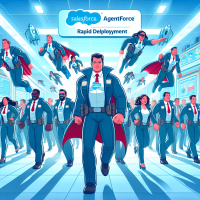
Salesforce Agentforce is revolutionizing how businesses deliver personalized and always-available support through powerful, autonomous AI agents. To fully capitalize on this innovative tool, understanding both your business needs and the Salesforce ecosystem is essential. With extensive experience in Salesforce and developing customized AI solutions, Tectonic is well-positioned to help businesses and government agencies visualize a working proof of concept for adopting Agentforce. Together, Tectonic will help companies develop AI agents tailored to their industry, providing 24/7 support for both employees and customers, regardless of location. At Dreamforce 2024, Salesforce unveiled Agentforce, one of the most anticipated AI releases of the year. Built on Salesforce’s advanced AI technology, Agentforce is poised to transform business operations. While Salesforce is known for its exciting announcements, it’s often challenging to discern how these new products apply to your business. So, let’s get past the hype. What does Agentforce really offer, and how can Tectonic help your company take advantage of it today? Key Use Cases for Agentforce CX Agent (Internal Usage) The Customer Experience (CX) Agent is an AI-powered solution designed to enhance customer interactions across various channels. Tectonic’s implementation focuses on providing human agents the information they need from numerous data sources to respond to customer inquiries, resolving issues, and guiding users through processes. By ensuring seamless communication and support, businesses can elevate the overall customer experience and foster loyalty. Customer Service (External Customer Usage) Agentforce transforms customer service operations by deploying AI agents that handle common inquiries, troubleshoot issues, and provide information 24/7. Tectonic’s implementation allows organizations to reduce wait times and enhance service quality, freeing human agents to tackle more complex problems. This shift not only improves operational efficiency but also leads to higher customer satisfaction levels. How Your Business Can Leverage Agentforce Agentforce isn’t just about adding AI—it’s about improving efficiency and reducing the burden on employees. The challenge lies in integrating these AI agents effectively into existing processes. That’s where Tectonic steps in. With a focus on helping businesses quickly realize the value of Agentforce, Tectonic can help you implement a Proof of Concept (POC) to demonstrate how AI could impact operations, whether it’s improving customer service or enhancing sales. Why Start Now? Agentforce’s release has captured the attention of businesses eager to adopt cutting-edge AI technology. However, turning Agentforce into a game-changer requires a practical approach: Availability for these POCs is limited, so now is the time to act if you’re interested in testing Agentforce. This opportunity allows businesses to see firsthand how AI agents can improve efficiency, productivity, and customer experience. How to Get Started Tectonic’s team can walk you through potential use cases and demonstrate how autonomous agents can boost customer service, empower sales teams, optimize marketing, and more. If you’re ready to take the next step, reach out to one of Tectonic’s experts to see how Agentforce can transform your business. Like Related Posts Who is Salesforce? Who is Salesforce? Here is their story in their own words. From our inception, we’ve proudly embraced the identity of Read more Salesforce Marketing Cloud Transactional Emails Salesforce Marketing Cloud Transactional Emails are immediate, automated, non-promotional messages crucial to business operations and customer satisfaction, such as order Read more Salesforce Unites Einstein Analytics with Financial CRM Salesforce has unveiled a comprehensive analytics solution tailored for wealth managers, home office professionals, and retail bankers, merging its Financial Read more AI-Driven Propensity Scores AI plays a crucial role in propensity score estimation as it can discern underlying patterns between treatments and confounding variables Read more

Read More
large concept model

Large Concept Models

Large Concept Models (LCMs) are a new type of language model that differ from traditional Large Language Models (LLMs) by working with concepts, rather than individual words, to process and generate language. Instead of focusing on tokens, LCMs focus on semantic representations at the sentence level, allowing for more abstract and nuanced reasoning.  Key Features of LCMs: How LCMs Differ from LLMs: Potential Applications of LCMs: Like Related Posts Who is Salesforce? Who is Salesforce? Here is their story in their own words. From our inception, we’ve proudly embraced the identity of Read more Salesforce Unites Einstein Analytics with Financial CRM Salesforce has unveiled a comprehensive analytics solution tailored for wealth managers, home office professionals, and retail bankers, merging its Financial Read more AI-Driven Propensity Scores AI plays a crucial role in propensity score estimation as it can discern underlying patterns between treatments and confounding variables Read more Tectonic’s Successful Salesforce Track Record Salesforce Technology Services Integrator – Tectonic has successfully delivered Salesforce in a variety of industries including Public Sector, Hospitality, Manufacturing, Read more
Read More
Second Wave of AI Agents

Second Wave of AI Agents

The “second wave” of AI agents refers to the evolution of AI beyond simple chatbots and into more sophisticated, autonomous systems that can plan, execute, and deliver results independently, often leveraging large language models (LLMs). These agents are characterized by their ability to interact with other applications, interpret the screen, fill out forms, and coordinate with other AI systems to achieve a desired outcome. They are also seen as a significant step beyond the first wave of AI, which primarily focused on predictive models and statistical learning. Key Characteristics of the Second Wave of AI Agents: Examples and Applications: In 2023 Bill Gates prophesized AI Agents would be here in 5 years. His timing was off. But not his prediction. The Future of Computing: Your AI Agent, Your Digital Sidekick Imagine this: No more juggling apps. No more digging through menus. No more searching for a document or a spreadsheet. Just tell your device—in plain English—what you need, and it handles the rest. Whether it’s planning a tour, managing your schedule, or helping with work, your AI assistant will understand you personally, adapting to your life based on what you choose to share. This isn’t science fiction. Today, everyone online has access to an AI-powered personal assistant far more advanced than anything available in 2023. Meet the Agent: The Next Era of Computing This next-generation software—called an agent—responds to natural language and accomplishes tasks using deep knowledge of you and your needs. Bill Gates first wrote about agents in his 1995 book The Road Ahead, but only now, with recent AI breakthroughs, have they become truly possible. Agents won’t just change how we interact with technology. They’ll reshape the entire software industry, marking the biggest shift in computing since we moved from command lines to touchscreens. Consider Salesforce’s AgentForce. A platform driven by automated AI agents that can be trained to do virtually anything. Freeing staff up from mundane data entry and administrative work to really set them loose. Marketers can once again create content, but with the insights provided by AI. Sales teams can close deals, but with the lead rating details provided by AI. Developers can devote more time to writing code but letting AI do the repetitive pieces that take time away from awe inspiring development. Why This Changes Everything We’re on the brink of a revolution—one where technology doesn’t just respond to commands but anticipates your needs and acts on your behalf. The age of the AI agent is here, and it’s going to redefine how we live and work. By Tectonic’s Marketing Operations Manager, Shannan Hearne Like Related Posts Who is Salesforce? Who is Salesforce? Here is their story in their own words. From our inception, we’ve proudly embraced the identity of Read more Salesforce Marketing Cloud Transactional Emails Salesforce Marketing Cloud Transactional Emails are immediate, automated, non-promotional messages crucial to business operations and customer satisfaction, such as order Read more Salesforce Unites Einstein Analytics with Financial CRM Salesforce has unveiled a comprehensive analytics solution tailored for wealth managers, home office professionals, and retail bankers, merging its Financial Read more AI-Driven Propensity Scores AI plays a crucial role in propensity score estimation as it can discern underlying patterns between treatments and confounding variables Read more

Read More
Rise of Agentforce

Revolutionizing Government Services with AI-Powered Support

Government customer service isn’t just about solving problems—it’s about building trust, efficiency, and accessibility for all citizens. That’s why innovations like Salesforce’s AI-powered Agentforce are transforming public sector operations. As reported in CX Today, 85% of Salesforce’s own customer inquiries are now resolved by Agentforce—proving that AI can dramatically reduce wait times, improve accuracy, and free up human agents for high-value tasks. What This Means for Government Agencies 1. Faster, More Accurate Citizen Services ✔ AI assistants can instantly handle common inquiries—benefits applications, tax questions, permit requests—reducing delays.✔ 24/7 self-service ensures citizens get answers anytime, without long hold times. 2. Empowered Public Sector Teams ✔ By automating routine tasks, employees focus on complex cases, policy work, and personalized support.✔ AI-driven insights help identify trends, improving service design and resource allocation. 3. Greater Efficiency & Cost Savings ✔ Reduced operational costs by minimizing manual processing.✔ Scalable solutions that adapt to demand spikes (e.g., tax season, emergencies). 4. Trust Through Transparency & Compliance ✔ Built-in audit trails, data security, and governance ensure AI aligns with public sector regulations.✔ Citizens gain clear, consistent, and accountable interactions. Agentforce: A Tailored Solution for Government Salesforce’s Agentforce is designed to meet the unique needs of the public sector, offering: 🔹 Automated Case Management – Smart routing, status tracking, and self-service portals.🔹 Real-Time Analytics – Predictive insights to anticipate citizen needs.🔹 Emergency Response Tools – Rapid communication during crises.🔹 Seamless Salesforce Integration – Leveraging Service Cloud, Marketing Cloud, and Einstein AI for end-to-end citizen engagement. The Future of Public Service is Here By integrating AI like Agentforce, governments can:✅ Deliver faster, more equitable services.✅ Optimize limited resources.✅ Restore public trust through transparency. The goal? A smarter, more responsive government that works better for everyone. Ready to transform your agency’s service delivery? Let’s discuss how AI can empower your team. #PublicSector #GovTech #AI #DigitalTransformation #CitizenExperience Like1 Related Posts Who is Salesforce? Who is Salesforce? Here is their story in their own words. From our inception, we’ve proudly embraced the identity of Read more Salesforce Marketing Cloud Transactional Emails Salesforce Marketing Cloud Transactional Emails are immediate, automated, non-promotional messages crucial to business operations and customer satisfaction, such as order Read more Salesforce Unites Einstein Analytics with Financial CRM Salesforce has unveiled a comprehensive analytics solution tailored for wealth managers, home office professionals, and retail bankers, merging its Financial Read more AI-Driven Propensity Scores AI plays a crucial role in propensity score estimation as it can discern underlying patterns between treatments and confounding variables Read more

Read More
gettectonic.com