Marketing Cloud Account Engagement, previously recognized as Pardot, serves as a B2B marketing automation tool that empowers marketers to identify leads with a high probability of conversion. Salesforce introduced this rebranding in April 2022 as part of its initiative to create a unified and easily comprehensible product suite within Marketing Cloud, aligning with the overarching goal of consistency and clarity in Salesforce’s offerings. account engagement pardot.
Despite the change in nomenclature, the functionality of the product persists without retirement. Pardot Classic, however, is undergoing a phased-out process.
Account engagement, in essence, denotes the efficacy of engaging an entire account to establish and nurture a relationship, aiming to acquire or retain them as a client.
While Marketing Cloud encompasses a broader range of features catering to various channels and large-scale B2C campaigns, Account Engagement focuses on B2B interactions, emphasizing lead management and sales alignment.
Pardot and Marketing Cloud
To distinguish Pardot from Marketing Cloud, Pardot primarily functions as an email marketing and nurture platform. In contrast, Marketing Cloud Account Engagement extends its capabilities to include functions like Advertising and Mobile Studio, fostering enhanced marketing and sales alignment through seamless integration with Sales Cloud.
To enhance customer engagement across accounts, Marketing Cloud Account Engagement facilitates connected customer journeys and efficient lead generation. It empowers users to create landing pages and forms swiftly, segment leads, and initiate personalized, automated, cross-channel journeys. AI-powered lead scoring and grading aid in nurturing leads for marketing qualification.
Account Engagement Pardot
The platform supports cross-channel journeys by enabling engagement across various channels and connecting third-party webinar, survey, and SMS apps directly to marketing programs. This allows for triggering webinar and event registrations, survey sends, and SMS sends within automated journeys.
Account-Based Engagement is a notable feature that helps discover and engage the best accounts, targeting and nurturing key prospects with the collaboration of sales and service on a unified platform. Einstein, Salesforce’s AI, identifies accounts with the highest likelihood to purchase using key insights.
Aligning revenue teams on a single source of truth is achieved with AI scoring, providing comprehensive insights into prospects, engagement history insights, and real-time sales alerts. This ensures that sales teams are promptly informed about hot leads and prospects ready to convert, improving collaboration between marketing and sales.
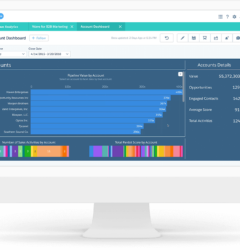
For optimizing marketing performance and fostering customer relationships, Marketing Cloud Account Engagement offers full-funnel multi-touch attribution, an Account-Based Marketing Dashboard, and out-of-the-box analytics. These features provide insights into marketing and sales impact, revenue and pipeline for key accounts, and a direct connection to Sales Cloud for understanding the prospect journey. A/B testing, email reporting, and predictive analytics further contribute to making strategic decisions and identifying factors that drive conversion.
🔔🔔 Follow us on LinkedIn 🔔🔔
Who is Salesforce? Here is their story in their own words. From our inception, we've proudly embraced the identity of Read more
Salesforce Marketing Cloud Transactional Emails are immediate, automated, non-promotional messages crucial to business operations and customer satisfaction, such as order Read more

Salesforce has unveiled a comprehensive analytics solution tailored for wealth managers, home office professionals, and retail bankers, merging its Financial Read more
AI plays a crucial role in propensity score estimation as it can discern underlying patterns between treatments and confounding variables Read more