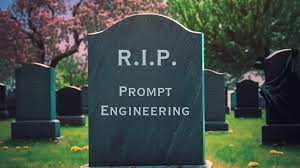
The Rise and Fall of Prompt Engineering
Prompt engineering is everywhere—it’s the hot topic in the AI world. The World Economic Forum, OpenAI’s Sam Altman, and the Twitterverse can’t stop talking about it. My feeds are filled with ads promoting courses that promise to make you a fortune with minimal effort. But here’s the uncomfortable truth: prompt engineering is already facing its decline. Don Giannatti originally wrote on this topic in June of 2023. Whic got us thinking, is prompt engineering dying?
Why Is Prompt Engineering Fading?
Reason 1: AI Is Getting Smarter
AI is advancing rapidly. Machines are starting to understand our words and phrases just like we do, similar to a child learning to talk. The need for finely tuned prompts is decreasing because AI is developing the ability to generate its own prompts simply by interpreting questions. It’s learning all the time.
Reason 2: AI Crafts Its Own Prompts
SDon already usea minimal nudge prompts, which AI then expands into detailed, contextually accurate prompts. GPT-4 can do this, and GPT-5 will have it even more integrated. While prompt engineering has been trendy among marketers and tech enthusiasts, its relevance is quickly waning.
Reason 3: Prompts Are Limited in Versatility
Prompts are tailored for specific AI models and versions, limiting their flexibility. AI can overcome these limitations more efficiently than humans. Machine learning excels in reducing input and friction, and AI is quickly learning and improving upon human-made prompts.
The Future: Problem Formulation
The enduring skill in the AI age is problem formulation—how we identify, analyze, and define problems. When we can clearly illustrate a problem, AI can provide efficient solutions. AI cannot identify unquantifiable problems that aren’t part of existing systems—that’s still a human strength, for now.
Prompt Engineering vs. Problem Formulation
Prompt engineering focuses on the words, sentence structure, and punctuation. Problem formulation is about defining the problem—seeing the bigger picture and broader strokes. Without a well-defined problem, even the best-crafted prompt is just a set of words.
Why Problem Formulation Matters
Problem formulation has been overshadowed by problem-solving. It’s not easy, isn’t taught in universities, and isn’t popularized by futurists. Yet, it’s essential. Executives often struggle with diagnosing problems—85% of them say so. To stay ahead, we need better problem formulation.
Four Ways to Enhance Problem Formulation
- Diagnosis: Identify the problem that AI can solve. Learn to ask the right questions and explore different perspectives.
- Decomposition: Break big problems into smaller, manageable parts. Let AI help analyze these parts, as it excels with data.
- Reframing: Shift perspectives to find new interpretations. Re-examine and recombine elements to discover hidden solutions.
- Constraint Design: Set clear boundaries for solutions. Define what to achieve and how to know when it’s done, guiding AI to understand its mission.
Embracing AI Wisely
AI is evolving quickly. To leverage its potential, we must clearly identify problems. Once defined, AI can generate prompts to find solutions.
A Take on AI
While one can appreciate the educational and helpful capabilities of GPT and other language models, be cautious about the rapid integration of AI into our lives without adequate discussion or input from society. I trust AI more than the billionaires driving its adoption, but be wary of their motivations.

Who is Salesforce? Here is their story in their own words. From our inception, we've proudly embraced the identity of Read more

Salesforce Marketing Cloud Transactional Emails are immediate, automated, non-promotional messages crucial to business operations and customer satisfaction, such as order Read more

Salesforce has unveiled a comprehensive analytics solution tailored for wealth managers, home office professionals, and retail bankers, merging its Financial Read more

AI plays a crucial role in propensity score estimation as it can discern underlying patterns between treatments and confounding variables Read more