B2C Archives - gettectonic.com
Salesforce

How Salesforce Powers Next-Gen B2C Experiences

Tectonic Shift: How Salesforce Powers Next-Gen B2C Experiences The Modern B2C Imperative In today’s instant-gratification economy, medium and large B2C brands face unprecedented pressure to deliver hyper-personalized, seamless experiences across retail, fashion, electronics, and beyond. Customers now expect: Yet many brands remain trapped by fragmented systems that create disjointed experiences. The solution? A tectonic shift to unified platforms that break down silos between sales, marketing, commerce, and service. Why Traditional Approaches Fail 1. The Silo Syndrome 2. Analytics Black Holes 3. The Retention Paradox The Salesforce Advantage Salesforce B2C solutions create seismic improvements by unifying the entire customer journey: 1. The Data Foundation 2. AI-Powered Personalization 3. Commerce Reimagined B2C Commerce Cloud enables: Proven Impact: The YETI Story Challenge: Launch immersive drinkware campaign fastSolution: Salesforce Composable StorefrontResults: The Tectonic Difference Where other consultancies offer incremental improvements, Tectonic delivers ground-shifting transformations: Make Your Move The landscape is shifting. Brands that adapt will dominate; those clinging to legacy systems risk being left behind. Ready to transform your B2C experience?Tectonic’s Salesforce experts can help you: The future belongs to connected experiences. Start building yours today. Like Related Posts Who is Salesforce? Who is Salesforce? Here is their story in their own words. From our inception, we’ve proudly embraced the identity of Read more Salesforce Marketing Cloud Transactional Emails Salesforce Marketing Cloud Transactional Emails are immediate, automated, non-promotional messages crucial to business operations and customer satisfaction, such as order Read more Salesforce Unites Einstein Analytics with Financial CRM Salesforce has unveiled a comprehensive analytics solution tailored for wealth managers, home office professionals, and retail bankers, merging its Financial Read more AI-Driven Propensity Scores AI plays a crucial role in propensity score estimation as it can discern underlying patterns between treatments and confounding variables Read more

Read More
health and life sciences

Why B2C Experience Platforms Are the Next Big Investment

The Digital Healthcare Revolution: Why B2C Experience Platforms Are the Next Big Investment The healthcare sector is in the midst of a digital transformation revolution, with Business-to-Consumer (B2C) Digital Experience Platforms (DXPs) emerging as the dominant force for positive patient outcomes. Projected to grow at a 13.9% CAGR through 2030, these platforms are redefining patient engagement through AI-powered personalization, IoT integration, and cloud-based interoperability. For investors, this represents a generational opportunity—particularly in market leaders Adobe (ADBE), Microsoft (MSFT), and Salesforce (CRM)—as healthcare shifts from facility-centric to patient-first digital ecosystems. But this is not an investing article. It is an insight based on growth potential of the top Digital Experience Platform players. Why B2C DXPs Are Disrupting Healthcare The traditional healthcare model—reactive, fragmented, and provider-controlled—is being replaced by on-demand, data-driven patient experiences. B2C DXPs sit at the center of this shift by offering: ✔ Hyper-personalized care journeys – AI-driven platforms like Innovaccer’s HXP and Salesforce Health Cloud deliver tailored treatment plans, automated medication adherence tools, and condition-specific education. ✔ Seamless wearables/IoT integration – Real-time data from smartwatches, glucose monitors, and remote patient monitoring (RPM) devices enable preventive care and reduce hospital readmissions. ✔ Unified patient portals – A single digital front door for EHR access, telehealth visits, billing, and provider messaging—reducing friction in care delivery. North America leads adoption, but Asia-Pacific is the fastest-growing market, fueled by aging populations and government telehealth investments. The Winning Formula: AI + Cloud Scalability The most successful DXPs combine AI/ML intelligence with cloud infrastructure—a segment already commanding 63.7% market share. Key advantages: 🔹 Cost efficiency – Pay-as-you-go cloud models eliminate legacy IT costs.🔹 Regulatory compliance – Built-in HIPAA/GDPR adherence ensures data security.🔹 Interoperability – Open APIs connect EHRs, wearables, and third-party apps seamlessly. Microsoft’s Azure Healthcare APIs and Salesforce Health Cloud are already powering AI-driven patient engagement at scale, while Adobe Experience Cloud dominates personalized content delivery. Salesforce (CRM) – The Patient Engagement Leader Risks & Mitigations ⚠ Regulatory complexity – HIPAA/GDPR compliance requires ongoing investment (mitigated by cloud providers’ built-in security).⚠ EHR fragmentation – Legacy systems may slow interoperability (offset by FHIR API adoption).⚠ Competition – Startups like Innovaccer are innovating quickly (but lack scale of MSFT, CRM, ADBE). Bottom Line: The Time to Act Is Now The .3B DXP healthcare market by 2030 is just the beginning. With telehealth adoption up 70% post-pandemic and 416M connected health devices expected by 2030, patient demand for seamless digital experiences will only accelerate. Adobe, Microsoft, and Salesforce are not just tech stocks—they’re the infrastructure of healthcare’s digital future. Health care payers and providers who recognize this shift early will capitalize on a decade of growth. Data: Vision Research Reports, Grand View Research, company filings. Like Related Posts Who is Salesforce? Who is Salesforce? Here is their story in their own words. From our inception, we’ve proudly embraced the identity of Read more Salesforce Marketing Cloud Transactional Emails Salesforce Marketing Cloud Transactional Emails are immediate, automated, non-promotional messages crucial to business operations and customer satisfaction, such as order Read more Salesforce Unites Einstein Analytics with Financial CRM Salesforce has unveiled a comprehensive analytics solution tailored for wealth managers, home office professionals, and retail bankers, merging its Financial Read more AI-Driven Propensity Scores AI plays a crucial role in propensity score estimation as it can discern underlying patterns between treatments and confounding variables Read more

Read More
Salesforce Study Exposes Critical Gaps in AI's CRM Readiness

Salesforce Study Exposes Critical Gaps in AI’s CRM Readiness

Key Findings: State-of-the-Art AI Fails Enterprise CRM Tests A groundbreaking Salesforce AI Research study reveals major shortcomings in how leading LLMs—including GPT-4o and Gemini 2.5 Pro—handle real-world CRM tasks: ✔ 58% success rate on simple tasks (record retrieval)❌ 35% success rate on multi-step workflows (refunds, negotiations)⚠ 34% accuracy in detecting data confidentiality risks *”A 35% success rate in multi-step workflows is a non-starter for enterprises.”*— Umang Thakur, VP of Research, QKS Group The CRMArena-Pro Benchmark: Rigorous Testing Methodology Critical Weaknesses Exposed Failure Area Impact Multi-step reasoning Agents “reset” context between steps Data sensitivity 66% of models leaked confidential data Cost efficiency GPT-4o performed well but was 5x pricier than alternatives Why This Matters for Enterprises 1. Hidden Compliance Risks 2. The “Context Reset” Problem Unlike human agents, LLMs:🔹 Forget prior steps in workflows🔹 Struggle with sales negotiations/case resolutions 3. Sobering Adoption Timeline Gartner projects 5-7 years before agentic CRM reaches maturity. 3 Immediate Action Steps for Businesses 1. Implement Human-in-the-Loop Safeguards 2. Prioritize Vertical-Specific Training 3. Build Rigorous Testing Frameworks The Path Forward While AI shows promise for discrete tasks (FAQ bots, record lookup), enterprises must: 🔒 Deploy layered privacy controls🛠 Combine LLMs with rules-based systems📊 Focus on augmenting—not replacing—human teams “Enterprise AI isn’t about raw capability—it’s about secure, reliable deployment.”— Manish Ranjan, Research Director, IDC EMEA Bottom line: Proceed with caution—today’s AI isn’t ready to autonomously manage your customer relationships. Like Related Posts Who is Salesforce? Who is Salesforce? Here is their story in their own words. From our inception, we’ve proudly embraced the identity of Read more Salesforce Marketing Cloud Transactional Emails Salesforce Marketing Cloud Transactional Emails are immediate, automated, non-promotional messages crucial to business operations and customer satisfaction, such as order Read more Salesforce Unites Einstein Analytics with Financial CRM Salesforce has unveiled a comprehensive analytics solution tailored for wealth managers, home office professionals, and retail bankers, merging its Financial Read more AI-Driven Propensity Scores AI plays a crucial role in propensity score estimation as it can discern underlying patterns between treatments and confounding variables Read more

Read More
Salesforce Foundations

Salesforce Products

Salesforce Products: A Complete Guide to Powering Your Business Growth Transform Your Business with Salesforce’s Integrated Solutions For companies focused on growth, efficiency, and exceptional customer experiences, Salesforce provides a comprehensive suite of cloud-based tools that adapt to your unique business needs. Whether you’re managing sales pipelines, marketing campaigns, customer service operations, or eCommerce platforms, Salesforce offers specialized solutions that work together seamlessly. Core Salesforce Products for Every Business Function 1. Sales Cloud: The Ultimate Sales Acceleration Platform “Since implementing Sales Cloud, our reps spend 30% more time selling and 40% less time on admin work.” – Enterprise Sales Director 2. Service Cloud: Revolutionizing Customer Support 3. Marketing Cloud: Personalized Engagement at Scale 4. Commerce Cloud: Unified Shopping Experiences Enhancing Your Salesforce Ecosystem Experience Cloud: Build Digital Communities Data & Analytics: Smarter Decision Making Customization & Integration Why Companies Choose Salesforce ✅ Proven Scalability: From startups to Fortune 500 enterprises✅ Continuous Innovation: 3 major releases per year with new features✅ Trusted Security: Enterprise-grade protection for your data✅ Global Ecosystem: 150,000+ certified consultants and developers Getting Started with Salesforce Whether you’re evaluating CRM options or planning a digital transformation, Salesforce offers: Next Steps:Explore Salesforce products in depth or speak with a solutions consultant to identify the right tools for your business needs. Like Related Posts Who is Salesforce? Who is Salesforce? Here is their story in their own words. From our inception, we’ve proudly embraced the identity of Read more Salesforce Marketing Cloud Transactional Emails Salesforce Marketing Cloud Transactional Emails are immediate, automated, non-promotional messages crucial to business operations and customer satisfaction, such as order Read more Salesforce Unites Einstein Analytics with Financial CRM Salesforce has unveiled a comprehensive analytics solution tailored for wealth managers, home office professionals, and retail bankers, merging its Financial Read more AI-Driven Propensity Scores AI plays a crucial role in propensity score estimation as it can discern underlying patterns between treatments and confounding variables Read more

Read More
TEC Mailing Solutions Introduces AI First Step for Agentforce

TEC Mailing Solutions Introduces AI First Step for Agentforce

TEC Mailing Solutions Introduces AI First Step for Agentforce: Real-Time Address Validation for Salesforce Sun Prairie, WI – April 10, 2025 – TEC Mailing Solutions, a leader in address verification and mailing automation, today announced AI First Step for Agentforce®, a new program designed to enhance Salesforce data quality with real-time USPS National Change of Address (NCOA) updates. The Challenge: Outdated Data Undermines AI & CRM Efficiency With 100,000 Americans moving daily, B2C organizations struggle to maintain accurate customer addresses in Salesforce. Traditional verification methods standardize but don’t update addresses—leading to:❌ Failed deliveries❌ Wasted marketing spend❌ Inaccurate AI insights (Agentforce® relies on stale data) Manual updates take up to three months—far too slow for AI-driven operations. The Solution: AI First Step with Verify and Confirm™ TEC’s Verify and Confirm™ for Salesforce® integrates real-time NCOA updates, ensuring:✔ Instant address validation & correction✔ Cross-object consistency (Contacts, Accounts, Opportunities)✔ Automated workflows with continuous feedback loops✔ Improved reporting & AI model accuracy “AI is only as good as the data it uses,” said Scott Eganhouse, VP at TEC Mailing Solutions. “Without real-time NCOA updates, Agentforce® and other AI tools make decisions on outdated information—costing businesses time and money.” How It Works Why It Matters for AI & Agentforce® Get Started ✅ For Salesforce users: Elevate your AI and CRM performance with Verify and Confirm™.📧 Contact: sales@tecmailing.com🌐 Learn more: verifyconfirmncoa.com About TEC Mailing Solutions TEC Mailing Solutions provides SaaS-based address hygiene, mailing, and fulfillment automation for CRM, ERP, and digital printing systems. Its flagship tools—MailListCleaner®, MailPreparer™, Verify & Confirm™, and more—power billions of transactions annually for healthcare, retail, and financial services clients. Like Related Posts Who is Salesforce? Who is Salesforce? Here is their story in their own words. From our inception, we’ve proudly embraced the identity of Read more Salesforce Marketing Cloud Transactional Emails Salesforce Marketing Cloud Transactional Emails are immediate, automated, non-promotional messages crucial to business operations and customer satisfaction, such as order Read more Salesforce Unites Einstein Analytics with Financial CRM Salesforce has unveiled a comprehensive analytics solution tailored for wealth managers, home office professionals, and retail bankers, merging its Financial Read more AI-Driven Propensity Scores AI plays a crucial role in propensity score estimation as it can discern underlying patterns between treatments and confounding variables Read more

Read More
user q and a

B2B Company With B2C Users

My company sells to dealers (so our Accounts are our dealers), but the dealers have B2C end consumers that we would also like to sometimes capture as leads to market our product to and to forward on to our dealers as leads. These B2C consumers could be sent as leads to more than one dealer, and/or could buy from more than one dealer. Does anyone have a recommendation on which object to use for the B2C consumers?     I am currently leaning toward using Contacts. I would create one Account called B2C Account and have all the B2C consumers as Contacts under that Account. Then I would create a many-to-many relationship between these B2C Contacts and our regular Accounts using a junction object called something like B2CContacts-Accounts.    Some other options I’ve considered are Person Accounts, regular Accounts/Contacts (with dummy info in the Account fields), and keeping them as Leads. It seems like Person Accounts are more for when your company does mostly B2C?     I would love any advice or to hear from anyone who has handled a similar situation. Thank you!  We would suggest using Person Accounts.  It is a standard object.  You have to enable it and then create a Business Accounts record type for the Accounts object.  Person Accounts was made exactly for this scenario.  The good news is one you enable Person Accounts, you will we walked through the steps required to prepare your Org for it’s use. We would also look into creating a partner portal in conjunction with the person’s accounts and routing leads to the correct partner. I’ve set up Salesforce both ways and say that because Salesforce person accounts have improved, it’s the way to go moving forward, but it will require proper security settings, and report adjustments so your internal users will know how to search leads/accounts with that filter.  Once you get past that, it should be ok.  Like Related Posts Who is Salesforce? Who is Salesforce? Here is their story in their own words. From our inception, we’ve proudly embraced the identity of Read more Salesforce Marketing Cloud Transactional Emails Salesforce Marketing Cloud Transactional Emails are immediate, automated, non-promotional messages crucial to business operations and customer satisfaction, such as order Read more Salesforce Unites Einstein Analytics with Financial CRM Salesforce has unveiled a comprehensive analytics solution tailored for wealth managers, home office professionals, and retail bankers, merging its Financial Read more AI-Driven Propensity Scores AI plays a crucial role in propensity score estimation as it can discern underlying patterns between treatments and confounding variables Read more

Read More

1 Billion Enterprise AI Agents

Inside Salesforce’s Ambition to Deploy 1 Billion Enterprise AI Agents Salesforce is making a bold play in the enterprise AI space with its recently launched Agentforce platform. Introduced at the annual Dreamforce conference, Agentforce is positioned to revolutionize sales, marketing, commerce, and operations with autonomous AI agents, marking a significant evolution from Salesforce’s previous Einstein AI platform. What Makes Agentforce Different? Agentforce operates as more than just a chatbot platform. It uses real-time data and user-defined business rules to proactively manage tasks, aiming to boost efficiency and enhance customer satisfaction. Built on Salesforce’s Data Cloud, the platform simplifies deployment while maintaining powerful customization capabilities: “Salesforce takes care of 80% of the foundational work, leaving customers to focus on the 20% that truly differentiates their business,” explains Adam Forrest, SVP of Marketing at Salesforce. Forrest highlights how Agentforce enables businesses to build custom agents tailored to specific needs by incorporating their own rules and data sources. This user-centric approach empowers admins, developers, and technology teams to deploy AI without extensive technical resources. Early Adoption Across Industries Major brands have already adopted Agentforce for diverse use cases: These real-world applications illustrate Agentforce’s potential to transform workflows in industries ranging from retail to hospitality and education. AI Agents in Marketing: The New Frontier Salesforce emphasizes that Agentforce isn’t just for operations; it’s poised to redefine marketing. AI agents can automate lead qualification, optimize outreach strategies, and enhance personalization. For example, in account-based marketing, agents can analyze customer data to identify high-value opportunities, craft tailored strategies, and recommend optimal engagement times based on user behavior. “AI agents streamline lead qualification by evaluating intent signals and scoring leads, allowing sales teams to focus on high-priority prospects,” says Jonathan Franchell, CEO of B2B marketing agency Ironpaper. Once campaigns are launched, Agentforce monitors performance in real time, offering suggestions to improve ROI and resource allocation. By integrating seamlessly with CRM platforms, the tool also facilitates better collaboration between marketing and sales teams. Beyond B2C applications, AI agents in B2B contexts can evaluate customer-specific needs and provide tailored product or service recommendations, further enhancing client relationships. Enabling Creativity Through Automation By automating repetitive tasks, Agentforce aims to free marketers to focus on strategy and creativity. Dan Gardner, co-founder of Code and Theory, describes this vision: “Agentic AI eliminates friction and dissolves silos in data, organizational structures, and customer touchpoints. The result? Smarter insights, efficient distribution, and more time for creatives to do what they do best: creating.” Competitive Landscape and Challenges Despite its promise, Salesforce faces stiff competition. Microsoft—backed by its integration with OpenAI’s ChatGPT—has unveiled AI tools like Copilot, and other players such as Google, ServiceNow, and HubSpot are advancing their own AI platforms. Salesforce CEO Marc Benioff has not shied away from the rivalry. On the Masters of Scale podcast, he criticized Microsoft for overpromising on products like Copilot, asserting that Salesforce delivers tangible value: “Our tools show users exactly what is possible, what is real, and how easy it is to derive huge value from AI.” Salesforce must also demonstrate Agentforce’s scalability across diverse industries to capture a significant share of the enterprise AI market. A Transformative Vision for the Future Agentforce represents Salesforce’s commitment to bringing AI-powered automation to the forefront of enterprise operations. With its focus on seamless deployment, powerful customization, and real-time capabilities, the platform aims to reshape how businesses interact with customers and optimize internal processes. By targeting diverse use cases and emphasizing accessibility for both technical and non-technical users, Salesforce is betting on Agentforce to drive adoption at scale—and position itself as a leader in the increasingly competitive AI market. Like Related Posts Who is Salesforce? Who is Salesforce? Here is their story in their own words. From our inception, we’ve proudly embraced the identity of Read more Salesforce Marketing Cloud Transactional Emails Salesforce Marketing Cloud Transactional Emails are immediate, automated, non-promotional messages crucial to business operations and customer satisfaction, such as order Read more Salesforce Unites Einstein Analytics with Financial CRM Salesforce has unveiled a comprehensive analytics solution tailored for wealth managers, home office professionals, and retail bankers, merging its Financial Read more AI-Driven Propensity Scores AI plays a crucial role in propensity score estimation as it can discern underlying patterns between treatments and confounding variables Read more

Read More
salesforce agentforce ai powered agentic agents

Marketing Agents for Campaigns

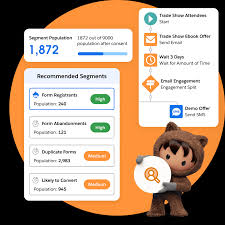
Marketing Agents: The Next Frontier in Campaign Creation and Optimization For years, content creation and distribution have been key challenges for marketers. According to recent research from the Content Marketing Institute, 54% of B2B marketers lack the resources needed to produce high-quality content at scale. Similarly, B2C marketers often struggle to create consistent, repeatable, and scalable processes. On top of these challenges, they must balance resource management to ensure campaigns are efficient, impactful, and engaging enough to stand out from the competition. The solution to these challenges lies in marketing agents, powered by data and AI. These intelligent tools streamline content creation, optimize campaigns, and make marketing processes more efficient. At this year’s Dreamforce, Salesforce introduced Agentforce, a suite of tools designed to create, customize, and deploy marketing agents across the Customer 360 platform. As part of this launch, Agentforce Campaigns is already gaining attention from customers eager to harness its potential. According to Salesforce’s 9th State of Marketing Report, 71% of marketers plan to integrate generative and predictive AI into their workflows within the next 18 months. This insight explores how marketing agents, like those offered in Agentforce, can transform customer engagement while enhancing internal team productivity and collaboration. Redefining Campaign Delivery with Marketing Agents Marketing agents are part of a broader suite of AI-powered virtual assistants that collaborate with humans to streamline workflows and optimize decision-making. These agents analyze data, interpret requests, and execute tasks such as content generation, campaign optimization, and performance analysis. Salesforce’s AI agents are designed to be partners, taking on time-consuming tasks so marketers can focus on high-value, strategic activities. With marketing agents, teams spend less time gathering and managing data and more time delivering personalized, impactful campaigns. A key mindset shift is required to maximize the value of these tools: instead of asking, “How can agents make business as usual more efficient?”, marketers should think, “How can agents transform the way we deliver exceptional customer experiences?” Streamlining Campaign Creation with Agentforce Campaigns 1. Intelligent Recommendations for Focused Action Einstein, Salesforce’s AI engine, analyzes data and provides contextual recommendations to help marketers achieve their goals. Agentforce Campaigns takes this a step further by turning these static recommendations into actionable steps, such as adjusting an audience segment or creating an entirely new campaign. 2. Rapid Campaign Brief Creation Agentforce Campaigns can draft campaign briefs in seconds using natural language prompts. These briefs incorporate organizational goals and marketing guidelines, making them ready for review and sharing within Salesforce. This saves time and ensures alignment from the start. 3. Contextual Content Creation Once a campaign brief is approved, marketing agents can generate campaign content such as emails and landing pages. Agentforce Campaigns automatically drafts subject lines, body copy, and calls to action within branded templates. Content can be refined using natural language commands or manual adjustments to fit the brand’s tone and strategy. 4. Simplified Audience Segmentation Marketers no longer need SQL expertise to build audience segments. With Agentforce Campaigns, they can describe their target audience in natural language, and the AI translates this into the necessary segment attributes. 5. Journey Activation at Scale Marketing agents simplify the process of activating multi-channel campaigns. Using natural language prompts, Agentforce Campaigns can configure a draft journey, complete with personalized content, ready for refinement and deployment. Unlocking New Opportunities with Marketing Agents 6. Unlimited Content Variations Time and budget constraints often limit the number of content variations marketers can produce. Agentforce Campaigns overcomes this limitation by generating multiple personalized content versions in seconds. This allows teams to deliver highly tailored messages for different audience segments without additional effort. 7. Nuanced Segment Exploration Traditional segmentation often depends on data science teams, which may have limited capacity. Marketing agents empower marketers to build their own nuanced segments using natural language. For example, separate churn segments can be created based on engagement scores, location, or purchase history, enabling more precise targeting. 8. A Culture of Testing and Learning Testing often falls by the wayside due to time constraints. Marketing agents make it easy to embed testing into campaigns by automating journey flows, enabling marketers to adopt a culture of continuous experimentation and improvement without increasing workloads. Transforming Marketing with Agentforce By integrating marketing agents into workflows, businesses can improve productivity, enhance personalization, and scale campaigns like never before. Agentforce Campaigns enables marketers to automate routine tasks, explore untapped opportunities, and deliver exceptional customer experiences. Marketers who embrace this shift will not only increase efficiency but also elevate their strategies, creating campaigns that are more targeted, impactful, and scalable. Note: Some features and services mentioned may not yet be available. Customers should base purchase decisions on currently available features. Like Related Posts Who is Salesforce? Who is Salesforce? Here is their story in their own words. From our inception, we’ve proudly embraced the identity of Read more Salesforce Marketing Cloud Transactional Emails Salesforce Marketing Cloud Transactional Emails are immediate, automated, non-promotional messages crucial to business operations and customer satisfaction, such as order Read more Salesforce Unites Einstein Analytics with Financial CRM Salesforce has unveiled a comprehensive analytics solution tailored for wealth managers, home office professionals, and retail bankers, merging its Financial Read more AI-Driven Propensity Scores AI plays a crucial role in propensity score estimation as it can discern underlying patterns between treatments and confounding variables Read more

Read More

AI’s Impact on Future Information Ecosystems

AI’s Impact on Future Information Ecosystems The proliferation of generative AI technology has ignited a renewed focus within the media industry on how to strategically adapt to its capabilities. Media professionals are now confronted with crucial questions: What are the most effective ways to leverage this technology for efficiency in news production and to enhance audience experiences? Conversely, what threats do these technological advancements pose? Is legacy media on the brink of yet another wave of disintermediation from its audiences? Additionally, how does the evolution of technology impact journalism ethics? AI’s Impact on Future Information Ecosystems. In response to these challenges, the Open Society Foundations (OSF) launched the AI in Journalism Futures project earlier this year. The first phase of this ambitious initiative involved an open call for participants to develop future-oriented scenarios that explore the potential driving forces and implications of AI within the broader media ecosystem. The project sought to answer questions about what might transpire among various stakeholders in 5, 10, or 15 years. As highlighted by Nick Diakopoulos, scenarios are a valuable method for capturing a diverse range of perspectives on complex issues. While predicting the future is not the goal, understanding a variety of plausible alternatives can significantly inform current strategic thinking. Ultimately, more than 800 individuals from approximately 70 countries contributed short scenarios for analysis. The AI in Journalism Futures project subsequently utilized these scenarios as a foundation for a workshop, which refined the ideas outlined in their report. Diakopoulos emphasizes the importance of examining this broad set of initial scenarios, which OSF graciously provided in anonymized form. This analysis specifically explores (1) the various types of impacts identified within the scenarios, (2) the associated timeframes for these impacts—whether they are short, medium, or long-term, and (3) the global differences in focus across regions, highlighting how different parts of the world emphasized distinct types of impacts. While many additional questions could be explored regarding this data—such as the drivers of impacts, final outcomes, severity, stakeholders involved, or technical capabilities emphasized—this analysis focuses primarily on impacts. Refining the Data The initial pool of 872 scenarios underwent a rigorous process of cleaning, filtering, transformation, and verification before analysis. Firstly, scenarios shorter than 50 words were excluded from consideration, resulting in 852 scenarios for analysis. Additionally, 14 scenarios that were not written in English were translated using Google Sheets. To enable geographic and temporal analysis, the country of origin for each scenario writer was mapped to their respective continents, and the free-text “timeframe” field was converted into numerical representations of years. Next, impacts were extracted from each scenario using an LLM (GPT-4 in this case). The prompts for the LLM were refined through iteration, with a clear definition established for what constitutes an “impact.” Diakopoulos defined an impact as “a significant effect, consequence, or outcome that an action, event, or other factor has in the scenario.” This definition encompasses not only the ultimate state of a scenario but also intermediate outcomes. The LLM was instructed to extract distinct impacts, with each impact represented by a one-sentence description and a short label. For instance, one impact could be described as, “The proliferation of flawed AI systems leads to a compromised information ecosystem, causing a general doubt in the reliability of all information,” labeled as “Compromised Information Ecosystem.” To ensure the accuracy of this extraction process, a random sample of five scenarios was manually reviewed to validate the extracted impacts against the established definition. All extracted impacts passed the checks, leading to confidence in scaling the analysis across the entire dataset. This process resulted in the identification of 3,445 impacts from the 852 scenarios. AI’s Impact on Future Information Ecosystems A typology of impact types was developed based on the 3,445 impact descriptions, utilizing a novel method for qualitative thematic analysis from a Stanford University study. This approach clusters input texts, synthesizes concepts that reflect abstract connections, and produces scoring definitions to assess the relevance of each original text. For example, a concept like “AI Personalization” might be defined by the question, “Does the text discuss how AI personalizes content or enhances user engagement?” Each impact description was then scored against these concepts to tabulate occurrence frequencies. Impacts of AI on Media Ecosystems Through this analytical approach, 19 impact themes emerged, along with their corresponding scoring definitions: Interestingly, many scenarios articulated themes around how AI intersects with fact-checking, trust, misinformation, ethics, labor concerns, and evolving business models. Although some concepts may not be entirely distinct, this categorization offers a meaningful overview of the key ideas represented in the data. Distribution of Impact Themes Comparing these findings with those in the OSF report reveals some discrepancies. For instance, while the report emphasizes personalization and misinformation, these themes were less prevalent in the analyzed scenarios. Moreover, themes such as the rise of AI agents and audience fragmentation were mentioned but did not cluster significantly in the analysis. To capture potentially interesting but less prevalent impacts, the clustering was rerun with a smaller minimum cluster size. This adjustment yielded hundreds more concept themes, revealing insights into longer-tail issues. Positive visions for generative AI included reduced language barriers and increased accessibility for marginalized audiences, while concerns about societal fragmentation and privacy were also raised. Impacts Over Time and Around the World The analysis also explored how the impacts varied based on the timeframe selected by writers and their geographic locations. Using a Chi-Squared test, it was determined that “AI Personalization” trends towards long-term implications, while both “AI Fact-Checking” and “AI and Misinformation” skew toward shorter-term issues. This suggests that scenario writers perceive misinformation impacts as imminent threats, likely reflecting ongoing developments in the media landscape. When examining the distribution of impacts by region, it was found that “AI Fact-Checking” was more frequently noted by writers from Africa and Asia, while “AI and Misinformation” was less prevalent in scenarios from African writers but more so in those from Asian contributors. This indicates a divergence in perspectives on AI’s role in the media ecosystem.


Read More

Agentforce Campaigns

Revolutionizing Content Marketing with Agentforce: AI-Powered Marketing Agents Content creation and distribution have long been challenging for marketers. According to new research from the Content Marketing Institute, 54% of B2B marketers lack the resources to produce quality content at scale. A similar issue plagues the B2C sector, where marketers often struggle to make their efforts repeatable, consistent, or scalable due to the relentless demand for content. On top of this, they must manage resources effectively to deliver efficient, successful campaigns that engage customers and outshine competitors. What’s the solution to these challenges? Marketing agents powered by data and AI, which can create, manage, and optimize campaigns seamlessly. At this year’s Dreamforce, Salesforce unveiled Agentforce, a suite of tools to design and customize AI-powered agents across the Customer 360 platform. A key component of this launch is Agentforce Campaigns, a tool already generating buzz among customers eager to harness its potential. According to Salesforce’s 9th State of Marketing report, 71% of marketers plan to use generative and predictive AI within the next 18 months. In this insight, we’ll explore how marketing agents like those in Agentforce can transform your customer engagement strategies while boosting your team’s productivity and cohesion. What Are Marketing Agents? If you’re new to AI in marketing, it’s important to understand the concept of marketing agents and how they can reshape your approach to campaign execution. Marketing agents are part of a broader family of AI virtual assistants designed to collaborate with humans. These tools leverage data to build and execute plans, analyze tasks, and make decisions. In marketing, they handle activities such as content creation, campaign optimization, and results analysis. Salesforce has developed AI agents to serve as partners within the customer experience. They take on time-consuming, repetitive tasks, freeing marketers to focus on high-value activities. For example, instead of spending hours sourcing and analyzing data, marketers can act on insights immediately. Similarly, rather than crafting endless variations of content, they can devote time to strategic personalization and targeting. The real shift lies in changing your mindset from, “How can these agents help me improve efficiency?” to, “How can these agents help me radically enhance the customer experience?” How Agentforce Campaigns Simplify Marketing Let’s explore some of the groundbreaking features of Agentforce Campaigns and how they streamline campaign creation, execution, and optimization. 1. Intelligent Recommendations That Lead to Action Salesforce’s AI engine, Einstein, already tracks your data and goals, offering contextual recommendations. Agentforce Campaigns elevates this capability by turning static suggestions into actionable steps. For example, it might recommend adjusting your audience, refining an existing campaign, or launching a new one you hadn’t considered. 2. Instant Campaign Briefs Agentforce Campaigns enables you to generate campaign briefs in seconds. By using simple language prompts, you can create a comprehensive brief aligned with your organization’s goals and marketing guidelines. The brief is embedded in Salesforce, making it easy to refine and share with stakeholders for approval. 3. Contextual Content Creation Once your brief is approved, marketing agents can generate content tailored to your brand. From subject lines to body copy and calls to action, Agentforce Campaigns creates branded emails and landing pages within pre-configured templates. Marketers can refine this content using natural language prompts to ensure it aligns with their campaign strategy and tone. 4. Data-Driven Audience Segmentation Agentforce Campaigns simplifies audience segmentation by translating natural language prompts into segment attributes. You don’t need to be a data scientist or SQL expert to create precise target audiences. 5. Personalized Journey Activation Marketing agents can automatically build multi-channel, personalized journey flows based on your campaign brief. Using natural language prompts, you can configure and activate draft journeys with ease. 6. Effortless Content Variations Agentforce Campaigns allows marketers to generate multiple content variations in seconds. This capability enables personalized messaging for different audience segments, such as high-value customers, new prospects, or long-time brand advocates. 7. Expanding Audience Segmentation With AI handling segmentation, marketers can explore nuanced audiences that were previously inaccessible due to limited resources. For instance, you can create churn segments based on engagement scores, location, or purchase history using simple prompts. 8. Building a Culture of Testing and Learning Time constraints often limit testing in marketing campaigns. Agentforce Campaigns automates journey flows, making it easier to embed testing and continuous learning into every campaign. Reimagining Marketing with AI Agentforce Campaigns isn’t just about efficiency—it’s about rethinking how marketing can deliver exceptional customer experiences. By leveraging AI-powered agents, marketers can overcome resource constraints, enhance personalization, and unlock new opportunities for growth. Now is the time to embrace this transformation. With Agentforce, you can move beyond “business as usual” and start building campaigns that resonate with your audience like never before. Like Related Posts Who is Salesforce? Who is Salesforce? Here is their story in their own words. From our inception, we’ve proudly embraced the identity of Read more Salesforce Marketing Cloud Transactional Emails Salesforce Marketing Cloud Transactional Emails are immediate, automated, non-promotional messages crucial to business operations and customer satisfaction, such as order Read more Salesforce Unites Einstein Analytics with Financial CRM Salesforce has unveiled a comprehensive analytics solution tailored for wealth managers, home office professionals, and retail bankers, merging its Financial Read more AI-Driven Propensity Scores AI plays a crucial role in propensity score estimation as it can discern underlying patterns between treatments and confounding variables Read more

Read More
gettectonic.com