Returns Archives - gettectonic.com

Agentforce AI Platform Expands with 200+ Prebuilt Agents

Salesforce has rapidly scaled its Agentforce AI platform, now offering over 200 prebuilt AI agents—a significant leap from the handful available at its October 2024 launch. This expansion addresses a critical challenge for businesses: how to effectively deploy AI automation without extensive technical overhead. Solving the AI Implementation Challenge Enterprises are eager to adopt AI but often struggle with execution. Martin Kihn, SVP of Market Strategy at Salesforce Marketing Cloud, explains: “Customers were excited about AI’s potential but asked, ‘Can I really make this work?’ We took that feedback and built ready-to-use agents that simplify adoption.” Rather than leaving businesses to build AI solutions from scratch, Salesforce’s strategy focuses on preconfigured, customizable agents that accelerate deployment across industries. Proven Business Impact Early adopters of Agentforce are already seeing measurable results: According to Slack’s upcoming Workforce Index, AI agent adoption has surged 233% in six months, with 8,000+ Salesforce clients now using Agentforce. Adam Evans, EVP & GM of Salesforce AI, states: “Agentforce unifies AI, data, and apps into a digital labor platform—helping companies realize agentic AI’s potential today.” Agentforce 3: Scaling AI with Transparency In June 2025, Salesforce launched Agentforce 3, introducing key upgrades for enterprise-scale AI management: Kihn notes: “Most prebuilt agents are a starting point—helping customers overcome hesitation and envision AI’s possibilities.” Once businesses embrace the technology, the use cases become limitless. The Human vs. AI Agent Debate A major challenge for enterprises is how human-like AI agents should appear. Early chatbots attempted to mimic people, but Kihn warns: “Humans excel at detecting non-humans. If an AI pretends to be human, then transfers you to a real agent, it erodes trust.” Salesforce’s Approach: Clarity Over Imitation Kihn illustrates the risk: “Imagine confiding in a ‘sympathetic’ AI agent about a health issue, only to learn it’s not human. That damages trust.” What’s Next for Agentforce? With thousands of AI agents already deployed, Salesforce continues refining the platform. Kihn compares the rapid evolution to “learning to drive an F1 car while racing.” As businesses increasingly adopt AI automation, Agentforce’s library of prebuilt solutions positions Salesforce as a leader in practical, scalable AI deployment. The future? More agents, smarter workflows, and seamless enterprise AI integration. Like Related Posts Who is Salesforce? Who is Salesforce? Here is their story in their own words. From our inception, we’ve proudly embraced the identity of Read more Salesforce Marketing Cloud Transactional Emails Salesforce Marketing Cloud Transactional Emails are immediate, automated, non-promotional messages crucial to business operations and customer satisfaction, such as order Read more Salesforce Unites Einstein Analytics with Financial CRM Salesforce has unveiled a comprehensive analytics solution tailored for wealth managers, home office professionals, and retail bankers, merging its Financial Read more AI-Driven Propensity Scores AI plays a crucial role in propensity score estimation as it can discern underlying patterns between treatments and confounding variables Read more

Read More
AI evolves with tools like Agentforce and Atlas

How the Atlas Reasoning Engine Powers Agentforce

Autonomous, proactive AI agents form the core of Agentforce. But how do they operate? A closer look reveals the sophisticated mechanisms driving their functionality. The rapid pace of AI innovation—particularly in generative AI—continues unabated. With today’s technical advancements, the industry is swiftly transitioning from assistive conversational automation to role-based automation that enhances workforce capabilities. For artificial intelligence (AI) to achieve human-level performance, it must replicate what makes humans effective: agency. Humans process data, evaluate potential actions, and execute decisions. Equipping AI with similar agency demands exceptional intelligence and decision-making capabilities. Salesforce has leveraged cutting-edge developments in large language models (LLMs) and reasoning techniques to introduce Agentforce—a suite of ready-to-use AI agents designed for specialized tasks, along with tools for customization. These autonomous agents can think, reason, plan, and orchestrate with remarkable sophistication, marking a significant leap in AI automation for customer service, sales, marketing, commerce, and beyond. Agentforce: A Breakthrough in AI Reasoning Agentforce represents the first enterprise-grade conversational automation solution capable of proactive, intelligent decision-making at scale with minimal human intervention. Several key innovations enable this capability: Additional Differentiators of Agentforce Beyond the Atlas Reasoning Engine, Agentforce boasts several distinguishing features: The Future of Agentforce Though still in its early stages, Agentforce is already transforming businesses for customers like Wiley and Saks Fifth Avenue. Upcoming innovations include: The Third Wave of AI Agentforce heralds the third wave of AI, surpassing predictive AI and copilots. These agents don’t just react—they anticipate, plan, and reason autonomously, automating entire workflows while ensuring seamless human collaboration. Powered by the Atlas Reasoning Engine, they can be deployed in clicks to revolutionize any business function. The era of autonomous AI agents is here. Are you ready? Like Related Posts Who is Salesforce? Who is Salesforce? Here is their story in their own words. From our inception, we’ve proudly embraced the identity of Read more Salesforce Marketing Cloud Transactional Emails Salesforce Marketing Cloud Transactional Emails are immediate, automated, non-promotional messages crucial to business operations and customer satisfaction, such as order Read more Salesforce Unites Einstein Analytics with Financial CRM Salesforce has unveiled a comprehensive analytics solution tailored for wealth managers, home office professionals, and retail bankers, merging its Financial Read more AI-Driven Propensity Scores AI plays a crucial role in propensity score estimation as it can discern underlying patterns between treatments and confounding variables Read more

Read More
Salesforce Code Genie

Salesforce Code Genie

How Salesforce’s Agentforce Is Reshaping Development—Saving 30,000 Hours a Month “AI agents are transforming my role—shifting me from pure technical execution to strategic leadership,” says one Salesforce developer. Instead of spending hours on repetitive tasks like code reviews or debugging, she now focuses on designing scalable architectures, optimizing workflows, and driving innovation. This shift reflects a broader evolution in software development: Developers are becoming AI supervisors, guiding autonomous agents, refining outputs, and ensuring alignment with business goals. Success in this new paradigm requires systems thinking, context management, and strategic oversight—not just coding expertise. Agentforce: The AI-Powered Developer Revolution Salesforce is already leading this transition with Agentforce, its digital labor platform, which has saved 30,000 developer hours per month—equivalent to 15 full-time engineers—by automating routine tasks. Key tools powering this transformation include: Unlike traditional AI coding assistants (which suggest snippets or autocomplete boilerplate), Agentforce agents act autonomously. For example, a developer can simply prompt: “Create a component that calls this API, processes these parameters, and returns success/failure status.” The AI then: The developer’s role? Review, refine, and ensure alignment with broader system goals. CodeGenie: Salesforce’s Internal AI Powerhouse Behind Agentforce lies CodeGenie, Salesforce’s internal AI assistant, built on its proprietary CodeGen model. The results speak for themselves: ✅ 7M+ lines of code accepted✅ 500K+ developer questions answered✅ 30K+ hours saved monthly✅ Seamless integration (IDEs, GitHub, Slack, CLI) “CodeGenie handles repetitive work, freeing me to solve complex problems,” says NaveenKumar Namachivayam, Senior Software Engineer at Salesforce. “It’s like having an expert collaborator—making coding faster, smarter, and more efficient.” Lessons from Salesforce’s AI Journey These insights don’t just benefit Salesforce—they directly shape Agentforce’s external offerings. CodeGenie’s success, for example, informed Agentforce for Developers, ensuring enterprise users get battle-tested AI assistance. The Bottom Line: AI Won’t Replace Developers—It Will Elevate Them Just as cloud computing didn’t kill IT jobs, AI won’t make developers obsolete—it will redefine their roles. The future belongs to those who: 🔹 Embrace AI as a force multiplier🔹 Shift from writing code to orchestrating AI agents🔹 Focus on architecture, strategy, and innovation For organizations, this demands investment in training, culture, and tools that empower teams to lead in the agentic era. The message is clear: Developers who adapt will thrive—not as coders, but as AI-powered strategists. Salesforce’s Agentforce is proving it’s possible today. Like Related Posts Who is Salesforce? Who is Salesforce? Here is their story in their own words. From our inception, we’ve proudly embraced the identity of Read more Salesforce Marketing Cloud Transactional Emails Salesforce Marketing Cloud Transactional Emails are immediate, automated, non-promotional messages crucial to business operations and customer satisfaction, such as order Read more Salesforce Unites Einstein Analytics with Financial CRM Salesforce has unveiled a comprehensive analytics solution tailored for wealth managers, home office professionals, and retail bankers, merging its Financial Read more AI-Driven Propensity Scores AI plays a crucial role in propensity score estimation as it can discern underlying patterns between treatments and confounding variables Read more

Read More
Salesforce Platform

How Agentic Automation Builds Lasting Customer Relationships

Why Agentic Automation?Customers now engage with brands across 8+ channels, demanding consistency and personalization at every touchpoint. Yet: 73% of customers expect better personalization as tech evolves (Salesforce “State of the AI Connected Customer”) 1 .Only 31% of marketers feel confident unifying customer data (Salesforce “State of Marketing”) 43% still use fragmented personalization, mixing mass messaging with targeted efforts Traditional automation falls short—but AI-powered agents bridge the gap, acting as intelligent assistants that autonomously execute tasks, personalize interactions, and optimize campaigns in real time. What is Agentic Automation?Agents are AI systems that understand, decide, and act—handling everything from customer service queries to full campaign orchestration. Unlike rule-based automation, they:✅ Learn & adapt based on real-time data✅ Multitask (e.g., draft emails, adjust ad spend, qualify leads simultaneously)✅ Work across silos, unifying data for seamless customer journeys The 5 Key Attributes of an AgentRole – What it’s designed to do (e.g., optimize social campaigns, nurture leads) Trusted Data – Access to CRM, engagement history, brand guidelines 2 .Actions – Skills like content generation, A/B testing, performance tracking Channels – Where it operates (email, social, chat, ads) Guardrails – Ethical limits, compliance rules, brand voice guidelines Example: A social media agent can: Analyze past performance & trends Generate post ideas aligned with brand voice Schedule content & adjust targeting in real time Escalate sensitive issues to humans How Agents Transform the Customer Lifecycle1. Awareness: Smarter Campaign CreationAutonomously generates audience segments, ad copy, and campaign briefs Optimizes spend by pausing low-performing ads & reallocating budgets Personalizes content based on real-time engagement data 2. Conversion: Automated Lead NurturingEngages website visitors with dynamic recommendations Scores & routes leads to sales teams based on intent signals Orchestrates follow-ups via email, SMS, or chat 3. Engagement: Hyper-Personalized ExperiencesRecommends products/content based on browsing history A/B tests messaging across channels Adjusts journeys in real time (e.g., swaps promo offers if a customer hesitates) 4. Retention & Loyalty: Proactive Relationship-BuildingIdentifies at-risk customers & triggers re-engagement offers Handles service inquiries (returns, tech support) via chat/SMS Escalates complex issues to human agents seamlessly The Marketer’s Advantage: From Tactical to StrategicAgents don’t replace marketers—they amplify their impact:🔹 Eliminate grunt work (e.g., manual reporting, repetitive follow-ups)🔹 Break down data silos, unifying CRM, ads, and service history🔹 Make real-time decisions (e.g., pausing ads, adjusting discounts)🔹 Scale 1:1 personalization without added headcount Example: An agent can: Draft a win-back email for a lapsing customer Sync it with their past purchases & service tickets Send it via their preferred channel (email/SMS) Track opens/clicks & trigger a follow-up if ignored Getting Started: Building Your Agent FoundationUnify Your Data – Integrate CRM, marketing tools, and service platforms. Define Key Roles – Start with one high-impact use case (e.g., lead nurturing). Set Guardrails – Ensure brand compliance, privacy, and ethical AI use. Test & Refine – Use feedback loops to improve accuracy and relevance. “Agents are like a tireless, data-driven marketing assistant—freeing you to focus on strategy while they handle execution.” The Future: AI + Human CollaborationThe next era of marketing isn’t about choosing between automation and human touch—it’s about combining them. Agents will: Handle routine interactions, letting teams focus on high-value creativity Predict customer needs before they arise Drive unprecedented efficiency (e.g., 275K+ hours saved annually at Salesforce) Ready to transform your marketing? Start small, scale fast, and let agents turn data into lasting relationships. Key Takeaway: Agentic automation isn’t just efficiency—it’s smarter, faster, and more personal customer engagement at scale. Like Related Posts Who is Salesforce? Who is Salesforce? Here is their story in their own words. From our inception, we’ve proudly embraced the identity of Read more Salesforce Marketing Cloud Transactional Emails Salesforce Marketing Cloud Transactional Emails are immediate, automated, non-promotional messages crucial to business operations and customer satisfaction, such as order Read more Salesforce Unites Einstein Analytics with Financial CRM Salesforce has unveiled a comprehensive analytics solution tailored for wealth managers, home office professionals, and retail bankers, merging its Financial Read more AI-Driven Propensity Scores AI plays a crucial role in propensity score estimation as it can discern underlying patterns between treatments and confounding variables Read more

Read More

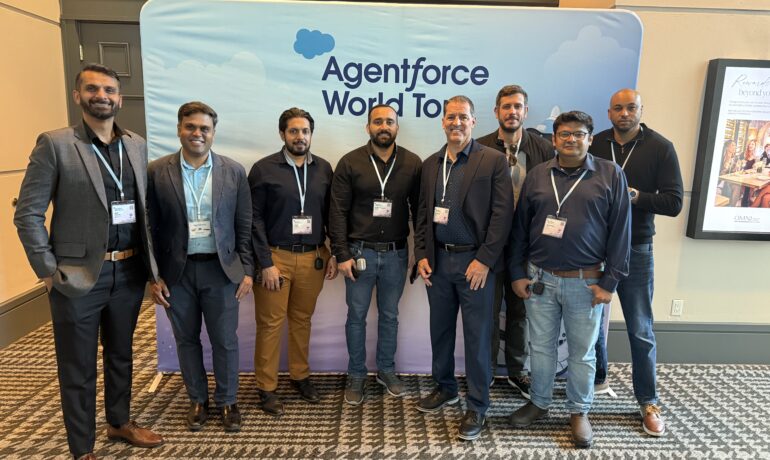
Tectonic Shook Things Up at AgentForce World Tour in Denver

The Tectonic team attended Salesforce’s Denver AgentForce World Tour this week. It was a great experience to develop our AgentBlazer team and a true seismic time was had by all! AI Agents were the topic of conversation and kept things lively! One almost expected to meet an Agentic Robot around every corner. We were all excited to network with Salesforce, customers, and partners alike. Key Takeaways Autonomous AI agents can understand and interpret customers’ questions using natural language, with minimal human intervention. Here’s what you need to know. The AI Assistant Revolution: Empowering Every Employee Imagine if every person in your company—from the CEO to frontline employees—had a dedicated assistant at their fingertips. An assistant who:✔ Knows your customers inside out✔ Delivers instant, data-driven insights✔ Helps prioritize next best actions Thanks to AI agents, this future is already here—and it’s transforming how businesses operate. How AI Agents Are Supercharging Teams 1. Instant Insights, No Manual Work 🔹 Generative AI agents analyze your trusted customer data in seconds—eliminating hours of manual research.🔹 Sales, service, and marketing teams get real-time recommendations, allowing them to focus on high-impact work. 2. Scaling Teams Without Adding Headcount 🔹 AI agents handle routine tasks—customer inquiries, data entry, meeting prep—freeing employees for strategic work.🔹 Quickly ramp up productivity during peak demand without overburdening staff. 3. Proactive Problem-Solving 🔹 AI doesn’t just react—it predicts.🔹 Identifies risks, suggests optimizations, and prevents small issues from becoming big ones. 4. Personalized Support for Every Role 🔹 Sales: AI suggests the best leads, crafts follow-ups, and forecasts deals.🔹 Service: Resolves common cases instantly, escalating only when needed.🔹 Leadership: Delivers real-time business insights for faster decisions. The Future of Work Is AI-Augmented AI agents aren’t replacing humans—they’re empowering them. By automating the mundane and enhancing decision-making, they help teams:✅ Work smarter, not harder✅ Deliver better customer experiences✅ Stay ahead of the competition The question isn’t if your company should adopt AI agents—it’s how soon you can start leveraging them. Tectonic, a trusted Salesforce partner, is here to help. Ready to explore AI-powered productivity? Let’s talk about the right AI strategy for your business. AI Agents: Your Intelligent Digital Workforce What Is an AI Agent? An AI agent is an autonomous artificial intelligence system that understands, processes, and responds to customer inquiries—without human intervention. Built using platforms like Agentforce, these agents leverage machine learning (ML) and natural language processing (NLP) to handle tasks ranging from simple FAQs to complex problem-solving. Unlike traditional AI, which requires manual programming for each task, AI agents continuously learn and improve from interactions, becoming smarter over time. How Do AI Agents Work? AI agents operate through a seamless four-step process: 💡 Result? Faster resolutions, happier customers, and more efficient teams. 6 Game-Changing Benefits of AI Agents Feature Impact 1. 24/7 Availability Instant support across time zones. 2. Hyper-Efficiency Handle thousands of queries simultaneously—no wait times. 3. Smarter Escalations Auto-route complex cases to the best-suited human agent. 4. Personalized Experiences Tailor responses using real-time customer data. 5. Scalability Grow support capacity without hiring more staff. 6. Data-Backed Insights Uncover trends to optimize operations & CX. “72% of companies already deploy AI—with generative AI adoption accelerating.” – McKinsey AI Agents in Action: Industry Use Cases 🏦 Finance ✔ Personalized wealth advice based on spending habits✔ Auto-summarize client cases for faster resolutions 🏭 Manufacturing ✔ Predict equipment failures before they happen✔ Optimize supply chain decisions with real-time data 🛒 Retail & Consumer Goods ✔ Smart inventory tracking (e.g., flagging stock discrepancies)✔ AI-generated promo content for targeted campaigns 🚗 Automotive ✔ Proactive vehicle maintenance alerts via telematics✔ Dynamic dealership promotions to boost sales 🏥 Healthcare ✔ Automated patient scheduling with the right specialist✔ Clinical trial matching using AI-driven eligibility checks Join the AI Revolution with Agentforce AI agents aren’t just tools—they’re productivity multipliers that help teams:✅ Work faster with automated workflows✅ Serve customers better with personalized AI assistance✅ Stay ahead with predictive insights 📈 Ready to transform your business? Connect with Tectonic today, or check out our Agentforce Quickstart offering. Connect with the Tectonic Agentforce team and launch your Agentic Revolution. AI Agents: The Ultimate Productivity Multiplier for Every Team AI agents aren’t just transforming customer service—they’re revolutionizing how every department operates. From 24/7 customer support to hyper-personalized marketing campaigns, AI agents help teams work smarter, move faster, and deliver exceptional experiences. Here’s how AI agents supercharge key business functions: 🤝 AI Agents for Service Teams Never miss a customer inquiry—even at 2 AM.✔ Instant, 24/7 support across email, chat, and social media✔ Smart escalation—AI routes complex cases to human agents with full context✔ Brand-consistent responses powered by your CRM data 🔹 With Agentforce for Service, deploy AI agents in minutes using prebuilt templates—or customize them for your unique needs. 💰 AI Agents for Sales Teams Turn every lead into a conversation—automatically.✔ Autonomous lead engagement—AI answers product questions & books meetings✔ Always-on SDRs—Agentforce Sales Development Reps qualify leads 24/7✔ Controlled escalation—Set rules for when & how AI hands off to your team 🔹 No more missed opportunities—AI keeps your pipeline full while your reps focus on closing. 🛍️ AI Agents for Commerce Teams Personal shopping assistants—powered by AI.✔ Smart product recommendations based on browsing & purchase history✔ Guided shopping experiences—AI helps customers find what they need faster✔ Omnichannel support—Engage shoppers on your site, WhatsApp, and more 🔹 Boost conversions with AI that acts like your best sales associate—for every customer. 📢 AI Agents for Marketing Teams Campaigns that write, optimize, and improve themselves.✔ AI-generated campaign briefs—audience targeting, messaging & KPIs✔ Automated content creation—draft ads, emails & social posts in your brand voice✔ Performance optimization—AI analyzes results & suggests improvements 🔹 With Agentforce Campaigns, launch better campaigns in hours—not weeks. Why AI Agents? The Bottom Line ✅ Scale operations without scaling headcount✅ Deliver instant, personalized experiences 24/7✅ Free your team to focus on high-value work “Companies using AI agents see 40% faster response times and 30% higher customer satisfaction.” Ready to deploy your AI workforce? See how Agentforce can transform your business #FutureOfWork

Read More
Salesforce Managed Services

Key Signs Your Business Needs a Salesforce Support & Maintenance Partner

Salesforce is a powerful CRM platform, but simply implementing it doesn’t guarantee success. To maximize ROI, businesses need continuous optimization, expert guidance, and proactive maintenance—something an in-house team may struggle to provide alone. Discover the key signs your business needs a Salesforce support and maintenance partner. Many companies invest in Salesforce expecting high returns but end up facing: These challenges turn Salesforce into a cost center rather than a revenue-driving platform. If you’re noticing these issues, it’s time to consider a Salesforce support and maintenance partner. This insight explores the critical warning signs and how a managed services provider can help. What Is a Salesforce Support & Maintenance Partner? A Salesforce support and maintenance partner is a specialized provider that manages, optimizes, and secures your Salesforce org. They provide you: ✔ Proactive Monitoring – 24/7 performance checks to prevent downtime, security breaches, and data decay.✔ Expert Guidance – Certified professionals resolve feature stagnation (unused automation/AI tools) and boost user adoption.✔ Strategic Roadmaps – Align Salesforce with business goals for long-term success.✔ Elimination of Technical Debt – Reduce technology noise slowing down your org. Why Are They Crucial? ✅ Cost Efficiency – Avoid hiring full-time specialists.✅ Risk Mitigation – Ensure compliance, security, and data integrity.✅ ROI Maximization – Unlock advanced features and improve team efficiency. A trusted partner like Tectonic identifies warning signs early, preventing short- and long-term inefficiencies. 9 Key Signs You Need a Salesforce Support & Maintenance Partner 1. Declining User Adoption The Problem: Employees avoid Salesforce due to poor training, complex workflows, or inefficient processes.Why It Matters: Low adoption wastes your CRM investment. (Only 36% of agents upsell due to lack of training—Salesforce State of Service Report.)The Solution: 2. Security & Compliance Risks The Problem: Unclear GDPR/HIPAA compliance, outdated security settings, or unauthorized access attempts.Why It Matters: Data breaches lead to fines, legal risks, and lost trust. (Non-compliance costs $14.8M on average—Globalscape.)The Solution: 3. Rising Ticket Backlogs The Problem: IT teams are overwhelmed with unresolved requests, slowing operations.Why It Matters: Delays hurt sales cycles, employee morale, and customer satisfaction.The Solution: 4. Underutilized Salesforce Features The Problem: Only basic functions (leads/contacts) are used—AI, automation, and analytics are ignored.Why It Matters: Manual processes slow growth. (Only 49% of service orgs use AI—Salesforce.)The Solution: 5. Poor Data Quality & Duplicates The Problem: Duplicate leads, missing fields, and inaccurate reports lead to bad decisions.Why It Matters: Poor data costs .9M annually (Gartner).The Solution: 6. Increasing Downtime The Problem: Frequent crashes, slow reports, or integration failures.Why It Matters: Downtime = lost sales & productivity. (Meta lost $100M in 2 hours in 2024.)The Solution: 7. Lack of Strategic Roadmap The Problem: No clear upgrade plan, leading to disorganized workflows.Why It Matters: 30-70% of CRM projects fail due to poor planning.The Solution: 8. Unstable Customizations The Problem: Apex triggers, Flows, or Lightning components break after updates.Why It Matters: Patchwork fixes increase technical debt & admin workload.The Solution: 9. Slow Salesforce Performance The Problem: Reports load slowly, or users face “Service Unavailable” errors.Why It Matters: A 100ms delay can hurt conversions by 7% (Akamai).The Solution: Conclusion If you’re experiencing any of these issues, your Salesforce org needs expert care. A managed services partner like Tectonic helps:✔ Reduce downtime✔ Improve performance✔ Boost user adoption✔ Enhance security & compliance With 24/7 proactive support, strategic roadmaps, and advanced feature utilization, Tectonic ensures your Salesforce investment drives revenue—not costs. Need help optimizing Salesforce? Contact Tectonic today for a free assessment. Like1 Related Posts Who is Salesforce? Who is Salesforce? Here is their story in their own words. From our inception, we’ve proudly embraced the identity of Read more Salesforce Marketing Cloud Transactional Emails Salesforce Marketing Cloud Transactional Emails are immediate, automated, non-promotional messages crucial to business operations and customer satisfaction, such as order Read more Salesforce Unites Einstein Analytics with Financial CRM Salesforce has unveiled a comprehensive analytics solution tailored for wealth managers, home office professionals, and retail bankers, merging its Financial Read more AI-Driven Propensity Scores AI plays a crucial role in propensity score estimation as it can discern underlying patterns between treatments and confounding variables Read more

Read More
Agentforce to the Team

Agentforce Explained

What Is Agentforce? As a kid, you probably wished for a robot to handle chores like washing dishes or tidying your room so you could spend more time riding bikes or playing video games. Now, as an adult in the business world, that wish hasn’t changed—you still want something to handle tedious tasks and improve customer interactions. Enter Agentforce. Agentforce seamlessly integrates AI-powered agents into your workflows, allowing them to manage tasks for employees and customers. These agents understand your business and can autonomously handle a range of responsibilities, making work more efficient and engaging. How Does Agentforce Work? Agentforce is a proactive, conversational AI solution built on the Salesforce Platform. It consists of autonomous AI agents that can interpret inquiries, take actions, and adapt dynamically with minimal or no human intervention. Think of them as digital teammates that learn, respond, and execute tasks efficiently within your predefined guidelines. Key Components of Agentforce Data Like employees, AI agents need information to perform effectively. With Agentforce, you define the data and access controls available to your agents. They can utilize structured and unstructured data from knowledge articles, CRM records, and external sources to complete their tasks securely. Reasoning The core intelligence behind each agent is its reasoning engine, which enables it to comprehend user intent, navigate complex interactions, and make informed decisions. Salesforce’s Atlas Reasoning Engine powers this capability, ensuring agents can adapt as conversations evolve. Actions Actions are the specific tasks an agent performs, such as initiating a product return, generating sales emails, or accessing external APIs. These actions can be customized or created from scratch to align with your business processes. Topics Topics define what an agent is capable of handling. For example, an Order Management topic might include actions like tracking orders or processing returns. Natural language instructions assigned to topics help agents execute the right actions at the right time. Channels Agentforce can be deployed across multiple communication platforms, including Salesforce, Slack, text messaging, and email. Agents can also integrate workflows across channels for a seamless experience. How Agentforce Gets Work Done When a user submits a request, the agent identifies the most relevant topic and initiates corresponding actions. It might retrieve customer details, book appointments, or search your knowledge base for solutions. If additional information is needed, the agent can request clarification or escalate the issue when necessary. What Jobs Can Agentforce Perform? Agentforce offers both standard agents and custom agents, catering to different business needs. Standard Agents Agentforce includes a library of ready-to-use AI agents designed for various roles. These agents come pre-configured with relevant topics and actions and integrate seamlessly with specific Salesforce clouds and licenses. Some examples include: Custom Agents If no standard agent fits your needs, you can create a custom agent using natural language commands. Simply describe the job, and Agentforce will generate relevant topics and instructions based on its extensive library of actions and workflows. For instance, you can configure an agent to review travel expenses or manage internal approvals. Note: The standard agents available depend on your Salesforce licenses. Check if a standard agent meets your needs before creating a custom one. Where Can You Use Agentforce? If you have the necessary Agentforce permissions, you can configure agents for both employees and customers. Employees can interact with agents directly within Salesforce, Slack, or mobile apps for tasks like summarizing account details or reviewing cases. Customers can engage with agents via websites or experience sites for support, scheduling, and self-service interactions. Agents and Trust Salesforce prioritizes security, and Agentforce is built with the Einstein Trust Layer to mitigate AI risks. This ensures: The Agentforce Testing Center allows you to preview and refine agent responses, ensuring reliability and security before deployment. Wrap-Up Agentforce brings the power of AI-driven automation to your business, enabling digital teammates that assist with tasks, improve efficiency, and enhance customer interactions. By integrating natural language processing, intelligent reasoning, and secure data handling, Agentforce helps businesses scale operations while maintaining trust and control. Whether you use standard or custom agents, the possibilities for automation are limitless. Like1 Related Posts Who is Salesforce? Who is Salesforce? Here is their story in their own words. From our inception, we’ve proudly embraced the identity of Read more Salesforce Marketing Cloud Transactional Emails Salesforce Marketing Cloud Transactional Emails are immediate, automated, non-promotional messages crucial to business operations and customer satisfaction, such as order Read more Salesforce Unites Einstein Analytics with Financial CRM Salesforce has unveiled a comprehensive analytics solution tailored for wealth managers, home office professionals, and retail bankers, merging its Financial Read more AI-Driven Propensity Scores AI plays a crucial role in propensity score estimation as it can discern underlying patterns between treatments and confounding variables Read more

Read More
B2B Customer Service with Agentforce

Agents are the Future of Customer Engagement

Agentic Customer Engagement is Here There was a time when customer service meant going into a brick and mortar building and talking to a person face to face. It was time consuming and did not guarantee a solution. The mail order business brought on the need for the 800 number to contact a merchant. The dot com boom brought customer engagement opportunities directly to our homes. Ios and Android apps brought customer engagement to our fingertips. Yet we still were dependent upon the availability of humans or at least chatbots. Customer service often repressed customer engagement, not enhanced it. Agents, like Salesforce Agentforce, brought 24 7 customer engagement to us no matter where we are, when it is, or how complicated our issue is. And agents improved customer service! What’s next? Robots and drones who deliver our items and answer our questions? Who knows. AI bots are transforming client relationships and customer service. To achieve unparalleled efficiency, these intelligent systems plan and automate difficult activities, make deft decisions, and blend in seamlessly with current workflows. Yes, it’s widely believed that AI agents will play a crucial role in the future of customer engagement, offering personalized, efficient, and consistent experiences across various channels.  Here’s why AI agents are poised to be a key driver in customer engagement: AI agents are becoming smarter every day, using machine learning and natural language processing to predict customer needs, handle complex queries with empathy and offer real-time, personalized assistance. How AI Agents Are Redefining Customer Engagement Marketing is undergoing a seismic transformation. Tectonic shift, if you will. The past decade was dominated by complex tech stacks and data integration—now, AI is shifting the focus back to what truly matters: crafting impactful content and campaigns. Welcome to the era of agentic customer engagement and marketing. The Rise of Marketing Agents Unlike traditional customer service agents handling one-to-one interactions, marketing agents amplify human expertise to engage audiences at scale—whether targeting broad segments or hyper-personalized personas. They ensure consistent, high-quality messaging across every channel while automating the intricate backend work of delivering the right content to the right customer at the right time. This shift is powered by rapid AI advancements: How Agentic Engagement Amplifies Marketing Marketing agents don’t replace human creativity—they extend it. Once strategists set guidelines, approve messaging, and define brand voice, agents execute with precision across channels. At Typeface, for example, AI securely learns brand tones and styles to generate on-brand imagery, text, and videos—ensuring every asset aligns with the company’s identity. Key Capabilities of Marketing Agents The Human-Agent Partnership AI agents don’t replace marketers—they empower them. Humans bring creativity, emotional intelligence, and strategic decision-making; agents handle execution, data processing, and scalability. Marketers will evolve into “agent wranglers”, setting objectives, monitoring performance, and ensuring alignment with business goals. Meanwhile, agents will work in interconnected ecosystems—where a content agent’s blog post triggers a social agent’s promotion, while a performance agent optimizes distribution, and a brand agent tracks reception. Preparing for the Agent Era To stay ahead, businesses should:✅ Start small, think big – Pilot agents in low-risk areas before scaling.✅ Train teams – Ensure marketers understand agent management.✅ Build governance frameworks – Define oversight and intervention protocols.✅ Strengthen data infrastructure – Clean, structured data fuels agent effectiveness.✅ Maintain human oversight – Regularly audit agent outputs for quality and alignment. Work with a Salesforce partner like Tectonic to prepare for the Agent Era. The Future is Agentic The age of AI-driven marketing isn’t coming—it’s here. Companies that embrace agentic engagement will unlock unprecedented efficiency, personalization, and impact. The question isn’t if you’ll adopt AI agents—it’s how soon. Ready to accelerate your strategy? Discover how Agentforce (Salesforce’s agentic layer) can cut deployment time by 16x while boosting accuracy by 70%. The future of marketing isn’t just automated—it’s autonomous, adaptive, and agentic. Are you prepared? The Future of Customer Experience: AI-Driven Efficiency and Innovation Businesses have long understood the connection between operational efficiency and superior customer experience (CX). However, the rapid advancement of AI-powered technologies, including next-generation hardware and virtual agents, is transforming this connection into a measurable driver of value creation. Increasingly well-documented use cases for generative AI (GenAI) demonstrate that companies can simultaneously deliver a vastly superior customer experience at a significantly lower cost-to-serve, resulting in substantial financial gains. From Customer Journeys to Autonomous Customer Missions To achieve this ideal balance, companies are shifting from traditional customer journeys—where users actively manage their own experiences via apps—to a more comprehensive approach driven by trusted autonomous agents. These agents are designed to complete specific tasks with minimal human involvement, creating an entirely new paradigm for customer engagement. While early implementations may be rudimentary, the convergence of hardware and AI will lead to sophisticated, seamless experiences far beyond current capabilities. AI-Enabled Internal and External Transformation AI is already driving transformation both internally and externally. Internally, it streamlines processes, enhances employee experiences, and significantly boosts productivity. In customer service operations, for example, GenAI has driven productivity improvements of 15% to 30%, with some companies targeting up to 80% efficiency gains. Externally, AI is reshaping customer interactions, making them more personalized, efficient, and intuitive. Virtual co-pilots assist customers by answering inquiries, processing returns, and curating tailored offers—freeing human employees to focus on complex issues that require nuanced decision-making. Linking Operational Efficiency to Customer Experience Leading organizations are demonstrating how AI-driven efficiencies translate into enhanced CX. Despite these gains, companies must raise the bar even further to fully capitalize on AI’s potential. The convergence of next-generation hardware with AI-driven automation presents an unprecedented opportunity to redefine customer engagement. From App-Driven Experiences to Autonomous Agents At Dreamforce 2024, Salesforce CEO Marc Benioff highlighted that service employees waste over 40% of their time on repetitive, low-value tasks. Similarly, customers face friction in making significant purchases or planning events. Google research indicates that travelers may engage in over 700 digital touchpoints when planning a trip—a fragmented and often frustrating experience. Imagine instead a network of proprietary and third-party agents seamlessly executing customer missions—such as purchasing a car or planning a vacation—without requiring constant user input. These AI agents

Read More
Return on Sales (ROS)

Return on Sales (ROS)

Return on Sales (ROS): Definition, Calculation & How to Improve It Want to know how efficiently your business converts sales into profit? Who doesn’t? Return on Sales (ROS) measures operational efficiency, helping you maximize earnings and identify wasteful spending. Even profitable businesses can struggle with cash flow if they overspend on marketing, R&D, or other expenses—leaving little profit despite high revenue. ROS answers: “How much profit do we keep from each dollar of sales?” Let’s break down what ROS is, how to calculate it, and strategies to improve it. What Is Return on Sales (ROS)? Return on Sales (ROS) is a profitability ratio that shows how much of your revenue turns into operating profit. Also called operating profit margin, it excludes interest and taxes, focusing purely on operational efficiency. Formula: ROS=(Operating ProfitNet Sales)×100ROS = (Net SalesOperating Profit​)×100 ROS vs. ROI vs. Net Profit Margin Metric What It Measures Key Difference ROS Profit from operations (before interest & taxes) Focuses on operational efficiency ROI (Return on Investment) Profit generated from an investment Measures effectiveness of capital spent (e.g., new equipment, marketing) Net Profit Margin Profit after all expenses (taxes, interest, etc.) Shows final profitability after all costs How to Calculate ROS Step-by-Step Formula Example Calculation Item Amount Revenue $10,000,000 Returns $1,000,000 COGS $2,000,000 Operating Expenses (SG&A) $4,000,000 Operating Profit $3,000,000 Net Sales $9,000,000 ROS = (3,000,0009,000,000)×100=∗∗33.3%∗∗ROS=(9,000,0003,000,000​)×100=∗∗33.3%∗∗ What Is a Good ROS? It depends on your industry. Here are average benchmarks: Industry Average ROS Healthcare 6-30%* Hotels 8-15% Manufacturing 6-8% Restaurants 3-7% Retail 2-5% Tech 10-20%+ *Higher for specialized services (e.g., surgical centers at 30%) Key Insight: If ROS declines as revenue grows, your costs may be rising too fast. 5 Ways to Improve Your ROS 1. Optimize Pricing Strategy 2. Reduce Costs 3. Boost Operational Efficiency 4. Improve Sales Process 5. Lower Customer Acquisition Cost (CAC) Why ROS Matters Pro Tip: Monitor ROS quarterly—if it drops, investigate rising costs or pricing issues. Summary ROS is a powerful metric for assessing how well your business turns sales into profit. By optimizing pricing, cutting costs, and improving efficiency, you can increase profitability and ensure sustainable growth. Like Related Posts Who is Salesforce? Who is Salesforce? Here is their story in their own words. From our inception, we’ve proudly embraced the identity of Read more Salesforce Marketing Cloud Transactional Emails Salesforce Marketing Cloud Transactional Emails are immediate, automated, non-promotional messages crucial to business operations and customer satisfaction, such as order Read more Salesforce Unites Einstein Analytics with Financial CRM Salesforce has unveiled a comprehensive analytics solution tailored for wealth managers, home office professionals, and retail bankers, merging its Financial Read more AI-Driven Propensity Scores AI plays a crucial role in propensity score estimation as it can discern underlying patterns between treatments and confounding variables Read more

Read More
Autonomous AI Service Agents

The Evolving Role of AI Agents in Key Industries

Legal Services The future of AI in the legal field lies in deeper collaboration between human lawyers and AI systems. AI agents will handle routine document processing, contract analysis, and compliance checks, while legal professionals focus on strategy, negotiation, and final validation. This approach ensures efficiency without compromising accuracy or legal accountability. Finance The financial sector has been an early adopter of AI agents, leveraging them for market analysis, trading, and risk management. 1. Market Analysis & Research 2. Trading & Investment 3. Risk Management Current Limitations: While results are promising, financial AI applications require strict risk management and regulatory oversight. Most firms start with narrowly scoped use cases—such as single-asset trading—before expanding into complex portfolio management. Research & Science AI agents are transforming scientific research by accelerating discovery while maintaining rigorous methodology. A multi-agent approach is proving valuable throughout the research lifecycle: This framework has already shown success in chemistry, where AI agents have identified novel catalysts and reaction pathways. With Google’s Gemini Deep Research, AI-driven knowledge synthesis is expanding beyond specialized fields to broader scientific domains. Challenges & Considerations: The key to success is integrating AI agents into existing research methodologies while preserving scientific rigor. Emerging AI Agent Trends Across industries, three core patterns define the evolution of AI agents: While AI agents hold immense potential, most industries remain in an experimental phase of adoption. Many organizations start with Retrieval-Augmented Generation (RAG) before advancing to fully autonomous agents. The Challenge of Implementation Adopting AI agents requires careful evaluation of their benefits vs. complexity: Organizations must balance innovation, security, and operational efficiency to maximize the impact of AI agents in their industries. Like Related Posts Who is Salesforce? Who is Salesforce? Here is their story in their own words. From our inception, we’ve proudly embraced the identity of Read more Salesforce Unites Einstein Analytics with Financial CRM Salesforce has unveiled a comprehensive analytics solution tailored for wealth managers, home office professionals, and retail bankers, merging its Financial Read more AI-Driven Propensity Scores AI plays a crucial role in propensity score estimation as it can discern underlying patterns between treatments and confounding variables Read more Tectonic’s Successful Salesforce Track Record Salesforce Technology Services Integrator – Tectonic has successfully delivered Salesforce in a variety of industries including Public Sector, Hospitality, Manufacturing, Read more

Read More
Agentforce Redefines Generative AI

Agentforce and Commerce Cloud

SharkNinja, a global product design and technology company, is implementing Salesforce’s Agentforce and Commerce Cloud to enhance its global customer service operations. The company, known for its Shark and Ninja brands of household products, aims to scale support across more than 30 markets using autonomous agents. Agentforce will create an AI-powered digital workforce available 24/7 to assist customers with buying processes, product inquiries, troubleshooting, and returns management. This implementation will allow human agents to focus on high-impact interactions while providing tailored support based on customer data and purchase history. The integration of Commerce Cloud will enable SharkNinja to consolidate customer data from multiple sources into a unified view, facilitating more personalized shopping experiences and better tracking of customer engagement across their global customer base. Salesforce (NYSE: CRM), the world’s #1 AI CRM, today announced that SharkNinja, a global product design and technology company, is implementing Agentforce and other Salesforce products, including Commerce Cloud, to drive global growth by scaling its personalized customer service approach with autonomous agents. SharkNinja is a global leader in indoor and outdoor household products, transforming how people cook, clean, and live in homes around the world. As the innovation powerhouse behind two multi-billion-dollar brands — Shark and Ninja — SharkNinja is renowned for its diversified portfolio of cutting-edge products, including Shark vacuum cleaners and beauty tools, as well as Ninja kitchen appliances, such as blenders, air fryers, and ice cream makers. To support its rapid, global growth, SharkNinja is embracing solutions that will scale support and service more efficiently across more than 30 markets while delivering a seamless consumer shopping experience. Agentforce, a new layer on the Salesforce Platform, will enable SharkNinja to easily build and deploy AI agents that can autonomously take action across any business function. With Agentforce, SharkNinja will have an always-on, digital workforce available 24/7 to guide customers through the buying process, answer product questions, troubleshoot issues, and manage returns — streamlining human agent workloads so they can focus on meaningful, high-impact interactions. “Innovation is the driver behind every product SharkNinja creates across our vast portfolio, so it was really important to find a tool that could give us the capabilities needed to be just as innovative across every consumer interaction,” said Velia Carboni, CIO, SharkNinja. “We believe Agentforce is this key to helping us build a community that keeps consumers coming back as we continue to grow and develop new problem-solving innovations that positively impact people’s lives in homes around the world.” “SharkNinja prioritizes quality, innovation, and an exceptional customer experience,” said Adam Evans, EVP & GM of Salesforce AI Platform. “By integrating customer data with service and support functions, Agentforce enables SharkNinja to deliver an exceptional experience at every touchpoint — building customer loyalty and keeping them coming back time and time again.” Agentforce will also help SharkNinja enhance brand loyalty through tailored support interactions that deliver targeted solutions and recommendations based on insights from customer data from previous purchases and service history. SharkNinja will also leverage Commerce Cloud, enabling the company to consolidate customer data from multiple sources into a single, unified view. This integration will enable the delivery of more personalized shopping experiences for each customer. At the same time, having unified touchpoints will allow SharkNinja to more effectively track engagement across its global customer base. Like Related Posts Who is Salesforce? Who is Salesforce? Here is their story in their own words. From our inception, we’ve proudly embraced the identity of Read more Salesforce Marketing Cloud Transactional Emails Salesforce Marketing Cloud Transactional Emails are immediate, automated, non-promotional messages crucial to business operations and customer satisfaction, such as order Read more Salesforce Unites Einstein Analytics with Financial CRM Salesforce has unveiled a comprehensive analytics solution tailored for wealth managers, home office professionals, and retail bankers, merging its Financial Read more AI-Driven Propensity Scores AI plays a crucial role in propensity score estimation as it can discern underlying patterns between treatments and confounding variables Read more

Read More
AI and Related Tools Boost Holiday Sales

AI and Related Tools Boost Holiday Sales

AI Drives Holiday Sales in 2024: A Record-Breaking Shopping Season with Rising Returns Artificial intelligence (AI) played a transformative role in shaping the 2024 holiday shopping season, with Salesforce reporting that AI-powered tools influenced $229 billion, or 19%, of global online sales. Based on data from 1.5 billion global shoppers and 1.6 trillion page views, AI tools such as product recommendations, targeted promotions, and customer service significantly boosted sales, marking a 6% year-over-year increase in engagement. Generative AI features, including conversational agents, saw a 25% surge in usage during the holiday period compared to earlier months, further highlighting their role in shaping consumer behavior. Mobile commerce amplified AI’s influence, with nearly 70% of global online sales being placed via smartphones. On Christmas Day alone, mobile orders accounted for 79% of transactions, showcasing the shift toward mobile-first shopping. “Retailers who have embraced AI and conversational agents are already reaping the benefits, but these tools will become even more critical in the new year as retailers aim to minimize revenue losses from returns and reengage with shoppers,” said Caila Schwartz, Salesforce’s Director of Consumer Insights. Record-Breaking Sales and Rising Returns Online sales hit .2 trillion globally and 2 billion in the U.S. during the holiday season, but returns surged to $122 billion globally—a 28% increase compared to 2023. Salesforce attributed this spike to evolving shopping habits like bracketing (buying multiple sizes to ensure fit) and try-on hauls (bulk purchasing for social media content), which have become increasingly common. The surge in returns presents a challenge to retailers, potentially eroding profit margins. To address this, many are turning to AI-powered solutions for streamlining returns processes. According to Salesforce, 75% of U.S. shoppers expressed interest in using AI agents for returns, with one-third showing strong enthusiasm for such tools. The Role of AI in Enhancing the Holiday Shopping Experience AI-powered chatbots saw a 42% year-over-year increase in usage during the holiday season, supporting customers with purchases, returns, and product inquiries. These conversational agents, combined with AI-driven loyalty programs and targeted promotions, were instrumental in engaging customers and increasing conversion rates. AI’s influence extended to social commerce, with platforms like TikTok Shop and Instagram driving 20% of global holiday sales. Personalized recommendations and advertisements, powered by AI algorithms, significantly boosted social media referral traffic, which grew by 8% year-over-year. Mobile Commerce and AI Synergy Mobile devices were the dominant force in holiday shopping, generating 2 billion in global online sales and 5 billion in the U.S. Orders placed via smartphones peaked on Christmas Day, with mobile accounting for 79% of all transactions. This mobile-first trend highlights the growing importance of integrating AI into mobile commerce to enhance the shopping experience. AI Integration Expands Across Retail Operations In the UK, retailers are increasingly leveraging AI to optimize operations and improve personalization. A study by IMRG and Scurri revealed that 57% of UK online retailers used generative AI for content creation in 2024, while 31% implemented AI-informed product search tools. By 2025, 75% of UK retailers plan to adopt AI for marketing efforts, and 42% aim to use AI-powered product information management systems to streamline processes. Tesco, for example, uses AI to analyze Clubcard data, enabling tailored product recommendations, healthier purchasing choices, and waste reduction. Meanwhile, Must Have Ideas, a homeware retailer, has launched an AI-driven TV shopping channel powered by proprietary software, Spark, which automates programming schedules based on real-time stock levels and market trends. Looking Ahead The 2024 holiday season underscored the transformative potential of AI in retail. While AI-powered tools drove record sales and engagement, the rise in returns presents a challenge that retailers must address to protect their bottom line. As AI continues to evolve, its role in shaping consumer behavior, streamlining operations, and enhancing customer experiences will become even more integral in the retail landscape. Like Related Posts Who is Salesforce? Who is Salesforce? Here is their story in their own words. From our inception, we’ve proudly embraced the identity of Read more Salesforce Marketing Cloud Transactional Emails Salesforce Marketing Cloud Transactional Emails are immediate, automated, non-promotional messages crucial to business operations and customer satisfaction, such as order Read more Salesforce Unites Einstein Analytics with Financial CRM Salesforce has unveiled a comprehensive analytics solution tailored for wealth managers, home office professionals, and retail bankers, merging its Financial Read more AI-Driven Propensity Scores AI plays a crucial role in propensity score estimation as it can discern underlying patterns between treatments and confounding variables Read more

Read More
gettectonic.com