
- gettectonic.com - Page 17
Pitfall of Process Optimization

Pitfall of Process Optimization

In 1963, Peter Drucker wrote one of the most influential articles on business, Managing for Business Effectiveness. Much like Fred Brooks’ 1975 classic, The Mythical Man-Month, it has profound lessons. However, through today’s lens of AI and automation, it seems we may have misinterpreted Drucker’s insights, inadvertently industrializing the problem rather than solving it. Pitfall of process optimization. Pitfalls of process optimization. One pivotal point from Drucker’s essay (highlighted by Dave Duggal) is: “The major problem is the confusion between effectiveness and efficiency. There is nothing more useless than doing efficiently what should not be done at all. Yet our tools — especially accounting concepts and data — all focus on efficiency. What we need is a way to identify areas of effectiveness and a method to concentrate on them.” While Drucker emphasized focusing on results and making data-driven decisions, his warning that “our data and accounting focus on efficiency” has been largely overlooked. Instead of addressing this, businesses have industrialized the pursuit of efficiency at the expense of effectiveness. The Efficiency Trap Drucker’s assertion that “there is nothing more useless than doing with great efficiency what should not be done at all” remains true, yet much of the business and IT landscape has fixated on eliminating steps, even if the return on this effort is minimal. He warned that too much focus is placed on problems rather than opportunities and on areas where even exceptional performance yields little impact. This mirrors many process optimization efforts, where the goal is often to remove unnecessary steps, focusing on efficiency rather than true effectiveness. The Pitfall of Process Optimization Entire business methodologies were built around simplifying processes and eliminating redundant steps. Companies created cultures centered on optimization, believing that by cutting out inefficiencies, they would achieve success. Yet, as Drucker noted, this focus on efficiency has often resulted in neglecting broader opportunities. Poor Data, Poor Outcomes Drucker’s concerns about tools and data have proven strangely prophetic. Instead of focusing on effectiveness, many organizations now face data problems, often rooted in over-optimized processes. Some of the firms most dedicated to process optimization are the very ones known for slow responses to market changes, as their data fails to keep pace with business needs. Focusing on Process, Missing the Bigger Picture When businesses focus narrowly on processes, they overlook key information needed downstream. This might improve micro-level efficiency, but it often damages macro-level outcomes. For instance, optimizing an order submission process may mean critical data isn’t captured, leading to issues further along in the supply chain. This process-driven thinking fosters data silos—disconnected systems that, while progressing individual steps, fail to offer the necessary insights for broader business decisions. Effectiveness Requires Understanding Reality AI amplifies these challenges. To fully leverage AI, businesses must shift from process-centric to reality-based thinking. Companies that can manage their digital reality, enabling AI to make smart, outcome-driven decisions, will outperform those stuck in outdated process mentalities. AI won’t just optimize individual steps like restocking inventory; it will manage complex tasks such as provisioning networks, negotiating with suppliers, or resolving customer complaints. To support this, businesses must move beyond step-based optimization and embrace new approaches that focus on multi-dimensional KPIs and AI-driven outcomes. A Shift from Process to Reality The future of business optimization will require understanding KPIs in a multi-dimensional way, embedding AI into operations, and allowing it to drive business outcomes. This will necessitate a shift in data architecture, with a focus on operational reality rather than reporting. The Dangers of Ignoring the Shift Businesses that cling to process thinking may find isolated success with AI but risk falling behind competitors that embrace a broader transformation. Like retailers who tried to compete with Amazon by merely launching websites without addressing underlying fulfillment challenges, companies may see short-term gains but falter in the long run. The Cultural Challenge of Transformation Switching from process-focused thinking to a reality-based approach will be difficult. Since Drucker’s 1963 essay, the industrialization of step-elimination has become deeply ingrained in business culture. Processes are comfortable; they allow for focused problem-solving in isolated areas. Moving to a mindset that prioritizes operational reality, dependencies, and cross-functional collaboration is a significant cultural shift. Embracing the Change However, the businesses that make this transition will gain a competitive advantage. Those that recognize the scale of change required—making cultural, organizational, and architectural shifts—will operate in a different league than those who don’t. By shifting from efficiency-driven processes to reality-based effectiveness, organizations can unlock the full potential of AI, ensuring not just operational improvements but transformational business success. You can avoid the pitfalls of process optimization. Like Related Posts Who is Salesforce? Who is Salesforce? Here is their story in their own words. From our inception, we’ve proudly embraced the identity of Read more Salesforce Marketing Cloud Transactional Emails Salesforce Marketing Cloud Transactional Emails are immediate, automated, non-promotional messages crucial to business operations and customer satisfaction, such as order Read more Salesforce Unites Einstein Analytics with Financial CRM Salesforce has unveiled a comprehensive analytics solution tailored for wealth managers, home office professionals, and retail bankers, merging its Financial Read more AI-Driven Propensity Scores AI plays a crucial role in propensity score estimation as it can discern underlying patterns between treatments and confounding variables Read more


Read More
Intelligent Adoption Framework

Intelligent Adoption Framework

Intelligent Adoption Framework Marks a New Era for AI IntegrationAfter a surge of initial excitement, AI has now entered a phase of more thoughtful and strategic adoption, focusing on sustainable progress and measurable results. Following years of hype in which artificial intelligence was hailed as a revolutionary force poised to instantly transform industries, AI is now facing a more tempered reality. As it settles into Gartner’s “Trough of Disillusionment,” organizations are grappling with the reality of high costs and challenges scaling experimental projects. However, this phase of learning is typical for any emerging technology, and the journey to unlock AI’s full potential is far from over. Steve Daly, Senior Vice President of Solutions at New Era Technology, explains: “AI has been around for 70 years, but the recent hype inflated expectations. At $30 per user per month for tools like Microsoft 365 Copilot, they’re appealing for proof-of-concept projects. But once those initial tests are over, many companies struggle to find a clear ROI when scaling.” Cost is not the only barrier to broader AI adoption. Concerns over data security and sharing sensitive information are top priorities for many organizations. Daly adds, “New Era’s robust data and security practice has shifted to offer Copilot Studio, allowing companies to build GenAI solutions with tighter security controls. With Copilot Studio, you can limit access to specific files or libraries, ensuring greater control over sensitive data.” Moving Beyond OverpromisesBuilding confidence in AI requires addressing several factors. First, organizations must tackle security and data control issues, alongside developing a clear business model to justify AI investments. Equally important is maintaining momentum—patience and persistence are key to seeing projects through to success, or determining when to pivot. Daly observes, “We’re seeing many projects lose steam. Around half of AI initiatives stall due to poor security practices and suboptimal data management. Projects must demonstrate progress, and that’s difficult in the innovation phase when you don’t always know what you don’t know.” Introducing Intelligent AdoptionThis is where Copilot Studio and New Era’s Intelligent Adoption Framework come into play. The framework is designed to help organizations chart their AI development journey and ensure investments yield tangible results. Copilot Studio supports IT teams by focusing on the tasks that truly drive value, helping them stay on track toward their goals. The Intelligent Adoption Framework is built around three core pillars: technical redesign, organizational readiness, and user readiness. New Era’s framework leverages its expertise to guide businesses through the steps necessary to define their AI strategy, align their corporate vision, and identify the most valuable use cases for AI adoption. Daly concludes, “It’s not just about purchasing licenses—it’s about creating a roadmap for successful adoption. We’re developing packaged solutions, such as ‘train the trainer’ programs from day one, followed by proof-of-concept demonstrations using Copilot Studio. Our goal is to help customers answer key questions, like when to build a GenAI chatbot, while navigating the complexities of AI adoption and managing the pressures CIOs face from stakeholders.” In this new era of AI, success will be determined not by rushed deployment, but by strategic, intelligent adoption that ensures sustained value over time. Like Related Posts Who is Salesforce? Who is Salesforce? Here is their story in their own words. From our inception, we’ve proudly embraced the identity of Read more Salesforce Unites Einstein Analytics with Financial CRM Salesforce has unveiled a comprehensive analytics solution tailored for wealth managers, home office professionals, and retail bankers, merging its Financial Read more AI-Driven Propensity Scores AI plays a crucial role in propensity score estimation as it can discern underlying patterns between treatments and confounding variables Read more Tectonic’s Successful Salesforce Track Record Salesforce Technology Services Integrator – Tectonic has successfully delivered Salesforce in a variety of industries including Public Sector, Hospitality, Manufacturing, Read more

Read More
Provider Hybrid Care Model

Provider Hybrid Care Model

Primary care in the United States urgently needs a redesign, as rural hospital closures and a shortage of providers are severely limiting access for nearly one-third of the population. While advanced technologies like virtual care have helped expand primary care access, there is still a strong preference for in-person visits. To address this, healthcare providers must create a hybrid care model that integrates both virtual and in-person services to better meet patient needs. Hackensack Meridian Health, a New Jersey-based health system, has embraced an AI-based solution to establish this hybrid care model. Through a partnership with K Health, the system aims to create a seamless patient journey that fluidly transitions between virtual and in-person care as needed. According to Dr. Daniel Varga, chief physician executive at Hackensack Meridian Health, the need for this partnership became apparent during the COVID-19 pandemic, which disrupted in-person care across New Jersey. “Before the pandemic, we did zero virtual visits in our offices,” Varga said. “By early 2020, we were doing thousands per day, and we realized there was real demand for it, but we didn’t have the skill set to execute it properly.” With the support of K Health, Varga believes the health system now has the technology and expertise to integrate AI-driven virtual care into its network of 18 hospitals. However, successful implementation requires overcoming technology integration challenges. The AI-Powered Virtual Care Solution The partnership between Hackensack Meridian Health and K Health has two key components, Varga explained. The first is a 24/7 AI-driven virtual care service, and the second is a professional services agreement between K Health’s doctors and the Hackensack medical group. The AI system used in the virtual care platform is built to learn from clinical data, distinguishing it from traditional symptom-checking tools. According to K Health co-founder Ran Shaul, the AI analyzes data from patients’ EHRs and symptom inputs to provide detailed insights into the patient’s health history, giving primary care providers a comprehensive view of the patient‘s current health concerns. “We know about your chronic conditions, your recent visits, and whether you’ve followed up on key health checks like mammograms,” Shaul explained. “It creates a targeted medical chart rather than a generic symptom analysis.” In addition, K Health’s virtual physicians and Hackensack Meridian’s medical group are integrated, sharing the same tax ID and EHR system, which ensures continuity of care between virtual and in-person visits. Varga highlighted that this integration allows for seamless transitions between care settings, where virtual doctors’ notes are readily available to in-person providers the following day. “If a patient sees a virtual doctor at 2 a.m., I have the 24/7 notes right in front of me the next morning in the office,” Varga said. The service is accessible to all patients, including new patients and those recently discharged from Hackensack Meridian Health’s inpatient services who require follow-up care. Overcoming Challenges in Implementation Deploying an AI-driven virtual care system across 18 hospitals presents significant challenges, but Hackensack Meridian Health has developed several strategies to ensure smooth implementation. First, the health system provided training to all 36,000 team members to familiarize them with the platform. Additionally, a dedicated team was created to enhance collaboration between the traditional medical group and the virtual care team. One major focus was connecting hospitals and 24/7 virtual care services to ensure continuity of care for patients leaving emergency departments or being discharged from inpatient care. “Many patients don’t have a primary care doctor when they leave the hospital,” Varga explained. “With this virtual service, we can immediately book a virtual appointment for them before they leave the ED.” Provider Hybrid Care Models provide better patient care, follow-up, and outcomes. The system also offers language accessibility, with patients able to interact with the platform in Spanish and request Spanish-speaking clinicians. This feature is part of the health system’s broader strategy to break down barriers to care access and improve health equity. Improving Access and Health Equity-Provider Hybrid Care Model Shaul noted that the convenience of scheduling virtual appointments at any time helps patients who would otherwise struggle to see a doctor due to work schedules or long travel distances. The virtual care service also addresses the needs of patients with limited English proficiency, allowing them to access care in their native language. By connecting patients who lack a usual source of care with primary care providers through the virtual platform, Hackensack Meridian Health aims to close care gaps. Access to primary care is critical for improving health outcomes, yet the number of Americans with a regular source of care has dropped by 10% in the past 18 years. This decline disproportionately affects Hispanic individuals, those with lower education levels, and the uninsured. Varga emphasized that the virtual care service aligns with Hackensack’s goal of meeting patients where they are—whether virtually, in their hospitals, or at brick-and-mortar medical offices. “The reason we have such a geographically diverse spread of sites is that we believe in meeting patients where they are,” Varga said. “If that means a virtual visit, we’ll meet them there. If it means the No. 1 ranked hospital in New Jersey, we’ll meet them there. And if it’s a medical office, that’s where we’ll meet them.” Salesforce and Tectonic can help your provider solution offer the same diversity. Contact us today! Heath and Life Sciences are winning a competitive edge with Salesforce for better patient outcomes. Like Related Posts Who is Salesforce? Who is Salesforce? Here is their story in their own words. From our inception, we’ve proudly embraced the identity of Read more Salesforce Unites Einstein Analytics with Financial CRM Salesforce has unveiled a comprehensive analytics solution tailored for wealth managers, home office professionals, and retail bankers, merging its Financial Read more AI-Driven Propensity Scores AI plays a crucial role in propensity score estimation as it can discern underlying patterns between treatments and confounding variables Read more Tectonic’s Successful Salesforce Track Record Salesforce Technology Services Integrator – Tectonic has successfully delivered Salesforce in a variety of industries including

Read More
AI Agents

AI Agents Interview

In the rapidly evolving world of large language models and generative AI, a new concept is gaining momentum: AI agents. AI Agents Interview explores. AI agents are advanced tools designed to handle complex tasks that traditionally required human intervention. While they may be confused with robotic process automation (RPA) bots, AI agents are much more sophisticated, leveraging generative AI technology to execute tasks autonomously. Companies like Google are positioning AI agents as virtual assistants that can drive productivity across industries. In this Q&A, Jason Gelman, Director of Product Management for Vertex AI at Google Cloud, shares insights into Google’s vision for AI agents and some of the challenges that come with this emerging technology. AI Agents Interview How does Google define AI agents? Jason Gelman: An AI agent is something that acts on your behalf. There are two key components. First, you empower the agent to act on your behalf by providing instructions and granting necessary permissions—like authentication to access systems. Second, the agent must be capable of completing tasks. This is where large language models (LLMs) come in, as they can plan out the steps to accomplish a task. What used to require human planning is now handled by the AI, including gathering information and executing various steps. What are current use cases where AI agents can thrive? Gelman: AI agents can be useful across a wide range of industries. Call centers are a common example where customers already expect AI support, and we’re seeing demand there. In healthcare, organizations like Mayo Clinic are using AI agents to sift through vast amounts of information, helping professionals navigate data more efficiently. Different industries are exploring this technology in unique ways, and it’s gaining traction across many sectors. What are some misconceptions about AI agents? Gelman: One major misconception is that the technology is more advanced than it actually is. We’re still in the early stages, building critical infrastructure like authentication and function-calling capabilities. Right now, AI agents are more like interns—they can assist, but they’re not yet fully autonomous decision-makers. While LLMs appear powerful, we’re still some time away from having AI agents that can handle everything independently. Developing the technology and building trust with users are key challenges. I often compare this to driverless cars. While they might be safer than human drivers, we still roll them out cautiously. With AI agents, the risks aren’t physical, but we still need transparency, monitoring, and debugging capabilities to ensure they operate effectively. How can enterprises balance trust in AI agents while acknowledging the technology is still evolving? Gelman: Start simple and set clear guardrails. Build an AI agent that does one task reliably, then expand from there. Once you’ve proven the technology’s capability, you can layer in additional tasks, eventually creating a network of agents that handle multiple responsibilities. Right now, most organizations are still in the proof-of-concept phase. Some companies are using AI agents for more complex tasks, but for critical areas like financial services or healthcare, humans remain in the loop to oversee decision-making. It will take time before we can fully hand over tasks to AI agents. AI Agents Interview What is the difference between Google’s AI agent and Microsoft Copilot? Gelman: Microsoft Copilot is a product designed for business users to assist with personal tasks. Google’s approach with AI agents, particularly through Vertex AI, is more focused on API-driven, developer-based solutions that can be integrated into applications. In essence, while Copilot serves as a visible assistant for users, Vertex AI operates behind the scenes, embedded within applications, offering greater flexibility and control for enterprise customers. The real potential of AI agents lies in their ability to execute a wide range of tasks at the API level, without the limitations of a low-code/no-code interface. Like Related Posts Who is Salesforce? Who is Salesforce? Here is their story in their own words. From our inception, we’ve proudly embraced the identity of Read more Salesforce Unites Einstein Analytics with Financial CRM Salesforce has unveiled a comprehensive analytics solution tailored for wealth managers, home office professionals, and retail bankers, merging its Financial Read more AI-Driven Propensity Scores AI plays a crucial role in propensity score estimation as it can discern underlying patterns between treatments and confounding variables Read more Tectonic’s Successful Salesforce Track Record Salesforce Technology Services Integrator – Tectonic has successfully delivered Salesforce in a variety of industries including Public Sector, Hospitality, Manufacturing, Read more

Read More
More AI Tools to Use

More AI Tools to Use

Additionally, Arc’s collaboration with Perplexity elevates browsing by transforming search experiences. Perplexity functions as a personal AI research assistant, fetching and summarizing information along with sources, visuals, and follow-up questions. Premium users even have access to advanced large language models like GPT-4 and Claude. Together, Arc and Perplexity revolutionize how users navigate the web. Like Related Posts Who is Salesforce? Who is Salesforce? Here is their story in their own words. From our inception, we’ve proudly embraced the identity of Read more Salesforce Unites Einstein Analytics with Financial CRM Salesforce has unveiled a comprehensive analytics solution tailored for wealth managers, home office professionals, and retail bankers, merging its Financial Read more AI-Driven Propensity Scores AI plays a crucial role in propensity score estimation as it can discern underlying patterns between treatments and confounding variables Read more Tectonic’s Successful Salesforce Track Record Salesforce Technology Services Integrator – Tectonic has successfully delivered Salesforce in a variety of industries including Public Sector, Hospitality, Manufacturing, Read more

Read More
agentblazer

Agentblazers

In every industry, there are leaders who see the potential of cutting-edge technology and act as catalysts for change. In the age of AI, these forward-thinkers are known as Agentblazers. They understand that AI agents can do more than assist—they can transform operations, save costs, and shape the future of business.

Read More
How to Implement AI for Business Transformation

Trust Deepens as AI Revolutionizes Content Creation

Artificial intelligence (AI) is transforming the content creation industry, sparking conversations about trust, authenticity, and the future of human creativity. As developers increasingly adopt AI tools, their trust in these technologies grows. Over 75% of developers now express confidence in AI, a trend that highlights the far-reaching potential of these advancements across industries. A study shared by Parametric Architecture underscores the expanding reliance on AI, with sectors ranging from marketing to architecture integrating these tools for tasks like design and communication. Yet, the implications for trust and authenticity remain nuanced, as stakeholders grapple with ensuring AI-driven content meets ethical and quality standards. Major players like Microsoft are capitalizing on this AI surge, offering solutions that enhance business efficiency. From automating emails to managing records, Microsoft’s tools demonstrate how AI can bridge the gap between human interaction and machine-driven processes. These advancements also intensify competition with other industry leaders, including Salesforce, as businesses seek smarter ways to streamline operations. In marketing, AI’s influence is particularly transformative. As noted by Karla Jo Helms in MarketingProfs, platforms like Google are adapting to the proliferation of AI-generated content by implementing stricter guidelines to combat misinformation. With projections suggesting that 90% of online content could be AI-generated by 2026, marketers face the dual challenge of maintaining authenticity while leveraging automation. Trust remains central to these efforts. According to Helms, “82% of consumers say brands must advertise on safe, accurate, and trustworthy content.” To meet these expectations, marketers must prioritize quality and transparency, aligning with Google’s emphasis on value-driven content over mass-produced AI outputs. This focus on trustworthiness is critical to maintaining audience confidence in an increasingly automated landscape. Beyond marketing, AI is making waves in diverse fields. In agriculture, Southern land-grant scientists are leveraging AI for precision spraying and disease detection, helping farmers reduce costs while improving efficiency. These innovations highlight how AI can drive strategic advancements even in traditional sectors. Across industries, the interplay between AI adoption and ethical content creation poses critical questions. AI should serve as a collaborator, enhancing rather than replacing human creativity. Achieving this balance requires transparency about AI’s role, along with regulatory frameworks to ensure accountability and ethical use. As AI takes center stage in content creation, industries must address challenges around trust and authenticity. The focus must shift from merely implementing AI to integrating it responsibly, fostering user confidence while maintaining the integrity of human narratives. Looking ahead, the path to success lies in balancing automation’s efficiency with genuine storytelling. By emphasizing ethical practices, clear communication about AI’s contributions, and a commitment to quality, content creators can cultivate trust and establish themselves as dependable voices in an increasingly AI-driven world. Like Related Posts Who is Salesforce? Who is Salesforce? Here is their story in their own words. From our inception, we’ve proudly embraced the identity of Read more Salesforce Marketing Cloud Transactional Emails Salesforce Marketing Cloud Transactional Emails are immediate, automated, non-promotional messages crucial to business operations and customer satisfaction, such as order Read more Salesforce Unites Einstein Analytics with Financial CRM Salesforce has unveiled a comprehensive analytics solution tailored for wealth managers, home office professionals, and retail bankers, merging its Financial Read more AI-Driven Propensity Scores AI plays a crucial role in propensity score estimation as it can discern underlying patterns between treatments and confounding variables Read more

Read More
Salesforce Maps Winter 25

Salesforce Maps Winter 25

The Salesforce Maps Winter 25 release will be available in production environments between October 29 – 31. Auto-Enablement of the new Maps experience in October To enhance your experience in Salesforce Maps on desktop, the new features currently available in all environments will be auto-enabled in the Winter ’25 release. The Enhanced User Experience setting in the admin configuration settings will remain and can be manually disabled until the Spring ‘25 release. Get Release Ready-Salesforce Maps Winter 25 To ensure a smooth transition, please take the following actions prior to the production release. What This Change Brings See Spring ’25 Updates Like Related Posts Who is Salesforce? Who is Salesforce? Here is their story in their own words. From our inception, we’ve proudly embraced the identity of Read more Salesforce Marketing Cloud Transactional Emails Salesforce Marketing Cloud Transactional Emails are immediate, automated, non-promotional messages crucial to business operations and customer satisfaction, such as order Read more Salesforce Unites Einstein Analytics with Financial CRM Salesforce has unveiled a comprehensive analytics solution tailored for wealth managers, home office professionals, and retail bankers, merging its Financial Read more AI-Driven Propensity Scores AI plays a crucial role in propensity score estimation as it can discern underlying patterns between treatments and confounding variables Read more
Read More
Salesforce Connected Assets

Salesforce Connected Assets

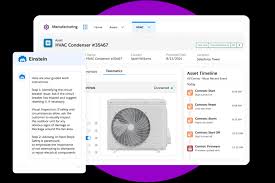
Salesforce has unveiled Connected Assets, a robust suite of capabilities in Manufacturing Cloud, designed to offer manufacturers a comprehensive, real-time perspective on connected asset data. This includes data on service history, asset status, customer records, and telematics, allowing manufacturers to monitor asset health and performance while proactively addressing maintenance needs to reduce downtime and boost customer satisfaction. Enhanced AI Capabilities for Connected AssetsConnected Assets integrates Salesforce’s advanced AI to empower teams with actionable insights. Sales, customer service, and field teams can now receive real-time alerts and quickly access asset history and health, enabling faster, data-driven support and the delivery of more personalized offers. AI-driven insights and recommendations based on asset condition, service history, and performance data enhance the ability of manufacturers to predict maintenance needs and provide proactive support, including on-site recommendations to field technicians. Innovative Features for Optimized Asset Management Salesforce PerspectiveAchyut Jajoo, SVP and GM of Manufacturing and Automotive, states, “The manufacturing industry is embracing a historic transformation toward AI-enabled modernization. Connected Assets and our sector-specific AI tools in Manufacturing Cloud empower our customers to lead with improved customer experiences, optimized asset performance, and new revenue-generating services. With Agentforce, our customers will soon be able to leverage autonomous agents to monitor connected asset data at scale, enabling them to focus on strategic, high-value initiatives.” Real-World ApplicationKawasaki Engines exemplifies Connected Assets in action, using Manufacturing Cloud to enhance customer relationships by offering proactive support and minimizing equipment downtime. “Salesforce’s Connected Assets will enable us to deliver exceptional service, keeping our customers satisfied and our products operating efficiently,” says Tony Gondick, Senior Manager of IT Business Strategy at Kawasaki Engines. Extending Across IndustriesBeyond Manufacturing Cloud, Connected Assets is also being introduced to Salesforce’s other industry clouds, such as Energy & Utilities, Communications, and Media, allowing a wide range of sectors to tap into the benefits of connected asset management, minimize downtime, and generate new value. Like Related Posts Who is Salesforce? Who is Salesforce? Here is their story in their own words. From our inception, we’ve proudly embraced the identity of Read more Salesforce Marketing Cloud Transactional Emails Salesforce Marketing Cloud Transactional Emails are immediate, automated, non-promotional messages crucial to business operations and customer satisfaction, such as order Read more Salesforce Unites Einstein Analytics with Financial CRM Salesforce has unveiled a comprehensive analytics solution tailored for wealth managers, home office professionals, and retail bankers, merging its Financial Read more AI-Driven Propensity Scores AI plays a crucial role in propensity score estimation as it can discern underlying patterns between treatments and confounding variables Read more

Read More
Trends in AI for CRM

Trends in AI for CRM

Nearly half of customer service teams, over 40% of salespeople, and a third of marketers have fully implemented artificial intelligence (AI) to enhance their work. However, 77% of business leaders report persistent challenges related to trusted data and ethical concerns that could stall their AI initiatives, according to Salesforce research released today. The Trends in AI for CRM report analyzed data from multiple studies, revealing that companies are worried about missing out on the opportunities generative AI presents if the data powering large language models (LLMs) isn’t rooted in their own trusted customer records. At the same time, respondents expressed ongoing concerns about the lack of clear company policies governing the ethical use of AI, as well as the complexity of a vendor landscape where 80% of enterprises are currently using multiple LLMs. Salesforce’s Four Keys to Enterprise AI Success Why it matters: AI is one of the most transformative technologies in generations, with projections forecasting a net gain of over trillion in new business revenues by 2028 from Salesforce and its network of partners alone. As enterprises across industries develop their AI strategies, leaders in customer-facing departments such as sales, service, and marketing are eager to leverage AI to drive internal efficiencies and revolutionize customer experiences. Key Findings from the Trends in AI for CRM Report Expert Perspective “This is a pivotal moment as business leaders across industries look to AI to unlock growth, efficiency, and customer loyalty,” said Clara Shih, CEO of Salesforce AI. “But success requires much more than an LLM. Enterprise deployments need trusted data, user access control, vector search, audit trails and citations, data masking, low-code builders, and seamless UI integration. Salesforce brings all of these components together with our Einstein 1 Platform, Data Cloud, Slack, and dozens of customizable, turnkey prompts and actions offered across our clouds.” Like Related Posts Who is Salesforce? Who is Salesforce? Here is their story in their own words. From our inception, we’ve proudly embraced the identity of Read more Salesforce Marketing Cloud Transactional Emails Salesforce Marketing Cloud Transactional Emails are immediate, automated, non-promotional messages crucial to business operations and customer satisfaction, such as order Read more Salesforce Unites Einstein Analytics with Financial CRM Salesforce has unveiled a comprehensive analytics solution tailored for wealth managers, home office professionals, and retail bankers, merging its Financial Read more AI-Driven Propensity Scores AI plays a crucial role in propensity score estimation as it can discern underlying patterns between treatments and confounding variables Read more

Read More
Necessary Salesforce Admin Skills

Necessary Salesforce Admin Skills

In 2023, Salesforce Admins created 230,000 objects, generated over 2.7 billion reports monthly, and performed 1 trillion AI predictions weekly. These figures highlight the critical role of an Admin in the Salesforce ecosystem. However, becoming an expert Salesforce Admin requires more than just technical know-how. A blend of both technical and soft skills is essential to truly excel in this role. Whether you’re new to the role or looking to enhance your skills, learning the right abilities is key to thriving as a Salesforce Admin. In this guide, we’ll cover the essential Salesforce Admin skills you need to effectively manage the platform and drive business success. Key Takeaways 14 Essential Salesforce Admin Skills to Master These are some of the key skills outlined in Salesforce’s “Admin Skills Kit” that will help you secure top Salesforce Admin positions. 1. Communication Strong communication skills are critical for Salesforce Admins, who act as the link between technical teams, stakeholders, and users. You’ll need to explain complex processes clearly so that all parties can understand. Why It Matters: Clear communication ensures users can effectively engage with the platform and make informed decisions based on Salesforce data. How To Improve: Practice simplifying technical concepts, actively listen to others’ needs, and refine your ability to convey information clearly. 2. Problem Solving Challenges will arise in your role, from system errors to user issues. Having strong problem-solving skills allows you to identify the root cause of issues and quickly implement effective solutions. Why It Matters: Efficient problem resolution minimizes downtime and keeps the Salesforce platform running smoothly. How To Improve: Break down problems into manageable parts, brainstorm solutions, and always evaluate the impact of your decisions. 3. Attention to Detail Salesforce admins deal with complex data and processes that require accuracy. From maintaining data integrity to configuring processes, attention to detail is crucial. Why It Matters: Even small errors can result in inaccurate data, security risks, or inefficient processes. How To Improve: Double-check your work, use Salesforce validation tools, and ensure all workflows are correctly configured before launching. 4. Learner’s Mindset Salesforce evolves constantly, with frequent updates and new features. A learner’s mindset helps you stay on top of these changes and continuously improve your skills. Why It Matters: The more you know, the more value you bring. Keeping up with updates ensures you’re using the latest tools to benefit your organization. How To Improve: Engage with Salesforce communities, complete Trailhead modules, and attend webinars to stay current. 5. User Management As an Admin, you’ll be responsible for managing users, creating profiles, setting roles and permissions, and ensuring proper access to data. Why It Matters: Proper user management boosts productivity while ensuring data security. How To Improve: Learn the ins and outs of Salesforce profiles, roles, and permission sets, and practice managing users in a sandbox environment. 6. Security Management In today’s digital age, data security is a top priority. Salesforce Admins are responsible for safeguarding organizational data from unauthorized access or breaches. Why It Matters: Poor security can lead to data leaks, damaging the company’s reputation and finances. How To Improve: Master security settings, understand field-level permissions, and stay informed on two-step verification and audit tracking. 7. Business Analysis Admins need to understand the business needs of their organization. Business analysis skills help you gather requirements, understand workflows, and tailor Salesforce to meet those needs. Why It Matters: The better you understand the business, the more effectively you can customize Salesforce to add value. How To Improve: Collaborate with stakeholders to identify pain points and design solutions that address specific business needs. 8. Data Analysis Working with large data sets is a regular part of being a Salesforce Admin. Knowing how to analyze data and generate insights is essential. Why It Matters: Data analysis drives informed decision-making, streamlines workflows, and improves communication. How To Improve: Familiarize yourself with Salesforce’s reporting tools, dashboards, and data export features. 9. Data Management Effective data management is critical to maintaining a well-functioning Salesforce system. This involves data transfers, cleaning, deduplication, and archiving. Why It Matters: Clean and organized data supports accurate reporting and better decision-making. How To Improve: Learn best practices for data imports, validation rules, and data maintenance tools like Data Loader. 10. Designer’s Mindset Admins with a designer’s mindset can create user-friendly interfaces and workflows that enhance the system’s usability. Why It Matters: A well-designed interface improves the user experience, making work more efficient and enjoyable. How To Improve: Use the Lightning App Builder to create custom page layouts and optimize user flows. 11. Change Management When implementing new processes or updates, effective change management is key. This includes communication, ensuring smooth transitions, and training users on new features. Why It Matters: Proper change management ensures high adoption rates and a smooth transition to new features or updates. How To Improve: Develop communication plans, conduct training, and gather user feedback during transitions. 12. Process Automation Salesforce’s automation capabilities allow admins to streamline repetitive tasks. Automation skills help you create workflows, approval processes, and automated communications. Why It Matters: Automating repetitive tasks saves time and ensures that critical business processes are followed consistently. How To Improve: Learn how to use Flows, Process Builder, and Workflow Rules to automate business operations. 13. Product Management A product management mindset helps Admins align the platform with users’ and stakeholders’ needs, ensuring Salesforce delivers value to the organization. Why It Matters: Meeting evolving business needs ensures you continue to add value as an Admin. How To Improve: Collect user feedback, prioritize requests, and align updates with overall business goals. 14. Project Management Salesforce Admins often lead projects such as implementing new features or migrating data. Strong project management skills are essential to execute these tasks effectively. Why It Matters: Good project management ensures that goals are met on time and within budget. How To Improve: Get comfortable with project management tools, scheduling, resource management, and stakeholder communication. Conclusion The role of a Salesforce Admin combines both technical and soft skills like communication,

Read More
AI and Disability

AI and Disability

Dr. Johnathan Flowers of American University recently sparked a conversation on Bluesky regarding a statement from the organizers of NaNoWriMo, which endorsed the use of generative AI technologies, such as LLM chatbots, in this year’s event. Dr. Flowers expressed concern about the implication that AI assistance was necessary for accessibility, arguing that it could undermine the creativity and agency of individuals with disabilities. He believes that art often serves as a unique space where barriers imposed by disability can be transcended without relying on external help or engaging in forced intimacy. For Dr. Flowers, suggesting the need for AI support may inadvertently diminish the perceived capabilities of disabled and marginalized artists. Since the announcement, NaNoWriMo organizers have revised their stance in response to criticism, though much of the social media discussion has become unproductive. In earlier discussions, the author has explored the implications of generative AI in art, focusing on the human connection that art typically fosters, which AI-generated content may not fully replicate. However, they now wish to address the role of AI as a tool for accessibility. Not being personally affected by physical disability, the author approaches this topic from a social scientific perspective. They acknowledge that the views expressed are personal and not representative of any particular community or organization. Defining AI In a recent presentation, the author offered a new definition of AI, drawing from contemporary regulatory and policy discussions: AI: The application of specific forms of machine learning to perform tasks that would otherwise require human labor. This definition is intentionally broad, encompassing not just generative AI but also other machine learning applications aimed at automating tasks. AI as an Accessibility Tool AI has potential to enhance autonomy and independence for individuals with disabilities, paralleling technological advancements seen in fields like the Paris Paralympics. However, the author is keen to explore what unique benefits AI offers and what risks might arise. Benefits Risks AI and Disability The author acknowledges that this overview touches only on some key issues related to AI and disability. It is crucial for those working in machine learning to be aware of these dynamics, striving to balance benefits with potential risks and ensuring equitable access to technological advancements. Like Related Posts Who is Salesforce? Who is Salesforce? Here is their story in their own words. From our inception, we’ve proudly embraced the identity of Read more Salesforce Unites Einstein Analytics with Financial CRM Salesforce has unveiled a comprehensive analytics solution tailored for wealth managers, home office professionals, and retail bankers, merging its Financial Read more AI-Driven Propensity Scores AI plays a crucial role in propensity score estimation as it can discern underlying patterns between treatments and confounding variables Read more Tectonic’s Successful Salesforce Track Record Salesforce Technology Services Integrator – Tectonic has successfully delivered Salesforce in a variety of industries including Public Sector, Hospitality, Manufacturing, Read more
Read More
gettectonic.com