
Real-Time Decision Making Archives - gettectonic.com
Shifting KPIs With Real-Time Intelligence

Shifting KPIs With Real-Time Intelligence

Marketing without metrics is akin to driving blindfolded. To gauge the effectiveness of their efforts, marketers are investing in analytics capabilities to gain a precise understanding of how their messages, campaigns, and marketing expenditures impact their objectives. The ability to swiftly unlock these insights empowers marketers to promptly address customer needs and make well-informed decisions to propel business growth. This is bringing about Shifting KPIs With Real-Time Intelligence In contrast to 61% of underperforming marketers, a significant 72% of high-performing marketers can analyze marketing performance in real time. This real-time analysis provides them with a distinct advantage in responding to and optimizing campaign performance. However, a notable 33% of marketers still rely on manual processes for marketing attribution, a figure that has seen marginal improvement from 34% in 2020. In 2022, 68% of marketers claim they can analyze marketing performance in real time. For organizations aiming to enhance efficiency and maximize value, identifying the right metrics to track is imperative. As marketing budgets face rigorous scrutiny, analytics offer leaders the insights needed to optimize spending and reduce acquisition costs, reinforcing the value of marketing efforts. Shifting KPIs With Real-Time Intelligence The landscape of analytics has expanded, with marketers now monitoring a comprehensive set of metrics, including year-over-year revenue and customer satisfaction. Personalization and customer touchpoints have gained prominence, leading to increased tracking of web/mobile analytics, content engagement, and customer lifetime value. Marketers are now monitoring an extensive array of key performance indicators (KPIs), encompassing revenue, customer satisfaction metrics (CSAT), web and mobile analytics, customer acquisition costs, B2B sales funnel statistics, content engagement, customer retention rates, customer referral rates, and customer lifetime value. Despite the growing sophistication in tracking various metrics, marketers highlight measuring marketing ROI/attribution as their second most significant challenge. This indicates a continued need for streamlining the reporting process to enhance efficiency and effectiveness. Like Related Posts Who is Salesforce? Who is Salesforce? Here is their story in their own words. From our inception, we’ve proudly embraced the identity of Read more Salesforce Marketing Cloud Transactional Emails Salesforce Marketing Cloud Transactional Emails are immediate, automated, non-promotional messages crucial to business operations and customer satisfaction, such as order Read more Salesforce Unites Einstein Analytics with Financial CRM Salesforce has unveiled a comprehensive analytics solution tailored for wealth managers, home office professionals, and retail bankers, merging its Financial Read more AI-Driven Propensity Scores AI plays a crucial role in propensity score estimation as it can discern underlying patterns between treatments and confounding variables Read more

Read More
Salesforce Data Cloud

Salesforce Data Cloud – The Ultimate Guide to Unified Customer Intelligence

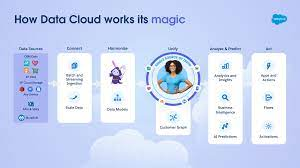
Why Salesforce Data Cloud is Transforming Business Operations In today’s digital-first economy, customer data is your most valuable asset—if you can harness it effectively. Salesforce Data Cloud revolutionizes how enterprises unify, analyze, and activate customer data across every touchpoint. 5 Key Business Transformations The Data Cloud Advantage: Beyond Traditional CDPs Unlike legacy customer data platforms, Salesforce Data Cloud delivers: Feature Traditional Solutions Salesforce Data Cloud Data Integration Manual ETL processes Real-time harmonization AI Capabilities Basic segmentation Predictive insights & recommendations Activation Limited channel support Native Salesforce app integration Scalability Fixed data models Elastic cloud infrastructure Total Cost Hidden implementation fees Transparent consumption model Proven Results Across Industries Financial Services Healthcare Retail Implementation Roadmap Phase 1: Foundation (Weeks 1-4) Phase 2: Activation (Weeks 5-8) Phase 3: Scaling (Ongoing) Overcoming Common Challenges “Our data is too messy”→ Automated data quality tools clean and standardize information during ingestion “We can’t afford another platform”→ Consumption-based pricing starts at $25K/year with proven 3-5X ROI “Our team isn’t technical enough”→ No-code tools like Flow Builder enable business user configuration The Future of Data-Driven Business As AI reshapes customer expectations, Salesforce Data Cloud provides the essential infrastructure to: Leading organizations are already achieving: Next Steps for Your Data Transformation “Companies using Data Cloud see 47% faster decision-making and 32% higher customer satisfaction scores within 6 months.” – Forrester Consulting Study Unlock your data’s full potential. Contact our specialists today to begin your assessment. Like Related Posts Who is Salesforce? Who is Salesforce? Here is their story in their own words. From our inception, we’ve proudly embraced the identity of Read more Salesforce Marketing Cloud Transactional Emails Salesforce Marketing Cloud Transactional Emails are immediate, automated, non-promotional messages crucial to business operations and customer satisfaction, such as order Read more Salesforce Unites Einstein Analytics with Financial CRM Salesforce has unveiled a comprehensive analytics solution tailored for wealth managers, home office professionals, and retail bankers, merging its Financial Read more AI-Driven Propensity Scores AI plays a crucial role in propensity score estimation as it can discern underlying patterns between treatments and confounding variables Read more

Read More
Salesforce Data Cloud

Enable Real-Time Decision Making With Unified Data

Goal You use business metrics to guide prioritization of data efforts. Your teams build data sources to address the most critical business questions. Enable real-time decision making with unified data. What it looks like Data owners and business owners form a cross-functional team to identify or create key data sources. Ensure that your data sources align to one or multiple parts of a business process. Use a data lake to centralize, secure, process, and organize large amounts of data so that teams across your entire company can access the unified data they need from a single location. Next, identify critical decision points. Use your data sources to inform these points, explore and model potential outcomes, and measure the impact. Generate insights on crucial business processes. Aggregate data from business processes most impacted by key performance metrics.  Unify your leadership team with data. Structure a workflow where each data owner, business stakeholder, and process expert all have a single view of the data and are assigned to oversee a different, crucial business process.  Audit your data use. Work with leadership teams to identify relevance of existing data sources, and resolve gaps in knowledge to create a complete and unified view of your data. Enable Real-Time Decision Making with Unified Data Build data sources to support key decision points. Support key decision points with data analytics and unified data.  Run experiments with unified data. Achieve incremental improvements by adjusting different factors in multiple experimental trials. Identify new drivers of improved performance. Monitor changes and measure the impact on business success. Enable real-time decision making with unified data. Track ROI following business improvements. Analyze business impact with key performance metrics.  Offer your teams a single view of the data. Support performance reviews with data visualization to ensure that your team members’ accomplishments are acknowledged and rewarded.  Collect data from process changes. Document all stages of business transformation, and make data associated with process changes available to teams across your company to guide their decisions. Like1 Related Posts Capture Initial Traffic Source With Google Analytics To ensure the proper sequencing of Tags, modify the Tag sequencing in the Google Analytics preview Tag settings. The custom Read more Snowflake and Salesforce with Embed Snowflake has deepened its partnership with investor Salesforce by introducing two tools that seamlessly connect their cloud-native systems. Snowflake and Read more Salesforce CDP Explained What is a Customer Data Platform (CDP)? A Customer Data Platform (CDP) is one of the most transformative tools in Read more What is BI in Salesforce? Salesforce BI helps to create fast, digestible reports to help you make informed decisions at the right time. Salesforce Einstein Read more

Read More
gettectonic.com