Code Snippet Archives - gettectonic.com
The Rise of Conceptual AI

Emerging AI Interface Paradigms

The 7 Emerging AI Interface Paradigms Shaping the Future of UX The rise of LLMs and AI agents has supercharged traditional UI patterns like chatbots—but the real breakthrough lies in embedding AI into sophisticated, task-driven interfaces. From right-panel assistants to semantic spreadsheets, these spatial layouts aren’t just design choices—they fundamentally shape how users discover, trust, and interact with AI. This article explores seven emerging AI interface layouts, analyzing how each influences user expectations, discoverability, and agent capabilities. 1. The Customer Service Agent (Chatbot Widget) Example: Zendesk, IntercomLayout: Floating bottom-right chat window Key Traits: ✅ Discoverability: Subtle yet persistent, avoiding disruption.✅ Interaction Pattern: Asynchronous, lightweight support—users open/close as needed.✅ Agent’s Role: Reactive helper—handles FAQs, order lookups, password resets. Modern AI adds memory, personalization, and automation.❌ Limitations: Not built for proactive, multi-step reasoning or deep collaboration. 2. The Precision Assistant (Inline Overlay Prompts) Example: Notion AI, GrammarlyLayout: Context-aware suggestions within text (underlines, hovers, popovers) Key Traits: ✅ Discoverability: Triggered by user actions (typing, selecting).✅ Interaction Pattern: Micro-level edits—accept, tweak, or regenerate instantly.✅ Agent’s Role: A surgical editor—rephrases sentences, completes code snippets, adjusts tone.❌ Limitations: Struggles with open-ended creativity or multi-step logic. 3. The Creative Collaborator (Infinite Canvas) Example: TLDraw, Figma, MiroLayout: Boundless 2D workspace with AI-triggered element enhancements Key Traits: ✅ Discoverability: AI surfaces when hovering/selecting objects (stickies, shapes, text).✅ Interaction Pattern: Parallel AI calls—generate, rename, or refine canvas elements without breaking flow.✅ Agent’s Role: A visual co-creator—suggests layouts, refines ideas, augments sketches.❌ Limitations: Weak at version control or document-wide awareness. 4. The General-Purpose Assistant (Center-Stage Chat) Example: ChatGPT, Perplexity, MidjourneyLayout: Full-width conversational pane with prompt-first input Key Traits: ✅ Discoverability: Minimalist—focused on the input box.✅ Interaction Pattern: Freeform prompting—iterative refinements via follow-ups.✅ Agent’s Role: A broad-knowledge helper—answers questions, writes, codes, designs.❌ Limitations: Poor for structured workflows (e.g., app building, form filling). 5. The Strategic Partner (Left-Panel Co-Creator) Example: ChatGPT Canvas, LovableLayout: Persistent left-side chat panel + right-side workspace Key Traits: ✅ Discoverability: Aligns with F-shaped scanning—keeps AI always accessible.✅ Interaction Pattern: Multi-turn ideation—users refine outputs in real time.✅ Agent’s Role: A thought partner—structures complex projects (code, docs, designs).❌ Limitations: Overkill for lightweight tasks; vague prompts risk errors. 6. The Deep-Context Expert (Right-Panel Assistant) Example: GitHub Copilot, Microsoft Copilot, Gmail GeminiLayout: Collapsible right-hand panel for on-demand help Key Traits: ✅ Discoverability: Non-intrusive but available—stays out of the way until needed.✅ Interaction Pattern: Just-in-time assistance—debugs code, drafts emails, summarizes docs.✅ Agent’s Role: A specialist—understands deep context (coding, legal, enterprise).❌ Limitations: Not ideal for AI-first experiences; novices may overlook it. 7. The Distributed Research Agent (Semantic Spreadsheet) Example: AnswerGrid, ElicitLayout: AI-powered grid where each cell acts as a mini-agent Key Traits: ✅ Discoverability: Feels familiar (rows, columns) but autofills intelligently.✅ Interaction Pattern: Prompt-to-grid—AI scrapes data, synthesizes research, populates cells.✅ Agent’s Role: A data synthesis engine—automates research, compiles reports.❌ Limitations: Requires structured thinking; spreadsheet-savvy users only. Conclusion: AI Interfaces Are a New Design Frontier LLMs aren’t just tools—they’re a new computing medium. Just as GUIs and mobile reshaped UX decades ago, AI demands rethinking where intelligence lives in our products. Key Takeaways: 🔹 Spatial layout dictates perceived AI role (assistant vs. co-creator vs. expert).🔹 Discoverability & trust depend on placement (left/right/center).🔹 The best AI interfaces feel invisible—enhancing workflows, not disrupting them. The future belongs to context-aware, embedded AI—not just chatbots. Which paradigm will dominate your product? Like Related Posts Who is Salesforce? Who is Salesforce? Here is their story in their own words. From our inception, we’ve proudly embraced the identity of Read more Salesforce Unites Einstein Analytics with Financial CRM Salesforce has unveiled a comprehensive analytics solution tailored for wealth managers, home office professionals, and retail bankers, merging its Financial Read more AI-Driven Propensity Scores AI plays a crucial role in propensity score estimation as it can discern underlying patterns between treatments and confounding variables Read more Tectonic’s Successful Salesforce Track Record Salesforce Technology Services Integrator – Tectonic has successfully delivered Salesforce in a variety of industries including Public Sector, Hospitality, Manufacturing, Read more


Read More
AI Interface Paradox

AI Interface Paradox

The AI Interface Paradox: Why the Search Box is Failing Generative AI The Google Legacy: How Search Conditioned Our Digital Behavior Google’s revolutionary insight wasn’t algorithmic—it was psychological. By stripping away all complexity from search interfaces (remember AltaVista’s cluttered filters?), they created what became the most ingrained digital behavior pattern of the internet age: This elegant simplicity made Google the gateway to the internet. But it also created an unshakable mental model that now hampers AI adoption. The Cognitive Dissonance of AI Interfaces Today’s AI tools present users with a cruel irony: The exact same empty text box that promised effortless answers now demands programming-like precision. The Fundamental Mismatch Google Search Generative AI Works with fragments (“weather paris”) Requires structured prompts (“Act as a meteorologist…”) Delivers finished results Needs iterative refinement Single interaction Requires multi-turn conversations Predictable outcomes Wildly variable quality This explains why: Why the Search Metaphor Fails AI 1. The Blank Canvas Problem The same empty box is asked to handle: Without interface cues, users experience choice paralysis—like being handed a single blank sheet of paper when you need both a spreadsheet and a paintbrush. 2. The Conversation Illusion Elizabeth Laraki’s Madrid itinerary struggle reveals the flaw: human collaboration isn’t linear. We: Current chat UIs force all interaction through a sequential text tunnel, losing the richness of real collaboration. 3. The Hidden Grammar Requirement Effective prompting requires skills most users lack: This creates a participation gap where only power users benefit. Blueprint for the Post-Search Interface Emerging solutions point to five key principles for next-gen AI interfaces: 1. Context-Aware Launchpads Instead of blank slates, interfaces should offer: Example: Notion AI’s “/” command menu that suggests context-appropriate actions. 2. Adaptive Input Modalities Task Type Optimal Input Visual design Image upload + text Data analysis File import + natural language Creative writing Voice dictation Programming Code snippet + comments 3. Collaborative Workspaces Moving beyond chat streams to: Example: Vercel’s v0 design mode that blends generation with direct manipulation. 4. Guided Co-Creation Instead of silent processing, interfaces should: 5. Specialized Agents Ecosystem A shift from monolithic AI to: The Coming Interface Revolution The companies that crack this will do for AI what Google did for search—not by improving what exists, but by reimagining interaction from first principles. Early signs suggest: As NN/g’s research confirms, the future belongs to outcome-oriented interfaces that adapt to goals rather than forcing users through static workflows. What This Means for Adoption Until interfaces evolve, we’ll remain in the “early adopter phase” where: The breakthrough will come when AI interfaces stop pretending to be search boxes and start embracing their true nature—dynamic collaboration spaces. When that happens, we’ll see the real AI revolution begin. Like Related Posts Who is Salesforce? Who is Salesforce? Here is their story in their own words. From our inception, we’ve proudly embraced the identity of Read more Salesforce Unites Einstein Analytics with Financial CRM Salesforce has unveiled a comprehensive analytics solution tailored for wealth managers, home office professionals, and retail bankers, merging its Financial Read more AI-Driven Propensity Scores AI plays a crucial role in propensity score estimation as it can discern underlying patterns between treatments and confounding variables Read more Tectonic’s Successful Salesforce Track Record Salesforce Technology Services Integrator – Tectonic has successfully delivered Salesforce in a variety of industries including Public Sector, Hospitality, Manufacturing, Read more
Read More
Second Wave of AI Agents

Second Wave of AI Agents

The “second wave” of AI agents refers to the evolution of AI beyond simple chatbots and into more sophisticated, autonomous systems that can plan, execute, and deliver results independently, often leveraging large language models (LLMs). These agents are characterized by their ability to interact with other applications, interpret the screen, fill out forms, and coordinate with other AI systems to achieve a desired outcome. They are also seen as a significant step beyond the first wave of AI, which primarily focused on predictive models and statistical learning. Key Characteristics of the Second Wave of AI Agents: Examples and Applications: In 2023 Bill Gates prophesized AI Agents would be here in 5 years. His timing was off. But not his prediction. The Future of Computing: Your AI Agent, Your Digital Sidekick Imagine this: No more juggling apps. No more digging through menus. No more searching for a document or a spreadsheet. Just tell your device—in plain English—what you need, and it handles the rest. Whether it’s planning a tour, managing your schedule, or helping with work, your AI assistant will understand you personally, adapting to your life based on what you choose to share. This isn’t science fiction. Today, everyone online has access to an AI-powered personal assistant far more advanced than anything available in 2023. Meet the Agent: The Next Era of Computing This next-generation software—called an agent—responds to natural language and accomplishes tasks using deep knowledge of you and your needs. Bill Gates first wrote about agents in his 1995 book The Road Ahead, but only now, with recent AI breakthroughs, have they become truly possible. Agents won’t just change how we interact with technology. They’ll reshape the entire software industry, marking the biggest shift in computing since we moved from command lines to touchscreens. Consider Salesforce’s AgentForce. A platform driven by automated AI agents that can be trained to do virtually anything. Freeing staff up from mundane data entry and administrative work to really set them loose. Marketers can once again create content, but with the insights provided by AI. Sales teams can close deals, but with the lead rating details provided by AI. Developers can devote more time to writing code but letting AI do the repetitive pieces that take time away from awe inspiring development. Why This Changes Everything We’re on the brink of a revolution—one where technology doesn’t just respond to commands but anticipates your needs and acts on your behalf. The age of the AI agent is here, and it’s going to redefine how we live and work. By Tectonic’s Marketing Operations Manager, Shannan Hearne Like Related Posts Who is Salesforce? Who is Salesforce? Here is their story in their own words. From our inception, we’ve proudly embraced the identity of Read more Salesforce Marketing Cloud Transactional Emails Salesforce Marketing Cloud Transactional Emails are immediate, automated, non-promotional messages crucial to business operations and customer satisfaction, such as order Read more Salesforce Unites Einstein Analytics with Financial CRM Salesforce has unveiled a comprehensive analytics solution tailored for wealth managers, home office professionals, and retail bankers, merging its Financial Read more AI-Driven Propensity Scores AI plays a crucial role in propensity score estimation as it can discern underlying patterns between treatments and confounding variables Read more

Read More
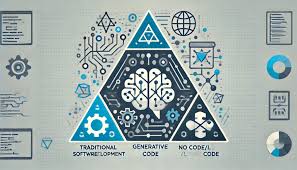
No-Code Generative AI

Generative-Driven Development

Nowhere has the rise of generative AI tools been more transformative than in software development. It began with GitHub Copilot’s enhanced autocomplete, which then evolved into interactive, real-time coding assistants like Aider and Cursor that allow engineers to dictate changes and see them applied live in their editor. Today, platforms like Devin.ai aim even higher, aspiring to create autonomous software systems capable of interpreting feature requests or bug reports and delivering ready-to-review code. At its core, the ambition of these AI tools mirrors the essence of software itself: to automate human work. Whether you were writing a script to automate CSV parsing in 2005 or leveraging AI today, the goal remains the same—offloading repetitive tasks to machines. What makes generative AI tools distinct, however, is their focus on automating the work of automation itself. Framing this as a guiding principle enables us to consider the broader challenges and opportunities generative AI brings to software development. Automate the Process of Automation The Doctor-Patient Strategy Most contemporary generative AI tools operate under what can be called the Doctor-Patient strategy. In this model, the GenAI tool acts on a codebase as a distinct, external entity—much like a doctor treats a patient. The relationship is one-directional: the tool modifies the codebase based on given instructions but remains isolated from the architecture and decision-making processes within it. Why This Strategy Dominates: However, the limitations of this strategy are becoming increasingly apparent. Over time, the unidirectional relationship leads to bot rot—the gradual degradation of code quality due to poorly contextualized, repetitive, or inconsistent changes made by generative AI. Understanding Bot Rot Bot rot occurs when AI tools repeatedly make changes without accounting for the macro-level architecture of a codebase. These tools rely on localized context, often drawing from semantically similar code snippets, but lack the insight needed to preserve or enhance the overarching structure. Symptoms of Bot Rot: Example:Consider a Python application that parses TPS report IDs. Without architectural insight, a code bot may generate redundant parsing methods across multiple modules rather than abstracting the logic into a centralized model. Over time, this duplication compounds, creating a chaotic and inefficient codebase. A New Approach: Generative-Driven Development (GDD) To address the flaws of the Doctor-Patient strategy, we propose Generative-Driven Development (GDD), a paradigm where the codebase itself is designed to enable generative AI to enhance automation iteratively and sustainably. Pillars of GDD: How GDD Improves the Development Lifecycle Under GDD, the traditional Test-Driven Development (TDD) cycle (red, green, refactor) evolves to integrate AI processes: This complete cycle eliminates the gaps present in current generative workflows, reducing bot rot and enabling sustainable automation. Over time, GDD-based codebases become easier to maintain and automate, reducing error rates and cycle times. A Day in the Life of a GDD Engineer Imagine a GDD-enabled workflow for a developer tasked with updating TPS report parsing: By embedding AI into the development process, GDD empowers engineers to focus on high-level decision-making while ensuring the automation process remains sustainable and aligned with architectural goals. Conclusion Generative-Driven Development represents a significant shift in how we approach software development. By prioritizing architecture, embedding automation into the software itself, and writing GenAI-optimized code, GDD offers a sustainable path to achieving the ultimate goal: automating the process of automation. As AI continues to reshape the industry, adopting GDD will be critical to harnessing its full potential while avoiding the pitfalls of bot rot. Like Related Posts Who is Salesforce? Who is Salesforce? Here is their story in their own words. From our inception, we’ve proudly embraced the identity of Read more Salesforce Unites Einstein Analytics with Financial CRM Salesforce has unveiled a comprehensive analytics solution tailored for wealth managers, home office professionals, and retail bankers, merging its Financial Read more AI-Driven Propensity Scores AI plays a crucial role in propensity score estimation as it can discern underlying patterns between treatments and confounding variables Read more Tectonic’s Successful Salesforce Track Record Salesforce Technology Services Integrator – Tectonic has successfully delivered Salesforce in a variety of industries including Public Sector, Hospitality, Manufacturing, Read more

Read More
Python-Based Reasoning Engine

Python-Based Reasoning Engine

Introducing a Python-Based Reasoning Engine for Deterministic AI In the age of large language models (LLMs), there’s a growing need for deterministic systems that enforce rules and constraints while reasoning about information. We’ve developed a Python-based reasoning and validation framework that bridges the gap between traditional rule-based logic and modern AI capabilities, inspired by frameworks like Pydantic. This approach is designed for developers and non-technical experts alike, making it easy to build complex rule engines that translate natural language instructions into enforceable code. Our fine-tuned model automates the creation of rules while ensuring human oversight for quality and conflict detection. The result? Faster implementation of rule engines, reduced developer overhead, and flexible extensibility across domains. The Framework at a Glance Our system consists of five core components: To analogize, this framework operates like a game of chess: Our framework supports two primary use cases: Key Features and Benefits Case Studies Validation Engine: Ensuring Compliance A mining company needed to validate employee qualifications based on age, region, and role. Example Data Structure: jsonCopy code{ “employees”: [ { “name”: “Sarah”, “age”: 25, “role”: “Manager”, “documents”: [“safe_handling_at_work”, “heavy_lifting”] }, { “name”: “John”, “age”: 17, “role”: “Laborer”, “documents”: [“heavy_lifting”] } ] } Rules: jsonCopy code{ “rules”: [ { “type”: “min_age”, “parameters”: { “min_age”: 18 } }, { “type”: “dozer_operator”, “parameters”: { “document_type”: “dozer_qualification” } } ] } Outcome:The system flagged violations, such as employees under 18 or missing required qualifications, ensuring compliance with organizational rules. Reasoning Engine: Solving the River Crossing Puzzle The classic river crossing puzzle demonstrates the engine’s reasoning capabilities. Problem Setup:A farmer must ferry a goat, a wolf, and a cabbage across a river, adhering to specific constraints (e.g., the goat cannot be left alone with the cabbage). Steps: Output:The engine generated a solution in 0.0003 seconds, showcasing its efficiency in navigating complex logic. Advanced Features: Dynamic Rule Expansion The system supports real-time rule adjustments. For instance, adding a “wolf cannot be left with a chicken” constraint introduces a conflict. By extending rules (e.g., allowing the farmer to carry two items), the engine dynamically resolves previously unsolvable scenarios. Sample Code Snippet: pythonCopy codeclass CarryingCapacityRule(Rule): def evaluate(self, state): items_moved = sum(1 for item in [‘wolf’, ‘goat’, ‘cabbage’, ‘chicken’] if getattr(state, item) == state.farmer) return items_moved <= 2 def get_description(self): return “Farmer can carry up to two items at a time” Result:The adjusted engine solved the puzzle in three moves, down from seven, while maintaining rule integrity. Collaborative UI for Rule Creation Our user interface empowers domain experts to define rules without writing code. Developers validate these rules, which are then seamlessly integrated into the system. Visual Workflow: Like Related Posts Who is Salesforce? Who is Salesforce? Here is their story in their own words. From our inception, we’ve proudly embraced the identity of Read more Salesforce Unites Einstein Analytics with Financial CRM Salesforce has unveiled a comprehensive analytics solution tailored for wealth managers, home office professionals, and retail bankers, merging its Financial Read more AI-Driven Propensity Scores AI plays a crucial role in propensity score estimation as it can discern underlying patterns between treatments and confounding variables Read more Tectonic’s Successful Salesforce Track Record Salesforce Technology Services Integrator – Tectonic has successfully delivered Salesforce in a variety of industries including Public Sector, Hospitality, Manufacturing, Read more

Read More
GitHub Copilot Autofix

GitHub Copilot Autofix

On Wednesday, GitHub announced the general availability of Copilot Autofix, an AI-driven tool designed to identify and remediate software vulnerabilities. Originally unveiled in March and tested in public beta, Copilot Autofix integrates GitHub’s CodeQL scanning engine with GPT-4, heuristics, and Copilot APIs to generate code suggestions for developers. The tool provides prompts based on CodeQL analysis and code snippets, allowing users to accept, edit, or reject the suggestions. In a blog post, Mike Hanley, GitHub’s Chief Security Officer and Senior Vice President of Engineering, highlighted the challenges developers and security teams face in addressing existing vulnerabilities. “Code scanning tools can find vulnerabilities, but the real issue is remediation, which requires security expertise and time—both of which are in short supply,” Hanley noted. “The problem isn’t finding vulnerabilities; it’s fixing them.” According to GitHub, the private beta of Copilot Autofix showed that users could respond to a CodeQL alert and automatically remediate a vulnerability in a pull request in just 28 minutes on average, compared to 90 minutes for manual remediation. The tool was even faster for common vulnerabilities like cross-site scripting, with remediation times averaging 22 minutes compared to three hours manually, and SQL injection flaws, which were fixed in 18 minutes on average versus almost four hours manually. Hanley likened the efficiency of Copilot Autofix in fixing vulnerabilities to the speed at which GitHub Copilot, their generative AI coding assistant released in 2022, produces code for developers. However, there have been concerns that GitHub Copilot and similar AI coding assistants could replicate existing vulnerabilities in the codebases they help generate. Industry analyst Katie Norton from IDC noted that while the replication of vulnerabilities is concerning, the rapid pace at which AI coding assistants generate new software could pose a more significant security issue. Chris Wysopal, CTO and co-founder of Veracode, echoed this concern, pointing out that faster coding speeds have led to more software being produced and a larger backlog of vulnerabilities for developers to manage. Norton also emphasized that AI-powered tools like Copilot Autofix could help alleviate the burden on developers by reducing these backlogs and enabling them to fix vulnerabilities without needing to be security experts. Other vendors, including Mobb and Snyk, have also developed AI-powered autoremediation tools. Initially supporting JavaScript, TypeScript, Java, and Python during its public beta, Copilot Autofix now also supports C#, C/C++, Go, Kotlin, Swift, and Ruby. Hanley also highlighted that Copilot Autofix would benefit the open-source software community. GitHub has previously provided open-source maintainers with free access to enterprise security tools for code scanning, secret scanning, and dependency management. Starting in September, Copilot Autofix will also be made available for free to these maintainers. “As the global home of the open-source community, GitHub is uniquely positioned to help maintainers detect and remediate vulnerabilities, making open-source software safer and more reliable for everyone,” Hanley said. Copilot Autofix is now available to all GitHub customers globally. Like Related Posts Who is Salesforce? Who is Salesforce? Here is their story in their own words. From our inception, we’ve proudly embraced the identity of Read more Salesforce Unites Einstein Analytics with Financial CRM Salesforce has unveiled a comprehensive analytics solution tailored for wealth managers, home office professionals, and retail bankers, merging its Financial Read more AI-Driven Propensity Scores AI plays a crucial role in propensity score estimation as it can discern underlying patterns between treatments and confounding variables Read more Tectonic’s Successful Salesforce Track Record Salesforce Technology Services Integrator – Tectonic has successfully delivered Salesforce in a variety of industries including Public Sector, Hospitality, Manufacturing, Read more

Read More
marketing cloud utm parameters

UTM Parameter FAQs

How to Retrieve UTM Data Using Google Tag Manager Retrieving UTM data in Google Tag Manager involves a straightforward process to enhance tracking and analytics. Follow these steps: By following these steps, you can effectively retrieve and utilize UTM data in Google Tag Manager, enhancing your tracking capabilities and improving data accuracy for marketing campaigns. Content updated March 2024. Like Related Posts Who is Salesforce? Who is Salesforce? Here is their story in their own words. From our inception, we’ve proudly embraced the identity of Read more Salesforce Marketing Cloud Transactional Emails Salesforce Marketing Cloud Transactional Emails are immediate, automated, non-promotional messages crucial to business operations and customer satisfaction, such as order Read more Salesforce Unites Einstein Analytics with Financial CRM Salesforce has unveiled a comprehensive analytics solution tailored for wealth managers, home office professionals, and retail bankers, merging its Financial Read more AI-Driven Propensity Scores AI plays a crucial role in propensity score estimation as it can discern underlying patterns between treatments and confounding variables Read more

Read More
gettectonic.com