Hybrid Model Archives - gettectonic.com

Rise and Limits of GPT Models

The Rise and Limits of GPT Models: What They Can’t Do (And What Comes Next) GPT Models: The Engines of Modern AI GPT models have revolutionized AI, offering speed, flexibility, and generative power that older architectures like RNNs couldn’t match. Without their development—starting with GPT-1 (2018) and BERT (2018)—today’s AI landscape, especially generative AI, wouldn’t exist. Yet, despite their dominance, GPT models have fundamental flaws—hallucinations, reasoning gaps, and context constraints—that make them unsuitable for some critical tasks. So, what can’t GPT models do well? Which limitations can be fixed, and which are unavoidable? How GPT Models Work (And Why They’re Different) GPT models are transformer-based, meaning they process data in parallel (unlike sequential RNNs). This allows them to:✔ Analyze entire sentences at once✔ Generate coherent, context-aware responses✔ Scale efficiently with more data But this architecture also introduces key weaknesses. The 3 Biggest Limitations of GPT Models 1. Hallucinations: When AI Makes Things Up Why it happens: Can it be fixed? 2. Struggles with Long-Form Data Why it happens: Can it be fixed? 3. They Can’t Really “Reason” Why it happens: Can it be fixed? The Future: Can GPT Models Improve? Option 1: Patch the Transformer But these are band-aids, not true fixes. Option 2: Move Beyond Transformers New architectures are emerging: The Bottom Line ✅ GPT models are here to stay (for now)❌ But they’ll never be perfect at reasoning or long-context tasks🚀 The next AI breakthrough may come from a totally new architecture What’s next? Keep an eye on Mamba, Megalodon, and neurosymbolic AI—they might just dethrone transformers. Like Related Posts Who is Salesforce? Who is Salesforce? Here is their story in their own words. From our inception, we’ve proudly embraced the identity of Read more Salesforce Unites Einstein Analytics with Financial CRM Salesforce has unveiled a comprehensive analytics solution tailored for wealth managers, home office professionals, and retail bankers, merging its Financial Read more AI-Driven Propensity Scores AI plays a crucial role in propensity score estimation as it can discern underlying patterns between treatments and confounding variables Read more Tectonic’s Successful Salesforce Track Record Salesforce Technology Services Integrator – Tectonic has successfully delivered Salesforce in a variety of industries including Public Sector, Hospitality, Manufacturing, Read more

Read More
Revenue Cloud

Salesforce Revenue Cloud Advanced

Salesforce Revenue Cloud Advanced (RCA): The Ultimate Quote-to-Cash Solution Revolutionize Your Revenue Operations Salesforce Revenue Cloud Advanced (RCA) is an end-to-end revenue management platform that transforms complex quote-to-cash processes into automated, compliant, and customer-centric experiences. Designed for mid-market and enterprise organizations, RCA empowers businesses to: ✔ Simplify CPQ, billing, and revenue recognition✔ Ensure compliance with ASC 606/IFRS 15✔ Accelerate deal velocity✔ Manage multi-channel revenue streams Ideal for: SaaS, Manufacturing, High Tech, Healthcare, and other industries with subscription models, usage-based pricing, and dynamic bundling. Key Capabilities of Revenue Cloud Advanced 1. Intelligent CPQ (Configure, Price, Quote) 2. Flexible Billing & Monetization 3. Accurate Revenue Recognition 4. Partner & Channel Management Who Benefits from RCA? Team Key Value Sales Faster quoting, guided selling, deal acceleration Finance Automated revenue compliance, reduced manual errors RevOps End-to-end process automation, scalability IT Pre-built integrations, low technical debt Why Choose Salesforce RCA? Native to the Salesforce Ecosystem Seamlessly integrates with: AI-Powered Insights Enterprise-Grade Scalability Transform Your Revenue Lifecycle ✅ Close deals faster with AI-guided selling✅ Eliminate billing errors with automation✅ Stay audit-ready with compliant revenue reporting✅ Scale effortlessly as your business grows Ready to optimize your quote-to-cash process? Contact Tectonic today. Like Related Posts Who is Salesforce? Who is Salesforce? Here is their story in their own words. From our inception, we’ve proudly embraced the identity of Read more Salesforce Marketing Cloud Transactional Emails Salesforce Marketing Cloud Transactional Emails are immediate, automated, non-promotional messages crucial to business operations and customer satisfaction, such as order Read more Salesforce Unites Einstein Analytics with Financial CRM Salesforce has unveiled a comprehensive analytics solution tailored for wealth managers, home office professionals, and retail bankers, merging its Financial Read more AI-Driven Propensity Scores AI plays a crucial role in propensity score estimation as it can discern underlying patterns between treatments and confounding variables Read more

Read More
agents and copilots

Copilots and Agents

Which Agentic AI Features Truly Matter? Modern large language models (LLMs) are often evaluated based on their ability to support agentic AI capabilities. However, the effectiveness of these features depends on the specific problems AI agents are designed to solve. The term “AI agent” is frequently applied to any AI application that performs intelligent tasks on behalf of a user. However, true AI agents—of which there are still relatively few—differ significantly from conventional AI assistants. This discussion focuses specifically on personal AI applications rather than AI solutions for teams and organizations. In this domain, AI agents are more comparable to “copilots” than traditional AI assistants. What Sets AI Agents Apart from Other AI Tools? Clarifying the distinctions between AI agents, copilots, and assistants helps define their unique capabilities: AI Copilots AI copilots represent an advanced subset of AI assistants. Unlike traditional assistants, copilots leverage broader context awareness and long-term memory to provide intelligent suggestions. While ChatGPT already functions as a form of AI copilot, its ability to determine what to remember remains an area for improvement. A defining characteristic of AI copilots—one absent in ChatGPT—is proactive behavior. For example, an AI copilot can generate intelligent suggestions in response to common user requests by recognizing patterns observed across multiple interactions. This learning often occurs through in-context learning, while fine-tuning remains optional. Additionally, copilots can retain sequences of past user requests and analyze both memory and current context to anticipate user needs and offer relevant suggestions at the appropriate time. Although AI copilots may appear proactive, their operational environment is typically confined to a specific application. Unlike AI agents, which take real actions within broader environments, copilots are generally limited to triggering user-facing messages. However, the integration of background LLM calls introduces a level of automation beyond traditional AI assistants, whose outputs are always explicitly requested. AI Agents and Reasoning In personal applications, an AI agent functions similarly to an AI copilot but incorporates at least one of three additional capabilities: Reasoning and self-monitoring are critical LLM capabilities that support goal-oriented behavior. Major LLM providers continue to enhance these features, with recent advancements including: As of March 2025, Grok 3 and Gemini 2.0 Flash Thinking rank highest on the LMArena leaderboard, which evaluates AI performance based on user assessments. This competitive landscape highlights the rapid evolution of reasoning-focused LLMs, a critical factor for the advancement of AI agents. Defining AI Agents While reasoning is often cited as a defining feature of AI agents, it is fundamentally an LLM capability rather than a distinction between agents and copilots. Both require reasoning—agents for decision-making and copilots for generating intelligent suggestions. Similarly, an agent’s ability to take action in an external environment is not exclusive to AI agents. Many AI copilots perform actions within a confined system. For example, an AI copilot assisting with document editing in a web-based CMS can both provide feedback and make direct modifications within the system. The same applies to sensor capabilities. AI copilots not only observe user actions but also monitor entire systems, detecting external changes to documents, applications, or web pages. Key Distinctions: Autonomy and Versatility The fundamental differences between AI copilots and AI agents lie in autonomy and versatility: If an AI system is labeled as a domain-specific agent or an industry-specific vertical agent, it may essentially function as an AI copilot. The distinction between copilots and agents is becoming increasingly nuanced. Therefore, the term AI agent should be reserved for highly versatile, multi-purpose AI systems capable of operating across diverse domains. Notable examples include OpenAI’s Operator and Deep Research. Like1 Related Posts Who is Salesforce? Who is Salesforce? Here is their story in their own words. From our inception, we’ve proudly embraced the identity of Read more Salesforce Marketing Cloud Transactional Emails Salesforce Marketing Cloud Transactional Emails are immediate, automated, non-promotional messages crucial to business operations and customer satisfaction, such as order Read more Salesforce Unites Einstein Analytics with Financial CRM Salesforce has unveiled a comprehensive analytics solution tailored for wealth managers, home office professionals, and retail bankers, merging its Financial Read more AI-Driven Propensity Scores AI plays a crucial role in propensity score estimation as it can discern underlying patterns between treatments and confounding variables Read more
Read More
AI Agents

AI Agents in Action: Real-World Applications

The true potential of AI agents lies in their practical use across industries. Let’s explore how different sectors are leveraging AI agents to solve real challenges. Software Development The shift from simple code completion to autonomous software development highlights AI’s expanding role in engineering. While GitHub Copilot introduced real-time coding assistance in 2021, today’s AI agents—like Devin—can manage end-to-end development, from setting up environments to deployment. Multi-agent frameworks, such as MetaGPT, showcase how specialized AI agents collaborate effectively: While AI agents lack human limitations, this shift raises fundamental questions about development practices shaped over decades. AI excels at tasks like prototyping and automated testing, but the true opportunity lies in rethinking software development itself—not just making existing processes faster. This transformation is already affecting hiring trends. Salesforce, for example, announced it will not hire new software engineers in 2025, citing a 30% productivity increase from AI-driven development. Meanwhile, Meta CEO Mark Zuckerberg predicts that by 2025, AI will reach the level of mid-level software engineers, capable of generating production-ready code. However, real-world tests highlight limitations. While Devin performs well on isolated tasks like API integrations, it struggles with complex development projects. In one evaluation, Devin successfully completed only 3 out of 20 full-stack tasks. In contrast, developer-driven workflows using tools like Cursor have proven more reliable, suggesting that AI agents are best used as collaborators rather than full replacements. Customer Service The evolution from basic chatbots to sophisticated AI service agents marks one of the most successful AI deployments to date. Research by Sierra shows that modern AI agents can handle complex tasks—such as flight rebookings and multi-step refunds—previously requiring multiple human agents, all while maintaining natural conversation flow. Key capabilities include: However, challenges remain, particularly in handling policy exceptions and emotionally sensitive situations. Many companies address this by limiting AI agents to approved knowledge sources and implementing clear escalation protocols. The most effective approach in production environments has been a hybrid model, where AI agents handle routine tasks and escalate complex cases to human staff. Sales & Marketing AI agents are now playing a critical role in structured sales and marketing workflows, such as lead qualification, meeting scheduling, and campaign analytics. These agents integrate seamlessly with CRM platforms and communication tools while adhering to business rules. For example, Salesforce’s Agentforce processes customer interactions, maintains conversation history, and escalates complex inquiries when necessary. 1. Sales Development 2. Marketing Operations Core capabilities: However, implementing AI in sales and marketing presents challenges: A hybrid approach—where AI manages routine tasks and data-driven decisions while humans focus on relationship-building and strategy—has proven most effective. Legal Services AI agents are also transforming the legal industry by processing complex documents and maintaining compliance across jurisdictions. Systems like Harvey can break down multi-month projects, such as S-1 filings, into structured workflows while ensuring regulatory compliance. Key capabilities: However, AI-assisted legal work faces significant challenges. Validation and liability remain critical concerns—AI-generated outputs require human review, and the legal responsibility for AI-assisted decisions is still unresolved. While AI excels at document processing and legal research, strategic decisions remain firmly in human hands. Final Thoughts Across industries, AI agents are proving their value in automation, efficiency, and data-driven decision-making. However, fully autonomous systems are not yet replacing human expertise—instead, the most successful implementations involve AI-human collaboration, where agents handle repetitive tasks while humans oversee complex decision-making. As AI technology continues to evolve, businesses must strike the right balance between automation, control, and human oversight to maximize its potential. Like Related Posts Who is Salesforce? Who is Salesforce? Here is their story in their own words. From our inception, we’ve proudly embraced the identity of Read more Salesforce Marketing Cloud Transactional Emails Salesforce Marketing Cloud Transactional Emails are immediate, automated, non-promotional messages crucial to business operations and customer satisfaction, such as order Read more Salesforce Unites Einstein Analytics with Financial CRM Salesforce has unveiled a comprehensive analytics solution tailored for wealth managers, home office professionals, and retail bankers, merging its Financial Read more AI-Driven Propensity Scores AI plays a crucial role in propensity score estimation as it can discern underlying patterns between treatments and confounding variables Read more

Read More

Event-Driven Architecture

Event-driven architecture (EDA) is a software design pattern that allows systems to respond to events in real time. It’s used in many applications, including online banking, streaming services, and multiplayer games.  How it works  Benefits of EDA  EDA topologies  Like Related Posts Who is Salesforce? Who is Salesforce? Here is their story in their own words. From our inception, we’ve proudly embraced the identity of Read more Salesforce Marketing Cloud Transactional Emails Salesforce Marketing Cloud Transactional Emails are immediate, automated, non-promotional messages crucial to business operations and customer satisfaction, such as order Read more Salesforce Unites Einstein Analytics with Financial CRM Salesforce has unveiled a comprehensive analytics solution tailored for wealth managers, home office professionals, and retail bankers, merging its Financial Read more AI-Driven Propensity Scores AI plays a crucial role in propensity score estimation as it can discern underlying patterns between treatments and confounding variables Read more

Read More
Data Governance Frameworks

Data Governance Frameworks

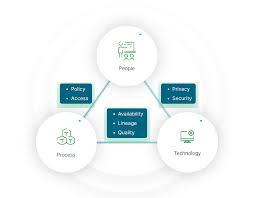
Examples of Data Governance Frameworks Data governance is not a one-size-fits-all approach. Organizations must carefully choose a framework that aligns with their unique goals, structure, and culture. Data is one of an organization’s most valuable assets, and proper governance is key to unlocking its potential. Without a well-designed framework, companies risk poor data quality, privacy breaches, regulatory noncompliance, and missed insights. A data governance framework provides a structured way to manage data throughout its lifecycle, including policies, processes, and standards to ensure data is accurate, accessible, and secure. By putting clear guidelines in place, organizations can increase trust in their data and improve decision-making. Key Pillars of a Data Governance Frameworks A robust data governance framework typically rests on four key pillars: 1. Center-Out Model The center-out model places a centralized team, such as a data governance council, at the core of the governance process. This group establishes policies and oversees data management across the organization, balancing consistency with flexibility for different departments. The Data Governance Institute’s framework is an example of this model. It focuses on creating a Data Governance Office responsible for managing key governance functions such as setting data policies, assigning data stewards, and monitoring compliance. The framework provides a clear structure while allowing business units some leeway in adapting governance practices to their needs. PwC’s model also adopts a center-out approach, with an emphasis on using data governance to monetize data assets. It highlights the importance of maintaining consistency while minimizing the risk of data silos. 2. Top-Down Model In the top-down model, data governance is driven by executive leadership, ensuring alignment with strategic goals. This model provides authority for enforcing governance standards but may face challenges if business units feel disconnected from the central governance team. McKinsey’s framework exemplifies this approach, focusing on integrating data governance with broader business transformation efforts. Executive leadership plays a key role in ensuring that governance initiatives receive the necessary attention and resources. 3. Hybrid Model The hybrid model combines centralized governance with flexibility for individual business units. It establishes an enterprise-wide framework while allowing departments to adapt governance practices to their specific needs. The Eckerson Group’s Modern Data Governance Framework represents a hybrid approach. It emphasizes the importance of people and culture, alongside technology and processes, and encourages organizations to create a roadmap for governance that evolves as needs change. This model provides a balance between centralized control and decentralized flexibility. 4. Bottom-Up Model In the bottom-up model, data governance is driven by subject matter experts and data stakeholders across the organization. This approach promotes collaboration and buy-in from the people closest to the data, ensuring that governance policies are practical and effective. The DAMA-DMBOK framework, developed by the Data Management Association, is a prime example. Although flexible, it often starts as a bottom-up initiative, driven by IT departments and data experts who later gain executive support. 5. Silo-In Model The silo-in model allows individual business units or departments to create their own governance practices. While this approach addresses localized data issues, it often leads to inconsistencies and challenges when the organization needs to integrate data across the enterprise. Though not widely recommended, the silo-in approach may emerge when specific business units take the initiative to establish governance due to regulatory requirements or data management needs within their domains. However, as organizations mature, they often transition to more holistic frameworks to support cross-functional collaboration and data integration. Choosing the Right Framework Selecting the right data governance framework involves evaluating the organization’s needs, structure, and culture. Whether an organization adopts a center-out, top-down, hybrid, bottom-up, or silo-in approach, success depends on involving key stakeholders, securing executive buy-in, and committing to continuous improvement. By treating data as a critical asset and implementing a governance framework that aligns with its business strategy, an organization can ensure that its data management practices support growth, innovation, and regulatory compliance. Like Related Posts Who is Salesforce? Who is Salesforce? Here is their story in their own words. From our inception, we’ve proudly embraced the identity of Read more Salesforce Marketing Cloud Transactional Emails Salesforce Marketing Cloud Transactional Emails are immediate, automated, non-promotional messages crucial to business operations and customer satisfaction, such as order Read more Salesforce Unites Einstein Analytics with Financial CRM Salesforce has unveiled a comprehensive analytics solution tailored for wealth managers, home office professionals, and retail bankers, merging its Financial Read more AI-Driven Propensity Scores AI plays a crucial role in propensity score estimation as it can discern underlying patterns between treatments and confounding variables Read more
Read More
Salesforce Revenue Cloud

Transition from Salesforce CPQ to Revenue Cloud

As organizations look to optimize their revenue processes, Salesforce has been encouraging customers to transition from Salesforce CPQ (Configure, Price, Quote) to Revenue Cloud (Rev Cloud). However, while the advantages of Revenue Cloud are often highlighted, clear, actionable steps to make the migration worthwhile are not always readily available. After consulting with Salesforce teams and partners, it’s evident that many customers remain hesitant due to concerns about cost, disruption, and customization complexities.

Read More
gettectonic.com