Hyperforce Archives - gettectonic.com
AI evolves with tools like Agentforce and Atlas

Salesforce Atlas

Salesforce Atlas: The Brainpower Behind AI-Driven Transformation A New Era of AI for Enterprise AI is reshaping industries at an unprecedented pace, and agentic AI—AI that can think, plan, and act autonomously—is at the forefront of this revolution. Salesforce is leading the charge with Agentforce, a low-code platform that allows businesses to build, refine, and deploy autonomous AI agents across multiple business functions. At the core of this innovation is Salesforce Atlas, the reasoning engine that empowers Agentforce to tackle complex decision-making tasks just like a human. But Atlas goes further—it continuously learns, adapts, and evolves, setting a new standard for AI-driven enterprises. Let’s explore how Atlas works, its capabilities, and why it’s a game-changer for businesses. Salesforce Atlas: The Reasoning Engine Powering Agentforce Atlas is the intelligent decision-making engine that powers Agentforce’s AI agents. Rather than simply following predefined rules, Atlas evaluates data, refines its approach, and continuously learns from outcomes. When an AI agent encounters a decision point, Atlas asks: ➡️ Do I have enough data to ensure accuracy?✔ If yes, it proceeds with a decision.❌ If no, it seeks additional data or escalates the issue. This iterative learning process ensures that AI agents become more reliable, context-aware, and autonomous over time. Salesforce CEO Marc Benioff teased the potential of Atlas, revealing that: 📊 “We are seeing 90-95% resolution on all service and sales issues with the new Atlas.” That’s a staggering success rate, demonstrating how AI-driven reasoning can transform enterprise efficiency and customer engagement. How Salesforce Atlas Works: The “Flywheel” Process Atlas operates using a structured flywheel process that enables self-improvement and adaptability. Here’s how it works: 1️⃣ Data Retrieval – Atlas pulls structured and unstructured data from the Salesforce Data Cloud.2️⃣ Evaluation – It analyzes the data, generates a plan of action, and assesses whether the plan will drive the desired outcome.3️⃣ Refinement – If the plan isn’t strong enough, Atlas loops back, refines its approach, and iterates until it’s confident in its decision. This cycle repeats continuously, ensuring AI agents deliver accurate, data-driven outcomes that align with business goals. Once a task is completed, Atlas learns from the results, refining its approach to become even smarter over time. The Core Capabilities of Salesforce Atlas Atlas stands out because of its advanced reasoning, adaptive learning, and built-in safeguards—all designed to deliver trustworthy, autonomous AI experiences. 1. Advanced Reasoning & Decision-Making Atlas doesn’t just execute tasks; it thinks critically, determining the best way to approach each challenge. Unlike traditional AI models that follow rigid scripts, Atlas: 🔍 Analyzes real-time data to determine the most effective course of action.📊 Refines its decisions dynamically based on live feedback.🌍 Adapts to changing circumstances to optimize outcomes. At Dreamforce 2024, Marc Benioff demonstrated Atlas’s power by showcasing how it could optimize theme park experiences in real time, analyzing: 🎢 Ride availability👥 Guest preferences🚶 Park flow patterns This real-time decision-making showcases the game-changing potential of agentic AI. 2. Advanced Data Retrieval Atlas leverages Retrieval-Augmented Generation (RAG) to pull highly relevant, verified data from multiple sources. This ensures: ✔ More accurate responses✔ Minimized AI hallucinations✔ Reliable, data-driven insights For example, Saks Fifth Avenue uses Atlas to personalize shopping recommendations for millions of customers—tailoring experiences with precision. 3. Built-in Guardrails for Security & Compliance Salesforce recognizes the importance of AI governance, and Atlas includes robust safeguards to ensure responsible AI usage. 🔐 Ethical AI protocols – Ensures compliance with evolving regulations.🚨 Escalation capabilities – AI knows when to seek human intervention for complex issues.🌍 Hyperforce security – Provides enterprise-grade privacy and security standards. These protections ensure Atlas operates securely, responsibly, and at scale across global enterprises. 4. Reinforcement Learning & Continuous Improvement Atlas doesn’t just process data—it learns from outcomes. 🔄 Refines decisions based on real-world results📈 Optimizes performance over time⚡ Becomes increasingly efficient and tailored to business needs Whether it’s increasing sales conversions, resolving service issues, or optimizing workflows, Atlas ensures AI agents grow smarter with every interaction. Why Salesforce Atlas is a Game-Changer Salesforce Atlas isn’t just another AI tool—it’s the brain behind Salesforce’s next-generation AI ecosystem. With Atlas, businesses can: ✅ Automate complex tasks with AI-driven decision-making.✅ Deliver hyper-personalized customer experiences with confidence.✅ Scale AI-powered workflows across sales, service, and operations.✅ Ensure compliance and trust with built-in governance measures.✅ Adapt AI capabilities to meet evolving business needs. Marc Benioff envisions Atlas as the core of a future where AI and humans collaborate to drive innovation and efficiency. By combining advanced reasoning, dynamic adaptability, and enterprise security, Atlas empowers organizations to work smarter, faster, and more effectively—unlocking the full potential of agentic AI. The future of AI-driven enterprise has arrived. With Salesforce Atlas, businesses can build AI agents that don’t just follow instructions—they think, learn, and evolve. Like Related Posts Who is Salesforce? Who is Salesforce? Here is their story in their own words. From our inception, we’ve proudly embraced the identity of Read more Salesforce Marketing Cloud Transactional Emails Salesforce Marketing Cloud Transactional Emails are immediate, automated, non-promotional messages crucial to business operations and customer satisfaction, such as order Read more Salesforce Unites Einstein Analytics with Financial CRM Salesforce has unveiled a comprehensive analytics solution tailored for wealth managers, home office professionals, and retail bankers, merging its Financial Read more AI-Driven Propensity Scores AI plays a crucial role in propensity score estimation as it can discern underlying patterns between treatments and confounding variables Read more


Read More

Salesforce Functions

Salesforce Functions: A Retrospective on the Retired Serverless Solution What Was Salesforce Functions? Salesforce Functions (retired January 31, 2025) was a serverless compute platform that enabled developers to extend Salesforce with custom, elastically scalable logic using familiar programming languages like: Unlike traditional Apex development, Functions allowed teams to write, deploy, and scale business logic without managing infrastructure—all while integrating seamlessly with Apex, Flows, and Lightning Web Components (LWC). Key Features & Benefits (While Active) 1. Language Flexibility ✔ No Apex lock-in – Developers used preferred languages (Java, JS, TS) and tools.✔ Reuse existing code – Leverage libraries, frameworks, and open-source solutions. 2. Elastic, Serverless Scaling ✔ Auto-scaling – No capacity planning; Salesforce handled compute resources.✔ Pay-per-use model – Cost-efficient for variable workloads. 3. Native Salesforce Integration ✔ Trigger from Apex, Flows, or LWC – Seamlessly embed custom logic in Salesforce processes.✔ Secure & compliant – Built on Salesforce’s trusted infrastructure. 4. Reduced DevOps Overhead ✔ No server management – Salesforce handled deployment, scaling, and uptime.✔ Focus on business logic – No need to provision or monitor cloud resources. Why Was Salesforce Functions Retired? Salesforce officially sunset Functions on January 31, 2025, citing: Existing customers were required to migrate to alternative solutions before their contract terms ended. How It Worked (Before Retirement) Example Use Cases Migration Paths After Retirement Organizations previously using Functions were advised to transition to: Alternative Solution Best For Salesforce Code Builder Cloud-based development in VS Code. Einstein Automate Low-code/serverless automation with AI. External Cloud Functions AWS Lambda, Azure Functions + Salesforce Connect. Final Thoughts Salesforce Functions bridged a critical gap by letting developers break free from Apex while maintaining Salesforce’s security and scalability. Its retirement reflects Salesforce’s broader shift toward Hyperforce and cloud-agnostic development. Looking ahead? While Functions is no longer available, its legacy lives on in Salesforce’s evolving low-code and pro-code ecosystem. Key Takeaways:✔ Retired January 2025 – No new Functions could be created.✔ Enabled Java/JS/TS development – Without Apex limitations.✔ Migrate to Code Builder, Einstein Automate, or external cloud functions.✔ Part of Salesforce’s shift toward Hyperforce & cloud-native solutions. Next Steps for Former Users:➡ Audit existing Functions dependencies.➡ Evaluate Einstein Automate for low-code alternatives.➡ Explore Salesforce Code Builder for cloud-based development. Like Related Posts Who is Salesforce? Who is Salesforce? Here is their story in their own words. From our inception, we’ve proudly embraced the identity of Read more Salesforce Marketing Cloud Transactional Emails Salesforce Marketing Cloud Transactional Emails are immediate, automated, non-promotional messages crucial to business operations and customer satisfaction, such as order Read more Salesforce Unites Einstein Analytics with Financial CRM Salesforce has unveiled a comprehensive analytics solution tailored for wealth managers, home office professionals, and retail bankers, merging its Financial Read more AI-Driven Propensity Scores AI plays a crucial role in propensity score estimation as it can discern underlying patterns between treatments and confounding variables Read more

Read More
Salesforce Hyperforce

Salesforce Hyperforce in 2025

Salesforce Hyperforce in 2025: The Multi-Cloud Revolution By 2025, 78% of enterprise customers have adopted Salesforce Hyperforce, running multi-cloud deployments across AWS, GCP, and Azure simultaneously. What began as a flexibility advantage has become the non-negotiable backbone of zero-trust security, enabling cross-cloud data residency that was unthinkable just months ago. This insight reveals the five critical security patterns top enterprises are implementing—and the third one is sparking fierce debate among compliance teams. Hyperforce in 2025: Market Dominance & Strategic Impact A. Key Milestones in Hyperforce’s 3-Year Evolution Since its 2022 acceleration, Hyperforce has shattered every single roadmap target: B. How Hyperforce Redefined Enterprise Cloud Strategy Enterprises no longer debate whether to migrate—they strategize which cloud to use for each workload. The result? Faster innovation, reduced vendor lock-in, and unprecedented flexibility. Multi-Cloud Mastery: AWS, GCP & Azure in Action A. Why Multi-Cloud is Now Mandatory B. AWS: Powering Compliance & Serverless Workflows C. GCP: AI & Analytics at Hyperscale D. Azure: Seamless Microsoft 365 Integration E. Performance Benchmarks: Which Cloud Wins? Metric AWS GCP Azure Transaction Speed 15ms 18ms 16ms Data Transfer Cost High Low Medium Global Availability 27 22 25 AI Integration Good Best Very Good AWS leads in speed, GCP dominates cost-efficiency, and Azure excels in enterprise integration. Security Breakthroughs: Zero-Trust & Data Sovereignty Enterprise Migration: How to Deploy at Scale A. Proven Migration Strategies B. Real-World Success Stories What’s Next? Hyperforce’s 2025 Roadmap Conclusion: Hyperforce is the Enterprise Standard Salesforce Hyperforce has redefined cloud infrastructure—delivering multi-cloud agility, ironclad security, and 43% cost savings. For finance, healthcare, and global enterprises, it’s no longer optional. Ready to future-proof your cloud strategy? [Inquire Now] to speak with a Hyperforce specialist. Leverage Tectonic’s Salesforce Development Services—migrate, secure, and scale with Hyperforce today! Like Related Posts Who is Salesforce? Who is Salesforce? Here is their story in their own words. From our inception, we’ve proudly embraced the identity of Read more Salesforce Marketing Cloud Transactional Emails Salesforce Marketing Cloud Transactional Emails are immediate, automated, non-promotional messages crucial to business operations and customer satisfaction, such as order Read more Salesforce Unites Einstein Analytics with Financial CRM Salesforce has unveiled a comprehensive analytics solution tailored for wealth managers, home office professionals, and retail bankers, merging its Financial Read more AI-Driven Propensity Scores AI plays a crucial role in propensity score estimation as it can discern underlying patterns between treatments and confounding variables Read more
Read More
Salesforce Document Generation

Generating Documents in Salesforce

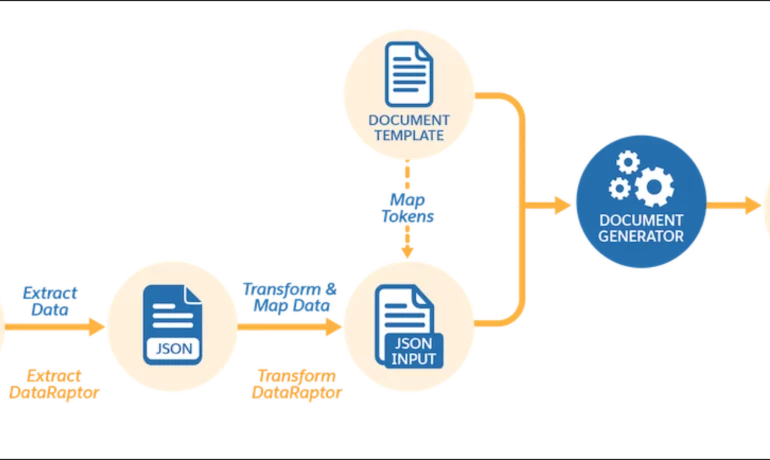
Salesforce document generation poses a challenge for businesses, given the intricacies of integration involved. Fortunately, a variety of tools are available for generating documents in Salesforce, and Tectonic is well-equipped to assist in their successful implementation. Salesforce Industries Document Generation empowers businesses to craft and manage accurate documents linked to standard Salesforce objects, encompassing contracts, opportunities, orders, quotes, and custom objects. For a more dynamic approach, Salesforce OmniStudio Document Generation facilitates the creation of documents using Microsoft Word and Microsoft PowerPoint templates. These templates can incorporate values from any JSON-based data within the text, including data sourced from various Salesforce objects. This versatile tool enables the generation of contracts, proposals, quotes, reports, non-disclosure agreements, service agreements, and more. Salesforce Industries Document Generation seamlessly integrates with Vlocity Insurance, Vlocity Health, communications, media, energy, utilities, government, and beyond. Vlocity Analytics, another valuable component, offers pre-built measurement tools that seamlessly integrate with Salesforce Reports, Dashboards, and Einstein. The Salesforce AppExchange boasts an extensive array of over 200 document generation tools. Your Salesforce partner can assist in selecting, installing, and implementing the most suitable options based on your business requirements. With Document Generation, you can generate contracts, proposals, quotes, reports, non-disclosure agreements, job offers, service agreements, and so on. You can generate documents using the specified sample client-side or server-side OmniScripts. You can also create your own OmniScripts by cloning and customizing the sample OmniScript to generate documents. Client-Side document generation is a synchronous process that results in a downloadable preview of the generated documents. You can generate documents from Microsoft Word (.docx), Microsoft PowerPoint (.pptx), and Web templates. These templates can include values from any JSON-based data in the text, including data from any Salesforce object. You can optionally convert the resulting documents to .pdf format. Server-Side document generation is available in both the OmniStudio Foundation and Salesforce Industries packages. Server-Side document generation is an asynchronous process that’s best for large and rendering-heavy documents and for document generation in batches. The Server-Side document generation service is secure and scalable and is hosted on Salesforce Hyperforce. The generated document is stored in your Salesforce org, and is attached to the object for which it’s generated. You can use Apex Classes, sample Integration Procedures, or a sample OmniScript to generate documents. Client-Side document generation supports Customer Community Plus, Customer Community, and Partner Community users to generate documents using client-side OmniScripts. Server-Side document generation supports Customer Community Plus, Customer Community, and Partner Community users to generate documents using the singleDocxServersideLwc server-side OmniScript. With the right licenses, Document Generation is available in the Salesforce Industries package. Metering measures resource utilization levels and throttling controls resource access and use based on defined rules. Metering measures the number of server-side documents that are generated by an org hourly and daily. The default hourly and daily limits for processing server-side document generation requests are 1,000 per org and 24,000 per org respectively. Throttling maintains consistency and resilience of the server-side document generation service by managing incoming server-side document generation requests from multiple orgs. Throttling can also prevent service degradation caused by high volume of requests at peak hours by blocking requests that exceed the default limits. The request details are saved in the Document Generation Processes entity. You can retrieve the blocked requests and later retry the server-side document generation. No matter what your specific document generation needs, Tectonic simplifies the process of getting your system up and running seamlessly, whether it’s through Salesforce Quickstarts or comprehensive implementation services. Content updated in 2February 2024, Shannan Hearne. Like1 Related Posts Who is Salesforce? Who is Salesforce? Here is their story in their own words. From our inception, we’ve proudly embraced the identity of Read more Salesforce Marketing Cloud Transactional Emails Salesforce Marketing Cloud Transactional Emails are immediate, automated, non-promotional messages crucial to business operations and customer satisfaction, such as order Read more Salesforce Unites Einstein Analytics with Financial CRM Salesforce has unveiled a comprehensive analytics solution tailored for wealth managers, home office professionals, and retail bankers, merging its Financial Read more AI-Driven Propensity Scores AI plays a crucial role in propensity score estimation as it can discern underlying patterns between treatments and confounding variables Read more

Read More
gettectonic.com