Software Archives - gettectonic.com - Page 5
Autonomous AI Service Agents

Developing AI Agents

Developing AI Agents: A Practical Guide Why AI Agent Development is Different Building AI agents requires an iterative, hands-on approach rather than traditional waterfall planning. Unlike conventional software projects, you can’t fully design an agent in documents before building – you need to prototype, test, and refine continuously. Key Principles: Designing the User Experience Take a user-centered approach to ensure your agent delivers value: Protip: Test different UX approaches in sandbox before finalizing channel configurations. Technical Implementation Guide 1. Data Strategy 2. Channel & Routing Configuration 3. Security Framework For Employee-Facing Agents: For Customer-Facing Agents: Agent User Permissions: Testing Tip: Always debug flows running as the agent user to catch permission issues. Salesforce Environment Considerations Requirements Checklist Integration Planning Implementation Best Practices Remember: Successful AI agent development balances careful planning with agile experimentation. The most effective agents evolve through real-world testing and refinement. Like Related Posts Who is Salesforce? Who is Salesforce? Here is their story in their own words. From our inception, we’ve proudly embraced the identity of Read more Salesforce Marketing Cloud Transactional Emails Salesforce Marketing Cloud Transactional Emails are immediate, automated, non-promotional messages crucial to business operations and customer satisfaction, such as order Read more Salesforce Unites Einstein Analytics with Financial CRM Salesforce has unveiled a comprehensive analytics solution tailored for wealth managers, home office professionals, and retail bankers, merging its Financial Read more AI-Driven Propensity Scores AI plays a crucial role in propensity score estimation as it can discern underlying patterns between treatments and confounding variables Read more

Read More
AI Agents Are the Future of Enterprise

AI Agents Are the Future of Enterprise

AI Agents Are the Future of Enterprise—But They Need the Right Architecture AI agents are poised to revolutionize enterprise operations with autonomous problem-solving, adaptive workflows, and scalability. However, the biggest challenge isn’t improving models—it’s building the infrastructure to support them. Agents require seamless access to data, tools, and the ability to share insights across systems—with outputs usable by multiple services, including other agents. This isn’t just an AI challenge; it’s an infrastructure and data interoperability problem. Traditional approaches—like chaining commands—won’t cut it. Instead, enterprises need an event-driven architecture (EDA) powered by real-time data streams. As HubSpot CTO Dharmesh Shah put it, “Agents are the new apps.” To unlock their potential, businesses must invest in the right design patterns from the start. This insight explores why EDA is critical for scaling AI agents and integrating them into modern enterprise systems. The Evolution of AI: From Predictive Models to Autonomous Agents AI has progressed through three key waves, each overcoming—but also introducing—new limitations. 1. The First Wave: Predictive Models Early AI relied on traditional machine learning (ML) for narrow, domain-specific tasks. These models were rigid, requiring extensive retraining for new use cases. Limitations: 2. The Second Wave: Generative AI Generative AI, powered by large language models (LLMs), introduced general-purpose intelligence. Unlike predictive models, LLMs could handle diverse tasks—from text generation to code synthesis. Limitations: For example, asking an LLM to recommend an insurance policy based on a user’s health history fails—unless the model can dynamically retrieve personal data. 3. The Third Wave: Compound AI & Agentic Systems To overcome these gaps, Compound AI systems combine LLMs with: But even RAG has limits—it relies on fixed workflows, making it inflexible for dynamic tasks. Enter AI agents: autonomous systems that reason, plan, and adapt in real time. Why Agents Are the Next Frontier Salesforce CEO Marc Benioff recently noted that LLMs are hitting their limits, and the future lies in autonomous agents. Unlike static models, agents: Key Agent Design Patterns These patterns enable Agentic RAG, where retrieval isn’t fixed but adaptive—agents decide what data to fetch based on context. The Scaling Challenge: It’s an Infrastructure Problem Agents need real-time data access and seamless interoperability—but connecting them via APIs creates tight coupling, leading to: The Solution: Event-Driven Architecture (EDA) EDA decouples agents using asynchronous event streams (e.g., Kafka, Redpanda). Benefits:✅ Loose coupling – Agents communicate without direct dependencies.✅ Real-time reactivity – Instant responses to changing data.✅ Scalability – New agents join without redesigning the system.✅ Resilience – Failures don’t cascade. Example: An agent analyzing customer data publishes an event—other agents, CRMs, or analytics tools consume it without explicit coordination. Why EDA is the Future for AI Agents Just as microservices replaced monoliths, EDA will replace rigid AI pipelines. Early adopters (like Facebook with scalable infrastructure) outcompeted those that couldn’t scale (like Friendster). The same will happen with AI agents. Enterprises that embrace event-driven agents will: The Bottom Line AI agents are the next evolution of enterprise software—but without EDA, they’ll hit a wall. Companies that invest in event-driven infrastructure today will lead the next wave of AI innovation. The rest? They’ll struggle to keep up. Ready to future-proof your AI strategy? AI Agents Are the Future of Enterprise. The time to build for agents is now. Contact Tectonic today. Like Related Posts Who is Salesforce? Who is Salesforce? Here is their story in their own words. From our inception, we’ve proudly embraced the identity of Read more Salesforce Marketing Cloud Transactional Emails Salesforce Marketing Cloud Transactional Emails are immediate, automated, non-promotional messages crucial to business operations and customer satisfaction, such as order Read more Salesforce Unites Einstein Analytics with Financial CRM Salesforce has unveiled a comprehensive analytics solution tailored for wealth managers, home office professionals, and retail bankers, merging its Financial Read more AI-Driven Propensity Scores AI plays a crucial role in propensity score estimation as it can discern underlying patterns between treatments and confounding variables Read more

Read More
AI Data Cloud and Integration

It is Time to Implement Data Cloud

With Salesforce Data Cloud you can: With incomplete data your 360-degree customer view is limited and often leads to multiple sales reps working on the same lead. Slow access to the right leads at the right time leads to missed opportunties and delayed closings. If your team cannot trust the data due to siloes and inaccuracies, they avoid using it. It is Time to Implement Data Cloud. Unified Connect and harmonize data from all your Salesforce applications and external data systems. Then activate your data with insights and automation across every customer touchpoint. Powerful With Data Cloud and Agentforce, you can create the most intelligent agents possible, giving them access to the exact data they need to deliver any employee or customer experience. Secure Securely connect your data to any large language model (LLM) without sacrificing data governance and security thanks to the Einstein 1 trust layer. Open Data Cloud is fully open and extensible – bring your own data lake or model to reduce complexity and leverage what’s already been built. Plus, share out to popular destinations like Snowflake, Google Ads, or Meta Ads. Salesforce Data Cloud is the only hyperscale data engine native to Salesforce. It is more than a CDP. It goes beyond a data lake. You can do more with Data Cloud. Your Agentforce journey begins with Data Cloud. Agents need the right data to work. With Data Cloud, you can create the most intelligent agents possible, giving them access to the exact data they need to deliver any employee or customer experience. Use any data in your organization with Agentforce in a safe and secure manner thanks to the Einstein 1 Trust Layer. Datablazers are Salesforce community members who are passionate about driving business growth with data and AI powered by Data Cloud. Sign up to join a growing group of members to learn, connect, and grow with Data Cloud. Join today. The path to AI success begins and ends with quality data. Business, IT, and analytics decision makers with high data maturity were 2x more likely than low-maturity leaders to have the quality data needed to use AI effectively, according to our State of Data and Analytics report. “What’s data maturity?” you might wonder. Hang tight, we’ll explain in chapter 1 of this guide. Data-leading companies also experience: Your data strategy isn’t just important, it’s critical in getting you to the head of the market with new AI technology by your side. That’s why this Salesforce guide is based on recent industry findings and provides best practices to help your company get the most from your data. Tectonic will be sharing a focus on the 360 degree customer view with Salesforce Data Cloud in our insights. Stay tuned. It is Time to Implement Data Cloud Like Related Posts Who is Salesforce? Who is Salesforce? Here is their story in their own words. From our inception, we’ve proudly embraced the identity of Read more Salesforce Marketing Cloud Transactional Emails Salesforce Marketing Cloud Transactional Emails are immediate, automated, non-promotional messages crucial to business operations and customer satisfaction, such as order Read more Salesforce Unites Einstein Analytics with Financial CRM Salesforce has unveiled a comprehensive analytics solution tailored for wealth managers, home office professionals, and retail bankers, merging its Financial Read more AI-Driven Propensity Scores AI plays a crucial role in propensity score estimation as it can discern underlying patterns between treatments and confounding variables Read more

Read More
multi-channel campaigns

Understanding AI Agent Capabilities

AI agents vary widely in their autonomy and complexity. Some tasks require only basic tool use and response generation, while others demand advanced reasoning and independent decision-making. Recognizing these capability levels helps determine when to use simpler, predictable systems versus fully autonomous agents. The Core Capabilities of AI Agents Three fundamental capabilities distinguish AI agents from basic AI tools: Reasoning and Planning Tool Use Memory and Learning The AI Agent Spectrum The evolution from simple AI tools to fully autonomous agents follows a progression of increasing complexity: Not every problem demands the highest level of autonomy. In many cases, tool-using models or orchestrated systems are more practical and cost-effective. Balancing Capability with Control As AI agents become more autonomous, striking the right balance between capability and oversight is critical. Key factors to consider include: Security and Governance Reliability and Trust Cost and Resource Optimization Understanding where your needs fall on this spectrum is essential for effective AI deployment. Not every task requires a fully autonomous agent—sometimes, a simpler, well-structured system is the smarter, more cost-efficient choice. Like Related Posts Who is Salesforce? Who is Salesforce? Here is their story in their own words. From our inception, we’ve proudly embraced the identity of Read more Salesforce Unites Einstein Analytics with Financial CRM Salesforce has unveiled a comprehensive analytics solution tailored for wealth managers, home office professionals, and retail bankers, merging its Financial Read more AI-Driven Propensity Scores AI plays a crucial role in propensity score estimation as it can discern underlying patterns between treatments and confounding variables Read more Tectonic’s Successful Salesforce Track Record Salesforce Technology Services Integrator – Tectonic has successfully delivered Salesforce in a variety of industries including Public Sector, Hospitality, Manufacturing, Read more


Read More
Generative AI in Marketing

Generative AI in Marketing

Generative Artificial Intelligence (GenAI) continues to reshape industries, providing product managers (PMs) across domains with opportunities to embrace AI-focused innovation and enhance their technical expertise. Over the past few years, GenAI has gained immense popularity. AI-enabled products have proliferated across industries like a rapidly expanding field of dandelions, fueled by abundant venture capital investment. From a product management perspective, AI offers numerous ways to improve productivity and deepen strategic domain knowledge. However, the fundamentals of product management remain paramount. This discussion underscores why foundational PM practices continue to be indispensable, even in the evolving landscape of GenAI, and how these core skills can elevate PMs navigating this dynamic field. Why PM Fundamentals Matter, AI or Not Three core reasons highlight the enduring importance of PM fundamentals and actionable methods for excelling in the rapidly expanding GenAI space. 1. Product Development is Inherently Complex While novice PMs might assume product development is straightforward, the reality reveals a web of interconnected and dynamic elements. These may include team dependencies, sales and marketing coordination, internal tooling managed by global teams, data telemetry updates, and countless other tasks influencing outcomes. A skilled product manager identifies and orchestrates these moving pieces, ensuring product growth and delivery. This ability is often more impactful than deep technical AI expertise (though having both is advantageous). The complexity of modern product development is further amplified by the rapid pace of technological change. Incorporating AI tools such as GitHub Copilot can accelerate workflows but demands a strong product culture to ensure smooth integration. PMs must focus on fundamentals like understanding user needs, defining clear problems, and delivering value to avoid chasing fleeting AI trends instead of solving customer problems. While AI can automate certain tasks, it is limited by costs, specificity, and nuance. A PM with strong foundational knowledge can effectively manage these limitations and identify areas for automation or improvement, such as: 2. Interpersonal Skills Are Irreplaceable As AI product development grows more complex, interpersonal skills become increasingly critical. PMs work with diverse teams, including developers, designers, data scientists, marketing professionals, and executives. While AI can assist in specific tasks, strong human connections are essential for success. Key interpersonal abilities for PMs include: Stakeholder management remains a cornerstone of effective product management. PMs must build trust and tailor their communication to various audiences—a skill AI cannot replicate. 3. Understanding Vertical Use Cases is Essential Vertical use cases focus on niche, specific tasks within a broader context. In the GenAI ecosystem, this specificity is exemplified by AI agents designed for narrow applications. For instance, Microsoft Copilot includes a summarization agent that excels at analyzing Word documents. The vertical AI market has experienced explosive growth, valued at .1 billion in 2024 and projected to reach .1 billion by 2030. PMs are crucial in identifying and validating these vertical use cases. For example, the team at Planview developed the AI Assistant “Planview Copilot” by hypothesizing specific use cases and iteratively validating them through customer feedback and data analysis. This approach required continuous application of fundamental PM practices, including discovery, prioritization, and feedback internalization. PMs must be adept at discovering vertical use cases and crafting strategies to deliver meaningful solutions. Key steps include: Conclusion Foundational product management practices remain critical, even as AI transforms industries. These core skills ensure that PMs can navigate the challenges of GenAI, enabling organizations to accelerate customer value in work efficiency, time savings, and quality of life. By maintaining strong fundamentals, PMs can lead their teams to thrive in an AI-driven future. AI Agents on Madison Avenue: The New Frontier in Advertising AI agents, hailed as the next big advancement in artificial intelligence, are making their presence felt in the world of advertising. Startups like Adaly and Anthrologic are introducing personalized AI tools designed to boost productivity for advertisers, offering automation for tasks that are often time-consuming and tedious. Retail brands such as Anthropologie are already adopting this technology to streamline their operations. How AI Agents WorkIn simple terms, AI agents operate like advanced AI chatbots. They can handle tasks such as generating reports, optimizing media budgets, or analyzing data. According to Tyler Pietz, CEO and founder of Anthrologic, “They can basically do anything that a human can do on a computer.” Big players like Salesforce, Microsoft, Anthropic, Google, and Perplexity are also championing AI agents. Perplexity’s CEO, Aravind Srinivas, recently suggested that businesses will soon compete for the attention of AI agents rather than human customers. “Brands need to get comfortable doing this,” he remarked to The Economic Times. AI Agents Tailored for Advertisers Both Adaly and Anthrologic have developed AI software specifically trained for advertising tasks. Built on large language models like ChatGPT, these platforms respond to voice and text prompts. Advertisers can train these AI systems on internal data to automate tasks like identifying data discrepancies or analyzing economic impacts on regional ad budgets. Pietz noted that an AI agent can be set up in about a month and take on grunt work like scouring spreadsheets for specific figures. “Marketers still log into 15 different platforms daily,” said Kyle Csik, co-founder of Adaly. “When brands in-house talent, they often hire people to manage systems rather than think strategically. AI agents can take on repetitive tasks, leaving room for higher-level work.” Both Pietz and Csik bring agency experience to their ventures, having crossed paths at MediaMonks. Industry Response: Collaboration, Not Replacement The targets for these tools differ: Adaly focuses on independent agencies and brands, while Anthrologic is honing in on larger brands. Meanwhile, major holding companies like Omnicom and Dentsu are building their own AI agents. Omnicom, on the verge of merging with IPG, has developed internal AI solutions, while Dentsu has partnered with Microsoft to create tools like Dentsu DALL-E and Dentsu-GPT. Havas is also developing its own AI agent, according to Chief Activation Officer Mike Bregman. Bregman believes AI tools won’t immediately threaten agency jobs. “Agencies have a lot of specialization that machines can’t replace today,” he said. “They can streamline processes, but

Read More
The Rise of AI Agents: 2024 and Beyond

The Rise of AI Agents: 2024 and Beyond

In 2024, we witnessed major breakthroughs in AI agents. OpenAI’s o1 and o3 models demonstrated the ability to deconstruct complex tasks, while Claude 3.5 showcased AI’s capacity to interact with computers like humans—navigating interfaces and running software. These advancements, alongside improvements in memory and learning systems, are pushing AI beyond simple chat interactions into the realm of autonomous systems. AI agents are already making an impact in specialized fields, including legal analysis, scientific research, and technical support. While they excel in structured environments with defined rules, they still struggle with unpredictable scenarios and open-ended challenges. Their success rates drop significantly when handling exceptions or adapting to dynamic conditions. The field is evolving from conversational AI to intelligent systems capable of reasoning and independent action. Each step forward demands greater computational power and introduces new technical challenges. This article explores how AI agents function, their current capabilities, and the infrastructure required to ensure their reliability. What is an AI Agent? An AI agent is a system designed to reason through problems, plan solutions, and execute tasks using external tools. Unlike traditional AI models that simply respond to prompts, agents possess: Understanding the shift from passive responders to autonomous agents is key to grasping the opportunities and challenges ahead. Let’s explore the breakthroughs that have fueled this transformation. 2024’s Key Breakthroughs OpenAI o3’s High Score on the ARC-AGI Benchmark Three pivotal advancements in 2024 set the stage for autonomous AI agents: AI Agents in Action These capabilities are already yielding practical applications. As Reid Hoffman observed, we are seeing the emergence of specialized AI agents that extend human capabilities across various industries: Recent research from Sierra highlights the rapid maturation of these systems. AI agents are transitioning from experimental prototypes to real-world deployment, capable of handling complex business rules while engaging in natural conversations. The Road Ahead: Key Questions As AI agents continue to evolve, three critical questions for us all emerge: The next wave of AI innovation will be defined by how well we address these challenges. By building robust systems that balance autonomy with oversight, we can unlock the full potential of AI agents in the years ahead. Like Related Posts Who is Salesforce? Who is Salesforce? Here is their story in their own words. From our inception, we’ve proudly embraced the identity of Read more Salesforce Unites Einstein Analytics with Financial CRM Salesforce has unveiled a comprehensive analytics solution tailored for wealth managers, home office professionals, and retail bankers, merging its Financial Read more AI-Driven Propensity Scores AI plays a crucial role in propensity score estimation as it can discern underlying patterns between treatments and confounding variables Read more Tectonic’s Successful Salesforce Track Record Salesforce Technology Services Integrator – Tectonic has successfully delivered Salesforce in a variety of industries including Public Sector, Hospitality, Manufacturing, Read more

Read More
salesforce end to end

Salesforce and Google Announcement

Salesforce (NYSE:CRM) has entered into a deal with Google (NASDAQ:GOOGL) to offer its customer relations management software, Agentforce artificial intelligence assistants, and Data Cloud offerings through Google Cloud, the companies announced today. Google and Salesforce already have many of the same clients, and this new deal will allow for more product integration between Google Workspace and Salesforce’s customer relationship management and AI offerings. Salesforce already uses Amazon (AMZN) Web Services for much of its cloud computing. “Our mutual customers have asked us to be able to work more seamlessly across Salesforce and Google Cloud, and this expanded partnership will help them accelerate their AI transformations with agentic AI, state-of-the-art AI models, data analytics, and more,” said Thomas Kurian, CEO of Google Cloud. The deal is expected to total $2.5B over the next seven years, according to a report by Bloomberg. Salesforce and Google today announced a major expansion of their strategic partnership, delivering choice in the models and capabilities businesses use to build and deploy AI-powered agents. In today’s constantly evolving AI landscape, innovations like autonomous agents are emerging so quickly that businesses struggle to keep pace. This expanded partnership provides crucial flexibility, empowering customers to develop tailored AI solutions that meet their specific needs, rather than being locked into a single model provider. Google Cloud is at the forefront of enterprise AI innovation with millions of developers building with Google’s cutting-edge Gemini models and on Google Cloud’s AI-optimized infrastructure. This expanded partnership will empower Salesforce customers to build Agentforce agents using Gemini and to deploy Salesforce on Google Cloud. This is an expansion of the existing partnership that allows customers to use data from Data Cloud and Google BigQuery bi-directionally via zero-copy technology—further equipping customers with the data, AI, trust, and actions they need to bring autonomous agents into their businesses. Additionally, this integration empowers Agentforce agents with the ability to reference up-to-the-minute data, news, current events, and credible citations, substantially enhancing their contextual awareness and ability to deliver accurate, evidence-backed responses. For example, in supply chain management and logistics, an agent built with Agentforce could track shipments and monitor inventory levels in Salesforce Commerce Cloud and proactively identify potential disruptions using real-time data from Google Search, including weather conditions, port congestion, and geopolitical events. Availability is expected in the coming months. AI: Unlocking the Power of Choice and Flexibility with Gemini and Agentforce Businesses need the freedom to choose the best models for their needs rather than be locked into one vendor. In 2025, Google’s Gemini models will also be available for prompt building and reasoning directly within Agentforce. With Gemini and Agentforce, businesses will benefit from: For example, an insurance customer can submit a claim with photos of the damage and an audio voicemail from a witness. Agentforce, using Gemini, can then help the insurance provider deliver better customer experiences by processing all these inputs, assessing the claim’s validity, and even using text-to-speech to contact the customer with a resolution, streamlining the traditionally lengthy claims process. Availability is expected this year. Trust: Salesforce Platform deployed on Google Cloud Customers will be able to use Salesforce’s unified platform (Agentforce, Data Cloud, Customer 360) on Google Cloud’s highly secure, AI-optimized infrastructure, benefiting from features like dynamic grounding, zero data retention, and toxicity detection provided by the Einstein Trust Layer. Once Salesforce products are available on Google Cloud, customers will also have the ability to procure Salesforce offerings through the Google Cloud Marketplace, opening up new possibilities for global businesses to optimize their investments across Salesforce and Google Cloud and benefiting thousands of existing joint customers. Action: Enhanced Employee Productivity and Customer Service with AI-Powered Integrations Millions use Salesforce and Google Cloud daily. This partnership prioritizes choice and flexibility, enabling seamless cross-platform work. New and deeper connections between platforms like Salesforce Service Cloud and Google Cloud’s Customer Engagement Suite, as well as Slack and Google Workspace, will empower AI agents and service representatives with unified data access, streamlined workflows, and advanced AI capabilities, regardless of platform. Salesforce and Google Cloud are deeply integrating their customer service platforms—Salesforce Service Cloud and Google Cloud’s Customer Engagement Suite—to create a seamless and intelligent support experience. Expected later this year, this unified approach empowers AI agents in Service Cloud with: Salesforce and Google Cloud are also exploring deeper integrations between Slack and Google Workspace, boosting productivity and creating a more cohesive digital workspace for teams and organizations. The companies are currently exploring use cases such as: Expanding Partnership Capabilities and Integrations This partnership goes beyond core product integrations to deliver a more connected and intelligent data foundation for businesses. Expected availability throughout 2025: This landmark partnership between Salesforce and Google represents a strategic paradigm shift in enterprise AI deployment, emphasizing infrastructure innovation, AI capability enhancement, and enterprise value. The integration of Google Search grounding provides a unique competitive advantage, offering real-time, factual responses backed by the world’s most comprehensive search engine. The companies are committed to ongoing innovation and deeper collaboration to empower businesses with even more powerful solutions. Like1 Related Posts Who is Salesforce? Who is Salesforce? Here is their story in their own words. From our inception, we’ve proudly embraced the identity of Read more Salesforce Marketing Cloud Transactional Emails Salesforce Marketing Cloud Transactional Emails are immediate, automated, non-promotional messages crucial to business operations and customer satisfaction, such as order Read more Salesforce Unites Einstein Analytics with Financial CRM Salesforce has unveiled a comprehensive analytics solution tailored for wealth managers, home office professionals, and retail bankers, merging its Financial Read more AI-Driven Propensity Scores AI plays a crucial role in propensity score estimation as it can discern underlying patterns between treatments and confounding variables Read more

Read More

Amadeus and Salesforce Expand Partnership

Amadeus and Salesforce Expand Partnership to Transform Hotel Service Centers Amadeus is deepening its collaboration with Salesforce to develop a next-generation hotel service center, designed to tackle key challenges in hospitality reservations and customer service. Currently in development, this innovative solution integrates Salesforce Service Cloud with Amadeus’ Central Reservations Systems and Guest Interaction solutions, targeting the global hospitality market. Enhancing the Guest Experience and Driving Revenue At its core, the new service center will elevate the Amadeus Central Reservations System (ACRS™) and iHotelier® by streamlining booking experiences and transforming how call center agents assist travelers. Key benefits include: By leveraging intelligent automation and real-time guest insights, hotels can enhance customer interactions, drive incremental revenue, and deliver more tailored experiences. A Flexible, Scalable Solution for All Hotel Operators The new service center is designed for maximum adaptability, enabling hoteliers to seamlessly integrate with Salesforce Service Cloud while scaling from entry-level solutions to advanced implementations. Capabilities range from basic booking and guest profile management to advanced features such as: ✔ Agent task automation for improved efficiency.✔ Ongoing case management to ensure seamless guest support.✔ Omnichannel communications for a unified guest experience. From boutique hotels to global chains, operators can now access enterprise-grade technology tailored to their needs, boosting both service quality and operational efficiency. Leveraging AI and Automation to Empower Hotel Agents Recognizing the potential of Agentforce to enhance productivity, Amadeus is exploring AI-driven automation and intelligent case management to further streamline workflows and optimize customer service operations. Brian Landsman, EVP, Global Business Development and Partnerships at Salesforce, stated: “Building on the success of Amadeus Delphi® on Salesforce, Amadeus has chosen the Salesforce Platform and Agentforce to scale its new Service Center offering. This collaboration empowers customer service representatives with the combined power of Salesforce Service Cloud and Amadeus’ ACRS and iHotelier solutions. We see incredible potential in continuing to bring innovations to our mutual customers.” Peter Waters, Executive Vice President, Hotel IT Solutions at Amadeus, added: “We’re thrilled to expand our partnership with Salesforce to deliver an end-to-end solution that enhances hotel guest services while driving bookings and revenue. By optimizing guest management and service workflows, this next-generation service center will redefine hospitality operations.” Tectonic has additional implemented Salesforce Marketing Cloud Engagement with Amadeus for marketing automation. About Amadeus Amadeus powers personalized, seamless travel experiences, helping hospitality providers attract, serve, and retain guests. With over 30 years of expertise, Amadeus develops cutting-edge, open software solutions that drive operational efficiency and customer satisfaction. With a presence in 175+ countries, Amadeus is committed to enabling hotels to create unforgettable guest experiences while maximizing revenue opportunities. Like Related Posts Who is Salesforce? Who is Salesforce? Here is their story in their own words. From our inception, we’ve proudly embraced the identity of Read more Salesforce Marketing Cloud Transactional Emails Salesforce Marketing Cloud Transactional Emails are immediate, automated, non-promotional messages crucial to business operations and customer satisfaction, such as order Read more Salesforce Unites Einstein Analytics with Financial CRM Salesforce has unveiled a comprehensive analytics solution tailored for wealth managers, home office professionals, and retail bankers, merging its Financial Read more AI-Driven Propensity Scores AI plays a crucial role in propensity score estimation as it can discern underlying patterns between treatments and confounding variables Read more

Read More
Scope of Generative AI

Generative AI Game Changer for Cybersecurity

Generative AI: A Game Changer for Cybersecurity—Both Good and Bad Generative AI is revolutionizing cybersecurity, enabling both cybercriminals and defenders to operate faster, smarter, and at a larger scale. How Hackers Leverage GenAI Cybercriminals are using generative AI to: One real-world example: In early 2024, fraudsters used a deepfake of a multinational company’s CFO to trick an employee into transferring $25 million. How Cybersecurity Teams Use GenAI for Defense Enterprise security teams are adopting generative AI to: According to a 2024 CrowdStrike survey, 64% of cybersecurity professionals are already researching or using AI tools, with 69% planning to invest further within a year. The Risks of AI in Cybersecurity Despite its benefits, AI introduces new risks: Security leaders must balance AI adoption with human oversight to maximize its defensive potential while minimizing unintended risks. As AI continues to shape the cybersecurity landscape, both attackers and defenders must adapt to stay ahead. Like Related Posts Who is Salesforce? Who is Salesforce? Here is their story in their own words. From our inception, we’ve proudly embraced the identity of Read more Salesforce Unites Einstein Analytics with Financial CRM Salesforce has unveiled a comprehensive analytics solution tailored for wealth managers, home office professionals, and retail bankers, merging its Financial Read more AI-Driven Propensity Scores AI plays a crucial role in propensity score estimation as it can discern underlying patterns between treatments and confounding variables Read more Tectonic’s Successful Salesforce Track Record Salesforce Technology Services Integrator – Tectonic has successfully delivered Salesforce in a variety of industries including Public Sector, Hospitality, Manufacturing, Read more
Read More
ai trust layer

Gen AI Trust Layers

Addressing the Generative AI Production Gap with Trust Layers Despite the growing excitement around generative AI, only a small percentage of projects have successfully moved into production. A key barrier is the persistent concern over large language models (LLMs) generating hallucinations—responses that are inconsistent or completely disconnected from reality. To address these issues, organizations are increasingly adopting AI trust layers to enhance reliability and mitigate risk. Understanding the Challenge Generative AI models, like LLMs, are powerful tools trained on vast amounts of unstructured data, enabling them to answer questions and complete tasks based on text, documents, recordings, images, and videos. This capability has revolutionized the creation of chatbots, co-pilots, and even semi-autonomous agents. However, these models are inherently non-deterministic, meaning they don’t always produce consistent outputs. This lack of predictability leads to the infamous phenomenon of hallucination—what the National Institute of Standards and Technology (NIST) terms “confabulation.” While hallucination is a byproduct of how generative models function, its risks in mission-critical applications cannot be ignored. Implementing AI Trust Layers To address these challenges, organizations are turning to AI trust layers—frameworks designed to monitor and control generative AI behavior. These trust layers vary in implementation: Galileo: Building AI Trust from the Ground Up Galileo, founded in 2021 by Yash Sheth, Atindriyo Sanyal, and Vikram Chatterji, has emerged as a leader in developing AI trust solutions. Drawing on his decade of experience at Google building LLMs for speech recognition, Sheth recognized early on that non-deterministic AI systems needed robust trust frameworks to achieve widespread adoption in enterprise settings. The Need for Trust in Mission-Critical AI “Sheth explained: ‘Generative AI doesn’t give you the same answer every time. To mitigate risk in mission-critical tasks, you need a trust framework to ensure these models behave as expected in production.’ Enterprises, which prioritize privacy, security, and reputation, require this level of assurance before deploying LLMs at scale. Galileo’s Approach to Trust Layers Galileo’s AI trust layer is built on its proprietary foundation model, which evaluates the behavior of target LLMs. This approach is bolstered by metrics and real-time guardrails to block undesirable outcomes, such as hallucinations, data leaks, or harmful outputs. Key Products in Galileo’s Suite Sheth described the underlying technology: “Our evaluation foundation models are dependable, reliable, and scalable. They run continuously in production, ensuring bad outcomes are blocked in real time.” By combining these components, Galileo provides enterprises with a trust layer that gives them confidence in their generative AI applications, mirroring the reliability of traditional software systems. From Research to Real-World Impact Unlike vendors who quickly adapted traditional machine learning frameworks for generative AI, Galileo spent two years conducting research and developing its Generative AI Studio, launched in August 2023. This thorough approach has started to pay off: A Crucial Moment for AI Trust Layers As enterprises prepare to move generative AI experiments into production, trust layers are becoming essential. These frameworks address lingering concerns about the unpredictable nature of LLMs, allowing organizations to scale AI while minimizing risk. Sheth emphasized the stakes: “When mission-critical software starts becoming infused with AI, trust layers will define whether we progress or regress to the stone ages of software. That’s what’s holding back proof-of-concepts from reaching production.” With Galileo’s innovative approach, enterprises now have a path to unlock the full potential of generative AI—responsibly, securely, and at scale. Like Related Posts Who is Salesforce? Who is Salesforce? Here is their story in their own words. From our inception, we’ve proudly embraced the identity of Read more Salesforce Marketing Cloud Transactional Emails Salesforce Marketing Cloud Transactional Emails are immediate, automated, non-promotional messages crucial to business operations and customer satisfaction, such as order Read more Salesforce Unites Einstein Analytics with Financial CRM Salesforce has unveiled a comprehensive analytics solution tailored for wealth managers, home office professionals, and retail bankers, merging its Financial Read more AI-Driven Propensity Scores AI plays a crucial role in propensity score estimation as it can discern underlying patterns between treatments and confounding variables Read more

Read More
Salesforce Life Sciences Cloud and Honeywell

Salesforce Life Sciences Cloud and Honeywell

Honeywell’s TrackWise® Quality solution suite, in combination with Salesforce Life Sciences Cloud, will provide a comprehensive software platform for pharmaceutical and medical technology companies. Honeywell has expanded its strategic partnership with Salesforce, Inc. to introduce an integrated software platform designed for the life sciences industry. This platform, which includes Honeywell’s TrackWise Quality, Salesforce Life Sciences Cloud, Agentforce, and other solutions, aims to help pharmaceutical and medical technology companies accelerate the delivery of critical medications and healthcare devices with enhanced safety and cost efficiency. By digitizing and automating quality and compliance processes, Honeywell’s TrackWise Quality enables companies to manufacture products more efficiently, mitigate risks, reduce production costs, and bring safer products to market faster. Salesforce Life Sciences Cloud consolidates diverse data sources—such as clinical test results and medical records—to optimize interactions between pharmaceutical and medtech organizations, healthcare professionals, partners, and patients. This collaboration underscores the shared commitment of Honeywell and Salesforce to advancing automation and efficiency in the life sciences sector. “Our ongoing commitment to providing innovative software to manufacturers of critical life-supporting treatments centers around fostering trust between providers and patients,” said Frank Defesche, SVP & GM, Life Sciences at Salesforce. “The long-standing collaboration between Salesforce and Honeywell strengthens the life sciences industry by enhancing quality interactions and products, ultimately leading to improved patient outcomes.” “Partnering with Salesforce allows us to leverage our combined expertise in life sciences to drive operational efficiency, improve quality, and enhance patient-centric solutions through technology,” said Sunil Pandita, Vice President & General Manager of Honeywell Life Sciences. “From assisting patients in finding life-changing clinical trials to detecting anomalies in pharmaceutical manufacturing, Honeywell and Salesforce technologies are enabling better patient care.” Honeywell’s TrackWise Quality fosters a proactive approach to quality management by integrating industry best practices, advanced tracking and analytics, and artificial intelligence (AI) capabilities. This empowers life sciences companies to harness data more effectively, optimize performance, and enhance decision-making processes. Salesforce Life Sciences Cloud serves as a comprehensive, AI-powered engagement platform for pharmaceutical and medtech companies. Built on Sales Cloud and Service Cloud, it streamlines processes such as automating pharmacy benefit verification and expediting the screening of clinical trial candidates. These enhancements improve patient access, medication adherence, and accelerate diverse patient recruitment while reducing trial attrition. Additional Salesforce solutions within the platform include Agentforce, Data Cloud, and Analytics. As part of its continued commitment to life sciences customers, Honeywell has joined the Salesforce Agentforce Partner Network, a global ecosystem of partners developing solutions for regulatory-compliant training materials for life sciences professionals. To learn more about Honeywell’s industry-leading technologies for life sciences, visit: www.honeywell.com/us/en/industries/life-sciences. Salesforce, Salesforce Life Sciences Cloud, Agentforce, Data Cloud, and other names are trademarks of Salesforce, Inc. About Honeywell Honeywell is a diversified operating company serving a wide range of industries worldwide. Its business aligns with three key megatrends—automation, the future of aviation, and energy transition—supported by the Honeywell Accelerator operating system and Honeywell Forge IoT platform. As a trusted partner, Honeywell helps organizations address complex global challenges, delivering innovative solutions through its Aerospace Technologies, Industrial Automation, Building Automation, and Energy and Sustainability Solutions segments. For more news and updates on Honeywell, visit www.honeywell.com/newsroom. Like Related Posts Who is Salesforce? Who is Salesforce? Here is their story in their own words. From our inception, we’ve proudly embraced the identity of Read more Salesforce Marketing Cloud Transactional Emails Salesforce Marketing Cloud Transactional Emails are immediate, automated, non-promotional messages crucial to business operations and customer satisfaction, such as order Read more Salesforce Unites Einstein Analytics with Financial CRM Salesforce has unveiled a comprehensive analytics solution tailored for wealth managers, home office professionals, and retail bankers, merging its Financial Read more AI-Driven Propensity Scores AI plays a crucial role in propensity score estimation as it can discern underlying patterns between treatments and confounding variables Read more

Read More
No-Code Generative AI

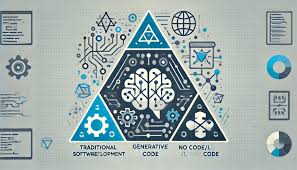
Generative-Driven Development

Nowhere has the rise of generative AI tools been more transformative than in software development. It began with GitHub Copilot’s enhanced autocomplete, which then evolved into interactive, real-time coding assistants like Aider and Cursor that allow engineers to dictate changes and see them applied live in their editor. Today, platforms like Devin.ai aim even higher, aspiring to create autonomous software systems capable of interpreting feature requests or bug reports and delivering ready-to-review code. At its core, the ambition of these AI tools mirrors the essence of software itself: to automate human work. Whether you were writing a script to automate CSV parsing in 2005 or leveraging AI today, the goal remains the same—offloading repetitive tasks to machines. What makes generative AI tools distinct, however, is their focus on automating the work of automation itself. Framing this as a guiding principle enables us to consider the broader challenges and opportunities generative AI brings to software development. Automate the Process of Automation The Doctor-Patient Strategy Most contemporary generative AI tools operate under what can be called the Doctor-Patient strategy. In this model, the GenAI tool acts on a codebase as a distinct, external entity—much like a doctor treats a patient. The relationship is one-directional: the tool modifies the codebase based on given instructions but remains isolated from the architecture and decision-making processes within it. Why This Strategy Dominates: However, the limitations of this strategy are becoming increasingly apparent. Over time, the unidirectional relationship leads to bot rot—the gradual degradation of code quality due to poorly contextualized, repetitive, or inconsistent changes made by generative AI. Understanding Bot Rot Bot rot occurs when AI tools repeatedly make changes without accounting for the macro-level architecture of a codebase. These tools rely on localized context, often drawing from semantically similar code snippets, but lack the insight needed to preserve or enhance the overarching structure. Symptoms of Bot Rot: Example:Consider a Python application that parses TPS report IDs. Without architectural insight, a code bot may generate redundant parsing methods across multiple modules rather than abstracting the logic into a centralized model. Over time, this duplication compounds, creating a chaotic and inefficient codebase. A New Approach: Generative-Driven Development (GDD) To address the flaws of the Doctor-Patient strategy, we propose Generative-Driven Development (GDD), a paradigm where the codebase itself is designed to enable generative AI to enhance automation iteratively and sustainably. Pillars of GDD: How GDD Improves the Development Lifecycle Under GDD, the traditional Test-Driven Development (TDD) cycle (red, green, refactor) evolves to integrate AI processes: This complete cycle eliminates the gaps present in current generative workflows, reducing bot rot and enabling sustainable automation. Over time, GDD-based codebases become easier to maintain and automate, reducing error rates and cycle times. A Day in the Life of a GDD Engineer Imagine a GDD-enabled workflow for a developer tasked with updating TPS report parsing: By embedding AI into the development process, GDD empowers engineers to focus on high-level decision-making while ensuring the automation process remains sustainable and aligned with architectural goals. Conclusion Generative-Driven Development represents a significant shift in how we approach software development. By prioritizing architecture, embedding automation into the software itself, and writing GenAI-optimized code, GDD offers a sustainable path to achieving the ultimate goal: automating the process of automation. As AI continues to reshape the industry, adopting GDD will be critical to harnessing its full potential while avoiding the pitfalls of bot rot. Like Related Posts Who is Salesforce? Who is Salesforce? Here is their story in their own words. From our inception, we’ve proudly embraced the identity of Read more Salesforce Unites Einstein Analytics with Financial CRM Salesforce has unveiled a comprehensive analytics solution tailored for wealth managers, home office professionals, and retail bankers, merging its Financial Read more AI-Driven Propensity Scores AI plays a crucial role in propensity score estimation as it can discern underlying patterns between treatments and confounding variables Read more Tectonic’s Successful Salesforce Track Record Salesforce Technology Services Integrator – Tectonic has successfully delivered Salesforce in a variety of industries including Public Sector, Hospitality, Manufacturing, Read more

Read More
AI and Related Tools Boost Holiday Sales

AI and Related Tools Boost Holiday Sales

AI Drives Holiday Sales in 2024: A Record-Breaking Shopping Season with Rising Returns Artificial intelligence (AI) played a transformative role in shaping the 2024 holiday shopping season, with Salesforce reporting that AI-powered tools influenced $229 billion, or 19%, of global online sales. Based on data from 1.5 billion global shoppers and 1.6 trillion page views, AI tools such as product recommendations, targeted promotions, and customer service significantly boosted sales, marking a 6% year-over-year increase in engagement. Generative AI features, including conversational agents, saw a 25% surge in usage during the holiday period compared to earlier months, further highlighting their role in shaping consumer behavior. Mobile commerce amplified AI’s influence, with nearly 70% of global online sales being placed via smartphones. On Christmas Day alone, mobile orders accounted for 79% of transactions, showcasing the shift toward mobile-first shopping. “Retailers who have embraced AI and conversational agents are already reaping the benefits, but these tools will become even more critical in the new year as retailers aim to minimize revenue losses from returns and reengage with shoppers,” said Caila Schwartz, Salesforce’s Director of Consumer Insights. Record-Breaking Sales and Rising Returns Online sales hit .2 trillion globally and 2 billion in the U.S. during the holiday season, but returns surged to $122 billion globally—a 28% increase compared to 2023. Salesforce attributed this spike to evolving shopping habits like bracketing (buying multiple sizes to ensure fit) and try-on hauls (bulk purchasing for social media content), which have become increasingly common. The surge in returns presents a challenge to retailers, potentially eroding profit margins. To address this, many are turning to AI-powered solutions for streamlining returns processes. According to Salesforce, 75% of U.S. shoppers expressed interest in using AI agents for returns, with one-third showing strong enthusiasm for such tools. The Role of AI in Enhancing the Holiday Shopping Experience AI-powered chatbots saw a 42% year-over-year increase in usage during the holiday season, supporting customers with purchases, returns, and product inquiries. These conversational agents, combined with AI-driven loyalty programs and targeted promotions, were instrumental in engaging customers and increasing conversion rates. AI’s influence extended to social commerce, with platforms like TikTok Shop and Instagram driving 20% of global holiday sales. Personalized recommendations and advertisements, powered by AI algorithms, significantly boosted social media referral traffic, which grew by 8% year-over-year. Mobile Commerce and AI Synergy Mobile devices were the dominant force in holiday shopping, generating 2 billion in global online sales and 5 billion in the U.S. Orders placed via smartphones peaked on Christmas Day, with mobile accounting for 79% of all transactions. This mobile-first trend highlights the growing importance of integrating AI into mobile commerce to enhance the shopping experience. AI Integration Expands Across Retail Operations In the UK, retailers are increasingly leveraging AI to optimize operations and improve personalization. A study by IMRG and Scurri revealed that 57% of UK online retailers used generative AI for content creation in 2024, while 31% implemented AI-informed product search tools. By 2025, 75% of UK retailers plan to adopt AI for marketing efforts, and 42% aim to use AI-powered product information management systems to streamline processes. Tesco, for example, uses AI to analyze Clubcard data, enabling tailored product recommendations, healthier purchasing choices, and waste reduction. Meanwhile, Must Have Ideas, a homeware retailer, has launched an AI-driven TV shopping channel powered by proprietary software, Spark, which automates programming schedules based on real-time stock levels and market trends. Looking Ahead The 2024 holiday season underscored the transformative potential of AI in retail. While AI-powered tools drove record sales and engagement, the rise in returns presents a challenge that retailers must address to protect their bottom line. As AI continues to evolve, its role in shaping consumer behavior, streamlining operations, and enhancing customer experiences will become even more integral in the retail landscape. Like Related Posts Who is Salesforce? Who is Salesforce? Here is their story in their own words. From our inception, we’ve proudly embraced the identity of Read more Salesforce Marketing Cloud Transactional Emails Salesforce Marketing Cloud Transactional Emails are immediate, automated, non-promotional messages crucial to business operations and customer satisfaction, such as order Read more Salesforce Unites Einstein Analytics with Financial CRM Salesforce has unveiled a comprehensive analytics solution tailored for wealth managers, home office professionals, and retail bankers, merging its Financial Read more AI-Driven Propensity Scores AI plays a crucial role in propensity score estimation as it can discern underlying patterns between treatments and confounding variables Read more

Read More
understand ai chatbots

Understand AI Chatbots

AI chatbots are software programs that use artificial intelligence (AI) and natural language processing (NLP) to simulate human-like conversations with users. They can understand and respond to text or voice input, helping with various tasks like customer service, sales, and information retrieval.  How they work: What they can do: Benefits of using AI chatbots: Like Related Posts Who is Salesforce? Who is Salesforce? Here is their story in their own words. From our inception, we’ve proudly embraced the identity of Read more Salesforce Marketing Cloud Transactional Emails Salesforce Marketing Cloud Transactional Emails are immediate, automated, non-promotional messages crucial to business operations and customer satisfaction, such as order Read more Salesforce Unites Einstein Analytics with Financial CRM Salesforce has unveiled a comprehensive analytics solution tailored for wealth managers, home office professionals, and retail bankers, merging its Financial Read more AI-Driven Propensity Scores AI plays a crucial role in propensity score estimation as it can discern underlying patterns between treatments and confounding variables Read more

Read More
gettectonic.com