
- gettectonic.com - Page 5

Salesforce Tackles Enterprise AI Reliability with Enterprise General Intelligence (EGI)

As businesses increasingly adopt AI, a critical challenge has emerged: inconsistent performance in real-world applications. Salesforce calls this phenomenon “jagged intelligence”—where AI excels in controlled environments but falters under dynamic enterprise demands. To address this, Salesforce is pioneering Enterprise General Intelligence (EGI), a new framework designed to ensure AI is not just powerful but reliable, consistent, and safe for business use. Why Enterprise AI Needs a New Approach Traditional AI benchmarks often fail to reflect real-world enterprise needs. Issues like: …have made many companies hesitant to fully deploy AI at scale. Salesforce’s EGI rethinks AI alignment for enterprises, prioritizing:✔ Consistency – Reliable performance across diverse business cases✔ Specialization – Task-specific AI models over generic LLMs✔ Safety & Governance – Built-in guardrails for compliance Key Innovations Powering EGI 1. SIMPLE: Measuring AI Consistency Salesforce’s SIMPLE dataset (225 reasoning questions) evaluates how AI performs under varying conditions—helping identify and fix inconsistencies before deployment. 2. CRMArena: Real-World AI Testing This benchmarking framework simulates authentic CRM scenarios (service agents, analysts, managers) to ensure AI adapts to real business needs—not just lab conditions. 3. SFR-Embedding: Smarter Enterprise AI A new embedding model (ranked #1 on MTEB’s 56-dataset benchmark) enhances AI’s ability to understand complex business data, improving decision-making in Salesforce Data Cloud. 4. xLAM V2: AI That Takes Action Unlike text-only LLMs, Large Action Models (xLAM V2) predict and execute enterprise tasks—optimizing everything from inventory management to financial forecasting with high precision. 5. SFR-Guard & ContextualJudgeBench: AI Safety Co-Innovation: Doubling AI Accuracy with Customer Feedback Salesforce’s customer-driven development has already doubled AI accuracy in key applications. Itai Asseo, Senior Director of Incubation & Brand Strategy at Salesforce: “By working directly with enterprises, we’ve refined AI to outperform competitors in real-world use cases—boosting both performance and trust.” The Future of Enterprise AI Salesforce’s EGI framework is setting a new standard: AI that works as reliably in business as it does in theory. For telecom and tech leaders, this means:✅ Fewer AI surprises – Consistent, predictable outputs✅ Higher ROI – Specialized models for key workflows✅ Stronger compliance – Built-in governance & safety As AI evolves, Salesforce is ensuring enterprises don’t just adopt AI—they can depend on it. Next Steps: The era of reliable enterprise AI is here. Like Related Posts Who is Salesforce? Who is Salesforce? Here is their story in their own words. From our inception, we’ve proudly embraced the identity of Read more Salesforce Marketing Cloud Transactional Emails Salesforce Marketing Cloud Transactional Emails are immediate, automated, non-promotional messages crucial to business operations and customer satisfaction, such as order Read more Salesforce Unites Einstein Analytics with Financial CRM Salesforce has unveiled a comprehensive analytics solution tailored for wealth managers, home office professionals, and retail bankers, merging its Financial Read more AI-Driven Propensity Scores AI plays a crucial role in propensity score estimation as it can discern underlying patterns between treatments and confounding variables Read more

Read More

Salesforce Supported Browsers – Summer ’25 Release Update

Browser Support for Lightning Experience Lightning Experience is available in Essentials, Group, Professional, Enterprise, Performance, Unlimited, and Developer editions. For the best mobile experience, Salesforce recommends using the Salesforce mobile app or accessing Lightning Experience via iPad Safari (with some limitations). Desktop & Laptop Browser Support Salesforce supports the latest stable versions of: ✅ Microsoft Edge (Chromium)✅ Google Chrome✅ Mozilla Firefox✅ Apple Safari Unsupported Browsers:❌ Internet Explorer (no longer supported)❌ Microsoft Edge (non-Chromium)❌ Incognito/private browsing modes Key Notes: Tablet Browser Support Device Supported Browser Notes iPadOS Safari (iOS 13+) Landscape mode only; no portrait switching. Android Salesforce Mobile App Browser access not supported. Important: Mobile (Phone) Support For the best experience, use the Salesforce mobile app. Third-Party Browser Extensions & JavaScript Libraries While some extensions can enhance Salesforce, DOM-manipulating extensions may cause instability. Recommendations: ✔ Check AppExchange for trusted partner extensions.✔ Use Salesforce-approved JavaScript libraries (uploaded as static resources).✔ For custom components: Risks: Salesforce Classic Browser Support Salesforce Classic is available in all editions but does not support mobile browsers—use the Salesforce mobile app instead. Supported Browsers: ✅ Microsoft Edge (Chromium)✅ Google Chrome✅ Mozilla Firefox✅ Apple Safari (except for Classic Console) Unsupported:❌ Internet Explorer 11 (deprecated after Dec 31, 2022)❌ Microsoft Edge (non-Chromium) CRM Analytics Browser Support Follows the same browser compatibility as Lightning Experience. Final Notes For more details, refer to Salesforce Help. Like Related Posts Who is Salesforce? Who is Salesforce? Here is their story in their own words. From our inception, we’ve proudly embraced the identity of Read more Salesforce Marketing Cloud Transactional Emails Salesforce Marketing Cloud Transactional Emails are immediate, automated, non-promotional messages crucial to business operations and customer satisfaction, such as order Read more Salesforce Unites Einstein Analytics with Financial CRM Salesforce has unveiled a comprehensive analytics solution tailored for wealth managers, home office professionals, and retail bankers, merging its Financial Read more AI-Driven Propensity Scores AI plays a crucial role in propensity score estimation as it can discern underlying patterns between treatments and confounding variables Read more

Read More
Create a Service Provider Portal in PSS

Salesforce Industry Clouds: Tailored Solutions for Public Sector Transformation

Salesforce Public Sector Solutions (PSS) represents a paradigm shift in government technology, offering purpose-built applications that combine the power of CRM with public sector operational needs. This comprehensive suite enables agencies to modernize constituent services while maintaining rigorous compliance standards. Core Differentiators Public Sector Solutions Architecture 1. Foundation Layer ![Government Cloud Infrastructure] 2. Government Data Model Standard Object Enhanced Capability Case Violation tracking, benefit eligibility Account Citizen/business entity differentiation Inspection Mobile checklist workflows 3. Prebuilt Applications Diagram Code Download License & Permits Dynamic Forms Fee Automation Grants Mgmt Application Portal Disbursement Tracking Key Solution Areas 🆘 Emergency Program Management 📑 License & Permit Management 🔍 Inspection Management 💰 Grants Management Implementation Framework Phased Rollout Approach Add-On Modules Proven Outcomes BioMADE Case StudyChallenge: 9-month grant approval cyclesSolution: PSS Grants Management + DocuSignResults: Local Government Impact python Copy Download # Productivity metrics after PSS adoption print(f”Case resolution time: {before_hrs}hrs → {after_hrs}hrs”) print(f”Constituent satisfaction: {before_score} → {after_score}”) Typical Output:Case resolution time: 72hrs → 18hrsConstituent satisfaction: 62% → 89% Why Governments Choose Salesforce “PSS allowed us to stand up pandemic relief programs in 11 days – something that previously took 11 months.”— State CIO, Northeast U.S. Like Related Posts Who is Salesforce? Who is Salesforce? Here is their story in their own words. From our inception, we’ve proudly embraced the identity of Read more Salesforce Marketing Cloud Transactional Emails Salesforce Marketing Cloud Transactional Emails are immediate, automated, non-promotional messages crucial to business operations and customer satisfaction, such as order Read more Salesforce Unites Einstein Analytics with Financial CRM Salesforce has unveiled a comprehensive analytics solution tailored for wealth managers, home office professionals, and retail bankers, merging its Financial Read more AI-Driven Propensity Scores AI plays a crucial role in propensity score estimation as it can discern underlying patterns between treatments and confounding variables Read more
Read More
AI Project Planning by Workflows

Salesforce Flow Explained

Salesforce Flow: The No-Code Automation Powerhouse Salesforce Flow revolutionizes business process automation by enabling visual, click-based workflow design—eliminating the need for complex coding. From simple task automation to intricate multi-system integrations, Flow empowers admins and business users to streamline operations, enhance accuracy, and boost productivity—all within the Salesforce ecosystem. Why Salesforce Flow? Key Benefits ✅ No-Code Simplicity – Build complex automations with drag-and-drop ease, reducing reliance on developers.✅ End-to-End Automation – Handle data updates, approvals, user guidance, and external integrations seamlessly.✅ Error Reduction – Minimize manual entry mistakes with automated, logic-driven workflows.✅ Flexible Triggers – Run flows on demand, on schedule, or in response to real-time record changes.✅ Enhanced User Experience – Guide employees through processes with intuitive, step-by-step screens. Types of Salesforce Flows & When to Use Them Flow Type Best For Screen Flows Interactive user interfaces (e.g., onboarding wizards, guided data entry). Record-Triggered Flows Auto-updating records on creation/modification (e.g., lead scoring, SLA tracking). Schedule-Triggered Flows Recurring tasks (e.g., nightly data syncs, batch record updates). Auto-Launched Flows API-triggered automations or sub-processes within larger workflows. Platform Event Flows Real-time integrations with external systems (e.g., ERP, payment gateways). Top Use Cases for Salesforce Flow 1. Automated Data Management 2. Smarter Approval Workflows 3. Guided User Journeys 4. Seamless Integrations 5. Advanced Business Logic Flow vs. Process Builder vs. Apex: Which to Use? Tool Complexity Best For Limitations Flow Low to High End-to-end automation, UI-guided processes. Not for ultra-high-volume transactions. Process Builder Low Simple record-triggered actions. Limited logic capabilities. Apex (Code) High Custom logic, heavy computations. Requires developer expertise. Pro Tip: Salesforce recommends migrating from Process Builder to Flow, as it offers greater flexibility and future-proofing. Getting Started with Salesforce Flow The Future of Automation Is Clicks, Not Code Salesforce Flow puts enterprise-grade automation in the hands of non-developers, accelerating digital transformation. By reducing manual work, cutting errors, and ensuring process consistency, it’s a game-changer for CRM efficiency. Ready to automate? Start with a simple Record-Triggered Flow today and scale up as your needs grow! Key Takeaways:✔ No-code automation for admins & business users.✔ Five flow types cover everything from UI guides to backend integrations.✔ Replaces Process Builder as Salesforce’s recommended automation tool.✔ Critical for CRM efficiency—saves time, reduces errors, and enforces best practices. Like Related Posts Who is Salesforce? Who is Salesforce? Here is their story in their own words. From our inception, we’ve proudly embraced the identity of Read more Salesforce Marketing Cloud Transactional Emails Salesforce Marketing Cloud Transactional Emails are immediate, automated, non-promotional messages crucial to business operations and customer satisfaction, such as order Read more Salesforce Unites Einstein Analytics with Financial CRM Salesforce has unveiled a comprehensive analytics solution tailored for wealth managers, home office professionals, and retail bankers, merging its Financial Read more AI-Driven Propensity Scores AI plays a crucial role in propensity score estimation as it can discern underlying patterns between treatments and confounding variables Read more

Read More
AI Adoption Not Even Across the Board

State of AI Adoption in 2024

The State of AI Adoption in 2024: Trends, Impacts, and Industry Shifts AI Goes Mainstream: Adoption Reaches Tipping Point The AI revolution has transitioned from experimentation to enterprise-wide implementation, with adoption rates accelerating across industries. Current data reveals a watershed moment in business technology: Key Adoption Metrics Sector-by-Sector Breakdown Early Adopter Industries (60%+ adoption) Emerging Adopters (30-50% adoption) Late Adopters (<30%) Geographic Note: Colorado, Florida and Utah lead U.S. adoption while Mississippi and Maine trail significantly. The Generative AI Boom The 2023-2024 period saw explosive growth in specific technologies: Proven Business Impact Organizations report tangible benefits from AI integration: The Global Perspective While U.S. adoption lags at 33% (Exploding Topics), international markets show stronger uptake: The Road Ahead Three critical trends emerging: “We’ve passed the inflection point where AI advantage separates market leaders from laggards.”— AI Strategy Report 2024 Organizations that accelerate adoption while addressing ethical, security and workforce challenges will define the next era of competitive advantage. The question is no longer if to adopt AI, but how fast to scale impact. Like Related Posts Who is Salesforce? Who is Salesforce? Here is their story in their own words. From our inception, we’ve proudly embraced the identity of Read more Salesforce Unites Einstein Analytics with Financial CRM Salesforce has unveiled a comprehensive analytics solution tailored for wealth managers, home office professionals, and retail bankers, merging its Financial Read more AI-Driven Propensity Scores AI plays a crucial role in propensity score estimation as it can discern underlying patterns between treatments and confounding variables Read more Tectonic’s Successful Salesforce Track Record Salesforce Technology Services Integrator – Tectonic has successfully delivered Salesforce in a variety of industries including Public Sector, Hospitality, Manufacturing, Read more

Read More

Mastering AI Prompts

Mastering AI Prompts: OpenAI’s Guide to Optimizing Reasoning Models OpenAI has released an updated prompting guide that reveals how to get the most accurate and useful responses from its reasoning models. As AI becomes more advanced, how you ask questions significantly impacts the quality of answers. Whether you’re a developer, business leader, or researcher, these best practices will help refine your AI interactions. Key Prompting Strategies from OpenAI 1. Simplicity Wins: Keep Prompts Direct Overloading prompts with unnecessary instructions can confuse the model. Instead of micromanaging its reasoning, trust the AI’s built-in logic. ✅ Better:“Analyze sales trends from this dataset.” ❌ Less Effective:“Break down this dataset step-by-step, explain each calculation, and ensure statistical best practices are followed.” 2. Skip the “Think Step by Step” Approach While some believe explicitly asking for reasoning helps, OpenAI found that models already optimize for logic—adding such instructions can backfire. ✅ Better:“What’s 25% of 200?” ❌ Less Effective:“Explain your reasoning step-by-step to calculate 25% of 200.” Need an explanation? Ask for it after getting the answer. 3. Use Delimiters for Complex Inputs When feeding structured data, contracts, or multi-part questions, clear separators prevent misinterpretation. ✅ Better: Copy Summarize the contract below: — [Contract text] — ❌ Less Effective:“Summarize this contract: The first party agrees to…” 4. Limit Context in Retrieval-Augmented Tasks When referencing external documents, only include relevant sections—too much info dilutes accuracy. ✅ Better:“Summarize key points from Sections 2 and 3 of this report.” ❌ Less Effective:“Read this 10-page document and summarize everything.” 5. Define Constraints for Precision The more specific your requirements, the better the output. ✅ Better:“Suggest a $500/month LinkedIn ad strategy for a B2B SaaS startup.” ❌ Less Effective:“Suggest a marketing plan.” 6. Iterate for Better Results If the first response isn’t perfect, refine your prompt with additional details. First Attempt:“Give me startup ideas.” Refined Prompt:“Suggest AI-powered B2B SaaS ideas for small business accounting.” Why This Matters OpenAI’s findings show that optimized prompting = better outputs. Whether you’re integrating AI into apps or using it for research, these techniques ensure smarter, faster, and more reliable responses. Try these strategies today—how will you refine your prompts? Like Related Posts Who is Salesforce? Who is Salesforce? Here is their story in their own words. From our inception, we’ve proudly embraced the identity of Read more Salesforce Marketing Cloud Transactional Emails Salesforce Marketing Cloud Transactional Emails are immediate, automated, non-promotional messages crucial to business operations and customer satisfaction, such as order Read more Salesforce Unites Einstein Analytics with Financial CRM Salesforce has unveiled a comprehensive analytics solution tailored for wealth managers, home office professionals, and retail bankers, merging its Financial Read more AI-Driven Propensity Scores AI plays a crucial role in propensity score estimation as it can discern underlying patterns between treatments and confounding variables Read more
Read More

Revenue Cloud Summer ’25: The Ultimate Guide to Monetization Innovation

Transform Your Quote-to-Cash Operations Salesforce’s Summer ’25 release delivers 40+ revenue acceleration features across pricing, configuration, billing, and usage management. Here’s what revenue teams need to know: 🚀 Top 5 Game-Changers Deep Dive: Key Capabilities 📦 Product Catalog Revolution Feature Impact Default Catalog Views 35% faster product selection Attribute-Based Search Find SKUs 4x quicker Bundle Simplification 80% cleaner quote presentations Pro Tip: Use new auto-renewal triggers to boost recurring revenue by 22% (Salesforce benchmark) 💵 Pricing & Discounts What’s New: Customer Story: Telecom provider reduced pricing errors by 91% ⚙️ Configuration 2.0 apex Copy Download // Sample Constraint Rule (GA) ProductConfiguration.Constraint( Name: ‘Enterprise_Server_Combo’, Condition: ‘RAM_GB >= 64 WHEN CPU_Cores > 16’, Action: ‘AUTO_ADD_Backup_Service’ ) Benefits: 📊 Usage & Billing Token Economy Features: Billing Hub Updates: Implementation Toolkit ✅ Prebuilt Revenue Playbooks✅ Sandbox Enablement Kits✅ Admin Trailhead Modules (NEW) “These updates help enterprises monetize 30% faster while maintaining compliance,” says Salesforce VP of Revenue Cloud. Download Technical Specs | Join Release Webinar Ready to transform your revenue operations? Like Related Posts Who is Salesforce? Who is Salesforce? Here is their story in their own words. From our inception, we’ve proudly embraced the identity of Read more Salesforce Marketing Cloud Transactional Emails Salesforce Marketing Cloud Transactional Emails are immediate, automated, non-promotional messages crucial to business operations and customer satisfaction, such as order Read more Salesforce Unites Einstein Analytics with Financial CRM Salesforce has unveiled a comprehensive analytics solution tailored for wealth managers, home office professionals, and retail bankers, merging its Financial Read more AI-Driven Propensity Scores AI plays a crucial role in propensity score estimation as it can discern underlying patterns between treatments and confounding variables Read more

Read More
Streamline Data Collection from Connected Vehicles and Assets with AWS and Salesforce

Streamline Data Collection from Connected Vehicles and Assets with AWS and Salesforce

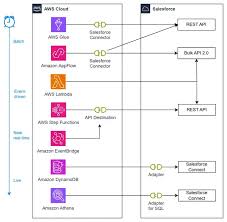
Unlock Real-Time Insights with AWS IoT and Salesforce Industry Clouds This guide explains how to gather, process, and distribute data from connected vehicles and industrial assets—such as manufacturing equipment or utility meters—into Salesforce Industry Cloud solutions using Amazon Web Services (AWS). Key AWS IoT Services for Data Collection By leveraging these services, businesses can integrate telemetry data into: Why This Integration Matters Strong customer relationships rely on real-time insights. Automakers, manufacturers, and utility providers can enhance customer interactions by unifying telemetry data with CRM workflows—enabling smarter marketing, sales, and service decisions. Prerequisites To integrate AWS IoT with Salesforce, you’ll need: AWS Services Salesforce Requirements Use Cases 1. Predictive Maintenance with AWS & Salesforce 2. In-Car Notifications 3. On-Demand Vehicle/Asset Health Insights 4. Data-Driven Customer Engagement Solution Architecture Data Flow Overview Implementation Steps 1. Set Up AWS IoT Rules 2. Configure Salesforce Event Handling 3. Enable Real-Time Analytics Conclusion By integrating AWS IoT with Salesforce Industry Clouds, businesses can:✔ Improve operational efficiency with predictive maintenance.✔ Enhance customer experiences through real-time alerts and diagnostics.✔ Drive data-driven decisions with unified analytics. Next Steps: Empower your teams with real-time IoT insights—start building today! Like Related Posts Who is Salesforce? Who is Salesforce? Here is their story in their own words. From our inception, we’ve proudly embraced the identity of Read more Salesforce Marketing Cloud Transactional Emails Salesforce Marketing Cloud Transactional Emails are immediate, automated, non-promotional messages crucial to business operations and customer satisfaction, such as order Read more Salesforce Unites Einstein Analytics with Financial CRM Salesforce has unveiled a comprehensive analytics solution tailored for wealth managers, home office professionals, and retail bankers, merging its Financial Read more AI-Driven Propensity Scores AI plays a crucial role in propensity score estimation as it can discern underlying patterns between treatments and confounding variables Read more

Read More

Agentforce and Einstein Spring 25 Updates

Transform Your Salesforce Experience with AI-Powered Innovations Discover how Agentforce and Einstein are revolutionizing productivity across every Salesforce cloud. With monthly feature releases, we’re constantly enhancing your AI toolkit. The May ’25 updates highlighted below will become available when Summer ’25 reaches your org. Key AI Innovations Coming in Summer ’25 Service Cloud 🔹 Enhanced Agentforce Service Agent Automation & Integration 🔹 Einstein Decision Element Commerce Cloud 🔹 Personalized Cart Recommendations Education Cloud (Pilot) 🔹 Agentforce for Student Advising Field Service 🔹 Proactive Asset Scheduling Marketing Cloud 🔹 Campaign Designer (Beta) Platform 🔹 External Objects in Prompt Builder Public Sector (Beta) 🔹 Einstein Grant Solutions Revenue Cloud 🔹 Conversational Quoting Agent Sales 🔹 Multilingual Agentforce SDR Service 🔹 AI-Powered Presence Management Agentforce & Einstein Platform Updates May ’25 Enhancements 🔹 Custom Lightning Type Support Why This Matters Stay Ahead: Bookmark our release notes and check back monthly for the latest AI capabilities. Learn More About AI at Salesforce | Summer ’25 Release Notes 🚀 The future of intelligent CRM starts here – are you ready? Like1 Related Posts Who is Salesforce? Who is Salesforce? Here is their story in their own words. From our inception, we’ve proudly embraced the identity of Read more Salesforce Marketing Cloud Transactional Emails Salesforce Marketing Cloud Transactional Emails are immediate, automated, non-promotional messages crucial to business operations and customer satisfaction, such as order Read more Salesforce Unites Einstein Analytics with Financial CRM Salesforce has unveiled a comprehensive analytics solution tailored for wealth managers, home office professionals, and retail bankers, merging its Financial Read more AI-Driven Propensity Scores AI plays a crucial role in propensity score estimation as it can discern underlying patterns between treatments and confounding variables Read more

Read More
Salesforce analytics insurance

4 Steps to Unlock the Right Marketing Insights

Overwhelmed by Dashboard Data? 4 Steps to Unlock the Right Marketing Insights An effective dashboard should present marketing data clearly and concisely, enabling teams to quickly extract insights and make confident decisions. 4 Steps to Unlock the Right Marketing Insights Turning Data into Action with Trusted Insights Imagine walking into a restaurant with an overwhelming menu—dozens of dishes spanning multiple cuisines, making it difficult to choose. While the food may be good, the sheer volume of options leads to decision fatigue, causing diners to default to familiar choices rather than exploring new possibilities. The same challenge applies to marketing dashboards. When cluttered with excessive metrics, they become difficult to navigate, obscuring key insights rather than revealing them. A well-designed dashboard, like a well-curated menu, should guide users to the most valuable information—helping them act quickly and strategically. The Difference Between Reporting and Insights Many dashboards fall into the trap of displaying every possible metric, but true value comes from actionable insights, not just raw data. Example: A live campaign shows that email conversions outperform social ads. Instead of just noting the discrepancy, an insights-driven dashboard helps marketers diagnose why—perhaps stronger subject lines or better landing page alignment—and adjust social strategies in real time for immediate improvement. 4 Steps to Build Dashboards That Drive Decisions To transform dashboards from data overload into insight engines, follow this structured approach: 1. Define the User Persona Dashboards should cater to specific roles, not broad audiences. Different stakeholders need different insights: A one-size-fits-all dashboard drowns users in irrelevant data. Instead, tailor views to each persona’s core needs. 2. Align with Daily Tasks Collaborate with users to understand how they apply data in their workflows. A well-designed dashboard should: 3. Answer Key Business Questions Every dashboard should directly address the user’s most critical questions, such as: Prioritize KPIs that drive action, like:✔ Impressions (Reach)✔ Click-through rate (CTR) (Engagement)✔ Conversion rate (CVR) (Effectiveness)✔ Revenue per sale (ROI) Supplement these with supporting metrics (e.g., time on site, repeat visits) to uncover deeper trends. 4. Design for Clarity and Impact A great dashboard balances simplicity with depth: Example for Executives: A high-level dashboard showing revenue, CAC, and CLTV by region helps identify growth opportunities. If one region shows strong CLTV, leadership might invest further in similar markets. The Result? Faster, Smarter Decisions By focusing on personas, tasks, key questions, and clarity, marketers can move beyond data overload and unlock real business value. The best dashboards don’t just report numbers—they illuminate the path forward. Ready to streamline your insights? Start by having Tectonic refine one dashboard using these steps—and watch decision-making improve. Like Related Posts Who is Salesforce? Who is Salesforce? Here is their story in their own words. From our inception, we’ve proudly embraced the identity of Read more Salesforce Marketing Cloud Transactional Emails Salesforce Marketing Cloud Transactional Emails are immediate, automated, non-promotional messages crucial to business operations and customer satisfaction, such as order Read more Salesforce Unites Einstein Analytics with Financial CRM Salesforce has unveiled a comprehensive analytics solution tailored for wealth managers, home office professionals, and retail bankers, merging its Financial Read more AI-Driven Propensity Scores AI plays a crucial role in propensity score estimation as it can discern underlying patterns between treatments and confounding variables Read more
Read More
agentic revolution

The Agentic AI Revolution

The Agentic AI Revolution: Reskilling and Trust as Competitive Imperatives The rise of agentic AI—autonomous systems capable of independent decision-making—isn’t just another tech trend; it’s a fundamental shift in how businesses operate. With AI agents projected to unlock $6 trillion in digital labor value, companies that fail to adapt risk being outpaced by AI-driven competitors. To thrive in this new era, business leaders must focus on two critical pillars: 1. Reskilling for the Age of AI Collaboration The Urgent Skills Gap Key Competencies for the AI Era ✅ Human-AI Collaboration – Managing AI agents, prompt engineering, and oversight✅ Strategic Thinking – Shifting from routine tasks to big-picture planning✅ Leadership & Management – Overseeing AI “teams” and decision flows A Call to Action for Businesses “With AI handling routine coding, developers can now focus on system architecture and innovation—but only if we equip them for this shift.” 2. Trust: The Foundation of AI Adoption The Risks of Unchecked AI Building a Trusted AI Framework 🛡️ Guardrails & Escalation Protocols – Define when AI must defer to humans🔐 Data Protection – Ensure compliance with zero-retention LLM policies (e.g., Einstein Trust Layer)📊 Transparency Tools – Give employees visibility into AI decision logic Salesforce’s Approach: Agentforce The Path Forward: AI + Humans in Partnership Why This Matters Now Key Takeaways for Leaders Linda SaundersCountry Manager & Senior Director of Solution Engineering, Africa | Salesforce “The future belongs to businesses that combine AI’s efficiency with human ingenuity—guided by an unwavering commitment to trust.” Ready to lead in the agentic AI era? The AI revolution isn’t coming—it’s here. The question is: Will your organization be a disruptor or disrupted? Like Related Posts Who is Salesforce? Who is Salesforce? Here is their story in their own words. From our inception, we’ve proudly embraced the identity of Read more Salesforce Marketing Cloud Transactional Emails Salesforce Marketing Cloud Transactional Emails are immediate, automated, non-promotional messages crucial to business operations and customer satisfaction, such as order Read more Salesforce Unites Einstein Analytics with Financial CRM Salesforce has unveiled a comprehensive analytics solution tailored for wealth managers, home office professionals, and retail bankers, merging its Financial Read more AI-Driven Propensity Scores AI plays a crucial role in propensity score estimation as it can discern underlying patterns between treatments and confounding variables Read more

Read More
Natural Language Processing Explained

Exploring 3 Types of Natural Language Processing in Healthcare

Healthcare generates vast amounts of unstructured, text-based data—primarily in the form of clinical notes stored in electronic health records (EHRs). While this data holds immense potential for improving patient outcomes, extracting meaningful insights from it remains a challenge. Natural language processing (NLP) offers a solution by enabling healthcare stakeholders to analyze and interpret this data efficiently. NLP technologies can support population health management, clinical decision-making, and medical research by transforming unstructured text into actionable insights. Despite the excitement around NLP in healthcare—particularly amid clinician burnout and EHR inefficiencies—its two core components, natural language understanding (NLU) and natural language generation (NLG), receive less attention. This insight explores NLP, NLU, and NLG, highlighting their differences and healthcare applications. Understanding NLP, NLU, and NLG While related, these three concepts serve distinct purposes: Healthcare Applications NLP technologies offer diverse benefits across clinical, administrative, and research settings: 1. NLP in Clinical and Operational Use Cases Real-World Examples: 2. NLU for Research & Chatbots While less widely adopted than NLP, NLU shows promise in: 3. NLG for Generative AI in Healthcare Challenges & Barriers to Adoption Despite their potential, NLP technologies face several hurdles: 1. Data Quality & Accessibility 2. Bias & Fairness Concerns 3. Regulatory & Privacy Issues 4. Performance & Clinical Relevance The Future of NLP in Healthcare Despite these challenges, NLP, NLU, and NLG hold tremendous potential to revolutionize healthcare by:✔ Enhancing clinical decision-making✔ Streamlining administrative workflows✔ Accelerating medical research As the technology matures, addressing data, bias, and regulatory concerns will be key to unlocking its full impact. Like Related Posts Who is Salesforce? Who is Salesforce? Here is their story in their own words. From our inception, we’ve proudly embraced the identity of Read more Salesforce Marketing Cloud Transactional Emails Salesforce Marketing Cloud Transactional Emails are immediate, automated, non-promotional messages crucial to business operations and customer satisfaction, such as order Read more Salesforce Unites Einstein Analytics with Financial CRM Salesforce has unveiled a comprehensive analytics solution tailored for wealth managers, home office professionals, and retail bankers, merging its Financial Read more AI-Driven Propensity Scores AI plays a crucial role in propensity score estimation as it can discern underlying patterns between treatments and confounding variables Read more

Read More
Agentic AI is Here

The Rise of Agentic AI

Beyond Predictive Models: The Rise of Agentic AI Agentic AI represents a fundamental shift from passive language models to dynamic systems capable of perception, reasoning, and action across digital and physical environments. Unlike traditional AI that merely predicts text, agentic architectures interact with the world, learn from feedback, and coordinate multiple specialized agents to solve complex problems. This evolution is built on three core principles: Core Principles of Agentic AI 1. Causality & Adaptive Decision-Making Traditional AI systems rely on statistical patterns, often producing plausible but incorrect responses. Agentic AI models cause-and-effect relationships, enabling iterative refinement when faced with unexpected outcomes. Example Applications: 2. Multimodal World Interaction Modern agentic systems integrate text, vision, and sensor data to interact with complex environments. Real-World Implementations: 3. Multi-Agent Collaboration Next-generation frameworks deploy specialized sub-agents that work in parallel rather than relying on single monolithic models. Implementation Examples: Key Components of Agentic Systems 1. Modular Skill Architectures Modern platforms enable: Use Case Scenario:A business intelligence agent that pulls real-time market data, analyzes trends, and generates reports while maintaining data governance standards 2. Multi-Agent Orchestration Advanced frameworks provide: Practical Application:Software development environments where coding, debugging, and security validation occur simultaneously through coordinated AI agents 3. Visual Environment Interaction Cutting-edge solutions bridge the gap between AI and graphical interfaces by: Implementation Example:Intelligent process automation that navigates legacy systems and modern applications without manual scripting Advanced Implementation Patterns 1. Knowledge-Enhanced Agents Example Implementation:Customer service systems that access order history, product details, and support documentation before responding 2. Human Oversight Integration Use Case:Medical diagnostic support that flags uncertain cases for professional review 3. Persistent Context Management Application Example:Project management assistants that track progress, dependencies, and timelines over weeks or months Industry Applications Sector Agentic AI Solutions Software Development Automated testing, debugging, and deployment pipelines Healthcare Integrated diagnostic systems combining multiple data sources Education Adaptive learning systems with personalized tutoring Financial Services Real-time fraud detection and risk analysis Manufacturing Dynamic process optimization and quality control Current Challenges & Research Directions Getting Started with Agentic AI For organizations beginning their agentic AI journey: The Path Forward Agentic AI represents a fundamental evolution from conversational systems to active, adaptive problem-solvers. By combining causal reasoning, specialized collaboration, and real-world interaction, these systems are moving us closer to truly intelligent automation. The future belongs to AI systems that don’t just process information – but perceive, decide, and act in dynamic environments. Organizations that embrace this paradigm today will be positioned to lead in the AI-powered economy of tomorrow. Like Related Posts Who is Salesforce? Who is Salesforce? Here is their story in their own words. From our inception, we’ve proudly embraced the identity of Read more Salesforce Unites Einstein Analytics with Financial CRM Salesforce has unveiled a comprehensive analytics solution tailored for wealth managers, home office professionals, and retail bankers, merging its Financial Read more AI-Driven Propensity Scores AI plays a crucial role in propensity score estimation as it can discern underlying patterns between treatments and confounding variables Read more Tectonic’s Successful Salesforce Track Record Salesforce Technology Services Integrator – Tectonic has successfully delivered Salesforce in a variety of industries including Public Sector, Hospitality, Manufacturing, Read more

Read More
gettectonic.com