

Generative AI Archives - gettectonic.com - Page 15
Recent advancements in AI

Recent advancements in AI

Recent advancements in AI have been propelled by large language models (LLMs) containing billions to trillions of parameters. Parameters—variables used to train and fine-tune machine learning models—have played a key role in the development of generative AI. As the number of parameters grows, models like ChatGPT can generate human-like content that was unimaginable just a few years ago. Parameters are sometimes referred to as “features” or “feature counts.” While it’s tempting to equate the power of AI models with their parameter count, similar to how we think of horsepower in cars, more parameters aren’t always better. An increase in parameters can lead to additional computational overhead and even problems like overfitting. There are various ways to increase the number of parameters in AI models, but not all approaches yield the same improvements. For example, Google’s Switch Transformers scaled to trillions of parameters, but some of their smaller models outperformed them in certain use cases. Thus, other metrics should be considered when evaluating AI models. The exact relationship between parameter count and intelligence is still debated. John Blankenbaker, principal data scientist at SSA & Company, notes that larger models tend to replicate their training data more accurately, but the belief that more parameters inherently lead to greater intelligence is often wishful thinking. He points out that while these models may sound knowledgeable, they don’t actually possess true understanding. One challenge is the misunderstanding of what a parameter is. It’s not a word, feature, or unit of data but rather a component within the model‘s computation. Each parameter adjusts how the model processes inputs, much like turning a knob in a complex machine. In contrast to parameters in simpler models like linear regression, which have a clear interpretation, parameters in LLMs are opaque and offer no insight on their own. Christine Livingston, managing director at Protiviti, explains that parameters act as weights that allow flexibility in the model. However, more parameters can lead to overfitting, where the model performs well on training data but struggles with new information. Adnan Masood, chief AI architect at UST, highlights that parameters influence precision, accuracy, and data management needs. However, due to the size of LLMs, it’s impractical to focus on individual parameters. Instead, developers assess models based on their intended purpose, performance metrics, and ethical considerations. Understanding the data sources and pre-processing steps becomes critical in evaluating the model’s transparency. It’s important to differentiate between parameters, tokens, and words. A parameter is not a word; rather, it’s a value learned during training. Tokens are fragments of words, and LLMs are trained on these tokens, which are transformed into embeddings used by the model. The number of parameters influences a model’s complexity and capacity to learn. More parameters often lead to better performance, but they also increase computational demands. Larger models can be harder to train and operate, leading to slower response times and higher costs. In some cases, smaller models are preferred for domain-specific tasks because they generalize better and are easier to fine-tune. Transformer-based models like GPT-4 dwarf previous generations in parameter count. However, for edge-based applications where resources are limited, smaller models are preferred as they are more adaptable and efficient. Fine-tuning large models for specific domains remains a challenge, often requiring extensive oversight to avoid problems like overfitting. There is also growing recognition that parameter count alone is not the best way to measure a model’s performance. Alternatives like Stanford’s HELM and benchmarks such as GLUE and SuperGLUE assess models across multiple factors, including fairness, efficiency, and bias. Three trends are shaping how we think about parameters. First, AI developers are improving model performance without necessarily increasing parameters. A study of 231 models between 2012 and 2023 found that the computational power required for LLMs has halved every eight months, outpacing Moore’s Law. Second, new neural network approaches like Kolmogorov-Arnold Networks (KANs) show promise, achieving comparable results to traditional models with far fewer parameters. Lastly, agentic AI frameworks like Salesforce’s Agentforce offer a new architecture where domain-specific AI agents can outperform larger general-purpose models. As AI continues to evolve, it’s clear that while parameter count is an important consideration, it’s just one of many factors in evaluating a model’s overall capabilities. To stay on the cutting edge of artificial intelligence, contact Tectonic today. Like Related Posts Who is Salesforce? Who is Salesforce? Here is their story in their own words. From our inception, we’ve proudly embraced the identity of Read more Salesforce Marketing Cloud Transactional Emails Salesforce Marketing Cloud Transactional Emails are immediate, automated, non-promotional messages crucial to business operations and customer satisfaction, such as order Read more Salesforce Unites Einstein Analytics with Financial CRM Salesforce has unveiled a comprehensive analytics solution tailored for wealth managers, home office professionals, and retail bankers, merging its Financial Read more AI-Driven Propensity Scores AI plays a crucial role in propensity score estimation as it can discern underlying patterns between treatments and confounding variables Read more

Read More
NYT Issues Cease-and-Desist Letter to Perplexity AI

NYT Issues Cease-and-Desist Letter to Perplexity AI

NYT Issues Cease-and-Desist Letter to Perplexity AI Over Alleged Unauthorized Content Use The New York Times (NYT) has issued a cease-and-desist letter to Perplexity AI, accusing the AI-powered search startup of using its content without permission. This move marks the second time the NYT has confronted a company for allegedly misappropriating its material. According to reports, the Times claims Perplexity is accessing and utilizing its content to generate summaries and other outputs, actions it argues infringe on copyright laws. The startup now has two weeks to respond to the accusations. A Growing Pattern of Tensions Perplexity AI is not the only publisher-facing scrutiny. In June, Forbes threatened legal action against the company, alleging “willful infringement” by using its text and images. In response, Perplexity launched the Perplexity Publishers’ Program, a revenue-sharing initiative that collaborates with publishers like Time, Fortune, and The Texas Tribune. Meanwhile, the NYT remains entangled in a separate lawsuit with OpenAI and its partner Microsoft over alleged misuse of its content. A Strategic Legal Approach The NYT’s decision to issue a cease-and-desist letter instead of pursuing an immediate lawsuit signals a calculated move. “Cease-and-desist approaches are less confrontational, less expensive, and faster,” said Sarah Kreps, a professor at Cornell University. This method also opens the door for negotiation, a pragmatic step given the uncharted legal terrain surrounding generative AI and copyright law. Michael Bennett, a responsible AI expert from Northeastern University, echoed this view, suggesting that the cease-and-desist approach positions the Times to protect its intellectual property while maintaining leverage in ongoing legal battles. If the NYT wins its case against OpenAI, Bennett added, it could compel companies like Perplexity to enter financial agreements for content use. However, if the case doesn’t favor the NYT, the publisher risks losing leverage. The letter also serves as a warning to other AI vendors, signaling the NYT’s determination to safeguard its intellectual property. Perplexity’s Defense: Facts vs. Expression Perplexity AI has countered the NYT’s claims by asserting that its methods adhere to copyright laws. “We aren’t scraping data for building foundation models but rather indexing web pages and surfacing factual content as citations,” the company stated. It emphasized that facts themselves cannot be copyrighted, drawing parallels to how search engines like Google operate. Kreps noted that Perplexity’s approach aligns closely with other AI platforms, which typically index pages to provide factual answers while citing sources. “If Perplexity is culpable, then the entire AI industry could be held accountable,” she said, contrasting Perplexity’s citation-based model with platforms like ChatGPT, which often lack transparency about data sources. The Crux of the Copyright Argument The NYT’s cease-and-desist letter centers on the distinction between facts and the creative expression of facts. While raw facts are not protected under copyright, the NYT claims that its specific interpretation and presentation of those facts are. Vincent Allen, an intellectual property attorney, explained that if Perplexity is scraping data and summarizing articles, it may involve making unauthorized copies of copyrighted content, strengthening the NYT’s claims. “This is a big deal for content providers,” Allen said, “as they want to ensure they’re compensated for their work.” Implications for the AI Industry The outcome of this dispute could set a precedent for how AI platforms handle content generated by publishers. If Perplexity’s practices are deemed infringing, it could reshape the operational models of similar AI vendors. At the heart of the debate is the balance between fostering innovation in AI and protecting intellectual property, a challenge that will likely shape the future of generative AI and its relationship with content creators. Like Related Posts Who is Salesforce? Who is Salesforce? Here is their story in their own words. From our inception, we’ve proudly embraced the identity of Read more Salesforce Unites Einstein Analytics with Financial CRM Salesforce has unveiled a comprehensive analytics solution tailored for wealth managers, home office professionals, and retail bankers, merging its Financial Read more AI-Driven Propensity Scores AI plays a crucial role in propensity score estimation as it can discern underlying patterns between treatments and confounding variables Read more Tectonic’s Successful Salesforce Track Record Salesforce Technology Services Integrator – Tectonic has successfully delivered Salesforce in a variety of industries including Public Sector, Hospitality, Manufacturing, Read more
Read More
Third Wave of AI at Salesforce

Third Wave of AI at Salesforce

The Third Wave of AI at Salesforce: How Agentforce is Transforming the Landscape At Dreamforce 2024, Salesforce unveiled several exciting innovations, with Agentforce taking center stage. This insight explores the key changes and enhancements designed to improve efficiency and elevate customer interactions. Introducing Agentforce Agentforce is a customizable AI agent builder that empowers organizations to create and manage autonomous agents for various business tasks. But what exactly is an agent? An agent is akin to a chatbot but goes beyond traditional capabilities. While typical chatbots are restricted to scripted responses and predefined questions, Agentforce agents leverage large language models (LLMs) and generative AI to comprehend customer inquiries contextually. This enables them to make independent decisions, whether processing requests or resolving issues using real-time data from your company’s customer relationship management (CRM) system. The Role of Atlas At the heart of Agentforce’s functionality lies the Atlas reasoning engine, which acts as the operational brain. Unlike standard assistive tools, Atlas is an agentic system with the autonomy to act on behalf of the user. Atlas formulates a plan based on necessary actions and can adjust that plan based on evaluations or new information. When it’s time to engage, Atlas knows which business processes to activate and connects with customers or employees via their preferred channels. This sophisticated approach allows Agentforce to significantly enhance operational efficiency. By automating routine inquiries, it frees up your team to focus on more complex tasks, delivering a smoother experience for both staff and customers. Speed to Value One of Agentforce’s standout features is its emphasis on rapid implementation. Many AI projects can be resource-intensive and take months or even years to launch. However, Agentforce enables quick deployment by leveraging existing Salesforce infrastructure, allowing organizations to implement solutions rapidly and with greater control. Salesforce also offers pre-built Agentforce agents tailored to specific business needs—such as Service Agent, Sales Development Representative Agent, Sales Coach, Personal Shopper Agent, and Campaign Agent—all customizable with the Agent Builder. Agentforce for Service and Sales will be generally available starting October 25, 2024, with certain elements of the Atlas Reasoning Engine rolling out in February 2025. Pricing begins at $2 per conversation, with volume discounts available. Transforming Customer Insights with Data Cloud and Marketing Cloud Dreamforce also highlighted enhancements to Data Cloud, Salesforce’s backbone for all cloud products. The platform now supports processing unstructured data, which constitutes up to 90% of company data often overlooked by traditional reporting systems. With new capabilities for analyzing various unstructured formats—like video, audio, sales demos, customer service calls, and voicemails—businesses can derive valuable insights and make informed decisions across Customer 360. Furthermore, Data Cloud One enables organizations to connect siloed Salesforce instances effortlessly, promoting seamless data sharing through a no-code, point-and-click setup. The newly announced Marketing Cloud Advanced edition serves as the “big sister” to Marketing Cloud Growth, equipping larger marketing teams with enhanced features like Path Experiment, which tests different content strategies across channels, and Einstein Engagement Scoring for deeper insights into customer behavior. Together, these enhancements empower companies to engage customers more meaningfully and measurably across all touchpoints. Empowering the Workforce Through Education Salesforce is committed to making AI accessible for all. They recently announced free instructor-led courses and AI certifications available through 2025, aimed at equipping the Salesforce community with essential AI and data management skills. To support this initiative, Salesforce is establishing AI centers in major cities, starting with London, to provide hands-on training and resources, fostering AI expertise. They also launched a global Agentforce World Tour to promote understanding and adoption of the new capabilities introduced at Dreamforce, featuring repackaged sessions from the conference and opportunities for specialists to answer questions. The Bottom Line What does this mean for businesses? With the rollout of Agentforce, along with enhancements to Data Cloud and Marketing Cloud, organizations can operate more efficiently and connect with customers in more meaningful ways. Coupled with a focus on education through free courses and global outreach, getting on board has never been easier. If you’d like to discuss how we can help your business maximize its potential with Salesforce through data and AI, connect with us and schedule a meeting with our team. Legacy systems can create significant gaps between operations and employee needs, slowing lead processes and resulting in siloed, out-of-sync data that hampers business efficiency. Responding to inquiries within five minutes offers a 75% chance of converting leads into customers, emphasizing the need for rapid, effective marketing responses. Salesforce aims to help customers strengthen relationships, enhance productivity, and boost margins through its premier AI CRM for sales, service, marketing, and commerce, while also achieving these goals internally. Recognizing the complexity of its decade-old processes, including lead assignment across three systems and 2 million lines of custom code, Salesforce took on the role of “customer zero,” leveraging Data Cloud to create a unified view of customers known as the “Customer 360 Truth Profile.” This consolidation of disparate data laid the groundwork for enterprise-wide AI and automation, improving marketing automation and reducing lead time by 98%. As Michael Andrew, SVP of Marketing Decision Science at Salesforce, noted, this initiative enabled the company to provide high-quality leads to its sales team with enriched data and AI scoring while accelerating time to market and enhancing data quality. Embracing Customer Zero “Almost exactly a year ago, we set out with a beginner’s mind to transform our lead automation process with a solution that would send the best leads to the right sales teams within minutes of capturing their data and support us for the next decade,” said Andrew. The initial success metric was “speed to lead,” aiming to reduce the handoff time from 20 minutes to less than one minute. The focus was also on integrating customer and lead data to develop a more comprehensive 360-degree profile for each prospect, enhancing lead assignment and sales rep productivity. Another objective was to boost business agility by cutting the average time to implement assignment changes from four weeks to mere days. Accelerating Success with

Read More
Generative AI Replaces Legacy Systems

Generative AI Replaces Legacy Systems

Generative AI Will Overtake Legacy Stack Vendors With the rise of generative AI, legacy software vendors like Appian, IBM, Salesforce, SAP, Pegasystems, IFS, Oracle, Software AG, TIBCO, and UIPath are becoming increasingly obsolete. These vendors represent the old guard, clinging to outdated business process automation systems, while the future clearly belongs to AI-driven innovation. Back in the early 2010s, discussions around dynamic processes—self-assembling workflows created by artificial intelligence—were already gaining traction. The vision was to bypass the need for traditional process mapping or manually designing new interfaces. Instead, AI would dynamically generate processes in response to specific tasks, allowing for far greater flexibility and adaptability. However, business rules within BPMS (Business Process Management Systems) often imposed constraints that limited decision-making flexibility. Today, this vision is finally within reach. Many traditional stack vendors are scrambling to integrate generative AI into their offerings in a desperate bid to remain relevant. But the truth is, generative AI renders these vendors largely unnecessary. For instance, Pegasystems, like many others, now incorporates generative AI into its software, but users are still bound to old workflows and low-code development systems. The reliance on building processes, regardless of AI assistance, keeps them stuck in the past. Across the board—whether it’s ERP, CRM, or RPA—vendors such as Salesforce, SAP, and IFS remain tethered to their outdated systems, even though they possess all the necessary data, both structured and unstructured, to benefit from a simpler, AI-powered approach. All that’s needed is a generative AI layer on top to handle tasks like customer complaints. Consider a customer complaint scenario: traditionally, a complaint is processed through a defined workflow, often requiring the creation of expensive, custom SaaS solutions. But what if an LLM (Large Language Model) could handle this instead? The LLM could analyze the complaint, extract key information, assess urgency through sentiment analysis, and generate a custom workflow on the fly. It could even generate backend code in real-time to process refunds or update databases, all without relying on legacy front-end systems. The LLM’s ability to create and execute dynamic workflows eliminates the need for static business processes. The AI generates temporary code and UI elements to handle a specific interaction, then discards them once the task is complete. This shifts the focus away from traditional, bloated enterprise systems and towards dynamic, JIT (Just-In-Time) interactions that are tailored to each individual customer. The efficiency gains are not in cutting jobs but in eliminating the need for costly, antiquated software and lengthy digital transformation programs. Generative AI doesn’t require massive ERP or CRM implementations, and businesses can converse directly with customer data through AI, bypassing the need for complex system integrations. Master Data Management, which once consumed millions of dollars and years of effort, is now positioned to become a simple, AI-powered solution. Enterprises already have well-structured and clean data, and adding a generative AI layer could remove the need for integrating or syncing legacy systems. The era of major vendors selling AI-enhanced solutions built on top of decaying software stacks is coming to an end. The idea of using generative AI as the foundation for a new business operating system, without the need for bloated, legacy software, is increasingly appealing. With the global workflow automation market projected to grow to .4 billion by 2030, the future clearly belongs to AI-driven solutions. Like Related Posts Who is Salesforce? Who is Salesforce? Here is their story in their own words. From our inception, we’ve proudly embraced the identity of Read more Salesforce Marketing Cloud Transactional Emails Salesforce Marketing Cloud Transactional Emails are immediate, automated, non-promotional messages crucial to business operations and customer satisfaction, such as order Read more Salesforce Unites Einstein Analytics with Financial CRM Salesforce has unveiled a comprehensive analytics solution tailored for wealth managers, home office professionals, and retail bankers, merging its Financial Read more AI-Driven Propensity Scores AI plays a crucial role in propensity score estimation as it can discern underlying patterns between treatments and confounding variables Read more

Read More
Benioff Excited About AI

Benioff Excited About AI

Salesforce CEO Marc Benioff recently critiqued Microsoft for overhyping the capabilities of its Copilot AI tool, arguing that the tech giant has done a “tremendous disservice” to the industry. In a Rapid Response interview with Bob Safian, Benioff emphasized that Salesforce’s Agentforce is “what AI was meant to be.” More excited than ever, he sees Agentforce as a technology poised to transform industries in ways comparable to past cloud, mobile, and social revolutions. Benioff Excited About AI. Reflecting on Dreamforce 2024Benioff called this year’s Dreamforce the most significant yet. With 45,000 attendees and millions joining online, Agentforce took center stage, allowing users to build their own AI agents firsthand. This hands-on experience was vital, he said, to clear up misconceptions caused by overpromised AI products. Salesforce already handles trillions of AI transactions through its Einstein platform, but Benioff believes Agentforce represents a groundbreaking shift in enterprise AI. Agentforce vs. Copilot: A Clear DifferenceBenioff drew a sharp contrast between Agentforce and Microsoft’s Copilot, comparing the latter to the infamous Microsoft Clippy. According to Benioff, Copilot often fails to deliver meaningful results, creating confusion and dissatisfaction among customers. In contrast, Agentforce is set to deliver powerful outcomes by connecting customers, raising revenues, and augmenting employees. He anticipates that within a year, Salesforce will operate over a billion AI agents worldwide. Benioff Excited About AI. Benioff Excited About AI Agentforce’s Real-World ImpactSharing a story from the healthcare sector, Benioff illustrated how Agentforce has resolved over 90% of patient inquiries and scheduling needs for one large provider, enabling rapid and meaningful interactions. He foresees similar applications across media, finance, and travel, as Agentforce helps industries implement AI-driven agents with high success rates. Scheduled to go live on October 25, Agentforce is expected to be adopted by hundreds of thousands of companies. MIT IDE Annual Conference Insights: AI’s Potential and ChallengesWhile businesses explore AI’s possibilities, researchers at MIT’s Initiative on the Digital Economy (IDE) are investigating the complexities and ethical considerations of AI. At the 2024 MIT IDE Annual Conference, findings on AI’s influence on various domains were presented, with highlights including: These MIT findings highlight both the immense promise and the challenges AI presents, as companies like Salesforce aim to harness AI’s true potential while navigating ethical and practical concerns. Like Related Posts Who is Salesforce? Who is Salesforce? Here is their story in their own words. From our inception, we’ve proudly embraced the identity of Read more Salesforce Marketing Cloud Transactional Emails Salesforce Marketing Cloud Transactional Emails are immediate, automated, non-promotional messages crucial to business operations and customer satisfaction, such as order Read more Salesforce Unites Einstein Analytics with Financial CRM Salesforce has unveiled a comprehensive analytics solution tailored for wealth managers, home office professionals, and retail bankers, merging its Financial Read more AI-Driven Propensity Scores AI plays a crucial role in propensity score estimation as it can discern underlying patterns between treatments and confounding variables Read more
Read More
Impact of Generative AI

Impact of Generative AI

Generative AI has emerged as the most dominant trend in data management and analytics, overshadowing all other technologies. This prominence began with the launch of ChatGPT by OpenAI in November 2022, which significantly advanced the capabilities of large language models (LLMs) and demonstrated the transformative potential of generative AI (GenAI) for enterprises. Generative AI’s impact is profound, particularly in making advanced business intelligence tools accessible to a broader range of employees, not just data scientists and analysts. Before the advent of GenAI, complex data management and analytics platforms required computer science skills, statistical expertise, and extensive data literacy. Generative AI has reduced these barriers, enabling more people to leverage data insights for decision-making. Another key advantage of generative AI is its ability to greatly enhance efficiency. It can automate time-consuming, repetitive tasks previously performed manually by data engineers and experts, acting as an independent agent in managing data processes. The landscape of generative AI has evolved rapidly. Following the launch of ChatGPT, a wave of competing LLMs has emerged. Initially, the transformative potential of these technologies was theoretical, but it is now becoming tangible. Companies like Google are developing tools to help customers build and deploy their own generative AI models and applications. Enterprises are increasingly moving from pilot testing to developing and implementing production models. Generative AI does not operate in isolation. Enterprises are also focusing on complementary aspects such as data quality and governance. Ensuring that the data feeding and training generative AI is reliable is crucial. Additionally, real-time data and automation are essential for making generative AI a proactive technology rather than a reactive one. Generative AI has highlighted the need for a robust data foundation. The main challenge now is ensuring that enterprise data is trusted, governed, and ready for AI applications. With the rise of multimodal data, enterprises require a unified approach to manage and govern diverse data types effectively. In addition to generative AI, other significant trends in data management and analytics include the focus on real-time data processing and automation. Integrating generative AI with real-time data streams and automated systems is expected to drive substantial business transformation. By enabling real-time insights and actions, businesses can achieve a level of operational efficiency previously unattainable. The convergence of these technologies is transforming business operations. Unified and simplified technology stacks, integrating foundational technologies, LLMs, and real-time data platforms, are essential for driving this transformation. The industry is making strides towards creating integrated solutions that support comprehensive data management and analytics. Like Related Posts Who is Salesforce? Who is Salesforce? Here is their story in their own words. From our inception, we’ve proudly embraced the identity of Read more Salesforce Unites Einstein Analytics with Financial CRM Salesforce has unveiled a comprehensive analytics solution tailored for wealth managers, home office professionals, and retail bankers, merging its Financial Read more AI-Driven Propensity Scores AI plays a crucial role in propensity score estimation as it can discern underlying patterns between treatments and confounding variables Read more Tectonic’s Successful Salesforce Track Record Salesforce Technology Services Integrator – Tectonic has successfully delivered Salesforce in a variety of industries including Public Sector, Hospitality, Manufacturing, Read more

Read More
New Salesforce Maps Experience Auto-Enabled in Winter ‘25 (October) Release

Christmas 2024

With artificial Christmas trees and holiday inflatables already appearing alongside Halloween decorations at big-box retailers, (and in neighbors’ yards before the first drop of pumpkin spice has been sipped) it’s clear that the holiday season is beginning earlier than ever this year. However, according to a new forecast from Salesforce, the expected holiday sales boost may be somewhat modest. Salesforce projects a 2 percent increase in overall sales for November and December, a slight drop from the 3 percent increase seen in 2023. The forecast highlights that consumers are facing higher debt due to elevated interest rates and inflation, which is likely to diminish their purchasing power compared to recent years. About 40 percent of shoppers plan to cut back on spending this year, while just under half intend to maintain their current spending levels. Adding to the challenge is the brief holiday shopping window between Thanksgiving and Christmas this year—only 27 days, the shortest since 2019. This data comes from Salesforce’s analysis of over 1.5 billion global shoppers across 64 countries, with a focus on 12 key markets including the U.S., Canada, U.K., Germany, and France. Shopping Trends and Strategies In terms of shopping habits, bargain hunters are expected to turn to platforms like Temu, Shein, and other Chinese-owned apps, with nearly one in five holiday purchases anticipated from these sources. TikTok is seeing rapid growth as a sales platform, with a 24 percent increase in shoppers making purchases through the app since April. For businesses, the focus on price is likely to intensify. Two-thirds of global shoppers will let cost dictate their shopping decisions this year, compared to 46 percent in 2020. Less than a third will prioritize product quality over price when selecting gifts. This trend suggests a busy Black Friday and Cyber Monday, with two-thirds of shoppers planning to delay major purchases until Cyber Week to seek out bargains. Salesforce forecasts an average discount of 30 percent in the U.S. during this period. Caila Schwartz, director of strategy and consumer insights at Salesforce, notes, “This season will be competitive, intense, and focused heavily on pricing and discounting strategies.” Shipping and Technology Challenges The shipping industry also poses a potential challenge, with container shipping costs becoming increasingly unstable. Brands and retailers are expected to incur an additional $197 billion in middle-mile expenses—a 97 percent increase from last year. To counter the threat from discount online retailers, stores with online capabilities should enhance their in-store pickup options. Salesforce predicts that buy online, pick up in store (BOPIS) will account for up to one-third of online orders globally in the week leading up to Christmas. Additionally, while still emerging, artificial intelligence (AI) is expected to play a role in holiday sales, with 18 percent of global orders influenced by predictive and generative AI, according to Salesforce. As retailers navigate these complexities, strategic pricing and efficient logistics will be key to capturing consumer attention and driving holiday sales. Like Related Posts Who is Salesforce? Who is Salesforce? Here is their story in their own words. From our inception, we’ve proudly embraced the identity of Read more Salesforce Marketing Cloud Transactional Emails Salesforce Marketing Cloud Transactional Emails are immediate, automated, non-promotional messages crucial to business operations and customer satisfaction, such as order Read more Salesforce Unites Einstein Analytics with Financial CRM Salesforce has unveiled a comprehensive analytics solution tailored for wealth managers, home office professionals, and retail bankers, merging its Financial Read more AI-Driven Propensity Scores AI plays a crucial role in propensity score estimation as it can discern underlying patterns between treatments and confounding variables Read more
Read More
AI Agents, Tech's Next Big Bet

AI Agents, Tech’s Next Big Bet

What Marketers Need to Know About AI Agents, Tech’s Next Big Bet Companies like Salesforce and OpenAI are making significant investments in AI agents, which are digital assistants poised to represent the next evolution of artificial intelligence. These agents promise to autonomously handle a variety of tasks, from making reservations to negotiating business deals. During OpenAI’s DevDay event in San Francisco last week, the company showcased a voice bot that successfully ordered 400 chocolate-covered strawberries from a local delivery service, specifying delivery and payment terms with minimal issues. OpenAI CEO Sam Altman stated, “2025 is when agents will work,” highlighting the potential for these technologies to revolutionize workflows. While this may seem futuristic, companies like Salesforce, HubSpot, and Pactum AI are already implementing their own AI agents, though examples from brands like Qantas Airways remain relatively scarce—a point of discussion at Advertising Week New York. What Are AI Agents? AI agents extend beyond mere chatbots. According to Parasvil Patel, a partner at Radical Ventures, they lack a single unifying definition and encompass a wide range of functionalities, from automating workflows to scheduling meetings. The overarching goal, however, is clear: “The ultimate aim is to execute work autonomously,” Patel explained. Currently, AI agents are in the “co-pilot” phase, handling specific tasks such as summarizing meetings. The true breakthrough will occur when they transition to “autopilot,” managing more complex tasks without human intervention. According to Patel, this shift could take up to 24 months. When Did They Emerge? AI agents first gained attention on social media in early 2023, with various startups, including AutoGPT—an open-source application built on OpenAI’s models—promising autonomous capabilities. However, Patel notes that many of these early experiments were not robust enough to be deployed effectively in production environments. How Are Companies Using AI Agents? The appeal of AI agents lies in their ability to save time, enhance efficiency, and free employees from repetitive tasks. For instance, a large distribution company struggling to manage 100,000 suppliers utilized Pactum’s AI, which deploys autonomous agents for negotiations. Instead of seeing negotiations as a dead end, these AI agents continuously customized payment deals based on the speed of suppliers’ goods. This approach led to price discounts, rebates, and allowances. Salesforce has also seen positive results with its AI agents. Its pilot program, AgentForce, launched with five clients—including OpenTable and global publisher Wiley—and achieved a 40% increase in case resolution compared to its previous chatbot for Wiley. At the firm’s Dreamforce event, Salesforce demonstrated AgentForce with Ask Astro, assisting attendees in planning their schedules by suggesting sessions and making reservations. Salesforce’s chief marketing officer, Ariel Kelman, stated that the company has heavily invested in developing its AI agent platform in response to client demand. “What companies are figuring out with generative AI is how to deliver productivity improvements for employees and provide meaningful interactions with customers,” he noted. What About Roadblocks? The journey to fully functional AI agents is not without challenges. Managing different data formats—text, images, and videos—can be complex, as highlighted by William Chen, director of product management for AI & emerging tech at Agora. “Your system is only as good as your data source,” he said. For Salesforce, the challenge lies in the nascent customer adoption of AI agents, with companies just beginning to explore how to leverage them for productivity, according to Kelman. The key challenge is determining what solutions work best for employees and customers across various use cases. Are Jobs at Risk? Not necessarily. AI agents are unlikely to replace jobs in the immediate future. Instead, they allow employees to focus on more strategic and meaningful tasks. Rand explained, “The role of people will shift to configuring the autopilot, rather than flying the plane, which is a positive change.” For example, a major logistics client of Pactum, which previously relied on human negotiators for managing deals with freight providers, can now use AI agents to negotiate more efficiently. This adaptability allows companies to dynamically shift their business strategies based on market conditions. What’s Next? While early adopters of AI agents are seeing initial successes, there’s much more to discover. Salesforce plans to launch its next AI agent later this month: a Sales Development Representative (SDR) designed to manage early-stage sales interactions. Typically, human SDRs follow up on marketing leads through emails and calls, but this AI agent will qualify leads, providing human salespeople with a targeted list of 50 to 100 prospects eager to engage. “Instead of receiving a list of 500 leads, they’ll get a refined list of those who actually want to talk,” Kelman concluded. Like Related Posts Who is Salesforce? Who is Salesforce? Here is their story in their own words. From our inception, we’ve proudly embraced the identity of Read more Salesforce Marketing Cloud Transactional Emails Salesforce Marketing Cloud Transactional Emails are immediate, automated, non-promotional messages crucial to business operations and customer satisfaction, such as order Read more Salesforce Unites Einstein Analytics with Financial CRM Salesforce has unveiled a comprehensive analytics solution tailored for wealth managers, home office professionals, and retail bankers, merging its Financial Read more AI-Driven Propensity Scores AI plays a crucial role in propensity score estimation as it can discern underlying patterns between treatments and confounding variables Read more

Read More
Einstein Copilot for Healthcare

Einstein Copilot for Healthcare

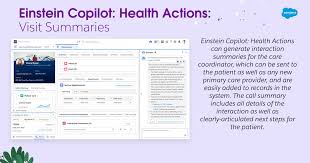
Einstein Copilot for Healthcare – Salesforce has introduced a new AI-powered healthcare assistant within its CRM system, marking its latest move to expand into the healthcare industry. As AI development accelerates, tech giants like Microsoft, Google, Amazon Web Services, and Salesforce are capitalizing on the opportunity to integrate AI and cloud technologies into healthcare to streamline administrative and operational tasks. Salesforce’s healthcare-specific AI tool, Einstein Copilot, is a conversational assistant that leverages an organization’s private data to provide relevant responses. Einstein Copilot enables healthcare providers and care teams to digitally capture and summarize information from both clinical and nonclinical sources, update patient records, and automate manual workflows. Key Features of Einstein Copilot Providers can use Einstein Copilot to generate patient summaries that include medications, diagnoses, social determinants, assessments, clinical service requests, and care gaps. A care manager can also ask the assistant to find an in-network provider based on location, specialty, and insurance coverage, and auto-fill referral forms using natural language prompts. The AI assistant can also trigger workflows for tasks such as sending referrals, scheduling appointments, and updating care plans. Salesforce expects Einstein Copilot to be HIPAA-compliant by summer 2024, with Copilot: Health Actions slated for general availability in winter 2024. Digitizing Health Assessments Salesforce is adding a feature called Assessment Generation that allows healthcare organizations to digitize standardized health assessments. These can be automatically populated into Salesforce Health Cloud, filled out electronically, and tracked for progress over time. Reducing Administrative Waste Salesforce cites research from McKinsey & Co. showing that administrative costs account for nearly a quarter of U.S. healthcare spending, with a potential savings of up to $320 billion. By integrating AI and CRM tools, Salesforce aims to reduce the operational burden on healthcare providers and improve patient outcomes. Amit Khanna, Senior Vice President and General Manager for Health at Salesforce, highlighted the value of these innovations: “These new data, AI, and CRM features reduce the administrative and operational burden for healthcare providers, leading to better outcomes for patients. With Salesforce’s trusted AI, healthcare organizations excited about generative AI—but wary of clinical and security concerns—can confidently integrate these innovations into their workflows.” Early Adopters and Impact Healthcare providers including Baptist Health South Florida and HarmonyCares are already leveraging Salesforce to personalize patient interactions and create unified patient views. HarmonyCares, which operates across 14 states with over 150 primary care providers, has used Salesforce’s AI-driven field service platform to streamline patient scheduling. The company reported a 50% increase in self-scheduling efficiency since adopting the platform and plans to expand its use of Salesforce Health Cloud for care management and engagement. Kristin Darby, Chief Information Officer at HarmonyCares, emphasized the benefits of AI in healthcare: “AI will dramatically improve our ability to quickly synthesize patient needs and preferences, enabling us to offer a more personalized experience with greater accuracy.” However, the integration of AI in healthcare is not without skepticism. A recent survey revealed that 69% of individuals are uncomfortable with AI being used to diagnose them, though more than half are open to its use in nonclinical tasks like scheduling and billing. Salesforce’s Healthcare Journey Salesforce first launched Health Cloud in 2015 to help providers manage patients by aggregating data from electronic medical records, devices, and wearables. In 2022, the company expanded this offering with Customer 360 for Health, a unified platform that combines real-time data from Data Cloud, Einstein AI, and automation tools like Flow to streamline processes such as prior authorizations, intake, and patient scheduling. Like Related Posts Who is Salesforce? Who is Salesforce? Here is their story in their own words. From our inception, we’ve proudly embraced the identity of Read more Salesforce Marketing Cloud Transactional Emails Salesforce Marketing Cloud Transactional Emails are immediate, automated, non-promotional messages crucial to business operations and customer satisfaction, such as order Read more Salesforce Unites Einstein Analytics with Financial CRM Salesforce has unveiled a comprehensive analytics solution tailored for wealth managers, home office professionals, and retail bankers, merging its Financial Read more AI-Driven Propensity Scores AI plays a crucial role in propensity score estimation as it can discern underlying patterns between treatments and confounding variables Read more

Read More
SingleStore Acquires BryteFlow

SingleStore Acquires BryteFlow

SingleStore Acquires BryteFlow, Paving the Way for Real-Time Analytics and Next-Gen AI Use Cases SingleStore, the world’s only database designed to transact, analyze, and search petabytes of data in milliseconds, has announced its acquisition of BryteFlow, a leading data integration platform. This move enhances SingleStore’s capabilities to ingest data from diverse sources—including SAP, Oracle, and Salesforce—while empowering users to operationalize data from their CRM and ERP systems. With the acquisition, SingleStore will integrate BryteFlow’s data integration technology into its core offering, launching a new experience called SingleConnect. This addition will complement SingleStore’s existing functionalities, enabling users to gain deeper insights from their data, accelerate real-time analytics, and support emerging generative AI (GenAI) use cases. “This acquisition marks a pivotal step in our mission to deliver unparalleled speed, scale, and simplicity,” said Raj Verma, CEO of SingleStore. “Customer demands are evolving rapidly due to shifts in big data storage formats and advancements in generative AI. We believe that data is the foundation of all intelligence, and SingleConnect comes at a perfect time to address this need.” BryteFlow’s platform provides scalable change data capture (CDC) capabilities across multiple data sources, ensuring data integrity between source and target. It integrates seamlessly with major cloud platforms like AWS, Microsoft Azure, and Google Cloud, making it a powerful tool for cloud-based data warehouses and data lakes. Its no-code interface allows for easy and accessible data integration, ensuring that existing BryteFlow customers will experience uninterrupted service and ongoing support. “By combining BryteFlow’s real-time data integration expertise with SingleStore’s capabilities, we aim to help global organizations extract maximum value from their data and scale modern applications,” said Pradnya Bhandary, CEO of BryteFlow. “With SingleConnect, developers will find it easier and faster to access enterprise data sources, tackle complex workloads, and deliver exceptional experiences to their customers.” Like Related Posts Who is Salesforce? Who is Salesforce? Here is their story in their own words. From our inception, we’ve proudly embraced the identity of Read more Salesforce Marketing Cloud Transactional Emails Salesforce Marketing Cloud Transactional Emails are immediate, automated, non-promotional messages crucial to business operations and customer satisfaction, such as order Read more Salesforce Unites Einstein Analytics with Financial CRM Salesforce has unveiled a comprehensive analytics solution tailored for wealth managers, home office professionals, and retail bankers, merging its Financial Read more AI-Driven Propensity Scores AI plays a crucial role in propensity score estimation as it can discern underlying patterns between treatments and confounding variables Read more
Read More
Autonomous Agents on the Agentforce Platform

Autonomous Agents on the Agentforce Platform

In early September, Salesforce introduced its latest innovation: Salesforce Agentforce. This AI-powered suite is part of Salesforce’s expanding portfolio aimed at enhancing efficiency and streamlining business operations. Autonomous Agents on the Agentforce Platform are here. What is Salesforce Agentforce? Salesforce Agentforce is a platform designed to build autonomous AI agents, allowing businesses to manage critical tasks without requiring human involvement. What are Autonomous Agents on the Agentforce Platform ? Autonomous AI Service AgentsAn AI agent is an intelligent assistant that autonomously handles customer service and sales functions. These agents operate continuously, addressing basic queries without needing complex dialog systems, Natural Language Processing (NLP), or pre-configured workflows. Autonomous Agents on the Agentforce Platform Agentforce Service Agent The Agentforce Service Agent is an AI-powered customer support assistant that delivers autonomous, natural service. Unlike traditional chatbots, these generative AI agents provide brand-aligned responses while handling tasks, making decisions, and operating around the clock across self-service portals and messaging channels. Key Benefits of Agentforce Service Agent: Agentforce SDR Agent The Agentforce SDR Agent is designed to help businesses engage and qualify inbound leads. It manages prospect inquiries, addresses objections, and leverages customer insights to schedule meetings with the appropriate sales representatives. Key Benefits of Agentforce SDR Agent: Agentforce is Already Delivering Results! As a premier pilot partner for Salesforce we has been working with customers to implement Agentforce, generating rapid success. Stay tuned for more exciting updates and opportunities with Agentforce! Like1 Related Posts Who is Salesforce? Who is Salesforce? Here is their story in their own words. From our inception, we’ve proudly embraced the identity of Read more Salesforce Marketing Cloud Transactional Emails Salesforce Marketing Cloud Transactional Emails are immediate, automated, non-promotional messages crucial to business operations and customer satisfaction, such as order Read more Salesforce Unites Einstein Analytics with Financial CRM Salesforce has unveiled a comprehensive analytics solution tailored for wealth managers, home office professionals, and retail bankers, merging its Financial Read more AI-Driven Propensity Scores AI plays a crucial role in propensity score estimation as it can discern underlying patterns between treatments and confounding variables Read more
Read More
Gen AI to Predict and Automate Discharge

Gen AI to Predict and Automate Discharge

While electronic health records (EHRs) have improved data exchange for care coordination, they have also increased the clinical documentation burden on healthcare providers. Research from 2023 suggests that clinicians may now spend more time on EHRs than on direct patient care. On average, providers spend over 36 minutes on EHR tasks for every 30-minute patient visit. Generative AI, however, holds the potential to transform this. As defined by the Government Accountability Office, generative AI (GenAI) is a technology that can create content—such as text, images, audio, or video—based on user prompts. With the rise of chatbot interfaces like Chat-GPT, health IT vendors and healthcare systems are piloting GenAI tools to streamline clinical documentation. While the technology shows promise in reducing the documentation burden and mitigating clinician burnout, several challenges still hinder widespread adoption. Ambient Clinical Intelligence Ambient clinical intelligence leverages smartphone microphones and GenAI to transcribe patient encounters in real time, producing draft clinical documentation for providers to review within seconds. A 2024 study examined the use of ambient AI scribes by 10,000 physicians and staff at The Permanente Medical Group. The results were promising—providers reported better patient conversations and less after-hours EHR documentation. However, accuracy is critical for patient safety. A 2023 study found that ambient AI tools struggle with non-lexical conversational sounds (NLCSes)—like “mm-hm” and “uh-uh”—which patients and providers use to convey information. For instance, a patient might say “Mm-hm” to confirm they have no allergies to antibiotics. The study found that while the AI tools had a word error rate of 12% for all words, the error rate for NLCSes conveying clinically relevant information was as high as 98.7%. These inaccuracies could lead to patient safety risks, highlighting the importance of provider review. Patient Communication Patient portal messaging has surged since the COVID-19 pandemic, with a 2023 report showing a 157% increase in messages compared to pre-pandemic levels. To manage inbox overload, healthcare systems are exploring generative AI for drafting responses to patient messages. Clinicians review and edit these drafts before sending them to patients. A 2024 study found that primary care physicians rated AI-generated responses higher in communication style and empathy than those written by providers. However, the AI-generated responses were often longer and more complex, posing challenges for patients with lower health or English literacy. There are also potential risks to clinical decision-making. A 2024 simulation study revealed that the content of replies to patient messages changed when physicians used AI assistance, introducing an automation bias that could impact patient outcomes. Although most AI-generated drafts posed minimal safety risks, a small portion, if left unedited, could result in severe harm or death. Although GenAI may reduce the cognitive load of writing replies, it might not significantly decrease the overall time spent on patient communications. A recent study showed that while providers felt less emotional exhaustion when using AI to draft messages, the time spent on replying, reading, and writing messages remained unchanged from pre-pilot levels. Discharge Summaries Generative AI has also been shown to improve the readability of patient discharge summaries. A study published in JAMA Network Open demonstrated that GenAI could lower the reading level of discharge notes from an eleventh-grade to a sixth-grade level, which is more appropriate for diverse health literacy levels. However, accuracy is still a concern. Physician reviews of these AI-generated summaries found that while some were complete, others contained omissions and inaccuracies that raised safety concerns. Balancing AI’s Benefits with Oversight While generative AI shows promise in alleviating the documentation burden and improving patient communication, challenges remain. Issues such as accurately capturing non-verbal cues and ensuring document accuracy underscore the need for careful provider oversight. As AI technologies continue to evolve, ensuring that the benefits are balanced with provider review will be crucial for safe and effective healthcare implementation. Like Related Posts Who is Salesforce? Who is Salesforce? Here is their story in their own words. From our inception, we’ve proudly embraced the identity of Read more Salesforce Unites Einstein Analytics with Financial CRM Salesforce has unveiled a comprehensive analytics solution tailored for wealth managers, home office professionals, and retail bankers, merging its Financial Read more AI-Driven Propensity Scores AI plays a crucial role in propensity score estimation as it can discern underlying patterns between treatments and confounding variables Read more Tectonic’s Successful Salesforce Track Record Salesforce Technology Services Integrator – Tectonic has successfully delivered Salesforce in a variety of industries including Public Sector, Hospitality, Manufacturing, Read more

Read More

GenAI in the Enterprise

🔔🔔 Follow us on LinkedIn 🔔🔔 10 Ways GenAI is Transforming the Enterprise Organizations are adopting Generative AI (GenAI) at different paces—some forging ahead with full-scale deployments, while others cautiously experiment with proofs of concept. Regardless of where they stand in their AI journey, enterprises must navigate challenges such as data quality, ethical considerations, compliance requirements, and AI accuracy. To maximize GenAI’s benefits while minimizing risks, companies must ensure sufficient, high-quality data, implement human oversight, and establish mechanisms to validate AI-generated outputs. AI’s success hinges on its ability to work alongside employees, enhancing efficiency without replacing human ingenuity. Despite these challenges, GenAI is already driving enterprise transformation across industries. Here are ten key ways it’s reshaping business operations: 1. Enhancing Customer Service GenAI elevates customer interactions, enabling more natural and intelligent automated support. Chatbots powered by GenAI engage customers conversationally, providing fast and accurate responses by analyzing vast amounts of data. For customer service agents, GenAI serves as a real-time assistant, offering insights and recommendations to improve interactions. According to Gartner, 85% of customer service leaders plan to explore or pilot conversational GenAI systems in 2025. However, research suggests that the most successful implementations will enhance—not replace—human support, striking a balance between automation and human touch. 2. Revolutionizing Knowledge Management GenAI excels at retrieving and analyzing structured and unstructured data, making it a game-changer for enterprise knowledge management. By surfacing relevant insights from vast information repositories, GenAI enables employees to access critical knowledge more efficiently. Forrester Research highlights that while AI-driven knowledge management boosts efficiency, true transformation occurs when it complements human expertise, fostering collaboration and innovation. 3. Optimizing Supply Chain Management With its ability to analyze historical, internal, and external data, GenAI is improving supply chain management by predicting demand, optimizing inventory, mitigating disruptions, and streamlining logistics. Organizations leveraging AI-driven insights can enhance operational efficiency, reduce costs, and drive sustainability by integrating environmental considerations into supply chain decisions. McKinsey & Co. reports that supply chain and inventory management are among the business functions where GenAI delivers the most significant revenue increases. 4. Automating Content Creation GenAI’s content generation capabilities extend beyond simple text creation to include audio, video, and design assets. Enterprises use GenAI for tasks ranging from drafting emails to developing full-scale marketing campaigns, significantly reducing content production time. A recent study by Enterprise Strategy Group found that 35% of businesses cite content creation as a primary benefit of GenAI, highlighting its role in accelerating marketing and communications efforts. 5. Accelerating Software Development GenAI is streamlining software development by generating code, user requirements, and technical documentation. This not only reduces development time for experienced programmers but also democratizes coding by enabling non-technical users to build applications with AI assistance. According to Capgemini Research Institute, AI-assisted coding is expected to account for 37% of all software development by 2026, significantly boosting productivity across industries. 6. Increasing Employee Productivity with AI Assistants AI-powered assistants are helping employees across various functions work smarter and faster. Whether aiding programmers, customer service representatives, or operations teams, GenAI-driven tools enable professionals to complete tasks with greater efficiency. A survey by Enterprise Strategy Group found that increased productivity is the top GenAI benefit, with 60% of respondents reporting measurable improvements in workplace efficiency. 7. Identifying Process Optimization Opportunities Beyond automating individual tasks, GenAI helps organizations rethink and optimize entire workflows. Companies are increasingly using AI to analyze operational processes, identify inefficiencies, and recommend automation opportunities. Rather than merely accelerating existing processes, AI is enabling businesses to redesign workflows from the ground up, unlocking new levels of efficiency. 8. Transforming Research & Development GenAI is playing an emerging role in research and development, particularly in fields like drug discovery and materials science. The technology helps researchers identify promising compounds, explore new innovations, and iterate through potential solutions at unprecedented speeds. While AI-driven R&D is still in its early stages, Gartner reports that GenAI is already improving productivity and cycle times in innovation-heavy industries. 9. Driving Competitive Differentiation and Revenue Growth Forward-thinking organizations are leveraging GenAI to create new products, services, and business models. Some use AI to identify market opportunities, while others integrate AI directly into their offerings. For example, J.P. Morgan’s Quest IndexGPT uses AI to analyze financial news and recommend investment opportunities, showcasing how businesses can differentiate themselves through AI-powered innovation. 10. Advancing Data-Driven Decision-Making By making analytics more accessible, GenAI is democratizing data-driven decision-making. AI-powered tools allow employees across all levels to interact with data conversationally, lowering barriers to data literacy and empowering informed decision-making. Beyond human decision support, GenAI is also paving the way for agentic AI systems—autonomous AI agents capable of making real-time decisions and executing tasks without human intervention. This next-generation AI capability is expected to further accelerate enterprise automation and innovation. The Future of GenAI in the Enterprise As businesses continue their AI adoption journey, GenAI will become an increasingly integral part of operations, driving efficiency, innovation, and competitive advantage. Organizations that strategically integrate GenAI while ensuring ethical oversight and responsible AI governance will be best positioned to harness its full potential. Like Related Posts Who is Salesforce? Who is Salesforce? Here is their story in their own words. From our inception, we’ve proudly embraced the identity of Read more Salesforce Marketing Cloud Transactional Emails Salesforce Marketing Cloud Transactional Emails are immediate, automated, non-promotional messages crucial to business operations and customer satisfaction, such as order Read more Salesforce Unites Einstein Analytics with Financial CRM Salesforce has unveiled a comprehensive analytics solution tailored for wealth managers, home office professionals, and retail bankers, merging its Financial Read more AI-Driven Propensity Scores AI plays a crucial role in propensity score estimation as it can discern underlying patterns between treatments and confounding variables Read more

Read More
gettectonic.com