ADA Archives - gettectonic.com - Page 40
Salesforce Document Generation

Generating Documents in Salesforce

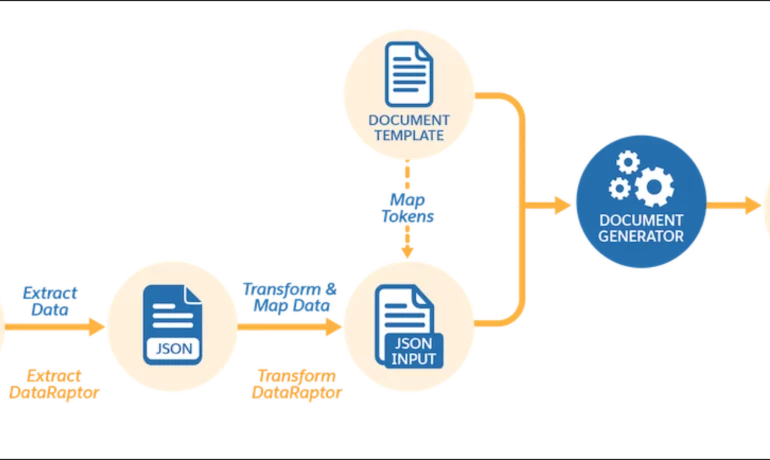
Salesforce document generation poses a challenge for businesses, given the intricacies of integration involved. Fortunately, a variety of tools are available for generating documents in Salesforce, and Tectonic is well-equipped to assist in their successful implementation. Salesforce Industries Document Generation empowers businesses to craft and manage accurate documents linked to standard Salesforce objects, encompassing contracts, opportunities, orders, quotes, and custom objects. For a more dynamic approach, Salesforce OmniStudio Document Generation facilitates the creation of documents using Microsoft Word and Microsoft PowerPoint templates. These templates can incorporate values from any JSON-based data within the text, including data sourced from various Salesforce objects. This versatile tool enables the generation of contracts, proposals, quotes, reports, non-disclosure agreements, service agreements, and more. Salesforce Industries Document Generation seamlessly integrates with Vlocity Insurance, Vlocity Health, communications, media, energy, utilities, government, and beyond. Vlocity Analytics, another valuable component, offers pre-built measurement tools that seamlessly integrate with Salesforce Reports, Dashboards, and Einstein. The Salesforce AppExchange boasts an extensive array of over 200 document generation tools. Your Salesforce partner can assist in selecting, installing, and implementing the most suitable options based on your business requirements. With Document Generation, you can generate contracts, proposals, quotes, reports, non-disclosure agreements, job offers, service agreements, and so on. You can generate documents using the specified sample client-side or server-side OmniScripts. You can also create your own OmniScripts by cloning and customizing the sample OmniScript to generate documents. Client-Side document generation is a synchronous process that results in a downloadable preview of the generated documents. You can generate documents from Microsoft Word (.docx), Microsoft PowerPoint (.pptx), and Web templates. These templates can include values from any JSON-based data in the text, including data from any Salesforce object. You can optionally convert the resulting documents to .pdf format. Server-Side document generation is available in both the OmniStudio Foundation and Salesforce Industries packages. Server-Side document generation is an asynchronous process that’s best for large and rendering-heavy documents and for document generation in batches. The Server-Side document generation service is secure and scalable and is hosted on Salesforce Hyperforce. The generated document is stored in your Salesforce org, and is attached to the object for which it’s generated. You can use Apex Classes, sample Integration Procedures, or a sample OmniScript to generate documents. Client-Side document generation supports Customer Community Plus, Customer Community, and Partner Community users to generate documents using client-side OmniScripts. Server-Side document generation supports Customer Community Plus, Customer Community, and Partner Community users to generate documents using the singleDocxServersideLwc server-side OmniScript. With the right licenses, Document Generation is available in the Salesforce Industries package. Metering measures resource utilization levels and throttling controls resource access and use based on defined rules. Metering measures the number of server-side documents that are generated by an org hourly and daily. The default hourly and daily limits for processing server-side document generation requests are 1,000 per org and 24,000 per org respectively. Throttling maintains consistency and resilience of the server-side document generation service by managing incoming server-side document generation requests from multiple orgs. Throttling can also prevent service degradation caused by high volume of requests at peak hours by blocking requests that exceed the default limits. The request details are saved in the Document Generation Processes entity. You can retrieve the blocked requests and later retry the server-side document generation. No matter what your specific document generation needs, Tectonic simplifies the process of getting your system up and running seamlessly, whether it’s through Salesforce Quickstarts or comprehensive implementation services. Content updated in 2February 2024, Shannan Hearne. Like1 Related Posts AI Automated Offers with Marketing Cloud Personalization AI-Powered Offers Elevate the relevance of each customer interaction on your website and app through Einstein Decisions. Driven by a Read more Salesforce OEM AppExchange Expanding its reach beyond CRM, Salesforce.com has launched a new service called AppExchange OEM Edition, aimed at non-CRM service providers. Read more The Salesforce Story In Marc Benioff’s own words How did salesforce.com grow from a start up in a rented apartment into the world’s Read more Salesforce Jigsaw Salesforce.com, a prominent figure in cloud computing, has finalized a deal to acquire Jigsaw, a wiki-style business contact database, for Read more

Read More
Salesforce Quickstart

Step By Step Guide to a Salesforce Quickstart

Salesforce Implementation with a Tectonic Quickstart: Step-by-Step Salesforce Quickstart Guide. Step 1: Define Your Business Requirements Step 2: Choose the Appropriate Salesforce Products Step 3: Choose the Right Salesforce Quickstart Package Step 4: Prepare Your Data Step 5: Customize Your Quickstart Package Step 6: Train Your Users Step 7: Monitor and Optimize Your Processes Benefits of Salesforce Implementation with QuickStart Package Is it time for your business to get up and running on Salesforce? Contact Tectonic about our Salesforce Quickstart solutions today. Salesforce quickstarts are also known as Salesforce Implementation Solutions. Content updated December 2024. Like1 Related Posts AI Automated Offers with Marketing Cloud Personalization AI-Powered Offers Elevate the relevance of each customer interaction on your website and app through Einstein Decisions. Driven by a Read more Salesforce OEM AppExchange Expanding its reach beyond CRM, Salesforce.com has launched a new service called AppExchange OEM Edition, aimed at non-CRM service providers. Read more The Salesforce Story In Marc Benioff’s own words How did salesforce.com grow from a start up in a rented apartment into the world’s Read more Salesforce Jigsaw Salesforce.com, a prominent figure in cloud computing, has finalized a deal to acquire Jigsaw, a wiki-style business contact database, for Read more

Read More
AI-driven propensity scores

AI-Driven Propensity Scores

AI plays a crucial role in propensity score estimation as it can discern underlying patterns between treatments and confounding variables through machine learning, without explicit programming. This insight has gone through numerous updates as the information and use of AI-driven propensity scores evolved. In many cases, writers give a brief overview of the what of a tool. Today, we are going way beyond “what the sausage tastes like” to “how the sausage is made” Tectonic hopes you will enjoy learning how propensity models and AI driven propensity scores improve your data. Propensity Model in Artificial Intelligence: Propensity modeling generates a propensity score, representing the probability that a visitor, lead, or customer will take a specific action. For instance, a propensity model, using data science or machine learning, can help predict the likelihood of a lead converting to a customer. AI-driven propensity scores take an existing data model and improve its predictions, speed, and analysis with AI. Propensity Score in CRM: In CRM, a propensity score is the model’s probabilistic estimate of a customer performing a specific action. Grouping customers by score ranges allows for effective comparison and analysis within each bucket. Enhancing Propensity Modeling with AI: Traditional statistical propensity models might lack accuracy, but integrating machine learning technologies, as demonstrated by Alphonso, can significantly optimize ad spend and increase prediction accuracy from 8% to 80%. That’s a whopping 72% improvement. Propensity Modeling Overview: Propensity modeling involves predictive models analyzing past behaviors to forecast the future actions of a target audience. It identifies the likelihood of specific actions, aiding in personalized marketing. Role of Machine Learning in Propensity Models: Propensity models rely on machine learning algorithms, acting as binary classifiers predicting whether a certain event or behavior will occur. Logistic regression and Classification and Regression Tree Analysis are common methods for calculating propensity scores. Characteristics of Effective Propensity Models: For robust predictions, propensity models should be dynamic, scalable, and adaptive. Dynamic models adapt to trends, scalable for diverse predictions, and adaptive with regular data updates. Propensity Modeling Applications: Propensity models find applications in predicting customer behavior, such as purchasing, converting, churning, or engaging. Real-time predictions, data analysis, and AI integration contribute to successful implementations. AI-driven propensity scores are extremely useful in that they can be coupled with many other models to give additional insights to your data. Types of Propensity Score Models: Various models include propensity to purchase/convert, customer lifetime value (CLV), propensity to churn, and propensity to engage. Combining models can enhance the effectiveness of marketing campaigns. When to Use Propensity Scores: Propensity scores are beneficial when random assignment of treatments is impractical. They help estimate treatment effects in observational studies, providing an alternative to traditional model-building methods. Limitations of Propensity Score Methods: While propensity scores help achieve exchangeability between exposed and unexposed groups, they do not claim to eliminate confounding due to unmeasured covariates. Findings from observational studies must be interpreted cautiously due to potential residual confounding. Content updated October 2021. Content updated February 2025. Like3 Related Posts AI Automated Offers with Marketing Cloud Personalization AI-Powered Offers Elevate the relevance of each customer interaction on your website and app through Einstein Decisions. Driven by a Read more Salesforce OEM AppExchange Expanding its reach beyond CRM, Salesforce.com has launched a new service called AppExchange OEM Edition, aimed at non-CRM service providers. Read more The Salesforce Story In Marc Benioff’s own words How did salesforce.com grow from a start up in a rented apartment into the world’s Read more Salesforce Jigsaw Salesforce.com, a prominent figure in cloud computing, has finalized a deal to acquire Jigsaw, a wiki-style business contact database, for Read more

Read More
Salesforce XML

XML-Based Messaging Protocol

The primary focus of the XML based messaging Protocol Working Group is to establish a framework for XML-based messaging systems. This framework encompasses the specification of a message envelope format and a method for data serialization. While the emphasis is on RPC applications, the framework adheres to the specified principles, catering not exclusively but primarily to RPC applications. XML messaging represents a rapidly growing, dynamic area of IT, a situation that makes it exciting and tiresome at the same time. As B2B exchanges and other forms of inter-business electronic communication grow, XML messaging will be more widely deployed than ever. Dirk Reinshagen, Javaworld What are XML messages? XML Messaging format is designed to facilitate the exchange of structured information in the implementation of Web Services within computer networks. An XML interface serves as the foundational layer of a web services protocol stack, providing a fundamental messaging framework upon which web services can be constructed. How can XML text messages be read? XML files are encoded in plaintext, allowing them to be easily opened and read in any text editor. To do so, right-click the XML file and select “Open With.” A list of programs to open the file will appear, and you can choose “Notepad” (Windows) or “TextEdit” (Mac) for clear readability. SOAP API (Simple Object Access Protocol) is a protocol used for accessing web services in Salesforce. It enables developers to interact with the Salesforce platform using a standardized messaging format and receive data in the form of XML. is Like Related Posts AI Automated Offers with Marketing Cloud Personalization AI-Powered Offers Elevate the relevance of each customer interaction on your website and app through Einstein Decisions. Driven by a Read more Salesforce OEM AppExchange Expanding its reach beyond CRM, Salesforce.com has launched a new service called AppExchange OEM Edition, aimed at non-CRM service providers. Read more The Salesforce Story In Marc Benioff’s own words How did salesforce.com grow from a start up in a rented apartment into the world’s Read more Salesforce Jigsaw Salesforce.com, a prominent figure in cloud computing, has finalized a deal to acquire Jigsaw, a wiki-style business contact database, for Read more

Read More
360 SMS Salesforce Chatbot

Salesforce 360

Unlock the full potential of your business with Salesforce 360, the world’s leading customer relationship management platform. Imagine having a 360-degree view of your customers, empowering you to engage effectively, streamline operations, and drive sustainable growth. Whether you’re a startup or an enterprise, Salesforce adapts to your unique needs, ensuring your CRM evolves with your business. Our team of certified consultants is dedicated to designing solutions that align with your long-term goals, enhancing both customer satisfaction and employee efficiency. Discover how we can transform your Salesforce investment into a powerful engine for growth and customer success.

Read More
managed salesforce services

Why Managed Salesforce Services

Utilizing a managed services program for Salesforce can offer numerous benefits to your company: By hiring experts on a fixed hourly basis instead of full-time, you can pay for actual work hours, eliminating delays and downtime. This flexible agreement model is a preferred choice for businesses and contributes to reducing operational costs. Depending upon your needs you can purchase cost-effective hours for a reasonable turn around on work or premium hours for high priority projects. Managed Services provide ongoing support and maintenance to ensure the effective functioning of the Salesforce CRM in sync with the evolving needs of the organization. What is a Salesforce MSP? The MSP Track is designed by Salesforce for partners that engage with their customers in new ways by offering managed services. Unlike consulting partners involved during sales and implementation, MSP Partners provide services post-implementation or on an ongoing basis. Internal Components of Salesforce Managed Services Consulting: Tailored solutions designed to meet customers’ unique needs. Salesforce consulting provides precise strategies that align with departmental goals across sales, marketing, and customer service. Implementation: Salesforce professionals craft a personalized solution based on your business objectives, ensuring a tailored CRM system that supports business growth and success. Integration: Seamlessly connect your Salesforce solution with other systems to create a unified, user-friendly experience across all your platforms. Development and Customization: Build custom workflows, reports, and email templates to ensure Salesforce integrates effortlessly with your operations, delivering results that meet your objectives. Lightning Migration: Upgrade to Salesforce Lightning to unlock advanced features like artificial intelligence. This migration enhances productivity, empowering your team to operate efficiently while utilizing Salesforce’s cutting-edge, user-friendly tools. Support and Maintenance: Engage with experts to optimize your Salesforce investment. These services ensure proper system operation, minimize the need for a full-time administrator, and adapt to your business needs to maximize ROI and ongoing success. 10 Key Benefits of Salesforce Managed Services with Tectonic Based in the United States, Tectonic offers managed services for your Salesforce ecosystem. Contact us today for more information. Content updated December 2024. Like2 Related Posts AI Automated Offers with Marketing Cloud Personalization AI-Powered Offers Elevate the relevance of each customer interaction on your website and app through Einstein Decisions. Driven by a Read more Salesforce OEM AppExchange Expanding its reach beyond CRM, Salesforce.com has launched a new service called AppExchange OEM Edition, aimed at non-CRM service providers. Read more The Salesforce Story In Marc Benioff’s own words How did salesforce.com grow from a start up in a rented apartment into the world’s Read more Salesforce Jigsaw Salesforce.com, a prominent figure in cloud computing, has finalized a deal to acquire Jigsaw, a wiki-style business contact database, for Read more

Read More
Cloud First

Overlooked Costs of a Salesforce Implementation

Let’s look at some frequently overlooked Salesforce costs. The goal is to provide businesses and decision-makers with a comprehensive understanding of the full financial implications involved in adopting Salesforce. By highlighting these often unexpected expenses, Tectonic aims to align your journey from initiation to ‘go live’ with your budget expectations.

Read More
Salesforce analytics insurance

Business Analysis and Project Management Acronyms

Here is a helpful glossary of business analysis and project management acronyms you may encounter when discussing business analysis and project management. Acronym Meaning Definition BPMN Business Process Management Notation “A flow chart method that models the steps of a planned business process from end to end. Its purpose is to model ways to improve efficiency, account for new circumstances or gain competitive advantage.” (source) CCMP Certified Change Management Professional CCMP (Certified Change Management Professional) is aimed at change management professionals, which includes Salesforce Consultants, Business Analysts, Project Managers, Salesforce Admins, and other similar roles. CIO Chief Information Officer The member of the C-suite who takes responsibility for IT systems, especially an organization’s data. DoD Definition of Done “Definition of done” relates to one of the requirements that the user story must adhere to for the Development Team to call it complete. This is following the acceptance criteria being met. FRS Functional Requirements Specification The project documentation where the business requirements are defined from an end user or business perspective. It will specify the expected outcomes. INVEST Independent, Negotiable, Valuable, Estimable, Small, Testable Use the INVEST checklist to assess the quality of a user story. Have you met all the criteria? JTBD Jobs To Be Done JTBD is a methodology for determining what problems users are trying to solve, focused on understanding users in terms of functional, emotional and social needs. JTBD is a core concept in the Strategy Designer Certification. PM Project Manager Project Managers oversee Salesforce projects end-to-end on a variety of Salesforce ‘clouds’ and levels of complexity. Their priority is to ensure the project is successful – delivered on time, and within budget.The responsibilities of a Salesforce Project Manager range from typical organizational tasks and technical acumen, through to work that requires emotional intelligence, tact, solid communication, and many other ‘soft’ skills. PMO Project Management Officers Project Management Officers work with the organization’s leaders to fulfill the same responsibilities as project managers. In addition, PMOs will carry out pre-project planning, such as risk analysis and opportunity analysis. PMP Project Management Professional Project Management Professional (PMP) equips project managers with up-to-date trends and practices with project management tools, processes, and methods. PPM Portfolio Project Management A category of technology that enables project managers to outline, track, and collaborate on a set of ongoing projects. PSA Professional Services Automation A category of technology that combines project management, time tracking, invoicing, resource planning, and more. PSM Professional Scrum Master Scrum helps people and teams deliver value incrementally in a collaborative manner. The entry level PSM-1 is aimed at understanding Scrum best practice when working on Agile projects. You will find this very useful on Salesforce projects. RACI Responsible, Accountable, Consulted, Informed A matrix that delineates who is responsible for what in the context of the business analysis effort. Responsible (person who performs an activity or does the work), Accountable (person who is ultimately accountable for the outcome), Consulted (person who needs to provide feedback or contribute to the activity), Informed (person who needs to know of a decision or action). RFI Request for Information Requests For Information (RFIs) and Requests for Proposal (RFPs) are a useful approach for teams evaluating Salesforce tooling – they allow you to quickly source information on features, workflows, and pricing from a range of vendors. RFP Request for Purchase Requests For Information (RFIs) and Requests for Proposal (RFPs) are a useful approach for teams evaluating Salesforce tooling – they allow you to quickly source information on features, workflows, and pricing from a range of vendors. SIPOC Supplier, Inputs, Process, Outputs, and Customers SIPOC is a type of process map that shows the key elements of a process such as Suppliers, Inputs, Process, Outputs, and Customers. SoW Statement of Work The SoW is a legal document that outlines the work to be carried out (the scope), what’s excluded (out of scope), the client-side responsibilities, and the project schedule and fees. SRS System Requirements Specification The project documentation that details how the complete system should function and enumerates hardware, software, and functional and behavioral requirements of the system. UML Unified Modeling Language Diagramming that uses “a common visual language in the complex world of software development that would also be understandable for business users and anyone who wants to understand a system”. (source) UPN Universal Process Notation A simpler and more engaging diagramming notation that has been designed to be easily understood by all the stakeholders and viewed online. As a hierarchical diagram, you are able to drill down to give more detail (with no limit to the number of levels you can go down). business analysis and project management acronyms Like Related Posts AI Automated Offers with Marketing Cloud Personalization AI-Powered Offers Elevate the relevance of each customer interaction on your website and app through Einstein Decisions. Driven by a Read more Salesforce OEM AppExchange Expanding its reach beyond CRM, Salesforce.com has launched a new service called AppExchange OEM Edition, aimed at non-CRM service providers. Read more The Salesforce Story In Marc Benioff’s own words How did salesforce.com grow from a start up in a rented apartment into the world’s Read more Salesforce Jigsaw Salesforce.com, a prominent figure in cloud computing, has finalized a deal to acquire Jigsaw, a wiki-style business contact database, for Read more

Read More
Salesforce CRM for AI driven transformation

Salesforce Artificial Intelligence

Is artificial intelligence integrated into Salesforce? Salesforce Einstein stands as an intelligent layer embedded within the Lightning Platform, bringing robust AI technologies directly into users’ workspaces. The Einstein Platform offers administrators and developers a comprehensive suite of platform services, empowering them to create smarter applications and tailor AI solutions for their enterprises. What is the designated name for Salesforce’s AI? Salesforce Einstein represents an integrated array of CRM AI technologies designed to facilitate personalized and predictive experiences, enhancing the professionalism and attractiveness of businesses. Since its introduction in 2016, it has consistently been a leading force in AI technology within the CRM realm. Is Salesforce Einstein a current feature? “Einstein is now every customer’s data scientist, simplifying the utilization of best-in-class AI capabilities within the context of their business.” Is Salesforce Einstein genuinely AI? Salesforce Einstein for Service functions as a generative AI tool, contributing to the enhancement of customer service and field service operations. Its capabilities extend to improving customer satisfaction, cost reduction, increased productivity, and informed decision-making. Salesforce Artificial Intelligence AI is just the starting point; real-time access to customer data, robust analytics, and business-wide automation are essential for AI effectiveness. Einstein serves as a comprehensive solution for businesses to initiate AI implementation with a trusted architecture that prioritizes data security. Einstein is constructed on an open platform, allowing the safe utilization of any large language model (LLM), whether developed by Salesforce Research or external sources. It offers flexibility in working with various models within a leading ecosystem of LLM platforms. Salesforce’s commitment to AI is evident through substantial investments in researching diverse AI areas, including Conversational AI, Natural Language Processing (NLP), Multimodal Data Intelligence and Generation, Time Series Intelligence, Software Intelligence, Fundamentals of Machine Learning, Science, Economics, and Environment. These endeavors aim to advance technology, improve productivity, and contribute to fields such as science, economics, and environmental sustainability. Content updated April 2023. Like1 Related Posts AI Automated Offers with Marketing Cloud Personalization AI-Powered Offers Elevate the relevance of each customer interaction on your website and app through Einstein Decisions. Driven by a Read more Salesforce OEM AppExchange Expanding its reach beyond CRM, Salesforce.com has launched a new service called AppExchange OEM Edition, aimed at non-CRM service providers. Read more The Salesforce Story In Marc Benioff’s own words How did salesforce.com grow from a start up in a rented apartment into the world’s Read more Salesforce Jigsaw Salesforce.com, a prominent figure in cloud computing, has finalized a deal to acquire Jigsaw, a wiki-style business contact database, for Read more

Read More
abc

Alphabet Soup of Cloud Terminology

As with any technology, the cloud brings its own alphabet soup of terms. This insight will hopefully help you navigate your way through the terminology, and provide you the knowledge and power to make the decisions you need to make when considering a new cloud implementation. Here’s the list of terms we will cover in this article: Phew—that’s a lot. Let’s dig in to the definitions and examples to help drive home the meanings of the list of terms above. SaaS (Software as a Service) This is probably the most common implementation of cloud services end users experience. This is software that users access through their web browser. Some software may be installed locally to help augment functionality or provide a richer user experience, but the software installed locally has minimal impact on the user’s computer. Figure 1 provides a high-level overview of this concept. Figure 1 High-level overview of Software as a Service You are probably a user Facebook, Google docs, Office 365, Salesforce, or LinkedIn either at home or at work, so you’ve experienced SaaS first hand and probably for a long time. What SaaS tools are you using outside of those mentioned here? Reach out and let me know—I’m very curious. PaaS (Platform as a Service) PaaS allows a developer to deploy code to an environment that supports their software but they do not have full access to the operating system. In this case the developer has no server responsibility or server access. When I first started writing about cloud technology three years ago, this was kind of primitive service. The provider would just give you access to a folder somewhere on the server with just a bit of documentation and then you were on your own. Now there are tools, such as CloudFoundry, that allow a developer to deploy right from their Integrated Development Environment (IDE) or from a command line production release tool. Then CloudFoundry can take the transmitted release and install it correctly into the cloud environment. With a little trial and error, anyone with a bit of technical skills can deploy to a tool like CloudFoundry where the older style of PaaS took a lot of skill and experience to deploy correctly. IaaS (Infrastructure as a Service) Originally IaaS dealt with a provider giving a user access to a virtual machine located on a system in the provider’s data center. A virtual machine is an operating system that resides in a piece of software on the host computer. Virtual Box, Parallels and VMWare are examples of software that provide virtualization of operating systems called Virtual Machines (VM) Virtualization of servers was all the rage for a while, but when you try to scale within the cloud with multiple virtual servers there are a lot of drawbacks. First, it’s a lot of work to make VMs aware of each other and they don’t always share filesystems and resources easily. Plus, as your needs grow, VMs with a lot of memory and disk space are very expensive, and very often an application on a VM is only using a portion of the OS. For example, if you are deploying a tool that does data aggregation and runs as a service you won’t be taking advantage of the web server that might be running on server too. The issues mentioned in the previous paragraph are common headaches for those moving their on-premise implementations to the cloud, and those headaches gave rise to Docker. Docker is a lighter weight form of virtualization that allows for easier sharing of files, versioning, and configuration. Servers that could only host a few VMs can host thousands of Docker images, so providers get better bang for the buck for their server purchases. Further explanation of Docker is an article all by itself, but for now it’s import to realize that Docker needs to be part of any discussion of moving your applications to the cloud. DaaS (Desktop as a Service) Desktop computers are expensive for large corporations to implement and maintain. The cost of the OS, hardware, security software, productivity software, and more start to add up to where it makes a major impact on any corporation’s budget. Then just as they finish deploying new systems to everyone in the company, it’s time to start upgrading again because Microsoft just released a new OS. Another fact with most desktop computers is that they are heavily underutilized, and DaaS allows an IT department to dynamically allocate RAM and disk space based on user need. In addition backups and restores are a breeze in this environment, and if you are using a third party provider all you need to do is make a phone call when a restore of a file or desktop is needed. Plus upgrades to new operating systems are seamless because the DaaS provider takes care of them for you. The main advantage I see with DaaS is security. With one project I was involved with, we restored the state of each Desktop to a base configuration each night. While this did not affect user files, it did remove any malware that might have been accidently installed by a user clicking on the wrong email. Documents from Microsoft Office or Adobe products were scanned with a separate antivirus program residing on the storage system they were a part of, and the network appliance that we used did not allow for the execution of software. That made it very secure for the client I was working with. So what does a user have on their desktops? Luckily in recent years there has been an explosion of low cost computing devices, such as a Raspberry PI, that support Remote Desktop Protocol (RDP) so your users could access a windows desktop from the linux-based PI which you can get for a measely . DaaS is awesome for your average information worker, but for a power user like a software developer this setup in my experience doesn’t work well. Your average developer needs

Read More
Why Use Marketing Cloud Mobile Connect

Salesforce Bolsters Mobile Security with Acquisition of Toopher

San Francisco, CA – Salesforce has acquired Toopher, an Austin-based mobile authentication startup, signaling a stronger push into adaptive security solutions for its cloud platform. The deal, announced on Toopher’s website and confirmed by Salesforce to TechCrunch, marks another strategic move to enhance identity verification and access control for businesses operating on the go. What Toopher Brings to Salesforce Toopher’s location-aware two-factor authentication (2FA) technology adds an intelligent layer of security by: The startup, which had raised million in funding, will immediately halt product sales as its team integrates into Salesforce. Why This Matters for Salesforce The acquisition aligns with Salesforce’s growing focus on mobile-first security, particularly as remote work and BYOD (“Bring Your Own Device”) policies expand. Toopher’s tech could enhance: “We’re thrilled to join Salesforce and scale our vision on the world’s #1 cloud platform,” said Toopher co-founders Josh Alexander and Evan Grim in a statement. The Bigger Picture As cyber threats grow more sophisticated, Salesforce is doubling down on adaptive security—balancing stringent access controls with seamless usability. Toopher’s IP may soon surface in Salesforce’s Identity & Access Management (IAM) offerings or as part of Customer 360 integrations. Terms of the deal remain undisclosed, but the move underscores Salesforce’s commitment to secure, frictionless enterprise mobility. What’s Next?Expect tighter integration of Toopher’s geofencing and behavioral authentication into Salesforce’s ecosystem—potentially reducing reliance on third-party security tools for enterprises. Like Related Posts AI Automated Offers with Marketing Cloud Personalization AI-Powered Offers Elevate the relevance of each customer interaction on your website and app through Einstein Decisions. Driven by a Read more Salesforce OEM AppExchange Expanding its reach beyond CRM, Salesforce.com has launched a new service called AppExchange OEM Edition, aimed at non-CRM service providers. Read more The Salesforce Story In Marc Benioff’s own words How did salesforce.com grow from a start up in a rented apartment into the world’s Read more Salesforce Jigsaw Salesforce.com, a prominent figure in cloud computing, has finalized a deal to acquire Jigsaw, a wiki-style business contact database, for Read more

Read More
gettectonic.com