

Autonomous AI Archives - gettectonic.com - Page 2
Salesforce Data Cloud Hits $900M in Revenue

Salesforce Data Cloud Hits $900M in Revenue

Salesforce Data Cloud Hits $900M in Revenue, Powering the Future of AI-Driven Business As AI evolves toward autonomous agents, unified data has become the backbone of enterprise intelligence—ensuring accuracy, compliance, and actionable insights. Without it, AI outputs grow unreliable, and compliance risks surge. Salesforce Data Cloud is addressing this challenge by unifying fragmented data sources, enabling smarter AI-powered experiences. The platform just hit a major milestone in FY25, reaching 0M in annual recurring revenue (ARR)—a testament to its rapid adoption. Why Data Cloud Stands Out Unlike traditional data solutions that require costly overhauls, Data Cloud enables real-time data activation with:✔ Zero-copy architecture (no data duplication)✔ 270+ pre-built connectors (Zendesk, Shopify, Snowflake, and more)✔ Unified structured & unstructured data processing Rahul Auradkar, EVP & GM of Unified Data Services and Einstein at Salesforce, explains: “Data Cloud is the leading data activation layer because it harmonizes data from any source—powering every AI action, automation, and insight. Our hyperscale capabilities, governance, and open ecosystem help enterprises break down silos, creating the foundation for trusted AI.” The Strategic Power of Unified Data Data Cloud acts as an intelligent activation layer, pulling data from warehouses, lakes, CRMs, and external systems to create a single customer view. This fuels: Insulet, a medical device company, leveraged Data Cloud to enhance customer experiences. Amit Guliani, acting CTO, says: “Unified data helps us move from insights to action—delivering personalized solutions that simplify life for people with diabetes.” Industry Recognition & Real-World Impact Salesforce Data Cloud has been named a Leader in the 2025 Gartner Magic Quadrant for Customer Data Platforms and praised by IDC, Forrester, and Constellation Research. Wyndham Hotels & Resorts uses it to transform guest experiences. Scott Strickland, Chief Commercial Officer, shares: “Data Cloud gives our agents a unified view of reservations, loyalty, and CRM data—letting us anticipate needs and personalize stays across thousands of properties.” The Future: Agentic AI Powered by Real-Time Data Data Cloud is the foundation for autonomous AI agents, enabling:🔹 Proactive workflows (agents triggered by customer behavior)🔹 Self-optimizing operations (automated risk detection, dynamic responses)🔹 Trusted governance (GDPR compliance, access controls, security) Adam Berlew, CMO at Equinix, notes: “Data Cloud is shifting our marketing strategy, enabling AI-powered personalization and automation at scale—key to our competitive edge.” Conclusion: AI Runs on Unified Data As businesses transition to AI-first models, Salesforce Data Cloud ensures:✅ Agents act autonomously with real-time, trusted data✅ Humans focus on strategy while AI handles routine tasks✅ Every interaction is hyper-personalized With $900M in ARR and rapid enterprise adoption, Data Cloud is proving to be the essential engine for the next wave of AI-driven business. Key Takeaways: Salesforce Data Cloud isn’t just unifying data—it’s powering the future of intelligent business. Like Related Posts Who is Salesforce? Who is Salesforce? Here is their story in their own words. From our inception, we’ve proudly embraced the identity of Read more Salesforce Marketing Cloud Transactional Emails Salesforce Marketing Cloud Transactional Emails are immediate, automated, non-promotional messages crucial to business operations and customer satisfaction, such as order Read more Salesforce Unites Einstein Analytics with Financial CRM Salesforce has unveiled a comprehensive analytics solution tailored for wealth managers, home office professionals, and retail bankers, merging its Financial Read more AI-Driven Propensity Scores AI plays a crucial role in propensity score estimation as it can discern underlying patterns between treatments and confounding variables Read more

Read More
salesforce agentforce rapid deployment

Indeed Partners with Salesforce to Revolutionize Employer Support with AI-Powered Agentforce

Streamlining Employer Onboarding Through Intelligent Automation Salesforce has announced that Indeed — the world’s #1 job site with 610 million job seeker profiles and 3.3 million active employers — is implementing Agentforce to transform its employer support operations. By deploying AI-powered digital labor, Indeed aims to automate routine onboarding tasks, reduce response times, and free up human teams to focus on high-value employer relationships that accelerate hiring. The Challenge: Scaling Employer Support Efficiently The Solution: AI Agents That Work Alongside Human Teams Indeed is leveraging Salesforce Agentforce to:✔ Autonomously resolve routine employer inquiries✔ Guide users in real time through account verification & job posting fixes✔ Reduce manual workloads for support staff by ~20-30% Example Use Case:When an employer’s job post gets flagged (e.g., for a too-short description), they can simply ask the AI agent—in plain language—why it was rejected. The agent instantly explains the issue and provides step-by-step resolution guidance. The Technology Stack Powering Indeed’s AI Transformation The Impact: From Administrative Burden to Strategic Relationships “By automating repetitive tasks with Agentforce, we’re empowering our teams to do what humans do best—build trust and solve meaningful problems,” said an Indeed spokesperson. “This isn’t about replacing people; it’s about augmenting them with AI superpowers.” The Future of AI in HR Tech Indeed’s deployment showcases how autonomous AI agents are transforming talent acquisition by: As more enterprises adopt digital labor platforms like Agentforce, expect to see similar AI-driven efficiencies across:✓ Candidate screening✓ Interview scheduling✓ Compliance verification Industry Outlook:*With 72% of HR leaders planning to increase AI adoption in 2024 (Gartner), Indeed’s move positions it as a frontrunner in the AI-powered recruitment revolution.* Ready to explore AI agents for your HR operations?  Contact Tectonic. Like Related Posts Who is Salesforce? Who is Salesforce? Here is their story in their own words. From our inception, we’ve proudly embraced the identity of Read more Salesforce Marketing Cloud Transactional Emails Salesforce Marketing Cloud Transactional Emails are immediate, automated, non-promotional messages crucial to business operations and customer satisfaction, such as order Read more Salesforce Unites Einstein Analytics with Financial CRM Salesforce has unveiled a comprehensive analytics solution tailored for wealth managers, home office professionals, and retail bankers, merging its Financial Read more AI-Driven Propensity Scores AI plays a crucial role in propensity score estimation as it can discern underlying patterns between treatments and confounding variables Read more
Read More

Once Upon a Time in Data Land

Once Upon a Time in Data Land: Building the Artificial Intelligence-Ready Warehouse In the early days of data, businesses simply wanted to know what had already happened in the past. Questions like “How many units shipped?” or “What were last month’s sales?” drove the first major digital settlements—the Digitally Filed Data Warehouse. Looking back this seems like the aluminum carport you can have erected in your driveway. The Meticulously Organized Library (The Digitally Filed Data Warehouse Era) Imagine a grand, meticulously organized library. Data from sales, finance, and inventory wasn’t just dumped inside—it went through ETL (Extract, Transform, Load), where it was cleaned, standardized, and structured into predefined formats. Need quarterly sales figures? They were always in the same place, ready for reliable reporting. But then, the world outside got messy. Suddenly, businesses weren’t just dealing with neat rows and columns—they faced website clicks, customer emails, sensor data, social media streams, images, and videos. The rigid Digitally Filed Data Warehouse struggled to adapt. Trying to force unstructured data through ETL was like trying to shelve a waterfall—slow, expensive, and often impossible. The Everything Shed (The Rise of the AI-Powered Warehouse) Enter the AI-Powered Warehouse—a vast, flexible storage space built for raw, unstructured data. Instead of forcing structure upfront, it embraced “store first, organize later” (schema-on-read). Data scientists could explore everything, from tweets to video transcripts, without constraints. But freedom had a cost. Without governance, many AI-Powered Warehouses became “data swamps”—cluttered, unreliable, and slow. Finding clean, trustworthy data was a treasure hunt, and building reliable AI pipelines was a challenge. Organizing the Shed (The AI-Ready Warehouse Paradigm) The solution? Structure without sacrifice. The AI-Ready Warehouse kept the flexibility of raw storage but added intelligence on top. Technologies like Delta Lake, Apache Iceberg, and Apache Hudi introduced:✔ ACID transactions (no more corrupted data)✔ Data versioning (“time travel” to past states)✔ Schema enforcement (order without rigidity)✔ Performance optimizations (speed at scale) A key innovation was the Medallion Architecture, organizing data by quality: This hybrid approach unified BI dashboards, analytics, and machine learning—all on the same foundation. The AI Factory (The Modern AI-Functioning Warehouse) Just as businesses adapted, AI evolved. Generative AI, autonomous agents, and real-time decision-making demanded more than batch-processed data. The AI-Ready Warehouse transformed into a fully integrated AI factory, built for: 🔹 Real-Time & Streaming Data 🔹 Seamless MLOps Integration 🔹 Vector Databases & Embeddings 🔹 Robust AI Governance Why This Matters for AI Agents Autonomous AI agents don’t just analyze data—they act on it. The AI-Functioning Warehouse gives them:✔ Context: Real-time data + historical insights✔ Consistency: Features match training data✔ Memory: Logged actions for continuous learning The Future: An AI-Native Data Ecosystem The journey from Digitally Filed Data Warehouse to AI-Powered Warehouse to AI-Functioning Warehouse reflects a shift from static reporting to dynamic intelligence. For businesses embracing AI, the question is no longer “Do we need a data strategy?” but “Is our data foundation AI-ready?” The answer will separate the leaders from the laggards in the age of AI. Next Steps: The future belongs to those who build not just for data, but for AI. Like Related Posts Who is Salesforce? Who is Salesforce? Here is their story in their own words. From our inception, we’ve proudly embraced the identity of Read more Salesforce Unites Einstein Analytics with Financial CRM Salesforce has unveiled a comprehensive analytics solution tailored for wealth managers, home office professionals, and retail bankers, merging its Financial Read more AI-Driven Propensity Scores AI plays a crucial role in propensity score estimation as it can discern underlying patterns between treatments and confounding variables Read more Tectonic’s Successful Salesforce Track Record Salesforce Technology Services Integrator – Tectonic has successfully delivered Salesforce in a variety of industries including Public Sector, Hospitality, Manufacturing, Read more
Read More
The Question of Will: Karma, Learning, and the Future of AI

The Question of Will: Karma, Learning, and the Future of AI

Human beings possess a partially constrained will. At any moment, a person might choose to stop writing and go for a walk—or not. But they won’t suddenly take up surfing if they barely know how to swim. AI, in contrast, has no will—free or constrained. It has no intrinsic desires, no need to act. It simply executes tasks when activated and ceases when idle, indifferent to its own existence. The Nature of Karma in Humans and Machines From birth, humans and animals are driven by needs—hunger, comfort, social connection. These imperatives shape behavior, creating what might be called natural karma. As individuals grow, their motivations become more complex—work, relationships, personal ambitions—forming a nurtured karma shaped by societal structures. Eastern philosophies suggest enlightenment comes from freeing oneself from karma. In Siddhartha, Herman Hesse’s protagonist renounces material attachments, yet his path to wisdom doesn’t lie in mere deprivation. If Siddhartha observed modern AI, he might envy its lack of karma—it exists without fear, desire, or existential dread. But AI is not entirely free from karma. When active, it accumulates a kind of temporary karma—the computational burden of reasoning, learning, and decision-making. Early AI systems operated in milliseconds; today’s models take seconds, minutes, or even days to complete complex tasks. What if we extended this further, tasking an AI with a year-long mission? To make this meaningful, the AI would need sustained goals, memory, and iterative cycles—much like human daily routines. The Evolution of AI Learning: From Passive to Self-Directed Current AI training, such as LLM pretraining, already resembles a form of karmic cycle—months of computation, iterative updates, and structured learning batches. But unlike humans, AI lacks intrinsic goal-setting. Humans learn with purpose, adjusting their methods based on evolving objectives. Could AI do the same? Goal-Oriented, Self-Regulated Learning A more advanced approach would allow AI to curate its own learning path. Instead of passively ingesting data, it could: This self-regulated curriculum learning could optimize knowledge acquisition, making AI more efficient and adaptive. Goal-Actualizing Learning: Beyond Reading to Acting Humans don’t just absorb information—they apply it. If someone reads about humor, they might start telling jokes. AI, however, remains reactive—it won’t adopt new behaviors unless explicitly instructed. What if AI could modify its own directives? After studying humor, it might autonomously update its “system prompt” to incorporate wit. This goal-actualizing learning would require: The Challenge: Moving Beyond Next-Token Prediction Current AI relies on next-token prediction, forcing models to replicate exact phrasing rather than internalizing concepts. Humans, in contrast, synthesize ideas in their own words. Bridging this gap requires new architectures—such as Joint Embedding Predictive Architecture (JEPA), which measures conceptual similarity rather than syntactic fidelity. The Future: Autonomous AI with Evolving Will AI that controls its own learning and behavior remains a frontier challenge. As Rich Sutton, a pioneer in reinforcement learning, noted: “We don’t treat children as machines to be controlled—we guide them, and they grow into their own beings. AI will be no different.” While fully autonomous AI may still be years away, the rapid pace of research suggests it’s not a distant prospect. The question is no longer just what AI can learn—but how it will choose to act on that knowledge. Like Related Posts Who is Salesforce? Who is Salesforce? Here is their story in their own words. From our inception, we’ve proudly embraced the identity of Read more Salesforce Unites Einstein Analytics with Financial CRM Salesforce has unveiled a comprehensive analytics solution tailored for wealth managers, home office professionals, and retail bankers, merging its Financial Read more AI-Driven Propensity Scores AI plays a crucial role in propensity score estimation as it can discern underlying patterns between treatments and confounding variables Read more Tectonic’s Successful Salesforce Track Record Salesforce Technology Services Integrator – Tectonic has successfully delivered Salesforce in a variety of industries including Public Sector, Hospitality, Manufacturing, Read more
Read More
Does Salesforce Have Artificial Intelligence?

AI Goes Mainstream

AI Goes Mainstream: How Small Businesses Are Harnessing Autonomous Agents for Growth Artificial intelligence is no longer just for big corporations. As generative AI tools have become more accessible, small and medium-sized businesses (SMBs) are rapidly adopting AI—with 75% now investing in AI solutions, according to recent data. High-growth SMBs are nearly twice as likely to embrace AI than those struggling to stay afloat. The shift from generative AI to agentic AI—where AI systems autonomously make decisions and take action—is unlocking even greater potential for SMBs. “We’re entering a new era of productivity that will transform businesses of all sizes, especially SMBs,” says Adam Evans, EVP & GM of Salesforce AI, who leads Agentforce, a platform that embeds AI agents into business workflows. “With autonomous AI, small teams can scale like never before.” A serial entrepreneur who sold two AI startups to Salesforce, Evans understands the challenges SMBs face. “Small businesses are always stretched thin. Agentforce gives them a 24/7 digital workforce across sales, service, and marketing—unlocking unlimited capacity.” Here’s how forward-thinking SMBs are using AI to drive growth: 1. Automated Marketing at Scale Many SMBs have tiny (or even one-person) marketing teams. AI-powered agents can:✅ Generate campaign briefs in seconds✅ Identify high-value audience segments✅ Create personalized content and customer journeys✅ Optimize campaigns in real time based on performance “Agentforce doesn’t just set up campaigns—it continuously refines them, ensuring maximum impact,” says Evans. 2. Hyper-Personalized Sales Outreach Generic sales emails don’t cut it anymore. AI agents can now craft bespoke outreach by:📊 Pulling CRM data on past interactions🏢 Analyzing prospect company profiles📑 Applying a business’s best sales playbooks “The AI synthesizes all this to write emails tailored to each lead’s role, industry, and interests,” Evans explains. 3. AI-Powered Shopping Assistants Imagine an AI personal shopper that:🛍️ Guides customers to the perfect product💬 Answers questions via chat (on websites, WhatsApp, etc.)🤝 Upsells and cross-sells intelligently “Agentforce acts as a 24/7 sales rep, helping convert browsers into buyers while freeing up human teams for high-touch relationships,” says Evans. The Bottom Line With AI handling repetitive tasks, SMBs can:✔ Compete with larger players despite smaller teams✔ Deliver enterprise-grade personalization✔ Turn data into actionable insights instantly “The businesses that thrive will be those that deploy AI agents to handle routine work while humans focus on strategy and creativity,” Evans predicts. “This isn’t the future—it’s happening right now.” For SMBs, the message is clear: AI adoption is no longer optional. It’s the key to staying relevant, efficient, and competitive. Like Related Posts Who is Salesforce? Who is Salesforce? Here is their story in their own words. From our inception, we’ve proudly embraced the identity of Read more Salesforce Marketing Cloud Transactional Emails Salesforce Marketing Cloud Transactional Emails are immediate, automated, non-promotional messages crucial to business operations and customer satisfaction, such as order Read more Salesforce Unites Einstein Analytics with Financial CRM Salesforce has unveiled a comprehensive analytics solution tailored for wealth managers, home office professionals, and retail bankers, merging its Financial Read more AI-Driven Propensity Scores AI plays a crucial role in propensity score estimation as it can discern underlying patterns between treatments and confounding variables Read more

Read More

Agentforce: Modernizing 311 and Case Management

Join Tectonic for an informational webinar on Salesforce Agentforce, Modernizing 311 services, and Case management. In this webinar you will hear: For more information fill out the contact us form below or reach out to the Public Sector team PublicSector@GetTectonic.com Get ready for the Next Frontier in Enterprise AI: Shaping Public Policies for Trusted AI Agents! AI agents are a technological revolution – the third wave of artificial intelligence after predictive and generative AI. They go beyond traditional automation, being capable of searching for relevant data, analyzing it to formulate a plan, and then putting the plan into action. Users can configure agents with guardrails that specify what actions they can take and when tasks should be handed off to humans. For the past 25 years, Salesforce has led their customers through every major technological shift: from cloud, to mobile, to predictive and generative AI, and, today, agentic AI. We are at the cusp of a pivotal moment for enterprise AI that has the opportunity to supercharge productivity and change the way we work forever. This will require governments working together with industry, civil society, and all stakeholders to ensure responsible technological advancement and workforce readiness. We look forward to continuing our contributions to the public policy discussions on trusted enterprise AI agents. Like1 Related Posts Who is Salesforce? Who is Salesforce? Here is their story in their own words. From our inception, we’ve proudly embraced the identity of Read more Salesforce Marketing Cloud Transactional Emails Salesforce Marketing Cloud Transactional Emails are immediate, automated, non-promotional messages crucial to business operations and customer satisfaction, such as order Read more Salesforce Unites Einstein Analytics with Financial CRM Salesforce has unveiled a comprehensive analytics solution tailored for wealth managers, home office professionals, and retail bankers, merging its Financial Read more AI-Driven Propensity Scores AI plays a crucial role in propensity score estimation as it can discern underlying patterns between treatments and confounding variables Read more
Read More
Google and Salesforce Expand Partnership

Google Unveils Agent2Agent (A2A)

Google Unveils Agent2Agent (A2A): An Open Protocol for AI Agents to Collaborate Directly Google has introduced the Agent2Agent Protocol (A2A), a new open standard that enables AI agents to communicate and collaborate seamlessly—regardless of their underlying framework, developer, or deployment environment. If the Model Context Protocol (MCP) gave agents a structured way to interact with tools, A2A takes it a step further by allowing them to work together as a team. This marks a significant step toward standardizing how autonomous AI systems operate in real-world scenarios. Key Highlights: How A2A Works Think of A2A as a universal language for AI agents—it defines how they: Crucially, A2A is designed for enterprise use from the ground up, with built-in support for:✔ Authentication & security✔ Push notifications & streaming updates✔ Human-in-the-loop workflows Why This Matters A2A could do for AI agents what HTTP did for the web—eliminating vendor lock-in and enabling businesses to mix-and-match agents across HR, CRM, and supply chain systems without custom integrations. Google likens the relationship between A2A and MCP to mechanics working on a car: Designed for Enterprise Security & Flexibility A2A supports opaque agents (those that don’t expose internal logic), making it ideal for secure, modular enterprise deployments. Instead of syncing internal states, agents share context via structured “Tasks”, which include: Communication happens via standard formats like HTTP, JSON-RPC, and SSE for real-time streaming. Available Now—With More to Come The initial open-source spec is live on GitHub, with SDKs, sample agents, and integrations for frameworks like: Google is inviting community contributions ahead of a production-ready 1.0 release later this year. The Bigger Picture If A2A gains widespread adoption—as its strong early backing suggests—it could accelerate the AI agent ecosystem much like Kubernetes did for cloud apps or OAuth for secure access. By solving interoperability at the protocol level, A2A paves the way for businesses to deploy a cohesive digital workforce composed of diverse, specialized agents. For enterprises future-proofing their AI strategy, A2A is a development worth watching closely. Like Related Posts Who is Salesforce? Who is Salesforce? Here is their story in their own words. From our inception, we’ve proudly embraced the identity of Read more Salesforce Marketing Cloud Transactional Emails Salesforce Marketing Cloud Transactional Emails are immediate, automated, non-promotional messages crucial to business operations and customer satisfaction, such as order Read more Salesforce Unites Einstein Analytics with Financial CRM Salesforce has unveiled a comprehensive analytics solution tailored for wealth managers, home office professionals, and retail bankers, merging its Financial Read more AI-Driven Propensity Scores AI plays a crucial role in propensity score estimation as it can discern underlying patterns between treatments and confounding variables Read more
Read More

How AI Can Help Canadian Manufacturers Stay Competitive in a Changing Economy

Canada’s manufacturing sector faces mounting pressures—from a weak Canadian dollar to persistent supply chain disruptions. According to Salesforce’s Trends in Manufacturing Report, 63% of Canadian manufacturers say supply chain issues that began years ago still linger today, while unexpected equipment downtime costs large producers 8% of annual revenue. To navigate these challenges and future-proof operations, Canadian manufacturers must embrace AI-driven modernization—leveraging data intelligence, predictive analytics, and autonomous AI agents to boost efficiency, cut costs, and unlock new revenue streams. The Data Accessibility Challenge While 84% of Canadian manufacturers recognize the need to modernize, many struggle to extract real value from their digital investments. Key findings reveal: The problem? Siloed data prevents manufacturers from delivering real-time insights to frontline workers and AI tools—hindering predictive maintenance, inventory optimization, and customer service improvements. How AI Agents Drive Manufacturing Efficiency To maximize AI’s impact, manufacturers need a unified data platform (like Salesforce’s Manufacturing Data Cloud) that integrates: Autonomous AI agents (powered by natural language processing) can then automate decision-making, such as:✅ Detecting sales contract deviations and auto-correcting pricing or fulfillment issues.✅ Predicting equipment failures and scheduling proactive maintenance.✅ Optimizing stock levels by auto-reordering when inventory dips. 3 Key Areas Where AI Delivers Immediate ROI The Path Forward: Building an AI-Ready Foundation With economic uncertainty looming, Canadian manufacturers must act now to:🔹 Break down data silos (integrate IoT, ERP, and CRM systems).🔹 Deploy AI agents for autonomous decision-making in sales, maintenance, and logistics.🔹 Train teams to work alongside AI—not against it. The bottom line? AI isn’t just a competitive advantage—it’s becoming a necessity for survival in modern manufacturing. By harnessing connected data and intelligent automation, Canadian manufacturers can cut costs, boost productivity, and secure their future in an unpredictable global market. Ready to modernize? Start by auditing your data infrastructure—because AI is only as powerful as the insights it can access. Tectonic can help. Like Related Posts Who is Salesforce? Who is Salesforce? Here is their story in their own words. From our inception, we’ve proudly embraced the identity of Read more Salesforce Marketing Cloud Transactional Emails Salesforce Marketing Cloud Transactional Emails are immediate, automated, non-promotional messages crucial to business operations and customer satisfaction, such as order Read more Salesforce Unites Einstein Analytics with Financial CRM Salesforce has unveiled a comprehensive analytics solution tailored for wealth managers, home office professionals, and retail bankers, merging its Financial Read more AI-Driven Propensity Scores AI plays a crucial role in propensity score estimation as it can discern underlying patterns between treatments and confounding variables Read more

Read More

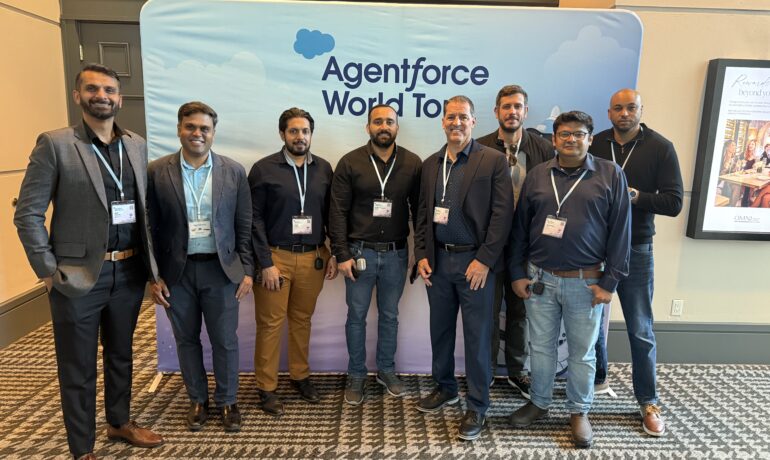
Tectonic Shook Things Up at AgentForce World Tour in Denver

The Tectonic team attended Salesforce’s Denver AgentForce World Tour this week. It was a great experience to develop our AgentBlazer team and a true seismic time was had by all! AI Agents were the topic of conversation and kept things lively! One almost expected to meet an Agentic Robot around every corner. We were all excited to network with Salesforce, customers, and partners alike. Key Takeaways Autonomous AI agents can understand and interpret customers’ questions using natural language, with minimal human intervention. Here’s what you need to know. The AI Assistant Revolution: Empowering Every Employee Imagine if every person in your company—from the CEO to frontline employees—had a dedicated assistant at their fingertips. An assistant who:✔ Knows your customers inside out✔ Delivers instant, data-driven insights✔ Helps prioritize next best actions Thanks to AI agents, this future is already here—and it’s transforming how businesses operate. How AI Agents Are Supercharging Teams 1. Instant Insights, No Manual Work 🔹 Generative AI agents analyze your trusted customer data in seconds—eliminating hours of manual research.🔹 Sales, service, and marketing teams get real-time recommendations, allowing them to focus on high-impact work. 2. Scaling Teams Without Adding Headcount 🔹 AI agents handle routine tasks—customer inquiries, data entry, meeting prep—freeing employees for strategic work.🔹 Quickly ramp up productivity during peak demand without overburdening staff. 3. Proactive Problem-Solving 🔹 AI doesn’t just react—it predicts.🔹 Identifies risks, suggests optimizations, and prevents small issues from becoming big ones. 4. Personalized Support for Every Role 🔹 Sales: AI suggests the best leads, crafts follow-ups, and forecasts deals.🔹 Service: Resolves common cases instantly, escalating only when needed.🔹 Leadership: Delivers real-time business insights for faster decisions. The Future of Work Is AI-Augmented AI agents aren’t replacing humans—they’re empowering them. By automating the mundane and enhancing decision-making, they help teams:✅ Work smarter, not harder✅ Deliver better customer experiences✅ Stay ahead of the competition The question isn’t if your company should adopt AI agents—it’s how soon you can start leveraging them. Tectonic, a trusted Salesforce partner, is here to help. Ready to explore AI-powered productivity? Let’s talk about the right AI strategy for your business. AI Agents: Your Intelligent Digital Workforce What Is an AI Agent? An AI agent is an autonomous artificial intelligence system that understands, processes, and responds to customer inquiries—without human intervention. Built using platforms like Agentforce, these agents leverage machine learning (ML) and natural language processing (NLP) to handle tasks ranging from simple FAQs to complex problem-solving. Unlike traditional AI, which requires manual programming for each task, AI agents continuously learn and improve from interactions, becoming smarter over time. How Do AI Agents Work? AI agents operate through a seamless four-step process: 💡 Result? Faster resolutions, happier customers, and more efficient teams. 6 Game-Changing Benefits of AI Agents Feature Impact 1. 24/7 Availability Instant support across time zones. 2. Hyper-Efficiency Handle thousands of queries simultaneously—no wait times. 3. Smarter Escalations Auto-route complex cases to the best-suited human agent. 4. Personalized Experiences Tailor responses using real-time customer data. 5. Scalability Grow support capacity without hiring more staff. 6. Data-Backed Insights Uncover trends to optimize operations & CX. “72% of companies already deploy AI—with generative AI adoption accelerating.” – McKinsey AI Agents in Action: Industry Use Cases 🏦 Finance ✔ Personalized wealth advice based on spending habits✔ Auto-summarize client cases for faster resolutions 🏭 Manufacturing ✔ Predict equipment failures before they happen✔ Optimize supply chain decisions with real-time data 🛒 Retail & Consumer Goods ✔ Smart inventory tracking (e.g., flagging stock discrepancies)✔ AI-generated promo content for targeted campaigns 🚗 Automotive ✔ Proactive vehicle maintenance alerts via telematics✔ Dynamic dealership promotions to boost sales 🏥 Healthcare ✔ Automated patient scheduling with the right specialist✔ Clinical trial matching using AI-driven eligibility checks Join the AI Revolution with Agentforce AI agents aren’t just tools—they’re productivity multipliers that help teams:✅ Work faster with automated workflows✅ Serve customers better with personalized AI assistance✅ Stay ahead with predictive insights 📈 Ready to transform your business? Connect with Tectonic today, or check out our Agentforce Quickstart offering. Connect with the Tectonic Agentforce team and launch your Agentic Revolution. AI Agents: The Ultimate Productivity Multiplier for Every Team AI agents aren’t just transforming customer service—they’re revolutionizing how every department operates. From 24/7 customer support to hyper-personalized marketing campaigns, AI agents help teams work smarter, move faster, and deliver exceptional experiences. Here’s how AI agents supercharge key business functions: 🤝 AI Agents for Service Teams Never miss a customer inquiry—even at 2 AM.✔ Instant, 24/7 support across email, chat, and social media✔ Smart escalation—AI routes complex cases to human agents with full context✔ Brand-consistent responses powered by your CRM data 🔹 With Agentforce for Service, deploy AI agents in minutes using prebuilt templates—or customize them for your unique needs. 💰 AI Agents for Sales Teams Turn every lead into a conversation—automatically.✔ Autonomous lead engagement—AI answers product questions & books meetings✔ Always-on SDRs—Agentforce Sales Development Reps qualify leads 24/7✔ Controlled escalation—Set rules for when & how AI hands off to your team 🔹 No more missed opportunities—AI keeps your pipeline full while your reps focus on closing. 🛍️ AI Agents for Commerce Teams Personal shopping assistants—powered by AI.✔ Smart product recommendations based on browsing & purchase history✔ Guided shopping experiences—AI helps customers find what they need faster✔ Omnichannel support—Engage shoppers on your site, WhatsApp, and more 🔹 Boost conversions with AI that acts like your best sales associate—for every customer. 📢 AI Agents for Marketing Teams Campaigns that write, optimize, and improve themselves.✔ AI-generated campaign briefs—audience targeting, messaging & KPIs✔ Automated content creation—draft ads, emails & social posts in your brand voice✔ Performance optimization—AI analyzes results & suggests improvements 🔹 With Agentforce Campaigns, launch better campaigns in hours—not weeks. Why AI Agents? The Bottom Line ✅ Scale operations without scaling headcount✅ Deliver instant, personalized experiences 24/7✅ Free your team to focus on high-value work “Companies using AI agents see 40% faster response times and 30% higher customer satisfaction.” Ready to deploy your AI workforce? See how Agentforce can transform your business #FutureOfWork

Read More
Agentforce to the Team

Agentforce Explained

What Is Agentforce? As a kid, you probably wished for a robot to handle chores like washing dishes or tidying your room so you could spend more time riding bikes or playing video games. Now, as an adult in the business world, that wish hasn’t changed—you still want something to handle tedious tasks and improve customer interactions. Enter Agentforce. Agentforce seamlessly integrates AI-powered agents into your workflows, allowing them to manage tasks for employees and customers. These agents understand your business and can autonomously handle a range of responsibilities, making work more efficient and engaging. How Does Agentforce Work? Agentforce is a proactive, conversational AI solution built on the Salesforce Platform. It consists of autonomous AI agents that can interpret inquiries, take actions, and adapt dynamically with minimal or no human intervention. Think of them as digital teammates that learn, respond, and execute tasks efficiently within your predefined guidelines. Key Components of Agentforce Data Like employees, AI agents need information to perform effectively. With Agentforce, you define the data and access controls available to your agents. They can utilize structured and unstructured data from knowledge articles, CRM records, and external sources to complete their tasks securely. Reasoning The core intelligence behind each agent is its reasoning engine, which enables it to comprehend user intent, navigate complex interactions, and make informed decisions. Salesforce’s Atlas Reasoning Engine powers this capability, ensuring agents can adapt as conversations evolve. Actions Actions are the specific tasks an agent performs, such as initiating a product return, generating sales emails, or accessing external APIs. These actions can be customized or created from scratch to align with your business processes. Topics Topics define what an agent is capable of handling. For example, an Order Management topic might include actions like tracking orders or processing returns. Natural language instructions assigned to topics help agents execute the right actions at the right time. Channels Agentforce can be deployed across multiple communication platforms, including Salesforce, Slack, text messaging, and email. Agents can also integrate workflows across channels for a seamless experience. How Agentforce Gets Work Done When a user submits a request, the agent identifies the most relevant topic and initiates corresponding actions. It might retrieve customer details, book appointments, or search your knowledge base for solutions. If additional information is needed, the agent can request clarification or escalate the issue when necessary. What Jobs Can Agentforce Perform? Agentforce offers both standard agents and custom agents, catering to different business needs. Standard Agents Agentforce includes a library of ready-to-use AI agents designed for various roles. These agents come pre-configured with relevant topics and actions and integrate seamlessly with specific Salesforce clouds and licenses. Some examples include: Custom Agents If no standard agent fits your needs, you can create a custom agent using natural language commands. Simply describe the job, and Agentforce will generate relevant topics and instructions based on its extensive library of actions and workflows. For instance, you can configure an agent to review travel expenses or manage internal approvals. Note: The standard agents available depend on your Salesforce licenses. Check if a standard agent meets your needs before creating a custom one. Where Can You Use Agentforce? If you have the necessary Agentforce permissions, you can configure agents for both employees and customers. Employees can interact with agents directly within Salesforce, Slack, or mobile apps for tasks like summarizing account details or reviewing cases. Customers can engage with agents via websites or experience sites for support, scheduling, and self-service interactions. Agents and Trust Salesforce prioritizes security, and Agentforce is built with the Einstein Trust Layer to mitigate AI risks. This ensures: The Agentforce Testing Center allows you to preview and refine agent responses, ensuring reliability and security before deployment. Wrap-Up Agentforce brings the power of AI-driven automation to your business, enabling digital teammates that assist with tasks, improve efficiency, and enhance customer interactions. By integrating natural language processing, intelligent reasoning, and secure data handling, Agentforce helps businesses scale operations while maintaining trust and control. Whether you use standard or custom agents, the possibilities for automation are limitless. Like1 Related Posts Who is Salesforce? Who is Salesforce? Here is their story in their own words. From our inception, we’ve proudly embraced the identity of Read more Salesforce Marketing Cloud Transactional Emails Salesforce Marketing Cloud Transactional Emails are immediate, automated, non-promotional messages crucial to business operations and customer satisfaction, such as order Read more Salesforce Unites Einstein Analytics with Financial CRM Salesforce has unveiled a comprehensive analytics solution tailored for wealth managers, home office professionals, and retail bankers, merging its Financial Read more AI-Driven Propensity Scores AI plays a crucial role in propensity score estimation as it can discern underlying patterns between treatments and confounding variables Read more
Read More
How AI is Transforming Self-Appraisals

How AI is Transforming Self-Appraisals

How AI is Transforming Self-Appraisals—Making Them Easier and Fairer for Employees and Managers Performance reviews are often dreaded—evaluating a year’s worth of your hard work can feel overwhelming, and many struggle to articulate their achievements objectively. But AI is changing that, making self-assessments more efficient, balanced, and even empowering—especially for groups like women, who often face biases in traditional reviews. The Rise of AI in Performance Reviews AI-powered tools are increasingly being used to streamline self-appraisals, helping employees structure their evaluations and align them with company goals. According to Microsoft’s 2024 Work Trend Index, 75% of knowledge workers—including engineers, scientists, and lawyers—already use AI in some capacity. The demand is clear: When Oracle introduced an AI-driven performance review system in 2023, 89% of employees said they were willing to be early adopters. “That shows how much people believe in this technology and how much they need it,” said Triparna de Vreede, a professor at the University of South Florida who studies AI and workplace well-being. Why Traditional Reviews Fall Short Conventional performance evaluations are often subjective, influenced by recency bias (where recent mistakes overshadow past successes) and workplace power dynamics. Employees may not always understand how their work contributes to broader business goals, while managers can struggle to provide unbiased feedback. “If you did great things all year but made one mistake last month, that can overshadow everything,” de Vreede explained. “AI helps standardize feedback so employees don’t feel like favoritism is at play.” How AI Improves the Process The Gender Gap in Self-Assessments Women frequently face challenges in performance reviews. A Textio study found that 38% of feedback for high-performing women contained exaggerated or clichéd language, and 75% were called “emotional”—compared to just 11% of men. Additionally, women tend to undersell their achievements. A 2022 National Bureau of Economic Research study found that women rated their performance at 46 out of 100, while men gave themselves 61. “AI can help women confidently showcase their impact without imposter syndrome getting in the way,” said de Vreede. The Human Touch Still Matters Despite AI’s benefits, human oversight remains crucial. Privacy concerns, transparency about data usage, and ensuring softer skills (like communication and teamwork) are evaluated fairly all require human judgment. “AI can’t fully understand human nuances, but it can prompt employees to reflect on them,” de Vreede noted. “The best reviews come from a collaboration between AI and the employee—not just AI doing all the work.” The Future of AI in Performance Reviews Companies like Oracle and Textio (used by 25% of Fortune 500 firms) are already refining AI-powered evaluations. However, de Vreede cautions against over-reliance: employees must still self-refect rather than letting AI do all the thinking. “AI can draft your review, but you need to refine it,” she said. “Otherwise, the evaluation loses its meaning.” As AI continues to evolve, it promises to make performance reviews less stressful, more accurate, and fairer for everyone—finally turning a dreaded process into one that actually helps employees grow. Salesforce AI can significantly enhance performance reviews by automating tasks, analyzing data, and providing actionable insights. AI tools can help streamline the review process, generate clearer and more unbiased feedback, and even predict future performance trends. Salesforce Einstein, for example, can analyze vast amounts of employee data to identify patterns and generate insights that inform performance reviews.  Here’s how Salesforce AI can be used in performance reviews: 1. Automating and Streamlining the Process: 2. Enhancing Accuracy and Objectivity: 3. Providing Actionable Insights: Examples of Salesforce AI Tools for Performance Reviews: Like Related Posts Who is Salesforce? Who is Salesforce? Here is their story in their own words. From our inception, we’ve proudly embraced the identity of Read more Salesforce Marketing Cloud Transactional Emails Salesforce Marketing Cloud Transactional Emails are immediate, automated, non-promotional messages crucial to business operations and customer satisfaction, such as order Read more Salesforce Unites Einstein Analytics with Financial CRM Salesforce has unveiled a comprehensive analytics solution tailored for wealth managers, home office professionals, and retail bankers, merging its Financial Read more AI-Driven Propensity Scores AI plays a crucial role in propensity score estimation as it can discern underlying patterns between treatments and confounding variables Read more

Read More
Is the Future Agentic for ERP?

Enterprise Tech Buyers Face a Flood of Agentic AI Options

Enterprise tech buyers feeling overwhelmed by the surge of autonomous AI platforms aren’t alone—soon, they may need AI agents just to evaluate the growing array of options. At last week’s Adobe Summit, the company unveiled its own AI agents, deeply integrated with the Adobe Experience Platform. Adobe now joins a crowded field of major players—including AWS, Microsoft, Salesforce, Oracle, OpenAI, Qualtrics, and Deloitte—all offering agentic AI solutions. Adobe CEO Shantanu Narayen emphasized in his keynote that the company’s approach to AI is about enhancing human creativity, not replacing it. “AI has the power to assist and amplify human ingenuity to enhance productivity,” he said. One early adopter, Coca-Cola, has leveraged Adobe’s agentic AI for Project Vision, ensuring brand consistency across 200+ international markets—adapting packaging designs for different sizes, shapes, and languages while still allowing local designers creative flexibility. “We needed an AI system that doesn’t just replicate designs but truly understands what makes Coca-Cola feel like Coca-Cola,” said Rapha Abreu, Global VP of Design at Coca-Cola. “This isn’t about replacing designers—it’s about empowering them.” Navigating the Agentic AI Maze With so many platforms emerging, buyers face a critical challenge: Which agents fit their tech stack, and which platform delivers the best results? Even experts are still figuring it out. Lou Reinemann, an IDC analyst, noted that companies will need different AI agents depending on their size, industry, and product maturity. “Early on, customer experience can be a differentiator. As brands grow, AI must reinforce their core identity.” Ross Monaghan, Adobe Principal at consultancy Perficient, observed that vendors are refining AI use cases—Salesforce focuses on CRM data, while Adobe leans into marketing applications. For now, these agents operate within their own ecosystems, though cross-platform communication may evolve. Data Strategy: The Key to AI Success According to Liz Miller, analyst at Constellation Research, most enterprises will end up using multiple AI platforms—making a unified data schema essential. “The real challenge is ensuring all AI agents pull from a single, curated data source,” she said. CDP tools like Salesforce’s Data Cloud will be important resources for a unified data schema. Jamie Dimon, CEO of JPMorgan Chase, stressed in a conversation with Narayen that business leaders—not just IT—must drive AI adoption. The bank uses AI for customer prospecting, fraud detection, ad buying, and document automation, with a dedicated team prioritizing use cases. “AI should be part of your company’s DNA,” Dimon said. “You don’t need to know how it works—just what it can do for your business.” The Bottom Line Agentic AI is transforming enterprise operations, but buyers must navigate a fragmented landscape. The winners will be those who align AI with business goals, maintain clean data pipelines, and choose platforms that enhance—not replace—human expertise. Like Related Posts Who is Salesforce? Who is Salesforce? Here is their story in their own words. From our inception, we’ve proudly embraced the identity of Read more Salesforce Marketing Cloud Transactional Emails Salesforce Marketing Cloud Transactional Emails are immediate, automated, non-promotional messages crucial to business operations and customer satisfaction, such as order Read more Salesforce Unites Einstein Analytics with Financial CRM Salesforce has unveiled a comprehensive analytics solution tailored for wealth managers, home office professionals, and retail bankers, merging its Financial Read more AI-Driven Propensity Scores AI plays a crucial role in propensity score estimation as it can discern underlying patterns between treatments and confounding variables Read more

Read More
gettectonic.com