Consulting Archives - gettectonic.com - Page 4
Salesforce Implementation Solutions

Salesforce Implementation Solutions Are Here!

Tectonic is Pleased to Announce Salesforce Implementation Solutions! The world’s #1 CRM platform has just received a new function in deliverability. Salesforce Implementation Solutions from Tectonic are pre-planned, flxed rate priced, low technical debt solution to Salesforce implementations. Designed with the SMB in mind, Tectonic’s Salesforce Implementation Solutions get you up and running quickly on the Salesforce solutions you need. Finding the right mix of Salesforce products can be as challenging as finding the right Salesforce partner. Tectonic has custom designed Salesforce Implementation Solutions to help ease the integration to the Salesforce platform. Sometimes called quickstarts, jumpstarts, or even accelorators, Salesforce Implementation Solutions are designed to get you set up right and fast, to see the value from your Salesforce investment. Tectonic has tailored our packages to address specific business needs. Pre-defined Salesforce Deliverables at a Fixed Price The Salesforce Implementation Solutions experts at Tectonic will enable you to deploy Salesforce in weeks not months to maximize efficiency. Whether you are seeking a marketing platform solution, a healthcare CRM, personalization, feedback management, or core Salesforce platform capabilities we have you covered. Tectonic gets you started on Salesforce quickly and affordably, without compromising on quality. These fast implementation solutions help you hit the ground running. It doesn’t matter if you’ve never used Salesforce, never purchased a Salesforce license, or have been using the simple, out-of-the-box version. Our team of Salesforce experts will identify and implement what is critical for your business’s immediate success. Thereby giving you the functionality that can develop and grow along with your business at minimal cost, and lightning speed. Why Salesforce Implementation Solutions? From kick off call and discovery to UAT and launch, these packages are here for quick and easy implementation service. With a flat fee, you know your project will be completed on time and budget. When you are seeking a basic platform stand-up, you don’t need to be bombarded with endless choices and decisions. With the help of our certified Salesforce professionals, you will receive expert guidance and support as we implement your new system with a focus on maximizing functionality. You want an implementation with a proven roadmap. Implementation solutions include a range of tools and resources, such as a personalized onboarding plan, training resources, and pre-built solutions, that can help reduce the time it takes to implement Salesforce. This can be especially helpful if you are new to Salesforce or if you need to get your implementation completed in a short time frame. Efficiency, speed, and success are the promises of Tectonic Salesforce Implementation Solutions. Salesforce is your customer success platform, designed to help you sell, service, market, analyze, and connect with your customers. Interested in making the most of Salesforce? Tectonic’s implementation solutions get your business or nonprofit up and running in weeks. Automation is one of the big keys to managing tons of data. Our implementations get you where you need to be in no time flat. Salesforce CRM isn’t just a solution to automate processes, manage workflows, and corral data. Salesforce can jumpstart your digital transformation. Tectonic’s Salesforce implementations avoid the unexpected costs of an implementation. Fixed price packages prevent surprises. Tectonic provides niche, high quality, service-oriented Salesforce implementation, customization, and managed services. The best time to embark on your transformation was 5 years ago. The second best time is right now.  Tectonic Salesforce implementation solutions, or quickstarts, are limited engagement implementations. They zero in on key planning and decision making, standard and custom configurations, and essential training to get up and running lightning fast. Therefore our solutions provide immediate benefits and ROI. Tectonic even offers implementations for upgrading versions and clouds within Salesforce. These all-in-one solutions take the guesswork out of implementing Salesforce with a proven partner to guide you every step of the way. Learn about all Tectonic’s Salesforce Implementation Solutions here. If you have other needs you’d like to address in a flat bundled project, contact us today. Like2 Related Posts Who is Salesforce? Who is Salesforce? Here is their story in their own words. From our inception, we’ve proudly embraced the identity of Read more Salesforce Marketing Cloud Transactional Emails Salesforce Marketing Cloud Transactional Emails are immediate, automated, non-promotional messages crucial to business operations and customer satisfaction, such as order Read more Salesforce Unites Einstein Analytics with Financial CRM Salesforce has unveiled a comprehensive analytics solution tailored for wealth managers, home office professionals, and retail bankers, merging its Financial Read more AI-Driven Propensity Scores AI plays a crucial role in propensity score estimation as it can discern underlying patterns between treatments and confounding variables Read more
Read More
Harnessing Sales Data

Harnessing Sales Data

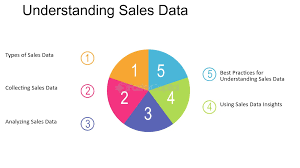
Harnessing Sales Data for Better Insights and Rapid Deal Closure Sales data is a critical asset for gaining insights and closing deals swiftly. With the ever-expanding data footprint, including customer response rates, leads in the pipeline, and quota attainment, tracking these metrics is essential. Ignoring them can be detrimental, as nearly all sales professionals recognize the importance of real-time data in meeting customer expectations, according to the Trends in Data and Analytics for Sales Report. However, concerns about data setup for generative AI and data accuracy persist. Sixty-three percent of sales professionals report that their company’s data isn’t optimized for AI, and only 42% are confident in their data’s accuracy. The demand for sales data has become a focal point for sales leaders and representatives, who increasingly rely on data to enhance customer engagement and productivity through trusted sources and AI integration. What is Sales Data? Sales data encompasses two main categories: external data, which includes information about prospects such as demographics, interests, behavior, and engagement; and internal sales data, including deal attributes and sales performance metrics. This data helps inform deal actions, assess progress toward sales targets or key performance indicators (KPIs), and supports tools like AI to enhance efficiency. Why is Sales Data Important? Sales data provides a measurable framework for all sales activities, enabling the setting of performance benchmarks and targets. It helps identify risks in the pipeline and highlights opportunities for upselling or fostering competition among sales reps. The data is also crucial for leveraging generative AI, which can automate tasks such as email drafting and sales pitch creation, provided the data is accurate and well-organized. Types of Sales Data Collecting and Utilizing Sales Data To effectively collect and utilize sales data, invest in a CRM system that serves as a centralized data repository with analytics capabilities. Automate data collection within the CRM, integrate data from other tools, and prioritize the security of sensitive information. Visualizing data through dashboards can help track progress toward business goals and make informed decisions. Real-Life Application: A Case Study A global consulting firm used sales data to enhance win rates and accelerate deal velocity. By integrating CRM analytics with data from various sources, the firm identified key deal attributes impacting success and adjusted strategies accordingly. The use of AI-driven “opportunity scores” further enabled the firm to monitor deal health and optimize resource allocation. Essential Tools for Harnessing Sales Data Turning Sales Data into Actionable Insights Regularly reviewing CRM-generated insights and adjusting strategies based on these insights is crucial for closing more deals and delivering consistent value to customers. By focusing on data-driven decision-making, sales teams can stay competitive and meet evolving customer needs. Like Related Posts Who is Salesforce? Who is Salesforce? Here is their story in their own words. From our inception, we’ve proudly embraced the identity of Read more Salesforce Marketing Cloud Transactional Emails Salesforce Marketing Cloud Transactional Emails are immediate, automated, non-promotional messages crucial to business operations and customer satisfaction, such as order Read more Salesforce Unites Einstein Analytics with Financial CRM Salesforce has unveiled a comprehensive analytics solution tailored for wealth managers, home office professionals, and retail bankers, merging its Financial Read more AI-Driven Propensity Scores AI plays a crucial role in propensity score estimation as it can discern underlying patterns between treatments and confounding variables Read more

Read More
Salesforce Partner Trailblazer Score

Salesforce Partner Trailblazer Score

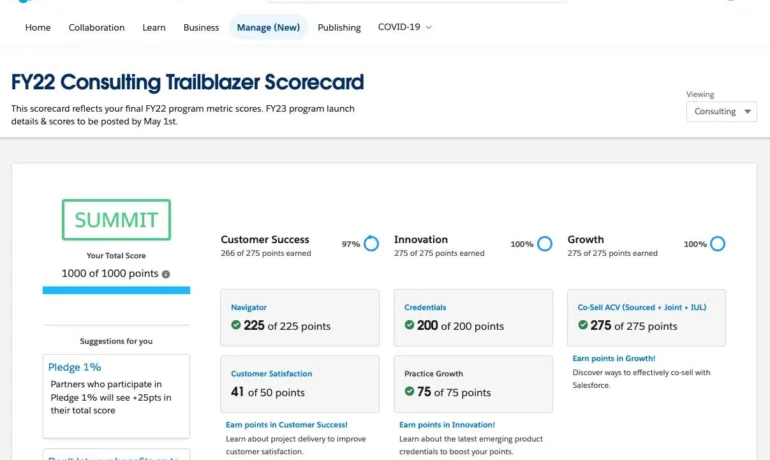
Salesforce Partner Trailblazer Score explained. The Consulting Trailblazer scorecard undergoes daily updates, while tier calculations occur on a quarterly basis. Following the conclusion of each quarter, the subsequent month is utilized to determine any tier adjustments. Upon completion of the quarterly assessment, any tier advancements take effect on the first day of the subsequent month. For precise timing regarding quarterly evaluations, please refer to our Partner Program Policies. Salesforce Partner Trailblazer Score. Upon accruing the requisite points for promotion to the next tier, individuals can anticipate the new tier to be reflected on their scorecard quarterly, occurring one month subsequent to the conclusion of the preceding quarter. This interval allows our internal teams adequate time for review and system updates. While accumulating sufficient points may indicate eligibility for tier advancement, it’s important to note that tiers are not automatically updated. Tier transitions occur solely following the culmination of a tier evaluation period. In instances where tier advancement does not align with expectations post-quarterly evaluation, individuals are encouraged to initiate a case via Salesforce Help for further investigation. To expedite the resolution process, Salesforce asks you to kindly provide the following details: Partners can monitor their Consulting Partner Trailblazer score via the Manage (New) tab within the Partner Community. Access to the Manage (New) tab is granted exclusively to partners who have progressed beyond the Provisional tier (Base, Ridge, Crest, Summit). Like1 Related Posts Who is Salesforce? Who is Salesforce? Here is their story in their own words. From our inception, we’ve proudly embraced the identity of Read more Salesforce Marketing Cloud Transactional Emails Salesforce Marketing Cloud Transactional Emails are immediate, automated, non-promotional messages crucial to business operations and customer satisfaction, such as order Read more Salesforce Unites Einstein Analytics with Financial CRM Salesforce has unveiled a comprehensive analytics solution tailored for wealth managers, home office professionals, and retail bankers, merging its Financial Read more AI-Driven Propensity Scores AI plays a crucial role in propensity score estimation as it can discern underlying patterns between treatments and confounding variables Read more

Read More
How to Implement AI for Business Transformation

How to Implement AI for Business Transformation

Harnessing the Power of AI for Business Transformation The age of artificial intelligence (AI) is here. How to Implement AI for Business Transformation? Once a niche technology confined to research labs and the realm of science fiction, AI has now become a mainstream force. Today, an estimated 35% of businesses are leveraging AI to enhance products, boost efficiency, and gain a competitive edge. However, for companies yet to begin their AI journey, the path to implementation can seem daunting. So how can organizations navigate the complexities of AI and unlock its potential to drive success? This comprehensive guide is designed to empower businesses to confidently adopt AI. We’ll break down what AI is, assess your organization’s readiness, help you develop a robust AI strategy, and explore how to implement and integrate AI across operations. Ultimately, this insight will show you how to embrace AI for continuous innovation, helping automate tasks, uncover insights, and future-proof your business. AI Era Demands an Intelligent Data Infrastructure AI consulting services and digital transformation partners like Tectonic underscore the technology’s immense value, helping organizations evaluate, implement, and scale AI initiatives. However, knowing where to start and who to trust can be challenging. This guide will provide best practices for planning and executing AI projects, helping you make informed decisions when selecting solutions and partners. By the end, your organization will be equipped with the knowledge and confidence needed to make AI a powerful competitive advantage. Understanding the AI Landscape Before diving into AI implementation, it’s important to understand what artificial intelligence is and the wide array of applications it offers. What is Artificial Intelligence? Artificial intelligence (AI) refers to software and machines designed to perform tasks that typically require human intelligence—such as visual perception, speech recognition, decision-making, and language translation. AI is already deeply integrated into many everyday products and services, including: Machine Learning Basics At the core of most AI systems is machine learning (ML), which involves training algorithms on vast datasets, enabling them to learn from examples without being explicitly programmed for every scenario. There are three main types of machine learning: Beyond ML, fields like natural language processing (NLP) focus on understanding human language, while computer vision analyzes visual content such as images and video. Real-World AI Applications Understanding the fundamentals of AI helps organizations align their needs with its capabilities. Common business use cases for AI include: Armed with this knowledge, businesses can better evaluate how AI fits into their goals and operations. Developing a Comprehensive AI Strategy Once you understand the AI landscape, the next step is developing a strategic plan to guide implementation. Establishing an AI Vision and Objectives AI adoption must align with clear financial and operational goals. Leadership teams should identify: Aligning stakeholders and executive leaders around specific use cases will drive urgency, investment, and commitment. AI Ethics and Governance AI adoption also requires guidelines for ethical usage, transparency, and accountability. Organizations should consider: Establishing these frameworks early ensures responsible and transparent AI usage. Resourcing an AI Program AI implementation requires the right talent and resources. Budget considerations should include: A Phased AI Adoption Roadmap Rather than attempting to scale AI all at once, organizations should adopt a phased approach: This roadmap balances short-term impact with long-term scalability. Choosing the Right AI Implementation Approach With your strategy in place, the next decision is how to implement AI. Three primary approaches are: The choice depends on your organization’s internal capabilities, desired level of customization, and timeline. Integrating AI into Your Operations Successful AI implementation requires careful planning and integration with existing operations. Develop an Integration Plan Consider how AI will interact with existing systems and workflows: Address Security and Privacy Ensure that AI systems comply with data privacy regulations and security protocols, especially when handling sensitive information. Drive Adoption Through Training Help staff understand how AI will augment their roles by providing training on how the algorithms work and how to interact with AI systems effectively. Monitor for Model Decay Implement processes to monitor and retrain models as needed to ensure continued performance and reliability. Embracing AI for Continuous Improvement AI should be viewed as an ongoing investment, driving continuous improvement across the organization. Encourage a Data-Driven Culture Empower teams to identify new AI use cases and experiment with AI-driven solutions. Provide the tools and frameworks to facilitate this culture of innovation. Foster Responsible AI Ensure that AI systems are transparent, accountable, and designed to augment human decision-making responsibly. Commit to Reskilling As AI capabilities evolve, continually upskill employees to ensure your workforce remains at the forefront of technological advancements. Unlocking the Future of AI The potential of AI to revolutionize businesses is clear. However, achieving success requires more than just technical capabilities. It demands thoughtful planning, strategic alignment, and a commitment to continuous improvement. By following this guide, your organization can confidently implement AI to unlock powerful data-driven insights, automate tasks, and achieve lasting competitive advantage. The future of AI is full of possibilities—are you ready to seize them? Tectonic is ready to help. How to Implement AI for Business Transformation Like Related Posts Who is Salesforce? Who is Salesforce? Here is their story in their own words. From our inception, we’ve proudly embraced the identity of Read more Salesforce Unites Einstein Analytics with Financial CRM Salesforce has unveiled a comprehensive analytics solution tailored for wealth managers, home office professionals, and retail bankers, merging its Financial Read more AI-Driven Propensity Scores AI plays a crucial role in propensity score estimation as it can discern underlying patterns between treatments and confounding variables Read more Tectonic’s Successful Salesforce Track Record Salesforce Technology Services Integrator – Tectonic has successfully delivered Salesforce in a variety of industries including Public Sector, Hospitality, Manufacturing, Read more
Read More
AI's Impact on the Workforce

AI’s Impact on the Workforce

According to McKinsey, generative AI has the potential to contribute between $2.6 trillion and $4.4 trillion in value to the global economy across various industries, spanning banking, retail, high tech, healthcare, and life sciences. Its impact is expected to reach diverse professions, including customer operations, marketing and sales, software engineering, and research and development. The influence of AI on the workforce is significant. A report by Goldman Sachs suggests that AI could replace the equivalent of 300 million full-time jobs, affecting a quarter of work tasks in the US and Europe. However, it also brings forth new job opportunities and a productivity boom. Despite concerns about job displacement, AI is anticipated to generate numerous new opportunities. Roles like prompt engineer and AI product manager are emerging, with a Salesforce-sponsored IDC white paper predicting a surge in demand for positions such as data architects, AI ethicists, and AI solutions architects over the next 12 months. The report also forecasts the creation of 11.6 million new jobs within the Salesforce ecosystem alone over the next six years. Recent advancements in generative AI, exemplified by products like ChatGPT with 100 million monthly active users in two months, have reignited discussions about automation’s impact on jobs. While the extent of disruption remains unknown, developers, users, and policymakers should consider its effects on workers. To address challenges and opportunities, Majority Leader Chuck Schumer has launched a SAFE Innovation Framework, emphasizing worker security. The Biden administration is developing a National AI Strategy to address economic and job impacts. For individuals in the workforce, there’s an opportunity to cultivate existing skills and acquire new ones through platforms like Salesforce’s Trailhead, Coursera, and LinkedIn. AI’s impact on jobs involves eliminating repetitive tasks, allowing individuals to focus on more strategic and creative aspects of their roles. In fields like sales, customer service, marketing, healthcare, finance, and graphic design, AI will transform roles and create new opportunities. Chris Poole, AI Technical Consulting Lead in Salesforce’s global AI practice, envisions AI becoming ingrained in every aspect of our lives, contributing to fascinating evolution across various fields. The scale of AI adoption’s impact on workers, especially with generative AI tools, remains uncertain. Potential effects include replacing, complementing, or freeing workers for more productive tasks, or creating new jobs. A Goldman Sachs estimate suggests that about two-thirds of current jobs are exposed to some degree of AI automation, with generative AI potentially substituting up to one-fourth of current work. McKinsey Global Institute estimates that 29.5 percent of all hours worked could be automated by 2030. Regarding job impact, professional occupations associated with clerical work in finance, law, and business management are most exposed to AI. However, AI is also concurrently creating many new jobs. Like Related Posts Who is Salesforce? Who is Salesforce? Here is their story in their own words. From our inception, we’ve proudly embraced the identity of Read more Salesforce Marketing Cloud Transactional Emails Salesforce Marketing Cloud Transactional Emails are immediate, automated, non-promotional messages crucial to business operations and customer satisfaction, such as order Read more Salesforce Unites Einstein Analytics with Financial CRM Salesforce has unveiled a comprehensive analytics solution tailored for wealth managers, home office professionals, and retail bankers, merging its Financial Read more AI-Driven Propensity Scores AI plays a crucial role in propensity score estimation as it can discern underlying patterns between treatments and confounding variables Read more

Read More
Salesforce Life Sciences Cloud

Salesforce Life Sciences Cloud

Salesforce has unveiled Life Sciences Cloud, a secure and trusted platform tailored for pharmaceutical (pharma) and medical technology (medtech) organizations. This innovative solution aims to expedite drug and device development, streamline patient enlistment and retention throughout the clinical trial journey, and harness AI capabilities to deliver personalized customer experiences. The significance of this announcement lies in the life sciences industry’s urgent need for accurate and accessible data to advance research and development efforts and enhance clinical trials. Despite this need, the industry has been slow to adopt digital tools, with a staggering 88% of healthcare and life sciences organizations yet to achieve their digital transformation objectives. Amit Khanna, SVP & GM of Health and Life Sciences at Salesforce, emphasized the necessity for integrated, compliant, and data-driven solutions in the life sciences industry. He highlighted Salesforce’s commitment to enhancing stakeholder engagement across the R&D and commercialization spectrum by leveraging data, AI, and CRM capabilities. The Salesforce solution encompasses: Commercial Operations, available now, provides insights into the commercial lifecycle, including contract compliance, pricing, and inventory management. AI-powered bots offer timely alerts to field representatives and forecasting insights to optimize sales strategies. Clinical Operations offers tools to set up and execute efficient trials, including Data Cloud for Health, Chain of Custody Management, and Participant Management features, aiming to enhance patient recruitment, safety, and engagement. Pharma CRM facilitates personalized engagement with stakeholders, managing interactions and digital content while ensuring compliance with regulations. Features like Healthcare Professional (HCP) Engagement and Einstein for Life Sciences enhance engagement and automate tasks for streamlined operations. Customer testimonials, such as from SI-BONE, highlight the tangible benefits of digitizing processes and improving efficiency with Salesforce solutions. Availability details for various features are provided, with some features already generally available and others set to roll out in the coming months and years. To learn more about Salesforce’s offerings for healthcare and life sciences, access industry insights, and explore the potential of CRM and AI in this sector, interested parties are encouraged to dig into the available resources or contact Tectonic today. Additionally, it’s noted that sales automation functionality for pharma/biotech customers will be available from mid-2025 onward. Learn about Salesforce for healthcare and life sciences  Learn more about Salesforce Life Sciences Cloud Like Related Posts Who is Salesforce? Who is Salesforce? Here is their story in their own words. From our inception, we’ve proudly embraced the identity of Read more Salesforce Marketing Cloud Transactional Emails Salesforce Marketing Cloud Transactional Emails are immediate, automated, non-promotional messages crucial to business operations and customer satisfaction, such as order Read more Salesforce Unites Einstein Analytics with Financial CRM Salesforce has unveiled a comprehensive analytics solution tailored for wealth managers, home office professionals, and retail bankers, merging its Financial Read more AI-Driven Propensity Scores AI plays a crucial role in propensity score estimation as it can discern underlying patterns between treatments and confounding variables Read more

Read More
AI Transparency

AI Transparency Explained

Understanding AI Transparency AI transparency is about making the inner workings of an AI model clear and understandable, allowing us to see how it arrives at its decisions. It involves a variety of tools and practices that help us comprehend the model, the data it’s trained on, how errors and biases are identified and categorized, and how these issues are communicated to developers and users. As AI models have become more advanced, the importance of transparency has grown. A significant concern is that more powerful models are often more opaque, leading to the so-called “black box” problem. “Humans naturally struggle to trust something they can’t understand,” said Donncha Carroll, partner and chief data scientist at Lotis Blue Consulting. “AI hasn’t always proven itself to be unbiased, which makes transparency even more critical.” Defining AI Transparency AI transparency is essential for building trust, as it allows users to understand how decisions are made by AI systems. Since AI models are trained on data that can carry biases or risks, transparency is crucial for gaining the trust of users and those affected by AI decisions. “AI transparency is about clearly explaining the reasoning behind the output, making the decision-making process accessible and comprehensible,” said Adnan Masood, chief AI architect at UST. “It’s about demystifying AI and providing insight into its decision-making process.” Transparency is becoming increasingly vital due to its role in fostering trust, enabling auditability, ensuring compliance, and helping to identify and address potential biases. Without it, AI systems risk perpetuating harmful biases, making opaque decisions, or causing unintended consequences in high-risk scenarios, Masood added. Explainability and Interpretability in AI Transparency AI transparency is closely related to concepts like explainability and interpretability, though they are distinct. Transparency ensures that stakeholders can understand how an AI system operates, including its decision-making and data processing. This clarity is essential for building trust, especially in high-stakes applications. Explainability, on the other hand, provides understandable reasons for AI’s decisions, while interpretability refers to how predictable a model‘s outputs are based on its inputs. While both are crucial for achieving transparency, they don’t fully encompass it. Transparency also involves openness about how data is handled, the model’s limitations, potential biases, and the context of its usage. Ilana Golbin Blumenfeld, responsible AI lead at PwC, emphasized that transparency in process, data, and system design complements interpretability and explainability. Process transparency involves documenting and logging key decisions during system development and implementation, while data and system transparency involves informing users that an AI or automated system will use their data, and when they are interacting with AI, like in the case of chatbots. The Need for AI Transparency AI transparency is crucial for fostering trust between AI systems and users. Manojkumar Parmar, CEO and CTO at AIShield, highlighted the top benefits of AI transparency: Challenges of the Black Box Problem AI models are often evaluated based on their accuracy—how often they produce correct results. However, even highly accurate models can be problematic if their decision-making processes are opaque. As AI’s accuracy increases, its transparency often decreases, making it harder for humans to trust its outcomes. In the early days of AI, the black box problem was somewhat acceptable, but it has become a significant issue as algorithmic biases have been identified. For example, AI models used in hiring or lending have been found to perpetuate biases based on race or gender due to biased training data. Even highly accurate models can make dangerous mistakes, such as misclassifying a stop sign as a speed limit sign. These errors highlight the importance of understanding how AI reaches its conclusions, especially in critical applications like healthcare, where a misdiagnosis could be life-threatening. Transparency in AI makes it a better partner for human decision-making. In regulated industries, like banking, explainability is often a legal requirement before AI models can be deployed. Similarly, regulations like GDPR give individuals the right to understand how decisions involving their private data are made by AI systems. Weaknesses of AI Transparency While AI transparency offers many benefits, it also presents challenges: As AI models continuously evolve, they must be monitored and evaluated to maintain transparency and ensure they remain trustworthy and aligned with their intended outcomes. Balancing AI Transparency and Complexity Achieving AI transparency requires a balance between different organizational needs. When implementing AI, organizations should consider the following factors: Best Practices for Implementing AI Transparency Achieving AI transparency requires continuous collaboration and learning within an organization. Leaders and employees must clearly understand the system’s requirements from a business, user, and technical perspective. Blumenfeld suggests that providing AI literacy training can help employees contribute to identifying flawed responses or behaviors in AI systems. Masood recommends prioritizing transparency from the beginning of AI projects. This involves creating datasheets for datasets, model cards for models, rigorous auditing, and ongoing analysis of potential harm. Key Use Cases for AI Transparency AI transparency has many facets, and teams should address each potential issue that could hinder transparency. Parmar suggests focusing on the following use cases: The Future of AI Transparency AI transparency is an evolving field as the industry continually uncovers new challenges and develops better processes to address them. “As AI adoption and innovation continue to grow, we’ll see greater AI transparency, especially in the enterprise,” Blumenfeld predicted. However, approaches to transparency will vary based on the needs of different industries and organizations. Carroll anticipates that AI transparency efforts will also be shaped by factors like insurance premiums, particularly in areas where AI risks are significant. These efforts will be influenced by an organization’s overall system risk and evidence of best practices in model deployment. Masood believes that regulatory frameworks, like the EU AI Act, will play a key role in driving AI transparency. This shift toward greater transparency is crucial for building trust, ensuring accountability, and responsibly deploying AI systems. “The journey toward full AI transparency is challenging, with its share of obstacles,” Masood said. “But through collective efforts from practitioners, researchers, policymakers, and society, I’m optimistic that

Read More
Salesforce Field Service

Understanding Salesforce Field Service

Salesforce Field Service is an expansive addition to Salesforce Service Cloud, offering a 360 degree perspective on workforce management, especially in scenarios where services extend beyond the office or work site into the field. This typically involves mobile employees such as service technicians, alongside service agents, dispatchers, and service managers. Let’s dive into the nuances of Salesforce Field Service, addressing key aspects like its definition, user roles, reporting, scheduling, optimization, and more. Salesforce Field Service is also a popular tool in public sector solutioning. Understanding Salesforce Field Service will help to decide if it is right for your service teams. Understanding Salesforce Field Service: Salesforce Field Service, formerly known as Field Service Lightning (FSL), is an extension of Service Cloud designed to provide a comprehensive workforce management view. It seamlessly manages services delivered in the field, such as a electrical installer arriving to fulfill a customer’s order. Field Service Lightning evolves with each Salesforce release, continually enhancing functionality. Salesforce Field Service enhances customer engagement with real-time personalization, optimization of field teams with a scheduling engine, and access to offline data. Components of Salesforce Field Service: Field Service comprises various components, including Service Appointments, Salesforce Service Cloud integration, Territory and Scheduling functionalities, the Field Service Dispatcher Console, and the Field Service Mobile App for Android and iOS with offline capabilities. A detailed data model diagram illustrates the relationship between Service Cloud and Field Service. Users of Salesforce Field Service: Salesforce Field Service is particularly valuable for organizations with mobile field technicians supporting customers. It excels in scenarios with intricate service delivery involving multiple individuals like dispatchers, field technicians, service agents, and service managers. Each user persona interacts with Salesforce Field Service in distinct ways, utilizing tools like the Dispatcher Console or Field Service Mobile App tailored to their roles. Use Cases for Salesforce Field Service: Field Service proves beneficial in diverse service scenarios, including repairs, maintenance, sales visits, and healthcare care visits. It facilitates efficient coordination among dispatchers, field technicians, service agents, and service managers, streamlining processes and enhancing customer satisfaction. Key Terms in Salesforce Field Service: Understanding key terms such as Work Orders, Service Appointments, Contracts, Entitlements, Work Types, Service Territories, Operating Hours, Resources, and Scheduling Policies is essential. These terms collectively form the foundation of Salesforce Field Service’s robust data model and optimized usability. Scheduling and Optimization: Scheduling in Salesforce Field Service is managed through the Dispatcher Console, empowering dispatchers to make informed decisions. Various methods, from manual to fully automated, enable the creation of service appointments, optimizing resource allocation and ensuring efficient service delivery. Forecasting and Planning: Use real-time data to quickly assess the impact of global or in-day optimization on travel time and resource utilization. Refine scheduling policies, get an instant view of optimization results, and KPI changes. Asset Service Management: Move from reactive to proactive service with real-time asset tracking. Monitor service outcomes and create preventive maintenance plans based on asset use, condition, age, and specific criteria. Service Territory Design: Service Territories, categorized as Primary, Secondary, and Relocation Territories, define where teams can perform work. Well-defined territories are crucial for efficient dispatcher satisfaction, requiring thoughtful initial design and ongoing maintenance. Field Service Mobile App: The Salesforce Field Service Mobile app is essential for on-the-move workforces, offering technicians essential information to optimize job execution. Offline capabilities ensure uninterrupted work, and the Visual Remote Assistant feature enables two-way video and audio communication between agents, technicians, and customers. Slack for Field Service: Empower your mobile workforce with seamless connectivity and timely assistance whenever it is needed. Mobilize for service appoints and tap into the expertise of colleagues throughout the organization with the user-friendly Slack interface. Reporting in Salesforce Field Service: Monitoring service efficiency and success involves leveraging Salesforce reports, list views, and other platform analytics. Work Order List Views and Field Service Report Types provide insights into service call-outs and overall performance. Enabling Field Service Lightning: Setting up Salesforce Field Service involves installing it as a Managed Package, assigning licenses to users, and configuring standard objects like Products, Assets, Service Contracts, and Entitlements. Creating records for Service Territories, Service Resources, and Operating Hours establishes the framework for the service model. Field Service Deployments: Deployments in Salesforce Field Service can be time-consuming due to its reliance on object data. Considerations for complex relational data movement between environments and potential risks, such as resistance to automation, require careful attention. Tectonic, as a Salesforce Consulting Partner, can assist your company in deploying Salesforce Field Service. Salesforce Field Service projects, while intricate, can be highly valuable when executed correctly providing a large ROI. Adequate planning, phased implementations, and a long-term perspective contribute to the success of organizations leveraging the capabilities of Salesforce Field Service. If you are looking for a more robust solution, consider Field Service Plus combining dispatch and technician functionality along with Service Cloud and Sales Cloud. Tectonic looks forward to helping your field service team utilize this Salesforce tool. Tectonic is please to announce Salesforce Service Cloud Implementation Solutions. Like2 Related Posts Who is Salesforce? Who is Salesforce? Here is their story in their own words. From our inception, we’ve proudly embraced the identity of Read more Salesforce Marketing Cloud Transactional Emails Salesforce Marketing Cloud Transactional Emails are immediate, automated, non-promotional messages crucial to business operations and customer satisfaction, such as order Read more Salesforce Unites Einstein Analytics with Financial CRM Salesforce has unveiled a comprehensive analytics solution tailored for wealth managers, home office professionals, and retail bankers, merging its Financial Read more AI-Driven Propensity Scores AI plays a crucial role in propensity score estimation as it can discern underlying patterns between treatments and confounding variables Read more
Read More
Salesforce Data Cloud

Salesforce Data Cloud – The Ultimate Guide to Unified Customer Intelligence

Why Salesforce Data Cloud is Transforming Business Operations In today’s digital-first economy, customer data is your most valuable asset—if you can harness it effectively. Salesforce Data Cloud revolutionizes how enterprises unify, analyze, and activate customer data across every touchpoint. 5 Key Business Transformations The Data Cloud Advantage: Beyond Traditional CDPs Unlike legacy customer data platforms, Salesforce Data Cloud delivers: Feature Traditional Solutions Salesforce Data Cloud Data Integration Manual ETL processes Real-time harmonization AI Capabilities Basic segmentation Predictive insights & recommendations Activation Limited channel support Native Salesforce app integration Scalability Fixed data models Elastic cloud infrastructure Total Cost Hidden implementation fees Transparent consumption model Proven Results Across Industries Financial Services Healthcare Retail Implementation Roadmap Phase 1: Foundation (Weeks 1-4) Phase 2: Activation (Weeks 5-8) Phase 3: Scaling (Ongoing) Overcoming Common Challenges “Our data is too messy”→ Automated data quality tools clean and standardize information during ingestion “We can’t afford another platform”→ Consumption-based pricing starts at $25K/year with proven 3-5X ROI “Our team isn’t technical enough”→ No-code tools like Flow Builder enable business user configuration The Future of Data-Driven Business As AI reshapes customer expectations, Salesforce Data Cloud provides the essential infrastructure to: Leading organizations are already achieving: Next Steps for Your Data Transformation “Companies using Data Cloud see 47% faster decision-making and 32% higher customer satisfaction scores within 6 months.” – Forrester Consulting Study Unlock your data’s full potential. Contact our specialists today to begin your assessment. Like Related Posts Who is Salesforce? Who is Salesforce? Here is their story in their own words. From our inception, we’ve proudly embraced the identity of Read more Salesforce Marketing Cloud Transactional Emails Salesforce Marketing Cloud Transactional Emails are immediate, automated, non-promotional messages crucial to business operations and customer satisfaction, such as order Read more Salesforce Unites Einstein Analytics with Financial CRM Salesforce has unveiled a comprehensive analytics solution tailored for wealth managers, home office professionals, and retail bankers, merging its Financial Read more AI-Driven Propensity Scores AI plays a crucial role in propensity score estimation as it can discern underlying patterns between treatments and confounding variables Read more

Read More
AI All Grown Up

Understanding Generative AI and Predictive AI

Understanding Generative AI and Predictive AI: A Synergistic Approach Artificial Intelligence (AI) is broadly categorized into two key branches: Generative AI and Predictive AI. Both play a crucial role across various industries, from healthcare and fintech to logistics and education. Their impact is undeniable, driving efficiency, accuracy, and innovation. However, this is not a debate about Generative AI versus Predictive AI. Instead, it is an exploration of both branches and how they contribute to technological advancement. Let’s dive in. Generative AI vs. Predictive AI: An Overview Generative AI has been around for decades, with early iterations like Generative Adversarial Networks (GANs) and Variational Autoencoders (VAEs). While these earlier models saw limited enterprise adoption, the success of ChatGPT demonstrated the vast potential of Generative AI in producing articulate, human-like content. Conversely, Predictive AI is widely used across industries to correlate data and support decision-making. It is particularly prevalent in applications like cybersecurity, inventory management, and digital twin technology. Businesses increasingly recognize the benefits of both AI branches. From automating processes to creating digital replicas for scenario testing, AI applications continue to evolve. The goal now is not to compare Generative AI and Predictive AI, but to understand their mechanisms and potential for seamless integration. Are you fully leveraging AI in your enterprise? If not, or if you have questions, feel free to reach out. Now, let’s delve into how these AI branches work. What is Generative AI? Generative AI is transforming industries by producing text, code, music, and even videos. Companies use it to analyze vast datasets and generate content instantaneously. Key Applications of Generative AI: By 2026, over 80% of businesses are expected to incorporate Generative AI into their workflows. While implementation can be complex, expert guidance can help streamline the process. How Does Generative AI Work? Generative AI leverages machine learning (ML) and big data to analyze input forms—such as text, images, or sound—and learn their structures. Once trained, it generates new content without merely replicating existing data, making it a powerful tool for innovation. Generative AI in Action: If you’re uncertain about how to implement Generative AI in your business, consulting with experts can provide clarity. What is Predictive AI? Predictive AI, or predictive analytics, forecasts future outcomes based on historical data. It empowers businesses to make informed decisions by identifying patterns and trends. Key Applications of Predictive AI: Predictive AI improves decision-making capabilities by analyzing large datasets and refining machine learning algorithms. Integrating it with other analytics tools enhances its effectiveness and mitigates implementation challenges. Predictive AI in Action: Predictive AI’s ability to anticipate market trends and consumer behavior makes it a valuable tool for businesses looking to stay ahead. Generative AI vs. Predictive AI: Key Differences While Generative AI focuses on creating new content based on learned data patterns, Predictive AI forecasts future outcomes using historical data. These two models are not competing forces; rather, they complement each other in building comprehensive business strategies. Both models require a strong foundation in data governance and cybersecurity to ensure ethical and effective AI implementation. The Future of AI: Generative vs. Predictive According to McKinsey, the combined impact of Generative and Predictive AI could contribute up to $4.4 trillion annually to the global economy. What’s Next for AI? Generative AI: Predictive AI: Both Generative and Predictive AI are poised to shape the future of AI-driven industries. Businesses that embrace both models will gain a competitive edge in innovation and strategic decision-making. Conclusion Generative and Predictive AI are not opposing technologies; they are complementary forces that drive efficiency, accuracy, and creativity. Their applications span numerous industries, proving their immense value in today’s tech-driven world. Navigating AI implementation can be complex, but expert guidance can simplify the process. If you have questions about integrating AI into your business, consulting with professionals can help you harness its full potential. The future of business is deeply intertwined with AI—taking the right steps today will ensure success in the years ahead. Let Tectonic take you to the AI world. Like Related Posts Who is Salesforce? Who is Salesforce? Here is their story in their own words. From our inception, we’ve proudly embraced the identity of Read more Salesforce Marketing Cloud Transactional Emails Salesforce Marketing Cloud Transactional Emails are immediate, automated, non-promotional messages crucial to business operations and customer satisfaction, such as order Read more Salesforce Unites Einstein Analytics with Financial CRM Salesforce has unveiled a comprehensive analytics solution tailored for wealth managers, home office professionals, and retail bankers, merging its Financial Read more AI-Driven Propensity Scores AI plays a crucial role in propensity score estimation as it can discern underlying patterns between treatments and confounding variables Read more

Read More

Can Marketing Cloud Be Used For B2B?

Elevate Your B2B Marketing with Salesforce Marketing CloudB2B marketing is a dynamic and intricate field, but with the right tools and strategies, your efforts can yield exceptional results. Salesforce Marketing Cloud stands out as one of the most powerful solutions for B2B marketers. As a trusted Salesforce consulting company and ISV partner, Tectonic empowers businesses to harness the unmatched efficiency and capabilities of this CRM platform to dominate their market. Key Benefits of Salesforce Marketing Cloud for B2B Marketing Salesforce Marketing Cloud offers a wealth of advantages to elevate your B2B marketing efforts: Optimizing Salesforce Marketing Cloud for B2B Success To fully leverage Salesforce Marketing Cloud, consider these strategies: Key Features of Salesforce Marketing Cloud for B2B Marketing Automation Salesforce Marketing Cloud is packed with features designed to streamline and enhance your B2B marketing efforts: Conclusion Salesforce Marketing Cloud is a game-changing tool for B2B marketers, offering a robust suite of automation, personalization, analytics, and collaboration features. By leveraging its capabilities, businesses can streamline their marketing efforts, deliver exceptional customer experiences, and achieve measurable success. With Salesforce Marketing Cloud, you can take your B2B marketing strategies to new heights and drive sustainable growth. Ready to transform your B2B marketing? Partner with Tectonic, a leading Salesforce consulting company, to unlock the full potential of Salesforce Marketing Cloud and elevate your business to the next level. Like Related Posts Who is Salesforce? Who is Salesforce? Here is their story in their own words. From our inception, we’ve proudly embraced the identity of Read more Salesforce Marketing Cloud Transactional Emails Salesforce Marketing Cloud Transactional Emails are immediate, automated, non-promotional messages crucial to business operations and customer satisfaction, such as order Read more Salesforce Unites Einstein Analytics with Financial CRM Salesforce has unveiled a comprehensive analytics solution tailored for wealth managers, home office professionals, and retail bankers, merging its Financial Read more AI-Driven Propensity Scores AI plays a crucial role in propensity score estimation as it can discern underlying patterns between treatments and confounding variables Read more

Read More
Salesforce Integration

Salesforce Implementation Services

As certified experts, Tectonic offers comprehensive Salesforce implementation, management, and support services. Seek professional guidance from a trusted Salesforce Partner. Tectonic’s Salesforce implementation services encompass consulting, configuration, customization, migration, integration, support, and more. With over a decade of experience in CRM development, Tectonic assists companies in implementing robust Salesforce solutions that empower their sales, customer service, and marketing processes. Who participates in Salesforce implementation? The implementation team should include sales agents, customer service representatives, IT experts, marketers, general users, and business administrators. And of course, your Salesforce implementation partner. As an experienced Salesforce Partner, we follow a proven six-phase approach to ensure project success: Kickoff, Discovery, Build, Test, Deploy, and Service. Is it possible to implement Salesforce independently? Yes, but, we strongly discourage attempting a solo Salesforce implementation, especially if you are new to the platform. While Salesforce provides an admin-friendly interface, the risk of creating a non-scalable solution is high without expert guidance. Do you need a Salesforce implementation partner? In cases involving large-scale projects requiring a team of 10+ Consultants, engaging a Certified Implementation Partner is recommended. What are the critical success factors for Salesforce implementation? A well-defined strategy aligned with business goals, user training, effective data migration, proper customization, ongoing support, user adoption, clear communication, and commitment to continuous improvement are crucial elements. How long does Salesforce implementation take? On average, implementation for core products like Sales Cloud takes 5 to 12 weeks. The timeline may extend for a few months with add-ons or highly customized projects. How challenging is Salesforce implementation? Implementing Salesforce can be challenging and overwhelming, with up to 70% of CRM platform implementations facing difficulties. Salesforce itself recommends working with a Salesforce Implementation partner. One of the biggest challenges with the Salesforce platform is that it is highly customizable, this is not software you install and run with. Being highly customizable, however, is also why Salesforce is the number one CRM solution in the world. Why do Salesforce implementations fail? Failures in Salesforce implementations can result from fundamental data problems such as incomplete, inaccurate, or duplicative data, leading to issues like poor customer experience and incorrect budget forecasting. The lifecycle of Salesforce development involves planning, design, development, testing, deployment, and maintenance phases. The development process includes analyzing requirements, designing a solution, building and testing, and deploying it to end users. Is it time to explore bringing in a Salesforce implementation partner? Contact Tectonic today. Like1 Related Posts Who is Salesforce? Who is Salesforce? Here is their story in their own words. From our inception, we’ve proudly embraced the identity of Read more Salesforce Marketing Cloud Transactional Emails Salesforce Marketing Cloud Transactional Emails are immediate, automated, non-promotional messages crucial to business operations and customer satisfaction, such as order Read more Salesforce Unites Einstein Analytics with Financial CRM Salesforce has unveiled a comprehensive analytics solution tailored for wealth managers, home office professionals, and retail bankers, merging its Financial Read more AI-Driven Propensity Scores AI plays a crucial role in propensity score estimation as it can discern underlying patterns between treatments and confounding variables Read more

Read More
gettectonic.com