
Digital Transformation Archives - gettectonic.com - Page 6
IBM Salesforce AI Partnership

IBM Salesforce AI Partnership

IBM and Salesforce Expand Partnership to Advance Open, Trusted AI and Data Ecosystems PR Newswire-IBM Salesforce AI Partnership ARMONK, N.Y. and SAN FRANCISCO, May 21, 2024 – IBM (NYSE: IBM) and Salesforce (NYSE: CRM) today announced an expanded strategic partnership designed to bring together IBM’s watsonx AI and Data Platform with the Salesforce Einstein 1 Platform. This collaboration aims to provide greater customer choice and flexibility in AI and data deployment, empowering teams to make data-driven decisions seamlessly. Key Highlights of the Expanded Partnership: 1. Enhanced Large Language Models for Generative AI: The IBM watsonx platform and IBM Granite series models will introduce more large language models (LLMs) to support generative AI use cases across the Salesforce Einstein 1 Platform. This integration will provide pre-built actions and prompts, enhancing AI capabilities for CRM solutions. 2. Zero Copy Data Integration: IBM joins the Salesforce Zero Copy Partner Network to enable secure, zero-copy data integration between IBM watsonx and Salesforce Data Cloud. This integration offers customers a cost-effective way to connect and leverage their data without the need to move it, ensuring seamless data access and actionability. 3. Commitment to Responsible AI: Salesforce has joined the AI Alliance, reinforcing its commitment to developing open, safe, and responsible AI. This collaboration aims to foster transparency and ethics in AI development, aligning with the AI Alliance’s mission to advance beneficial AI innovation. Integration Details: Large Language Model Flexibility: Organizations can deploy generative AI for CRM use cases with LLMs tailored to their business needs. Salesforce’s “Bring Your Own Large Language Model” strategy allows customers to integrate their LLMs with the watsonx.ai platform and Salesforce Einstein 1 Studio. This will provide access to IBM’s Granite series AI models and custom LLMs built on watsonx, enhancing AI-driven customer interactions. Industry-Specific Solutions: Together with IBM Consulting, Salesforce will offer industry-specific prompt templates and copilot actions in Einstein 1 Studio, starting with public sector use cases. These templates are designed to optimize both foundation and Granite models for various industries, including automotive, energy, financial services, and public sector. Bidirectional Data Integration: By joining the Salesforce Zero Copy Partner Network, IBM enables bidirectional data integration with Salesforce Data Cloud. This integration allows customers to access IBM data via watsonx.data within Salesforce Data Cloud, maintaining data security and minimizing risks. This approach simplifies data management, maximizing technology investments and ensuring comprehensive data accessibility for analytics and AI. Industry Impact: Ritika Gunnar, General Manager of Product Management, Data and AI at IBM, emphasized the importance of choosing the right foundation models for AI strategies, stating, “IBM and Salesforce are making it easier for clients to navigate the complex generative AI landscape by helping them select the right LLM for their business needs.” Rahul Auradkar, EVP & GM of United Data Services & Einstein at Salesforce, highlighted the benefits of the partnership, saying, “With bidirectional data integration, companies can harmonize all their data faster, fueling actionable insights that empower teams to make data-driven decisions and deliver integrated experiences across all customer touchpoints.” About IBM: IBM is a global leader in hybrid cloud and AI, providing consulting expertise to clients in over 175 countries. IBM’s innovations in AI, quantum computing, and industry-specific cloud solutions support digital transformations with a commitment to trust, transparency, and inclusivity. For more information, visit www.ibm.com. About Salesforce: Salesforce is the #1 AI CRM, helping companies connect with customers through CRM + AI + Data + Trust on one unified platform, Einstein 1. For more information, visit www.salesforce.com. For additional details on IBM Granite and the partnership with Salesforce, visit IBM Granite. Statements regarding IBM’s and Salesforce’s future directions are subject to change and represent goals and objectives only. Like1 Related Posts Who is Salesforce? Who is Salesforce? Here is their story in their own words. From our inception, we’ve proudly embraced the identity of Read more Salesforce Marketing Cloud Transactional Emails Salesforce Marketing Cloud Transactional Emails are immediate, automated, non-promotional messages crucial to business operations and customer satisfaction, such as order Read more Salesforce Unites Einstein Analytics with Financial CRM Salesforce has unveiled a comprehensive analytics solution tailored for wealth managers, home office professionals, and retail bankers, merging its Financial Read more AI-Driven Propensity Scores AI plays a crucial role in propensity score estimation as it can discern underlying patterns between treatments and confounding variables Read more

Read More
Salesforce for Manufacturing Operational Efficiency

Salesforce for Manufacturing Operational Efficiency

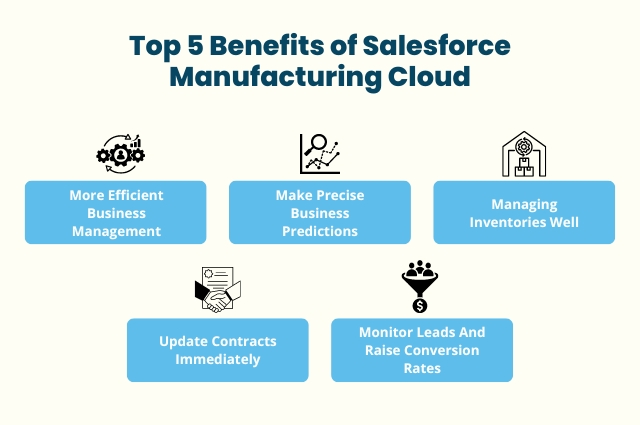
Shopping with distributors offers a distinct advantage in the form of personalized guidance throughout the purchasing journey, nurturing enduring relationships and encouraging repeat business. While distributors excel in delivering tailored service, digital-native rivals such as Amazon leverage operational efficiency to vie in today’s marketplace. As B2B preferences veer towards remote transactions and omnichannel experiences, distributors lagging in digitalization encounter hurdles. Salesforce for Manufacturing Operational Efficiency Manufacturing operational efficiency, while vital, cannot overshadow the significance of personalized service for customers. Traditional distributors hold a formidable competitive edge in this aspect. However, their reliance on antiquated, non-digitalized processes impedes effective competition. Distributors must confront these inefficiencies and embrace innovative technology to flourish. Conventional distributors often rely on disparate systems like spreadsheets and sticky notes, resulting in disjointed customer experiences. Siloed data leads to quote disparities, communication breakdowns, and a dearth of omnichannel capabilities. To retain competitiveness, distributors must transition to digital platforms that centralize data and streamline operations. Digital transformation in manufacturing is possible with Salesforce Manufacturing Cloud. Salesforce for Manufacturing Operational Efficiency with Manufacutring Cloud Salesforce Manufacturing Cloud emerges as a solution to these challenges. By consolidating all information within a centralized system, Salesforce empowers distributors to deliver seamless customer experiences across various channels. This eradicates confusion, ensures consistent communication, and elevates service quality. With Salesforce, distributors can provide exemplary service, nurturing customer loyalty and outpacing the competition. Like1 Related Posts Who is Salesforce? Who is Salesforce? Here is their story in their own words. From our inception, we’ve proudly embraced the identity of Read more Salesforce Marketing Cloud Transactional Emails Salesforce Marketing Cloud Transactional Emails are immediate, automated, non-promotional messages crucial to business operations and customer satisfaction, such as order Read more Salesforce Unites Einstein Analytics with Financial CRM Salesforce has unveiled a comprehensive analytics solution tailored for wealth managers, home office professionals, and retail bankers, merging its Financial Read more AI-Driven Propensity Scores AI plays a crucial role in propensity score estimation as it can discern underlying patterns between treatments and confounding variables Read more

Read More
mulesoft and healthcare

MuleSoft and Healthcare

Driving Innovation in Healthcare Through Data Interoperability Healthcare organizations are navigating an unprecedented surge in patient data, which is critical for communication, research, and management. This data plays a pivotal role in modernizing healthcare and improving outcomes, particularly with the shift toward a Value-Based Care Model. However, 81% of IT leaders report that much of this data remains trapped in silos, hindering innovation and negatively impacting patient satisfaction. The Importance of Interoperability in Healthcare Improving Patient Outcomes and Managing RiskLeading healthcare organizations understand that achieving interoperability—seamless data exchange across clinical and non-clinical systems—is vital. Beyond supporting Value-Based Care, interoperability drives patient satisfaction, loyalty, and cost-efficiency. By enabling accurate data sharing, healthcare providers can: Interoperability also supports proactive preventative care, reducing long-term healthcare costs and boosting life expectancy. Regulatory Mandates: The Interoperability and Patient Access Final RuleSince May 1, 2020, the Centers for Medicare & Medicaid Services (CMS) have mandated interoperability through the Interoperability and Patient Access Final Rule. This legislation holds U.S. healthcare providers accountable for: Non-compliance can result in significant fines and public reporting of violations, further emphasizing the criticality of achieving interoperability. The Challenge of ImplementationDespite its clear benefits—improved patient outcomes, compliance, and cost savings—achieving interoperability poses challenges. Technological complexities and siloed data structures hinder seamless integration. This is where MuleSoft, a Salesforce company, provides a powerful solution. How MuleSoft Enables Interoperability in Healthcare Breaking Down Silos with API-Led IntegrationMuleSoft is a trusted partner for leading healthcare organizations, offering secure, scalable solutions to eliminate data silos. Recognized as a Leader in Gartner’s Magic Quadrant for iPaaS, MuleSoft empowers providers with its HIPAA-compliant Anypoint Platform, facilitating interoperability through API-led integration. Key Features and Benefits Transforming Healthcare with MuleSoft The digital transformation of healthcare is accelerating, driven by evolving regulations, patient expectations, and a dynamic global environment. MuleSoft stands at the forefront of this shift, empowering healthcare organizations to: By partnering with MuleSoft, healthcare organizations can embrace innovation and build healthier connections—one integration at a time. Contact Tectonic today to get started. Like Related Posts Who is Salesforce? Who is Salesforce? Here is their story in their own words. From our inception, we’ve proudly embraced the identity of Read more Salesforce Marketing Cloud Transactional Emails Salesforce Marketing Cloud Transactional Emails are immediate, automated, non-promotional messages crucial to business operations and customer satisfaction, such as order Read more Salesforce Unites Einstein Analytics with Financial CRM Salesforce has unveiled a comprehensive analytics solution tailored for wealth managers, home office professionals, and retail bankers, merging its Financial Read more AI-Driven Propensity Scores AI plays a crucial role in propensity score estimation as it can discern underlying patterns between treatments and confounding variables Read more
Read More
Gen AI Role in Healthcare

Gen AI Role in Healthcare

Generative AI’s Growing Role in Healthcare: Potential and Challenges The rapid advancements in large language models (LLMs) have introduced generative AI tools into nearly every business sector, including healthcare. As defined by the Government Accountability Office, generative AI is “a technology that can create content, including text, images, audio, or video, when prompted by a user.” These systems learn patterns and relationships from vast datasets, enabling them to generate new content that resembles but is not identical to the original training data. This capability is powered by machine learning algorithms and statistical models. In healthcare, generative AI is being utilized for various applications, including clinical documentation, patient communication, and clinical text summarization. Streamlining Clinical Documentation Excessive documentation is a leading cause of clinician burnout, as highlighted by a 2022 athenahealth survey conducted by the Harris Poll. Generative AI shows promise in easing these documentation burdens, potentially improving clinician satisfaction and reducing burnout. A 2024 study published in NEJM Catalyst explored the use of ambient AI scribes within The Permanente Medical Group (TPMG). This technology employs smartphone microphones and generative AI to transcribe patient encounters in real-time, providing clinicians with draft documentation for review. In October 2023, TPMG deployed this ambient AI technology across various settings, benefiting 10,000 physicians and staff. Physicians who used the ambient AI scribe reported positive outcomes, including more personal and meaningful patient interactions and reduced after-hours electronic health record (EHR) documentation. Early patient feedback was also favorable, with improved provider interactions noted. Additionally, ambient AI produced high-quality clinical documentation for clinician review. However, a 2023 study in the Journal of the American Medical Informatics Association (JAMIA) cautioned that ambient AI might struggle with non-lexical conversational sounds (NLCSes), such as “mm-hm” or “uh-uh,” which can convey clinically relevant information. The study found that while the ambient AI tools had a word error rate of about 12% for all words, the error rate for NLCSes was significantly higher, reaching up to 98.7% for those conveying critical information. Misinterpretation of these sounds could lead to inaccuracies in clinical documentation and potential patient safety issues. Enhancing Patient Communication With the digital transformation in healthcare, patient portal messages have surged. A 2021 study in JAMIA reported a 157% increase in patient portal inbox messages since 2020. In response, some healthcare organizations are exploring the use of generative AI to draft replies to these messages. A 2024 study published in JAMA Network Open evaluated the adoption of AI-generated draft replies to patient messages at an academic medical center. After five weeks, clinicians used the AI-generated drafts 20% of the time, a notable rate considering the LLMs were not fine-tuned for patient communication. Clinicians reported reduced task load and emotional exhaustion, suggesting that AI-generated replies could help alleviate burnout. However, the study found no significant changes in reply time, read time, or write time between the pre-pilot and pilot periods. Despite this, clinicians expressed optimism about time savings, indicating that the cognitive ease of editing drafts rather than writing from scratch might not be fully captured by time metrics. Summarizing Clinical Data Summarizing information within patient records is a time-consuming task for clinicians, and errors in this process can negatively impact clinical decision support. Generative AI has shown potential in this area, with a 2023 study finding that LLM-generated summaries could outperform human expert summaries in terms of conciseness, completeness, and correctness. However, using generative AI for clinical data summarization presents risks. A viewpoint in JAMA argued that LLMs performing summarization tasks might not fall under FDA medical device oversight, as they provide language-based outputs rather than disease predictions or numerical estimates. Without statutory changes, the FDA’s authority to regulate these LLMs remains unclear. The authors also noted that differences in summary length, organization, and tone could influence clinician interpretations and subsequent decision-making. Furthermore, LLMs might exhibit biases, such as sycophancy, where responses are tailored to user expectations. To address these concerns, the authors called for comprehensive standards for LLM-generated summaries, including testing for biases and errors, as well as clinical trials to quantify potential harms and benefits. The Path Forward Generative AI holds significant promise for transforming healthcare and reducing clinician burnout, but realizing this potential requires comprehensive standards and regulatory clarity. A 2024 study published in npj Digital Medicine emphasized the need for defined leadership, adoption incentives, and ongoing regulation to deliver on the promise of generative AI in healthcare. Leadership should focus on establishing guidelines for LLM performance and identifying optimal clinical settings for AI tool trials. The study suggested that a subcommittee within the FDA, comprising physicians, healthcare administrators, developers, and investors, could effectively lead this effort. Additionally, widespread deployment of generative AI will likely require payer incentives, as most providers view these tools as capital expenses. With the right leadership, incentives, and regulatory framework, generative AI can be effectively implemented across the healthcare continuum to streamline clinical workflows and improve patient care. Like Related Posts Who is Salesforce? Who is Salesforce? Here is their story in their own words. From our inception, we’ve proudly embraced the identity of Read more Salesforce Unites Einstein Analytics with Financial CRM Salesforce has unveiled a comprehensive analytics solution tailored for wealth managers, home office professionals, and retail bankers, merging its Financial Read more AI-Driven Propensity Scores AI plays a crucial role in propensity score estimation as it can discern underlying patterns between treatments and confounding variables Read more Tectonic’s Successful Salesforce Track Record Salesforce Technology Services Integrator – Tectonic has successfully delivered Salesforce in a variety of industries including Public Sector, Hospitality, Manufacturing, Read more
Read More
MuleSoft Certifications Now Unified with Salesforce Certifications

MuleSoft Certifications Now Unified with Salesforce Certifications

MuleSoft Certifications Now Unified with Salesforce Certifications As of May 6, 2024, MuleSoft certifications have been officially integrated into the Salesforce Certification program, with management now handled through Webassessor. This move simplifies the certification process, enabling professionals to manage both their Salesforce and MuleSoft credentials within a single platform, streamlining maintenance and tracking. This article delves into the merging of MuleSoft certifications with Salesforce’s Trailhead platform, highlighting what this means for professionals in both ecosystems. The update offers a significant improvement in managing certifications, particularly for those working across both platforms, as Salesforce has owned MuleSoft since 2018. We’ll cover what this change entails for current certification holders, key dates in the transition, and the new opportunities this unified platform brings—including new certifications. What is MuleSoft? MuleSoft is a leading integration platform that enables businesses to connect applications, data, and devices seamlessly. As an Integration Platform as a Service (iPaaS), MuleSoft facilitates the integration of cloud-based and on-premise applications, ensuring smooth workflows across various systems. Acquired by Salesforce in 2018, MuleSoft powers the integration layer of the Salesforce ecosystem, playing a crucial role in enabling businesses to unify their systems and create connected experiences. With the increasing demand for digital transformation and connected systems, MuleSoft expertise is becoming ever more valuable in the job market. MuleSoft Certifications and Training MuleSoft certifications validate expertise in designing, building, and managing integrations using the Anypoint Platform. Prior to this transition, MuleSoft certifications were handled through the MuleSoft Training portal, which was separate from Salesforce’s broader certification system. While this independent platform was functional, it required separate accounts and processes, making exam registration and certification management more cumbersome. By integrating MuleSoft certifications into Trailhead, Salesforce has simplified this process, offering a unified, more user-friendly experience for managing certifications. Transition Timeline The following key dates marked the transition: What This Means for Current MuleSoft Certification Holders For those already certified through MuleSoft, the migration to Salesforce’s certification system should have occurred automatically. MuleSoft credentials were transferred to their Trailblazer profiles for anyone with existing Webassessor accounts. A confirmation email was sent to ensure that the transition was successful. For those without a Webassessor account, one was created on their behalf, with login details provided via email by April 2024. Certification Maintenance MuleSoft certification holders with maintenance pending as of January 1, 2024, are not required to complete additional tasks through the old system. The expectation is that certification holders will have ample time to familiarize themselves with the new Trailhead process before maintenance requirements are introduced in 2025. New Certifications on Trailhead With the migration, certifications such as the MuleSoft Certified Catalyst Specialist and MuleSoft Certified Hyperautomation Specialist have also been integrated into Trailhead. Though not entirely new, these certifications were part of the legacy MuleSoft program, originally launched in late 2022 and early 2023. Summary The integration of MuleSoft certifications into Salesforce’s Trailhead platform marks a significant step towards a unified, more efficient credentialing process. This transition simplifies certification management, making it easier for professionals to stay current across both platforms. By merging these certifications, Salesforce is empowering professionals to fully leverage the combined capabilities of Salesforce and MuleSoft, further enhancing their skill sets in an increasingly interconnected digital landscape. Content updated September 2024. Like Related Posts Who is Salesforce? Who is Salesforce? Here is their story in their own words. From our inception, we’ve proudly embraced the identity of Read more Salesforce Marketing Cloud Transactional Emails Salesforce Marketing Cloud Transactional Emails are immediate, automated, non-promotional messages crucial to business operations and customer satisfaction, such as order Read more Salesforce Unites Einstein Analytics with Financial CRM Salesforce has unveiled a comprehensive analytics solution tailored for wealth managers, home office professionals, and retail bankers, merging its Financial Read more AI-Driven Propensity Scores AI plays a crucial role in propensity score estimation as it can discern underlying patterns between treatments and confounding variables Read more

Read More
Salesforce Implementation Solutions

Salesforce Implementation Solutions Are Here!

Tectonic is Pleased to Announce Salesforce Implementation Solutions! The world’s #1 CRM platform has just received a new function in deliverability. Salesforce Implementation Solutions from Tectonic are pre-planned, flxed rate priced, low technical debt solution to Salesforce implementations. Designed with the SMB in mind, Tectonic’s Salesforce Implementation Solutions get you up and running quickly on the Salesforce solutions you need. Finding the right mix of Salesforce products can be as challenging as finding the right Salesforce partner. Tectonic has custom designed Salesforce Implementation Solutions to help ease the integration to the Salesforce platform. Sometimes called quickstarts, jumpstarts, or even accelorators, Salesforce Implementation Solutions are designed to get you set up right and fast, to see the value from your Salesforce investment. Tectonic has tailored our packages to address specific business needs. Pre-defined Salesforce Deliverables at a Fixed Price The Salesforce Implementation Solutions experts at Tectonic will enable you to deploy Salesforce in weeks not months to maximize efficiency. Whether you are seeking a marketing platform solution, a healthcare CRM, personalization, feedback management, or core Salesforce platform capabilities we have you covered. Tectonic gets you started on Salesforce quickly and affordably, without compromising on quality. These fast implementation solutions help you hit the ground running. It doesn’t matter if you’ve never used Salesforce, never purchased a Salesforce license, or have been using the simple, out-of-the-box version. Our team of Salesforce experts will identify and implement what is critical for your business’s immediate success. Thereby giving you the functionality that can develop and grow along with your business at minimal cost, and lightning speed. Why Salesforce Implementation Solutions? From kick off call and discovery to UAT and launch, these packages are here for quick and easy implementation service. With a flat fee, you know your project will be completed on time and budget. When you are seeking a basic platform stand-up, you don’t need to be bombarded with endless choices and decisions. With the help of our certified Salesforce professionals, you will receive expert guidance and support as we implement your new system with a focus on maximizing functionality. You want an implementation with a proven roadmap. Implementation solutions include a range of tools and resources, such as a personalized onboarding plan, training resources, and pre-built solutions, that can help reduce the time it takes to implement Salesforce. This can be especially helpful if you are new to Salesforce or if you need to get your implementation completed in a short time frame. Efficiency, speed, and success are the promises of Tectonic Salesforce Implementation Solutions. Salesforce is your customer success platform, designed to help you sell, service, market, analyze, and connect with your customers. Interested in making the most of Salesforce? Tectonic’s implementation solutions get your business or nonprofit up and running in weeks. Automation is one of the big keys to managing tons of data. Our implementations get you where you need to be in no time flat. Salesforce CRM isn’t just a solution to automate processes, manage workflows, and corral data. Salesforce can jumpstart your digital transformation. Tectonic’s Salesforce implementations avoid the unexpected costs of an implementation. Fixed price packages prevent surprises. Tectonic provides niche, high quality, service-oriented Salesforce implementation, customization, and managed services. The best time to embark on your transformation was 5 years ago. The second best time is right now.  Tectonic Salesforce implementation solutions, or quickstarts, are limited engagement implementations. They zero in on key planning and decision making, standard and custom configurations, and essential training to get up and running lightning fast. Therefore our solutions provide immediate benefits and ROI. Tectonic even offers implementations for upgrading versions and clouds within Salesforce. These all-in-one solutions take the guesswork out of implementing Salesforce with a proven partner to guide you every step of the way. Learn about all Tectonic’s Salesforce Implementation Solutions here. If you have other needs you’d like to address in a flat bundled project, contact us today. Like2 Related Posts Who is Salesforce? Who is Salesforce? Here is their story in their own words. From our inception, we’ve proudly embraced the identity of Read more Salesforce Marketing Cloud Transactional Emails Salesforce Marketing Cloud Transactional Emails are immediate, automated, non-promotional messages crucial to business operations and customer satisfaction, such as order Read more Salesforce Unites Einstein Analytics with Financial CRM Salesforce has unveiled a comprehensive analytics solution tailored for wealth managers, home office professionals, and retail bankers, merging its Financial Read more AI-Driven Propensity Scores AI plays a crucial role in propensity score estimation as it can discern underlying patterns between treatments and confounding variables Read more

Read More
salesforce unified knowledge

The Low-Code Revolution

The Low-Code Revolution: How Salesforce is Democratizing CRM Customization Redefining CRM Development Through Visual Innovation Salesforce has pioneered a fundamental shift in customer relationship management by embracing low-code/no-code technology, transforming how organizations customize their CRM platforms. This revolutionary approach enables business users across departments to actively participate in solution development through intuitive visual interfaces rather than complex programming. The low-code movement represents more than just simplified development—it’s a strategic empowerment of business teams to rapidly adapt systems to evolving needs without creating IT bottlenecks. By 2025, Gartner predicts 70% of new applications will use low-code/no-code technologies, with Salesforce positioned at the forefront of this transformation. Understanding the Low-Code/No-Code Paradigm Visual Development for Business Agility Low-code/no-code platforms replace traditional programming with: This approach creates a spectrum of capability: The Strategic Advantages of Salesforce’s Approach 1. Accelerated Digital Transformation 2. Cost-Effective Innovation 3. Cross-Functional Collaboration Salesforce’s Low-Code Ecosystem Core Platform Capabilities Expanding Possibilities Real-World Impact Across Industries Financial Services A regional bank reduced loan processing time by 40% by enabling loan officers to build their own workflow automations using Salesforce Flow. Healthcare A hospital network created a patient intake portal in three days using Lightning App Builder, eliminating a six-month development backlog. Retail A global retailer empowered store managers to build custom inventory apps, improving stock accuracy by 25% without IT involvement. The Future of Enterprise Development Salesforce’s low-code strategy represents more than just simplified tools—it’s redefining the relationship between business needs and technical solutions. Key emerging trends include: Implementing a Successful Low-Code Strategy Organizations maximizing Salesforce’s low-code potential typically: Conclusion: The Democratization of Digital Transformation Salesforce’s low-code/no-code revolution represents a fundamental shift in how businesses approach CRM customization and digital innovation. By empowering business users to become active participants in solution development, organizations can achieve: As the platform continues to evolve, Salesforce is positioned to lead the next wave of enterprise software—where the power to transform business processes resides not just with technical teams, but across the entire organization. This democratization of development capability marks a new era of business agility and competitive advantage. Content updated April 2025. Like Related Posts Who is Salesforce? Who is Salesforce? Here is their story in their own words. From our inception, we’ve proudly embraced the identity of Read more Salesforce Marketing Cloud Transactional Emails Salesforce Marketing Cloud Transactional Emails are immediate, automated, non-promotional messages crucial to business operations and customer satisfaction, such as order Read more Salesforce Unites Einstein Analytics with Financial CRM Salesforce has unveiled a comprehensive analytics solution tailored for wealth managers, home office professionals, and retail bankers, merging its Financial Read more AI-Driven Propensity Scores AI plays a crucial role in propensity score estimation as it can discern underlying patterns between treatments and confounding variables Read more

Read More
Salesforce's Get Ready for AI Report

Salesforce’s Get Ready for AI Report

Welcome to the future of business – Get Ready for AI is for analytics and data leaders. The tools for those who are interested in positioning themselves for AI success. From strategy to governance, you’ll learn what’s top-of-mind with other thought leaders, and see what actions you can take to be a more effective leader in a rapidly changing technology and business environment.  Salesforce’s Get Ready for AI Report This insight introduces four topics that are essential for data leaders beginning their AI journey: Access the full report here. Salesforce’s Get Ready for AI Report Data is at the center of any AI initiative, and organizations that are leading the way are focused on ensuring their data sources are current, authoritative, and complete. From talent, to strategy, to infrastructure, organizations that are prioritizing data across every business unit are ready to ride the AI wave. Positioning themselves for a significant competitive advantage over their peers. Salesforce’s Get Ready for AI Report As with any digital transformation, success depends on an enterprise-wide commitment. Data leaders are in a unique position to help guide their organizations through this transition, and achieve the benefits that AI can deliver. Like1 Related Posts Who is Salesforce? Who is Salesforce? Here is their story in their own words. From our inception, we’ve proudly embraced the identity of Read more Salesforce Marketing Cloud Transactional Emails Salesforce Marketing Cloud Transactional Emails are immediate, automated, non-promotional messages crucial to business operations and customer satisfaction, such as order Read more Salesforce Unites Einstein Analytics with Financial CRM Salesforce has unveiled a comprehensive analytics solution tailored for wealth managers, home office professionals, and retail bankers, merging its Financial Read more AI-Driven Propensity Scores AI plays a crucial role in propensity score estimation as it can discern underlying patterns between treatments and confounding variables Read more
Read More
Salesforce Success Story

Case Study: Salesforce Nonprofit Success Pack Configuration Correction

A Community Foundation located in the Northwest United States supported by donors / members that provides philanthropic leadership in the Northwest through awarding of grants and sponsorships to nonprofit organizations, student scholarships, and the coordination of collaborative responses to the region’s complex needs had an improperly installed Salesforce Nonprofit Success Pack. Salesforce Nonprofit Success Pack Configuration Correction case study. Industry: Nonprofit Problem: Nonprofit client uses Salesforce NonProfit Success Pack to maintain member data and associated donation records, but the solution was originally configured incorrectly, resulting in: Implemented : Our solution? Tectonic performed analysis on the existing Salesforce NonProfit Success Pack solution and identified errors and made improvements.  The following activities were performed during the project: Results: Salesforce offers customized solutions for the nonprofit and NGO industries, assisting companies in this field to provide outstanding donor and member experiences, optimize workflows, and spur expansion to further extend the reach of their good works. These solutions make use of the Salesforce Nonprofit Success Pack to improve communication, organize data, and provide a customized experience. Salesforce offers digital transformation technology for NGO, religious instutions and Nonprofit industries. If you are considering a Salesforce nonprofit implementation, contact Tectonic today. Like2 Related Posts Who is Salesforce? Who is Salesforce? Here is their story in their own words. From our inception, we’ve proudly embraced the identity of Read more Salesforce Marketing Cloud Transactional Emails Salesforce Marketing Cloud Transactional Emails are immediate, automated, non-promotional messages crucial to business operations and customer satisfaction, such as order Read more Salesforce Unites Einstein Analytics with Financial CRM Salesforce has unveiled a comprehensive analytics solution tailored for wealth managers, home office professionals, and retail bankers, merging its Financial Read more AI-Driven Propensity Scores AI plays a crucial role in propensity score estimation as it can discern underlying patterns between treatments and confounding variables Read more

Read More
Gov Agencies AI Workforce Challenges

Gov Agencies AI Workforce Challenges

Federal agencies are placing a higher priority on providing AI training to their workforces with a focus on principles of transparency and accountability, officials announced at ATARC’s GITEC conference in Charlottesville, Virginia earlier. Gov Agencies AI Workforce Challenges. Alexis Bonnell, Air Force Research Laboratory CIO and Director of the Digital Capabilities Directorate, emphasized the importance of upholding existing ethics standards rather than creating new ones. She stressed that agencies need to exercise the ethical principles they have always been expected to follow. President Biden’s October 2023 executive order on artificial intelligence mandated that agencies develop ethical AI and establish AI offices, among other directives. While agencies like the Defense Department and the Department of Homeland Security are optimistic about AI’s potential, leaders remain cautious about its ethical implications and stress the importance of safe technology development. It’s not just technologists who require AI training. To ensure all employees understand AI’s risks and benefits, government leaders are prioritizing education and upskilling efforts. Steven Brand, Energy Deputy CIO of Resource Management, highlighted the initiative to provide foundational AI training across his department, emphasizing that the goal is not to make employees experts. Tammy Hornsby-Fink, Executive Vice President and System CISO at the Federal Reserve Bank of Richmond, emphasized the need for accessible learning opportunities for all department members, from data scientists to executive assistants, to grasp AI concepts in manageable increments. Hornsby-Fink also emphasized the importance of providing sandboxes for employees to experiment with new technologies safely, stressing that experimentation is key to understanding how these technologies can create business value. According to Tony Boese, Department of Veterans Affairs Interagency Programs Manager, consistent education is essential to combat misinformation about AI. He mentioned the agency’s ASPIRE data-literacy program, which leverages AI to identify skills gaps and tailor educational pathways for individuals. Karen Howard, IRS Office of Online Services Executive Director, highlighted the need to modernize recruitment strategies and change management principles to attract top talent and leverage digital transformation and AI effectively. Jamie Holcombe, U.S. Patent and Trademark Office CIO, emphasized the importance of diversifying agency workforces by bringing in new perspectives from industry, such as those from Silicon Valley, to move away from outdated organizational playbooks. Gov Agencies AI Workforce Challenges Like Related Posts Who is Salesforce? Who is Salesforce? Here is their story in their own words. From our inception, we’ve proudly embraced the identity of Read more Salesforce Unites Einstein Analytics with Financial CRM Salesforce has unveiled a comprehensive analytics solution tailored for wealth managers, home office professionals, and retail bankers, merging its Financial Read more AI-Driven Propensity Scores AI plays a crucial role in propensity score estimation as it can discern underlying patterns between treatments and confounding variables Read more Tectonic’s Successful Salesforce Track Record Salesforce Technology Services Integrator – Tectonic has successfully delivered Salesforce in a variety of industries including Public Sector, Hospitality, Manufacturing, Read more
Read More
Salesforce Success Story

Case Study: Healthcare Health Cloud Marketing Cloud Large Childrens Hospital

Large children’s hospital needs a usable data model and enhanced security to deliver excellent patient outcomes. Healthcare Health Cloud Marketing Cloud Large Childrens Hospital. Industry: Healthcare Client is a large children’s hospital with pediatric healthcare offering acute care. Problem: Implemented : Our solution? Results: In order to improve operations, provide physician-facing services, and move data—including PHI and PII—to the cloud, we have assisted healthcare providers in overcoming these obstacles. Salesforce offers all-inclusive solutions specifically designed to meet the demands of payers (insurance companies) and providers (healthcare organizations). Better health outcomes, more operational effectiveness, and increased patient engagement are the goals of these solutions. Salesforce solutions for the health and life sciences are tailored to the particular requirements of the medical industry. Salesforce offers digital transformation technology for health and life sciences industries. If you are considering a Salesforce healthcare implementation, contact Tectonic today. Like2 Related Posts Who is Salesforce? Who is Salesforce? Here is their story in their own words. From our inception, we’ve proudly embraced the identity of Read more Salesforce Marketing Cloud Transactional Emails Salesforce Marketing Cloud Transactional Emails are immediate, automated, non-promotional messages crucial to business operations and customer satisfaction, such as order Read more Salesforce Unites Einstein Analytics with Financial CRM Salesforce has unveiled a comprehensive analytics solution tailored for wealth managers, home office professionals, and retail bankers, merging its Financial Read more AI-Driven Propensity Scores AI plays a crucial role in propensity score estimation as it can discern underlying patterns between treatments and confounding variables Read more

Read More
AI and the Role of Healthcare CIOs

AI and the Role of Healthcare CIOs

Healthcare leaders see significant potential in data analytics and AI technology to transform the industry over the next five years, according to a new market research report from Arcadia and The Harris Poll. AI and the Role of Healthcare CIOs The report, titled “The Healthcare CIO’s Role in the Age of AI,” examines AI’s impact on the healthcare sector and how decision-makers are preparing to leverage the technology. Notably, 96% of healthcare leaders surveyed believe that adopting AI effectively will provide a competitive edge both now and in the future. While only a third see AI as essential today, 73% expect it to become critical within five years. How Health Systems Are Using AI Around 63% of respondents revealed that their organizations use AI to analyze large patient data sets to identify trends and guide population health management efforts. Another 58% are using AI to analyze individual patient data to identify opportunities for improving health outcomes. Close to half of the leaders indicated that AI is being used to optimize electronic health records (EHR) management and analysis. These trends align with the findings of the recent “Top of Mind for Top Health Systems” survey, conducted by the University of Pittsburgh Medical Center’s Center for Connected Medicine (CCM) in collaboration with KLAS, which identified AI as the most exciting emerging technology in healthcare with transformative potential for both administration and care delivery. The excitement surrounding healthcare AI largely stems from its ability to break down data silos and tap into the wealth of clinical data that healthcare organizations already collect. “Healthcare leaders are thoughtfully preparing to harness the full value of AI in care delivery reform,” said Aneesh Chopra, Arcadia’s chief strategy officer. “As safe, secure data sharing scales, technology leaders prioritize data platforms that organize fragmented patient records into clinically relevant insights at every stage of the patient journey.” A quest for a 360 degree patient view abounds. Using AI to Support Strategic Priorities The Arcadia survey emphasized the importance of using analytics to improve patient care, with 83% of leaders believing that harnessing data will help healthcare organizations remain competitive and resilient while overcoming digital transformation and financial challenges. Eighty-four percent of respondents cited technology as a current priority, with 44% focusing on an enterprise-wide approach to data analytics, 41% prioritizing AI-driven decision-making, and 32% working to simplify technical ecosystems. These efforts are viewed as crucial to advancing other strategic goals, with 40% of leaders prioritizing the patient experience, 35% aiming to improve outcomes, and 29% focusing on patient engagement. Although healthcare leaders view AI adoption positively for strategic advancements, hurdles remain. While 96% of respondents are confident in adopting AI, many feel pressured to move quickly. When asked about the sources of this pressure, 82% cited data and analytics teams, 78% pointed to IT and tech teams, and 73% mentioned executives. However, successfully implementing AI requires talent and resources that some organizations lack. About 40% of leaders identified a lack of talent as a significant barrier to AI adoption, signaling the need for IT and analytics teams to acquire new skill sets. Seventy-one percent of IT leaders reported a growing demand for data-driven decision-making skills, while two-thirds pointed to a rising need for expertise in data analysis, machine learning, and systems integration. Additionally, nearly 60% mentioned the need for roles that focus on training and support for healthcare staff. The Evolving Role of CIOs CIOs and other healthcare leaders are seeing their roles evolve as AI and data become more integrated into healthcare operations. Eighty-seven percent of respondents see themselves as strategy influencers, actively involved in setting and executing AI strategies, while only 13% view themselves as purely focused on implementation. Despite these evolving roles, many CIOs feel constrained by daily operations. Fifty-eight percent reported being primarily focused on tactical execution rather than developing long-term AI strategies, although they believe they should spend 75% of their time on strategic planning to be most effective. Part of these strategies will likely focus on improving communication and workforce readiness. Three out of four leaders cited a lack of effective communication between IT teams and clinical staff as a barrier to leveraging new technologies, and two out of five noted that clinical staff are not fully equipped to make the best use of data analytics. “CIOs and their teams are setting the stage for an AI-powered revolution in patient care and healthcare operations,” said Michael Meucci, Arcadia’s president and CEO. “Our findings highlight a strong consensus that a solid data foundation is necessary to realize the future of AI in healthcare. At the same time, the human workforce, with evolving talent and skills, will shape the real-world impact of AI in healthcare.“ Content updated August 2024. Like Related Posts Who is Salesforce? Who is Salesforce? Here is their story in their own words. From our inception, we’ve proudly embraced the identity of Read more Salesforce Unites Einstein Analytics with Financial CRM Salesforce has unveiled a comprehensive analytics solution tailored for wealth managers, home office professionals, and retail bankers, merging its Financial Read more AI-Driven Propensity Scores AI plays a crucial role in propensity score estimation as it can discern underlying patterns between treatments and confounding variables Read more Tectonic’s Successful Salesforce Track Record Salesforce Technology Services Integrator – Tectonic has successfully delivered Salesforce in a variety of industries including Public Sector, Hospitality, Manufacturing, Read more
Read More
Salesforce CRM for AI driven transformation

Salesforce CRM Crucial for Transformation Driven by AI

Salesforce recently commission Forrester to wrangle up the state of AI. Overwhelmingly a CRM tool was found to be crucial for transformation driven by artificial intelligence. 89% of those surveyed said AI strategy and capability are top of mind when selecting a CRM partner. Tectonic is pleased to share our thoughts on the crucial role of Salesforce CRM for AI driven transformation. As companies increasingly adopt AI across various technologies, CRM is emerging as a crucial foundation for business transformation driven by AI. The interactions with customers generate substantial volumes of unstructured data from emails, meeting transcripts, phone conversations, and more. AI has the capability to distill this data into key insights and actionable next steps, thereby streamlining employee workflows and enhancing customer interactions. Today’s CRM customers are eager to leverage AI-powered CRMs to personalize front office content, address inquiries, and summarize customer interactions. Customers are rapidly integrating AI across most CRM use cases. According to Forrester’s research: The success of integrating AI capabilities into CRM relies heavily on data readiness. AI-powered CRMs depend on high-quality, well-structured, and clean data for informed predictions, personalized recommendations, and automation of various tasks. Respondents recognize the criticality of data readiness, with 92% emphasizing the importance of a strong data strategy for AI success. However, despite this awareness, many respondents are rushing to implement AI before achieving data readiness, with only 34% having a formal data strategy integrated across the business. Not only is Salesforce CRM a great choice for your digital AI transformation. Salesforce Data Cloud assists in ingesting and unifying data, ensuring your data is ready. Are you aware of the Salesforce Data Cloud license offer? Data readiness practices are generally low, as indicated by respondents ranking their organization’s level of data readiness into three bands: A, B, and C. Twenty-seven percent have ad hoc data initiatives and lack a formal strategy (band A), 39% have a formal data strategy but it is not integrated across the business (band B), and only 34% have a formal strategy integrated across the business (band C). Data readiness is critical for AI-powered CRM, as incomplete or unreliable data may lead to inaccurate and incomplete AI models, risking adverse outcomes. Data remains a primary challenge in Customer Relationship Management, with respondents highlighting data quality issues, extensive reliance on manual processes to synthesize data, and a lack of internal data skills as their top challenges. It’s essential to address these challenges, especially when incorporating generative AI features into an organization’s CRM, as genAI specifically requires a significant amount of data for successful implementation. Tectonic is ready to help you assess your data, implement Salesforce CRM, and experience an AI driven transformation. Contact Tectonic today for a trusted Salesforce partner to assist with your AI driven transformation. Like2 Related Posts Salesforce Unites Einstein Analytics with Financial CRM Salesforce has unveiled a comprehensive analytics solution tailored for wealth managers, home office professionals, and retail bankers, merging its Financial Read more AI-Driven Propensity Scores AI plays a crucial role in propensity score estimation as it can discern underlying patterns between treatments and confounding variables Read more Salesforce AI Einstein Next Best Action Salesforce AI Einstein Next Best Action is a feature designed to identify the most effective actions available to agents and Read more Salesforce Scheduler Salesforce Scheduler provides the objects required for appointment scheduling and an app that makes it easy to set up Scheduler. Read more

Read More

Salesforce Unveils Einstein Copilot

Salesforce Unveils Einstein Copilot: A New Era in AI-Powered CRM Salesforce, the world’s leading customer relationship management (CRM) platform, has introduced Einstein Copilot, an advanced AI-powered assistant designed to revolutionize business interactions with CRM systems. Seamlessly integrated within Salesforce’s ecosystem, including Data Cloud, Einstein Copilot automates complex workflows, enhances operational efficiency, and delivers highly personalized customer insights. By leveraging AI, it empowers sales, marketing, and customer service teams while ensuring compliance with data privacy and governance standards. The Challenge: Enhancing CRM Efficiency with AI As customer relationships became more intricate, businesses sought a CRM solution that could: Salesforce responded by integrating cutting-edge AI capabilities into its CRM platform, ensuring a seamless, secure, and intelligent customer experience. The Einstein Copilot Solution Salesforce has embedded Einstein Copilot across its CRM applications, transforming customer relationships through AI-driven automation. By harnessing Data Cloud, Einstein Copilot accesses unified, reliable data to generate real-time insights, helping businesses make smarter decisions and enhance customer interactions. With customization tools like Copilot Builder, Prompt Builder, Skill Builder, and Model Builder, businesses can tailor Einstein Copilot to meet their unique needs. Integration with Salesforce extensions and external APIs further optimizes workflows, automating tasks and streamlining operations. Key Features of Einstein Copilot Results: Transforming CRM with AI Since its launch, Einstein Copilot has significantly improved customer satisfaction and operational productivity by: Challenges & Considerations Despite its success, deploying Einstein Copilot presented some challenges, including: The Future of Einstein Copilot Salesforce is committed to expanding Einstein Copilot’s capabilities, focusing on: Salesforce envisions Einstein Copilot setting a new benchmark in AI-driven CRM, enabling businesses to foster stronger customer relationships, drive growth, and streamline operations. About Salesforce Salesforce is the world’s leading CRM platform, empowering businesses with innovative solutions that blend cloud computing, artificial intelligence, and big data analytics. Since its founding in 1999, Salesforce has been at the forefront of digital transformation, helping organizations optimize operations and elevate customer engagement. Conclusion Einstein Copilot marks a transformative shift in CRM, leveraging AI to enhance efficiency, automate workflows, and deliver superior customer experiences. With AI-driven automation and intelligent decision-making, businesses can now focus on building long-lasting customer relationships that drive loyalty and success. Einstein Copilot is now Agentforce. Content updated January 2025. Like Related Posts Who is Salesforce? Who is Salesforce? Here is their story in their own words. From our inception, we’ve proudly embraced the identity of Read more Salesforce Marketing Cloud Transactional Emails Salesforce Marketing Cloud Transactional Emails are immediate, automated, non-promotional messages crucial to business operations and customer satisfaction, such as order Read more Salesforce Unites Einstein Analytics with Financial CRM Salesforce has unveiled a comprehensive analytics solution tailored for wealth managers, home office professionals, and retail bankers, merging its Financial Read more AI-Driven Propensity Scores AI plays a crucial role in propensity score estimation as it can discern underlying patterns between treatments and confounding variables Read more

Read More
What is GovSlack

What is GovSlack?

GovSlack: Streamlined, Secure Collaboration for Government GovSlack brings together your team, tools, and partners into one secure platform, specifically designed to meet government regulations for processing and storing sensitive data. By integrating GovSlack, organizations can eliminate internal and external communication silos while empowering employees with the flexibility to excel in their roles. What is GovSlack?GovSlack is a tailored version of Slack that allows agencies, contractors, citizens, and partners to collaborate in a centralized, secure workspace. It complies with the strictest security and operational standards required by public sector clients. Is Slack FedRAMP approved?Yes, Slack holds FedRAMP Moderate authorization to meet public sector compliance needs. GovSlack goes further, earning FedRAMP JAB High authorization and is actively pursuing DoD CC SRG IL4 compliance to cater to defense sector clients. Does the federal government use Slack?Security is crucial for public sector agencies and their partners. Federal agencies trust Slack as their secure digital HQ, helping teams from the U.S. Department of Veterans Affairs to the GSA’s 18F office enhance collaboration while meeting stringent data privacy requirements. GovSlack Key FeaturesGovSlack, launched in July 2022 after extensive testing and feedback from government clients, offers several features to ensure secure and compliant collaboration: GovSlack integrates seamlessly with other government-specific tools such as Salesforce Government Cloud Plus, creating a powerful CRM and collaboration ecosystem to accelerate agency goals and improve constituent services. Case Study: Army Software Factory (SWF)The Army SWF, using agile methods to upskill soldiers and develop cutting-edge digital solutions, required a flexible and secure collaboration platform. By adopting GovSlack, they fostered improved collaboration without compromising compliance with stringent DoD policies. Partner IntegrationsLeading companies such as Lockheed Martin and Box are leveraging GovSlack to streamline collaboration while maintaining compliance with federal regulations. For example, Lockheed Martin is using GovSlack to manage projects with government partners while ensuring sensitive data remains protected. ThoughtsGovSlack is built for secure, government-specific collaboration, providing agencies and their partners with the flexibility to work more effectively while meeting compliance needs. By integrating with key tools and offering enhanced security features, GovSlack supports the digital transformation efforts of public sector organizations across the globe. Like Related Posts Who is Salesforce? Who is Salesforce? Here is their story in their own words. From our inception, we’ve proudly embraced the identity of Read more Salesforce Marketing Cloud Transactional Emails Salesforce Marketing Cloud Transactional Emails are immediate, automated, non-promotional messages crucial to business operations and customer satisfaction, such as order Read more Salesforce Unites Einstein Analytics with Financial CRM Salesforce has unveiled a comprehensive analytics solution tailored for wealth managers, home office professionals, and retail bankers, merging its Financial Read more AI-Driven Propensity Scores AI plays a crucial role in propensity score estimation as it can discern underlying patterns between treatments and confounding variables Read more

Read More
gettectonic.com