Einstein AI Archives - gettectonic.com - Page 4
How Does Salesforce Use AI

How Does Salesforce Use AI

With all the buzz in the news about AI, it may feel like AI is everywhere. In fact, as of 2023, over 80% of global companies report adopting AI to enhance their business operations. This means if your company isn’t yet leveraging AI to strengthen customer relationships, you risk falling behind. The good news is that Salesforce CRM already comes with a suite of AI tools ready for use. In this insight, we’ll explore how combining quality data, AI, and Salesforce can help you build more meaningful, lasting relationships with your customers. How Does Salesforce Use AI? Salesforce offers various built-in functionalities to create customizable, predictive, and generative AI experiences tailored to your business needs. One standout tool is Agentforce, which enables the creation of autonomous AI agents. If you have numerous routine tasks but limited staff, Agentforce could be the solution. For instance, if you lack an in-house customer support agent, Agentforce can build an AI service agent to handle incoming cases, responding intuitively in real-time. Not enough sales reps? No problem—create an AI sales agent to manage records, interact with leads, answer questions, and schedule meetings. Another significant AI feature is generative AI in Salesforce. According to KPMG, 77% of executives believe generative AI will have a more profound societal impact in the next three to five years than any other emerging technology. So, how can it improve your business? Salesforce’s in-house LLM, xGen, helps you generate human-like text and create original visual content from existing data or user input. This capability can enhance user experiences by automating the generation of dynamic and personalized imagery for applications. Generative AI also transforms how users interact with and consume data. Complex datasets can now be converted into easily understandable formats—visualizations, charts, or graphs—generated from natural language prompts. These insights make data accessible, enabling users to share knowledge and drive informed decisions. How Can You Use AI to Improve Customer Relationships? AI is reshaping business models, workflows, and customer engagement. By harnessing quality data, AI, and Salesforce, you can enhance how you connect with customers. Here are key ways to leverage this combination for a smarter customer strategy: Challenges You May Encounter on Your AI Journey Adopting AI in Salesforce, especially Einstein AI, offers many benefits, but it also comes with challenges. Here are some factors to consider for a successful rollout: Importance of Data Quality When Using AI Analytics Data quality is essential for AI accuracy and reliability. Poor data can skew predictions and erode user trust. Key factors that contribute to high data quality include: AI can also enhance data quality by automating data validation and cleansing. Machine learning algorithms can detect and address anomalies, duplicate records, and incomplete datasets, improving the reliability of your data over time. The Future of CRM: AI-Driven Customer Engagement and Business Growth Integrating AI into Salesforce is revolutionizing CRM by enabling businesses to engage with customers more intelligently. From automating routine tasks to enhancing decision-making and delivering personalized communication, AI-driven innovations are empowering businesses to build stronger relationships with customers. As AI continues to evolve, those who embrace it will gain a competitive edge and drive long-term growth. The future of CRM is here—and it’s smarter, faster, and more customer-focused than ever. Like Related Posts Who is Salesforce? Who is Salesforce? Here is their story in their own words. From our inception, we’ve proudly embraced the identity of Read more Salesforce Marketing Cloud Transactional Emails Salesforce Marketing Cloud Transactional Emails are immediate, automated, non-promotional messages crucial to business operations and customer satisfaction, such as order Read more Salesforce Unites Einstein Analytics with Financial CRM Salesforce has unveiled a comprehensive analytics solution tailored for wealth managers, home office professionals, and retail bankers, merging its Financial Read more AI-Driven Propensity Scores AI plays a crucial role in propensity score estimation as it can discern underlying patterns between treatments and confounding variables Read more

Read More
agentblazer

Agentblazers

In every industry, there are leaders who see the potential of cutting-edge technology and act as catalysts for change. In the age of AI, these forward-thinkers are known as Agentblazers. They understand that AI agents can do more than assist—they can transform operations, save costs, and shape the future of business.

Read More
Salesforce Connected Assets

Salesforce Connected Assets

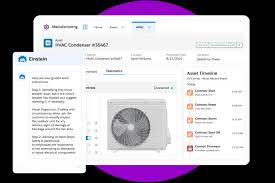
Salesforce has unveiled Connected Assets, a robust suite of capabilities in Manufacturing Cloud, designed to offer manufacturers a comprehensive, real-time perspective on connected asset data. This includes data on service history, asset status, customer records, and telematics, allowing manufacturers to monitor asset health and performance while proactively addressing maintenance needs to reduce downtime and boost customer satisfaction. Enhanced AI Capabilities for Connected AssetsConnected Assets integrates Salesforce’s advanced AI to empower teams with actionable insights. Sales, customer service, and field teams can now receive real-time alerts and quickly access asset history and health, enabling faster, data-driven support and the delivery of more personalized offers. AI-driven insights and recommendations based on asset condition, service history, and performance data enhance the ability of manufacturers to predict maintenance needs and provide proactive support, including on-site recommendations to field technicians. Innovative Features for Optimized Asset Management Salesforce PerspectiveAchyut Jajoo, SVP and GM of Manufacturing and Automotive, states, “The manufacturing industry is embracing a historic transformation toward AI-enabled modernization. Connected Assets and our sector-specific AI tools in Manufacturing Cloud empower our customers to lead with improved customer experiences, optimized asset performance, and new revenue-generating services. With Agentforce, our customers will soon be able to leverage autonomous agents to monitor connected asset data at scale, enabling them to focus on strategic, high-value initiatives.” Real-World ApplicationKawasaki Engines exemplifies Connected Assets in action, using Manufacturing Cloud to enhance customer relationships by offering proactive support and minimizing equipment downtime. “Salesforce’s Connected Assets will enable us to deliver exceptional service, keeping our customers satisfied and our products operating efficiently,” says Tony Gondick, Senior Manager of IT Business Strategy at Kawasaki Engines. Extending Across IndustriesBeyond Manufacturing Cloud, Connected Assets is also being introduced to Salesforce’s other industry clouds, such as Energy & Utilities, Communications, and Media, allowing a wide range of sectors to tap into the benefits of connected asset management, minimize downtime, and generate new value. Like Related Posts Who is Salesforce? Who is Salesforce? Here is their story in their own words. From our inception, we’ve proudly embraced the identity of Read more Salesforce Marketing Cloud Transactional Emails Salesforce Marketing Cloud Transactional Emails are immediate, automated, non-promotional messages crucial to business operations and customer satisfaction, such as order Read more Salesforce Unites Einstein Analytics with Financial CRM Salesforce has unveiled a comprehensive analytics solution tailored for wealth managers, home office professionals, and retail bankers, merging its Financial Read more AI-Driven Propensity Scores AI plays a crucial role in propensity score estimation as it can discern underlying patterns between treatments and confounding variables Read more
Read More
AI Innovation at Salesforce

AI Innovation at Salesforce

AI innovation is advancing at an unprecedented pace, unlike anything I’ve seen in nearly 25 years at Salesforce. It’s now a top priority for every CEO, CTO, and CIO I speak with. As a trusted partner, we help customers innovate, iterate, and navigate the evolving AI landscape. They recognize AI’s immense potential to revolutionize every aspect of business, across all industries. While they’re already seeing significant advancements, we are still just scratching the surface of AI’s full transformational promise. They seek AI technologies that will enhance productivity, augment employee performance at scale, improve customer relationships, and ultimately drive rapid time to value and higher margins. That’s where our new Agentforce Platform comes in. Agentforce represents a breakthrough in AI, delivering on the promise of autonomous AI agents. These agents perform advanced planning and decision-making with minimal human input, automating entire workflows, making real-time decisions, and adapting to new information—all without requiring human intervention. Salesforce customers are embracing Agentforce and integrating it with other products, including Einstein AI, Data Cloud, Sales Cloud, and Service Cloud. Here are some exciting ways our customers are utilizing these tools: Strengthening Customer Relationships with AI Agents OpenTable is leveraging autonomous AI agents to handle the massive scale of its operations, supporting 60,000 restaurants and millions of diners. By piloting Agentforce for Service, they’ve automated common tasks like account reactivations, reservation management, and loyalty point expiration. The AI agents even answer complex follow-up questions, such as “when do my points expire in Mexico?”—a real “wow” moment for OpenTable. These agents are redefining how customers engage with companies. Wiley, an educational publisher, faces a seasonal surge in service requests each school year. By piloting Agentforce Service Agent, they increased case resolution by 40-50% and sped up new agent onboarding by 50%, outperforming their previous systems. Harnessing Data Insights The Adecco Group, a global leader in talent solutions, wanted to unlock insights from its vast data reserves. Using Data Cloud, they’re connecting multiple Salesforce instances to give 27,000 recruiters and sales staff real-time, 360-degree views of their operations. This empowers Adecco to improve job fill rates and streamline operations for some of the world’s largest companies. Workday, a Salesforce customer for nearly two decades, uses Service Cloud to power customer service and Slack for internal collaboration. Our new partnership with Workday will integrate Agentforce with their platform, creating a seamless employee experience across Salesforce, Slack, and Workday. This includes AI-powered employee service agents accessible across all platforms. Wyndham Resorts is transforming its guest experience by using Data Cloud to harmonize CRM data across Sales Cloud, Marketing Cloud, and Service Cloud. By consolidating their systems, Wyndham anticipates a 30% reduction in call resolution time and an overall enhanced customer experience through better access to accurate guest and property data. Empowering Employees Air India, with ambitions to capture 30% of India’s airline market, is using Data Cloud, Service Cloud, and Einstein AI to unify data across merged airlines and enhance customer service. Now, human agents spend more time with customers while AI handles routine tasks, resulting in faster resolution of 550,000 monthly service calls. Heathrow Airport is focused on improving employee efficiency and personalizing passenger experiences. Service Cloud and Einstein chatbots have significantly reduced call volumes, with chatbots answering 4,000 questions monthly. Since launching, live chat usage has surged 450%, and average call times have dropped 27%. These improvements have boosted Heathrow’s digital revenue by 30% since 2019. Driving Productivity and Margins Aston Martin sought to improve customer understanding and dealer collaboration. By adopting Data Cloud, they unified their customer data, reducing redundancy by 52% and transitioning from six data systems to one, streamlining operations. Autodesk, a leader in 3D design and engineering software, uses Einstein for Service to generate AI-driven case summaries, cutting the time spent summarizing customer chats by 63%. They also use Salesforce to enhance data security, reducing ongoing maintenance by 30%. Creating a Bright Future for Our Customers For over 25 years, Salesforce has guided customers through transformative technological shifts. The fusion of AI and human intelligence is the most profound shift we’ve seen, unlocking limitless potential for business success. Join them at Dreamforce next month, where we’ll celebrate customer achievements and share the latest innovations. Like Related Posts Who is Salesforce? Who is Salesforce? Here is their story in their own words. From our inception, we’ve proudly embraced the identity of Read more Salesforce Marketing Cloud Transactional Emails Salesforce Marketing Cloud Transactional Emails are immediate, automated, non-promotional messages crucial to business operations and customer satisfaction, such as order Read more Salesforce Unites Einstein Analytics with Financial CRM Salesforce has unveiled a comprehensive analytics solution tailored for wealth managers, home office professionals, and retail bankers, merging its Financial Read more AI-Driven Propensity Scores AI plays a crucial role in propensity score estimation as it can discern underlying patterns between treatments and confounding variables Read more

Read More
Life of a Salesforce Admin in the AI Era

Life of a Salesforce Admin in the AI Era

The life of Salesforce admins is rapidly evolving as artificial intelligence (AI) becomes integral to business operations. Let’s examine the Life of a Salesforce Admin in the AI Era. By 2025, the Salesforce admin’s role will expand beyond managing CRM systems to include leveraging AI tools to enhance efficiency, boost productivity, and maintain security. While this future offers exciting opportunities, it also comes with new responsibilities that require admins to adapt and learn. So, what will Salesforce admins need to succeed in this AI-driven landscape? The Salesforce Admin’s Role in 2025 In 2025, Salesforce admins will be at the forefront of digital transformation, helping organizations harness the full potential of the Salesforce ecosystem and AI-powered tools. These AI tools will automate processes, predict trends, and improve overall efficiency. Many professionals are already enrolling in Salesforce Administrator courses focused on AI and automation, equipping them with the essential skills to thrive in this new era. Key Responsibilities in Life of a Salesforce Admin in the AI Era 1. AI Integration and Optimization Admins will be responsible for integrating AI tools like Salesforce Einstein AI into workflows, ensuring they’re properly configured and tailored to the organization’s needs. Core tasks include: 2. Automating Processes with AI AI will revolutionize automation, making complex workflows more efficient. Admins will need to: 3. Data Management and Predictive Analytics Admins will leverage AI to manage data and generate predictive insights. Key responsibilities include: 4. Enhancing Security and Compliance AI-powered security tools will help admins proactively protect systems. Responsibilities include: 5. Supporting AI-Driven Customer Experiences Admins will deploy AI tools that enhance customer interactions. Their responsibilities include: 6. Continuous Learning and Upskilling As AI evolves, so too must Salesforce admins. Key learning areas include: 7. Collaboration with Cross-Functional Teams Admins will work closely with IT, marketing, and sales teams to deploy AI solutions organization-wide. Their collaborative efforts will include: Skills Required for Future Salesforce Admins 1. AI and Machine Learning Proficiency Admins will need to understand how AI models like Einstein AI function and how to deploy them. While not requiring full data science expertise, a solid grasp of AI concepts—such as predictive analytics and machine learning—will be essential. 2. Advanced Data Management and Analysis Managing large datasets and ensuring data accuracy will be critical as admins work with AI tools. Proficiency in data modeling, SQL, SOQL, and ETL processes will be vital for handling AI-powered data management. 3. Automation and Process Optimization AI-enhanced automation will become a key responsibility. Admins must master tools like Salesforce Flow and Einstein Automate to build intelligent workflows and ensure smooth process automation. 4. Security and Compliance Expertise With AI-driven security protocols, admins will need to stay updated on data privacy regulations and deploy tools that ensure compliance and prevent data breaches. 5. Collaboration and Leadership Admins will lead the implementation of AI tools across departments, requiring strong collaboration and leadership skills to align AI-driven solutions with business objectives. Advanced Certifications for AI-Era Admins To stay competitive, Salesforce admins will need to pursue advanced certifications. Key certifications include: Tectonic’s Thoughts The Salesforce admin role is transforming as AI becomes an essential part of the platform. By mastering AI tools, optimizing processes, ensuring security, and continuously upskilling, Salesforce admins can become pivotal players in driving digital transformation. The future is bright for those who embrace the AI-powered Salesforce landscape and position themselves at the forefront of innovation. Like Related Posts Who is Salesforce? Who is Salesforce? Here is their story in their own words. From our inception, we’ve proudly embraced the identity of Read more Salesforce Marketing Cloud Transactional Emails Salesforce Marketing Cloud Transactional Emails are immediate, automated, non-promotional messages crucial to business operations and customer satisfaction, such as order Read more Salesforce Unites Einstein Analytics with Financial CRM Salesforce has unveiled a comprehensive analytics solution tailored for wealth managers, home office professionals, and retail bankers, merging its Financial Read more AI-Driven Propensity Scores AI plays a crucial role in propensity score estimation as it can discern underlying patterns between treatments and confounding variables Read more
Read More
Battle of Copilots

Battle of Copilots

Salesforce is directly challenging Microsoft in the growing battle of AI copilots, which are designed to enhance customer experience (CX) across key business functions like sales and support. In this competitive landscape, Salesforce is taking on not only Microsoft but also major AI rivals such as Google Gemini, OpenAI GPT, and IBM watsonx. At the heart of this strategy is Salesforce Agentforce, a platform that leverages autonomous decision-making to meet enterprise demands for data and AI abstraction. Salesforce Dreamforce Highlights One of the most significant takeaways from last month’s Dreamforce conference in San Francisco was the unveiling of autonomous agents, bringing advanced GenAI capabilities to the app development process. CEO Marc Benioff and other Salesforce executives made it clear that Salesforce is positioning itself to compete with Microsoft’s Copilot, rebranding and advancing its own AI assistant, previously known as Einstein AI. Microsoft’s stronghold, however, lies in Copilot’s seamless integration with widely used products like Teams, Outlook, PowerPoint, and Word. Furthermore, Microsoft has established itself as a developer’s favorite, especially with GitHub Copilot and the Azure portfolio, which are integral to app modernization in many enterprises. “Salesforce faces an uphill battle in capturing market share from these established players,” says Charlotte Dunlap, Research Director at GlobalData. “Salesforce’s best chance lies in highlighting the autonomous capabilities of Agentforce—enabling businesses to automate more processes, moving beyond basic chatbot functions, and delivering a personalized customer experience.” This emphasis on autonomy is vital, given that many enterprises are still grappling with the complexities of emerging GenAI technologies. Dunlap points out that DevOps teams are struggling to find third-party expertise that understands how GenAI fits within existing IT systems, particularly around security and governance concerns. Salesforce’s focus on automation, combined with the integration prowess of MuleSoft, positions it as a key player in making GenAI tools more accessible and intuitive for businesses. Elevating AI Abstraction and Automation Salesforce has increasingly focused on the idea of abstracting data and AI, exemplified by its Data Cloud and low-level UI capabilities. Now, with models like the Atlas Reasoning Engine, Salesforce is looking to push beyond traditional AI assistants. These tools are designed to automate complex, previously human-dependent tasks, spanning functions like sales, service, and marketing. Simplifying the Developer Experience The true measure of Salesforce’s success in its GenAI strategy will emerge in the coming months. The company is well aware that its ability to simplify the developer experience is critical. Enterprises are looking for more than just AI innovation—they want thought leadership that can help secure budget and executive support for AI initiatives. Many companies report ongoing struggles in gaining that internal buy-in, further underscoring the importance of strong, strategic partnerships with technology providers like Salesforce. In its pursuit to rival Microsoft Copilot, Salesforce’s future hinges on how effectively it can build on its track record of simplifying the developer experience while promoting the unique autonomous qualities of Agentforce. Like Related Posts Who is Salesforce? Who is Salesforce? Here is their story in their own words. From our inception, we’ve proudly embraced the identity of Read more Salesforce Marketing Cloud Transactional Emails Salesforce Marketing Cloud Transactional Emails are immediate, automated, non-promotional messages crucial to business operations and customer satisfaction, such as order Read more Salesforce Unites Einstein Analytics with Financial CRM Salesforce has unveiled a comprehensive analytics solution tailored for wealth managers, home office professionals, and retail bankers, merging its Financial Read more AI-Driven Propensity Scores AI plays a crucial role in propensity score estimation as it can discern underlying patterns between treatments and confounding variables Read more

Read More
Einstein Copilot for Healthcare

Einstein Copilot for Healthcare

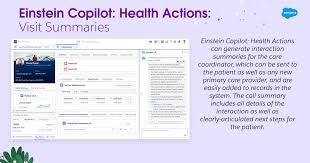
Einstein Copilot for Healthcare – Salesforce has introduced a new AI-powered healthcare assistant within its CRM system, marking its latest move to expand into the healthcare industry. As AI development accelerates, tech giants like Microsoft, Google, Amazon Web Services, and Salesforce are capitalizing on the opportunity to integrate AI and cloud technologies into healthcare to streamline administrative and operational tasks. Salesforce’s healthcare-specific AI tool, Einstein Copilot, is a conversational assistant that leverages an organization’s private data to provide relevant responses. Einstein Copilot enables healthcare providers and care teams to digitally capture and summarize information from both clinical and nonclinical sources, update patient records, and automate manual workflows. Key Features of Einstein Copilot Providers can use Einstein Copilot to generate patient summaries that include medications, diagnoses, social determinants, assessments, clinical service requests, and care gaps. A care manager can also ask the assistant to find an in-network provider based on location, specialty, and insurance coverage, and auto-fill referral forms using natural language prompts. The AI assistant can also trigger workflows for tasks such as sending referrals, scheduling appointments, and updating care plans. Salesforce expects Einstein Copilot to be HIPAA-compliant by summer 2024, with Copilot: Health Actions slated for general availability in winter 2024. Digitizing Health Assessments Salesforce is adding a feature called Assessment Generation that allows healthcare organizations to digitize standardized health assessments. These can be automatically populated into Salesforce Health Cloud, filled out electronically, and tracked for progress over time. Reducing Administrative Waste Salesforce cites research from McKinsey & Co. showing that administrative costs account for nearly a quarter of U.S. healthcare spending, with a potential savings of up to $320 billion. By integrating AI and CRM tools, Salesforce aims to reduce the operational burden on healthcare providers and improve patient outcomes. Amit Khanna, Senior Vice President and General Manager for Health at Salesforce, highlighted the value of these innovations: “These new data, AI, and CRM features reduce the administrative and operational burden for healthcare providers, leading to better outcomes for patients. With Salesforce’s trusted AI, healthcare organizations excited about generative AI—but wary of clinical and security concerns—can confidently integrate these innovations into their workflows.” Early Adopters and Impact Healthcare providers including Baptist Health South Florida and HarmonyCares are already leveraging Salesforce to personalize patient interactions and create unified patient views. HarmonyCares, which operates across 14 states with over 150 primary care providers, has used Salesforce’s AI-driven field service platform to streamline patient scheduling. The company reported a 50% increase in self-scheduling efficiency since adopting the platform and plans to expand its use of Salesforce Health Cloud for care management and engagement. Kristin Darby, Chief Information Officer at HarmonyCares, emphasized the benefits of AI in healthcare: “AI will dramatically improve our ability to quickly synthesize patient needs and preferences, enabling us to offer a more personalized experience with greater accuracy.” However, the integration of AI in healthcare is not without skepticism. A recent survey revealed that 69% of individuals are uncomfortable with AI being used to diagnose them, though more than half are open to its use in nonclinical tasks like scheduling and billing. Salesforce’s Healthcare Journey Salesforce first launched Health Cloud in 2015 to help providers manage patients by aggregating data from electronic medical records, devices, and wearables. In 2022, the company expanded this offering with Customer 360 for Health, a unified platform that combines real-time data from Data Cloud, Einstein AI, and automation tools like Flow to streamline processes such as prior authorizations, intake, and patient scheduling. Like Related Posts Who is Salesforce? Who is Salesforce? Here is their story in their own words. From our inception, we’ve proudly embraced the identity of Read more Salesforce Marketing Cloud Transactional Emails Salesforce Marketing Cloud Transactional Emails are immediate, automated, non-promotional messages crucial to business operations and customer satisfaction, such as order Read more Salesforce Unites Einstein Analytics with Financial CRM Salesforce has unveiled a comprehensive analytics solution tailored for wealth managers, home office professionals, and retail bankers, merging its Financial Read more AI-Driven Propensity Scores AI plays a crucial role in propensity score estimation as it can discern underlying patterns between treatments and confounding variables Read more
Read More
Marketing Cloud and Generative AI

Marketing Cloud and Generative AI

Generative AI and Salesforce: Revolutionizing Digital Marketing with Einstein AI Generative AI is a form of Artificial Intelligence that learns from existing content to generate new, creative outputs. Salesforce has long been at the forefront of AI innovation, primarily through its Einstein assistant, which has evolved to offer increasingly sophisticated solutions over time. Artificial Intelligence: Key Concepts Before diving into Salesforce’s AI capabilities, let’s clarify some foundational concepts. Artificial Intelligence (AI) refers to the creation of intelligent systems that can learn and reason autonomously. Within AI, Machine Learning (ML) plays a crucial role by enabling computers to learn from data and improve over time without explicit programming. ML models fall into two broad categories: Deep Learning and Neural Networks A more advanced subset of ML is Deep Learning, which uses neural networks to process large amounts of data and make autonomous decisions. Deep Learning powers technologies like voice assistants (e.g., Alexa or Siri), which can recognize speech and execute tasks. A specific application within Deep Learning is Generative AI, capable of autonomously creating new content based on learned patterns from vast datasets. Another critical AI system is the Foundational Model, which is trained on enormous amounts of unstructured data from across the web, including text, images, and videos. These models offer a wide range of capabilities, such as generating text, answering questions, creating designs, or solving complex problems. Salesforce Marketing Cloud and AI Salesforce has utilizeded AI through its Einstein platform, which has evolved over time to offer a variety of data-driven tools. For example, Sent Time Optimization uses customer data to determine the best time to send emails to maximize engagement. AI Tools in Salesforce Marketing Cloud Salesforce offers several AI-powered tools for Marketing Cloud to help businesses leverage data for personalization and efficiency: The Einstein Trust Layer: AI in Salesforce CRM Einstein is the first generative AI model integrated into a CRM, and Salesforce refers to its AI process as the Einstein Trust Layer. Here’s how it works: Marketing Applications of Salesforce AI Tools Salesforce’s AI tools can be applied across omnichannel marketing campaigns to hyper-personalize communication, increasing conversion rates and customer engagement. Predictive analytics also allow businesses to optimize cross-selling and upselling, offering tailored product recommendations based on customer behavior. Chatbots powered by AI further enhance productivity by interacting in natural language, collecting leads, suggesting products, and resolving customer inquiries. Salesforce’s Commitment to AI in Digital Marketing Salesforce has been a pioneer in AI, continually expanding its capabilities through Einstein. With the latest AI tools for Marketing Cloud, businesses can now interact with customers more precisely, boost engagement, and optimize purchase predictions—paving the way for a new era in digital marketing. Like Related Posts Who is Salesforce? Who is Salesforce? Here is their story in their own words. From our inception, we’ve proudly embraced the identity of Read more Salesforce Marketing Cloud Transactional Emails Salesforce Marketing Cloud Transactional Emails are immediate, automated, non-promotional messages crucial to business operations and customer satisfaction, such as order Read more Salesforce Unites Einstein Analytics with Financial CRM Salesforce has unveiled a comprehensive analytics solution tailored for wealth managers, home office professionals, and retail bankers, merging its Financial Read more AI-Driven Propensity Scores AI plays a crucial role in propensity score estimation as it can discern underlying patterns between treatments and confounding variables Read more

Read More
Salesforce AI Tools for Healthcare

Salesforce AI Tools for Healthcare

Salesforce to Launch Pre-Built AI Tools for Healthcare in October Salesforce is introducing a new library of out-of-the-box AI tools specifically designed for healthcare operations, available through its Health Cloud. These generative AI features aim to streamline time-consuming tasks by integrating directly into clinician workflows, enhancing both the quality and efficiency of patient care. Key Features and Benefits Part of Salesforce’s broader initiative to address operational challenges across 15 industries, these healthcare-specific AI tools are embedded in each of its industry clouds. The Einstein Copilot, for example, will allow healthcare providers to generate patient summaries in natural language, leveraging new data management capabilities. This could enable care coordinators to view comprehensive patient summaries—such as care plans, prescriptions, and prior authorizations—before appointments. According to Salesforce, these AI-driven services, powered by Einstein prompts, are integrated within Health Cloud’s member accounts, simplifying administrative tasks like sending referrals and booking appointments. Data privacy and security remain a priority, with Einstein’s data masking and zero data retention layer ensuring patient information is protected. Beyond patient care, the new AI features will support business operations, including verifying insurance coverage, determining out-of-pocket costs, and ensuring eligibility—all designed to reduce administrative burdens and improve operational efficiency. Why It Matters Healthcare organizations often lack the resources to build and train their own AI models, a process that can cost upwards of 0 million. Salesforce’s pre-built AI capabilities provide an accessible solution, allowing organizations of all sizes to adopt AI tools tailored to their specific needs. By automating administrative processes, healthcare providers can focus more on patient care, with faster approvals and fewer manual tasks. Salesforce is positioning these tools to help organizations streamline workflows, reduce inefficiencies, and ultimately improve the patient experience. The features will be generally available in October, with pricing based on specific implementations. Industry Impact and Larger Trend The release of these healthcare-specific AI tools is part of Salesforce’s broader push into industry-specific AI. In March, Salesforce launched the Einstein AI Copilot within its Einstein 1 Platform, designed to leverage healthcare organizations’ unique data within its Health Data Cloud. New capabilities, such as patient services and benefits verification, aim to reduce platform switching, enabling faster approvals and supporting clinicians in real-time patient record updates. Salesforce’s investment in industry-specific AI comes at a time when many healthcare organizations are grappling with the rising costs of technology and labor. At the HIMSS AI in Healthcare Forum in Boston, leaders echoed the challenges of managing expansive technology footprints while balancing the need for AI-driven transformation. Operational workflows, particularly back-office processes, offer a low-risk area for AI deployment, as noted by Lee Schwamm, chief digital health officer at Yale New Haven Health System. On the Record “Organizations of every size and budget can now easily get started with practical AI tools that were purposefully designed to solve their unique challenges,” said Jeff Amann, executive vice president and general manager of Salesforce Industries. Salesforce’s new AI use case library, featuring more than 100 AI capabilities embedded across 15 industry clouds, underscores the company’s commitment to developing industry-specific solutions. For healthcare, these tools include automated patient matching for clinical trials, AI-generated prescriptions, and pre-visit summaries—helping organizations accelerate time to care and improve clinical outcomes. In addition, a new auto-matching tool for life sciences will assist in identifying eligible clinical trial participants, using both structured and unstructured data to reduce assessment time. These features allow healthcare CIOs to easily deploy AI capabilities designed to address their organization’s unique needs. Looking Ahead Salesforce’s latest AI tools for healthcare represent a significant step in the company’s strategy to bring industry-specific AI to market, with healthcare, life sciences, financial services, and retail among its top priorities. By offering pre-built, customizable solutions, Salesforce is making AI accessible to a broader range of organizations, enabling them to deliver value quickly while navigating the complexities of modern healthcare operations. Like1 Related Posts Who is Salesforce? Who is Salesforce? Here is their story in their own words. From our inception, we’ve proudly embraced the identity of Read more Salesforce Marketing Cloud Transactional Emails Salesforce Marketing Cloud Transactional Emails are immediate, automated, non-promotional messages crucial to business operations and customer satisfaction, such as order Read more Salesforce Unites Einstein Analytics with Financial CRM Salesforce has unveiled a comprehensive analytics solution tailored for wealth managers, home office professionals, and retail bankers, merging its Financial Read more AI-Driven Propensity Scores AI plays a crucial role in propensity score estimation as it can discern underlying patterns between treatments and confounding variables Read more
Read More
Create Delightful Experiences

Create Delightful Experiences

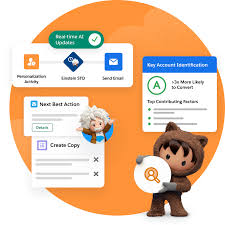
Ever had one of those unexpected moments when you reach out to customer service to resolve an issue, and by the end of the conversation, you’ve ended up purchasing something new—and actually feel good about it? Salesforce can help you Create Delightful Experiences. It’s those delightful experiences—when a company truly understands you—that make all the difference. Yet, far too often, these moments are the exception rather than the rule. Why is that? Despite having access to mountains of data from every click, call, and transaction, many companies still fail to create the seamless, personalized experiences that customers expect. In fact, 80% of customers believe their experiences should be better, given the wealth of data available. However, many organizations remain trapped in silos, with marketing, sales, and service teams working in isolation. The data exists, but it’s not being utilized effectively. Siloed data, un-unified data, and restricted access data make your agents seem less emphathetic. Customers expect them to know everything about them there is to know. For CMOs, this presents both a challenge and an opportunity. Positioned at the intersection of every customer touchpoint, many find themselves navigating disjointed strategies from different departments. But what if we could turn the tide? What if every interaction across any channel—whether in marketing, sales, or service—felt like one continuous conversation? From Silos to Synergy: Maximizing Every Customer Interaction The reality is that customers don’t recognize the internal barriers we’ve erected. They don’t care about the silos of marketing, sales, and service; to them, it’s one relationship. What matters most to them is being understood and treated consistently, regardless of whom they are engaging with. Create Delightful Experiences This is where a more unified approach comes into play. It’s not about collecting more data—we already have plenty of that. Instead, it’s about piecing together a puzzle where each interaction reveals a bigger picture. By doing so, we can anticipate customer needs and respond in ways that feel personal and relevant. Consider Fisher & Paykel. By integrating data from their online stores and marketing efforts, they gain a clearer understanding of their customers’ buying habits. Whether someone is a one-time buyer or a frequent shopper, they can tailor the experience accordingly. For instance, if a customer purchases a new fridge, rather than suggesting another fridge during their next visit—as if they were unaware of the previous purchase—the system might recommend relevant accessories like water filters. Plus, with connected device data, they can send timely reminders when it’s time for a replacement part. Now, picture a customer calling in with a service issue. Instead of merely resolving the problem, the representative is empowered by AI to suggest the next best action—perhaps offering a discount on a recently viewed product or an option for self-service. By leveraging AI insights from browsing behavior and purchase history, service teams can present timely offers that build trust and drive future purchases. This transformation turns service interactions into opportunities for building loyalty and generating revenue while ensuring customers feel valued and understood. With customer acquisition costs rising by 60% over the last five years, strategies like upselling, cross-selling, and referral marketing can yield new revenue at a fraction of the cost of traditional channels. The Technology That Ties It All Together None of this is feasible without the right technology. To craft these interconnected experiences, we need systems that consolidate data from every corner of the business. Salesforce’s Data Cloud accomplishes this by centralizing customer data and layering Einstein AI on top to generate meaningful, actionable insights. If your marketing chops are your muscles, your Salesforce org is your tool box. Gone are the days of guessing what customers need—you’ll know exactly when and how to engage them, transforming transactional interactions into those delightful moments that keep customers coming back. Take Air India as an example. Faced with managing over 550,000 monthly service cases within a decentralized system, they utilized Salesforce’s Data Cloud to unify customer data from various sources, providing service teams with a 360-degree view of every passenger. With AI-driven recommendations from Einstein AI, Air India’s teams can offer personalized services, such as seat upgrades during delays or tailored travel deals based on past trips. This approach not only enhances customer satisfaction but also streamlines operations and fosters business growth. The Strategic Imperative for CMOs So, what’s the key takeaway for marketers? We must think beyond our traditional roles and collaborate across the entire customer journey. It’s crucial to advocate for breaking down silos, aligning teams, and integrating data throughout our organizations. However, let’s be realistic: this is easier said than done. Internal politics can complicate efforts to unify departments, with leaders often fixated on their own priorities. The key lies in fostering a spirit of collaboration, not competition—demonstrating to other leaders how a unified approach benefits everyone. By working closely with other departments, marketing can evolve from merely a function into a pivotal part of the broader business strategy, helping to drive consistent customer experiences, increased revenue, and long-term loyalty. The future of marketing isn’t about doing more; it’s about being smarter. It’s about crafting personalized, meaningful experiences that reach the right customers at precisely the right moment, transforming every touchpoint into an opportunity to build lasting relationships. Unified data is the cornerstone of achieving this goal. Ultimately, the companies that understand their customers best will thrive—and that journey begins with us. Create Delightful Experiences with technology and AI for your customers. Like1 Related Posts Who is Salesforce? Who is Salesforce? Here is their story in their own words. From our inception, we’ve proudly embraced the identity of Read more Salesforce Marketing Cloud Transactional Emails Salesforce Marketing Cloud Transactional Emails are immediate, automated, non-promotional messages crucial to business operations and customer satisfaction, such as order Read more Salesforce Unites Einstein Analytics with Financial CRM Salesforce has unveiled a comprehensive analytics solution tailored for wealth managers, home office professionals, and retail bankers, merging its Financial Read more AI-Driven Propensity Scores AI plays a crucial role in propensity score

Read More
Introducing the New Nonprofit Cloud

Salesforce Transforming Nonprofit Operations with AI

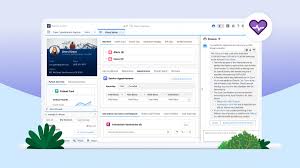
Salesforce Enhances Nonprofit Cloud with Generative AI Capabilities On August 6, 2024, Salesforce announced that its Nonprofit Cloud is now equipped with generative AI capabilities powered by the Einstein 1 Platform. This integration represents the first time Salesforce’s Industry Cloud portfolio has incorporated the Einstein 1 Platform, signaling a broader commitment to embedding AI tools across its product offerings. The update aims to revolutionize nonprofit operations by providing AI-powered tools for personalized donor engagement, operational efficiency, and funding discovery. Key features include AI-generated fundraising proposals and program summaries, which provide concise insights into grant details, donor histories, and program outcomes. Transforming Nonprofit Operations with AI The integration of generative AI into Nonprofit Cloud aligns with Salesforce’s strategy to empower nonprofits to navigate challenges such as donor fatigue, increased operational costs, and rising service demands. Notable enhancements include: Additionally, Salesforce launched Data Cloud for Nonprofits, enabling a unified, real-time view of donor, volunteer, and program data. This innovation breaks down data silos, empowering nonprofits to create tailored outreach strategies and assess program performance effectively. Four Pillars of AI Success Salesforce’s enhancements to Nonprofit Cloud embody its “four-pillar” approach to enterprise AI success: Key Innovations in Nonprofit Cloud Salesforce introduced three groundbreaking innovations to address nonprofit-specific challenges: These features, coupled with Nonprofit Cloud Einstein 1 Edition (which bundles Nonprofit Cloud, Data Cloud, Einstein, Experience Cloud, and Slack), provide nonprofits with comprehensive tools to drive impact. Nonprofit Adoption and Impact Nonprofits are already experiencing the transformative potential of AI. According to Salesforce’s Nonprofit Trends Report, organizations leveraging these AI tools have seen: Julie Fleshman, CEO of the Pancreatic Cancer Action Network, shared her organization’s success with Nonprofit Cloud: “Salesforce has been instrumental in helping us connect patients with specialized healthcare providers and clinical trials, advancing our mission and saving valuable time.” Nonprofit Cloud vs. NPSP While Nonprofit Cloud offers a unified, scalable platform with AI-driven insights and advanced donor management tools, the Nonprofit Success Pack (NPSP) serves as a free, open-source solution for smaller organizations. Here’s a quick comparison: Feature Nonprofit Cloud NPSP Functionality Comprehensive CRM with advanced tools Free app with basic CRM functionality Integration Seamless with other Salesforce products Requires additional configuration Ease of Use User-friendly and designed for nonprofits May require technical expertise Cost Subscription-based Free with optional paid add-ons Scalability Built for growing organizations Requires customization for growth Ideal Users Large and mid-sized nonprofits Small nonprofits Maximizing Fundraising with Nonprofit Cloud Nonprofit Cloud offers nonprofits flexibility and efficiency in managing their fundraising efforts, helping them overcome challenges like donor fatigue and retention. Its advanced features include: By leveraging these tools, nonprofits can improve engagement, strengthen donor relationships, and make data-driven decisions, ultimately amplifying their impact. The Tectonic Role Tectonic has been instrumental in implementing Salesforce Nonprofit Cloud for multiple organizations, ensuring they harness its full potential to optimize operations, engage donors, and achieve their missions. With Salesforce’s AI-driven enhancements and Tectonic’s expertise, nonprofits are poised to navigate challenges, unlock new opportunities, and amplify their societal impact. Like Related Posts Who is Salesforce? Who is Salesforce? Here is their story in their own words. From our inception, we’ve proudly embraced the identity of Read more Salesforce Marketing Cloud Transactional Emails Salesforce Marketing Cloud Transactional Emails are immediate, automated, non-promotional messages crucial to business operations and customer satisfaction, such as order Read more Salesforce Unites Einstein Analytics with Financial CRM Salesforce has unveiled a comprehensive analytics solution tailored for wealth managers, home office professionals, and retail bankers, merging its Financial Read more AI-Driven Propensity Scores AI plays a crucial role in propensity score estimation as it can discern underlying patterns between treatments and confounding variables Read more
Read More
gettectonic.com