

OpenAI Archives - gettectonic.com - Page 11
Gen AI and Test Automation

Gen AI and Test Automation

Generative AI has brought transformative advancements across industries, and test automation is no exception. By generating code, test scenarios, and even entire suites, Generative AI enables Software Development Engineers in Test (SDETs) to boost efficiency, expand test coverage, and improve reliability. 1. Enhanced Test Case Generation One of the biggest hurdles in test automation is generating diverse, comprehensive test cases. Traditional methods often miss edge cases or diverse scenarios. Generative AI, however, can analyze existing data and automatically generate extensive test cases, including potential edge cases that may not be apparent to human testers. Example: An SDET can use Generative AI to create test cases for a web application by feeding it requirements and user data. This enables the AI to produce hundreds of test cases, capturing diverse user behaviors and interactions that manual testers may overlook. pythonCopy codeimport openai openai.api_key = ‘YOUR_API_KEY’ def generate_test_cases(application_description): response = openai.Completion.create( engine=”text-davinci-003″, prompt=f”Generate comprehensive test cases for the following application: {application_description}”, max_tokens=500 ) return response.choices[0].text app_description = “An e-commerce platform for browsing products, adding to cart, and checking out.” test_cases = generate_test_cases(app_description) print(test_cases) Sample Output: 2. Intelligent Test Script Creation Writing test scripts manually can be labor-intensive and error-prone. Generative AI can simplify this by generating test scripts based on an application’s flow, ensuring consistency and precision. Example: If an SDET needs to automate tests for a mobile app, they can use Generative AI to generate scripts for various scenarios, significantly reducing manual work. pythonCopy codeimport hypothetical_ai_test_tool ui_description = “”” Login Page: – Username field – Password field – Login button Home Page: – Search bar – Product listings – Add to cart buttons “”” test_scripts = hypothetical_ai_test_tool.generate_selenium_scripts(ui_description) Sample Output for test_login.py: pythonCopy codefrom selenium import webdriver from selenium.webdriver.common.keys import Keys def test_login(): driver = webdriver.Chrome() driver.get(“http://example.com/login”) username_field = driver.find_element_by_name(“username”) password_field = driver.find_element_by_name(“password”) login_button = driver.find_element_by_name(“login”) username_field.send_keys(“testuser”) password_field.send_keys(“password”) login_button.click() assert “Home” in driver.title driver.quit() 3. Automated Maintenance of Test Suites As applications evolve, maintaining test suites is critical. Generative AI can monitor app changes and update test cases automatically, keeping test suites accurate and relevant. Example: In a CI/CD pipeline, an SDET can deploy Generative AI to track code changes and update affected test scripts. This minimizes downtime and ensures tests stay aligned with application updates. pythonCopy codeimport hypothetical_ai_maintenance_tool def maintain_test_suite(): changes = hypothetical_ai_maintenance_tool.analyze_code_changes() updated_scripts = hypothetical_ai_maintenance_tool.update_test_scripts(changes) for script_name, script_content in updated_scripts.items(): with open(script_name, ‘w’) as file: file.write(script_content) maintain_test_suite() Sample Output:“Updating test_login.py with new login flow changes… Test scripts updated successfully.” 4. Natural Language Processing for Test Case Design Generative AI with NLP can interpret human language, enabling SDETs to create test cases from plain-language descriptions, enhancing collaboration across technical and non-technical teams. Example: An SDET can use an NLP-powered tool to translate a feature description from a product manager into test cases. This speeds up the process and ensures that test cases reflect intended functionality. pythonCopy codeimport openai openai.api_key = ‘YOUR_API_KEY’ def create_test_cases(description): response = openai.Completion.create( engine=”text-davinci-003″, prompt=f”Create test cases based on this feature description: {description}”, max_tokens=500 ) return response.choices[0].text feature_description = “Allow users to reset passwords via email to regain account access.” test_cases = create_test_cases(feature_description) print(test_cases) Sample Output: 5. Predictive Analytics for Test Prioritization Generative AI can analyze historical data to prioritize high-risk areas, allowing SDETs to focus testing on critical functionalities. Example: An SDET can use predictive analytics to identify areas with frequent bugs, allocating resources more effectively and ensuring robust testing of high-risk components. pythonCopy codeimport hypothetical_ai_predictive_tool def prioritize_tests(): risk_areas = hypothetical_ai_predictive_tool.predict_risk_areas() prioritized_tests = hypothetical_ai_predictive_tool.prioritize_test_cases(risk_areas) return prioritized_tests prioritized_test_cases = prioritize_tests() print(“Prioritized Test Cases:”) for test in prioritized_test_cases: print(test) Sample Output: Gen AI and Test Automation Generative AI has the potential to revolutionize test automation, offering SDETs tools to enhance efficiency, coverage, and reliability. By embracing Generative AI for tasks like test case generation, script creation, suite maintenance, NLP-based design, and predictive prioritization, SDETs can reduce manual effort and focus on strategic tasks, accelerating testing processes and ensuring robust, reliable software systems. Like Related Posts Who is Salesforce? Who is Salesforce? Here is their story in their own words. From our inception, we’ve proudly embraced the identity of Read more Salesforce Marketing Cloud Transactional Emails Salesforce Marketing Cloud Transactional Emails are immediate, automated, non-promotional messages crucial to business operations and customer satisfaction, such as order Read more Salesforce Unites Einstein Analytics with Financial CRM Salesforce has unveiled a comprehensive analytics solution tailored for wealth managers, home office professionals, and retail bankers, merging its Financial Read more AI-Driven Propensity Scores AI plays a crucial role in propensity score estimation as it can discern underlying patterns between treatments and confounding variables Read more


Read More
New ChatGPT-4o

New ChatGPT-4o

OpenAI’s ChatGPT Upgraded with GPT-4o: Here’s What’s New OpenAI has just launched a significant upgrade to ChatGPT with the new ChatGPT-4o model, also known as Omni. This true multimodal AI effortlessly understands text, images, video, and audio, offering faster responses and eventually the ability to engage in spoken conversations. If before you read about the New ChatGPT-4o and inadvertently used it, ChatGPT may have surprised you with its responses. I’ve been told to “enjoy my coffee”, “sit back and relax” and more! Key Benefits of GPT-4o The main advantage of GPT-4o is its enhanced reasoning, processing, and natural language capabilities, now available to free ChatGPT users for the first time. In their Spring Update announcement, OpenAI emphasized their goal of making top-tier AI accessible to a broader audience. Gradual Rollout The rollout of GPT-4o is happening in phases. Features are being released in batches, so users should check which features are currently available and which are coming soon. Accessing GPT-4o is straightforward once it’s been activated for your account. Notably, the address for ChatGPT has changed to chatgpt.com, indicating OpenAI’s commitment to AI as a fully-fledged product. Availability Across Platforms If you have access to GPT-4o, it will be available through the mobile app and online. A Mac app is also rolling out to some users, but be cautious of fraudulent links aiming to spread malware. It’s best to wait for an official email or notification from OpenAI before downloading the app. Even with a valid app link, access won’t be granted until it’s enabled on your OpenAI account. Current Features of GPT-4o Currently, users can access the chat version of GPT-4o, with advanced voice and video functionality being rolled out gradually, starting with Plus and Team accounts. Free account users will notice significant improvements as GPT-4o surpasses both the previous 3.5 model and GPT-4. Users can now run code snippets, analyze images and text files, and use custom GPT chatbots. On mobile, you still have access to ChatGPT Voice, but it’s the older version that transcribes conversations into text. The new model understands speech, emotion, and interaction natively without needing this step. How to Use GPT-4o Emotional and Conversational Upgrades OpenAI has demonstrated that the upgraded ChatGPT can now handle more natural and emotionally aware conversations. The new model, available to both free and paid users, responds more quickly to voice, image, and video inputs. It can detect and express emotions, making interactions feel more human-like. During a recent demo, ChatGPT engaged in lively, expressive conversations, picking up on emotional cues and responding with simulated emotional reactions. This new interface aims to enhance user engagement and provide a more personalized experience. And it does. But it can be deceptively human-like. Ethical Considerations Despite the engaging new features, the lifelike interactions of advanced chatbots raise ethical concerns. Researchers warn that highly persuasive and emotionally responsive AI could have unintended consequences, such as fostering addictive behaviors or influencing user actions negatively. Future Developments OpenAI promises further advancements and additional announcements soon. The competition in the AI field remains intense, with companies like Google expected to unveil new technologies at their upcoming I/O developer conference. OpenAI’s latest update signifies a major leap in AI capabilities, aiming to blend advanced technology with everyday usability while navigating the complex ethical landscape of human-AI interactions. Like Related Posts AI-Driven Propensity Scores AI plays a crucial role in propensity score estimation as it can discern underlying patterns between treatments and confounding variables Read more Tectonic’s Successful Salesforce Track Record Salesforce Technology Services Integrator – Tectonic has successfully delivered Salesforce in a variety of industries including Public Sector, Hospitality, Manufacturing, Read more The Evolution of Industrial Revolutions History of First Four Industrial Revolutions Throughout history, humanity has always relied on technology. Although the technology of each era Read more Step By Step Guide to a Salesforce Quickstart Salesforce Implementation with a Tectonic Quickstart: Step-by-Step Salesforce Quickstart Guide. Step 1: Define Your Business Requirements Identify specific business processes Read more

Read More
UX Principles for AI in Healthcare

Agentic Era of UX

The Agentic Era of UX The future of digital experience has arrived, but it’s fragmenting into countless micro-applications. The missing piece in AI user experience? The experience itself. It’s been almost a year and a half since generative AI burst onto the scene, heralded as transformative. But what have we actually seen in terms of user experience? Many companies released AI-powered summaries or search features, claimed them as revolutionary, and received applause—until the applause faded. The so-called “next era” of tech hasn’t yet delivered on its promise. We were given “the most profound technology since fire,” yet many implementations feel like candles that barely flicker. Many UX designers continue advocating for AI to solve genuine user needs. Technology must serve users, not just exist for its own sake. The core issue now is broader: AI has often been treated as a quick fix rather than a true UX transformation. Where user experience traditionally supports the entire journey, AI is being wedged into small, isolated tasks, losing the holistic perspective. For most companies, AI feels like a string of individual “use cases” rather than a full, cohesive UX meal. Many consulting firms push companies to prioritize use cases in terms of complexity and value, often resulting in chatbots that address a handful of user needs. There are notable exceptions, though. For example, Loom went beyond simple AI features to enhance the user’s entire workflow, supporting end-to-end functionality for video recording, transcription, editing, and even task management. Welcome to the Agentic Era of AI We’re now on the verge of the “agentic” era of AI. Industry leaders are abuzz with the potential of AI agents. OpenAI’s Sam Altman calls agents AI’s “killer function,” while other leaders predict this future is within reach, possibly within 3–18 months. The agentic promise is profound: AI agents, or “agentic workflows,” break down complex tasks into manageable steps, helping users complete intricate projects with autonomy. As Ezra Klein describes, imagine telling an AI to plan your child’s dragon-themed birthday party in Brooklyn, and the agent handles everything from booking to ordering the cake—transforming a casual AI prompt into tangible results. Today’s general-purpose models can’t handle this level of complexity independently. But agentic workflows make this possible by chaining AI actions, allowing systems to execute tasks step-by-step. A Vision for Agentic UX Design’s role in this era is to bring a vision of agentic UX to life. In traditional digital experiences, we build systems that assist users along their journey, but we still expect users to navigate the journey themselves. With an agentic UX, an AI partner supports the user at every step. This vision means UX will be defined by three pillars: Early examples are emerging, like Adobe’s Gen Studio, Intercom’s Copilot, and Dovetail’s Magic Experience, each taking steps toward a future where AI provides ongoing, meaningful support to users. An agentic UX doesn’t necessarily need to label itself “agent-powered.” Dovetail, for instance, offers a suite of “Magic” features where the AI partner plays a supporting role, from summarizing transcripts to highlighting key points. Over time, as AI evolves, these agents will assume greater responsibility in user journeys, shifting from supportive to proactive. Strategically Reinvent for the Agentic Era Adapting to the agentic era presents an opportunity—and a risk for those who ignore it. Currently, organizations are focused on laying the infrastructure for “AI readiness.” While that’s essential, it can obscure the longer-term vision of what’s possible. Until business leaders fully grasp the agentic UX’s potential, it’s up to design to step into a strategic role and make this vision vivid, relatable, and exciting. This requires more than launching a quick proof of concept; it demands a reimagining of digital experience. Here’s a recommended approach: It’s been a challenging year for design, with layoffs and value debates. But with the agentic era approaching, the strategic potential for UX is immense. Now is the time to rally, to guide organizations into a new era of digital experience where users are truly supported every step of the way. 4ox Like Related Posts Who is Salesforce? Who is Salesforce? Here is their story in their own words. From our inception, we’ve proudly embraced the identity of Read more Salesforce Unites Einstein Analytics with Financial CRM Salesforce has unveiled a comprehensive analytics solution tailored for wealth managers, home office professionals, and retail bankers, merging its Financial Read more AI-Driven Propensity Scores AI plays a crucial role in propensity score estimation as it can discern underlying patterns between treatments and confounding variables Read more Tectonic’s Successful Salesforce Track Record Salesforce Technology Services Integrator – Tectonic has successfully delivered Salesforce in a variety of industries including Public Sector, Hospitality, Manufacturing, Read more

Read More
Tectonic at a Glance

Why AI Keeps Salesforce Co-Founder Up At Night

Parker Harris holds conflicting views on artificial intelligence (AI). As the co-founder of Salesforce, he has urged the company’s leaders to swiftly integrate AI into their products. However, he grapples with concerns about maintaining the balance between speed and the company’s reputation for delivering high-quality solutions to clients. This dilemma has even led him to lose sleep. Expressing his anxiety at Salesforce’s World Tour event in New York City, Harris emphasized the unprecedented pace of AI development. He feels a sense of urgency to accelerate the adoption of AI technologies, driven by the need to meet customer expectations. Yet, he recognizes the importance of caution, knowing that customers rely on Salesforce to provide reliable solutions. Harris acknowledges the challenge of navigating this balance, pondering how to move quickly without making critical mistakes. Transitioning to his role as chief technology officer at Slack, a subsidiary of Salesforce, Harris reflected on AI’s potential, particularly its ability to generate images and videos from simple prompts. However, he tempered the enthusiasm by noting that what may seem like “magic tricks” on social media platforms may not necessarily translate effectively in workplace contexts. Harris also acknowledged the pervasive fear among entrepreneurs of missing out on the AI revolution, especially after a significant milestone in February when OpenAI, a market leader, was valued at $80 billion. This realization, coupled with the partnership between Salesforce rival Microsoft and OpenAI, prompted Harris and Salesforce co-founder Marc Benioff to acknowledge their need to catch up in the AI race. Salesforce’s main AI offering, Einstein, enables businesses to create predictive AI models using proprietary customer data. In Slack, enterprises can access Slack AI, a tool that summarizes conversations and provides answers to questions, for a monthly fee of $10 per person. Despite the promise of AI, Harris highlighted a critical issue: trust. He expressed concerns about AI occasionally providing inaccurate information or omitting key details, which could erode user trust in the technology. Maintaining trust is crucial, as users are unlikely to continue using AI tools if they encounter such troubling issues. Like Related Posts Who is Salesforce? Who is Salesforce? Here is their story in their own words. From our inception, we’ve proudly embraced the identity of Read more Salesforce Marketing Cloud Transactional Emails Salesforce Marketing Cloud Transactional Emails are immediate, automated, non-promotional messages crucial to business operations and customer satisfaction, such as order Read more Salesforce Unites Einstein Analytics with Financial CRM Salesforce has unveiled a comprehensive analytics solution tailored for wealth managers, home office professionals, and retail bankers, merging its Financial Read more AI-Driven Propensity Scores AI plays a crucial role in propensity score estimation as it can discern underlying patterns between treatments and confounding variables Read more

Read More
Train On Your Own Data

Train On Your Own Data

General-purpose large language models (LLMs) offer businesses the convenience of immediate use without requiring any special setup or customization. However, to maximize the potential of LLMs in business environments, organizations can achieve significant benefits by customizing these models through training on their own data. Custom LLMs excel at handling organization-specific tasks that generic LLMs—such as OpenAI’s ChatGPT or Google’s Gemini—may not manage as effectively. By training an LLM on data unique to the enterprise, businesses can fine-tune the model to produce responses that are highly relevant to specific products, workflows, and customer interactions. To determine whether to customize an LLM with organization-specific data, businesses should first explore the various types of LLMs and understand the advantages of fine-tuning a model on custom data sets. Following this, they can proceed with the necessary steps: identifying data sources, cleaning and formatting the data, adjusting model parameters, retraining the model, and testing it in production. Generic vs. Customized LLMs LLMs can be broadly categorized into two types: Training an LLM on custom data doesn’t imply starting from scratch; instead, it often involves fine-tuning a pre-trained generic model with additional training on the organization’s data. This approach allows the model to retain the broad knowledge it acquired during initial training while enhancing its capabilities in areas specific to the business. Benefits of Customizing an LLM The primary reason for retraining or fine-tuning an LLM is to achieve superior performance on business-specific tasks compared to using a generic model. For example, a company that wants to deploy a chatbot for customer support needs an LLM that understands its products in detail. Even if a generic LLM has some familiarity with the product from public data sources, it may lack the depth of knowledge that the company’s internal documentation provides. Without this comprehensive context, a generic LLM might struggle to generate accurate responses when interacting with customers about specific products. Generic models are optimized for broad usability, which means they may not be tailored for the specialized conversations required in business scenarios. Organizations can overcome these limitations by retraining or fine-tuning an LLM with data related to their products and services. During this process, AI teams can also adjust parameters, such as model weights, to influence the type of output the model generates, making it more relevant to the organization’s needs. Steps to Customize an LLM with Organization-Specific Data To customize an LLM with your organization’s data, follow these steps: By following these steps, organizations can transform a generic LLM into a powerful, customized tool tailored to their unique business needs, enhancing efficiency, customer satisfaction, and overall operational effectiveness. Like Related Posts Who is Salesforce? Who is Salesforce? Here is their story in their own words. From our inception, we’ve proudly embraced the identity of Read more Salesforce Marketing Cloud Transactional Emails Salesforce Marketing Cloud Transactional Emails are immediate, automated, non-promotional messages crucial to business operations and customer satisfaction, such as order Read more Salesforce Unites Einstein Analytics with Financial CRM Salesforce has unveiled a comprehensive analytics solution tailored for wealth managers, home office professionals, and retail bankers, merging its Financial Read more AI-Driven Propensity Scores AI plays a crucial role in propensity score estimation as it can discern underlying patterns between treatments and confounding variables Read more

Read More
Apple's Privacy Changes: A Call for Email Marketing Innovation

Apple’s MM1

Apple’s MM1: The Next Frontier in Multimodal AI A New Challenger Emerges On March 14, 2024, Apple quietly revolutionized the AI landscape with MM1—a multimodal large language model that redefines what’s possible at the intersection of language and visual understanding. While not yet publicly available, MM1’s technical disclosures reveal an architecture poised to challenge OpenAI’s GPT-4 and Google’s Gemini. Architectural Breakthroughs Vision-Language Fusion Engine Training Data Alchemy MM1’s secret sauce lies in its curated multimodal diet: Benchmark Dominance Early evaluations show MM1 outperforming competitors in key areas: Task MM1-30B GPT-4V Gemini 1.5 Visual QA Accuracy 82.3% 78.1% 80.6% Image Captioning 91.2% 89.4% 90.1% Multimodal Reasoning 76.8% 72.3% 74.5% Scores represent relative performance on MMMU benchmark suite The Apple Advantage Three key differentiators set MM1 apart: Industry Transformations Ahead MM1’s capabilities suggest disruptive potential across sectors: Healthcare Education Retail The Road to Availability While Apple remains characteristically secretive about release plans, industry analysts predict: Why This Matters MM1 represents more than another LLM—it’s Apple’s first shot across the bow in the AI arms race. By combining:✔ Unmatched multimodal understanding✔ Apple’s hardware/software synergy✔ Industry-leading privacy standards This model could redefine how consumers and businesses interact with AI. As the tech world awaits access, one thing is clear: the multimodal AI landscape just got far more interesting. Like Related Posts Who is Salesforce? Who is Salesforce? Here is their story in their own words. From our inception, we’ve proudly embraced the identity of Read more Salesforce Unites Einstein Analytics with Financial CRM Salesforce has unveiled a comprehensive analytics solution tailored for wealth managers, home office professionals, and retail bankers, merging its Financial Read more AI-Driven Propensity Scores AI plays a crucial role in propensity score estimation as it can discern underlying patterns between treatments and confounding variables Read more Tectonic’s Successful Salesforce Track Record Salesforce Technology Services Integrator – Tectonic has successfully delivered Salesforce in a variety of industries including Public Sector, Hospitality, Manufacturing, Read more

Read More
Who Calls AI Ethical

Who Calls AI Ethical

Background – Who Calls AI Ethical On March 13, 2024, the European Union (EU) enacted the EU AI Act, a move that some argue has hindered its position in the global AI race. This legislation aims to ‘unify’ the development and implementation of AI within the EU, but it is seen as more restrictive than progressive. Rather than fostering innovation, the act focuses on governance, which may not be sufficient for maintaining a competitive edge. The EU AI Act embodies the EU’s stance on Ethical AI, a concept that has been met with skepticism. Critics argue that Ethical AI is often misinterpreted and, at worst, a monetizable construct. In contrast, Responsible AI, which emphasizes ensuring products perform as intended without causing harm, is seen as a more practical approach. This involves methodologies such as red-teaming and penetration testing to stress-test products. This critique of Ethical AI forms the basis of this insight,and Eric Sandosham article here. The EU AI Act To understand the implications of the EU AI Act, it is essential to summarize its key components and address the broader issues with the concept of Ethical AI. The EU defines AI as “a machine-based system designed to operate with varying levels of autonomy and that may exhibit adaptiveness after deployment. It infers from the input it receives to generate outputs such as predictions, content, recommendations, or decisions that can influence physical or virtual environments.” Based on this definition, the EU AI Act can be summarized into several key points: Fear of AI The EU AI Act appears to be driven by concerns about AI being weaponized or becoming uncontrollable. Questions arise about whether the act aims to prevent job disruptions or protect against potential risks. However, AI is essentially automating and enhancing tasks that humans already perform, such as social scoring, predictive policing, and background checks. AI’s implementation is more consistent, reliable, and faster than human efforts. Existing regulations already cover vehicular safety, healthcare safety, and infrastructure safety, raising the question of why AI-specific regulations are necessary. AI solutions automate decision-making, but the parameters and outcomes are still human-designed. The fear of AI becoming uncontrollable lacks evidence, and the path to artificial general intelligence (AGI) remains distant. Ethical AI as a Red Herring In AI research and development, the terms Ethical AI and Responsible AI are often used interchangeably, but they are distinct. Ethics involve systematized rules of right and wrong, often with legal implications. Morality is informed by cultural and religious beliefs, while responsibility is about accountability and obligation. These constructs are continuously evolving, and so must the ethics and rights related to technology and AI. Promoting AI development and broad adoption can naturally improve governance through market forces, transparency, and competition. Profit-driven organizations are incentivized to enhance AI’s positive utility. The focus should be on defining responsible use of AI, especially for non-profit and government agencies. Towards Responsible AI Responsible AI emphasizes accountability and obligation. It involves defining safeguards against misuse rather than prohibiting use cases out of fear. This aligns with responsible product development, where existing legal frameworks ensure products work as intended and minimize misuse risks. AI can improve processes such as recruitment by reducing errors compared to human solutions. AI’s role is to make distinctions based on data attributes, striving for accuracy. The concern is erroneous discrimination, which can be mitigated through rigorous testing for bias as part of product quality assurance. Conclusion The EU AI Act is unlikely to become a global standard. It may slow AI research, development, and implementation within the EU, hindering AI adoption in the region and causing long-term harm. Humanity has an obligation to push the boundaries of AI innovation. As a species facing eventual extinction from various potential threats, AI could represent a means of survival and advancement beyond our biological limitations. Like Related Posts Who is Salesforce? Who is Salesforce? Here is their story in their own words. From our inception, we’ve proudly embraced the identity of Read more Salesforce Marketing Cloud Transactional Emails Salesforce Marketing Cloud Transactional Emails are immediate, automated, non-promotional messages crucial to business operations and customer satisfaction, such as order Read more Salesforce Unites Einstein Analytics with Financial CRM Salesforce has unveiled a comprehensive analytics solution tailored for wealth managers, home office professionals, and retail bankers, merging its Financial Read more AI-Driven Propensity Scores AI plays a crucial role in propensity score estimation as it can discern underlying patterns between treatments and confounding variables Read more
Read More
Where Will AI Take Us?

Where Will AI Take Us?

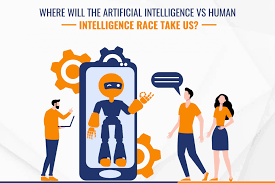
Author Jeremy Wagstaff wrote a very thought provoking article on the future of AI, and how much of it we could predict based on the past. This insight expands on that article. Artificial Intelligence (AI) refers to the simulation of human intelligence in machines that are programmed to think and learn. These machines can perform tasks that typically require human intelligence, such as visual perception, speech recognition, decision-making, and language translation. Many people think of artificial intelligence in the vein of how they personally use it. Some people don’t even realize when they are using it. Artificial intelligence has long been a concept in human mythology and literature. Our imaginations have been grabbed by the thought of sentient machines constructed by humans, from Talos, the enormous bronze automaton (self-operating machine) that safeguarded the island of Crete in Greek mythology, to the spacecraft-controlling HAL in 2001: A Space Odyssey. Artificial Intelligence comes in a variety of flavors, if you will. Artificial intelligence can be categorized in several ways, including by capability and functionality: You likely weren’t even aware of all of the above categorizations of artificial intelligence. Most of us still would sub set into generative ai, a subset of narrow AI, predictive ai, and reactive ai. Reflect on the AI journey through the Three C’s – Computation, Cognition, and Communication – as the guiding pillars for understanding the transformative potential of AI. Gain insights into how these concepts converge to shape the future of technology. Beyond a definition, what really is artificial intelligence, who makes it, who uses it, what does it do and how. Artificial Intelligence Companies – A Sampling AI and Its Challenges Artificial intelligence (AI) presents a novel and significant challenge to the fundamental ideas underpinning the modern state, affecting governance, social and mental health, the balance between capitalism and individual protection, and international cooperation and commerce. Addressing this amorphous technology, which lacks a clear definition yet pervades increasing facets of life, is complex and daunting. It is essential to recognize what should not be done, drawing lessons from past mistakes that may not be reversible this time. In the 1920s, the concept of a street was fluid. People viewed city streets as public spaces open to anyone not endangering or obstructing others. However, conflicts between ‘joy riders’ and ‘jay walkers’ began to emerge, with judges often siding with pedestrians in lawsuits. Motorist associations and the car industry lobbied to prioritize vehicles, leading to the construction of vehicle-only thoroughfares. The dominance of cars prevailed for a century, but recent efforts have sought to reverse this trend with ‘complete streets,’ bicycle and pedestrian infrastructure, and traffic calming measures. Technology, such as electric micro-mobility and improved VR/AR for street design, plays a role in this transformation. The guy digging out a road bed for chariots and Roman armies likely considered none of this. Addressing new technology is not easy to do, and it’s taken changes to our planet’s climate, a pandemic, and the deaths of tens of millions of people in traffic accidents (3.6 million in the U.S. since 1899). If we had better understood the implications of the first automobile technology, perhaps we could have made better decisions. Similarly, society should avoid repeating past mistakes with AI. The market has driven AI’s development, often prioritizing those who stand to profit over consumers. You know, capitalism. The rapid adoption and expansion of AI, driven by commercial and nationalist competition, have created significant distortions. Companies like Nvidia have soared in value due to AI chip sales, and governments are heavily investing in AI technology to gain competitive advantages. Listening to AI experts highlights the enormity of the commitment being made and reveals that these experts, despite their knowledge, may not be the best sources for AI guidance. The size and impact of AI are already redirecting massive resources and creating new challenges. For example, AI’s demand for energy, chips, memory, and talent is immense, and the future of AI-driven applications depends on the availability of computing resources. The rise in demand for AI has already led to significant industry changes. Data centers are transforming into ‘AI data centers,’ and the demand for specialized AI chips and memory is skyrocketing. The U.S. government is investing billions to boost its position in AI, and countries like China are rapidly advancing in AI expertise. China may be behind in physical assets, but it is moving fast on expertise, generating almost half of the world’s top AI researchers (Source: New York Times). The U.S. has just announced it will provide chip maker Intel with $20 billion in grants and loans to boost the country’s position in AI. Nvidia is now the third largest company in the world, entirely because its specialized chips account for more than 70 percent of AI chip sales. Memory-maker Micro has mostly run out of high-bandwidth memory (HBM) stocks because of the chips’ usage in AI—one customer paid $600 million up-front to lock in supply, according to a story by Stack. Back in January, the International Energy Agency forecast that data centers may more than double their electrical consumption by 2026 (Source: Sandra MacGregor, Data Center Knowledge). AI is sucking up all the payroll: Those tech workers who don’t have AI skills are finding fewer roles and lower salaries—or their jobs disappearing entirely to automation and AI (Source: Belle Lin at WSJ). Sam Altman of OpenAI sees a future where demand for AI-driven apps is limited only by the amount of computing available at a price the consumer is willing o pay. “Compute is going to be the currency of the future. I think it will be maybe the most precious commodity in the world, and I think we should be investing heavily to make a lot more compute.” Sam Altman, OpenAI CEO This AI buildup is reminiscent of past technological transformations, where powerful interests shaped outcomes, often at the expense of broader societal considerations. Consider early car manufacturers. They focused on a need for factories, components, and roads.

Read More
Top AI Tools Shaping Business Success

Top AI Tools Shaping Business Success

Top AI Tools Shaping Business Success in 2024 In the dynamic world of business, staying ahead means embracing the latest technologies. Artificial Intelligence (AI) is no longer just a buzzword—it’s a transformative force that helps businesses operate more efficiently, make smarter decisions, and enhance customer experiences. As we move through 2024, the AI tool ecosystem is rapidly expanding, offering innovative solutions to automate tasks, gain deep insights, and improve customer engagement. Below, we explore the top AI tools that are shaping the future of business. StoryChief is a comprehensive content marketing platform that simplifies the creation and distribution of content through AI. From ideation to optimization, it leverages machine learning to help businesses generate high-quality, engaging content at scale. Key Features: Pricing: Plans start with a free tier, with paid options ranging from $40 to $500 per month. Developed by OpenAI, ChatGPT is a versatile language model capable of generating human-like text. It excels in content creation, customer support, and data analysis. Key Use Cases: Pricing: API access with usage-based pricing. Perplexity AI is an advanced search engine that provides accurate, summarized answers to complex queries using natural language processing (NLP). Key Features: Pricing: Free version available, with Pro version at $20/month offering enhanced features. Zapier connects over 5,000 apps, enabling automation of repetitive tasks across your tech stack with AI-powered tools that simplify complex automations. Key Features: Pricing: Free plan available for up to 100 tasks per month; paid plans start at $19.99/month. Grammarly is an AI-driven writing assistant that enhances the quality of written communication, ensuring clarity, conciseness, and error-free content. Key Features: Pricing: Free version available; Premium plans start at $12/month for individuals and $25/user/month for businesses. Typeframes simplifies video creation with AI, turning scripts or images into professional-quality videos with animations, transitions, and voiceovers. Key Features: Pricing: Plans start at $29/month, with higher-tier options available. Chatbase enables businesses to build intelligent chatbots and virtual assistants that handle a wide range of customer service inquiries. Key Features: Pricing: Free plan available with limited message credits; paid plans start at $19/month. Secta is an AI-powered headshot generator that creates professional-quality headshots from user-submitted photos, ideal for businesses needing polished profile pictures. Key Features: Pricing: Pay-as-you-go at $49 per headshot session. Voicenotes is an AI-driven transcription tool that converts voice memos into concise summaries and action items, perfect for capturing important information efficiently. Key Features: Pricing: Free plan available; paid plans start at $10/month, with lifetime payment options. Notion AI enhances the popular Notion productivity platform with AI-powered writing assistance, content summarization, and database management. Key Features: Pricing: Available as an add-on at $10 per user per month, with discounts for annual plans. Choosing the Right AI Tools for Your Business Selecting the right AI tools involves considering several factors: By evaluating these aspects, you can effectively leverage AI to enhance efficiency, drive growth, and maintain a competitive edge in 2024. Like Related Posts Who is Salesforce? Who is Salesforce? Here is their story in their own words. From our inception, we’ve proudly embraced the identity of Read more Salesforce Marketing Cloud Transactional Emails Salesforce Marketing Cloud Transactional Emails are immediate, automated, non-promotional messages crucial to business operations and customer satisfaction, such as order Read more Salesforce Unites Einstein Analytics with Financial CRM Salesforce has unveiled a comprehensive analytics solution tailored for wealth managers, home office professionals, and retail bankers, merging its Financial Read more AI-Driven Propensity Scores AI plays a crucial role in propensity score estimation as it can discern underlying patterns between treatments and confounding variables Read more
Read More

Train Your Own SORA Model

Unveiling the Vision Transformer: A Leap in Video Generation The closest open-source model to SORA is Latte, which uses the same Vision Transformer architecture. So, what makes the Vision Transformer so outstanding, and how does it differ from previous methods? You can Train Your Own SORA Model. Latte hasn’t open-sourced its text-to-video training code. We’ve replicated this code from the paper and made it available for anyone to use in training their own SORA alternative model. Let’s discuss how effective our training was. From 3D U-Net to Vision Transformer Image generation has advanced significantly, with the U-Net model structure being the most commonly used: If you’re confused about the network structures, remember the key principle of deep learning: “Just Add More Layers!” Vision Transformer: A Game Changer In 3D U-Net, the transformer can only function within the U-Net, limiting its view. The Vision Transformer, however, enables transformers to globally manage video generation. Training Your Open-Source SORA Alternative with Latte Latte uses the video slicing sequence and Vision Transformer method discussed. While Latte hasn’t open-sourced its text-to-video model training code, we’ve replicated it here: GitHub Repo. Training involves three steps: For more details, see the GitHub repo. They’ve also made improvements to the training process: Model Performance The official Latte video shows impressive performance, especially in handling significant motion. However, our own tests indicate that while Latte performs well, it isn’t the top-performing model. Other open-source models have shown better performance. We will continue to share information on models with better performance, so stay tuned to Tectonic’s Insights. Hardware Requirements Due to its large scale, training Latte requires an A100 or H100 with 80GB of memory. Like Related Posts Who is Salesforce? Who is Salesforce? Here is their story in their own words. From our inception, we’ve proudly embraced the identity of Read more Salesforce Marketing Cloud Transactional Emails Salesforce Marketing Cloud Transactional Emails are immediate, automated, non-promotional messages crucial to business operations and customer satisfaction, such as order Read more Salesforce Unites Einstein Analytics with Financial CRM Salesforce has unveiled a comprehensive analytics solution tailored for wealth managers, home office professionals, and retail bankers, merging its Financial Read more AI-Driven Propensity Scores AI plays a crucial role in propensity score estimation as it can discern underlying patterns between treatments and confounding variables Read more

Read More
Einstein Copilot Studio

Einstein Copilot Studio Explained

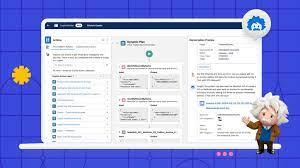
Einstein Copilot Studio Explained: Crafting and Personalizing a Reliable AI Assistant Enterprises aiming to personalize Einstein Copilot can leverage the newly introduced Einstein Copilot Studio. This platform enables the construction and customization of AI assistants, incorporating pertinent prompts, skills, and AI models tailored for specific sales, service, marketing, commerce, and IT tasks. Beyond the confines of Salesforce applications, companies can seamlessly integrate Einstein Copilot into consumer-facing channels. This extension enhances customer interactions by embedding AI assistants into websites for real-time chat capabilities or integrating with popular messaging platforms such as Slack, WhatsApp, or SMS. Einstein Copilot Studio comprises the following key components: Just as Microsoft has introduced its own Copilot solutions, powered by generative AI, Salesforce is tapping into the power of LLMs to empower sales, marketing, and customer service professionals. Building on Salesforce’s existing range of Einstein AI features, the company announced “Einstein 1” this year – the next generation of the Salesforce platform. Einstein 1 is a comprehensive suite of tools that empowers users to bring AI into their everyday workflows. The Einstein Copilot (Salesforce Copilot) solution is at the core of this solution, alongside the new Copilot studio and the Einstein Trust Layer. Contact Tectonic today to explore the value of Einstein Copilot Studio for your company., Like2 Related Posts Who is Salesforce? Who is Salesforce? Here is their story in their own words. From our inception, we’ve proudly embraced the identity of Read more Salesforce Marketing Cloud Transactional Emails Salesforce Marketing Cloud Transactional Emails are immediate, automated, non-promotional messages crucial to business operations and customer satisfaction, such as order Read more Salesforce Unites Einstein Analytics with Financial CRM Salesforce has unveiled a comprehensive analytics solution tailored for wealth managers, home office professionals, and retail bankers, merging its Financial Read more AI-Driven Propensity Scores AI plays a crucial role in propensity score estimation as it can discern underlying patterns between treatments and confounding variables Read more
Read More
New ChatGPT-4o

ChatGPT and Salesforce Explained

Supercharge Salesforce with ChatGPT: AI-Powered CRM Enhancements Integrating ChatGPT with Salesforce unlocks transformative potential across sales, service, marketing, and development—boosting efficiency, personalization, and decision-making. Here’s how businesses can harness generative AI to elevate their CRM strategy. 1. Automating Workflows & Boosting Productivity Workflow Optimization Accelerated Development AI-Generated Content 2. Smarter Customer Engagement Intelligent Lead Management Hyper-Personalized Communication Instant Customer Support 3. Data-Driven Sales & Marketing Predictive Sales Insights Laser-Targeted Campaigns AI-Powered Sales Forecasting 4. Seamless Salesforce Integration Einstein GPT + OpenAI Lightning Web Components (LWC) API Configuration 5. Real-World Use Cases Scenario AI Solution Outcome Case Summarization ChatGPT auto-generates case notes for agents. 50% faster resolution times. Dynamic Email Drafting AI crafts personalized responses in <10 seconds. 35% higher reply rates. Automated Reporting “Show me Q2 pipeline trends” → Instant dashboard. No-code analytics for all users. The Bottom Line By integrating ChatGPT with Salesforce, businesses can:✅ Reduce manual work with AI automation.✅ Enhance customer experiences through hyper-personalization.✅ Drive revenue growth with predictive insights. With Einstein GPT and custom LWC integrations, Salesforce users can deploy generative AI without complex coding—unlocking smarter, faster, and more scalable CRM operations. Ready to transform your Salesforce workflows? Start with a pilot in lead scoring, service automation, or sales forecasting today. Content updated June 2025. Like Related Posts Who is Salesforce? Who is Salesforce? Here is their story in their own words. From our inception, we’ve proudly embraced the identity of Read more Salesforce Marketing Cloud Transactional Emails Salesforce Marketing Cloud Transactional Emails are immediate, automated, non-promotional messages crucial to business operations and customer satisfaction, such as order Read more Salesforce Unites Einstein Analytics with Financial CRM Salesforce has unveiled a comprehensive analytics solution tailored for wealth managers, home office professionals, and retail bankers, merging its Financial Read more AI-Driven Propensity Scores AI plays a crucial role in propensity score estimation as it can discern underlying patterns between treatments and confounding variables Read more
Read More
Salesforce Einstein AI Trust Layer

Einstein AI Trust Layer Explained

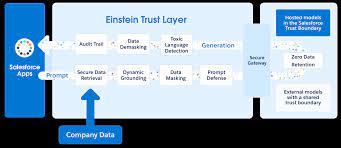
The Einstein Trust Layer is a secure AI architecture. It is natively built into the Salesforce Platform. Designed for enterprise security standards the Einstein Trust Layer continues to allow teams to benefit from generative AI. Without compromising their customer data, while at the same time letting companies use their trusted data to improve generative AI responses: Trusted AI starts with securely grounded prompts. A prompt is a canvas to provide detailed context and instructions to Large Language Models. The Einstein Trust layer allows you to responsibly ground all of your prompts in customer data and mask that data when the prompt is shared with Large Language Models*. With our Zero Retention architecture, none of your data is stored outside of Salesforce. Salesforce gives customers control over the use of their data for AI. Whether using our own Salesforce-hosted models or external models that are part of our Shared Trust Boundary, like OpenAI, no context is stored. The large language model forgets both the prompt and the output as soon as the output is processed. Like1 Related Posts Who is Salesforce? Who is Salesforce? Here is their story in their own words. From our inception, we’ve proudly embraced the identity of Read more Salesforce Marketing Cloud Transactional Emails Salesforce Marketing Cloud Transactional Emails are immediate, automated, non-promotional messages crucial to business operations and customer satisfaction, such as order Read more Salesforce Unites Einstein Analytics with Financial CRM Salesforce has unveiled a comprehensive analytics solution tailored for wealth managers, home office professionals, and retail bankers, merging its Financial Read more AI-Driven Propensity Scores AI plays a crucial role in propensity score estimation as it can discern underlying patterns between treatments and confounding variables Read more

Read More
Ready for GPT5

Ready for GPT5

Anticipating GPT-5: OpenAI’s Next Leap in Language Modeling Ready for GPT5-OpenAI’s recent advancements have sparked widespread speculation about the potential launch of GPT-5, the next iteration of their groundbreaking language model. This insight aims to explore the available information, analyze tweets from OpenAI officials, discuss potential features of GPT-5, and predict its release timeline. Additionally, it explores advancements in reasoning abilities, hardware considerations, and the evolving landscape of language models. Clues from OpenAI Officials Speculation around GPT-5 gained momentum with tweets from OpenAI’s President and Co-founder, Greg Brockman, and top researcher Jason Way. Brockman hinted at a full-scale training run, emphasizing the utilization of computing resources to maximize the model’s capabilities. Way’s tweet about the adrenaline rush of launching massive GPU training further fueled anticipation. Training Process and Red Teaming OpenAI typically follows a process of training smaller models before a full training run to gather insights. The red teaming network, responsible for safety testing, indicates that OpenAI is progressing towards evaluating GPT-5’s capabilities. The possibility of releasing checkpoints before the full model adds an interesting layer to the anticipation. Enhancements in Reasoning Abilities – Ready for GPT5 A key focus for GPT-5 is the incorporation of advanced reasoning capabilities. OpenAI aims to enable the model to lay out reasoning steps before solving a challenge, with internal or external checks on each step’s accuracy. This represents a significant shift towards enhancing the model’s reliability and reasoning prowess. Multimodal Capabilities GPT-5 is expected to further expand its multimodal capabilities, integrating text, images, audio, and potentially video. The goal is to create an operating system-like experience, where users interact with computers through a chat-based interface. OpenAI’s emphasis on gathering diverse data sources and reasoning data signifies their commitment to a holistic approach. Predictions on Model Size and Release Timeline Hardware CEO Gavin Uberti suggests that GPT-5 could have around 10 times the parameter count of GPT-4. Considering leaks indicating GPT-4’s parameter count of 1.5 to 1.8 trillion, GPT-5’s size is expected to be monumental. The article speculates on a potential release date, factoring in training time, safety testing, and potential checkpoints. Language Capabilities and Multilingual Data – Ready for GPT5 GPT-4’s surprising ability to understand unnatural scrambled text hints at the model’s language flexibility. The article discusses the likelihood of GPT-5 having improved multilingual capabilities, considering OpenAI’s data partnerships and emphasis on language diversity. Closing Thoughts Predictions about GPT-5’s exact capabilities remain speculative until the model is trained and unveiled. OpenAI’s commitment to pushing the boundaries of AI, surprises in AI development, and potential industry-defining products contribute to the excitement surrounding GPT-5. Like Related Posts Who is Salesforce? Who is Salesforce? Here is their story in their own words. From our inception, we’ve proudly embraced the identity of Read more Salesforce Unites Einstein Analytics with Financial CRM Salesforce has unveiled a comprehensive analytics solution tailored for wealth managers, home office professionals, and retail bankers, merging its Financial Read more AI-Driven Propensity Scores AI plays a crucial role in propensity score estimation as it can discern underlying patterns between treatments and confounding variables Read more Tectonic’s Successful Salesforce Track Record Salesforce Technology Services Integrator – Tectonic has successfully delivered Salesforce in a variety of industries including Public Sector, Hospitality, Manufacturing, Read more

Read More
gettectonic.com