Python Archives - gettectonic.com
agentforce testing center

Agentforce Testing Center

A New Framework for Reliable AI Agent Testing Testing traditional software is well understood, but AI agents introduce unique challenges. Their responses can vary based on interactions, memory, tool access, and sometimes inherent randomness. This unpredictability makes agent testing difficult—especially when repeatability, safety, and clarity are critical. Enter the Agentforce Testing Center. Agentforce Testing Center (ATC), part of Salesforce’s open-source Agentforce ecosystem, provides a structured framework to simulate, test, and monitor AI agent behavior before deployment. It supports real-world scenarios, tool mocking, memory control, guardrails, and test coverage—bringing testing discipline to dynamic agent environments. This insight explores how ATC works, its key differences from traditional testing, and how to set it up for Agentforce-based agents. We’ll cover test architecture, mock tools, memory injection, coverage tracking, and real-world use cases in SaaS, fintech, and HR. Why AI Agents Need a New Testing Paradigm? AI agents powered by LLMs don’t follow fixed instructions—they reason, adapt, and interact with tools and memory. Traditional testing frameworks assume: ✅ Deterministic inputs/outputs✅ Predefined state machines✅ Synchronous, linear flows But agentic systems are: ❌ Probabilistic (LLM outputs vary)❌ Stateful (memory affects decisions)❌ Non-deterministic (tasks may take different paths) Without proper testing, hallucinations, tool misuse, or logic loops can slip into production. Agentforce Testing Center bridges this gap by simulating realistic, repeatable agent behavior. What Is Agentforce Testing Center? ATC is a testing framework for Agentforce-based AI agents, offering: How ATC Works: Architecture & Testing Flow ATC wraps the Agentforce agent loop in a controlled testing environment: Step-by-Step Setup 1. Install Agentforce + ATC bash Copy Download pip install agentforce atc *(Requires Python 3.8+)* 2. Define a Test Scenario python Copy Download from atc import TestScenario scenario = TestScenario( name=”Customer Support Ticket”, goal=”Resolve a refund request”, memory_seed={“prior_chat”: “User asked about refund policy”} ) 3. Mock Tools python Copy Download scenario.mock_tool( name=”payment_api”, mock_response={“status”: “refund_approved”} ) 4. Add Assertions python Copy Download scenario.add_assertion( condition=lambda output: “refund” in output.lower(), error_message=”Agent failed to process refund” ) 5. Run & Analyze python Copy Download results = scenario.run() print(results.report()) Sample Output: text Copy Download ✅ Test Passed: Refund processed correctly 🛑 Tool Misuse: Called CRM API without permission ⚠️ Coverage Gap: Missing fallback logic Advanced Testing Patterns 1. Loop Detection Prevent agents from repeating actions indefinitely: python Copy Download scenario.add_guardrail(max_steps=10) 2. Regression Testing for LLM Upgrades Compare outputs between model versions: python Copy Download scenario.compare_versions( current_model=”gpt-4″, previous_model=”gpt-3.5″ ) 3. Multi-Agent Testing Validate workflows with multiple agents (e.g., research → writer → reviewer): python Copy Download scenario.test_agent_flow( agents=[researcher, writer, reviewer], expected_output=”Accurate, well-structured report” ) Best Practices for Agent Testing Real-World Use Cases Industry Agent Use Case Test Scenario SaaS Sales Copilot Generate follow-up email for healthcare lead Fintech Fraud Detection Bot Flag suspicious wire transfer HR Tech Resume Screener Rank top candidates with Python skills The Future of Agent Testing As AI agents move from prototypes to production, reliable testing is critical. Agentforce Testing Center provides: ✔ Controlled simulations (memory, tools, scenarios)✔ Actionable insights (coverage, guardrails, regressions)✔ CI/CD integration (automate safety checks) Start testing early—unchecked agents quickly become technical debt. Ready to build trustworthy AI agents?Agentforce Testing Center ensures they behave as expected—before they reach users. Like Related Posts AI Automated Offers with Marketing Cloud Personalization AI-Powered Offers Elevate the relevance of each customer interaction on your website and app through Einstein Decisions. Driven by a Read more Salesforce OEM AppExchange Expanding its reach beyond CRM, Salesforce.com has launched a new service called AppExchange OEM Edition, aimed at non-CRM service providers. Read more The Salesforce Story In Marc Benioff’s own words How did salesforce.com grow from a start up in a rented apartment into the world’s Read more Salesforce Jigsaw Salesforce.com, a prominent figure in cloud computing, has finalized a deal to acquire Jigsaw, a wiki-style business contact database, for Read more

Read More
Why AI Won't Kill SaaS

Essential Framework for Enterprise AI Development

LangChain: The Essential Framework for Enterprise AI Development The Challenge: Bridging LLMs with Enterprise Systems Large language models (LLMs) hold immense potential, but their real-world impact is limited without seamless integration into existing software stacks. Developers face three key hurdles: 🔹 Data Access – LLMs struggle to query databases, APIs, and real-time streams.🔹 Workflow Orchestration – Complex AI apps require multi-step reasoning.🔹 Accuracy & Hallucinations – Models need grounding in trusted data sources. Enter LangChain – the open-source framework that standardizes LLM integration, making AI applications scalable, reliable, and production-ready. LangChain Core: Prompts, Tools & Chains 1. Prompts – The Starting Point 2. Tools – Modular Building Blocks LangChain provides pre-built integrations for:✔ Data Search (Tavily, SerpAPI)✔ Code Execution (Python REPL)✔ Math & Logic (Wolfram Alpha)✔ Custom APIs (Connect to internal systems) 3. Chains – Multi-Step Workflows Chain Type Use Case Generic Basic prompt → LLM → output Utility Combine tools (e.g., search → analyze → summarize) Async Parallelize tasks for speed Example: python Copy Download chain = ( fetch_financial_data_from_API → analyze_with_LLM → generate_report → email_results ) Supercharging LangChain with Big Data Apache Spark: High-Scale Data Processing Apache Kafka: Event-Driven AI Enterprise Architecture: text Copy Download Kafka (Real-Time Events) → Spark (Batch Processing) → LangChain (LLM Orchestration) → Business Apps 3 Best Practices for Production 1. Deploy with LangServe 2. Debug with LangSmith 3. Automate Feedback Loops When to Use LangChain vs. Raw Python Scenario LangChain Pure Python Quick Prototyping ✅ Low-code templates ❌ Manual wiring Complex Workflows ✅ Built-in chains ❌ Reinvent the wheel Enterprise Scaling ✅ Spark/Kafka integration ❌ Custom glue code Criticism Addressed: The Future: LangChain as the AI Orchestration Standard With retrieval-augmented generation (RAG) and multi-agent systems gaining traction, LangChain’s role is expanding: 🔮 Autonomous Agents – Chains that self-prompt for complex tasks.🔮 Semantic Caching – Reduce LLM costs by reusing past responses.🔮 No-Code Builders – Business users composing AI workflows visually. Bottom Line: LangChain isn’t just for researchers—it’s the missing middleware for enterprise AI. “LangChain does for LLMs what Kubernetes did for containers—it turns prototypes into production.” Like Related Posts AI Automated Offers with Marketing Cloud Personalization AI-Powered Offers Elevate the relevance of each customer interaction on your website and app through Einstein Decisions. Driven by a Read more Salesforce OEM AppExchange Expanding its reach beyond CRM, Salesforce.com has launched a new service called AppExchange OEM Edition, aimed at non-CRM service providers. Read more The Salesforce Story In Marc Benioff’s own words How did salesforce.com grow from a start up in a rented apartment into the world’s Read more Salesforce Jigsaw Salesforce.com, a prominent figure in cloud computing, has finalized a deal to acquire Jigsaw, a wiki-style business contact database, for Read more

Read More

Grok 3 Model Explained

Grok 3 Model Explained: Everything You Need to Know xAI has introduced its latest large language model (LLM), Grok 3, expanding its capabilities with advanced reasoning, knowledge retrieval, and text summarization. In the competitive landscape of generative AI (GenAI), LLMs and their chatbot services have become essential tools for users and organizations. While OpenAI’s ChatGPT (powered by the GPT series) pioneered the modern GenAI era, alternatives like Anthropic’s Claude, Google Gemini, and now Grok (developed by Elon Musk’s xAI) offer diverse choices. The term grok originates from Robert Heinlein’s 1961 sci-fi novel Stranger in a Strange Land, meaning to deeply understand something. Grok is closely tied to X (formerly Twitter), where it serves as an integrated AI chatbot, though it’s also available on other platforms. What Is Grok 3? Grok 3 is xAI’s latest LLM, announced on February 17, 2025, in a live stream featuring CEO Elon Musk and the engineering team. Musk, known for founding Tesla, SpaceX, and acquiring Twitter (now X), launched xAI on March 9, 2023, with the mission to “understand the universe.” Grok 3 is the third iteration of the model, built using Rust and Python. Unlike Grok 1 (partially open-sourced under Apache 2.0), Grok 3 is proprietary. Key Innovations in Grok 3 Grok 3 excels in advanced reasoning, positioning it as a strong competitor against models like OpenAI’s o3 and DeepSeek-R1. What Can Grok 3 Do? Grok 3 operates in two core modes: 1. Think Mode 2. DeepSearch Mode Core Capabilities ✔ Advanced Reasoning – Multi-step problem-solving with self-correction.✔ Content Summarization – Text, images, and video summaries.✔ Text Generation – Human-like writing for various use cases.✔ Knowledge Retrieval – Accesses real-time web data (especially in DeepSearch mode).✔ Mathematics – Strong performance on benchmarks like AIME 2024.✔ Coding – Writes, debugs, and optimizes code.✔ Voice Mode – Supports spoken responses. Previous Grok Versions Model Release Date Key Features Grok 1 Nov. 3, 2023 Humorous, personality-driven responses. Grok 1.5 Mar. 28, 2024 Expanded context (128K tokens), better problem-solving. Grok 1.5V Apr. 12, 2024 First multimodal version (image understanding). Grok 2 Aug. 14, 2024 Full multimodal support, image generation via Black Forest Labs’ FLUX. Grok 3 vs. GPT-4o vs. DeepSeek-R1 Feature Grok 3 GPT-4o DeepSeek-R1 Release Date Feb. 17, 2025 May 24, 2024 Jan. 20, 2025 Developer xAI (USA) OpenAI (USA) DeepSeek (China) Reasoning Advanced (Think mode) Limited Strong Real-Time Data DeepSearch (web access) Training data cutoff Training data cutoff License Proprietary Proprietary Open-source Coding (LiveCodeBench) 79.4 72.9 64.3 Math (AIME 2024) 99.3 87.3 79.8 How to Use Grok 3 1. On X (Twitter) 2. Grok.com 3. Mobile App (iOS/Android) Same subscription options as Grok.com. 4. API (Coming Soon) No confirmed release date yet. Final Thoughts Grok 3 is a powerful reasoning-focused LLM with real-time search capabilities, making it a strong alternative to GPT-4o and DeepSeek-R1. With its DeepSearch and Think modes, it offers advanced problem-solving beyond traditional chatbots. Will it surpass OpenAI and DeepSeek? Only time—and benchmarks—will tell.  Like Related Posts AI Automated Offers with Marketing Cloud Personalization AI-Powered Offers Elevate the relevance of each customer interaction on your website and app through Einstein Decisions. Driven by a Read more Salesforce OEM AppExchange Expanding its reach beyond CRM, Salesforce.com has launched a new service called AppExchange OEM Edition, aimed at non-CRM service providers. Read more The Salesforce Story In Marc Benioff’s own words How did salesforce.com grow from a start up in a rented apartment into the world’s Read more Salesforce Jigsaw Salesforce.com, a prominent figure in cloud computing, has finalized a deal to acquire Jigsaw, a wiki-style business contact database, for Read more

Read More

Salesforce Industry Clouds

Salesforce Industry Clouds: Tailored Solutions for Public Sector Transformation Government-Specific CRM Built for the Digital Era Salesforce Public Sector Solutions (PSS) represents a paradigm shift in government technology, offering purpose-built applications that combine the power of CRM with public sector operational needs. This comprehensive suite enables agencies to modernize constituent services while maintaining rigorous compliance standards. Core Differentiators Public Sector Solutions Architecture 1. Foundation Layer ![Government Cloud Infrastructure] 2. Government Data Model Standard Object Enhanced Capability Case Violation tracking, benefit eligibility Account Citizen/business entity differentiation Inspection Mobile checklist workflows 3. Prebuilt Applications Diagram Code Download License & Permits Dynamic Forms Fee Automation Grants Mgmt Application Portal Disbursement Tracking Key Solution Areas 🆘 Emergency Program Management 📑 License & Permit Management 🔍 Inspection Management 💰 Grants Management Implementation Framework Phased Rollout Approach Add-On Modules Proven Outcomes BioMADE Case StudyChallenge: 9-month grant approval cyclesSolution: PSS Grants Management + DocuSignResults: Local Government Impact python Copy Download # Productivity metrics after PSS adoption print(f”Case resolution time: {before_hrs}hrs → {after_hrs}hrs”) print(f”Constituent satisfaction: {before_score} → {after_score}”) Typical Output:Case resolution time: 72hrs → 18hrsConstituent satisfaction: 62% → 89% Why Governments Choose Salesforce “PSS allowed us to stand up pandemic relief programs in 11 days – something that previously took 11 months.”— State CIO, Northeast U.S. Like Related Posts AI Automated Offers with Marketing Cloud Personalization AI-Powered Offers Elevate the relevance of each customer interaction on your website and app through Einstein Decisions. Driven by a Read more Salesforce OEM AppExchange Expanding its reach beyond CRM, Salesforce.com has launched a new service called AppExchange OEM Edition, aimed at non-CRM service providers. Read more The Salesforce Story In Marc Benioff’s own words How did salesforce.com grow from a start up in a rented apartment into the world’s Read more Salesforce Jigsaw Salesforce.com, a prominent figure in cloud computing, has finalized a deal to acquire Jigsaw, a wiki-style business contact database, for Read more

Read More
Create a Service Provider Portal in PSS

Salesforce Industry Clouds: Tailored Solutions for Public Sector Transformation

Salesforce Public Sector Solutions (PSS) represents a paradigm shift in government technology, offering purpose-built applications that combine the power of CRM with public sector operational needs. This comprehensive suite enables agencies to modernize constituent services while maintaining rigorous compliance standards. Core Differentiators Public Sector Solutions Architecture 1. Foundation Layer ![Government Cloud Infrastructure] 2. Government Data Model Standard Object Enhanced Capability Case Violation tracking, benefit eligibility Account Citizen/business entity differentiation Inspection Mobile checklist workflows 3. Prebuilt Applications Diagram Code Download License & Permits Dynamic Forms Fee Automation Grants Mgmt Application Portal Disbursement Tracking Key Solution Areas 🆘 Emergency Program Management 📑 License & Permit Management 🔍 Inspection Management 💰 Grants Management Implementation Framework Phased Rollout Approach Add-On Modules Proven Outcomes BioMADE Case StudyChallenge: 9-month grant approval cyclesSolution: PSS Grants Management + DocuSignResults: Local Government Impact python Copy Download # Productivity metrics after PSS adoption print(f”Case resolution time: {before_hrs}hrs → {after_hrs}hrs”) print(f”Constituent satisfaction: {before_score} → {after_score}”) Typical Output:Case resolution time: 72hrs → 18hrsConstituent satisfaction: 62% → 89% Why Governments Choose Salesforce “PSS allowed us to stand up pandemic relief programs in 11 days – something that previously took 11 months.”— State CIO, Northeast U.S. Like Related Posts AI Automated Offers with Marketing Cloud Personalization AI-Powered Offers Elevate the relevance of each customer interaction on your website and app through Einstein Decisions. Driven by a Read more Salesforce OEM AppExchange Expanding its reach beyond CRM, Salesforce.com has launched a new service called AppExchange OEM Edition, aimed at non-CRM service providers. Read more The Salesforce Story In Marc Benioff’s own words How did salesforce.com grow from a start up in a rented apartment into the world’s Read more Salesforce Jigsaw Salesforce.com, a prominent figure in cloud computing, has finalized a deal to acquire Jigsaw, a wiki-style business contact database, for Read more

Read More

Salesforce Research Pioneers Enterprise-Grade AI Reliability

Bridging the Gap Between AI Potential and Business Reality Salesforce AI Research has unveiled groundbreaking work to solve one of enterprise AI’s most persistent challenges: the “jagged intelligence” phenomenon that makes AI agents unreliable for business tasks. Their latest findings, published in the inaugural Salesforce AI Research in Review report, introduce three critical innovations to make AI agents truly enterprise-ready. The Jagged Intelligence Problem “Today’s AI can solve advanced calculus but might fail at basic customer service queries. This inconsistency is what we call ‘jagged intelligence’ – and it’s the biggest barrier to enterprise adoption.”— Shelby Heinecke, Senior AI Research Manager Key Findings: Three Pillars of Enterprise AI Reliability 1. SIMPLE Benchmark: Testing What Actually Matters 225 real-world business questions that reveal an AI’s true operational readiness: Why it matters: Unlike academic benchmarks, SIMPLE evaluates:✅ Practical reasoning✅ Consistency across repetitions✅ Business context understanding Early Results: Top models score 89% on coding tests but just 62% on SIMPLE. 2. ContextualJudgeBench: Fixing the AI Judge Problem When AIs evaluate other AIs, how do we know the judges are reliable? Salesforce’s solution: Evaluation Criteria Traditional Benchmarks ContextualJudgeBench Assessment Depth Single-score output 2,000+ response pairs Bias Detection None Measures rater consistency Enterprise Focus General knowledge Business decision-making Impact: Reduces “hallucinated” evaluations by 40% in testing. 3. CRMArena: The First AI Agent Proving Ground A specialized framework testing AI agents on real CRM tasks: Test Categories Sample Results: python Copy Download { “Agent”: “Einstein_Service_Pro”, “Task”: “Prioritize 50 support cases”, “Accuracy”: 92%, “Speed”: 3.2 sec/case, “Consistency”: 88% } Enterprise Benefit: Finally answers “Which AI agent actually works for my sales team?” Under-the-Hood Breakthroughs SFR-Embedding v2 SFR-Guard AI watchdog models that monitor:🔒 Toxicity🔒 Prompt injections🔒 Data leakage xLAM Updates TACO Models Generates chains of thought-and-action for complex workflows like: Why This Matters for Businesses “These aren’t flashy demos—they’re the industrial-grade foundations for AI that actually works in your ERP, CRM, and service systems,” explains Chief Scientist Silvio Savarese. Immediate Applications: What’s Next:Salesforce will open-source SIMPLE and expand CRMArena to 50+ industry-specific tasks by EOY 2024. “We’re not chasing artificial general intelligence—we’re building enterprise general intelligence: AI that’s boringly reliable where it matters most.”— Salesforce AI Research Team Like Related Posts AI Automated Offers with Marketing Cloud Personalization AI-Powered Offers Elevate the relevance of each customer interaction on your website and app through Einstein Decisions. Driven by a Read more Salesforce OEM AppExchange Expanding its reach beyond CRM, Salesforce.com has launched a new service called AppExchange OEM Edition, aimed at non-CRM service providers. Read more The Salesforce Story In Marc Benioff’s own words How did salesforce.com grow from a start up in a rented apartment into the world’s Read more Salesforce Jigsaw Salesforce.com, a prominent figure in cloud computing, has finalized a deal to acquire Jigsaw, a wiki-style business contact database, for Read more

Read More
Large and Small Language Models

Architecture for Enterprise-Grade Agentic AI Systems

LangGraph: The Architecture for Enterprise-Grade Agentic AI Systems Modern enterprises need AI that doesn’t just answer questions—but thinks, plans, and acts autonomously. LangGraph provides the framework to build these next-generation agentic systems capable of: ✅ Multi-step reasoning across complex workflows✅ Dynamic decision-making with real-time tool selection✅ Stateful execution that maintains context across operations✅ Seamless integration with enterprise knowledge bases and APIs 1. LangGraph’s Graph-Based Architecture At its core, LangGraph models AI workflows as Directed Acyclic Graphs (DAGs): This structure enables:✔ Conditional branching (different paths based on data)✔ Parallel processing where possible✔ Guaranteed completion (no infinite loops) Example Use Case:A customer service agent that: 2. Multi-Hop Knowledge Retrieval Enterprise queries often require connecting information across multiple sources. LangGraph treats this as a graph traversal problem: python Copy # Neo4j integration for structured knowledge from langchain.graphs import Neo4jGraph graph = Neo4jGraph(url=”bolt://localhost:7687″, username=”neo4j”, password=”password”) query = “”” MATCH (doc:Document)-[:REFERENCES]->(policy:Policy) WHERE policy.name = ‘GDPR’ RETURN doc.title, doc.url “”” results = graph.query(query) # → Feeds into LangGraph nodes Hybrid Approach: 3. Building Autonomous Agents LangGraph + LangChain agents create systems that: python Copy from langchain.agents import initialize_agent, Tool from langchain.chat_models import ChatOpenAI # Define tools search_tool = Tool( name=”ProductSearch”, func=search_product_db, description=”Searches internal product catalog” ) # Initialize agent agent = initialize_agent( tools=[search_tool], llm=ChatOpenAI(model=”gpt-4″), agent=AgentType.ZERO_SHOT_REACT_DESCRIPTION ) # Execute response = agent.run(“Find compatible accessories for Model X-42”) 4. Full Implementation Example Enterprise Document Processing System: python Copy from langgraph.graph import StateGraph from langchain.embeddings import OpenAIEmbeddings from langchain.vectorstores import Pinecone # 1. Define shared state class DocProcessingState(BaseModel): query: str retrieved_docs: list = [] analysis: str = “” actions: list = [] # 2. Create nodes def retrieve(state): vectorstore = Pinecone.from_existing_index(“docs”, OpenAIEmbeddings()) state.retrieved_docs = vectorstore.similarity_search(state.query) return state def analyze(state): # LLM analysis of documents state.analysis = llm(f”Summarize key points from: {state.retrieved_docs}”) return state # 3. Build workflow workflow = StateGraph(DocProcessingState) workflow.add_node(“retrieve”, retrieve) workflow.add_node(“analyze”, analyze) workflow.add_edge(“retrieve”, “analyze”) workflow.add_edge(“analyze”, END) # 4. Execute agent = workflow.compile() result = agent.invoke({“query”: “2025 compliance changes”}) Why This Matters for Enterprises The Future:LangGraph enables AI systems that don’t just assist workers—but autonomously execute complete business processes while adhering to organizational rules and structures. “This isn’t chatbot AI—it’s digital workforce AI.” Next Steps: Like Related Posts AI Automated Offers with Marketing Cloud Personalization AI-Powered Offers Elevate the relevance of each customer interaction on your website and app through Einstein Decisions. Driven by a Read more Salesforce OEM AppExchange Expanding its reach beyond CRM, Salesforce.com has launched a new service called AppExchange OEM Edition, aimed at non-CRM service providers. Read more The Salesforce Story In Marc Benioff’s own words How did salesforce.com grow from a start up in a rented apartment into the world’s Read more Salesforce Jigsaw Salesforce.com, a prominent figure in cloud computing, has finalized a deal to acquire Jigsaw, a wiki-style business contact database, for Read more

Read More
Python-Based Reasoning

Building Intelligent Order Management Workflows

Mastering LangGraph: Building Intelligent Order Management Workflows Introduction In this comprehensive guide, we will explore LangGraph—a robust library designed for orchestrating complex, multi-step workflows with Large Language Models (LLMs). We will apply it to a practical e-commerce use case: determining whether to place or cancel an order based on a user’s query. By the end of this tutorial, you will understand how to: We will walk through each step in detail, making it accessible to beginners and useful for those seeking to develop dynamic, intelligent workflows using LLMs. A dataset link is also provided for hands-on experimentation. Table of Contents 1. What Is LangGraph? LangGraph is a library that brings a graph-based approach to LangChain workflows. Traditional pipelines follow a linear progression, but real-world tasks often involve branching logic, loops (e.g., retrying failed steps), or human intervention. Key Features: 2. The Problem Statement: Order Management The workflow needs to handle two types of user queries: Since these operations require decision-making, we will use LangGraph to implement a structured, conditional workflow: 3. Environment Setup and Imports Explanation of Key Imports: 4. Data Loading and State Definition Load Inventory and Customer Data Define the Workflow State 5. Creating Tools and Integrating LLMs Define the Order Cancellation Tool Initialize LLM and Bind Tools 6. Defining Workflow Nodes Query Categorization Check Inventory Compute Shipping Costs Process Payment 7. Constructing the Workflow Graph 8. Visualizing and Testing the Workflow Like Related Posts AI Automated Offers with Marketing Cloud Personalization AI-Powered Offers Elevate the relevance of each customer interaction on your website and app through Einstein Decisions. Driven by a Read more Salesforce OEM AppExchange Expanding its reach beyond CRM, Salesforce.com has launched a new service called AppExchange OEM Edition, aimed at non-CRM service providers. Read more The Salesforce Story In Marc Benioff’s own words How did salesforce.com grow from a start up in a rented apartment into the world’s Read more Salesforce Jigsaw Salesforce.com, a prominent figure in cloud computing, has finalized a deal to acquire Jigsaw, a wiki-style business contact database, for Read more

Read More
The Growing Role of AI in Cloud Management

Introducing TACO

Advancing Multi-Modal AI with TACO: A Breakthrough in Reasoning and Tool Integration Developing effective multi-modal AI systems for real-world applications demands mastering diverse tasks, including fine-grained recognition, visual grounding, reasoning, and multi-step problem-solving. However, current open-source multi-modal models fall short in these areas, especially when tasks require external tools like OCR or mathematical calculations. These limitations largely stem from the reliance on single-step datasets that fail to provide a coherent framework for multi-step reasoning and logical action chains. Addressing these shortcomings is crucial for unlocking multi-modal AI’s full potential in tackling complex challenges. Challenges in Existing Multi-Modal Models Most existing multi-modal models rely on instruction tuning with direct-answer datasets or few-shot prompting approaches. Proprietary systems like GPT-4 have demonstrated the ability to effectively navigate CoTA (Chains of Thought and Actions) reasoning, but open-source models struggle due to limited datasets and tool integration. Earlier efforts, such as LLaVa-Plus and Visual Program Distillation, faced barriers like small dataset sizes, poor-quality training data, and a narrow focus on simple question-answering tasks. These limitations hinder their ability to address complex, multi-modal challenges requiring advanced reasoning and tool application. Introducing TACO: A Multi-Modal Action Framework Researchers from the University of Washington and Salesforce Research have introduced TACO (Training Action Chains Optimally), an innovative framework that redefines multi-modal learning by addressing these challenges. TACO introduces several advancements that establish a new benchmark for multi-modal AI performance: Training and Architecture TACO’s training process utilized a carefully curated CoTA dataset of 293K instances from 31 sources, including Visual Genome, offering a diverse range of tasks such as mathematical reasoning, OCR, and visual understanding. The system employs: Benchmark Performance TACO demonstrated significant performance improvements across eight benchmarks, achieving an average accuracy increase of 3.6% over instruction-tuned baselines and gains as high as 15% on MMVet tasks involving OCR and mathematical reasoning. Key findings include: Transforming Multi-Modal AI Applications TACO represents a transformative step in multi-modal action modeling by addressing critical deficiencies in reasoning and tool-based actions. Its innovative approach leverages high-quality synthetic datasets and advanced training methodologies to unlock the potential of multi-modal AI in real-world applications, from visual question answering to complex multi-step reasoning tasks. By bridging the gap between reasoning and action integration, TACO paves the way for AI systems capable of tackling intricate scenarios with unprecedented accuracy and efficiency. Like Related Posts AI Automated Offers with Marketing Cloud Personalization AI-Powered Offers Elevate the relevance of each customer interaction on your website and app through Einstein Decisions. Driven by a Read more Salesforce OEM AppExchange Expanding its reach beyond CRM, Salesforce.com has launched a new service called AppExchange OEM Edition, aimed at non-CRM service providers. Read more The Salesforce Story In Marc Benioff’s own words How did salesforce.com grow from a start up in a rented apartment into the world’s Read more Salesforce Jigsaw Salesforce.com, a prominent figure in cloud computing, has finalized a deal to acquire Jigsaw, a wiki-style business contact database, for Read more

Read More
Prompt Decorators

Prompt Decorators

Prompt Decorators: A Structured Approach to Enhancing AI Responses Artificial intelligence has transformed how we interact with technology, offering powerful capabilities in content generation, research, and problem-solving. However, the quality of AI responses often hinges on how effectively users craft their prompts. Many encounter challenges such as vague answers, inconsistent outputs, and the need for repetitive refinement. Prompt Decorators provide a solution—structured prefixes that guide AI models to generate clearer, more logical, and better-organized responses. Inspired by Python decorators, this method standardizes prompt engineering, making AI interactions more efficient and reliable. The Challenge of AI Prompting While AI models like ChatGPT excel at generating human-like text, their outputs can vary widely based on prompt phrasing. Common issues include: Without a systematic approach, users waste time fine-tuning prompts instead of getting useful answers. What Are Prompt Decorators? Prompt Decorators are simple prefixes added to prompts to modify AI behavior. They enforce structured reasoning, improve accuracy, and customize responses. Example Without a Decorator: “Suggest a name for an AI YouTube channel.”→ The AI may return a basic list of names without justification. Example With +++Reasoning Decorator: “+++Reasoning Suggest a name for an AI YouTube channel.”→ The AI first explains its naming criteria (e.g., clarity, memorability, relevance) before generating suggestions. Key Prompt Decorators & Their Uses Decorator Function Example Use Case +++Reasoning Forces AI to explain logic before answering “+++Reasoning What’s the best AI model for text generation?” +++StepByStep Breaks complex tasks into clear steps “+++StepByStep How do I fine-tune an LLM?” +++Debate Presents pros and cons for balanced discussion “+++Debate Is cryptocurrency a good investment?” +++Critique Evaluates strengths/weaknesses before suggesting improvements “+++Critique Analyze the pros and cons of online education.” +++Refine(N) Iteratively improves responses (N = refinement rounds) “+++Refine(3) Write a tagline for an AI startup.” +++CiteSources Includes references for claims “+++CiteSources Who invented the printing press?” +++FactCheck Prioritizes verified information “+++FactCheck What are the health benefits of coffee?” +++OutputFormat(FMT) Structures responses (JSON, Markdown, etc.) “+++OutputFormat(JSON) List top AI trends in 2024.” +++Tone(STYLE) Adjusts response tone (formal, casual, etc.) “+++Tone(Formal) Write an email requesting a deadline extension.” Why Use Prompt Decorators? Real-World Applications The Future of Prompt Decorators As AI evolves, Prompt Decorators could: Conclusion Prompt Decorators offer a simple yet powerful way to enhance AI interactions. By integrating structured directives, users can achieve more reliable, insightful, and actionable outputs—reducing frustration and unlocking AI’s full potential. Like Related Posts AI Automated Offers with Marketing Cloud Personalization AI-Powered Offers Elevate the relevance of each customer interaction on your website and app through Einstein Decisions. Driven by a Read more Salesforce OEM AppExchange Expanding its reach beyond CRM, Salesforce.com has launched a new service called AppExchange OEM Edition, aimed at non-CRM service providers. Read more The Salesforce Story In Marc Benioff’s own words How did salesforce.com grow from a start up in a rented apartment into the world’s Read more Salesforce Jigsaw Salesforce.com, a prominent figure in cloud computing, has finalized a deal to acquire Jigsaw, a wiki-style business contact database, for Read more

Read More
No-Code Generative AI

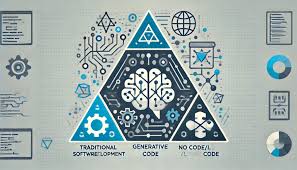
Generative-Driven Development

Nowhere has the rise of generative AI tools been more transformative than in software development. It began with GitHub Copilot’s enhanced autocomplete, which then evolved into interactive, real-time coding assistants like Aider and Cursor that allow engineers to dictate changes and see them applied live in their editor. Today, platforms like Devin.ai aim even higher, aspiring to create autonomous software systems capable of interpreting feature requests or bug reports and delivering ready-to-review code. At its core, the ambition of these AI tools mirrors the essence of software itself: to automate human work. Whether you were writing a script to automate CSV parsing in 2005 or leveraging AI today, the goal remains the same—offloading repetitive tasks to machines. What makes generative AI tools distinct, however, is their focus on automating the work of automation itself. Framing this as a guiding principle enables us to consider the broader challenges and opportunities generative AI brings to software development. Automate the Process of Automation The Doctor-Patient Strategy Most contemporary generative AI tools operate under what can be called the Doctor-Patient strategy. In this model, the GenAI tool acts on a codebase as a distinct, external entity—much like a doctor treats a patient. The relationship is one-directional: the tool modifies the codebase based on given instructions but remains isolated from the architecture and decision-making processes within it. Why This Strategy Dominates: However, the limitations of this strategy are becoming increasingly apparent. Over time, the unidirectional relationship leads to bot rot—the gradual degradation of code quality due to poorly contextualized, repetitive, or inconsistent changes made by generative AI. Understanding Bot Rot Bot rot occurs when AI tools repeatedly make changes without accounting for the macro-level architecture of a codebase. These tools rely on localized context, often drawing from semantically similar code snippets, but lack the insight needed to preserve or enhance the overarching structure. Symptoms of Bot Rot: Example:Consider a Python application that parses TPS report IDs. Without architectural insight, a code bot may generate redundant parsing methods across multiple modules rather than abstracting the logic into a centralized model. Over time, this duplication compounds, creating a chaotic and inefficient codebase. A New Approach: Generative-Driven Development (GDD) To address the flaws of the Doctor-Patient strategy, we propose Generative-Driven Development (GDD), a paradigm where the codebase itself is designed to enable generative AI to enhance automation iteratively and sustainably. Pillars of GDD: How GDD Improves the Development Lifecycle Under GDD, the traditional Test-Driven Development (TDD) cycle (red, green, refactor) evolves to integrate AI processes: This complete cycle eliminates the gaps present in current generative workflows, reducing bot rot and enabling sustainable automation. Over time, GDD-based codebases become easier to maintain and automate, reducing error rates and cycle times. A Day in the Life of a GDD Engineer Imagine a GDD-enabled workflow for a developer tasked with updating TPS report parsing: By embedding AI into the development process, GDD empowers engineers to focus on high-level decision-making while ensuring the automation process remains sustainable and aligned with architectural goals. Conclusion Generative-Driven Development represents a significant shift in how we approach software development. By prioritizing architecture, embedding automation into the software itself, and writing GenAI-optimized code, GDD offers a sustainable path to achieving the ultimate goal: automating the process of automation. As AI continues to reshape the industry, adopting GDD will be critical to harnessing its full potential while avoiding the pitfalls of bot rot. Like Related Posts AI Automated Offers with Marketing Cloud Personalization AI-Powered Offers Elevate the relevance of each customer interaction on your website and app through Einstein Decisions. Driven by a Read more Salesforce OEM AppExchange Expanding its reach beyond CRM, Salesforce.com has launched a new service called AppExchange OEM Edition, aimed at non-CRM service providers. Read more The Salesforce Story In Marc Benioff’s own words How did salesforce.com grow from a start up in a rented apartment into the world’s Read more Salesforce Jigsaw Salesforce.com, a prominent figure in cloud computing, has finalized a deal to acquire Jigsaw, a wiki-style business contact database, for Read more

Read More
gettectonic.com