Generative AI Archives - gettectonic.com - Page 31
AI Training Options

AI Training Options

As AI adoption accelerates, AI certifications and courses have proliferated, providing deeper knowledge of this rapidly evolving technology. AI Training Options. Numerous AI certifications cover the basics, so we’ve narrowed the field to 10 of the most diverse and comprehensive programs. AI Training Options Artificial intelligence is poised to become the key technology that drives business transformation and gives companies a competitive edge. According to a recent forecast by the International Data Corporation, global spending on AI—including AI-enabled applications, infrastructure, and related services—will more than double to $632 billion by 2028, growing at a compound annual rate of 29% between 2024 and 2028. AI helps businesses boost productivity by automating processes such as robotics and autonomous vehicles, while also supporting existing workforces with technologies like assisted and augmented intelligence. Companies are integrating AI across various sectors, including finance, healthcare, retail, smart home devices, fraud detection, and security surveillance. Why AI certifications are important: 10 of the best AI certifications and courses: Each certification offers unique benefits, whether you’re a beginner or an experienced professional aiming to stay ahead in AI-driven industries. Content updated September 2024. Like Related Posts Who is Salesforce? Who is Salesforce? Here is their story in their own words. From our inception, we’ve proudly embraced the identity of Read more Salesforce Unites Einstein Analytics with Financial CRM Salesforce has unveiled a comprehensive analytics solution tailored for wealth managers, home office professionals, and retail bankers, merging its Financial Read more AI-Driven Propensity Scores AI plays a crucial role in propensity score estimation as it can discern underlying patterns between treatments and confounding variables Read more Tectonic’s Successful Salesforce Track Record Salesforce Technology Services Integrator – Tectonic has successfully delivered Salesforce in a variety of industries including Public Sector, Hospitality, Manufacturing, Read more

Read More
Personalization With Customized AI-Driven Journeys

Personalization With Customized AI-Driven Journeys

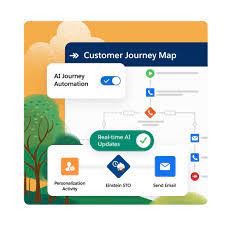
AI-Enabled Triggers for Guiding Customer Journeys – Personalization With Customized AI-Driven Journeys Initiate timely and relevant customer experiences that seamlessly lead individuals through their purchasing journey. Employ AI-powered decision-making to identify the most suitable next steps for customers, offering personalized suggestions based on real-time behavior, historical data, and business-specific datasets such as pricing and inventory. Deliver predefined experiences, such as browsing or cart abandonment journeys, while utilizing real-time interactions to determine the optimal content, channel, or offer for each customer. Efficiently extract insights by harnessing behavioral data and advanced analytics to visualize cross-channel customer journeys for both individuals and segments, identifying and resolving key friction points. Elevate customer acquisition, loyalty, and lifetime value by crafting personalized, omni-channel journeys that align with both customer desires and business objectives. Enable trigger-based customer journeys that facilitate immediate responses to customer actions, whether in the physical realm, such as entering a store and connecting to Wi-Fi, or in the virtual space, like visiting a shopping website. The Role of AI in Elevating the Customer Journey AI significantly contributes to heightened customer satisfaction, ultimately leading to improved retention. Address customer pain points in their preferred language and provide solutions tailored to their needs based on purchasing history and previous interactions with customer service. AI’s Influence Across Customer Journey Stages At each stage of the customer journey, AI transforms experiences by delivering personalized interactions from awareness to post-purchase. This transformation is made possible through automation, predictive analytics, and intelligent virtual agents. Transformative Impact of Generative AI on Customer Journeys Generative AI, exemplified by advanced language models like GPT-4, has the potential to revolutionize customer journeys. These models automate communication and content creation, dynamically adjusting tone and style to match customer preferences. For instance, Grammarly’s tone detector adapts communication based on the recipient’s profile and interaction history. Continuous Iteration and AI in Customer Journey Mapping In the era of digitization, AI-driven personalization surpasses traditional customer journey mapping based on a few personas. Organizations must harness AI and machine learning to create personalized journeys that enhance user experiences. The iterative improvement process involves collecting comprehensive data, utilizing AI for analysis and insights, implementing changes, and evaluating results through key performance indicators. Netflix: An AI Success Story Netflix serves as a prime example of AI success, continuously analyzing user behavior and preferences to refine content recommendation algorithms. This approach enhances personalization, leading to increased customer engagement and satisfaction. Integrating Generative AI into Existing Systems To fully capitalize on generative AI, integration into existing systems and processes is crucial. This may entail developing APIs to connect AI tools with customer relationship management (CRM) systems and content management systems. Testing and Continuous Enhancement Implementing AI-driven personalization necessitates a robust testing and evaluation process. Clearly defined key performance indicators and analytics capabilities are essential for measuring effectiveness and making continuous improvements. Like2 Related Posts Who is Salesforce? Who is Salesforce? Here is their story in their own words. From our inception, we’ve proudly embraced the identity of Read more Salesforce Marketing Cloud Transactional Emails Salesforce Marketing Cloud Transactional Emails are immediate, automated, non-promotional messages crucial to business operations and customer satisfaction, such as order Read more Salesforce Unites Einstein Analytics with Financial CRM Salesforce has unveiled a comprehensive analytics solution tailored for wealth managers, home office professionals, and retail bankers, merging its Financial Read more AI-Driven Propensity Scores AI plays a crucial role in propensity score estimation as it can discern underlying patterns between treatments and confounding variables Read more

Read More
New ChatGPT-4o

ChatGPT and Salesforce Explained

Supercharge Salesforce with ChatGPT: AI-Powered CRM Enhancements Integrating ChatGPT with Salesforce unlocks transformative potential across sales, service, marketing, and development—boosting efficiency, personalization, and decision-making. Here’s how businesses can harness generative AI to elevate their CRM strategy. 1. Automating Workflows & Boosting Productivity Workflow Optimization Accelerated Development AI-Generated Content 2. Smarter Customer Engagement Intelligent Lead Management Hyper-Personalized Communication Instant Customer Support 3. Data-Driven Sales & Marketing Predictive Sales Insights Laser-Targeted Campaigns AI-Powered Sales Forecasting 4. Seamless Salesforce Integration Einstein GPT + OpenAI Lightning Web Components (LWC) API Configuration 5. Real-World Use Cases Scenario AI Solution Outcome Case Summarization ChatGPT auto-generates case notes for agents. 50% faster resolution times. Dynamic Email Drafting AI crafts personalized responses in <10 seconds. 35% higher reply rates. Automated Reporting “Show me Q2 pipeline trends” → Instant dashboard. No-code analytics for all users. The Bottom Line By integrating ChatGPT with Salesforce, businesses can:✅ Reduce manual work with AI automation.✅ Enhance customer experiences through hyper-personalization.✅ Drive revenue growth with predictive insights. With Einstein GPT and custom LWC integrations, Salesforce users can deploy generative AI without complex coding—unlocking smarter, faster, and more scalable CRM operations. Ready to transform your Salesforce workflows? Start with a pilot in lead scoring, service automation, or sales forecasting today. Content updated June 2025. Like Related Posts Who is Salesforce? Who is Salesforce? Here is their story in their own words. From our inception, we’ve proudly embraced the identity of Read more Salesforce Marketing Cloud Transactional Emails Salesforce Marketing Cloud Transactional Emails are immediate, automated, non-promotional messages crucial to business operations and customer satisfaction, such as order Read more Salesforce Unites Einstein Analytics with Financial CRM Salesforce has unveiled a comprehensive analytics solution tailored for wealth managers, home office professionals, and retail bankers, merging its Financial Read more AI-Driven Propensity Scores AI plays a crucial role in propensity score estimation as it can discern underlying patterns between treatments and confounding variables Read more

Read More
How Good is Our Data

How Good is Our Data?

Generative AI promises to significantly reshape how you manage your customer relationships, but it requires data that is accurate, updated, accessible, and complete. Why is this important? You may do something differently this quarter than you did last quarter, based on the latest data. But if your data is outdated or incorrect, that’s what the AI will use.  Generative AI focuses on creating new and original content, chat responses, designs, synthetic content or even deepfakes. It’s particularly valuable in creative fields and for novel problem-solving, as it can autonomously generate many types of new outputs. Generative Artificial Intelligence models often present inaccurate information as though it were correct. This is often caused by limited information in the system, biases in training data, and issues with the algorithm. These are commonly called ‘hallucinations‘ and they present a huge problem. When training your models for generative AI, you should first ensure high information excellence from top to bottom. To get your information house in order, remove duplicates, outliers, errors, and other things that can negatively affect how you make decisions. Then connect your data sources — marketing, sales, service, commerce – into a single record, updated in real time, so the AI can make the best recommendations.   McKinsey recently wrote, “Companies that have not yet found ways to harmonize and provide ready access to their information will be unable to unlock much of generative AI’s potentially transformative power.” Why is data important in generative AI? Aside from the cost factor, poor information quality can introduce unnecessary and harmful noise into the generative AI systems and models, leading to misleading answers, nonsensical output, or overall lower efficacy. What is high-quality data for AI? High-quality information is essential for AI systems to deliver meaningful results. Data quality possesses several key attributes: Accuracy: High-quality information is free from errors and inaccuracies. Inaccurate information can mislead AI models and produce unreliable outputs. Is AI 100 percent accurate? Because AI will still rely on your data for decision making and accuracy depends on the quality of your information. AI machines must be well-programmed to make sure the machine is making decisions based on the correct, available information. Also, privacy and security of the data are paramount. AI machines need to access information that is encrypted and secure. Understand that Generative AI is most effective at creating new data based on existing patterns and examples, with a focus on text and image data. Generative AI is most suitable for generating new data based on existing patterns and examples. It doesn’t actually think for itself. Yet. Known Limitations Of Generative AI Large language models (LLMs) are prone to “hallucinations” – generating fictitious information, presented as factual or accurate. This can include citations, publications, biographical information, and other information commonly used in research and academic papers. Like1 Related Posts Who is Salesforce? Who is Salesforce? Here is their story in their own words. From our inception, we’ve proudly embraced the identity of Read more Salesforce Marketing Cloud Transactional Emails Salesforce Marketing Cloud Transactional Emails are immediate, automated, non-promotional messages crucial to business operations and customer satisfaction, such as order Read more Salesforce Unites Einstein Analytics with Financial CRM Salesforce has unveiled a comprehensive analytics solution tailored for wealth managers, home office professionals, and retail bankers, merging its Financial Read more AI-Driven Propensity Scores AI plays a crucial role in propensity score estimation as it can discern underlying patterns between treatments and confounding variables Read more

Read More
Exploring Google Vertex AI

Vertex AI

Exploring Google Vertex AI Conversation — Dialogflow CX with Generative AI, Data Stores, and Generators Vertex AI Conversation, built on Dialogflow and Vertex AI, introduces generative conversational features that utilize large language models (LLMs) for natural language understanding, crafting responses, and managing conversation flow. These advancements streamline agent design and enhance the quality of interactions. With Vertex AI Conversation, you can employ a state machine approach to develop sophisticated, generative AI-powered agents for dynamic conversation design and automation. In this insight, we’ll delve into the cutting-edge Dialogflow CX Generative AI technology, focusing on Data Stores and Generators. Data Stores: The Library of Information for Conversations Imagine Data Stores as an extensive library. When a question is asked, the virtual assistant acts as a librarian, locating relevant information. Dialogflow CX’s Data Store feature makes it easy to create conversations around stored information from various sources: For data preparation guidance, visit Google’s official documentation. Generators: LLM-Enhanced Dynamic Responses Dialogflow CX also enables Generators to use an LLM directly in Dialogflow CX without webhooks. Generators can perform tasks like summarization, parameter extraction, and data manipulation. Sourced from Vertex AI, they create real-time responses based on your prompts. For example, a Generator can be customized to summarize lengthy answers—an invaluable feature for simplifying conversations in chat or voice applications. You can find common Generator configurations in Google Cloud Platform (GCP) documentation. Creating a Chat Application with Vertex AI To start building, go to the Search and Conversation page in Google Cloud, agree to the terms, activate the API, and select “Chat.” Setting Up Your Agent After naming your agent and configuring data sources, like a Cloud Storage bucket with PDF documents, you’ll see your new chat app under Search & Conversation | Apps. Navigate to Dialogflow CX, where you can use your data store by setting up parameters for the agent and configuring responses. Once your agent is ready, you can test it in the Agent simulator. Adding a Generator for Summarization Using the Generator feature, you can further refine responses. Set parameters to target the Generator’s summarization feature, and link it to a specific page for summarized responses. This improves chat flow, providing concise answers for faster interactions. Integrating with Discord If you want to deploy your agent on platforms like Discord, follow Google’s integration guide for Dialogflow and adjust your code as needed. With the integration, responses will include hyperlinks for easy reference. Conclusion Vertex AI Conversation, with Dialogflow CX, enables powerful, human-like chat experiences by combining LLMs, Data Stores, and Generators. Ready to build your own dynamic conversational experiences? Now is the perfect time to experiment with this technology and see where it can take you. Like Related Posts Who is Salesforce? Who is Salesforce? Here is their story in their own words. From our inception, we’ve proudly embraced the identity of Read more Salesforce Unites Einstein Analytics with Financial CRM Salesforce has unveiled a comprehensive analytics solution tailored for wealth managers, home office professionals, and retail bankers, merging its Financial Read more AI-Driven Propensity Scores AI plays a crucial role in propensity score estimation as it can discern underlying patterns between treatments and confounding variables Read more Tectonic’s Successful Salesforce Track Record Salesforce Technology Services Integrator – Tectonic has successfully delivered Salesforce in a variety of industries including Public Sector, Hospitality, Manufacturing, Read more

Read More
Conversational Commerce

Conversational Commerce

“Hey Siri, find the top-rated red saddle pads.” This simple command exemplifies how conversational commerce is revolutionizing the digital shopping experience. While Siri and Alexa are training us to talk to our technology, traditional chatbots teach us to ask our technology in natural language to do something. Now, customers can utilize chatbots, messaging apps, and voice assistants to explore products and complete purchases online. This experiential shopping shift enables businesses to engage with consumers in a natural manner, seamlessly integrating into their everyday routines. With conversational AI, shopping feels akin to conversing with a friend. Thanks to advancements in generative AI, the process is becoming increasingly personalized, intuitive, and hassle-free. Here’s an overview of conversational commerce: What is conversational commerce? Conversational shopping tools involve enhancing sales through direct communication with customers. It encompasses automated conversation flows as well as interactions between sales and service representatives and customers via text or social media messaging. Ultimately, conversational commerce aims to establish meaningful, personalized connections with customers, combining the convenience of digital communication with the warmth of human language to drive sales and foster loyalty. Different Types of Conversational Commerce: The Role of AI in Conversational Commerce: AI plays a primary role in evolving conversational commerce by understanding consumer intent and guiding them through the purchasing process. Natural language processing (NLP) enables chatbots to comprehend inquiries and provide relevant responses, while machine learning analyzes customer data to offer personalized recommendations and streamline the purchase journey. Conversational Commerce and Social Commerce: Conversational commerce intersects with social commerce, capitalizing on platforms like Instagram and TikTok to build authentic connections with customers and facilitate seamless transactions embedded in their social interactions. Benefits of Conversational Commerce: Common Pitfalls and Solutions: By leveraging conversational commerce effectively, businesses can create seamless, personalized interactions that drive sales and foster long-term customer relationships. Like Related Posts Who is Salesforce? Who is Salesforce? Here is their story in their own words. From our inception, we’ve proudly embraced the identity of Read more Salesforce Marketing Cloud Transactional Emails Salesforce Marketing Cloud Transactional Emails are immediate, automated, non-promotional messages crucial to business operations and customer satisfaction, such as order Read more Salesforce Unites Einstein Analytics with Financial CRM Salesforce has unveiled a comprehensive analytics solution tailored for wealth managers, home office professionals, and retail bankers, merging its Financial Read more AI-Driven Propensity Scores AI plays a crucial role in propensity score estimation as it can discern underlying patterns between treatments and confounding variables Read more

Read More
steps to embrace ai

Steps to Embrace AI

The world is evolving rapidly, with AI playing a transformative role. Despite concerns about AI’s impact on jobs, it has the potential to empower and simplify our lives. Rather than replacing humans, AI can automate routine tasks, allowing individuals to focus on more creative and value-added work. The future lies in human-AI collaboration, requiring us to prepare for a shift in roles and responsibilities.

Read More
Generative AI Prompts with Retrieval Augmented Generation

Generative AI Cheat Sheets

Wanted to utilize this insight to share a link to some incredible AI cheat sheets compiled by Medium. Generative AI Cheat Sheets. Top 8 Cheat Sheets on AI Whether you need assistance building a Powerpoint Presentation, AI for enterprise, machine learning, podcast enhancement tools, large language models, efficient ChatGPT prompts, efficient use of emojis, journeys, or more. This list is pretty inclusive. Tectonic would like to share one additional tool we have been using internally. Fireflies. Firflies helps teams transcribe, summarize, search, and analyze voice conversations. When ChatGPT made its debut in late 2022, it sparked global recognition of the transformative capabilities of artificial intelligence (AI). This groundbreaking chatbot represents one of the most significant advancements in AI history. Unlike traditional AI systems that analyze or categorize existing data, generative AI has the remarkable ability to create entirely new content, spanning text, images, audio, synthetic data, and more. This innovation is poised to revolutionize human creativity and productivity across industries, including business, science, and society as a whole. From ChatGPT to DALL-E, the latest wave of generative AI applications has emerged from foundation models, sophisticated machine learning systems trained on massive datasets encompassing text, images, audio, or a combination of these data types. Recent advancements now enable companies to develop specialized models for image and language generation based on these foundation models, most of which are large language models (LLMs) trained on natural language. The power of these models lies not only in their scale but also in their adaptability to diverse tasks without the need for task-specific training. Techniques like zero-shot learning and in-context learning allow models to make predictions and generate responses even in domains they haven’t been explicitly trained on. As a result, companies can leverage these models to address a wide range of challenges, from customer service automation to product design. The introduction of pre-trained foundation models with unprecedented adaptability is expected to have profound implications. According to Accenture’s 2023 Technology Vision report, 97% of global executives believe that foundation models will revolutionize how and where AI is applied, enabling seamless connections across different data types. To thrive in this evolving landscape, businesses must leverage the full potential of generative AI. To expedite implementation, organizations can readily access foundation models through APIs. However, customization and fine-tuning are necessary to tailor these models to specific use cases and maximize their effectiveness. By harnessing generative AI, companies can enhance efficiency, drive innovation, and gain a competitive edge in the market. As generative AI continues to evolve, its impact will only multiply. Companies will increasingly rely on these technologies to streamline workflows, optimize processes, and unlock new opportunities for growth and innovation. With the global AI market projected to reach nearly trillion by 2030, the future holds immense potential for companies to leverage generative AI in solving complex problems and driving transformative change. Generative AI encompasses various machine learning techniques, including transformer models, generative adversarial networks (GANs), and variational autoencoders (VAEs). These technologies underpin a wide range of applications, from natural language processing to image generation, enabling businesses to approach tasks in innovative ways. While generative AI presents unprecedented opportunities, it also raises ethical and security concerns. It is essential for companies to adopt responsible AI practices and ensure the safe and ethical use of these technologies. By embracing generative AI and investing in the necessary infrastructure and talent, businesses can unlock its full potential and drive sustainable growth in the digital era. Like Related Posts Who is Salesforce? Who is Salesforce? Here is their story in their own words. From our inception, we’ve proudly embraced the identity of Read more Salesforce Marketing Cloud Transactional Emails Salesforce Marketing Cloud Transactional Emails are immediate, automated, non-promotional messages crucial to business operations and customer satisfaction, such as order Read more Salesforce Unites Einstein Analytics with Financial CRM Salesforce has unveiled a comprehensive analytics solution tailored for wealth managers, home office professionals, and retail bankers, merging its Financial Read more AI-Driven Propensity Scores AI plays a crucial role in propensity score estimation as it can discern underlying patterns between treatments and confounding variables Read more

Read More
Salesforce prompt builder

Create Test and Refine Prompt Templates With Prompt Builder

Salesforce has introduced Prompt Builder, a revolutionary tool powered by generative AI, designed to enhance business tasks by seamlessly integrating prompts into workflows. This article delves into the core AI concepts underlying Prompt Builder, offering insights into creating, managing, testing, and refining prompt templates for optimal performance. Before digging into the intricacies of this new innovation, let’s first explore what generative AI means for administrators. Create Test and Refine Prompt Templates With Prompt Builder. Understanding Key Terms: Key Features of Prompt Builder: Utilizing Prompt Templates: Testing and Refining Prompt Templates: Deploying Prompts: Designing Effective Prompt Templates: Embracing Generative AI with Prompt Builder: As Prompt Builder prepares for its general availability in Spring ’24, businesses can anticipate a paradigm shift in how they harness AI to propel their operations forward. Whether seasoned Salesforce Admins or newcomers to AI integration, Prompt Builder offers a gateway to unlocking the myriad possibilities of generative AI within Salesforce. Create Test and Refine Prompt Templates With Prompt Builder. Like1 Related Posts Who is Salesforce? Who is Salesforce? Here is their story in their own words. From our inception, we’ve proudly embraced the identity of Read more Salesforce Marketing Cloud Transactional Emails Salesforce Marketing Cloud Transactional Emails are immediate, automated, non-promotional messages crucial to business operations and customer satisfaction, such as order Read more Salesforce Unites Einstein Analytics with Financial CRM Salesforce has unveiled a comprehensive analytics solution tailored for wealth managers, home office professionals, and retail bankers, merging its Financial Read more AI-Driven Propensity Scores AI plays a crucial role in propensity score estimation as it can discern underlying patterns between treatments and confounding variables Read more

Read More
Generative AI Terms Do I Need to Understand

What Generative AI Terms Do I Need to Understand to Participate in AI Conversations?

You don’t need to be a software engineer, a data scientist, or a geek to understand gen AI or speak with authority about it with technical people. But business leaders should be able to think about AI holistically. Including benefits and risks, where it fits into the company’s culture, and mission. As well as what type of governance and infrastructure it requires.  What Generative AI Terms Do I Need to Understand to participate in the conversation? Business leaders can’t help lead AI programs to success if they can’t engage with the tech teams.    We’ve put together a list of the most essential AI terms that will help everyone in your company — no matter their technical background – understand the power of generative AI. Each term is defined based on how it impacts both your customers and your team, a crucial element in understanding the power of AI.  Gen AI technologies (and adoption) are growing extraordinarily fast. As it informs more business decisions and transforms your relationships with customers, leaders at all levels must understand its potential, its use cases, and its risks. How do you do that? Start by asking the right questions about AI.   Salesforce’s most recent survey on generative AI use among the general population within the U.S., UK, Australia and India found the public is split between users and non-users. Within each country, the online populations surveyed reported the below usage (note: cultural bias may impact results): Like1 Related Posts AI-Driven Propensity Scores AI plays a crucial role in propensity score estimation as it can discern underlying patterns between treatments and confounding variables Read more Einstein Relationship Insights ERI, serves as an AI-powered research assistant, enhancing sales processes. ERI operates as a desktop plugin with a browser extension, Read more Joined Datasets in B2B Marketing Analytics B2BMA empowers users to generate additional datasets using the data manager. This process involves creating datasets in various ways, such Read more AI in Sales Enablement automation, and personalization to enhance sales processes, increase customer engagement, and drive revenue growth. Companies are working with AI to Read more

Read More
Generative AI Glossary

Key Questions to Ask About Generative AI Before Diving into the Gene Pool

As generative AI plays an increasingly significant role in shaping business decisions and reshaping customer relationships, leaders must grasp the potential.  This means use cases, and risks associated with AI. The good, the bad, and the ugly.  Questions to Ask About Generative AI gene pool. The journey begins with asking pertinent questions. Are you feeling overwhelmed by generative AI yet? The multitude of questions that businesses need to address regarding AI—covering technology, skills, privacy, data, and organizational requirements, among others—can be seemingly endless. Knowing where to start and identifying the most crucial AI-related questions before jumping into implementation can be challenging.  But it is totally worth the time. “Many organizations are venturing into AI for the first time. They are transitioning from predictive AI, machine learning, or deep learning to explore the next generation of AI for elevating productivity.” Marc Benioff, CEO of Salesforce While the demand and potential of AI are substantial, so are the associated risks. To assist in navigating this landscape, here’s a snapshot: Employee View: Exec Summary: Your Next Move: By Tectonic’s Marketing Consultant, Shannan Hearne Like Related Posts Who is Salesforce? Who is Salesforce? Here is their story in their own words. From our inception, we’ve proudly embraced the identity of Read more Salesforce Marketing Cloud Transactional Emails Salesforce Marketing Cloud Transactional Emails are immediate, automated, non-promotional messages crucial to business operations and customer satisfaction, such as order Read more Salesforce Unites Einstein Analytics with Financial CRM Salesforce has unveiled a comprehensive analytics solution tailored for wealth managers, home office professionals, and retail bankers, merging its Financial Read more AI-Driven Propensity Scores AI plays a crucial role in propensity score estimation as it can discern underlying patterns between treatments and confounding variables Read more

Read More
Unfolding AI Revolution

Unfolding AI Revolution

Ways the AI Revolution is Unfolding The transformative potential of artificial intelligence (AI) is being explored by James Manyika, Senior VP of Research, Technology, and Society at Google, and Michael Spence, Nobel laureate in economics and professor at NYU Stern School of Business, in their recent article, “The Coming AI Economic Revolution: Can Artificial Intelligence Reverse the Productivity Slowdown?” Published in Foreign Affairs, the article outlines the conditions necessary for an AI-powered economy to thrive, including policies that augment human capabilities, promote widespread adoption, and foster organizational innovation. Manyika and Spence highlight AI’s potential to reverse stagnating productivity growth in advanced economies, stating, “By the beginning of the next decade, the shift to AI could become a leading driver of global prosperity.” However, the authors caution that this economic revolution will require robust policy frameworks to prevent harm and unlock AI’s full potential. Here are the key insights from their analysis: 1. The Great Slowdown The rapid advancements in AI arrive at a critical juncture for the global economy. While technological innovations have surged, productivity growth has stagnated. For instance, total factor productivity (TFP), a key contributor to GDP growth, grew by 1.7% in the U.S. between 1997 and 2005 but has since slowed to just 0.4%. This slowdown is exacerbated by aging populations and shrinking labor forces in major economies like China, Japan, and Italy. Without a transformative force like AI, economic growth could remain stifled, characterized by higher inflation, reduced labor supply, and elevated capital costs. 2. A Different Digital Revolution Unlike the rule-based automation of the 1990s digital revolution, AI has shattered previous technological constraints. Advances in AI now enable tasks that were previously unprogrammable, such as pattern recognition and decision-making. AI systems have surpassed human performance in areas like image recognition, cancer detection, and even strategic games like Go. This shift extends the impact of technology to domains previously thought to require exclusively human intuition and creativity. 3. Quick Studies Generative AI, particularly large language models (LLMs), offers exceptional versatility, multimodality, and accessibility, making its economic impact potentially transformative: Applications range from digital assistants drafting documents to ambient intelligence systems that automate homes or generate health records based on patient-clinician interactions. 4. Creative Instruction Despite its promise, AI has drawn criticism for issues like bias, misinformation, and the potential for job displacement. Critics highlight that AI systems may amplify societal inequities or produce unreliable outputs. However, research suggests that AI will primarily augment work rather than eliminate it. While about 10% of jobs may decline, two-thirds of occupations will likely see AI enhancing specific tasks. This shift emphasizes collaboration between humans and intelligent machines, requiring workers to develop new skills. Studies, such as MIT’s Work of the Future task force, reinforce that automation will not lead to a jobless future but rather to evolving roles and opportunities. 5. With Us, Not Against Us The full benefits of AI will not materialize if its deployment is left solely to market forces. Proactive measures are necessary to maximize AI’s positive impact while mitigating risks. This includes fostering widespread adoption of AI in ways that empower workers, enhance productivity, and address societal challenges. Policies should prioritize accessibility and equitable diffusion to ensure AI serves as a force for inclusive economic growth. 6. The Real AI Challenge Generative AI has the potential to spark a productivity renaissance at a time when the global economy urgently needs it. Yet, Manyika and Spence caution that AI could exacerbate existing economic disparities if not guided effectively. They argue that focusing solely on existential threats overlooks the broader risks posed by inequitable AI deployment. Instead, a positive vision is needed—one that prioritizes AI as a tool for global economic progress, equitable growth, and generational prosperity. “Harnessing the power of AI for good will require more than simply focusing on potential damage,” the authors conclude. “It will demand effective measures to turn that vision into reality.” The unfolding AI revolution offers immense opportunities, but realizing its full potential requires thoughtful action. By addressing risks and fostering innovation, AI could reshape the global economy for the better. Like Related Posts Who is Salesforce? Who is Salesforce? Here is their story in their own words. From our inception, we’ve proudly embraced the identity of Read more Salesforce Unites Einstein Analytics with Financial CRM Salesforce has unveiled a comprehensive analytics solution tailored for wealth managers, home office professionals, and retail bankers, merging its Financial Read more AI-Driven Propensity Scores AI plays a crucial role in propensity score estimation as it can discern underlying patterns between treatments and confounding variables Read more Tectonic’s Successful Salesforce Track Record Salesforce Technology Services Integrator – Tectonic has successfully delivered Salesforce in a variety of industries including Public Sector, Hospitality, Manufacturing, Read more

Read More
gettectonic.com