Generative AI Archives - gettectonic.com - Page 32

Prompt Builder Einstein

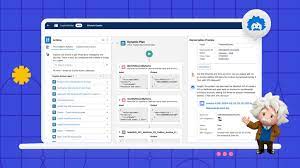
Prompt Builder in Salesforce Einstein: Revolutionizing AI-Powered Automation Salesforce Einstein has introduced a groundbreaking feature called Prompt Builder, designed to simplify and enhance the way businesses leverage generative AI for automation and productivity. Prompt Builder empowers users to create, customize, and deploy AI-driven prompts without needing deep technical expertise. This tool is part of Salesforce’s broader vision to make AI accessible and actionable for everyone. Let’s explore what Prompt Builder is, how it works, and why it’s a game-changer for businesses. What is Prompt Builder? Prompt Builder is a no-code/low-code tool within Salesforce Einstein that allows users to create and manage AI prompts for generative AI models. These prompts can be used to automate tasks, generate content, and provide intelligent responses across Salesforce applications. With Prompt Builder, businesses can harness the power of AI to improve efficiency, enhance customer experiences, and drive innovation. Key Features of Prompt Builder How Does Prompt Builder Work? Use Cases for Prompt Builder 1. Customer Service 2. Sales and Marketing 3. Content Creation 4. Internal Productivity Benefits of Prompt Builder How to Get Started with Prompt Builder The Future of Prompt Builder As generative AI continues to evolve, Prompt Builder is expected to become even more powerful. Future developments may include: Conclusion Salesforce Einstein’s Prompt Builder is a transformative tool that democratizes the use of generative AI for businesses. By enabling users to create, customize, and deploy AI-driven prompts with ease, Prompt Builder empowers organizations to automate tasks, enhance customer experiences, and drive innovation. Whether you’re in sales, marketing, customer service, or any other field, Prompt Builder can help you unlock the full potential of AI. Start exploring Prompt Builder today and revolutionize the way you work with AI! Content updated November 2024. Like Related Posts Who is Salesforce? Who is Salesforce? Here is their story in their own words. From our inception, we’ve proudly embraced the identity of Read more Salesforce Marketing Cloud Transactional Emails Salesforce Marketing Cloud Transactional Emails are immediate, automated, non-promotional messages crucial to business operations and customer satisfaction, such as order Read more Salesforce Unites Einstein Analytics with Financial CRM Salesforce has unveiled a comprehensive analytics solution tailored for wealth managers, home office professionals, and retail bankers, merging its Financial Read more AI-Driven Propensity Scores AI plays a crucial role in propensity score estimation as it can discern underlying patterns between treatments and confounding variables Read more

Read More
Salesforce Einstein AI Trust Layer

Einstein AI Trust Layer Explained

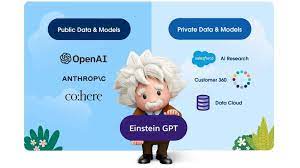
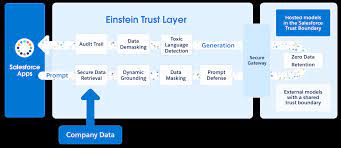
The Einstein Trust Layer is a secure AI architecture. It is natively built into the Salesforce Platform. Designed for enterprise security standards the Einstein Trust Layer continues to allow teams to benefit from generative AI. Without compromising their customer data, while at the same time letting companies use their trusted data to improve generative AI responses: Trusted AI starts with securely grounded prompts. A prompt is a canvas to provide detailed context and instructions to Large Language Models. The Einstein Trust layer allows you to responsibly ground all of your prompts in customer data and mask that data when the prompt is shared with Large Language Models*. With our Zero Retention architecture, none of your data is stored outside of Salesforce. Salesforce gives customers control over the use of their data for AI. Whether using our own Salesforce-hosted models or external models that are part of our Shared Trust Boundary, like OpenAI, no context is stored. The large language model forgets both the prompt and the output as soon as the output is processed. Like1 Related Posts Who is Salesforce? Who is Salesforce? Here is their story in their own words. From our inception, we’ve proudly embraced the identity of Read more Salesforce Marketing Cloud Transactional Emails Salesforce Marketing Cloud Transactional Emails are immediate, automated, non-promotional messages crucial to business operations and customer satisfaction, such as order Read more Salesforce Unites Einstein Analytics with Financial CRM Salesforce has unveiled a comprehensive analytics solution tailored for wealth managers, home office professionals, and retail bankers, merging its Financial Read more AI-Driven Propensity Scores AI plays a crucial role in propensity score estimation as it can discern underlying patterns between treatments and confounding variables Read more

Read More
AI's Impact on the Workforce

AI’s Impact on the Workforce

According to McKinsey, generative AI has the potential to contribute between $2.6 trillion and $4.4 trillion in value to the global economy across various industries, spanning banking, retail, high tech, healthcare, and life sciences. Its impact is expected to reach diverse professions, including customer operations, marketing and sales, software engineering, and research and development. The influence of AI on the workforce is significant. A report by Goldman Sachs suggests that AI could replace the equivalent of 300 million full-time jobs, affecting a quarter of work tasks in the US and Europe. However, it also brings forth new job opportunities and a productivity boom. Despite concerns about job displacement, AI is anticipated to generate numerous new opportunities. Roles like prompt engineer and AI product manager are emerging, with a Salesforce-sponsored IDC white paper predicting a surge in demand for positions such as data architects, AI ethicists, and AI solutions architects over the next 12 months. The report also forecasts the creation of 11.6 million new jobs within the Salesforce ecosystem alone over the next six years. Recent advancements in generative AI, exemplified by products like ChatGPT with 100 million monthly active users in two months, have reignited discussions about automation’s impact on jobs. While the extent of disruption remains unknown, developers, users, and policymakers should consider its effects on workers. To address challenges and opportunities, Majority Leader Chuck Schumer has launched a SAFE Innovation Framework, emphasizing worker security. The Biden administration is developing a National AI Strategy to address economic and job impacts. For individuals in the workforce, there’s an opportunity to cultivate existing skills and acquire new ones through platforms like Salesforce’s Trailhead, Coursera, and LinkedIn. AI’s impact on jobs involves eliminating repetitive tasks, allowing individuals to focus on more strategic and creative aspects of their roles. In fields like sales, customer service, marketing, healthcare, finance, and graphic design, AI will transform roles and create new opportunities. Chris Poole, AI Technical Consulting Lead in Salesforce’s global AI practice, envisions AI becoming ingrained in every aspect of our lives, contributing to fascinating evolution across various fields. The scale of AI adoption’s impact on workers, especially with generative AI tools, remains uncertain. Potential effects include replacing, complementing, or freeing workers for more productive tasks, or creating new jobs. A Goldman Sachs estimate suggests that about two-thirds of current jobs are exposed to some degree of AI automation, with generative AI potentially substituting up to one-fourth of current work. McKinsey Global Institute estimates that 29.5 percent of all hours worked could be automated by 2030. Regarding job impact, professional occupations associated with clerical work in finance, law, and business management are most exposed to AI. However, AI is also concurrently creating many new jobs. Like Related Posts Who is Salesforce? Who is Salesforce? Here is their story in their own words. From our inception, we’ve proudly embraced the identity of Read more Salesforce Marketing Cloud Transactional Emails Salesforce Marketing Cloud Transactional Emails are immediate, automated, non-promotional messages crucial to business operations and customer satisfaction, such as order Read more Salesforce Unites Einstein Analytics with Financial CRM Salesforce has unveiled a comprehensive analytics solution tailored for wealth managers, home office professionals, and retail bankers, merging its Financial Read more AI-Driven Propensity Scores AI plays a crucial role in propensity score estimation as it can discern underlying patterns between treatments and confounding variables Read more

Read More
Salesforce Einstein Commerce

Salesforce Einstein Commerce

Elevate Your Commerce Store Experience with Commerce Einstein Transform your commerce store with the advanced capabilities of Commerce Einstein, which includes features like Goals and Recommendations, the Commerce Concierge bot, Smart Promotions, and SEO-optimized meta tags. Salesforce Einstein Commerce, Enhance Store Performance with Goals and Recommendations Achieve key performance objectives for your store such as increased site conversion, higher site traffic, and greater average order value. Utilize an intuitive framework powered by AI recommendations to implement intelligent actions quickly and efficiently, facilitating the setup and growth of your store. Track progress with insights from Data Cloud. This feature is available for B2B Commerce and D2C Commerce in the Enterprise, Unlimited, and Developer editions. Access it through the Goals and Recommendations option in the Commerce App Navigation menu. Optimize Shopping Experience with the Commerce Concierge Bot Enhance the shopping experience by providing conversational product recommendations and reordering capabilities with the Commerce Concierge bot. Build a new bot using the Commerce Concierge template to connect your store to a new Einstein bot, or upgrade an existing bot with new Commerce Concierge bot blocks. This allows customers to authenticate, manage multiple accounts, reorder, and utilize Einstein’s generative AI features. Craft Intelligent Promotions with Einstein Create promotions effortlessly using Einstein and reliable data from Commerce Cloud. Employ natural language instructions and generative AI to quickly generate both simple and advanced promotions, making your promotional efforts smarter and more effective. Enhance SEO with Einstein Meta Tags Boost your SEO performance by using Einstein’s generative AI to create Page Title Tags and Page Meta Descriptions for products. This enriches search engines with relevant information, improving your store’s visibility. Alternatively, you can manually create and manage page meta tags through the SEO tab on a product record. Reduce Return Rates with Einstein Return Insights Analyze return reasons to refine product listings and minimize return rates. Einstein helps you identify up to 20 high return-rate products and provides analyzed and categorized return reasons, enabling you to make strategic improvements. Facilitate Product Discovery with AI-Powered Search (Generally Available) Improve your customers’ product discovery experience with Einstein semantic search. Using natural language processing, this feature interprets queries to deliver relevant results, accommodating synonyms, alternative spellings, typos, and more. For example, it matches terms like “couch” and “sofa” or “jumper” and “sweater,” aligning with the searcher’s intent. Enhance your commerce store with these innovative features from Commerce Einstein to drive growth, improve customer experience, and optimize operational efficiency. Like Related Posts Who is Salesforce? Who is Salesforce? Here is their story in their own words. From our inception, we’ve proudly embraced the identity of Read more Salesforce Marketing Cloud Transactional Emails Salesforce Marketing Cloud Transactional Emails are immediate, automated, non-promotional messages crucial to business operations and customer satisfaction, such as order Read more Salesforce Unites Einstein Analytics with Financial CRM Salesforce has unveiled a comprehensive analytics solution tailored for wealth managers, home office professionals, and retail bankers, merging its Financial Read more AI-Driven Propensity Scores AI plays a crucial role in propensity score estimation as it can discern underlying patterns between treatments and confounding variables Read more

Read More
Ready for GPT5

Ready for GPT5

Anticipating GPT-5: OpenAI’s Next Leap in Language Modeling Ready for GPT5-OpenAI’s recent advancements have sparked widespread speculation about the potential launch of GPT-5, the next iteration of their groundbreaking language model. This insight aims to explore the available information, analyze tweets from OpenAI officials, discuss potential features of GPT-5, and predict its release timeline. Additionally, it explores advancements in reasoning abilities, hardware considerations, and the evolving landscape of language models. Clues from OpenAI Officials Speculation around GPT-5 gained momentum with tweets from OpenAI’s President and Co-founder, Greg Brockman, and top researcher Jason Way. Brockman hinted at a full-scale training run, emphasizing the utilization of computing resources to maximize the model’s capabilities. Way’s tweet about the adrenaline rush of launching massive GPU training further fueled anticipation. Training Process and Red Teaming OpenAI typically follows a process of training smaller models before a full training run to gather insights. The red teaming network, responsible for safety testing, indicates that OpenAI is progressing towards evaluating GPT-5’s capabilities. The possibility of releasing checkpoints before the full model adds an interesting layer to the anticipation. Enhancements in Reasoning Abilities – Ready for GPT5 A key focus for GPT-5 is the incorporation of advanced reasoning capabilities. OpenAI aims to enable the model to lay out reasoning steps before solving a challenge, with internal or external checks on each step’s accuracy. This represents a significant shift towards enhancing the model’s reliability and reasoning prowess. Multimodal Capabilities GPT-5 is expected to further expand its multimodal capabilities, integrating text, images, audio, and potentially video. The goal is to create an operating system-like experience, where users interact with computers through a chat-based interface. OpenAI’s emphasis on gathering diverse data sources and reasoning data signifies their commitment to a holistic approach. Predictions on Model Size and Release Timeline Hardware CEO Gavin Uberti suggests that GPT-5 could have around 10 times the parameter count of GPT-4. Considering leaks indicating GPT-4’s parameter count of 1.5 to 1.8 trillion, GPT-5’s size is expected to be monumental. The article speculates on a potential release date, factoring in training time, safety testing, and potential checkpoints. Language Capabilities and Multilingual Data – Ready for GPT5 GPT-4’s surprising ability to understand unnatural scrambled text hints at the model’s language flexibility. The article discusses the likelihood of GPT-5 having improved multilingual capabilities, considering OpenAI’s data partnerships and emphasis on language diversity. Closing Thoughts Predictions about GPT-5’s exact capabilities remain speculative until the model is trained and unveiled. OpenAI’s commitment to pushing the boundaries of AI, surprises in AI development, and potential industry-defining products contribute to the excitement surrounding GPT-5. Like Related Posts Who is Salesforce? Who is Salesforce? Here is their story in their own words. From our inception, we’ve proudly embraced the identity of Read more Salesforce Unites Einstein Analytics with Financial CRM Salesforce has unveiled a comprehensive analytics solution tailored for wealth managers, home office professionals, and retail bankers, merging its Financial Read more AI-Driven Propensity Scores AI plays a crucial role in propensity score estimation as it can discern underlying patterns between treatments and confounding variables Read more Tectonic’s Successful Salesforce Track Record Salesforce Technology Services Integrator – Tectonic has successfully delivered Salesforce in a variety of industries including Public Sector, Hospitality, Manufacturing, Read more

Read More
Generative AI Trends for 2024

Generative AI Trends for 2024

It’s hard to believe that ChatGPT is only a year old. The number of exciting new product launches over the past 12 months has been astonishing — and there’s no sign of slowing down. In fact, quite the opposite. Earlier in November, OpenAI hosted DevDay, where the company announced extensive offerings across B2C and B2B markets. Cohere has doubled down on its knowledge search capabilities and private deployments. Amazon Web Services launched PartyRock, its no-code gen AI app-building playground. Generative AI Trends for 2024 you can expect to see. We believe that last month’s activity sets the stage for 2024 in the gen AI space. Here are six major trends happening across the space: While the technology’s possibilities continue to grow, we believe there are four principles for CEOs to consider as they drive their gen AI agendas. These principles draw from our experiences building gen AI applications with our clients throughout the year, as well as decades of delivering digital and analytics transformations. Be Intentional: Set Gen AI Strategy Top-Down Gen AI is a gold rush. Everyone from shareholders to employees to boards is scrambling to deploy the latest and most powerful gen AI tools, and many large organizations have over 150 gen AI use cases on backlog. While we share their excitement and admire their ambition, allowing dozens of gen AI projects to spawn across an organization puts at-scale value creation at risk. Generative AI Trends for 2024 With recent developments in the gen AI space, the proliferation of use cases and opportunities will continue to split the already divided attention of leadership teams. C-suites must bring focus with a top-down gen AI strategy, constantly asking how the technology can create enduring strategic distance between the organization and its competitors. Here are some examples from first movers: Smart organizations are taking a 2×2 approach: identifying two fast use cases to register quick wins and excite the organization while working on two slower, more transformational use cases that will change day-to-day business operations. Reimagine Entire Domains Rather Than Isolated Use Cases During 2023, most organizations began experimenting with gen AI, building one-off prototypes and buying off-the-shelf solutions. Yet, as these solutions are rolled out to end users, organizations are struggling to capture value. For example, some organizations that invested in GitHub Copilot have yet to figure out how the value capture is passed back to the business. Organizations need to reframe from isolated use cases to the full software delivery lifecycle. Scrum teams need to commit to shipping more product features, or sales need to offer more competitive pricing to win more business. Stopping at just buying a new shiny tool means the productivity gains will not translate to bottom-line gains. This often means reimagining entire workflows and domains. This serves two purposes: 1) it creates a more seamless end-user experience by avoiding point solutions; and 2) organizations can more easily track value against clear business outcomes. For example, an insurer we worked with is reimagining its end-to-end claims process — from first notice of loss to payment. For each step along the way, the insurer has identified gen AI, digital, and analytics opportunities, while never losing sight of the claims adjuster’s experience. Ultimately, this comprehensive approach made a step-change impact on end-to-end handling time. Buy Selectively, Build Strategically Matching the pace of innovation, many new startups and software offerings are entering the market, leaving enterprises with a familiar question: “Buy or build?” On the “buy” side, organizations are wary about investing in capabilities that will eventually be available for a fraction of the cost. These organizations are also skeptical of off-the-shelf solutions, unsure if the software will perform at scale without significant customization. As these solutions mature and prove their value, “buy” strategies will continue to play a central role in any gen AI strategy. Meanwhile, some organizations find compelling business cases to “build.” These players start by identifying use cases that create strategic competitive advantages against their peers by compounding existing strengths in their domain expertise, workflow integration, or regulatory know-how. For example, deploying gen AI to accelerate drug discovery has become standard in the pharmaceutical industry. Additionally, organizations are investing in data and IT infrastructure to enable their portfolio of gen AI use cases. For many organizations, there has been little to no investment in unstructured data governance. Now is the time. Build Products, Not Proofs of Concept (POCs) With the new tooling available, a talented engineer can build a proof-of-concept over a weekend. In some cases, this might be sufficient to serve an enterprise need (e.g., a summarization chatbot). However, for most use cases in a large enterprise context, proofs-of-concept are not sufficient. They do not scale well into production and their performance degrades without the appropriate engineering and experimentation. At OpenAI’s Dev Day, engineers demonstrated how hard it is to turn a POC into a production-grade product. Initially, a demo POC only achieved 45% accuracy for a retrieval task. After a few months and numerous experiments (e.g., fine-tuning, re-ranking, metadata tagging, data labeling, model self-assessment, risk guardrails), the engineers achieved 98% accuracy. Implications of Generative AI Trends for 2024 This has two implications. First, organizations cannot seek near-perfection on every use case. They need to be selective about when it is worthwhile to invest scarce engineering talent to develop high-performance gen AI applications. For some situations, 45% accuracy may be sufficient to deliver business benefits. Second, organizations need to scale their gen AI capabilities to meet their ambitions. Most organizations have identified hundreds of gen AI use cases. Therefore, organizations are turning to reusable code components to accelerate development. Dedicated engineers, often in a Center of Excellence (COE), codify best practices into these code components, allowing subsequent gen AI efforts to build off the lessons learned from pioneering projects. We have seen these components accelerate delivery by 25% to 50%. Throughout the past year, there has been an endless stream of gen AI news and hype. The coming year will likely be similar

Read More
2024 AI and Machine Learning Trends

2024 AI and Machine Learning Trends

In 2023, the AI landscape experienced transformative changes following the debut of ChatGPT in November 2022, a landmark event for artificial intelligence. 2024 AI and Machine Learning Trends ahead, AI is set to dramatically alter global business practices and drive significant advancements across various sectors. Organizations are shifting their focus from experimental initiatives to real-time applications, reflecting a more mature understanding of AI’s capabilities while still being intrigued by generative AI technologies. Key AI and Machine Learning Trends for 2024 Here are the top trends shaping the AI and machine learning landscape for 2024: 1. Agentic AIAgentic AI is evolving from reactive to proactive systems. Unlike traditional AI that primarily responds to user inputs, these advanced AI agents demonstrate autonomy, proactivity, and the ability to independently set and pursue goals. 2. Open-Source AIOpen-source AI is democratizing access to sophisticated AI models and tools by offering free, publicly accessible alternatives to proprietary solutions. This trend has seen significant growth, with notable competitors like Mistral AI’s Mixtral models and Meta’s Llama 2 making strides in 2023. 3. Multimodal AIMultimodal AI integrates various types of inputs—such as text, images, and audio—mimicking human sensory capabilities. Models like GPT-4 from OpenAI showcase this ability, enhancing applications in fields like healthcare by improving diagnostic precision. 4. Customized Enterprise Generative AI ModelsThere is a rising interest in bespoke generative AI models tailored to specific business needs. While broad tools like ChatGPT remain widely used, niche-specific models are increasingly popular for their efficiency in addressing specialized requirements. 5. Retrieval-Augmented Generation (RAG)RAG combines text generation with information retrieval to boost the accuracy and relevance of AI-generated content. By reducing model size and leveraging external data sources, RAG is well-suited for business applications that require up-to-date factual information. 6. Shadow AIShadow AI, which refers to user-friendly AI tools used without formal IT approval, is gaining traction among employees seeking quick solutions or exploring new technologies. While it fosters innovation, it also raises concerns about data privacy and security. Looking Ahead to 2024 These trends highlight AI and machine learning’s expanding role across industries in 2024. Organizations must adapt to these advancements to remain competitive, balancing innovation with strong governance frameworks to ensure security and compliance. Staying informed about these developments will be crucial for leveraging AI’s transformative potential in the coming year. Like Related Posts Who is Salesforce? Who is Salesforce? Here is their story in their own words. From our inception, we’ve proudly embraced the identity of Read more Salesforce Marketing Cloud Transactional Emails Salesforce Marketing Cloud Transactional Emails are immediate, automated, non-promotional messages crucial to business operations and customer satisfaction, such as order Read more Salesforce Unites Einstein Analytics with Financial CRM Salesforce has unveiled a comprehensive analytics solution tailored for wealth managers, home office professionals, and retail bankers, merging its Financial Read more AI-Driven Propensity Scores AI plays a crucial role in propensity score estimation as it can discern underlying patterns between treatments and confounding variables Read more

Read More
Copilot Capabilities

Copilot Capabilities

Einstein Copilot stands out from other AI assistants and copilots by leveraging Salesforce customers’ proprietary and trusted data to generate valuable responses. Unlike alternatives that lack access to relevant company data or require costly AI model training, Einstein Copilot capabilities provide answers, content summaries, task automation, and complex conversation interpretation—all while maintaining strict data governance. This innovation is achieved through a combination of conversational user interface, a robust large language model, and trusted company data integrated directly into Salesforce’s leading AI CRM applications. Einstein Copilot revolutionizes how users interact with Salesforce applications, offering seamless integration into their workflow to drive significant productivity improvements. With Einstein Copilot Studio, organizations can tailor their assistant to meet specific business requirements, further enhancing its effectiveness. Additionally, Einstein Copilot and Einstein Copilot Studio feature the Einstein Trust Layer, safeguarding sensitive data while leveraging trusted information to enhance generative AI responses. Copilot Capabilities The significance of these advancements is underscored by the increasing investment in AI, with 45% of executives boosting their AI initiatives. Early adopters are already experiencing benefits such as freeing up over 30% of employee time to focus on revenue growth, cost reduction, and delivering superior customer experiences. Einstein Copilot delivers accurate recommendations and content for various tasks, from building digital storefronts to drafting custom code and providing sales guidance. It securely integrates customer data from Salesforce Data Cloud, including enterprise content, Slack conversations, telemetry data, and structured/unstructured data, ensuring informed and precise decision-making. Like Related Posts Who is Salesforce? Who is Salesforce? Here is their story in their own words. From our inception, we’ve proudly embraced the identity of Read more Salesforce Marketing Cloud Transactional Emails Salesforce Marketing Cloud Transactional Emails are immediate, automated, non-promotional messages crucial to business operations and customer satisfaction, such as order Read more Salesforce Unites Einstein Analytics with Financial CRM Salesforce has unveiled a comprehensive analytics solution tailored for wealth managers, home office professionals, and retail bankers, merging its Financial Read more AI-Driven Propensity Scores AI plays a crucial role in propensity score estimation as it can discern underlying patterns between treatments and confounding variables Read more

Read More
Salesforce Einstein Copilot

Introducing Salesforce Einstein Copilot

Einstein Copilot introduces a cutting-edge generative A. Powered by a conversational assistant seamlessly embedded within every Salesforce application. Its strategically enhancing workflow and yielding substantial gains in productivity. Announced at Dreamforce 2023, in case you missed it, read on. The newly integrated Einstein 1 Data Cloud, part of the Einstein 1 Platform, allows customers to establish a unified customer profile. By connecting any data source. This integration infuses AI, automation, and analytics into every customer experience, fostering a comprehensive approach. Salesforce Einstein Copilot Studio Einstein Copilot Studio provides organizations with the flexibility to tailor Einstein Copilot. A Salesforce tool used according to specific business requirements. It incorporates the Einstein Trust Layer, ensuring the protection of sensitive data while leveraging trusted information to enhance generative AI responses. Unlike other generative AI copilot solutions, Einstein Copilot is natively integrated into the world’s leading AI CRM – Salesforce. Seamlessly tapping into data from various Salesforce applications. This integration ensures more accurate AI-powered recommendations and content generation. Data Cloud The Data Cloud serves as the foundation for Einstein Copilot. Data Cloud offers real-time, consolidated views of customers or entities. With Data Cloud, creating a data graph is simplified, enabling the generation of AI-powered apps with a single click, eliminating the need for manual data queries or joins. Einstein Trust Layer The Einstein Trust Layer, an integral part of the Einstein 1 Platform, ensures the secure retrieval of relevant data from Data Cloud. Before sending it to the Language Model (LLM), proprietary, sensitive, or confidential information is masked, maintaining a high level of data security and compliance. Copilot for Sales aligns with existing CRM access controls and user permissions. Salesforce requires ensuring administrators and users have the necessary permissions for customization and data management within Copilot for Sales. Salesforce Copilot service functions similarly to other generative AI tools in the customer experience landscape, responding to customer queries automatically with personalized answers grounded in company data. Einstein Copilot & Search, anticipated for availability from February 2024, is set to leverage Data Cloud unstructured support. It will be ushering in a new era where Generative AI-based apps redefine the user interface. Thereby allowing seamless interactions and conversations with applications. This transformative shift signifies a significant milestone in Enterprise Software, with Salesforce actively participating in this evolving landscape. Copilot for Sales How is Copilot for Sales different from Copilot for Microsoft 365? Microsoft Copilot for Sales is an AI assistant designed for sellers that brings together the capabilities of Copilot for Microsoft 365 with seller-specific insights and workflows. What Salesforce just did is drop the GPT name and go with Copilot, By endorsing the Microsoft branding it announced earlier this year with Microsoft Copilot for Microsoft 365 and CoPilot for Dynamics 365. Like Related Posts Who is Salesforce? Who is Salesforce? Here is their story in their own words. From our inception, we’ve proudly embraced the identity of Read more Salesforce Marketing Cloud Transactional Emails Salesforce Marketing Cloud Transactional Emails are immediate, automated, non-promotional messages crucial to business operations and customer satisfaction, such as order Read more Salesforce Unites Einstein Analytics with Financial CRM Salesforce has unveiled a comprehensive analytics solution tailored for wealth managers, home office professionals, and retail bankers, merging its Financial Read more AI-Driven Propensity Scores AI plays a crucial role in propensity score estimation as it can discern underlying patterns between treatments and confounding variables Read more

Read More
The Promise of AI in Health Outcomes

The Promise of AI in Health Outcomes

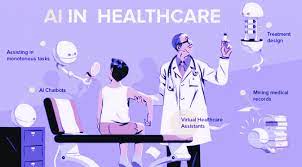
As President Biden has highlighted, artificial intelligence (AI) holds tremendous promise and potential peril. This is especially true in healthcare. On October 30, the President underscored his commitment by signing a landmark Executive Order aimed at governing AI development and use to improve health outcomes for Americans while safeguarding their security and privacy. The Biden-Harris Administration is leveraging every tool at its disposal to advance responsible AI in healthcare. However, U.S. government action alone cannot achieve the bold vision laid out by the President. By integrating AI into their platform, Salesforce aims to empower public health organizations with actionable insights and predictive analytics. From disease surveillance to population health management, AI-driven solutions have the potential to revolutionize how we approach public health initiatives. Therefore, policy priorities include managing and measuring the environmental impacts of AI by requiring emissions disclosures, adding environmental impact as a risk factor, and establishing efficiency standards for high-risk AI systems. In response to the Administration’s leadership, leading healthcare providers and payers have announced voluntary commitments to the safe, secure, and trustworthy use of AI in healthcare. These commitments build on ongoing efforts by the Department of Health and Human Services (HHS), the AI Executive Order, and earlier commitments from 15 leading AI companies to develop models responsibly. Today, 28 providers and payers have joined these commitments, including Allina Health, Bassett Healthcare Network, Boston Children’s Hospital, Curai Health, CVS Health, Devoted Health, Duke Health, Emory Healthcare, Endeavor Health, Fairview Health Systems, Geisinger, Hackensack Meridian, HealthFirst (Florida), Houston Methodist, John Muir Health, Keck Medicine, Main Line Health, Mass General Brigham, Medical University of South Carolina Health, Oscar, OSF HealthCare, Premera Blue Cross, Rush University System for Health, Sanford Health, Tufts Medicine, UC San Diego Health, UC Davis Health, and WellSpan Health. The commitments align with the “FAVES” principles—Fair, Appropriate, Valid, Effective, and Safe. Under these principles, companies commit to informing users when they receive content that is largely AI-generated and not reviewed by humans. They will adhere to a risk management framework to monitor and address potential harms of AI applications. Additionally, they pledge to develop AI solutions responsibly, advancing health equity, expanding access to care, making care affordable, improving care coordination, reducing clinician burnout, and enhancing patient experiences. Healthcare is an essential service, and quality care can be a matter of life and death. AI-enabled tools used for clinical decisions must undergo appropriate testing, risk mitigations, and human oversight to avoid costly or dangerous errors. AI diagnoses can be biased if not trained on diverse data, and AI’s data-collection capabilities could create privacy risks. Addressing these risks is crucial. Despite these risks, AI holds enormous potential to benefit patients, doctors, and hospital staff. AI can help doctors deliver higher-quality, more empathetic care and cut healthcare costs by hundreds of billions of dollars annually. It can also help patients make more informed health choices by better understanding their conditions and needs. Consider some examples: Each year, hospitals produce 3.6 billion medical images worldwide. AI helps doctors analyze images more quickly and effectively, detecting signs of breast cancer, lung nodules, and other conditions earlier than ever before. AI is also streamlining drug development, matching drug targets with new molecules faster and cheaper, translating to better care for patients. Additionally, new generative AI applications can alleviate clinician burnout by automating data extraction, form population, note recording, and patient communications. The Promise of AI in Health Outcomes To understand AI applications and the necessary risk-mitigation measures, the Biden-Harris Administration has engaged with healthcare providers, payers, academia, civil society, and other stakeholders. These engagements have informed the Administration’s approach, including the President’s October AI Executive Order, which tasks HHS with a wide range of actions to advance safe, secure, and trustworthy AI. These actions include developing frameworks, policies, and potential regulations for responsible AI deployment, documenting AI-related safety incidents, prioritizing grants for innovation in underserved communities, and ensuring compliance with nondiscrimination laws in AI deployment in healthcare. The private-sector commitments announced today are a critical step in our whole-of-society effort to advance AI for the health and well-being of Americans. These 28 providers and payers have stepped up, and we hope more will join these commitments in the coming weeks. The Promise of AI in Health Outcomes has been addressed by governments everywhere. In March 2024, Salesforce strengthened its AI commitment to healthcare. Salesforce’s Einstein 1 Platform powers Einstein Copilot with your healthcare organization’s unique data and metadata from Data Cloud to capture and summarize patient details, quickly update patient and member information, and automate manual processes Assessment Generation digitizes paper assessments and surveys to capture and track patient data Customers like Baptist Health South Florida and HarmonyCares are using Salesforce to personalize patient interactions and create a single, unified view of each patient Today, Salesforce announced AI and data innovations for CRM to help make healthcare operations more efficient and personalized. Einstein Copilot: Health Actions, a conversational AI assistant that will deliver trusted AI responses grounded with your healthcare organization’s own trusted and private data, Assessment Generation, and Data Cloud for Health help automate and streamline clinical summaries, deliver more personalized communication, and help compile tailored patient assessments faster for care teams, all from a single platform. These new innovations are powered by Salesforce’s Einstein 1 Platform, which helps organizations safely unlock their data to create better patient experiences and augment employee productivity. Why it matters: Nearly a quarter of U.S. healthcare spending is wasted on administrative costs, presenting a potential cost savings of up to $320 billion for healthcare organizations, according to McKinsey and Co. AI could be the solution, with recent Forrester data revealing that 82% of healthcare data leaders say AI is a top focus area that will drive operational efficiency.  Content updated April 2024. Like Related Posts Who is Salesforce? Who is Salesforce? Here is their story in their own words. From our inception, we’ve proudly embraced the identity of Read more Salesforce Unites Einstein Analytics with Financial CRM Salesforce has unveiled a comprehensive analytics solution tailored for wealth managers, home

Read More
Roles in AI

12 Roles in AI You Didn’t Know You Needed To Know

Exploring new roles in generative AI – 12 new roles to dive into For those intrigued by the possibilities of AI, here are twelve emerging roles to keep an eye on—some already in existence (albeit in early stages), and others envisioned by experts like Berthy for the near future. Could one of these roles be in your career trajectory? Like1 Related Posts Who is Salesforce? Who is Salesforce? Here is their story in their own words. From our inception, we’ve proudly embraced the identity of Read more Salesforce Marketing Cloud Transactional Emails Salesforce Marketing Cloud Transactional Emails are immediate, automated, non-promotional messages crucial to business operations and customer satisfaction, such as order Read more Salesforce Unites Einstein Analytics with Financial CRM Salesforce has unveiled a comprehensive analytics solution tailored for wealth managers, home office professionals, and retail bankers, merging its Financial Read more AI-Driven Propensity Scores AI plays a crucial role in propensity score estimation as it can discern underlying patterns between treatments and confounding variables Read more

Read More
Cool New AI Tools

Cool New AI Tools

In the rapidly growing world of artificial intelligence, staying abreast of the latest tools is not merely advantageous but imperative. As AI technology advances, so do the instruments that revolutionize problem-solving, innovation, and business growth. Whether you are an experienced developer, an aspiring entrepreneur, or simply interested in the expansive potential of AI, this insight offers a comprehensive guide to the newest and most impactful AI tools available. Additionally, startups and developers can now register their AI projects at no cost by visiting genai.works. Let us dig into this exciting wave of innovation. AI Tools Overview AI for Content & Voiceovers Parlandi AI: Accessible at parlandi.com, this tool enables the generation of various text content such as articles, blogs, advertisements, and media in 53 languages. Additionally, users can create AI-generated images by simply describing them, leveraging solutions like OpenAI DALL-E-2, DALL-E-3, DALL-E-3 HD, and Stable Diffusion by Stability.ai. AI for Clip Generation 10LevelUp: Available at 10levelup.com, this platform automates the creation of viral clips from YouTube videos, facilitating channel growth with minimal user input by generating engaging clips within minutes. AI for In-Depth Qualitative Research ResearchGOAT: Found at researchgoat.com, ResearchGOAT harnesses the burgeoning capabilities of generative AI to design, field, and analyze custom research studies across various vertical markets, geographical regions, and consumer cohorts. AI for Customer Support ChatFly: Accessible via chatfly.co, ChatFly is a robust platform for developing AI-driven chatbots. It empowers businesses to create intelligent bots using their data, which can be seamlessly integrated into existing systems to enhance customer support. AI to Automate Document Processes Base64.ai Document AI: Available at base64.ai, this leading no-code AI solution comprehends documents, photos, and videos, facilitating the automation of document-related processes. AI for Job & CV Management Xtramile: Accessible through lnkd.in, Xtramile offers an Office Add-in that allows the dissemination of job offers across job boards with a single click, streamlining the recruitment process. Conclusion Empower your operations and innovate with these cutting-edge AI tools, tailored to meet a variety of business needs from content creation and customer support to qualitative research and job management. Embrace the future of AI and unlock new potentials for growth and efficiency. Like Related Posts Who is Salesforce? Who is Salesforce? Here is their story in their own words. From our inception, we’ve proudly embraced the identity of Read more Salesforce Unites Einstein Analytics with Financial CRM Salesforce has unveiled a comprehensive analytics solution tailored for wealth managers, home office professionals, and retail bankers, merging its Financial Read more AI-Driven Propensity Scores AI plays a crucial role in propensity score estimation as it can discern underlying patterns between treatments and confounding variables Read more Tectonic’s Successful Salesforce Track Record Salesforce Technology Services Integrator – Tectonic has successfully delivered Salesforce in a variety of industries including Public Sector, Hospitality, Manufacturing, Read more

Read More
Learn AI

Learn AI

Achieving Excellence in Artificial Intelligence: The Path to Success-Learn AI In the rapidly evolving world of Artificial Intelligence (AI), quality and core skills are paramount for building a rewarding career. Merely possessing credentials won’t suffice in the highly competitive AI landscape. Employers are seeking knowledgeable employees. This is an industry so new, anyone can get involved. To embark on a trajectory of lifelong growth, investing in the right AI certification course is imperative. According to the Access Partnership Survey, 42% of employers seek individuals with AI development qualifications, a figure expected to rise to 51% in the next five years. This underscores the trust placed by global recruiters in renowned AI certification programs. Various specializations such as computer vision, machine learning, large language models, natural language processing, robotics, and AI software are witnessing significant profitability in the global market. For those seeking premier training in AI, a myriad of options awaits exploration, ranging from Generative AI to nuanced AI courses, paving the way for a flourishing career. Businesses across industries are actively seeking specialized AI professionals to drive amplified growth, while the workforce is keen on upskilling to seize lucrative AI job opportunities. As we gaze into 2024 and beyond, certain AI skills and roles will undoubtedly be in high demand, with AI emerging as one of the hottest job sectors. With Chat GPT’s rapid rise, mastering these leading AI skills has become essential. Let’s delve into the top free online AI certification programs for 2024, offering the best avenues for an illustrious AI career: While free courses are appealing, it’s essential to recognize that paid credentials often hold more weight. Enrolling in a rewarding paid AI certification program can provide a significant career boost. The United States Artificial Intelligence Institute (USAII®) stands out as a trusted choice among global recruiters. About the United States Artificial Intelligence Institute (USAII®): Renowned for its top-tier AI certification programs, USAII® is highly regarded among industry recruiters. Offering tailored certifications catering to diverse skill sets, it serves as a launchpad for AI aspirants worldwide. Explore the following AI certifications from USAII® to elevate your career: Embrace the best AI skills with globally recognized credentials, whether free or paid. Invest in an online AI certification to chart a course towards long-term career success. Like Related Posts Who is Salesforce? Who is Salesforce? Here is their story in their own words. From our inception, we’ve proudly embraced the identity of Read more Salesforce Unites Einstein Analytics with Financial CRM Salesforce has unveiled a comprehensive analytics solution tailored for wealth managers, home office professionals, and retail bankers, merging its Financial Read more AI-Driven Propensity Scores AI plays a crucial role in propensity score estimation as it can discern underlying patterns between treatments and confounding variables Read more Tectonic’s Successful Salesforce Track Record Salesforce Technology Services Integrator – Tectonic has successfully delivered Salesforce in a variety of industries including Public Sector, Hospitality, Manufacturing, Read more
Read More
Retrieval Augmented Generation in Artificial Intelligence

RAG – Retrieval Augmented Generation in Artificial Intelligence

Salesforce has introduced advanced capabilities for unstructured data in Data Cloud and Einstein Copilot Search. By leveraging semantic search and prompts in Einstein Copilot, Large Language Models (LLMs) now generate more accurate, up-to-date, and transparent responses, ensuring the security of company data through the Einstein Trust Layer. Retrieval Augmented Generation in Artificial Intelligence has taken Salesforce’s Einstein and Data Cloud to new heights. These features are supported by the AI framework called Retrieval Augmented Generation (RAG), allowing companies to enhance trust and relevance in generative AI using both structured and unstructured proprietary data. RAG Defined: RAG assists companies in retrieving and utilizing their data, regardless of its location, to achieve superior AI outcomes. The RAG pattern coordinates queries and responses between a search engine and an LLM, specifically working on unstructured data such as emails, call transcripts, and knowledge articles. How RAG Works: Salesforce’s Implementation of RAG: RAG begins with Salesforce Data Cloud, expanding to support storage of unstructured data like PDFs and emails. A new unstructured data pipeline enables teams to select and utilize unstructured data across the Einstein 1 Platform. The Data Cloud Vector Database combines structured and unstructured data, facilitating efficient processing. RAG in Action with Einstein Copilot Search: RAG for Enterprise Use: RAG aids in processing internal documents securely. Its four-step process involves ingestion, natural language query, augmentation, and response generation. RAG prevents arbitrary answers, known as “hallucinations,” and ensures relevant, accurate responses. Applications of RAG: RAG offers a pragmatic and effective approach to using LLMs in the enterprise, combining internal or external knowledge bases to create a range of assistants that enhance employee and customer interactions. Retrieval-augmented generation (RAG) is an AI technique for improving the quality of LLM-generated responses by including trusted sources of knowledge, outside of the original training set, to improve the accuracy of the LLM’s output. Implementing RAG in an LLM-based question answering system has benefits: 1) assurance that an LLM has access to the most current, reliable facts, 2) reduce hallucinations rates, and 3) provide source attribution to increase user trust in the output. Retrieval Augmented Generation in Artificial Intelligence Content updated July 2024. Like2 Related Posts Who is Salesforce? Who is Salesforce? Here is their story in their own words. From our inception, we’ve proudly embraced the identity of Read more Salesforce Marketing Cloud Transactional Emails Salesforce Marketing Cloud Transactional Emails are immediate, automated, non-promotional messages crucial to business operations and customer satisfaction, such as order Read more Salesforce Unites Einstein Analytics with Financial CRM Salesforce has unveiled a comprehensive analytics solution tailored for wealth managers, home office professionals, and retail bankers, merging its Financial Read more AI-Driven Propensity Scores AI plays a crucial role in propensity score estimation as it can discern underlying patterns between treatments and confounding variables Read more

Read More
Generative AI Glossary

The Salesforce Generative AI Glossary

Salesforce has built and maintains a fairly definitive glossary of generative Artificial Intelligence terminology, Tectonic thought was good enough to share in our insights. Salesforce Generative AI Glossary. Help everyone in your company understand key generative AI terms, and what they mean for your customer relationships. Fun fact: This article was (partially) written using generative AI. Bookmark this! This generative AI glossary will be updated regularly. Does it seem like everyone around you is casually tossing around terms like “generative AI,” “large language models,” or “deep learning”? Salesforce has created a primer on everything you need to know to understand the newest, most impactful technology that’s come along in decades. Let’s dive into the world of generative AI. Salesforce has built a list of the most essential terms that will help everyone in your company — no matter their technical background – understand the power of generative AI. Each term is defined based on how it impacts both your customers and your team. And to highlight the real-world applications of generative AI, we put it to work for this article. Salesforce experts weighed in on the key terms, and then let a generative AI tool lay the groundwork for this glossary. Each definition needed a human touch to get it ready for publication, but it saved loads of time. Anthropomorphism The tendency for people to attribute human motivation, emotions, characteristics or behavior to AI systems. For example, you may think the model or output is ‘mean’ based on its answers, even though it is not capable of having emotions, or you potentially believe that AI is sentient because it is very good at mimicking human language. While it might resemble something familiar, it’s essential to remember that AI, however advanced, doesn’t possess feelings or consciousness. It’s a brilliant tool, not a human being. Artificial intelligence (AI) AI is the broad concept of having machines think and act like humans. Generative AI is a specific type of AI (more on that below). Artificial neural network (ANN) An Artificial Neural Network (ANN) is a computer program that mimics the way human brains process information. Our brains have billions of neurons connected together, and an ANN (also referred to as a “neural network”) has lots of tiny processing units working together. Think of it like a team all working to solve the same problem. Every team member does their part, then passes their results on. In the end, you get the answer you need. Augmented intelligence Think of augmented intelligence as a melding of people and computers to get the best of both worlds. Computers are great at handling lots of data and doing complex calculations quickly. Humans are great at understanding context, finding connections between things even with incomplete data, and making decisions on instinct. Augmented intelligence combines these two skill sets. It’s not about computers replacing people or doing all the work for us. It’s more like hiring a really smart, well-organized assistant.  Customer Relationship Management (CRM) with Generative AI CRM is a technology that keeps customer records in one place to serve as the single source of truth for every department, which helps companies manage current and potential customer relationships. Generative AI can make CRM even more powerful — think personalized emails pre-written for sales teams, e-commerce product descriptions written based on the product name, contextual customer service ticket replies, and more. Deep learning Deep learning is an advanced form of AI that helps computers become really good at recognizing complex patterns in data. It mimics the way our brain works by using what’s called layered neural networks, where each layer is a pattern (like features of an animal) that then lets you make predictions based on the patterns you’ve learned before (ex: identifying new animals based on recognized features). It’s really useful for things like image recognition, speech processing, and natural-language understanding. Discriminator (in a GAN) In a Generative Adversarial Network (GAN), the discriminator is like a detective. When it’s shown pictures (or other data), it has to guess which are real and which are fake. The “real” pictures are from a dataset, while the “fake” ones are created by the other part of the GAN, called the generator (see generator below). The discriminator’s job is to get better at telling real from fake, while the generator tries to get better at creating fakes. This is the software version of continuously building a better mousetrap. Ethical AI maturity model An Ethical AI maturity model is a framework that helps organizations assess and enhance their ethical practices in using AI technologies. It maps out the ways organizations can evaluate their current ethical AI practices, then progress toward more responsible and trustworthy AI usage. It covers issues related to transparency, fairness, data privacy, accountability, and bias in predictions.  Explainable AI (XAI) Remember being asked to show your work in math class? That’s what we’re asking AI to do. Explainable AI (XAI) should provide insight into what influenced the AI’s results, which will help users to interpret (and trust!) its outputs. This kind of transparency is always important, but particularly so when dealing with sensitive systems like healthcare or finance, where explanations are required to ensure fairness, accountability, and in some cases, regulatory compliance. Generative AI Generative AI is the field of artificial intelligence that focuses on creating new content based on existing data. For a CRM system, generative AI can be used to create a range of helpful outputs, from writing personalized marketing content, to generating synthetic data to test new features or strategies. Generative adversarial network (GAN) One of two deep learning models, GANs are made up of two neural networks: a generator and a discriminator. The two networks compete with each other, with the generator creating an output based on some input, and the discriminator trying to determine if the output is real or fake. The generator then fine-tunes its output based on the discriminator’s feedback, and the cycle continues until it stumps the discriminator. Generative pre-trained transformer

Read More
gettectonic.com