
Salesforce Manufacturing Automotive Energy Archives - gettectonic.com - Page 6
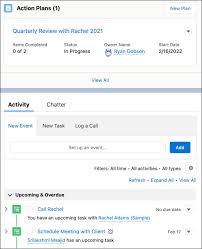
Salesforce Action Plans

Salesforce Action Plans Explained

An action plan defines the tasks and other items needed to complete a business process. Each task has a priority, a number of days in which it must be completed, and a person who is responsible for its completion. Action plans are created from action plan templates, which allow you to capture repeatable tasks. Users see the tasks assigned to them through task lists and views in Salesforce. Users record task status information using the standard interfaces for tasks or the Action Plan details view. Target records, such as accounts or contacts, also show lists of related action plans. For example, in Financial Services Cloud, you can create an action plan template for financial plan review meetings with clients. For such engagements, wealth managers need to set up a meeting in advance, collect financial documentation, and review the documentation. You set up this Salesforce action plan template once, and update it as your understanding of the repeatable tasks improves over time. Then as wealth managers need review meetings with clients, you can create an action plan based on the template. You don’t have to worry about all the appropriate tasks getting created because those tasks are defined in the template. Salesforce action plans defines the tasks and other items needed to complete a business process. Each task has a priority, a number of days in which it must be completed. What is included in a Salesforce Action Plan? Salesforce action plans generally include “what,” “who,” and “when.” They outline the action steps (the “what”) your program will take to achieve your goals and objectives, the person(s) responsible (the “who”), and the projected completion dates (the “when”). You can create an action plan template and its generated action plans for various objects, depending on the products and licenses available in your org. You can also create them for custom objects that have Activities enabled. Here are some examples of use cases for action plans: Action Plan Data Model The types of items that can be included in an action plan template and its generated action plans include: Target objects are: In an action plan template, assign each task or other item to a person, a role, a queue, or the action plan creator. When creating templates with the UI, the plan creator becomes the plan owner. When creating templates using the API, you can designate a plan owner different from the plan creator. Action plan template is a reusable framework that you can use to schedule visits where the set of activities to be performed in each visit remains constant. How do you create an action plan in Salesforce? Create Action Plans Buttons Navigate to Setup > Object Manager > Account > Search Layouts for Salesforce Classic. Click on “Edit” from the menu near “List View.” Move the “Create Account Action Plans” button from “Available Buttons” to “Selected Buttons.” Click “Save.” Salesforce admins enable users to edit and delete action plan details by giving them permissions for the Action Plans, Action Plan Templates, and Recurrence Schedule objects. Your users interact with action plans using standard features. The following standard Salesforce features are supported. Like1 Related Posts Who is Salesforce? Who is Salesforce? Here is their story in their own words. From our inception, we’ve proudly embraced the identity of Read more Salesforce Marketing Cloud Transactional Emails Salesforce Marketing Cloud Transactional Emails are immediate, automated, non-promotional messages crucial to business operations and customer satisfaction, such as order Read more Salesforce Unites Einstein Analytics with Financial CRM Salesforce has unveiled a comprehensive analytics solution tailored for wealth managers, home office professionals, and retail bankers, merging its Financial Read more AI-Driven Propensity Scores AI plays a crucial role in propensity score estimation as it can discern underlying patterns between treatments and confounding variables Read more

Read More

Salesforce Sales Acronyms

Here is a helpful glossary of sales terminology you may hear when discussing Salesforce sales. Salesforce Sales Acronyms Acronym Meaning Defintion BANT Budget, Authority, Need, Time A framework that helps sales reps judge how qualified a lead is/their propensity to purchase (how likely they are to purchase). From there, sales reps can focus their attention on the most promising prospects. This is more closely related to sales qualified leads than marketing qualified leads. CQ Calendar Quarter A period of three months that is used by organizations in order to calculate their budgets, profits, losses, and sales quotas. The calendar quarters start in January/April/July/October, whereas the fiscal quarters can start at any month (according to the organization), for example, Salesforce themselves start their fiscal year in February, which means their second fiscal quarter starts in May. Salesforce Admins and users will come across this when filtering date fields in the Salesforce report builder. CY Calendar Year A period of twelve months that is used by organizations in order to calculate their budgets, profits, losses, and sales quotas. The calendar year starts in January, whereas the fiscal year can start at any month (according to the organization). ECC Einstein Call Coaching Einstein Call Coaching gives users insights and trends from sales calls – taking the rich fabric of a conversation and splicing it into key moments. ECC is ‘product within a product’ of High Velocity Sales (HVS). ECI Einstein Conversation Insights Gives users insights and trends from sales calls – taking the rich fabric of a conversation and splicing it into key moments. Never before have sales managers and reps been able to analyze their conversations like this – at scale and at speed – which would be impossible without the help of AI. (Formerly known as Einstein Call Coaching). EEI Einstein Email Insights Einstein will surface contextual sales information while writing emails, so you ultimately send the best response, at the best time.Available with Sales Cloud Einstein, Inbox, High Velocity Sales, or Revenue Intelligence, which come at an additional cost. It’s available (at an extra cost) for Salesforce Enterprise, Performance, and Unlimited editions. FQ Fiscal Quarter A period of three months that is used by organizations in order to calculate their budgets, profits, losses, and sales quotas. Salesforce Admins and users will come across this when filtering date fields in the Salesforce report builder. FY Fiscal Year “A period of twelve months, used by organizations in order to calculate their budgets, profits, and losses.” (and sales quotas)(source).Salesforce Admins and users will come across this when filtering date fields in the Salesforce report builder. HVS High-velocity Sales High-velocity Sales was developed for inside sales/sales development teams that process a high-volume of activities, especially calls. Now called Sales Engagement, the product includes: Sales Cadences, Work Queue, Einstein Lead Score, Salesforce Inbox, Call Scripts and Einstein Call Coaching. YOY Year-on-year Comparing the performance in one period of time with the same time period the previous year. For example, comparing January 2022 to January 2021 to see if trends have increased or decreased. Like Related Posts Who is Salesforce? Who is Salesforce? Here is their story in their own words. From our inception, we’ve proudly embraced the identity of Read more Salesforce Marketing Cloud Transactional Emails Salesforce Marketing Cloud Transactional Emails are immediate, automated, non-promotional messages crucial to business operations and customer satisfaction, such as order Read more Salesforce Unites Einstein Analytics with Financial CRM Salesforce has unveiled a comprehensive analytics solution tailored for wealth managers, home office professionals, and retail bankers, merging its Financial Read more AI-Driven Propensity Scores AI plays a crucial role in propensity score estimation as it can discern underlying patterns between treatments and confounding variables Read more
Read More
Business Card Scanner App for Salesforce

Business Card Scanner App for Salesforce

Can I Scan a Business Card into Salesforce? Yes, you can scan a business card into Salesforce if your scanning system can create a CSV file or import data into Excel, which can then be saved as a .csv file. This resulting file can be uploaded to Salesforce. And there are several Business Card Scanner App for Salesforce solutions. Business Card Scanner App for Salesforce Does Salesforce Have a Business Card Scanner? Yes, Salesforce can utilize CamCard for Salesforce, a top OCR software that allows you to batch scan and digitize multiple business cards with unrivaled accuracy. Does CamCard Sync with Salesforce? Yes, CamCard perfectly integrates with customized Salesforce fields, making lead and contact management easier and more efficient on mobile. With a standard subscription, you can save unlimited cards to your Salesforce account. Is the CamCard App Free? CamCard offers many features, such as dating when you received a card, grouping cards received at one location, writing notes on each card, and searching by keywords, locations, or dates. The app is free, which is an added benefit. Is Scan to Salesforce Free? Yes, Scan to Salesforce allows you to instantly and accurately scan business cards and upload data to Salesforce for free. You can keep contacts in the iOS/Android app or sync them to your phone. How Do I Install Scan to Salesforce? Other Business Card Scanning Solutions: Using Outlook for Business Card Scanning: If you prefer more tools, consider those that import to Outlook and then use Salesforce’s Outlook integration tool to sync with Salesforce. This adds an extra step but offers more flexibility in choosing business card scanning software. Direct Integration with Salesforce: These options provide a variety of ways to seamlessly integrate business card data into Salesforce, ensuring efficient and accurate data management. Content updated March 2025. Like1 Related Posts Who is Salesforce? Who is Salesforce? Here is their story in their own words. From our inception, we’ve proudly embraced the identity of Read more Salesforce Marketing Cloud Transactional Emails Salesforce Marketing Cloud Transactional Emails are immediate, automated, non-promotional messages crucial to business operations and customer satisfaction, such as order Read more Salesforce Unites Einstein Analytics with Financial CRM Salesforce has unveiled a comprehensive analytics solution tailored for wealth managers, home office professionals, and retail bankers, merging its Financial Read more AI-Driven Propensity Scores AI plays a crucial role in propensity score estimation as it can discern underlying patterns between treatments and confounding variables Read more
Read More

Digital BSS for Telecom Profits

Digital Business Support Systems (BSS) play a critical role in managing essential functions such as billing, rating and charging, customer experience, CRM, fulfillment, and revenue management within communications service providers (CSPs). However, the scope of a comprehensive digital BSS stack extends beyond these core functionalities to enable, monetize, and manage new digital services and partnerships. This transformation is particularly crucial for CSPs transitioning into digital service providers (DSPs), especially in anticipation of the 5G era. Let’s delve into how a robust digital BSS transformation solution can drive profitability. Anticipating Customer Churn Telecom companies can leverage advanced analytics across BSS, OSS, CRM, and other systems to extract actionable insights from customer usage, transactions, complaints, billing, and social media data. Predictive modeling identifies potential churners, enabling targeted offers, promotions, and services aimed at retaining and nurturing loyal customers. Personalizing Customer Experiences Today’s digital consumers expect personalized interactions. Implementing a digital BSS stack empowers telecom companies to capture and utilize interaction data for tailored customer engagements. Whether resolving network issues, rewarding loyalty, or suggesting relevant offers, AI and deep learning algorithms ensure real-time responses that enhance customer satisfaction and increase ARPU (Average Revenue Per User). Innovating Service Offerings Cloud-based services are increasingly popular among consumers and businesses. A robust BSS solution allows operators to seamlessly integrate these services with traditional offerings, fostering innovation and boosting ARPU. Driving Agility and Efficiency A cloud-based BSS solution enhances business agility to support emerging technologies such as IoT and M2M systems. It streamlines partnership management and product launches in complex market landscapes, enabling providers to swiftly seize new opportunities. Retaining Profitable Customers Customer acquisition costs highlight the importance of retaining profitable customers. Integrated BSS and OSS applications provide telecom companies with comprehensive insights into customer behavior, facilitating convergent billing, tiered pricing models, and targeted incentives that enhance customer loyalty and lifetime value. Boosting Average Revenue Per User (ARPU) Telecom companies strive to increase ARPU by introducing compelling new services. Integration of customer-facing BSS systems with service delivery mechanisms accelerates provisioning and enables the launch of innovative offerings that drive revenue growth. In conclusion, a modernized and robust BSS infrastructure is indispensable for telecom companies looking to differentiate their services, elevate customer experiences, and capitalize on evolving market dynamics. By harnessing advanced analytics, embracing cloud-based solutions, and integrating diverse systems, telcos can unlock growth opportunities and enhance profitability in a competitive marketplace. Like Related Posts Who is Salesforce? Who is Salesforce? Here is their story in their own words. From our inception, we’ve proudly embraced the identity of Read more Salesforce Marketing Cloud Transactional Emails Salesforce Marketing Cloud Transactional Emails are immediate, automated, non-promotional messages crucial to business operations and customer satisfaction, such as order Read more Salesforce Unites Einstein Analytics with Financial CRM Salesforce has unveiled a comprehensive analytics solution tailored for wealth managers, home office professionals, and retail bankers, merging its Financial Read more AI-Driven Propensity Scores AI plays a crucial role in propensity score estimation as it can discern underlying patterns between treatments and confounding variables Read more

Read More
Salesforce Order Management

Salesforce Order Management Explained

What is Salesforce Order Management? It’s a platform for managing orders, customer records, fulfillment, inventory visibility, payments and invoicing, and customer care.

Read More
Cloud First

A Salesforce Architect’s Thoughts on User Experience

The intersection of Salesforce User Experience (UX) Design and Architecture in the Salesforce ecosystem is making traction. As User Experience Designer and Strategy Designer certifications were launched by Salesforce, architects are increasingly venturing into UX to create comprehensive and well thought out solutions. This collaboration, emphasizing the importance of user experience, has the potential to increase project success through efficient, scalable, and sustainable designs, particularly for Certified Technical Architects (CTAs). User Interaction and Adoption are important considerations for architects, requiring a focus on understanding user interactions to guide effective decisions. The method of creating a user story, showing what the user needs to accomplish, assists the designers in creating solutions that are user friendly By mapping the user journey and data flow through process and journey mapping, architects gain insights into necessary objects, relationships, and high-touchpoint objects influencing Large Data Volumes (LDV). Understanding user expectations informs architects about necessary record ownership changes, conversions, security, and data visibility requirements. Salesforce UX Certifications The recent emphasis on UX design in Salesforce, marked by certifications like Strategy Designer and User Experience Designer, has prompted useful discussions within the Salesforce architect community. Personal experience completing these certifications underscores the importance of architects embracing UX design, especially on the path to becoming a Certified Technical Architect. The incorporation of journey mapping into solution design, as discovered through creating process and journey maps from CTA scenarios, has proven invaluable. The synergy between architects and UX designers manifests as they collaborate to seamlessly integrate visual and technical elements. Thus resulting in cohesive, user-friendly solutions. Despite distinct areas of expertise, both roles converge on considering user needs, business requirements, and personas, fostering pivotal collaboration that ensures functional and aesthetically pleasing systems. A user-centric approach is crucial for architects in solving problems and ensuring holistic solutions. Process mapping facilitates identifying record ownership changes, conversions, security, and data visibility requirements. Higher Probability of Success is achieved by considering the users’ interactions. Building solutions that prioritize simplicity, reducing project complexity and enhancing user understanding. Performance, Scalability, and Usage must be factored into architectural considerations. Architects need to understand system usage, scalability needs, and performance to create efficient systems capable of handling increased usage. Additionally, architects should prioritize efficiency by identifying large data volume objects and designing for scalability. Return on Investment (ROI) through Sustainability is a key factor for project success. Architects should consider both adoption and sustainable design, ensuring long-term value. ROI-driven decisions should permeate the design process. Minimizing potential rework and supporting evolving technology and business requirements. Salesforce UX in Design Process Incorporating user experience design early in the design process enhances project success by avoiding costly redesigns and ensuring the final product meets user needs. Architects must prioritize sustainability. Then they can create designs that maximize ROI and provide long-term value to the organization. User experience design is integral for architects. While providing a framework for understanding user interactions and optimizing the Salesforce solutions the arcitects design and build. Embracing UX design and collaborating effectively, architects can create systems that are not only functional and efficient but also intuitive and enjoyable to use. When designing custom Salesforce solutions, the architect should always consider the end user. At Tectonic, our entire team of Salesforce consultants focus on delivering an application that meets everyone’s expectations. Contact us today. Like1 Related Posts Who is Salesforce? Who is Salesforce? Here is their story in their own words. From our inception, we’ve proudly embraced the identity of Read more Salesforce Marketing Cloud Transactional Emails Salesforce Marketing Cloud Transactional Emails are immediate, automated, non-promotional messages crucial to business operations and customer satisfaction, such as order Read more Salesforce Unites Einstein Analytics with Financial CRM Salesforce has unveiled a comprehensive analytics solution tailored for wealth managers, home office professionals, and retail bankers, merging its Financial Read more AI-Driven Propensity Scores AI plays a crucial role in propensity score estimation as it can discern underlying patterns between treatments and confounding variables Read more
Read More
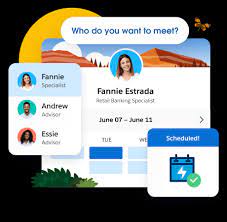
Salesforce Scheduler

Salesforce Scheduler

Salesforce Scheduler provides the objects required for appointment scheduling and an app that makes it easy to set up Scheduler. It provides preconfigured, customizable flows and rules that provide appointment booking experience. It also provides business APIs to create appointment booking experiences.

Read More
salesforce asset management

Asset Management Salesforce

Can Salesforce do asset management? You can manage assets in Consumer Goods (desktop) and in the Consumer Goods offline mobile app in Salesforce. Let’s understand the process in detail. Create Asset Templates and Asset Types: Before you create assets, ensure that admins have created asset templates and asset types. Assets are items, such as refrigerators or freezers, that you place at a customer location (retail store) to increase your sales. Assets are also items you use in your business such as vehicles or computers. As an asset’s owner, you’re responsible for the maintenance, repair, or any other services required for the asset. Managing assets efficiently can help reduce customer complaints and, in turn, increase your brand value. By actively tracking your assets’ conditions, you can budget better, reduce losses, and ensure employee safety. What is the use of asset object in Salesforce? So, Assets are used quite frequently by sales, customer service in your back office. Assets are a standard object. It comes out-of-the-box with Salesforce. And being a standard object we can add custom fields, validation rules, record types, multiple page layouts. How do I create an asset for a product in Salesforce? Create an Asset What is the asset state period in Salesforce? An asset state period represents a time span when an asset has the same quantity, amount, and monthly recurring revenue (MRR). An asset has as many asset state periods as there are changes to it (asset actions) during its lifecycle. The dashboard and related pages show the current asset state period. What is the difference between subscription and asset in Salesforce? Use subscriptions to keep records of subscription products you’ve quoted or sold. Use assets to keep records of stand-alone products you’ve quoted or sold. You can use these records later to manage amendments and renewals to your opportunities and orders. How do I enable assets in Salesforce? Enable Asset Scheduling in Salesforce Scheduler How do I create an asset in Salesforce CPQ? Salesforce CPQ creates assets when you click Contracted on an opportunity or order. The asset creation process varies based on your account’s renewal model and the value of the asset conversion field on the product you’re contracting. How do you renew assets in Salesforce CPQ? Select the assets you want to renew, and then click Renew. Salesforce CPQ creates a renewal quote, associates it with a renewal opportunity, and opens the quote line editor. Edit the quantities of the assets from your original quote as needed. You can also add new products. What is an asset state? Asset State denotes the different states of assets in the organization such as assets in Use, In Store, Expired and so on. Apart from the default asset states, you can create custom ones. You can also enable or disable ownership and scan for custom asset states you create. Note that Salesforce also has a Digital Asset Management (DAM) capability. Where is asset library in Salesforce? To view asset files in Files home, select Libraries and then select Asset Library . To view and edit asset files in Setup, enter Asset Files in the Quick Find box, then select Asset Files. For more information on Salesforce Asset Management, contact Tectonic today. Like1 Related Posts Who is Salesforce? Who is Salesforce? Here is their story in their own words. From our inception, we’ve proudly embraced the identity of Read more Salesforce Marketing Cloud Transactional Emails Salesforce Marketing Cloud Transactional Emails are immediate, automated, non-promotional messages crucial to business operations and customer satisfaction, such as order Read more Salesforce Unites Einstein Analytics with Financial CRM Salesforce has unveiled a comprehensive analytics solution tailored for wealth managers, home office professionals, and retail bankers, merging its Financial Read more AI-Driven Propensity Scores AI plays a crucial role in propensity score estimation as it can discern underlying patterns between treatments and confounding variables Read more

Read More
Tectonic-Ensuring Salesforce Customer Satisfaction

Tectonic’s Successful Salesforce Track Record

Salesforce Technology Services Integrator – Tectonic has successfully delivered Salesforce in a variety of industries including Public Sector, Hospitality, Manufacturing, and Health Life Sciences.  Read on about Tectonic’s successful Salesforce track record. Our primary focus is assisting clients with their Salesforce needs to solve business challenges. We work at the intersection of CRM, Marketing, Big Data, and Analytics. Public Sector Experience/Focus Proven Delivery – Tectonic delivers Salesforce Implementation, Integration and Managed Services, utilizing a modified Waterfall / Agile Delivery Method, leveraging US and International Delivery Center (IDC) resources, and delivering with strong, experienced Project Management Health and Life Sciences Focus We’ve helped healthcare providers navigate the challenges of moving data, including PHI and PII, into the cloud, providing physician facing services and improving operations. Salesforce provides comprehensive solutions tailored for the healthcare industry, addressing the specific needs of both payers (insurance providers) and providers (healthcare organizations). These solutions are designed to enhance patient engagement, improve operational efficiency, and drive better health outcomes. Financial Services Focus Transforming financial service delivery, optimizing operations, and cultivating community well-being and trust are at the core of Salesforce Financial Services Solutions. By automating every banking customer experience and uniting teams through Salesforce’s intelligence and a shared view of real-time customer data, a comprehensive banking solution is created, fostering customer satisfaction and loyalty. Travel and Hospitality Focus Salesforce provides tailored solutions for the hospitality and travel industry, helping businesses in this sector deliver exceptional customer experiences, streamline operations, and drive growth. These solutions leverage the power of the Salesforce Customer 360 platform to centralize data, enhance communication, and provide a personalized experience for guests. Manufacturing, Distribution, and Energy Focus We’ve helped small and large manufacturers optimize their sales operations and drive efficiencies in their contact center. Salesforce offers a suite of solutions tailored for manufacturing and distribution industries to enhance processes, improve collaboration, and drive overall efficiency. These solutions are designed to streamline operations. Designed improve customer relationships and provide valuable insights. Nonprofit Focus We’ve helped nonprofits and NGO’s optimize their operations and drive efficiencies in their fundraising and mission efforts. Salesforce offers a suite of solutions to nurture relationships and scale impact. Solutions with AI-driven, personalized services. Salesforce allows you to take control of your data on a single integrated platform. Nonprofit Cloud brings a nonprofit CRM, fundraising, programs, marketing engagement, and outcomes together in a single product. Strategic Relationship with Salesforce – Salesforce Ventures invested in Tectonic in Q3 2015.  We maintain strong working relationships with Salesforce License Sales, Professional Services and Alliances. Tectonic’s successful Salesforce track record stems from our great relationship with Salesforce and grows through each customer interaction. Like1 Related Posts Who is Salesforce? Who is Salesforce? Here is their story in their own words. From our inception, we’ve proudly embraced the identity of Read more Salesforce Marketing Cloud Transactional Emails Salesforce Marketing Cloud Transactional Emails are immediate, automated, non-promotional messages crucial to business operations and customer satisfaction, such as order Read more Salesforce Unites Einstein Analytics with Financial CRM Salesforce has unveiled a comprehensive analytics solution tailored for wealth managers, home office professionals, and retail bankers, merging its Financial Read more AI-Driven Propensity Scores AI plays a crucial role in propensity score estimation as it can discern underlying patterns between treatments and confounding variables Read more

Read More
gettectonic.com