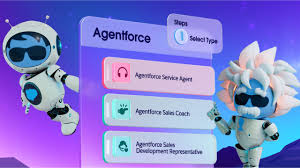
Agentforce: Deploy Autonomous AI Agents on the Salesforce Platform
Agentforce empowers businesses to deploy autonomous AI agents that enhance productivity, customer experience, and operational efficiency. These AI agents act as an intelligent layer on the Salesforce Platform, working 24/7 to analyze data, make decisions, converse naturally, and execute multi-step workflows—all while aligning with your business needs.
With Agentforce, you get:
✔ AI Agent Builder – Customizable tools to design and deploy agents
✔ Prebuilt Use Cases – Ready-to-deploy solutions for sales, service, marketing, and more
✔ Scalable Autonomy – Agents that learn, adapt, and operate independently within defined guardrails
Planning Your AI Agent: Key Considerations
Before deploying an AI agent, carefully evaluate:
1. Use Case Definition & Scope
- What job will the AI agent perform?
- Use the Jobs to Be Done framework to define tasks and outcomes.
- Start small with an MVP – Focus on the smallest viable scope that delivers measurable value.
- Refine over time – Expand autonomy as your AI maturity grows.
2. Business Value & Impact
- Why automate this task?
- Does the AI agent improve speed, accuracy, or customer experience?
- Set measurable goals – Define success metrics (e.g., reduced resolution time, increased conversions).
- Quick wins matter – Even a simple agent can validate ROI before scaling.
3. Decision-Making & Autonomy
- Can the task run without human intervention?
- Ensure decisions follow clear policies, rules, and constraints.
- Where should humans stay in the loop?
- Some tasks may require hybrid (human + AI) workflows.
4. Risk & Guardrails
- Does the agent comply with security, legal, and ethical standards?
- Implement safeguards – Prevent unintended actions with strict validation rules.
5. Data Readiness
- Is your data sufficient and trustworthy?
- AI agents need high-quality, relevant data to function effectively.
- Assess gaps early – Avoid investing in use cases with poor data foundations.
What Makes a Strong AI Use Case?
| Criteria | Key Questions |
|---|---|
| Value | Will the AI agent improve efficiency, accuracy, or experience? |
| Work Definition | Can the task be clearly defined with structured steps? |
| Decision-Making | Can the AI operate autonomously within set rules? |
| Risk Management | Does the use case comply with security and regulatory needs? |
| Data Quality | Is the necessary data available and reliable? |
Next Steps: Deploying AI Agents Successfully
- Prioritize use cases – Collaborate with business and technical teams to select high-impact opportunities.
- Start with an MVP – Test, refine, and scale based on real-world performance.
- Monitor & optimize – Continuously improve agent logic and data inputs.
Ready to Get Started?
Agentforce lets you build an AI agent in days—but thoughtful planning ensures long-term success. Begin with a focused use case, validate quickly, and scale intelligently.

Who is Salesforce? Here is their story in their own words. From our inception, we've proudly embraced the identity of Read more

Salesforce Marketing Cloud Transactional Emails are immediate, automated, non-promotional messages crucial to business operations and customer satisfaction, such as order Read more

Salesforce has unveiled a comprehensive analytics solution tailored for wealth managers, home office professionals, and retail bankers, merging its Financial Read more
AI plays a crucial role in propensity score estimation as it can discern underlying patterns between treatments and confounding variables Read more