
Data Cloud Archives - gettectonic.com - Page 20
Einstein 1 Unveiled

Salesforce Einstein 1 Platform

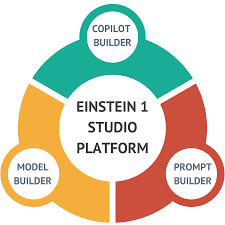
Welcome to the dawn of a bold new era in enterprise Artificial Intelligence, where the world demands a platform unlike any other. Enter Salesforce Einstein 1, the pinnacle of innovation, designed to navigate terabytes of disparate data seamlessly, offer freedom in AI model selection, and integrate directly into your workflow—all while upholding customer trust. Einstein 1 Platform serves as the nexus of your data, AI, CRM, development, and security needs, consolidating them into a singular, robust framework. This empowers IT, administrators, and developers alike with an adaptable AI platform, facilitating rapid development of transformative applications and automation. Within Einstein 1 lies an array of artificial intelligence tools, reflecting the modular architecture of the core Salesforce platform. From standardized to custom solutions, Einstein 1 caters to diverse needs. Examples include out-of-the-box AI features like sales email generation in Sales Cloud and service replies in Service Cloud. Since its unveiling as Genie, now Data Cloud, at Dreamforce ‘22, Salesforce has propelled this product to the forefront of its mission. The conversation has shifted from Customer 360 to encompass AI + CRM + Data—a strategic pivot poised for success in 2024 and beyond. But what does this transformation entail? Data Cloud has been a focal point of Salesforce’s narrative, hailed as a groundbreaking CDP innovation. The recent Q4 earnings call unveiled remarkable achievements: Gartner’s endorsement further solidifies Salesforce’s position, elevating it as a leader in the Magic Quadrant, surpassing rivals like Twilio and Adobe. This achievement is remarkable given Salesforce’s relatively recent CDP certification from the CDP Institute. However, understanding the significance of Data Cloud amidst a sea of CRM solutions may elude many. Yet, the resurgence of data underscores its importance. CRMs, while pivotal for sales, support, and marketing functions, fall short in managing the breadth of modern data collection, storage, and dissemination. Enter the CDP—a dedicated platform for aggregating customer data across every touchpoint throughout the customer lifecycle. Unlike CRMs, which traditionally served as the single source of truth, CDPs offer a comprehensive view, ingesting data from myriad sources. Two key attributes distinguish CDPs and Data Cloud: Yet, amidst this data revolution, the role of artificial intelligence cannot be understated. Einstein 1, formerly known as Salesforce Customer 360, epitomizes this synergy between AI, CRM, and Data. Einstein 1 boasts a diverse array of AI tools, from pre-built features to customizable solutions housed within the Einstein 1 Studio. This enables users to craft tailored AI functionality, seamlessly integrated with Salesforce’s ecosystem. Moreover, Salesforce’s agnostic approach to LLMs empowers users to harness the full potential of AI. Whether leveraging Salesforce’s proprietary LLM or integrating third-party or proprietary models, Einstein 1 ensures flexibility and innovation. As AI continues to permeate every facet of business and personal life, Salesforce’s strategic focus on Data Cloud and Einstein could propel the company to unprecedented growth. In the ever-evolving landscape of enterprise AI, Salesforce remains at the forefront, poised to redefine the future of customer engagement and business intelligence. Like Related Posts Who is Salesforce? Who is Salesforce? Here is their story in their own words. From our inception, we’ve proudly embraced the identity of Read more Salesforce Marketing Cloud Transactional Emails Salesforce Marketing Cloud Transactional Emails are immediate, automated, non-promotional messages crucial to business operations and customer satisfaction, such as order Read more Salesforce Unites Einstein Analytics with Financial CRM Salesforce has unveiled a comprehensive analytics solution tailored for wealth managers, home office professionals, and retail bankers, merging its Financial Read more AI-Driven Propensity Scores AI plays a crucial role in propensity score estimation as it can discern underlying patterns between treatments and confounding variables Read more


Read More

Prompt Builder Einstein

Prompt Builder in Salesforce Einstein: Revolutionizing AI-Powered Automation Salesforce Einstein has introduced a groundbreaking feature called Prompt Builder, designed to simplify and enhance the way businesses leverage generative AI for automation and productivity. Prompt Builder empowers users to create, customize, and deploy AI-driven prompts without needing deep technical expertise. This tool is part of Salesforce’s broader vision to make AI accessible and actionable for everyone. Let’s explore what Prompt Builder is, how it works, and why it’s a game-changer for businesses. What is Prompt Builder? Prompt Builder is a no-code/low-code tool within Salesforce Einstein that allows users to create and manage AI prompts for generative AI models. These prompts can be used to automate tasks, generate content, and provide intelligent responses across Salesforce applications. With Prompt Builder, businesses can harness the power of AI to improve efficiency, enhance customer experiences, and drive innovation. Key Features of Prompt Builder How Does Prompt Builder Work? Use Cases for Prompt Builder 1. Customer Service 2. Sales and Marketing 3. Content Creation 4. Internal Productivity Benefits of Prompt Builder How to Get Started with Prompt Builder The Future of Prompt Builder As generative AI continues to evolve, Prompt Builder is expected to become even more powerful. Future developments may include: Conclusion Salesforce Einstein’s Prompt Builder is a transformative tool that democratizes the use of generative AI for businesses. By enabling users to create, customize, and deploy AI-driven prompts with ease, Prompt Builder empowers organizations to automate tasks, enhance customer experiences, and drive innovation. Whether you’re in sales, marketing, customer service, or any other field, Prompt Builder can help you unlock the full potential of AI. Start exploring Prompt Builder today and revolutionize the way you work with AI! Content updated November 2024. Like Related Posts Who is Salesforce? Who is Salesforce? Here is their story in their own words. From our inception, we’ve proudly embraced the identity of Read more Salesforce Marketing Cloud Transactional Emails Salesforce Marketing Cloud Transactional Emails are immediate, automated, non-promotional messages crucial to business operations and customer satisfaction, such as order Read more Salesforce Unites Einstein Analytics with Financial CRM Salesforce has unveiled a comprehensive analytics solution tailored for wealth managers, home office professionals, and retail bankers, merging its Financial Read more AI-Driven Propensity Scores AI plays a crucial role in propensity score estimation as it can discern underlying patterns between treatments and confounding variables Read more
Read More
Salesforce Einstein AI Trust Layer

Einstein AI Trust Layer Explained

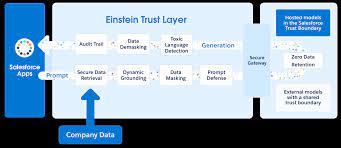
The Einstein Trust Layer is a secure AI architecture. It is natively built into the Salesforce Platform. Designed for enterprise security standards the Einstein Trust Layer continues to allow teams to benefit from generative AI. Without compromising their customer data, while at the same time letting companies use their trusted data to improve generative AI responses: Trusted AI starts with securely grounded prompts. A prompt is a canvas to provide detailed context and instructions to Large Language Models. The Einstein Trust layer allows you to responsibly ground all of your prompts in customer data and mask that data when the prompt is shared with Large Language Models*. With our Zero Retention architecture, none of your data is stored outside of Salesforce. Salesforce gives customers control over the use of their data for AI. Whether using our own Salesforce-hosted models or external models that are part of our Shared Trust Boundary, like OpenAI, no context is stored. The large language model forgets both the prompt and the output as soon as the output is processed. Like1 Related Posts Who is Salesforce? Who is Salesforce? Here is their story in their own words. From our inception, we’ve proudly embraced the identity of Read more Salesforce Marketing Cloud Transactional Emails Salesforce Marketing Cloud Transactional Emails are immediate, automated, non-promotional messages crucial to business operations and customer satisfaction, such as order Read more Salesforce Unites Einstein Analytics with Financial CRM Salesforce has unveiled a comprehensive analytics solution tailored for wealth managers, home office professionals, and retail bankers, merging its Financial Read more AI-Driven Propensity Scores AI plays a crucial role in propensity score estimation as it can discern underlying patterns between treatments and confounding variables Read more

Read More

Measures for Granular Calculated Insights

Add More Measures to Calculated Insights Now you can add more measures to your calculated insights to achieve an improved result. The max number of measures per calculated insight has increased from 5 to 20. View Calculated Insights in Builder Now it’s easier to review the objects, filters, relationships, and logic that you selected for a Calculated Insight. When you use the Insight Builder to create a Calculated Insight, you can view insight logic in the builder and in SQL. Where: This change applies to Lightning Experience in all editions. How: From Customer Data Platform, click Calculated Insights, and then click Show In Builder. Install or Update Data Kits That Power Standard Data Bundles Salesforce CRM data bundles are now powered by data kits to enable more scalable delivery and faster innovation for Salesforce CRM data bundles. As a Customer Data Platform Admin, you can install or update data kits that power Salesforce CRM data bundles. Where: This change applies to Lightning Experience in all editions. Exploring the Power of Calculated Insights (CI) Calculated Insights (CIs) in Salesforce Data Cloud enable you to define and compute complex, multidimensional metrics, offering a deeper understanding of your data. These insights help analyze performance across different dimensions—like channel-level activity or customer engagement metrics—empowering your organization to make data-driven decisions. For example, CIs can rank customers by engagement or spending, evaluate product performance, and uncover trends in purchasing or browsing behavior. Let’s walk through how to use CIs effectively, with examples and reporting guidance. Example 1: Simplifying Metrics with a Single Measure Consider a CI with one aggregatable metric, such as Lifetime Value (LTV). To report on this CI: When the report opens, all CI dimensions appear as groupings, while measures display as columns in a summary format. What Happens with CIs Containing More Than Three Dimensions? Currently, reports support up to three groupings. For CIs with more than three dimensions, the first three are automatically included, though you can replace one dimension with another. Salesforce plans to expand this limit in the future. For example, a CI with the dimensions brand, customer ID, and product category will default to these three groupings in a summary report. Example 2: Handling Complex Metrics Now, imagine a CI that includes: A measure is non-aggregatable when summing it wouldn’t provide meaningful results. For instance, summing rank values for 10 customers doesn’t make sense; instead, metrics like min or max can be applied. Reporting for Complex CIs: By default, reports group CI dimensions and display measures as columns in summary format. However, non-aggregatable measures depend on all dimensions being present. For example, Rank values rely on dimensions like Lead Source and Stage—if one dimension is removed, the related non-aggregatable measures will also be excluded to maintain data integrity. Using Calculated Insights in Real-World Scenarios Use Case 1: Optimizing Marketing Efforts Create a report on a CI that ranks web traffic sources and breaks them down by product category. Use Case 2: Enhancing Patient Engagement Develop a report on a unified patient profile CI, grouping patients by age group and health score. Use Case 3: Identifying High-Performing Channels Generate a CI report grouped by marketing channels and regions in your Customer Lifetime Value metric. Visualizing CIs in Reports You can add charts to your CI reports, adhering to the same restrictions as in Lightning Reports. This visualization capability enables you to uncover trends and share insights effectively. Calculated Insights unlock a powerful layer of reporting in Salesforce, offering flexibility, precision, and actionable intelligence. Whether optimizing marketing efforts, improving patient engagement, or refining customer segmentation, CIs empower teams to make data-driven decisions that drive success. Like Related Posts Who is Salesforce? Who is Salesforce? Here is their story in their own words. From our inception, we’ve proudly embraced the identity of Read more Salesforce Marketing Cloud Transactional Emails Salesforce Marketing Cloud Transactional Emails are immediate, automated, non-promotional messages crucial to business operations and customer satisfaction, such as order Read more Salesforce Unites Einstein Analytics with Financial CRM Salesforce has unveiled a comprehensive analytics solution tailored for wealth managers, home office professionals, and retail bankers, merging its Financial Read more AI-Driven Propensity Scores AI plays a crucial role in propensity score estimation as it can discern underlying patterns between treatments and confounding variables Read more

Read More
Salesforce Einstein Commerce

Salesforce Einstein Commerce

Elevate Your Commerce Store Experience with Commerce Einstein Transform your commerce store with the advanced capabilities of Commerce Einstein, which includes features like Goals and Recommendations, the Commerce Concierge bot, Smart Promotions, and SEO-optimized meta tags. Salesforce Einstein Commerce, Enhance Store Performance with Goals and Recommendations Achieve key performance objectives for your store such as increased site conversion, higher site traffic, and greater average order value. Utilize an intuitive framework powered by AI recommendations to implement intelligent actions quickly and efficiently, facilitating the setup and growth of your store. Track progress with insights from Data Cloud. This feature is available for B2B Commerce and D2C Commerce in the Enterprise, Unlimited, and Developer editions. Access it through the Goals and Recommendations option in the Commerce App Navigation menu. Optimize Shopping Experience with the Commerce Concierge Bot Enhance the shopping experience by providing conversational product recommendations and reordering capabilities with the Commerce Concierge bot. Build a new bot using the Commerce Concierge template to connect your store to a new Einstein bot, or upgrade an existing bot with new Commerce Concierge bot blocks. This allows customers to authenticate, manage multiple accounts, reorder, and utilize Einstein’s generative AI features. Craft Intelligent Promotions with Einstein Create promotions effortlessly using Einstein and reliable data from Commerce Cloud. Employ natural language instructions and generative AI to quickly generate both simple and advanced promotions, making your promotional efforts smarter and more effective. Enhance SEO with Einstein Meta Tags Boost your SEO performance by using Einstein’s generative AI to create Page Title Tags and Page Meta Descriptions for products. This enriches search engines with relevant information, improving your store’s visibility. Alternatively, you can manually create and manage page meta tags through the SEO tab on a product record. Reduce Return Rates with Einstein Return Insights Analyze return reasons to refine product listings and minimize return rates. Einstein helps you identify up to 20 high return-rate products and provides analyzed and categorized return reasons, enabling you to make strategic improvements. Facilitate Product Discovery with AI-Powered Search (Generally Available) Improve your customers’ product discovery experience with Einstein semantic search. Using natural language processing, this feature interprets queries to deliver relevant results, accommodating synonyms, alternative spellings, typos, and more. For example, it matches terms like “couch” and “sofa” or “jumper” and “sweater,” aligning with the searcher’s intent. Enhance your commerce store with these innovative features from Commerce Einstein to drive growth, improve customer experience, and optimize operational efficiency. Like Related Posts Who is Salesforce? Who is Salesforce? Here is their story in their own words. From our inception, we’ve proudly embraced the identity of Read more Salesforce Marketing Cloud Transactional Emails Salesforce Marketing Cloud Transactional Emails are immediate, automated, non-promotional messages crucial to business operations and customer satisfaction, such as order Read more Salesforce Unites Einstein Analytics with Financial CRM Salesforce has unveiled a comprehensive analytics solution tailored for wealth managers, home office professionals, and retail bankers, merging its Financial Read more AI-Driven Propensity Scores AI plays a crucial role in propensity score estimation as it can discern underlying patterns between treatments and confounding variables Read more

Read More
Salesforce Einstein Copilot

What’s Included in Einstein Copilot Studio?

Christmas came early this year with Salesforce’s announcement of Einstein Copilot Studio. Einstein Copilot Studio will encompass the following features: By Tectonic’s Salesforce Marketing Consultant, Shannan Hearne Like1 Related Posts Who is Salesforce? Who is Salesforce? Here is their story in their own words. From our inception, we’ve proudly embraced the identity of Read more Salesforce Marketing Cloud Transactional Emails Salesforce Marketing Cloud Transactional Emails are immediate, automated, non-promotional messages crucial to business operations and customer satisfaction, such as order Read more Salesforce Unites Einstein Analytics with Financial CRM Salesforce has unveiled a comprehensive analytics solution tailored for wealth managers, home office professionals, and retail bankers, merging its Financial Read more AI-Driven Propensity Scores AI plays a crucial role in propensity score estimation as it can discern underlying patterns between treatments and confounding variables Read more
Read More
Marketing Cloud Growth and Advanced Editions

Marketing Cloud Growth and Advanced Editions

While Growth Edition is tailored to small businesses looking to get started with robust marketing automation, Advanced Edition caters to companies that need more sophisticated tools to scale personalization efforts, improve customer engagement, and streamline workflows. It offers additional features, including real-time journey testing, predictive AI for customer scoring, and advanced SMS capabilities, allowing businesses to enhance every touchpoint with their customers.

Read More
Salesforce Einstein Copilot

Introducing Salesforce Einstein Copilot

Einstein Copilot introduces a cutting-edge generative A. Powered by a conversational assistant seamlessly embedded within every Salesforce application. Its strategically enhancing workflow and yielding substantial gains in productivity. Announced at Dreamforce 2023, in case you missed it, read on. The newly integrated Einstein 1 Data Cloud, part of the Einstein 1 Platform, allows customers to establish a unified customer profile. By connecting any data source. This integration infuses AI, automation, and analytics into every customer experience, fostering a comprehensive approach. Salesforce Einstein Copilot Studio Einstein Copilot Studio provides organizations with the flexibility to tailor Einstein Copilot. A Salesforce tool used according to specific business requirements. It incorporates the Einstein Trust Layer, ensuring the protection of sensitive data while leveraging trusted information to enhance generative AI responses. Unlike other generative AI copilot solutions, Einstein Copilot is natively integrated into the world’s leading AI CRM – Salesforce. Seamlessly tapping into data from various Salesforce applications. This integration ensures more accurate AI-powered recommendations and content generation. Data Cloud The Data Cloud serves as the foundation for Einstein Copilot. Data Cloud offers real-time, consolidated views of customers or entities. With Data Cloud, creating a data graph is simplified, enabling the generation of AI-powered apps with a single click, eliminating the need for manual data queries or joins. Einstein Trust Layer The Einstein Trust Layer, an integral part of the Einstein 1 Platform, ensures the secure retrieval of relevant data from Data Cloud. Before sending it to the Language Model (LLM), proprietary, sensitive, or confidential information is masked, maintaining a high level of data security and compliance. Copilot for Sales aligns with existing CRM access controls and user permissions. Salesforce requires ensuring administrators and users have the necessary permissions for customization and data management within Copilot for Sales. Salesforce Copilot service functions similarly to other generative AI tools in the customer experience landscape, responding to customer queries automatically with personalized answers grounded in company data. Einstein Copilot & Search, anticipated for availability from February 2024, is set to leverage Data Cloud unstructured support. It will be ushering in a new era where Generative AI-based apps redefine the user interface. Thereby allowing seamless interactions and conversations with applications. This transformative shift signifies a significant milestone in Enterprise Software, with Salesforce actively participating in this evolving landscape. Copilot for Sales How is Copilot for Sales different from Copilot for Microsoft 365? Microsoft Copilot for Sales is an AI assistant designed for sellers that brings together the capabilities of Copilot for Microsoft 365 with seller-specific insights and workflows. What Salesforce just did is drop the GPT name and go with Copilot, By endorsing the Microsoft branding it announced earlier this year with Microsoft Copilot for Microsoft 365 and CoPilot for Dynamics 365. Like Related Posts Who is Salesforce? Who is Salesforce? Here is their story in their own words. From our inception, we’ve proudly embraced the identity of Read more Salesforce Marketing Cloud Transactional Emails Salesforce Marketing Cloud Transactional Emails are immediate, automated, non-promotional messages crucial to business operations and customer satisfaction, such as order Read more Salesforce Unites Einstein Analytics with Financial CRM Salesforce has unveiled a comprehensive analytics solution tailored for wealth managers, home office professionals, and retail bankers, merging its Financial Read more AI-Driven Propensity Scores AI plays a crucial role in propensity score estimation as it can discern underlying patterns between treatments and confounding variables Read more
Read More
Salesforce Enhances Einstein 1 Platform with New Vector Database and AI Capabilities

Salesforce Enhances Einstein 1 Platform with New Vector Database and AI Capabilities

Salesforce (NYSE: CRM) has announced major updates to its Einstein 1 Platform, introducing the Data Cloud Vector Database and Einstein Copilot Search. These new features aim to power AI, analytics, and automation by integrating business data with large language models (LLMs) across the Einstein 1 Platform. Salesforce Enhances Einstein 1 Platform with New Vector Database and AI Capabilities. Unifying Business Data for Enhanced AI The Data Cloud Vector Database will unify all business data, including unstructured data like PDFs, emails, and transcripts, with CRM data. This will enable accurate and relevant AI prompts and Einstein Copilot, eliminating the need for expensive and complex fine-tuning of LLMs. Built into the Einstein 1 Platform, the Data Cloud Vector Database allows all business applications to harness unstructured data through workflows, analytics, and automation. This enhances decision-making and customer insights across Salesforce CRM applications. Introducing Einstein Copilot Search Einstein Copilot Search will provide advanced AI search capabilities, delivering precise answers from the Data Cloud in a conversational AI experience. This feature aims to boost productivity for all business users by interpreting and responding to complex queries with real-time data from various sources. Key Features and Benefits Salesforce Enhances Einstein 1 Platform with New Vector Database and AI Capabilities Data Cloud Vector Database Einstein Copilot Search Addressing the Data Challenge With 90% of enterprise data existing in unstructured formats, accessing and leveraging this data for business applications and AI models has been challenging. As Forrester predicts, the volume of unstructured data managed by enterprises will double by 2024. Salesforce’s new capabilities address this by enabling businesses to effectively harness their data, driving AI innovation and improved customer experiences. Salesforce’s Vision Rahul Auradkar, EVP and GM of Unified Data Services & Einstein, stated, “The Data Cloud Vector Database transforms all business data into valuable insights. This advancement, coupled with the power of LLMs, fosters a data-driven ecosystem where AI, CRM, automation, Einstein Copilot, and analytics turn data into actionable intelligence and drive innovation.” Practical Applications Customer Success Story Shohreh Abedi, EVP at AAA – The Auto Club Group, highlighted the impact: “With Salesforce automation and AI, we’ve reduced response time for roadside events by 10% and manual service cases by 30%. Salesforce AI helps us deliver faster support and increased productivity.” Availability Salesforce Enhances Einstein 1 Platform with New Vector Database and AI Capabilities Salesforce’s new Data Cloud Vector Database and Einstein Copilot Search promise to revolutionize how businesses utilize their data, driving AI-powered innovation and improved customer experiences. Salesforce Enhances Einstein 1 Platform with New Vector Database and AI Capabilities Like Related Posts Who is Salesforce? Who is Salesforce? Here is their story in their own words. From our inception, we’ve proudly embraced the identity of Read more Salesforce Marketing Cloud Transactional Emails Salesforce Marketing Cloud Transactional Emails are immediate, automated, non-promotional messages crucial to business operations and customer satisfaction, such as order Read more Salesforce Unites Einstein Analytics with Financial CRM Salesforce has unveiled a comprehensive analytics solution tailored for wealth managers, home office professionals, and retail bankers, merging its Financial Read more AI-Driven Propensity Scores AI plays a crucial role in propensity score estimation as it can discern underlying patterns between treatments and confounding variables Read more
Read More
Data Cloud Credits

Data Cloud Credits

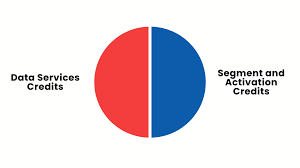
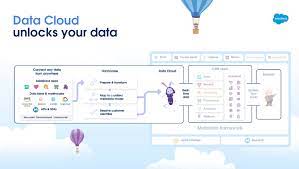
Credits are the currency of usage in Salesforce Data Cloud, where every action performed consumes credits. The consumption rate varies based on the complexity and compute cost of the action, reflecting different platform features. Data Cloud Pricing Model The pricing model for Data Cloud consists of three primary components: Data Service Credits Each platform action incurs a specific compute cost. For instance, processes like connecting, ingesting, transforming, and harmonizing data all consume ‘data service credits’. These credits are further divided into categories such as connect, harmonize, and activate, each encompassing multiple services with differing consumption rates. Segment and Activation Credits Apart from data service credits, ‘segment and activation credits’ are consumed based on the number of rows processed when publishing and activating segments. Monitoring Consumption Currently, Data Cloud users must request a consumption report from their Salesforce Account Executive to review credit and storage usage. However, the new Digital Wallet feature in the Summer ’24 Release will provide users with real-time monitoring capabilities. This includes tracking credit and storage consumption trends by usage type directly within the platform. Considerations and Best Practices To optimize credit consumption and ensure efficient use of resources, consider the following best practices: Final Thoughts Credits are integral to Data Cloud’s pricing structure, reflecting usage across various platform activities. Proactive monitoring through the Digital Wallet feature enables users to manage credits effectively, ensuring optimal resource allocation and cost efficiency. Content updated June 2024. Like Related Posts Who is Salesforce? Who is Salesforce? Here is their story in their own words. From our inception, we’ve proudly embraced the identity of Read more Salesforce Marketing Cloud Transactional Emails Salesforce Marketing Cloud Transactional Emails are immediate, automated, non-promotional messages crucial to business operations and customer satisfaction, such as order Read more Salesforce Unites Einstein Analytics with Financial CRM Salesforce has unveiled a comprehensive analytics solution tailored for wealth managers, home office professionals, and retail bankers, merging its Financial Read more AI-Driven Propensity Scores AI plays a crucial role in propensity score estimation as it can discern underlying patterns between treatments and confounding variables Read more
Read More
Copy Images to Salesforce CMS Workspace

Copy Images to Salesforce CMS Workspace

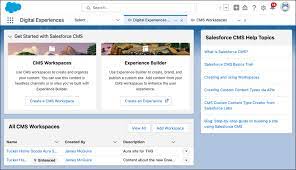
To Copy Images to Salesforce CMS Workspace you have several options. Transferring Images to Salesforce CMS Transfer your images to a Salesforce CMS workspace where they can be accessed for future marketing initiatives, such as creating an email campaign. This feature is available for Marketing Cloud Account Engagement Growth edition with Data Cloud enabled. To enable marketers to use their Account Engagement image files for future campaigns, allow the copying of images to a CMS Marketing workspace in Salesforce. Adding Images from Salesforce CMS to Your LWR Site You can add images from Salesforce CMS directly to your site page or to components populated with CMS content. In Experience Builder, you can update images attached to CMS content without altering the image in the Salesforce CMS workspace. To create dynamic content displays, nest content components within layout components on your LWR site, leveraging data binding. Creating and Cloning Content Content created in a CMS workspace is specific to that workspace and is generated in the default language. The process for adding content to a CMS workspace differs from adding content to an enhanced CMS workspace. Enhanced CMS workspaces allow you to clone content and create variants. Adding Content to a CMS Workspace: Adding Content to an Enhanced CMS Workspace: Note: When linking to external URLs, ensure your org supports the domain by reviewing the Content Security Policy (CSP) settings in Setup and adding the domain to your trusted URL list. Managing and Updating Image References When you update images in Salesforce CMS, all content referencing those images is updated as well. For example, changing an image in a published news piece will automatically update the image for your readers. Here’s how to manage image references: Salesforce CMS Media Content ID (MCID) The Media Content ID (MCID) is a unique identifier for images in Salesforce CMS. It can be found in: By leveraging Salesforce CMS, you can streamline the management and delivery of your marketing content, ensuring a consistent and efficient workflow for all your digital initiatives. Like Related Posts Who is Salesforce? Who is Salesforce? Here is their story in their own words. From our inception, we’ve proudly embraced the identity of Read more Salesforce Marketing Cloud Transactional Emails Salesforce Marketing Cloud Transactional Emails are immediate, automated, non-promotional messages crucial to business operations and customer satisfaction, such as order Read more Salesforce Unites Einstein Analytics with Financial CRM Salesforce has unveiled a comprehensive analytics solution tailored for wealth managers, home office professionals, and retail bankers, merging its Financial Read more AI-Driven Propensity Scores AI plays a crucial role in propensity score estimation as it can discern underlying patterns between treatments and confounding variables Read more

Read More
Salesforce Einstein 1 Platform

Salesforce Einstein 1 Platform

Salesforce unveils the groundbreaking Einstein 1 Platform, a transformative force in enterprise AI designed to enhance productivity and cultivate trusted customer experiences by seamlessly integrating data, AI, and CRM. This advanced platform meets the demands of a new AI era, adeptly managing extensive disconnected data, offering flexibility in AI model selection, and seamlessly integrating with workflow processes while prioritizing customer trust. Salesforce Einstein 1 Platform is a game changer from Salesforce. What is the Salesforce Einstein 1 platform? Einstein 1 has a mixture of artificial intelligence tools on the platform, and it kind of mirrors the way the core Salesforce platform is built, standardized and custom. We have out of the box AI features such as sales email generation in Sales Cloud, and service replies in Service Cloud. The Einstein 1 Platform consolidates data, AI, CRM, development, and security into a unified, comprehensive platform, empowering IT professionals, administrators, and developers with an extensible AI platform for rapid app development and automation. Streamlining change and release management, the DevOps Center allows centralized oversight of project work at every stage of the application lifecycle management process, ensuring secure data testing and AI app deployment. Salesforce customizes security and privacy add-on solutions, including data monitoring and masking, backup implementation, and compliance with evolving privacy and encryption regulations. Grounded in the Einstein 1 Platform, Salesforce AI delivers trusted and customizable experiences by leveraging customer data to create predictive and generative interactions tailored to diverse business needs. What are the Einstein platform products? Commerce Cloud Einstein is a generative AI tool that can be used to provide personalized commerce experiences throughout the entire buyer’s journey. It can be used to generate auto-generated recommendations, content, and communications that are based on real-time data from the Data Cloud. Einstein 1 serves as a comprehensive solution for organizations seeking a unified 360-degree view of their customers, integrating Silverline expertise to maximize AI potential and scalability. The introduction of Einstein 1 Data Cloud addresses data integration challenges, enabling users to connect any data source for a unified customer profile enriched with AI, automation, and analytics. Salesforce Data Cloud unifies and harmonizes customer data, enterprise content, telemetry data, Slack conversations, and other structured and unstructured data to create a single view of the customer. Einstein 1 Data Cloud is natively integrated with the Einstein 1 Platform and allows companies to unlock siloed data and scale in entirely new ways, including: Supporting thousands of metadata-enabled objects per customer, the platform ensures scalability, while re-engineering Marketing Cloud and Commerce Cloud onto the Einstein 1 Platform enables seamless incorporation of massive data volumes. Salesforce offers Data Cloud at no cost for Enterprise Edition or above customers, underscoring its commitment to supporting businesses at various stages of maturity. Einstein Copilot Search and the Data Cloud Vector Database further enhance Einstein 1 capabilities, providing improved AI search and unifying structured and unstructured data for informed workflows and automation. Einstein 1 introduces generative AI-powered conversational assistants, operating within the secure Einstein Trust Layer to enhance productivity while ensuring data privacy. Businesses are encouraged to embrace Einstein 1 as a strategic move toward becoming AI-centric, leveraging its unified data approach to effectively train AI models for informed decision-making. Salesforce’s Einstein 1 Platform introduces the Data Cloud Vector Database, seamlessly unifying structured and unstructured business data to enhance AI prompts and streamline workflows. Generative AI impacts businesses differently, augmenting processes to improve efficiency and productivity across sales, service, and field service teams. Einstein 1 Platform addresses challenges of fragmented customer data, offering a unified view for effective AI model training and decision-making. Salesforce’s continuous evolution ensures businesses have access to cutting-edge AI technologies, positioning Einstein 1 as a crucial tool for staying ahead in the AI-centric landscape. Ready to explore Data Cloud for Einstein 1? Limited access is available for $0, offering businesses an exclusive opportunity to leverage this transformative solution. Salesforce’s Einstein 1 Platform introduces advancements in AI search capabilities and unification of structured and unstructured business data, empowering informed workflows and automation. Einstein GPT expands conversational AI across Marketing and Commerce clouds, with the Data Cloud Vector Database playing a pivotal role in unifying data for Einstein 1 users. Einstein now has a generative AI-powered conversational AI assistant that includes Einstein Copilot and Einstein Copilot Studio. These two capabilities operate within the Einstein Trust Layer – a secure AI architecture built natively into the Einstein 1 Platform that allows you to leverage generative AI while preserving data privacy and security standards. Einstein Copilot is an out-of-the-box conversational AI assistant built into the user experience of every Salesforce application. Einstein Copilot drives productivity by assisting users within their flow of work, enabling them to ask questions in natural language and receive relevant and trustworthy answers grounded in secure proprietary company data from Data Cloud. Data Cloud Vector Database simplifies data integration, enhancing AI prompts without costly updates to specific business models. Data Cloud, integrated with the Einstein Trust Layer, provides secure data access and visualization, enabling businesses to fully harness generative AI. Einstein 1, with Data Cloud, offers a solution for organizations seeking comprehensive customer insights, guided by Silverline expertise for AI maximization. Salesforce’s Einstein 1 Platform securely integrates data, connecting various products to empower customer-centric businesses with AI-driven applications. Data Cloud for Einstein 1 supports AI assistants and enhances customer experiences, driving productivity and reducing operational costs. Einstein 1’s impact is evident in increased productivity and enhanced customer experiences, with ongoing evolution ensuring businesses stay at the forefront of AI technology. Generative AI augments existing processes, particularly in sales, service, and customer support, with Einstein 1 providing tools for streamlined operations. Salesforce’s Einstein 1 Platform introduces AI search enhancements and unified data capabilities, empowering businesses with informed decision-making and automation. Ready to embrace AI-driven productivity? Explore Data Cloud for Einstein 1 and revolutionize your business operations today. Like Related Posts Who is Salesforce? Who is Salesforce? Here is their story in their own words. From our inception, we’ve proudly embraced the identity of Read more Salesforce Marketing

Read More
What is Salesforce Einstein 1

Salesforce Revolutionizes Enterprise AI

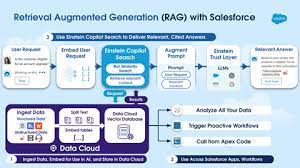
Salesforce Revolutionizes Enterprise AI with Unstructured Data Capabilities for Data Cloud and Einstein Copilot At World Tour NYC, Salesforce unveiled groundbreaking AI innovations that transform how businesses leverage their most valuable – yet often untapped – data assets. The introduction of unstructured data capabilities for Data Cloud and Einstein Copilot Search marks a significant leap forward in making AI more accurate, transparent, and secure for enterprise use. The Power of Retrieval-Augmented Generation (RAG) At the heart of these advancements is Retrieval-Augmented Generation (RAG), an AI framework that combines Salesforce’s data management strengths with cutting-edge large language model (LLM) technology. RAG enables companies to: How RAG Transforms Enterprise AI Breaking Down the Technology Stack Salesforce’s implementation creates an end-to-end solution for trusted enterprise AI: ![RAG Architecture Diagram](https://example.com/salesforce-rag-architecture.png) Real-World Applications Across Industries Sales Teams Service Teams Enterprise-Wide Benefits Why This Matters Now With 90% of enterprise data being unstructured, these capabilities unlock tremendous value: ✅ 71% reduction in AI security concerns (data stays protected)✅ 50% faster response generation with proper context✅ Verifiable outputs with source citations build trust “RAG allows us to use standardized LLMs while maintaining customer relevancy and domain specificity,” noted a Salesforce architect. “It’s the perfect balance of power and control.” Getting Started Companies can begin leveraging these capabilities by: The future of enterprise AI isn’t just about bigger models – it’s about smarter connections to your data. With these innovations, Salesforce continues to lead in delivering practical, trusted AI solutions for business. NOTE: Einstein 1 Platform is now Salesforce Platform. Content updated April 2025. Like Related Posts Who is Salesforce? Who is Salesforce? Here is their story in their own words. From our inception, we’ve proudly embraced the identity of Read more Salesforce Marketing Cloud Transactional Emails Salesforce Marketing Cloud Transactional Emails are immediate, automated, non-promotional messages crucial to business operations and customer satisfaction, such as order Read more Salesforce Unites Einstein Analytics with Financial CRM Salesforce has unveiled a comprehensive analytics solution tailored for wealth managers, home office professionals, and retail bankers, merging its Financial Read more AI-Driven Propensity Scores AI plays a crucial role in propensity score estimation as it can discern underlying patterns between treatments and confounding variables Read more

Read More
gettectonic.com