

EGI Archives - gettectonic.com - Page 6
Apex

Comprehensive Guide to Monitoring Apex Jobs in Salesforce

Why Monitoring Apex Jobs Matters Monitoring asynchronous Apex jobs is critical for maintaining Salesforce system health and performance. Batch processes, queueable jobs, and scheduled operations that fail or exceed limits can disrupt business operations. Proactive monitoring helps: Methods for Monitoring Apex Jobs 1. Using the Native Apex Jobs Dashboard Access Path: Key Features: Critical Data Points: Column Description Why It Matters Job Name Class/trigger name Identifies problem components Status Execution outcome Flags failures needing attention Total Batches Batch job iterations Reveals processing volume Submitted By Initiating user Tracks accidental executions Started/Finished Timestamps Calculates duration for optimization 2. Advanced Tracking with SOQL Queries For deeper analysis, query the AsyncApexJob object: sql Copy Download SELECT Id, ApexClass.Name, JobType, Status, CreatedDate, CompletedDate, NumberOfErrors, JobItemsProcessed, TotalJobItems, ExtendedStatus FROM AsyncApexJob WHERE CreatedDate = LAST_N_DAYS:1 ORDER BY CreatedDate DESC Key Fields Explained: 3. Proactive Monitoring with Custom Reports Recommended Report Type: Sample Report Filters: Best Practices for Effective Monitoring Troubleshooting Common Issues Problem Diagnostic Query Solution Stuck jobs WHERE Status = ‘Processing’ AND CreatedDate < LAST_N_HOURS:2 Abort via UI or API Batch job failures WHERE JobType = ‘BatchApex’ AND NumberOfErrors > 0 Check ExtendedStatus field Queueable job limits WHERE JobType = ‘Queueable’ AND CreatedDate = TODAY Implement queue depth monitoring Scheduled job overlaps WHERE JobType = ‘ScheduledApex’ AND Status = ‘Queued’ Adjust schedule frequencies Advanced Monitoring Options Conclusion Effective Apex job monitoring requires combining Salesforce’s native tools with custom queries and proactive alerting. By implementing these strategies, administrators can: ✔ Catch failures before users report them✔ Optimize job scheduling for better performance✔ Maintain clear audit trails of automated processes✔ Prevent governor limit issues Regular review of job metrics should be part of every Salesforce admin’s routine maintenance checklist to ensure system reliability and performance. Like Related Posts Who is Salesforce? Who is Salesforce? Here is their story in their own words. From our inception, we’ve proudly embraced the identity of Read more Salesforce Marketing Cloud Transactional Emails Salesforce Marketing Cloud Transactional Emails are immediate, automated, non-promotional messages crucial to business operations and customer satisfaction, such as order Read more Salesforce Unites Einstein Analytics with Financial CRM Salesforce has unveiled a comprehensive analytics solution tailored for wealth managers, home office professionals, and retail bankers, merging its Financial Read more AI-Driven Propensity Scores AI plays a crucial role in propensity score estimation as it can discern underlying patterns between treatments and confounding variables Read more
Read More
Salesforce Sales Cloud

Unleash Productivity with Our Latest Innovations

Do More with Less: Unleash Productivity with Our Latest Innovations Every business faces the same challenge: maximize efficiency with limited resources. That’s why we’re thrilled to introduce powerful new features designed to eliminate productivity bottlenecks, accelerate sales cycles, and scale your operations effortlessly. Key Highlights: ✅ Automate tedious tasks – No more manual data entry with AI-powered opportunity updates.✅ Smarter sales coaching – Get tailored guidance on any deal type with Agentforce Sales Coach.✅ Expand your partner network – Streamline enablement, pipelines, and compensation with Partner Cloud. This is just the beginning. Dive into the details below. 🚀 Onboard Fast, Sell Faster See how Sales Cloud supercharges your sales cycle with AI-driven insights—helping you close deals faster at every stage. ✨ New Releases at a Glance 🔹 Agentforce for Sales (June 2025) Pipeline Management Agentforce for Quoting 🔹 Sales Development Enhancements Testing Center (May 2025) 🔹 Sales Coaching (July 2025) Coach on Any Object 🔹 Sales Cloud (June 2025) Einstein Activity Capture 🔹 Partner Cloud (June 2025) Manage your entire partner ecosystem in one place: 🔹 Revenue Cloud (June 2025) Constraint Builder for Product Configurator Like Related Posts Who is Salesforce? Who is Salesforce? Here is their story in their own words. From our inception, we’ve proudly embraced the identity of Read more Salesforce Unites Einstein Analytics with Financial CRM Salesforce has unveiled a comprehensive analytics solution tailored for wealth managers, home office professionals, and retail bankers, merging its Financial Read more AI-Driven Propensity Scores AI plays a crucial role in propensity score estimation as it can discern underlying patterns between treatments and confounding variables Read more Tectonic’s Successful Salesforce Track Record Salesforce Technology Services Integrator – Tectonic has successfully delivered Salesforce in a variety of industries including Public Sector, Hospitality, Manufacturing, Read more
Read More
What is Salesforce Einstein 1

The Real Impact of Salesforce Einstein

The Real Impact of Salesforce Einstein: Beyond the Checkbox Implementation When AI Moves From Feature to Force Multiplier We’ve implemented Einstein across dozens of organizations, witnessing a clear pattern: the difference between superficial adoption and transformational results comes down to one factor – how deeply predictive intelligence is woven into operational workflows. When done right, the impact manifests in tangible, measurable ways. 1. Precision Focus: Working Smarter, Not Harder The first visible sign of successful Einstein adoption is the elimination of wasted effort. Teams stop operating on guesswork and start acting on intelligence: *”Our SDR team regained 15 hours per week by focusing only on Einstein-scored hot leads.”*– VP of Sales, SaaS Company 2. Real-Time Leadership: From Rearview Mirror to Windshield Einstein transforms management from historical reporting to predictive guidance: Traditional Approach Einstein-Enabled Leadership Monthly pipeline reviews Daily deal health pulse checks Gut-based forecasting AI-weighted revenue projections Post-mortem analysis Preemptive risk intervention Example: A manufacturing firm reduced forecast variance from ±15% to ±3% using Einstein Predictive Forecasting. 3. Your Data Finally Works For You Einstein unlocks trapped value in existing CRM data: “We discovered our highest-value customers shared three unexpected behavioral patterns we’d never tracked before.”– Director of Customer Success, FinTech 4. The Silent Efficiency Revolution AI-driven automation eliminates repetitive work: Process Before → Process AfterManual lead scoring → AI-prioritized inbound leadsFirst-in case assignment → Urgency-based routingBatch-and-blast emails → Behavior-timed campaigns 5. The Trust Transformation When teams see consistent accuracy, behavior changes fundamentally: Implementation Essentials for Real Impact Data Foundation Change Management Playbook Adoption Metrics to Track The Road Ahead Organizations that fully integrate Einstein see compound benefits: Year 1: Process efficienciesYear 2: Predictive operationsYear 3: Prescriptive automation “What began as lead scoring evolved into our competitive advantage in customer retention.”– CRO, Healthcare Technology Ready to move beyond checkbox AI?Contact us today! Transform your Einstein implementation from shelfware to strategic advantage with operationalized AI. Like Related Posts Who is Salesforce? Who is Salesforce? Here is their story in their own words. From our inception, we’ve proudly embraced the identity of Read more Salesforce Marketing Cloud Transactional Emails Salesforce Marketing Cloud Transactional Emails are immediate, automated, non-promotional messages crucial to business operations and customer satisfaction, such as order Read more Salesforce Unites Einstein Analytics with Financial CRM Salesforce has unveiled a comprehensive analytics solution tailored for wealth managers, home office professionals, and retail bankers, merging its Financial Read more AI-Driven Propensity Scores AI plays a crucial role in propensity score estimation as it can discern underlying patterns between treatments and confounding variables Read more

Read More
Whoever cracks reliable, scalable atomic power first could gain an insurmountable edge in the AI arms race.

How AI Can Strengthen Healthcare Cybersecurity

How AI Can Strengthen Healthcare Cybersecurity: Key Insights from H-ISAC As cyber threats grow more sophisticated, healthcare organizations must leverage artificial intelligence (AI) to enhance cybersecurity defenses—particularly in digital identity verification and fraud detection, according to a new Health Information Sharing and Analysis Center (H-ISAC) white paper. The Rising Threat: AI-Powered Cyberattacks Cybercriminals are increasingly using AI to craft advanced attacks, such as: H-ISAC warns that while attackers exploit AI for malicious purposes, healthcare Chief Information Security Officers (CISOs) should also focus on AI-driven defense strategies. 3 Key Ways AI Can Secure Healthcare Systems 1. AI-Powered Identity Verification Healthcare organizations can use AI to:✔ Analyze security features on identity documents (e.g., driver’s licenses, passports)✔ Detect deepfakes in remote job interviews and meetings using liveness detection✔ Flag suspicious applicants by cross-referencing IP addresses, device data, and known fraud databases “Fraud detection systems using AI can review an individual’s IP address, device information, and other metrics to spot anomalous behavior.” — H-ISAC 2. Automating Identity Governance & Access Control Managing hundreds of digital identities with varying access levels is a major challenge. AI can streamline Identity Governance and Administration (IGA) by:✔ Automating access certifications (reducing manual review burdens)✔ Customizing role-based access controls based on job functions✔ Ensuring compliance with regulatory requirements (e.g., HIPAA) “For managers overseeing large groups, AI-driven automation can save hours of manual access reviews.” 3. Phishing & Social Engineering Defense AI enhances threat detection by:✔ Identifying phishing emails with unnatural language patterns✔ Detecting fraudulent callers in healthcare call centers✔ Blocking social engineering attempts before breaches occur The Bottom Line: AI as a Cybersecurity Force Multiplier “AI is here to stay. Attackers will continue to leverage it for harm, but defenders can use the same technology to protect critical systems.” — H-ISAC Key Takeaways for Healthcare CISOs ✅ Deploy AI-driven identity verification to combat deepfakes & fraud.✅ Automate IGA processes to improve compliance & efficiency.✅ Use AI-enhanced monitoring to detect phishing & social engineering. By adopting AI-powered cybersecurity tools, healthcare organizations can stay ahead of evolving threats while safeguarding sensitive patient data. Like Related Posts Who is Salesforce? Who is Salesforce? Here is their story in their own words. From our inception, we’ve proudly embraced the identity of Read more Salesforce Marketing Cloud Transactional Emails Salesforce Marketing Cloud Transactional Emails are immediate, automated, non-promotional messages crucial to business operations and customer satisfaction, such as order Read more Salesforce Unites Einstein Analytics with Financial CRM Salesforce has unveiled a comprehensive analytics solution tailored for wealth managers, home office professionals, and retail bankers, merging its Financial Read more AI-Driven Propensity Scores AI plays a crucial role in propensity score estimation as it can discern underlying patterns between treatments and confounding variables Read more

Read More
state space search in ai

State Space Search

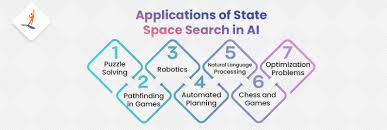
State space search is a problem-solving technique in AI where the focus is on exploring the space of all possible states to find a path to a desired goal state. It entails representing a problem as a graph or tree where nodes represent states and edges represent transitions between them. By systematically navigating this state space, AI systems can find solutions to complex tasks like puzzle-solving, robotics, and planning.  1. Representing Problems as State Spaces:  2. The Search Process: 3. Applications of State Space Search: Like Related Posts Who is Salesforce? Who is Salesforce? Here is their story in their own words. From our inception, we’ve proudly embraced the identity of Read more Salesforce Unites Einstein Analytics with Financial CRM Salesforce has unveiled a comprehensive analytics solution tailored for wealth managers, home office professionals, and retail bankers, merging its Financial Read more AI-Driven Propensity Scores AI plays a crucial role in propensity score estimation as it can discern underlying patterns between treatments and confounding variables Read more Tectonic’s Successful Salesforce Track Record Salesforce Technology Services Integrator – Tectonic has successfully delivered Salesforce in a variety of industries including Public Sector, Hospitality, Manufacturing, Read more
Read More
Salesforce in a Mega-Data Deal with Informatica

Salesforce and Informatica Again

Salesforce Revives Talks to Acquire Informatica in Major Data Play San Francisco, CA – Salesforce is reportedly in advanced discussions to acquire cloud data management firm Informatica, reigniting a potential deal that collapsed last year, according to sources familiar with the matter. Deal Details & Strategic Rationale A Deal Years in the Making Strategic Fit & Potential Hurdles Salesforce’s Acquisition History The CRM giant has a track record of blockbuster deals, including: However, activist investors recently pushed Salesforce to curb large acquisitions in favor of organic growth, leading to: The revived Informatica talks suggest a strategic pivot back to growth via acquisitions. Informatica’s Ownership & Market Position What’s Next? Industry Watch: Will Salesforce secure its next big bet, or will history repeat itself with another stalled deal? Key Takeaway: If successful, this acquisition would mark Salesforce’s return to large-scale M&A, positioning it as a stronger player in AI-powered data management. Follow-up Question: How would an Informatica acquisition impact Salesforce’s competition with Microsoft, Oracle, and Snowflake? Like Related Posts Who is Salesforce? Who is Salesforce? Here is their story in their own words. From our inception, we’ve proudly embraced the identity of Read more Salesforce Marketing Cloud Transactional Emails Salesforce Marketing Cloud Transactional Emails are immediate, automated, non-promotional messages crucial to business operations and customer satisfaction, such as order Read more Salesforce Unites Einstein Analytics with Financial CRM Salesforce has unveiled a comprehensive analytics solution tailored for wealth managers, home office professionals, and retail bankers, merging its Financial Read more AI-Driven Propensity Scores AI plays a crucial role in propensity score estimation as it can discern underlying patterns between treatments and confounding variables Read more

Read More
salesforce agentforce rapid deployment

Indeed Partners with Salesforce to Revolutionize Employer Support with AI-Powered Agentforce

Streamlining Employer Onboarding Through Intelligent Automation Salesforce has announced that Indeed — the world’s #1 job site with 610 million job seeker profiles and 3.3 million active employers — is implementing Agentforce to transform its employer support operations. By deploying AI-powered digital labor, Indeed aims to automate routine onboarding tasks, reduce response times, and free up human teams to focus on high-value employer relationships that accelerate hiring. The Challenge: Scaling Employer Support Efficiently The Solution: AI Agents That Work Alongside Human Teams Indeed is leveraging Salesforce Agentforce to:✔ Autonomously resolve routine employer inquiries✔ Guide users in real time through account verification & job posting fixes✔ Reduce manual workloads for support staff by ~20-30% Example Use Case:When an employer’s job post gets flagged (e.g., for a too-short description), they can simply ask the AI agent—in plain language—why it was rejected. The agent instantly explains the issue and provides step-by-step resolution guidance. The Technology Stack Powering Indeed’s AI Transformation The Impact: From Administrative Burden to Strategic Relationships “By automating repetitive tasks with Agentforce, we’re empowering our teams to do what humans do best—build trust and solve meaningful problems,” said an Indeed spokesperson. “This isn’t about replacing people; it’s about augmenting them with AI superpowers.” The Future of AI in HR Tech Indeed’s deployment showcases how autonomous AI agents are transforming talent acquisition by: As more enterprises adopt digital labor platforms like Agentforce, expect to see similar AI-driven efficiencies across:✓ Candidate screening✓ Interview scheduling✓ Compliance verification Industry Outlook:*With 72% of HR leaders planning to increase AI adoption in 2024 (Gartner), Indeed’s move positions it as a frontrunner in the AI-powered recruitment revolution.* Ready to explore AI agents for your HR operations?  Contact Tectonic. Like Related Posts Who is Salesforce? Who is Salesforce? Here is their story in their own words. From our inception, we’ve proudly embraced the identity of Read more Salesforce Marketing Cloud Transactional Emails Salesforce Marketing Cloud Transactional Emails are immediate, automated, non-promotional messages crucial to business operations and customer satisfaction, such as order Read more Salesforce Unites Einstein Analytics with Financial CRM Salesforce has unveiled a comprehensive analytics solution tailored for wealth managers, home office professionals, and retail bankers, merging its Financial Read more AI-Driven Propensity Scores AI plays a crucial role in propensity score estimation as it can discern underlying patterns between treatments and confounding variables Read more
Read More

How Reasoning Engines Are Transforming Enterprise Intelligence

The Next Evolution of Business AI: How Reasoning Engines Are Transforming Enterprise Intelligence Beyond Automation: AI That Thinks Like Your Best Employee Today’s business AI does far more than just automate boring, repetitive tasks—it’s drafting strategic emails, generating campaign briefs, and synthesizing complex customer calls. But what separates cutting-edge AI from basic chatbots? The ability to reason. Salesforce’s Agentforce, powered by the revolutionary Atlas Reasoning Engine, represents a quantum leap in enterprise AI—the first system capable of human-like analysis, decision-making, and problem-solving at scale. Why Reasoning Changes Everything Traditional AI assistants operate on: Atlas introduces System 2 Thinking to enterprise AI: “This isn’t automation—it’s augmentation. Atlas handles the cognitive heavy lifting so teams can focus on relationship-building.”—Salesforce AI Product Lead The Atlas Difference: How Enterprise-Grade Reasoning Works 1. Dynamic Problem-Solving Framework 2. Three Layers of Intelligence Reasoning Type Use Case Business Impact Deductive (Facts → Conclusion) Compliance checks 90% faster policy validation Inductive (Patterns → Insight) Sales forecasting 40% more accurate predictions Abductive (Partial data → Probable answer) Customer issue resolution 65% first-contact resolution 3. Enterprise-Grade Guardrails Real-World Impact Across Business Functions Customer Service Sales Enablement Operations The Future of Autonomous Business Agents Agentforce isn’t just another chatbot—it’s the first self-improving AI employee: “Our service team now resolves 40% more cases daily without adding headcount. Atlas handles the routine while humans focus on complex relationships.”—CIO, Global Financial Services Firm Your Next Step The era of reasoning AI is here. Discover how Agentforce can transform: Like Related Posts Who is Salesforce? Who is Salesforce? Here is their story in their own words. From our inception, we’ve proudly embraced the identity of Read more Salesforce Marketing Cloud Transactional Emails Salesforce Marketing Cloud Transactional Emails are immediate, automated, non-promotional messages crucial to business operations and customer satisfaction, such as order Read more Salesforce Unites Einstein Analytics with Financial CRM Salesforce has unveiled a comprehensive analytics solution tailored for wealth managers, home office professionals, and retail bankers, merging its Financial Read more AI-Driven Propensity Scores AI plays a crucial role in propensity score estimation as it can discern underlying patterns between treatments and confounding variables Read more

Read More
Financial Services Cloud and Core

AgentForce for Financial Services

Salesforce Revolutionizes Financial Services with AI-Powered Agentforce Platform AI Agents Take on Banking, Insurance, and Advisory Roles Salesforce has launched a suite of prebuilt AI agent templates designed to automate critical functions across financial services—from loan processing to insurance underwriting and wealth management. Embedded within Financial Services Cloud, these AI assistants aim to reduce administrative burdens, enhance customer experiences, and boost operational efficiency for banks, insurers, and investment firms. Key Features of Agentforce for Financial Services ✔ Prebuilt AI agents for loan officers, financial advisors, and insurance agents✔ 24/7 automated customer service (balance inquiries, claims processing, policy quotes)✔ Meeting intelligence (automated note-taking, follow-ups, and data-driven insights)✔ Regulatory compliance baked into every AI action✔ Seamless integration with core banking and CRM systems How AI Agents Transform Financial Workflows 1. Financial Advisors: Smarter, Faster Client Interactions 2. Banking & Insurance: Instant, Accurate Customer Service 3. Digital Loan Officers: Faster Approvals, Fewer Delays Why Financial Firms Need Specialized AI Agents Traditional customer service struggles with:❌ Long hold times❌ Repetitive data entry❌ Inconsistent compliance checks Agentforce AI solves these pain points by:✅ Reducing manual work (80%+ of routine tasks automated)✅ Improving accuracy (data-driven decisions, no human errors)✅ Ensuring compliance (built-in regulatory safeguards) Real-World Impact: “Agentforce has already transformed our service operations. The speed of deployment and immediate productivity gains have us exploring AI for claims and procurement next.”— Matt Brasch, VP of Digital Operations, Cumberland Mutual LLC The Future of AI in Finance Salesforce emphasizes that AI won’t replace human experts—it will empower them. By offloading repetitive tasks, financial professionals can focus on:✔ High-value client relationships✔ Complex decision-making✔ Strategic business growth Coming Next: Final Takeaway Salesforce’s Agentforce for Financial Services marks a major leap in AI-driven banking and insurance automation. Firms adopting this technology can expect:🔹 Faster customer service🔹 Higher advisor productivity🔹 Stronger compliance🔹 Increased revenue per employee Ready to deploy AI agents in your financial workflows? Contact Tectonic. Like Related Posts Who is Salesforce? Who is Salesforce? Here is their story in their own words. From our inception, we’ve proudly embraced the identity of Read more Salesforce Marketing Cloud Transactional Emails Salesforce Marketing Cloud Transactional Emails are immediate, automated, non-promotional messages crucial to business operations and customer satisfaction, such as order Read more Salesforce Unites Einstein Analytics with Financial CRM Salesforce has unveiled a comprehensive analytics solution tailored for wealth managers, home office professionals, and retail bankers, merging its Financial Read more AI-Driven Propensity Scores AI plays a crucial role in propensity score estimation as it can discern underlying patterns between treatments and confounding variables Read more
Read More
Slack Operating System

U.S. Government Secures Major Discounts on Slack for Federal Agencies

U.S. Government Secures Major Discounts on Slack for Federal Agencies Through New GSA-Salesforce Partnership May 19, 2025 – In a major step to boost federal efficiency, the U.S. General Services Administration (GSA) has signed a landmark OneGov agreement with Salesforce, slashing the cost of Slack for government agencies. The deal provides deep discounts on Slack’s enterprise collaboration tools, enabling federal offices to modernize operations while cutting costs. Key Details of the Agreement Under the new terms, federal agencies will receive: These reduced rates will be available until November 30, 2025, giving agencies a six-month window to adopt the platform at significantly lower costs. Unlike past agreements, where agencies negotiated individual discounts, this deal leverages the total purchasing power of the federal government, ensuring better pricing and streamlined procurement. The move reflects the GSA’s push to centralize IT acquisitions, eliminating redundancies and maximizing savings. Leadership and Strategic Goals Josh Gruenbaum, GSA Federal Acquisition Service Commissioner, highlighted the partnership’s significance: “Through the OneGov initiative, we’re demonstrating that the federal government is a strong partner for industry, securing top-tier tools at the best value for taxpayers.” The OneGov program, backed by the current administration, aims to foster long-term partnerships with tech providers, potentially leading to more discounted offerings in the coming fiscal year. Boosting Government Productivity Slack, now part of Salesforce, serves as a unified hub for communication, app integration, and AI-driven workflows. Its adoption across federal agencies could improve interdepartmental collaboration, reduce inefficiencies, and accelerate decision-making. The inclusion of Slack AI for Enterprise introduces advanced automation, helping agencies process data faster and optimize operations—a critical advantage for large, complex organizations. A Shift in Federal Tech Procurement This agreement signals a broader move toward modernizing government IT infrastructure while controlling costs. As noted by NextGov, the deal is part of GSA’s strategy to offer cost-effective, scalable solutions under the OneGov framework. By standardizing collaboration tools across agencies, the federal government could enhance interoperability, reduce reliance on fragmented systems, and lower long-term technical debt. Looking Ahead Industry analysts suggest that this partnership could pave the way for more AI and cloud-based solutions in government. The steep discounts may drive rapid adoption, setting a precedent for future public-private tech collaborations. As agencies integrate Slack into their workflows, the impact on federal productivity and service delivery will be closely monitored—potentially serving as a model for future digital transformation efforts. Sources: BizSugar, Investing.com, NextGov Like Related Posts Who is Salesforce? Who is Salesforce? Here is their story in their own words. From our inception, we’ve proudly embraced the identity of Read more Salesforce Marketing Cloud Transactional Emails Salesforce Marketing Cloud Transactional Emails are immediate, automated, non-promotional messages crucial to business operations and customer satisfaction, such as order Read more Salesforce Unites Einstein Analytics with Financial CRM Salesforce has unveiled a comprehensive analytics solution tailored for wealth managers, home office professionals, and retail bankers, merging its Financial Read more AI-Driven Propensity Scores AI plays a crucial role in propensity score estimation as it can discern underlying patterns between treatments and confounding variables Read more
Read More

Once Upon a Time in Data Land

Once Upon a Time in Data Land: Building the Artificial Intelligence-Ready Warehouse In the early days of data, businesses simply wanted to know what had already happened in the past. Questions like “How many units shipped?” or “What were last month’s sales?” drove the first major digital settlements—the Digitally Filed Data Warehouse. Looking back this seems like the aluminum carport you can have erected in your driveway. The Meticulously Organized Library (The Digitally Filed Data Warehouse Era) Imagine a grand, meticulously organized library. Data from sales, finance, and inventory wasn’t just dumped inside—it went through ETL (Extract, Transform, Load), where it was cleaned, standardized, and structured into predefined formats. Need quarterly sales figures? They were always in the same place, ready for reliable reporting. But then, the world outside got messy. Suddenly, businesses weren’t just dealing with neat rows and columns—they faced website clicks, customer emails, sensor data, social media streams, images, and videos. The rigid Digitally Filed Data Warehouse struggled to adapt. Trying to force unstructured data through ETL was like trying to shelve a waterfall—slow, expensive, and often impossible. The Everything Shed (The Rise of the AI-Powered Warehouse) Enter the AI-Powered Warehouse—a vast, flexible storage space built for raw, unstructured data. Instead of forcing structure upfront, it embraced “store first, organize later” (schema-on-read). Data scientists could explore everything, from tweets to video transcripts, without constraints. But freedom had a cost. Without governance, many AI-Powered Warehouses became “data swamps”—cluttered, unreliable, and slow. Finding clean, trustworthy data was a treasure hunt, and building reliable AI pipelines was a challenge. Organizing the Shed (The AI-Ready Warehouse Paradigm) The solution? Structure without sacrifice. The AI-Ready Warehouse kept the flexibility of raw storage but added intelligence on top. Technologies like Delta Lake, Apache Iceberg, and Apache Hudi introduced:✔ ACID transactions (no more corrupted data)✔ Data versioning (“time travel” to past states)✔ Schema enforcement (order without rigidity)✔ Performance optimizations (speed at scale) A key innovation was the Medallion Architecture, organizing data by quality: This hybrid approach unified BI dashboards, analytics, and machine learning—all on the same foundation. The AI Factory (The Modern AI-Functioning Warehouse) Just as businesses adapted, AI evolved. Generative AI, autonomous agents, and real-time decision-making demanded more than batch-processed data. The AI-Ready Warehouse transformed into a fully integrated AI factory, built for: 🔹 Real-Time & Streaming Data 🔹 Seamless MLOps Integration 🔹 Vector Databases & Embeddings 🔹 Robust AI Governance Why This Matters for AI Agents Autonomous AI agents don’t just analyze data—they act on it. The AI-Functioning Warehouse gives them:✔ Context: Real-time data + historical insights✔ Consistency: Features match training data✔ Memory: Logged actions for continuous learning The Future: An AI-Native Data Ecosystem The journey from Digitally Filed Data Warehouse to AI-Powered Warehouse to AI-Functioning Warehouse reflects a shift from static reporting to dynamic intelligence. For businesses embracing AI, the question is no longer “Do we need a data strategy?” but “Is our data foundation AI-ready?” The answer will separate the leaders from the laggards in the age of AI. Next Steps: The future belongs to those who build not just for data, but for AI. Like Related Posts Who is Salesforce? Who is Salesforce? Here is their story in their own words. From our inception, we’ve proudly embraced the identity of Read more Salesforce Unites Einstein Analytics with Financial CRM Salesforce has unveiled a comprehensive analytics solution tailored for wealth managers, home office professionals, and retail bankers, merging its Financial Read more AI-Driven Propensity Scores AI plays a crucial role in propensity score estimation as it can discern underlying patterns between treatments and confounding variables Read more Tectonic’s Successful Salesforce Track Record Salesforce Technology Services Integrator – Tectonic has successfully delivered Salesforce in a variety of industries including Public Sector, Hospitality, Manufacturing, Read more

Read More
gettectonic.com