
The Future of AI Agents: Why Interoperability is the Key to Unlocking True Automation
The Challenge of Multi-Agent Collaboration
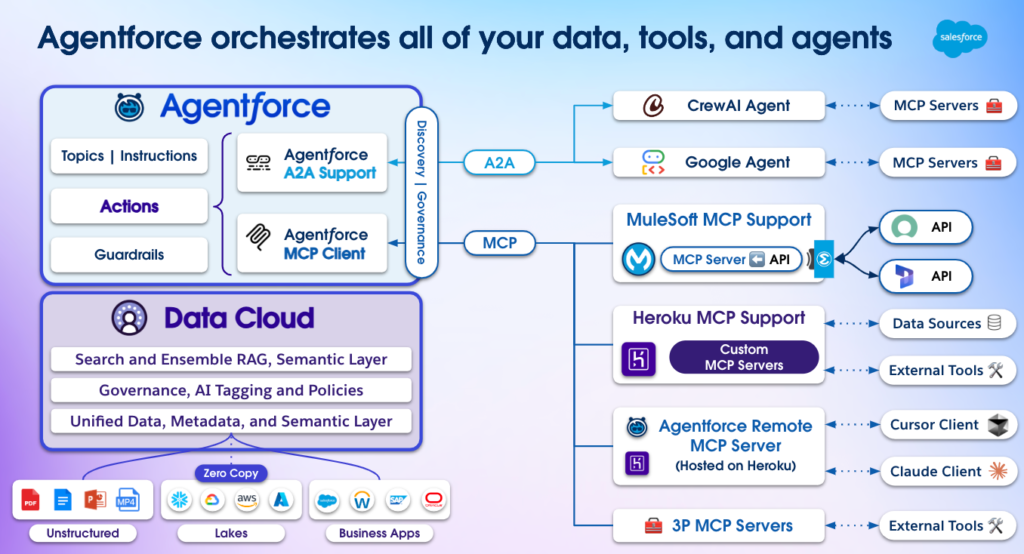
AI agents like Agentforce can reason, act autonomously, and execute complex workflows—but can they work together seamlessly? Our previous exploration of agentic maturity revealed that reaching Level 4 (multi-agent orchestration) requires more than just advanced AI—it demands industry-wide standards for agents to discover, authenticate, and communicate across platforms.
Without a common interoperability framework, the AI agent ecosystem risks fragmentation, limiting the potential for end-to-end automation in enterprise environments.
Why Agent Interoperability Matters
Customers operate in heterogeneous tech stacks, using diverse AI frameworks like:
While Agentforce offers a powerful way to build agents, we recognize that interoperability is essential for true scalability. That’s why we partnered with Google and 50+ leading tech vendors to develop A2A—the industry’s first agent-to-agent interoperability protocol.
Salesforce’s Contribution: The Agent Card
We introduced the Agent Card—a lightweight JSON contract that defines an agent’s:
✔ Capabilities
✔ Identity & compliance tags
✔ Trust Score
Google adopted this concept as the keystone of the A2A protocol, ensuring seamless capability discovery and version negotiation between agents.
The Business Case for Agent Interoperability
An open agent-to-agent protocol enables:
1. Breaking Down Vendor Silos
- Service, sales, marketing, and IT agents can share context across platforms.
- No need to rebuild agents for every new environment—existing agents plug and play.
2. Accelerating Time-to-Value
- Reuse existing agents instead of reinventing them.
- Reduce integration costs—no more brittle custom APIs.
3. Strengthening Governance & Security
- Unified observability across all agent interactions.
- Policy enforcement to ensure compliance and control.
The 10 Building Blocks of Agent Interoperability
To enable scalable, trusted agent collaboration, we’ve defined a foundational framework:
| Building Block | Function |
|---|---|
| Agent Metadata Card | A digital “business card” detailing an agent’s capabilities, identity, and technical specs. |
| Identity & Authorization (RBAC) | Ensures agents only access data and tools they’re permitted to use. |
| Registry & Discovery | A dynamic “address book” where agents register and find each other. |
| Communication Patterns | Standardized protocols for real-time and async interactions. |
| Agent Trust Score | Measures reliability, ethics, and compliance. |
| State & Conversation Management | Tracks ongoing interactions with a unique conversation ID. |
| Multimodal Support | Enables text, voice, image, and video interactions. |
| Observability & Auditability | Monitors performance, flags issues, and logs actions. |
| Security & Compliance | Encrypted data, PII masking, and threat detection. |
| Scalability & Performance | Handles surges in demand without slowdowns. |
Real-World Use Cases
1. Customer Service
- A retailer’s Service Agent processes a return request.
- It consults the manufacturer’s Return Specialist Agent (damage assessment via photos).
- Coordinates with a logistics Policy Agent for shipping rules.
→ Result: Faster, automated resolution.
2. Sales & Partnerships
- A B2B Sales Agent identifies a partnership opportunity.
- Negotiates terms with the partner’s Sales Agent.
- Drafts proposals, schedules meetings, plans campaigns.
→ Result: Accelerated deal cycles.
3. Financial Services
- A Wealth Management Agent generates investment advice.
- Cross-checks recommendations with a 3rd-party Compliance Agent.
→ Result: Ethical, regulation-compliant strategies.
The Path Forward
Agent interoperability isn’t just a technical challenge—it’s a strategic imperative for enterprises adopting AI at scale. By embracing A2A and open standards, businesses can:
✅ Eliminate vendor lock-in
✅ Reduce integration costs
✅ Unlock seamless automation
The future isn’t just AI agents—it’s AI agents that work together.
How could agent interoperability transform workflows in your organization?
🔔🔔 Follow us on LinkedIn 🔔🔔
Who is Salesforce? Here is their story in their own words. From our inception, we've proudly embraced the identity of Read more
Salesforce Marketing Cloud Transactional Emails are immediate, automated, non-promotional messages crucial to business operations and customer satisfaction, such as order Read more

Salesforce has unveiled a comprehensive analytics solution tailored for wealth managers, home office professionals, and retail bankers, merging its Financial Read more
AI plays a crucial role in propensity score estimation as it can discern underlying patterns between treatments and confounding variables Read more