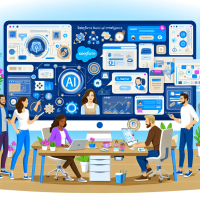
The Future of AI is Multi-Agent—But Scaling It Requires a New Architecture
AI is evolving beyond single-task automation. The real breakthrough lies in multi-agent systems—networks of specialized AI agents that collaborate to solve complex problems no single model could handle alone.
Why Multi-Agent AI is a Game-Changer
Imagine:
- A sales ops system where one AI scores leads, another adjusts pricing dynamically, and a third optimizes outreach—all in real time.
- A fraud detection network where one agent flags suspicious transactions, another cross-references external databases, and a third triggers security protocols.
These aren’t theoretical scenarios. Enterprises are already deploying multi-agent AI to automate high-stakes workflows. But scaling these systems is proving far harder than expected.
The Scaling Crisis in Multi-Agent AI
While prototypes work in controlled environments, real-world deployments are hitting major roadblocks:
- Debugging is a nightmare – Why did Agent A override Agent B’s decision?
- Agents step on each other’s toes – Duplicated work, missed updates, deadlocks.
- Data consistency breaks down – Agents work from outdated or conflicting information.
- Real-time responsiveness suffers – Traditional request/response architectures introduce lag.
The root problem? Communication.
We’ve Seen This Before: The Microservices Parallel
A decade ago, microservices faced the same scaling crisis. Early adopters built tightly coupled systems where services called each other directly—creating brittle, unscalable architectures. The solution? Event-driven design.
Instead of services polling each other:
- Services emit events (e.g., “OrderPlaced”).
- Other services react as needed, processing data in parallel.
- The system stays loosely coupled, scalable, and resilient.
Multi-agent AI needs the same revolution.
Why Event-Driven Design Solves Multi-Agent Scaling
Agents shouldn’t call each other directly. Instead, they should:
- Consume structured events (e.g., “HighRiskTransactionDetected”).
- Process independently, applying their specialized logic.
- Emit new events for downstream agents.
This approach fixes the core challenges:
✅ No more bottlenecks – Agents work in parallel, not waiting for responses.
✅ Easier debugging – Event logs provide an audit trail of decisions.
✅ Resilience – Failed agents replay missed events on recovery.
✅ Scalability – New agents subscribe to events without breaking existing ones.
The Future: AI Agents as a Reactive Network
Think of it like a breaking newsroom:
- A story (event) breaks.
- Reporters (agents) self-organize—some verify facts, others write headlines, others prep visuals—all in parallel.
- No central dispatcher is needed.
This is how enterprise-scale multi-agent AI should work.
The Bottom Line
Multi-agent AI is inevitable, but scaling it requires abandoning request/response thinking. Companies that adopt event-driven architectures now will be the ones deploying production-grade agent networks—while others remain stuck in prototype purgatory.
The question isn’t if your business will use multi-agent AI—it’s how soon you’ll build it to last.

Who is Salesforce? Here is their story in their own words. From our inception, we've proudly embraced the identity of Read more

Salesforce has unveiled a comprehensive analytics solution tailored for wealth managers, home office professionals, and retail bankers, merging its Financial Read more
AI plays a crucial role in propensity score estimation as it can discern underlying patterns between treatments and confounding variables Read more

Salesforce Technology Services Integrator - Tectonic has successfully delivered Salesforce in a variety of industries including Public Sector, Hospitality, Manufacturing, Read more