What Is Salesforce Data Cloud?
In today’s digital-first world, delivering personalized customer experiences requires trusted, unified, and actionable data. But how can businesses ensure their teams have a single source of truth for customer insights?
Enter Salesforce Data Cloud—a next-generation Customer Data Platform (CDP) built natively within the Salesforce ecosystem. Unlike traditional CDPs, Data Cloud unifies real-time customer data across multiple sources, enabling AI-driven automation, analytics, and personalized engagement at scale.
If you’re evaluating enterprise CDPs, this guide will help you understand:
✔ How Salesforce Data Cloud works
✔ Key capabilities & benefits
✔ How it differs from traditional CDPs
✔ Pricing & whether it’s right for your business
Salesforce Data Cloud: A Next-Gen CDP for AI & Automation
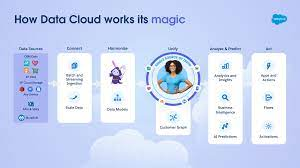
Formerly known as Salesforce CDP, Data Cloud is a real-time, AI-powered platform that consolidates structured and unstructured data from:
- Salesforce CRM (Sales, Service, Marketing Cloud)
- External data warehouses (Snowflake, BigQuery, Amazon S3)
- Third-party apps (ERP, IoT, web events)
It transforms raw data into standardized models, creating a single customer view that fuels AI, segmentation, and automation.
How Does Salesforce Data Cloud Work?
- Ingests data from multiple sources (batch or real-time streaming).
- Resolves identities using AI-powered fuzzy matching to eliminate duplicates.
- Harmonizes data into Salesforce’s 360 Data Model for consistency.
- Activates insights across Salesforce apps (Marketing, Sales, Service Cloud) and external tools.
Unlike legacy CDPs, Data Cloud supports zero-copy data access, meaning you can query external data without moving it, reducing costs and latency.
Key Capabilities of Salesforce Data Cloud
1. Real-Time Data Ingestion & Processing
- Supports batch & streaming data from multiple sources.
- Zero-copy access to external data lakes (Snowflake, BigQuery).
2. AI-Powered Identity Resolution
- Merges duplicate records into a “golden customer profile”.
- Uses fuzzy logic & configurable rules for accuracy.
3. Unified Data Models
- Maps raw data into Salesforce’s 360 Data Model for seamless segmentation.
- Eliminates manual data formatting.
4. Dynamic Customer Segmentation
- Creates real-time segments using behavioral, transactional, and demographic data.
- Enriches segments with AI-driven insights.
5. Native Integration with Salesforce & Beyond
- Powers personalized emails in Marketing Cloud.
- Triggers sales alerts in Sales Cloud.
- Optimizes service workflows in Service Cloud.
Salesforce Data Cloud vs. Traditional CDPs
| Feature | Salesforce Data Cloud | Traditional CDP |
|---|---|---|
| Integration | Native to Salesforce ecosystem | Often requires connectors |
| AI & Automation | Built-in AI (Einstein) | Limited AI capabilities |
| Real-Time Processing | Yes | Often batch-based |
| Zero-Copy Data Access | Yes | Rarely supported |
| Pricing | Consumption-based (credits) | Fixed licensing |
Top Use Cases for Salesforce Data Cloud
✅ AI-Powered Customer Service
- Agents & bots get full customer context for faster resolutions.
✅ Privacy-First Data Governance
- Built-in consent management, encryption, and compliance (GDPR, CCPA).
✅ Smarter Sales & Marketing Targeting
- Dynamic audience sync with Sales & Marketing Cloud.
✅ Unified Analytics with Tableau
- Deeper insights into engagement, revenue, and retention.
Salesforce Data Cloud Pricing
Data Cloud uses a consumption-based model:
- Activities (data ingestion, segmentation, activation) consume credits.
- Free tier included with Salesforce Enterprise & Unlimited editions.
- Bulk credit purchases (100,000+ credits) for large-scale use.
- Additional costs for storage & premium add-ons.
Should You Buy Salesforce Data Cloud?
✔ Yes, if you…
- Need a single customer view across Salesforce & external data.
- Want AI-driven automation & personalization.
- Already use Salesforce CRM (easier integration).
✖ Consider alternatives if…
- You don’t use Salesforce (integration may be complex).
- You need a simple, low-cost CDP (traditional CDPs may suffice).
Final Verdict: A Game-Changer for Salesforce Users
Salesforce Data Cloud is evolving rapidly, especially with Salesforce’s new partnership with Informatica (enhancing data quality & metadata management).
For Salesforce-powered businesses, it’s a must-have to unlock AI, automation, and hyper-personalization.
Ready to explore Data Cloud? Contact Tectonic!
Who is Salesforce? Here is their story in their own words. From our inception, we've proudly embraced the identity of Read more
Salesforce Marketing Cloud Transactional Emails are immediate, automated, non-promotional messages crucial to business operations and customer satisfaction, such as order Read more

Salesforce has unveiled a comprehensive analytics solution tailored for wealth managers, home office professionals, and retail bankers, merging its Financial Read more
AI plays a crucial role in propensity score estimation as it can discern underlying patterns between treatments and confounding variables Read more