Einstein Analytics Archives - gettectonic.com - Page 2
Engagement Frequency Dashboard

Engagement Frequency Dashboard

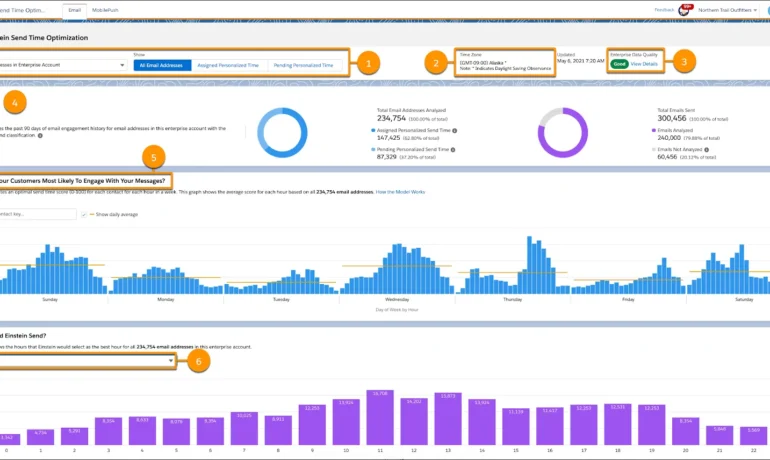
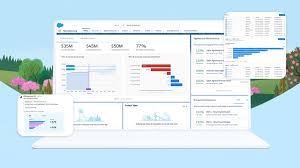
The Einstein Engagement Frequency Dashboard The Einstein Engagement Frequency Dashboard provides a comprehensive overview of your contacts’ email saturation levels. By analyzing this data, you can understand how your email sending frequency influences engagement metrics like opens, clicks, and unsubscribes over time. The What-If analyzer is a handy tool within the dashboard, allowing you to experiment with different sending frequencies to maximize your On Target saturation levels. Accessing the Dashboard To access the Einstein Engagement Frequency Dashboard: Once on the dashboard, you can click “View Details” at the top to check your data quality scores and get tips on how to improve them. This will give you an idea of how reliable your email or mobile engagement data is. Note on Data Quality If Einstein lacks sufficient data for certain contacts, it will assign frequency scores based on global model data. This can sometimes cause discrepancies between the Einstein Engagement Frequency dashboard and activity-level analytics in specific journeys. What-If Analyzer The What-If Analyzer is a feature on the dashboard that allows you to test different future saturation levels based on varying message frequencies. The goal is to increase the number of contacts in the “On Target” range for engagement. The analyzer provides a bar chart that predicts how adjusting your email frequency can shift contacts from being “Saturated” or “Undersaturated” to “On Target.” This tool helps you fine-tune your communication strategy to optimize engagement across your contact base. Like Related Posts Who is Salesforce? Who is Salesforce? Here is their story in their own words. From our inception, we’ve proudly embraced the identity of Read more Salesforce Marketing Cloud Transactional Emails Salesforce Marketing Cloud Transactional Emails are immediate, automated, non-promotional messages crucial to business operations and customer satisfaction, such as order Read more Salesforce Unites Einstein Analytics with Financial CRM Salesforce has unveiled a comprehensive analytics solution tailored for wealth managers, home office professionals, and retail bankers, merging its Financial Read more AI-Driven Propensity Scores AI plays a crucial role in propensity score estimation as it can discern underlying patterns between treatments and confounding variables Read more

Read More
Loan Origination Salesforce

Loan Origination Salesforce

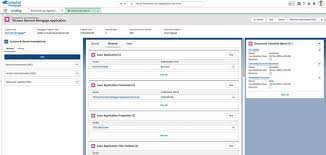
Salesforce Loan Origination: Unlocking Efficiency and Growth Implementing a CRM is a deal-changing decision for any retail mortgage brokerage. In a digital landscape dominated by loan origination platforms like Ellie Mae Encompass, Nortridge, Calyx, and Fiserv, staying lean and nimble is crucial. Understanding how to leverage Salesforce with your loan origination system (LOS) lays the groundwork for a streamlined future, empowering clients, partners, and employees. The suite of productivity and marketing tools Salesforce offers is key to your organization’s success. Remember, Rome wasn’t built in a day, and skilled architects with the right tools made it possible. Let’s explore the benefits of Salesforce in loan origination. Enhancing Prospecting, Referrals, and Marketing Once you’ve built an efficient loan origination machine, it’s time to fuel it. Salesforce integrates seamlessly with referral and channel partners like Bankrate, Zillow, and Realtor.com, feeding prospects directly into your marketing and loan origination funnel. Using tools like Web to Lead or Salesforce’s robust web service APIs, prospects can flow into your CRM in real time. Partner Communities can create portals for third parties to refer and manage their pipelines. Salesforce Marketing Cloud automates journeys, showcasing your company’s value and maintaining constant contact. Qualify prospects effectively by running their credit before they hit your LOS, reducing noise and understanding the quality each lead source brings. This maximizes marketing dollars and focuses efforts where they matter most. Streamlining the Sales Funnel Capturing leads is just the beginning. The real challenge is keeping them and ensuring they choose your business. Salesforce helps visualize your pipeline and accelerates the process with reminders, tasks, texts, emails, calls, and other automation tools. Einstein Analytics and AI provide insights into the most effective strategies, calculate close rates, and help forecast revenue streams accurately. Stay nimble. Not all prospects are tech-savvy, but you can use technology to enhance communication with them. Empowering Loan Officers Mortgage companies often aim to improve customer experience with new systems. However, empowering loan officers and ensuring their satisfaction is equally critical. Salesforce provides loan officers with a 360-degree view of their prospects, enabling them to pull client credit from mobile devices and drastically improve productivity and close rates. Salesforce Mobile places the entire origination process at their fingertips, anywhere and anytime. Integrations with web analytics offer insights into prospect behavior, allowing tailored conversations. A CRM that consolidates contact history creates a powerful ally, ensuring personalized experiences. Integrating Systems with Tectonic Integrating a loan origination system like CalyxPoint, Fiserv, or Ellie Mae Encompass can be daunting. Clients often rush to modernize, but the key is to take it step by step. Define a moment when the loan flows from Salesforce to the LOS, typically once a prospect is qualified. Updates, such as loan milestones and underwriting requests, can flow back into Salesforce, while changes to the loan document itself should occur in the LOS. Gradually progress towards a synchronized, bi-directional state to ensure success and buy-in. Leveraging Customer and Referral Portals Salesforce Customer Community: A drag-and-drop customer portal can sit on top of real-time data, understanding each customer’s loan lifecycle stage and dynamically adapting to drive desired behaviors. Use it to solicit additional documents or update loan statuses as they progress through milestones. Salesforce Partner Community: Real estate agents, insurance companies, and law firms are vital to a mortgage company’s referral system. Salesforce Partner Communities offer a portal to share relevant information with partners, creating a boutique experience that enhances referrals. Building Lifelong Client Relationships A fully funded loan is not the end; it’s the beginning of a new journey. The referral and refinancing process starts as soon as the origination process ends. Maintaining regular contact and demonstrating partnership should be core values for any mortgage company. Taking out a mortgage is one of the largest financial decisions most people make, and positive experiences can have a lasting impact. Leveraging Salesforce CRM and Marketing Cloud journeys helps keep relationships alive, ensuring a steady pipeline for years to come. Always remember the importance of first impressions and the long-term value of satisfied clients and partners. Like Related Posts Who is Salesforce? Who is Salesforce? Here is their story in their own words. From our inception, we’ve proudly embraced the identity of Read more Salesforce Marketing Cloud Transactional Emails Salesforce Marketing Cloud Transactional Emails are immediate, automated, non-promotional messages crucial to business operations and customer satisfaction, such as order Read more Salesforce Unites Einstein Analytics with Financial CRM Salesforce has unveiled a comprehensive analytics solution tailored for wealth managers, home office professionals, and retail bankers, merging its Financial Read more AI-Driven Propensity Scores AI plays a crucial role in propensity score estimation as it can discern underlying patterns between treatments and confounding variables Read more

Read More
Tableau CRM Refresh Button With LWC

Tableau CRM Refresh Button With LWC

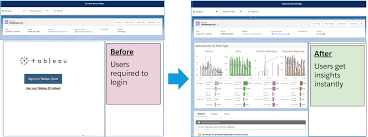
Revitalize your Tableau CRM (formerly known as Einstein Analytics) dashboards with a custom Refresh button, enhancing user experience and analytical efficiency. This button serves as a simple yet powerful tool to reset applied filters and revert the dashboard to its default state, facilitating seamless exploration of data insights. Tableau CRM Refresh Button With LWC. What exactly is a Tableau CRM Refresh Button With LWC? It’s a user interface component that, upon activation, clears all applied filters, restoring the dashboard to its initial configuration. This feature proves particularly beneficial in scenarios where users seek to initiate fresh analyses or when dealing with intricate filter structures. To embark on this enhancement journey, you’ll require three essential components: Once equipped, follow these steps to integrate the Refresh button seamlessly: Step 1: Crafting a Lightning Web Component (LWC) Initiate the creation process by developing a Lightning Web Component (LWC) within Salesforce. This component will seamlessly embed into your Tableau CRM dashboard. Step 2: Designing the HTML Framework Within the HTML file of your LWC (let’s name it refreshButton.html), define the structural blueprint for your button. Below is a sample markup: phpCopy code<template> <div class=”reset-btn_container”> <lightning-button variant=”base” label=”&#xe912;” aria-label=”Clear Filters” onclick={clearFilters} class=”slds-m-right_x-small hpe-icon-button hpe-icon-bare” ></lightning-button> </div> </template> This markup establishes a container for the button, utilizing a lightning-button element to create the button itself. Key attributes such as label, variant, and onclick event handler are set accordingly. Step 3: Implementing JavaScript Logic In the JavaScript file of your LWC (refreshButton.js), define the logic to execute filter clearance upon button activation. Here’s an illustrative example: typescriptCopy codeimport { LightningElement, api, track } from ‘lwc’; export default class DceResetDashboardButton extends LightningElement { @api getState; @api setState; @api refresh; @track initialState = null; clearFilters() { const {state, pageId} = this.getState(); const newState = { state: { …state, datasets: this.initialState.state.datasets, steps: Object.fromEntries(Object.entries(state.steps).map(([k, v]) => { return [k, { …v, values: [] }] })), }, pageId, } this.setState({ …newState, replaceState: true }); } connectedCallback() { this.initialState = this.getState(); } } This JavaScript snippet encompasses crucial elements such as property definition, filter clearance methodology, and initialization of the dashboard’s initial state. Step 4: Deploying the Lightning Web Component With your LWC crafted, proceed to deploy it within your Salesforce organization. Step 5: Integrating the LWC into Your Dashboard Edit your Tableau CRM dashboard, adding a new “Custom Component” widget and configuring it to utilize your deployed LWC as the custom component. Step 6: Testing Your Refresh Button Upon completion, navigate to your Tableau CRM dashboard to confirm the presence of the Refresh Button. A simple click on this button will swiftly clear all filters, providing a seamless experience for resetting your analysis. By incorporating this Refresh button into your Tableau CRM dashboard, you enhance user satisfaction and analytical agility. Take advantage of this tutorial to elevate your dashboards and witness the appreciation from your users firsthand! If you need assistance building a refresh button in your Tableau CRM dashboard, contact Tectonic today. Like Related Posts Who is Salesforce? Who is Salesforce? Here is their story in their own words. From our inception, we’ve proudly embraced the identity of Read more Salesforce Marketing Cloud Transactional Emails Salesforce Marketing Cloud Transactional Emails are immediate, automated, non-promotional messages crucial to business operations and customer satisfaction, such as order Read more Salesforce Unites Einstein Analytics with Financial CRM Salesforce has unveiled a comprehensive analytics solution tailored for wealth managers, home office professionals, and retail bankers, merging its Financial Read more AI-Driven Propensity Scores AI plays a crucial role in propensity score estimation as it can discern underlying patterns between treatments and confounding variables Read more

Read More
Einstein in Salesforce

Einstein in Salesforce

Salesforce AI and CRM Evolution Salesforce has long been a leader in customer relationship management (CRM) by pioneering cloud technologies. Recently, the platform has significantly advanced with the integration of generative artificial intelligence (AI) and AI-powered features, thanks to its Einstein technology. Einstein in Salesforce is like a super smart computer overseeing and analyzing the data in your CRM. This guide explores Salesforce’s AI strategy, exploring its specific products and features to help business teams understand and benefit from this technology. Exploring Salesforce’s Advanced AI Features Einstein, Salesforce’s AI technology, powers various advanced features within the platform. This guide will cover these capabilities, provide real-life adoption examples, and discuss their benefits. Additionally, it offers best practices, solutions, and services to facilitate your Einstein implementation. Salesforce’s Comprehensive CRM Solution Salesforce remains a number one in the CRM software world, offering robust solutions for managing relationships across various departments. Specific clouds within Salesforce enable teams to handle marketing, sales, customer service, e-commerce, and more. The platform focuses on customer experience and provides robust data analytics to support decision-making. Enhancements Through Generative AI Salesforce’s generative AI has rapidly enhanced the platform’s automation, workflow management, data analytics, and assistive capabilities for customer management. A prime example is Salesforce Copilot, which aids internal users with outreach and analysis tasks while improving the external user experience. What is Salesforce Einstein? Salesforce Einstein is the first comprehensive AI for CRM, integrating AI technologies to enhance the Customer Success Platform and bring AI to users everywhere. It is seamlessly integrated into many Salesforce products, offering generative AI built specifically for CRM. Key Features of Salesforce Einstein Comprehensive AI Capabilities of Salesforce Einstein Einstein extends its capabilities across the Salesforce CRM platform under the Customer 360 umbrella, enhancing intelligence and providing personalized customer experiences. Key Benefits of Salesforce Einstein Salesforce Einstein helps close deals faster, personalize customer service, understand customer behaviors, target audience segments better, and create personalized shopping experiences. It ensures data protection and privacy through the Einstein Trust Layer, maintaining strong data governance controls. Responsible AI Principles Salesforce is committed to responsible AI principles, ensuring Einstein is trustworthy and safe for every organization. Organizations can select from various principles to ensure ethical AI use in their operations. Implementation of Salesforce Einstein Salesforce Einstein is a powerful AI solution transforming how businesses interact with customers. By leveraging machine learning and data analysis, it personalizes experiences, predicts customer behavior, and automates tasks, boosting sales, enhancing service, and driving growth. As AI evolves, its impact on CRM will continue to grow, making it an indispensable tool for businesses aiming to stay competitive in today’s data-driven landscape. Top 4 Benefits of Salesforce Einstein in an Organization Einstein Essentials Salesforce Einstein and GPT (Generative Pretrained Transformer) technologies represent significant advancements in AI, particularly in CRM and natural language processing. Here’s a brief overview of their relevance and potential intersection: Data Handling and Ethics in Salesforce Salesforce manages a vast amount of customer data, and the ethical handling of this data is crucial. Key considerations include data privacy, secure storage, access controls, compliance with regulations like GDPR and CCPA, and the ethical use of AI and machine learning. It’s important to maintain transparency, avoid biases, and ensure AI models are making ethical decisions. Newest Einstein Features for 2024 In the rapidly evolving ecosystem of Salesforce, AI offers a suite of tools to spark innovation, streamline operations, and provide richer business insights. Explore these potentials and let Einstein AI reshape your work in 2024. Content updated June 2024. Like1 Related Posts Who is Salesforce? Who is Salesforce? Here is their story in their own words. From our inception, we’ve proudly embraced the identity of Read more Salesforce Marketing Cloud Transactional Emails Salesforce Marketing Cloud Transactional Emails are immediate, automated, non-promotional messages crucial to business operations and customer satisfaction, such as order Read more Salesforce Unites Einstein Analytics with Financial CRM Salesforce has unveiled a comprehensive analytics solution tailored for wealth managers, home office professionals, and retail bankers, merging its Financial Read more AI-Driven Propensity Scores AI plays a crucial role in propensity score estimation as it can discern underlying patterns between treatments and confounding variables Read more

Read More
Feedback Management

Einstein for Feedback Management

Einstein for Feedback Management: AI-Driven Insights for Smarter Decisions Salesforce introduces Einstein for Feedback Management, a next-generation solution that leverages generative AI to revolutionize how businesses collect, analyze, and act on customer and employee feedback. AI-Optimized Surveys for Higher Engagement ✔ Effortless Survey Creation – Generate tailored surveys in seconds using AI-powered question suggestions.✔ Personalized Questioning – Adapt surveys dynamically based on audience demographics and past interactions.✔ Higher Response Rates – Optimize survey length, tone, and structure to maximize participation. Break Language Barriers with AI-Powered Translations ✔ Global Reach – Instantly translate surveys into multiple languages while preserving meaning and cultural relevance.✔ Improved Accuracy – AI ensures high-quality translations, eliminating inconsistencies in multilingual feedback. Seamless Integration with Salesforce Einstein for Feedback Management automatically syncs with Salesforce data to:✔ Pre-fill surveys with known customer details for hyper-personalized experiences.✔ Auto-update CRM records with real-time feedback, eliminating manual data entry.✔ Trigger automated follow-ups (e.g., service tickets, loyalty rewards) based on responses. End-to-End Feedback Intelligence ✔ Omnichannel Distribution – Deploy surveys via email, chatbots, service portals, and more.✔ Journey Analytics – Map feedback across the entire customer lifecycle for deeper insights.✔ NPS & CSAT Tracking – Monitor satisfaction trends and identify improvement areas.✔ AI-Powered Dashboards – Get instant visualizations of feedback trends with Einstein Analytics. Why Feedback Management Matters Now According to Salesforce’s State of the Connected Customer Report: Ashish Kothari, SVP of Product Management at Salesforce Industries, emphasizes: “Real-time feedback is the key to unlocking personalized experiences. As customer expectations evolve, businesses need agile tools to capture and act on insights instantly. Einstein for Feedback Management turns raw data into actionable intelligence—helping companies make smarter decisions at every touchpoint.” The Future of Intelligent Feedback With AI-driven automation, seamless CRM integration, and global scalability, Einstein for Feedback Management empowers businesses to:🔹 Close the experience gap by understanding customer needs in real time.🔹 Drive operational efficiency with automated data capture and workflows.🔹 Build loyalty by acting on feedback at scale. Ready to transform feedback into action? Learn more! Part of the Salesforce Einstein 1 Platform—where AI meets CRM to deliver smarter, faster outcomes. Content updated March 2024. Like Related Posts Who is Salesforce? Who is Salesforce? Here is their story in their own words. From our inception, we’ve proudly embraced the identity of Read more Salesforce Marketing Cloud Transactional Emails Salesforce Marketing Cloud Transactional Emails are immediate, automated, non-promotional messages crucial to business operations and customer satisfaction, such as order Read more Salesforce Unites Einstein Analytics with Financial CRM Salesforce has unveiled a comprehensive analytics solution tailored for wealth managers, home office professionals, and retail bankers, merging its Financial Read more AI-Driven Propensity Scores AI plays a crucial role in propensity score estimation as it can discern underlying patterns between treatments and confounding variables Read more

Read More
What is Health Cloud

What is Health Cloud?

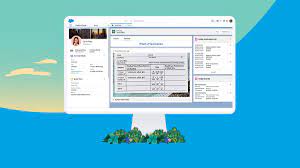
Salesforce Health Cloud, a specialized platform designed for healthcare organizations, aims to streamline operations and provide personalized care. By leveraging cloud technology, mobile capabilities, and social integration, Health Care Cloud enhances productivity, reduces costs, and offers a comprehensive view of patient data. Salesforce keeps electronic personal health information (ephi) safe and secure. Since its inception, Salesforce Health Cloud has evolved significantly to meet the unique and challenging needs of the healthcare sector. The introduction of Customer 360 for Health marks a milestone in fostering empathetic care and promoting collaboration among healthcare teams. What is Salesforce Health Cloud? At its core, Health Cloud facilitates seamless collaboration among healthcare teams to ensure optimal patient care. With robust security measures in place, patient data remains secure and accessible only to authorized personnel. Salesforce Health provides care teams with convenient access to both clinical and non-clinical patient information, including health conditions, medications, appointment history, communication preferences, and data from Electronic Health Records (EHRs). Categorized under Salesforce Industry Clouds, Health Cloud combines CRM capabilities with specialized features tailored for healthcare providers, payers, medical device companies, and pharmaceutical manufacturers. Its goal is to deliver personalized, connected care across the entire, sometimes disjointed healthcare ecosystem. Why Use Salesforce Health Cloud? Salesforce Health offers benefits to various stakeholders within the healthcare industry, including providers, payers, manufacturers, and research organizations. In a challenging healthcare landscape, Health Cloud addresses concerns such as managing complex patient data and enhancing patient experiences effectively. Success stories from organizations like New England Biolabs and John Muir Health highlight the impact of Health Salesforce in streamlining operations, improving customer satisfaction, and enhancing care coordination. Despite its transformative potential, widespread adoption and success require rebuilding patient trust, delivering empathetic care, and prioritizing data security. Tools like Health Cloud play a crucial role in achieving these goals. The Health Cloud Data Model Central to Salesforce Health is the flexible Health Cloud Data Model, built atop the Salesforce Platform. This model organizes diverse healthcare data sources, leveraging standard objects like Accounts and Contacts alongside custom objects tailored for healthcare applications. The data model revolves around organizing data around the patient, providing care teams with a holistic view for informed decision-making and personalized care. It supports interoperability and adheres to healthcare data standards like HL7 and FHIR, enabling seamless integration with EHRs and other healthcare applications. Key Features of Salesforce Health Salesforce Health Cloud offers a suite of robust features, including: Patient 360: Provides a unified view of the patient, consolidating demographics, clinical data, and interactions for informed decision-making and personalized care. Care Plans: Enables care teams to create, track, and manage personalized care plans, incorporating goals, tasks, and milestones to monitor patient progress. Care Coordination: Facilitates collaboration among care teams, supporting secure messaging and information sharing across providers. Health Timeline: Offers an interactive visualization of a patient’s medical history, including encounters, lab results, and medications, aiding in understanding and decision-making. Einstein Analytics for Healthcare: Utilizes AI to deliver advanced insights and predictions, empowering organizations to enhance patient outcomes and operational efficiency. Patient 360 for Health In addition to existing features, Salesforce introduces new innovations under Patient 360 for Health, powered by AI. These updates include: Advanced Therapy Management: Streamlines treatment processes for pharmaceutical companies, offering full visibility into patient treatment. Salesforce Genie for Healthcare: Integrates real-time clinical and non-clinical data to create comprehensive patient profiles. AI-Supported Health Timeline: Enhances navigation and accessibility of patient records and journeys through AI. Home Health: Automates intake and scheduling for in-home treatment, optimizing patient preferences. Data Cloud for Healthcare: Connects clinical and non-clinical patient data from multiple sources into a real-time patient profile. MuleSoft Direct for Health Cloud: Provides out-of-the-box connectors to access EHR data, facilitating smoother integration. Tableau Accelerators for Health Cloud: Offers ready-to-use dashboards for various use cases, empowering teams with data-driven insights. Integration With MuleSoft Salesforce Health seamlessly integrates with MuleSoft, enabling organizations to connect with existing EHRs, billing systems, and healthcare applications. MuleSoft’s Anypoint Platform provides pre-built connectors and APIs to simplify integration and unlock the full potential of healthcare data. Salesforce Health Cloud is not only a powerful platform for healthcare organizations but also a catalyst for positive change in patient care and operational efficiency. By leveraging HC’s capabilities, healthcare organizations can deliver exceptional patient experiences, streamline processes, and ensure data security and compliance. With continuous integration and innovation within the Salesforce ecosystem, Health Cloud remains positioned to drive transformative change in the healthcare industry, addressing challenges and paving the way for a brighter future in healthcare. Considering Salesforce Health Cloud for your practice? Contact Tectonic today. Like1 Related Posts Who is Salesforce? Who is Salesforce? Here is their story in their own words. From our inception, we’ve proudly embraced the identity of Read more Salesforce Marketing Cloud Transactional Emails Salesforce Marketing Cloud Transactional Emails are immediate, automated, non-promotional messages crucial to business operations and customer satisfaction, such as order Read more Salesforce Unites Einstein Analytics with Financial CRM Salesforce has unveiled a comprehensive analytics solution tailored for wealth managers, home office professionals, and retail bankers, merging its Financial Read more AI-Driven Propensity Scores AI plays a crucial role in propensity score estimation as it can discern underlying patterns between treatments and confounding variables Read more

Read More

Maximizing Business Efficiency with Salesforce Managed Services

The Importance of Salesforce Optimization In today’s super fast-paced business world, companies rely on Salesforce to streamline operations and reduce costs. As a leading customer relationship management (CRM) platform, Salesforce enables organizations to enhance workflows, improve efficiency, and drive better results. To maximize the value of your Salesforce platform, optimization is essential. This involves fine tuning the system to ensure ease of use, eliminating inefficiencies, and enhancing overall performance. However, managing Salesforce effectively requires significant time and resources—this is where Salesforce Managed Services come in. This Tectonic insight explores how Managed Services can elevate your Salesforce experience, driving improved business performance and maximizing return on investment. What is Salesforce Optimization? Salesforce optimization focuses on refining the platform to better align with your business needs. It involves continuous improvements in system configuration, workflows, and integrations to ensure peak performance. Given that business requirements evolve over time, optimization is an ongoing process rather than a one-time task. Through Managed Services, businesses can fine-tune settings, enhance workflows, and ensure seamless system integrations, leading to increased productivity and efficiency. How to Optimize Salesforce for Maximum Efficiency Optimizing Salesforce involves refining data management, automation, user experience, and security. Key areas of focus include: 1. Data Model Optimization 2. Indexing and Query Optimization 3. Managing Governor Limits 4. Data Loading and Migration 5. UI and Lightning Experience Optimization 6. Reporting and Dashboard Optimization 7. Security and Access Control 8. Performance Monitoring and Analysis Challenges in Salesforce Optimization Optimizing Salesforce can be complex, and failing to manage it properly can hinder performance. Common challenges include: Why Continuous Salesforce Optimization is Essential Ongoing optimization ensures that businesses maximize their Salesforce investment, enabling: Understanding Salesforce Managed Services Salesforce Managed Services offer a proactive approach to CRM optimization. Instead of managing Salesforce in-house, businesses can outsource expert professionals to ensure seamless operations, enhanced security, and continuous improvement. Key Benefits of Managed Services How Managed Services Improve Salesforce Performance Salesforce Managed Services take a proactive approach to optimization, preventing issues before they arise. Key areas of impact include: 1. Proactive Monitoring & Maintenance 2. Customization & Automation 3. Enhanced Data Integrity & Security 4. Seamless Third-Party Integrations Maximizing ROI with Managed Salesforce Services Optimizing Salesforce through Managed Services yields significant business benefits, including cost savings, operational efficiency, and revenue growth. 1. Cost Efficiency 2. Faster Implementation & Deployment 3. Improved User Adoption & Productivity 4. Measurable Business Growth Conclusion Salesforce optimization is crucial for maintaining an efficient and scalable CRM. By leveraging Managed Services, businesses can enhance system performance, improve data security, and increase operational efficiency in a cost-effective manner. A dedicated Salesforce Managed Service Provider like Tectonic ensures streamlined operations, optimized configurations, and enhanced user adoption, ultimately driving business growth. Elevate Your Salesforce Performance As your business grows, managing and optimizing Salesforce becomes increasingly complex. Our Managed Services provide expert support, ensuring that your CRM remains optimized, secure, and scalable. Looking to enhance your Salesforce strategy? Contact us today to optimize your Salesforce instance and unlock its full potential. Like Related Posts Who is Salesforce? Who is Salesforce? Here is their story in their own words. From our inception, we’ve proudly embraced the identity of Read more Salesforce Marketing Cloud Transactional Emails Salesforce Marketing Cloud Transactional Emails are immediate, automated, non-promotional messages crucial to business operations and customer satisfaction, such as order Read more Salesforce Unites Einstein Analytics with Financial CRM Salesforce has unveiled a comprehensive analytics solution tailored for wealth managers, home office professionals, and retail bankers, merging its Financial Read more AI-Driven Propensity Scores AI plays a crucial role in propensity score estimation as it can discern underlying patterns between treatments and confounding variables Read more

Read More

Salesforce Reports Explained

Salesforce Reports: A Complete Guide to Data Analysis & Insights What Are Salesforce Reports? Salesforce Reports empower users to access, analyze, and share critical business data stored in Salesforce. They transform raw data into actionable insights, helping teams track performance, identify trends, and make data-driven decisions. Reports can be customized, visualized in dashboards, and shared across teams for better collaboration. Key Types of Salesforce Reports Salesforce offers four main report types, each suited for different analytical needs: 1. Tabular Reports 2. Summary Reports 3. Matrix Reports 4. Joined Reports How to Create & Customize Reports Step 1: Navigate to the Reports Tab Step 2: Customize Your Report Step 3: Save & Share Advanced Analysis with Salesforce Reports Einstein Analytics Dynamic Filters Scheduled Reports Best Practices for Effective Reporting ✅ Define a Clear Purpose – What decision will this report drive?✅ Keep It User-Friendly – Use charts, summaries, and clear labels.✅ Ensure Data Accuracy – Regularly review filters & formulas.✅ Share Strategically – Grant access only to relevant stakeholders.✅ Automate Where Possible – Schedule reports to save time. Conclusion: Unlock the Power of Salesforce Reports Salesforce Reports turn raw data into strategic insights, helping businesses track performance, optimize processes, and drive growth. By mastering report types, customization, and sharing, teams can make faster, smarter decisions. Need help? Explore Salesforce’s Report Builder or check out Trailhead for hands-on training! Like Related Posts Who is Salesforce? Who is Salesforce? Here is their story in their own words. From our inception, we’ve proudly embraced the identity of Read more Salesforce Marketing Cloud Transactional Emails Salesforce Marketing Cloud Transactional Emails are immediate, automated, non-promotional messages crucial to business operations and customer satisfaction, such as order Read more Salesforce Unites Einstein Analytics with Financial CRM Salesforce has unveiled a comprehensive analytics solution tailored for wealth managers, home office professionals, and retail bankers, merging its Financial Read more AI-Driven Propensity Scores AI plays a crucial role in propensity score estimation as it can discern underlying patterns between treatments and confounding variables Read more

Read More
Einstein Discovery

Einstein Discovery Analysis

Elevate Your Business Outcomes with Einstein Discovery Analysis Einstein Discovery revolutionizes your approach to predictive analytics, allowing you to effortlessly build reliable machine learning models without any coding. Reduce reliance on data science teams with an intuitive model-building wizard and streamlined monitoring process. Transition swiftly from data to actionable insights, ensuring every decision is guided by intelligence. Enhance Your Business Intelligence with Einstein Discovery Incorporate statistical modeling and machine learning into your business intelligence with Einstein Discovery. Seamlessly integrated into your Salesforce environment, operationalize data analysis, predictions, and enhancements with clicks, not code. Developers can utilize the Einstein Prediction Service to access predictions programmatically, while data specialists can predict outcomes within recipes and dataflows. Tableau users can also leverage Einstein Discovery predictions and improvements directly within Tableau. Advanced Analytics Made Simple with Einstein Discovery Einstein Discovery offers a comprehensive suite of business analytics tailored to your specific data needs. Licensing and Permission Requirements for Einstein Discovery To utilize Einstein Discovery, your organization needs the appropriate license, with user accounts assigned relevant permissions. Supported Use Cases and Implementation Tasks Einstein Discovery solutions effectively address common business use cases, typically involving a series of defined implementation tasks. Key Differentiation: Einstein Analytics vs. Einstein Discovery While Einstein Analytics integrates predictive and analytical capabilities within Sales, Service, and Marketing clouds, Einstein Discovery is specifically focused on providing actionable insights and data-driven stories. Key Benefits of Einstein Discovery Supported Data Integration and Functionality Einstein Discovery enables direct integration and import of data from external sources like Hadoop, Oracle, and Microsoft SQL Server. It extracts data from diverse sources, leveraging AI, ML, and statistical intelligence to identify patterns and generate informed predictions. Enhanced Features Einstein Discovery seamlessly integrates insights into Tableau workflows, unlocks insights from unstructured data, fine-tunes prediction accuracy with trending data, handles missing values in datasets, accelerates prediction processing with high-volume writeback, and offers enhanced settings panels for efficient prediction management. Partner with Tectonic for Expert Guidance Collaborate with experienced Salesforce services providers like Tectonic to maximize the benefits of Einstein Discovery, ensuring a seamless implementation process and ongoing support. Empower Your Business with Einstein Discovery Einstein Discovery delivers automated data analysis, interactive visualizations, and predictive insights to elevate decision-making and optimize business operations. Unlock the power of AI-driven analytics within your Salesforce ecosystem to accelerate growth and gain a competitive edge. Like Related Posts Who is Salesforce? Who is Salesforce? Here is their story in their own words. From our inception, we’ve proudly embraced the identity of Read more Salesforce Marketing Cloud Transactional Emails Salesforce Marketing Cloud Transactional Emails are immediate, automated, non-promotional messages crucial to business operations and customer satisfaction, such as order Read more Salesforce Unites Einstein Analytics with Financial CRM Salesforce has unveiled a comprehensive analytics solution tailored for wealth managers, home office professionals, and retail bankers, merging its Financial Read more AI-Driven Propensity Scores AI plays a crucial role in propensity score estimation as it can discern underlying patterns between treatments and confounding variables Read more

Read More
Salesforce Health Cloud

Salesforce Health Cloud Information

Since its inception in 2016, Salesforce Health Cloud has evolved significantly, adapting to the intricacies of the sensitive and dynamic health industry. The latest addition to its offerings, Customer 360 for Health, represents a strategic move towards more empathetic care, bolstering patient trust and fostering team collaboration.

Read More
gettectonic.com