- gettectonic.com - Page 5
Einstein Trust Layer explained

Einstein Trust Layer Explained

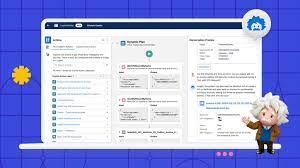
The Einstein Trust Layer, seamlessly integrated into the Salesforce Platform, serves as a secure AI architecture designed to meet enterprise security standards. This foundational layer prioritizes stringent security measures, allowing teams to harness the power of generative AI without compromising customer data. Simultaneously, it empowers companies to make the most of their trusted data, thereby enhancing the precision of generative AI responses. Key features of the Einstein Trust Layer include: Integrated and Grounded: An inherent component of every Einstein Copilot, the Trust Layer ensures that generative prompts are firmly rooted and enriched in trusted company data. Its integration with Salesforce Data Cloud establishes a seamless connection, reinforcing the reliability and relevance of generative responses. Zero-Data Retention and PII Protection: Companies can trust that their data will never be retained by third-party Large Language Model (LLM) providers. The Trust Layer incorporates masking techniques for personally identifiable information (PII), ensuring an added layer of data privacy. Toxicity Awareness and Compliance-Ready AI Monitoring: A dedicated safety-detector LLM within the Trust Layer acts as a guard against toxicity, assessing risks to brand reputation by scoring AI generations. This scoring mechanism instills confidence in the safety of responses. Moreover, each AI interaction is meticulously recorded in a secure, monitored audit trail, providing companies with visibility and control over how their data is utilized and ensuring compliance readiness. In alignment with Microsoft’s introduction of Copilot solutions powered by generative AI, Salesforce is leveraging the capabilities of Large Language Models (LLMs) to empower professionals in sales, marketing, and customer service. Building on Salesforce’s existing suite of Einstein AI features, the company unveiled “Einstein 1” this year—a next-generation suite of tools empowering users to seamlessly integrate AI into their everyday workflows. At the core of this advancement is the Einstein Copilot solution, complemented by the new Copilot studio and the Einstein Trust Layer. Like2 Related Posts Who is Salesforce? Who is Salesforce? Here is their story in their own words. From our inception, we’ve proudly embraced the identity of Read more Salesforce Marketing Cloud Transactional Emails Salesforce Marketing Cloud Transactional Emails are immediate, automated, non-promotional messages crucial to business operations and customer satisfaction, such as order Read more Salesforce Unites Einstein Analytics with Financial CRM Salesforce has unveiled a comprehensive analytics solution tailored for wealth managers, home office professionals, and retail bankers, merging its Financial Read more AI-Driven Propensity Scores AI plays a crucial role in propensity score estimation as it can discern underlying patterns between treatments and confounding variables Read more

Read More
Salesforce government and public sector solutions

Dynamic Apps and Intake Forms for Public Sector

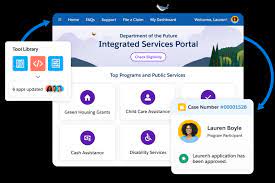
Utilize dynamic apps and intake forms using omniscript in public sector solutions with Salesforce. Develop guided application and intake forms for constituents using Public Sector Solutions with OmniScript. This technology, part of the OmniStudio suite, empowers users to create intricate web forms effortlessly, requiring minimal or no coding. Simply drag and drop interactive elements onto the OmniScript canvas, configure their properties, and arrange them according to your preferences. Elements encompass various question input types, DataRaptors drawing on Public Sector Solutions data, and other actions. OmniScripts even support embedding other OmniScripts, facilitating the creation of guided user experiences, including application and intake forms for licenses, permits, services, benefits, and grants. Dynamic Apps and Intake Forms for Public Sector Creating a Conditional Question in OmniScript: An Example Configuring Community Profiles for OmniScript Deployment To deploy an OmniScript from a Community, adjust sharing settings and profile access as follows: Applying Best Practices for OmniScript Design and Performance Design Best Practices: User Interface Best Practices: User Experience Design Principles: Performance Best Practices: Client-side: Server-side: Understanding OmniScript and Salesforce Flow Differences OmniScript, part of the OmniStudio suite, allows the creation of dynamic, code-free forms, providing a responsive single-page experience. Salesforce Screen Flow, on the other hand, is a type of Flow used to enhance user experiences. OmniScripts are UI-first designers, emphasizing visual and interactive components, while screen flows focus on process-first design. OmniScripts offer web analytics integration, low-code API consumption, and advanced data transformation capabilities, making them valuable for consumer-facing and partner-facing contexts. They utilize Integration Procedures and DataRaptors for data consumption. This insight emphasizing the importance of understanding these differences and utilizing the best practices outlined for optimal performance and design. Like1 Related Posts Tectonic’s Successful Salesforce Track Record Salesforce Technology Services Integrator – Tectonic has successfully delivered Salesforce in a variety of industries including Public Sector, Hospitality, Manufacturing, Read more Asset Management Salesforce Can Salesforce do asset management? You can manage assets in Consumer Goods (desktop) and in the Consumer Goods offline mobile Read more Generating Documents in Salesforce Salesforce document generation poses a challenge for businesses, given the intricacies of integration involved. Fortunately, a variety of tools are Read more Salesforce Scheduler Salesforce Scheduler provides the objects required for appointment scheduling and an app that makes it easy to set up Scheduler. Read more

Read More
Learn AI

Workflow Rules and Process Builder

End of Support Publish Date: Mar 5, 2024 Description Salesforce will no longer be supporting Workflow Rules and Process Builder on December 31, 2025, and we recommend that you migrate your automation to Flow Builder by that time. You’re also probably wondering why we’re retiring Workflow Rules & Process Builder. Salesforce wants to focus development on a modern, extensible, low-code automation solution in Flow Builder, which led us to retire the previous features. What does this change mean for me? If you have active Workflow Rules or Process Builder processes running after 2025, they will no longer receive customer support or bug fixes. What action can I take? We recommend implementing a plan to migrate any active rules or processes to Flow Builder before the deadline. Depending on the complexity of your org, this migration may take a significant amount of time and testing, so we recommend starting now. To assist in the migration process, we have a Migrate to Flow tool and extensive support resources available. What happens if I don’t take action? After December 31, 2025, Workflow Rules as well as Process Builder may continue to function and execute existing automation, but customer support will not be available, and bugs will not be fixed. How do I identify affected users? You can identify whether you have active workflow rules by going to Setup | Process Automation | Workflow Rules and sorting the Active column for checkmarks. You can identify whether you have active Process Builder processes by going to Setup | Process Automation | Process Builder and sorting the Status column for Active. If you have more questions, open a case with support via Salesforce Help. To view all current and past retirements, see Salesforce Product & Feature Retirements. To read about the Salesforce approach to retirements, read our Product & Feature Retirement Philosophy. Knowledge Article Number 001096524 Like Related Posts Who is Salesforce? Who is Salesforce? Here is their story in their own words. From our inception, we’ve proudly embraced the identity of Read more Salesforce Marketing Cloud Transactional Emails Salesforce Marketing Cloud Transactional Emails are immediate, automated, non-promotional messages crucial to business operations and customer satisfaction, such as order Read more Salesforce Unites Einstein Analytics with Financial CRM Salesforce has unveiled a comprehensive analytics solution tailored for wealth managers, home office professionals, and retail bankers, merging its Financial Read more AI-Driven Propensity Scores AI plays a crucial role in propensity score estimation as it can discern underlying patterns between treatments and confounding variables Read more
Read More
Advances in Public Sector Solutions

Salesforce Announces Advances in Public Sector Solutions

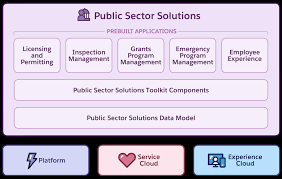
Explore the diverse new ways in which advances in Public Sector Solutions revolutionize the provision of public services. Establish interactive application forms and deploy them on an Experience Cloud site accessible to constituents. Develop automated approval processes for efficient application review. Employ dynamic assessments for evaluating applications, and generate care plans and referrals to assist constituents in need. Utilize a trial Salesforce PSS org to explore the product and prepare for implementation. Discover the synergy between the Salesforce platform, a dedicated data model, and a suite of common components that facilitate the implementation of a solution tailored to your agency’s needs. Whether implementing Public Sector Solutions for a municipality, state, province, or at the federal or national level, each public agency has distinct requirements for serving constituents through digital tools and workflows. Public Sector Solutions avoids a one-size-fits-all approach, allowing you to combine various components and tools to create a customized solution for you and your constituents. Salesforce Platform: The cloud-based Salesforce platform, encompassing Sales Cloud, Service Cloud, and Experience Cloud, forms the foundation of Public Sector Solutions and is inclusive with the product. Offering relationship management, case management, collaboration, integration, and data insight capabilities, the platform provides a 360-degree view of constituents for more effective service, management, and interaction. Adhering to stringent data security regulations, the platform allows quick deployment and scalability, with flexibility for expansion. Data Model: The Public Sector Solutions data model is tailored for government agencies, encompassing objects for defining regulatory agencies, authorization types, codes, constituents as business or person accounts, visits, complaints, violations, and more. Whether managing licenses and permits, conducting inspections, or overseeing social services programs, the data model accommodates diverse governmental tasks. Industry Common Layer: A suite of no-code and low-code components and tools, including OmniStudio, Action Plans, Document Tracking and Approvals, OmniStudio Document Generation, Business Rules Engine, and more, enables automation of traditionally paper-based processes. Common layer components facilitate the creation of dynamic forms, application reviews, complex policy decisions, and more. Prebuilt Apps: These elements culminate in several prebuilt applications, each addressing specific needs: Contact Tectonic today to explore Salesforce public sector solutions. Like1 Related Posts Who is Salesforce? Who is Salesforce? Here is their story in their own words. From our inception, we’ve proudly embraced the identity of Read more Salesforce Marketing Cloud Transactional Emails Salesforce Marketing Cloud Transactional Emails are immediate, automated, non-promotional messages crucial to business operations and customer satisfaction, such as order Read more Salesforce Unites Einstein Analytics with Financial CRM Salesforce has unveiled a comprehensive analytics solution tailored for wealth managers, home office professionals, and retail bankers, merging its Financial Read more AI-Driven Propensity Scores AI plays a crucial role in propensity score estimation as it can discern underlying patterns between treatments and confounding variables Read more

Read More
Salesforce Public Sector Solutions

Get a Public Sector Solutions Trial Salesforce Org

Explore Public Sector Solutions, purpose-built applications crafted on the world’s most reliable CRM, tailored to assist public sector organizations in fostering and sustaining vibrant communities. Public Sector Solutions Trial Salesforce offer is your chance to test drive the PSS SFDC platform. Public Sector Solutions Trial Salesforce Gain hands-on experience through a comprehensive trial of Public Sector Solutions, designed for proof of concept and guided exploration. These trial organizations have a 30-day lifespan and encompass pre-enabled features, including: Access a specialized solution empowering governments and public agencies to enhance digital service delivery. The free trial includes: Visit the Salesforce Public Sector Solutions Trailhead [link] for more details. Why Invest the Time in a Free Trial? Designed for proof of concept and guided exploration, these trial organizations have a 30-day lifespan. These solutions are particularly beneficial for state and local, federal, and tribal agencies seeking a rapid deployment of a flexible and scalable platform. This platform aims to modernize constituent services, such as licensing, permitting, and inspections, while expediting crisis response efforts to swiftly restore communities to well-being. For additional information, contact your Salesforce Account Executive or Tectonic. Like3 Related Posts Tectonic’s Successful Salesforce Track Record Salesforce Technology Services Integrator – Tectonic has successfully delivered Salesforce in a variety of industries including Public Sector, Hospitality, Manufacturing, Read more Asset Management Salesforce Can Salesforce do asset management? You can manage assets in Consumer Goods (desktop) and in the Consumer Goods offline mobile Read more Box and Salesforce Integration What is Box and Salesforce integration? Together, Box and Salesforce integration bring you seamless solutions that make it easy for Read more Salesforce Scheduler Salesforce Scheduler provides the objects required for appointment scheduling and an app that makes it easy to set up Scheduler. Read more

Read More
2024 Education Trends With Salesforce

2024 Education Trends With Salesforce

“Anticipating the Education Future: 8 Education Trends Shaping 2024”: 2024 Education Trends With Salesforce In 2023, the education industry experienced significant shifts, influenced by economic, environmental, political, and social factors. As we navigate through 2024, the following education trends are expected to make a profound impact on the sector: 2024 Education Trends With Salesforce These trends collectively shape the future of education in 2024, emphasizing personalization, diversity, technology integration, and a holistic approach to student success. Like1 Related Posts Salesforce in Education Salesforce for Education encompasses a suite of products that seamlessly integrate insights across recruitment, admissions, and student success, providing a Read more SysCloud Backup for Salesforce Introducing SysCloud Backup for Salesforce. Protect and manage your critical SaaS applications seamlessly: Backup and Restore: Automatically back up and Read more Salesforce Education Cloud Explained It’s back to school time. And there is no better time to discuss Salesforce Education Cloud! Powering the Learner Lifecycle Read more Salesforce Industry Cloud Explained What are Salesforce industry clouds? Salesforce Industry Cloud aims to fast-track the digital transformation within different industries by providing tailored Read more

Read More
Tectonic at a Glance

AI Product Management Tools

Embracing AI in Product Management: Your New Best Friend, Not a Replacement-Original published by https://zedaio.medium.com/ Amid the lively debates about AI taking over product management roles, let’s set the record straight: AI is here as an ally, not a replacement. It’s about leveraging AI to amplify our capabilities, streamline mundane tasks, and make room for the creative and strategic aspects of product management. AI Product Management Tools. Here are seven AI tools that will automate your daily routines, offering support that transforms the way you manage products. Ready to upgrade your product management game with AI by your side? Let’s dive in! 1. Zeda.io Zeda.io is one of the best AI tools for product managers. It offers a complete suite of features that help you in feedback management, strategic planning, and closing the loop. It is a perfect tool if you are striving to balance your customer needs and business goals. With integrations like Slack, Gong, Teams, Salesforce, and more, you can gather and manage customer feedback effortlessly. Its unique AI technology generates valuable, actionable insights by categorizing all the feedback, helping you uncover pressing customer issues and decide what to build next. Key Features: 2. ChatGPT An obvious choice, ChatGPT can automate many of your tasks. It helps make sense of vague product user feedback, create PRDs, release notes, and other documents. The key is to use the right prompts and GPT plugins tailored for product managers. Key Features: 3. Notion AI Notion is a cloud-based productivity and collaboration tool that provides various organizational tools, including task management, project tracking, to-do lists, bookmarking, and more. Notion’s AI can assist product managers in several ways. Key Features: 4. Uizard Uizard is a user interface design tool that uses AI to quickly and efficiently create wireframes, mockups, and prototypes in minutes. The tool’s advanced deep-learning algorithms analyze images provided by product teams and managers to create design themes. Key Features: 5. ClickUp ClickUp is a cloud-based tool that helps teams manage their work effectively, offering features like task management, time tracking, file sharing, and communication tools. ClickUp is highly customizable and offers multiple AI tools that integrate seamlessly into workflows. Key Features: 6. Delibr Delibr is an excellent tool for AI product teams to collaborate effectively during the feature refinement process. It helps capture, synthesize, and organize feedback from diverse sources, enabling informed decision-making and creating high-quality documentation. Key Features: 7. Fireflies.ai Fireflies.ai enhances meeting productivity by transcribing, summarizing, and analyzing voice conversations. It integrates with major video-conferencing platforms and offers various ways to capture meetings, including a Chrome extension and direct uploads. Key Features: AI Product Management Tools Embracing AI in product management doesn’t mean diminishing the value of human insight; it’s about enhancing our capabilities and efficiency. The seven AI tools outlined here offer a glimpse into a future where technology and creativity intersect, empowering product managers to achieve more in less time. By integrating suitable tools into your workflow, you can focus on innovation and strategy, ensuring your products not only meet but exceed user expectations. Let AI be your ally to achieve greater heights and product success. Like Related Posts Who is Salesforce? Who is Salesforce? Here is their story in their own words. From our inception, we’ve proudly embraced the identity of Read more Salesforce Marketing Cloud Transactional Emails Salesforce Marketing Cloud Transactional Emails are immediate, automated, non-promotional messages crucial to business operations and customer satisfaction, such as order Read more Salesforce Unites Einstein Analytics with Financial CRM Salesforce has unveiled a comprehensive analytics solution tailored for wealth managers, home office professionals, and retail bankers, merging its Financial Read more AI-Driven Propensity Scores AI plays a crucial role in propensity score estimation as it can discern underlying patterns between treatments and confounding variables Read more

Read More
Salesforce Email Alerts

How to Log Email Alerts as Activities in Salesforce

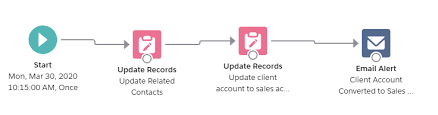
How do you log emails alerts as activities when sent with the ‘send email’ action? Goal. With the latest release from Salesforce, now it is possible to automatically log emails to a record’s Activity Timeline when using the Send Email action. This enhancement offers users the flexibility to: Prior to the Spring ‘24 release, emails sent using the Send Email action couldn’t be automatically tracked in Activity Timelines. As of Spring 24 release, it is not possible to log emails sent to users; otherwise, you will get an error. Before proceeding, you should become familiar with the EmailTemplate object in Salesforce. It represents a template for an email, mass email, list email, or Sales Engagement email. Supported in first-generation managed packages only. To solve this requirement, use the After-save Record-Triggered Flow. This will log email alerts as activities in Salesforce. If you need assistance sending email alerts as activities in Salesforce. Contact Tectonic today. Like1 Related Posts Who is Salesforce? Who is Salesforce? Here is their story in their own words. From our inception, we’ve proudly embraced the identity of Read more Salesforce Marketing Cloud Transactional Emails Salesforce Marketing Cloud Transactional Emails are immediate, automated, non-promotional messages crucial to business operations and customer satisfaction, such as order Read more Salesforce Unites Einstein Analytics with Financial CRM Salesforce has unveiled a comprehensive analytics solution tailored for wealth managers, home office professionals, and retail bankers, merging its Financial Read more AI-Driven Propensity Scores AI plays a crucial role in propensity score estimation as it can discern underlying patterns between treatments and confounding variables Read more

Read More
Salesforce Partner Trailblazer Score

Salesforce Partner Trailblazer Score

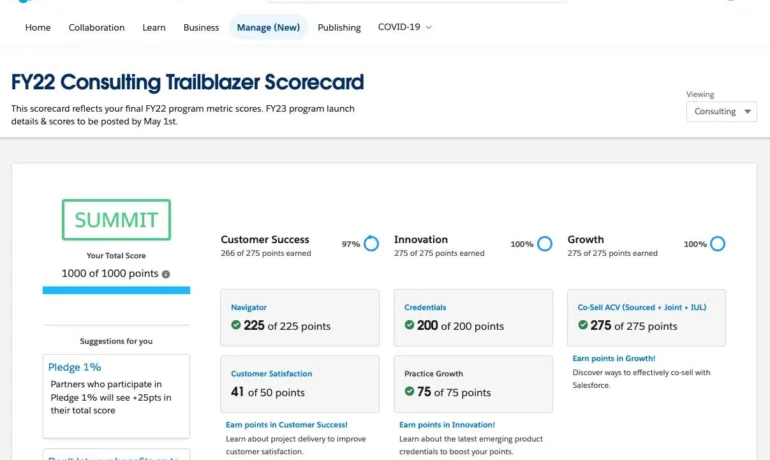
Salesforce Partner Trailblazer Score explained. The Consulting Trailblazer scorecard undergoes daily updates, while tier calculations occur on a quarterly basis. Following the conclusion of each quarter, the subsequent month is utilized to determine any tier adjustments. Upon completion of the quarterly assessment, any tier advancements take effect on the first day of the subsequent month. For precise timing regarding quarterly evaluations, please refer to our Partner Program Policies. Salesforce Partner Trailblazer Score. Upon accruing the requisite points for promotion to the next tier, individuals can anticipate the new tier to be reflected on their scorecard quarterly, occurring one month subsequent to the conclusion of the preceding quarter. This interval allows our internal teams adequate time for review and system updates. While accumulating sufficient points may indicate eligibility for tier advancement, it’s important to note that tiers are not automatically updated. Tier transitions occur solely following the culmination of a tier evaluation period. In instances where tier advancement does not align with expectations post-quarterly evaluation, individuals are encouraged to initiate a case via Salesforce Help for further investigation. To expedite the resolution process, Salesforce asks you to kindly provide the following details: Partners can monitor their Consulting Partner Trailblazer score via the Manage (New) tab within the Partner Community. Access to the Manage (New) tab is granted exclusively to partners who have progressed beyond the Provisional tier (Base, Ridge, Crest, Summit). Like1 Related Posts Who is Salesforce? Who is Salesforce? Here is their story in their own words. From our inception, we’ve proudly embraced the identity of Read more Salesforce Marketing Cloud Transactional Emails Salesforce Marketing Cloud Transactional Emails are immediate, automated, non-promotional messages crucial to business operations and customer satisfaction, such as order Read more Salesforce Unites Einstein Analytics with Financial CRM Salesforce has unveiled a comprehensive analytics solution tailored for wealth managers, home office professionals, and retail bankers, merging its Financial Read more AI-Driven Propensity Scores AI plays a crucial role in propensity score estimation as it can discern underlying patterns between treatments and confounding variables Read more
Read More

Train Your Own SORA Model

Unveiling the Vision Transformer: A Leap in Video Generation The closest open-source model to SORA is Latte, which uses the same Vision Transformer architecture. So, what makes the Vision Transformer so outstanding, and how does it differ from previous methods? You can Train Your Own SORA Model. Latte hasn’t open-sourced its text-to-video training code. We’ve replicated this code from the paper and made it available for anyone to use in training their own SORA alternative model. Let’s discuss how effective our training was. From 3D U-Net to Vision Transformer Image generation has advanced significantly, with the U-Net model structure being the most commonly used: If you’re confused about the network structures, remember the key principle of deep learning: “Just Add More Layers!” Vision Transformer: A Game Changer In 3D U-Net, the transformer can only function within the U-Net, limiting its view. The Vision Transformer, however, enables transformers to globally manage video generation. Training Your Open-Source SORA Alternative with Latte Latte uses the video slicing sequence and Vision Transformer method discussed. While Latte hasn’t open-sourced its text-to-video model training code, we’ve replicated it here: GitHub Repo. Training involves three steps: For more details, see the GitHub repo. They’ve also made improvements to the training process: Model Performance The official Latte video shows impressive performance, especially in handling significant motion. However, our own tests indicate that while Latte performs well, it isn’t the top-performing model. Other open-source models have shown better performance. We will continue to share information on models with better performance, so stay tuned to Tectonic’s Insights. Hardware Requirements Due to its large scale, training Latte requires an A100 or H100 with 80GB of memory. Like Related Posts Who is Salesforce? Who is Salesforce? Here is their story in their own words. From our inception, we’ve proudly embraced the identity of Read more Salesforce Marketing Cloud Transactional Emails Salesforce Marketing Cloud Transactional Emails are immediate, automated, non-promotional messages crucial to business operations and customer satisfaction, such as order Read more Salesforce Unites Einstein Analytics with Financial CRM Salesforce has unveiled a comprehensive analytics solution tailored for wealth managers, home office professionals, and retail bankers, merging its Financial Read more AI-Driven Propensity Scores AI plays a crucial role in propensity score estimation as it can discern underlying patterns between treatments and confounding variables Read more
Read More
demand generation web use cases for personalization

Demand Generation Web Use Cases for Personalization

Utilize effective personalization techniques adopted by businesses in online campaigns to stimulate demand generation. The term “demand generation” has somewhat faded from the marketing lexicon due to the emphasis on analytics, AI, and metrics for lead conversion. However, where does personalization fit into the broader scope of demand generation? Demand generation web use cases for personalization. Personalization plays a pivotal role in various aspects of demand generation: In lead nurturing, personalization is equally vital: Moreover, personalization is instrumental in lead acquisition efforts by delivering relevant experiences to all of your prospects. To effectively implement personalization, real-time insights into individual behaviors and interactions are essential. A comprehensive personalization solution should unify data from various channels and systems, enabling seamless cross-channel personalization. This includes “stitching” together anonymous and known user profiles, integrating data with complementary systems like CRMs and marketing platforms, and facilitating real-time omni-channel personalization. The key to successful personalization lies in understanding and addressing each individual’s unique needs and preferences. By adopting a customer-centric approach and setting clear objectives aligned with business goals, organizations can leverage personalization to enhance customer experiences, boost conversion rates, and drive measurable business growth. To execute a successful personalization strategy, organizations must: By following these steps and continuously optimizing personalization efforts, organizations can build stronger customer relationships, drive business growth, and maximize marketing ROI. Website personalization serves as the starting point for many companies embarking on their personalization journey. This entails ensuring that returning visitors encounter pages tailored to their previous experiences or recent purchases. It can also involve presenting new customers with product recommendations based on their current browsing session. The return on this initial investment can be substantial, with many companies witnessing a significant increase in conversion rates, sometimes by as much as 50% or more. For instance, a site converting 2% of visitors might see that figure rise to 3%, a dream scenario for digital marketers. Moreover, this boost in conversion rates can have far-reaching effects across marketing programs, leading to a reduction in overall customer acquisition costs. Tectonic now offers Personalization Implementation Solutions. The next stage in personalization maturity involves integrating a customer’s web and email experiences. This seamless connection between two major channels for customer engagement brings organizations closer to achieving an omni-channel personalization experience. Timely and relevant follow-up messages after a customer’s website visit or purchase can deepen relationships and enhance lifetime value without significant additional marketing expenditure. Finally, the ultimate goal is to extend personalization across all channels, ensuring consistent and tailored experiences wherever customers interact with your brand. However, achieving this can be challenging due to fragmented customer data across multiple channels, teams, and systems. An effective personalization solution should consolidate and synthesize this cross-channel information by maintaining unified customer profiles and enabling real-time omni-channel personalization. Testing is a crucial aspect of successful personalization efforts, allowing organizations to optimize campaigns and maximize engagement, conversions, and revenue. A robust personalization solution should facilitate A/B testing, measuring lift over control, evaluating impacts against specific goals, and filtering results by segment. Effective website personalization lays the foundation for broader personalization efforts across channels. By seamlessly integrating web and email experiences and extending personalization to all touchpoints, organizations can deliver tailored experiences that drive engagement, loyalty, and ultimately, business growth. By Tectonic’s Salesforce Marketing Platform Architect Shannan Hearne Like1 Related Posts Who is Salesforce? Who is Salesforce? Here is their story in their own words. From our inception, we’ve proudly embraced the identity of Read more Salesforce Marketing Cloud Transactional Emails Salesforce Marketing Cloud Transactional Emails are immediate, automated, non-promotional messages crucial to business operations and customer satisfaction, such as order Read more Salesforce Unites Einstein Analytics with Financial CRM Salesforce has unveiled a comprehensive analytics solution tailored for wealth managers, home office professionals, and retail bankers, merging its Financial Read more AI-Driven Propensity Scores AI plays a crucial role in propensity score estimation as it can discern underlying patterns between treatments and confounding variables Read more

Read More
Einstein Copilot Studio

Einstein Copilot Studio Explained

Einstein Copilot Studio Explained: Crafting and Personalizing a Reliable AI Assistant Enterprises aiming to personalize Einstein Copilot can leverage the newly introduced Einstein Copilot Studio. This platform enables the construction and customization of AI assistants, incorporating pertinent prompts, skills, and AI models tailored for specific sales, service, marketing, commerce, and IT tasks. Beyond the confines of Salesforce applications, companies can seamlessly integrate Einstein Copilot into consumer-facing channels. This extension enhances customer interactions by embedding AI assistants into websites for real-time chat capabilities or integrating with popular messaging platforms such as Slack, WhatsApp, or SMS. Einstein Copilot Studio comprises the following key components: Just as Microsoft has introduced its own Copilot solutions, powered by generative AI, Salesforce is tapping into the power of LLMs to empower sales, marketing, and customer service professionals. Building on Salesforce’s existing range of Einstein AI features, the company announced “Einstein 1” this year – the next generation of the Salesforce platform. Einstein 1 is a comprehensive suite of tools that empowers users to bring AI into their everyday workflows. The Einstein Copilot (Salesforce Copilot) solution is at the core of this solution, alongside the new Copilot studio and the Einstein Trust Layer. Contact Tectonic today to explore the value of Einstein Copilot Studio for your company., Like2 Related Posts Who is Salesforce? Who is Salesforce? Here is their story in their own words. From our inception, we’ve proudly embraced the identity of Read more Salesforce Marketing Cloud Transactional Emails Salesforce Marketing Cloud Transactional Emails are immediate, automated, non-promotional messages crucial to business operations and customer satisfaction, such as order Read more Salesforce Unites Einstein Analytics with Financial CRM Salesforce has unveiled a comprehensive analytics solution tailored for wealth managers, home office professionals, and retail bankers, merging its Financial Read more AI-Driven Propensity Scores AI plays a crucial role in propensity score estimation as it can discern underlying patterns between treatments and confounding variables Read more

Read More
gettectonic.com