- gettectonic.com - Page 89
Salesforce Copilot

What is Einstein Copilot for Salesforce?

What Is Einstein Copilot for Salesforce? Salesforce Copilot service operates similarly to other generative AI tools in the customer experience landscape. Users can instruct the tool to automatically respond to customer queries with pertinent, personalized answers based on company data. Is Copilot Safe to Use? Concerned about the safety of using Copilot? Rest assured, you have the ultimate control over your data. Your data remains private and is not shared with a third party unless you have expressly granted permission to do so. Moreover, Microsoft does not utilize your data to train or enhance Copilot or its AI features unless you have provided explicit consent for such purposes. Einstein Copilot represents a cutting-edge generative AI-powered conversational assistant integrated seamlessly into every Salesforce application. It enhances workflow efficiency, driving substantial gains in productivity. Einstein Copilot Studio empowers organizations to tailor their Einstein Copilot for specific business needs, offering a customizable solution. Both Einstein Copilot and Einstein Copilot Studio incorporate the Einstein Trust Layer, ensuring the protection of sensitive data while enabling companies to use their trusted data to enhance generative AI responses. Prominent businesses like AAA, Heathrow Airport, and KPMG US leverage Einstein to enhance productivity, boost revenue, and create personalized experiences. Shouldn’t you? Like1 Related Posts AI-Driven Propensity Scores AI plays a crucial role in propensity score estimation as it can discern underlying patterns between treatments and confounding variables Read more Salesforce AI Einstein Next Best Action Salesforce AI Einstein Next Best Action is a feature designed to identify the most effective actions available to agents and Read more Einstein Relationship Insights ERI, serves as an AI-powered research assistant, enhancing sales processes. ERI operates as a desktop plugin with a browser extension, Read more Joined Datasets in B2B Marketing Analytics B2BMA empowers users to generate additional datasets using the data manager. This process involves creating datasets in various ways, such Read more

Read More
Salesforce Service Cloud Einstein

Improve Customer Experiences with Trusted AI

Improving customer experiences is your top priority, but 68% of agents say balancing customer service speed with quality is difficult. Let’s discover how we can improve customer experiences with trusted AI. We’re in a new era of service: FROM TO Manual Support Generative Experiences Disparate Platforms Connected Channels Static Processes AI-Powered Flows Operational Summaries Intelligent Data Reimagine Contact Center Salesforce Field Service Power the future with trusted AI + Data Every business wants to capitalize on the AI Opportunity To drive growth, productivity, and customer success Customer Service AI Available Today It starts by connecting all of your customer data from any appor device with Out-of-the-box connectors. We have Service Cloud for Every Business and every industry. No matter what growth stage your business is in. Einstein 1 Service Edition is our newest edition and includes the bes of Salesforce for Service. Like Related Posts Who is Salesforce? Who is Salesforce? Here is their story in their own words. From our inception, we’ve proudly embraced the identity of Read more Salesforce Marketing Cloud Transactional Emails Salesforce Marketing Cloud Transactional Emails are immediate, automated, non-promotional messages crucial to business operations and customer satisfaction, such as order Read more Salesforce Unites Einstein Analytics with Financial CRM Salesforce has unveiled a comprehensive analytics solution tailored for wealth managers, home office professionals, and retail bankers, merging its Financial Read more AI-Driven Propensity Scores AI plays a crucial role in propensity score estimation as it can discern underlying patterns between treatments and confounding variables Read more

Read More

Prompt Builder Einstein

Prompt Builder in Salesforce Einstein: Revolutionizing AI-Powered Automation Salesforce Einstein has introduced a groundbreaking feature called Prompt Builder, designed to simplify and enhance the way businesses leverage generative AI for automation and productivity. Prompt Builder empowers users to create, customize, and deploy AI-driven prompts without needing deep technical expertise. This tool is part of Salesforce’s broader vision to make AI accessible and actionable for everyone. Let’s explore what Prompt Builder is, how it works, and why it’s a game-changer for businesses. What is Prompt Builder? Prompt Builder is a no-code/low-code tool within Salesforce Einstein that allows users to create and manage AI prompts for generative AI models. These prompts can be used to automate tasks, generate content, and provide intelligent responses across Salesforce applications. With Prompt Builder, businesses can harness the power of AI to improve efficiency, enhance customer experiences, and drive innovation. Key Features of Prompt Builder How Does Prompt Builder Work? Use Cases for Prompt Builder 1. Customer Service 2. Sales and Marketing 3. Content Creation 4. Internal Productivity Benefits of Prompt Builder How to Get Started with Prompt Builder The Future of Prompt Builder As generative AI continues to evolve, Prompt Builder is expected to become even more powerful. Future developments may include: Conclusion Salesforce Einstein’s Prompt Builder is a transformative tool that democratizes the use of generative AI for businesses. By enabling users to create, customize, and deploy AI-driven prompts with ease, Prompt Builder empowers organizations to automate tasks, enhance customer experiences, and drive innovation. Whether you’re in sales, marketing, customer service, or any other field, Prompt Builder can help you unlock the full potential of AI. Start exploring Prompt Builder today and revolutionize the way you work with AI! Content updated November 2024. Like Related Posts Who is Salesforce? Who is Salesforce? Here is their story in their own words. From our inception, we’ve proudly embraced the identity of Read more Salesforce Marketing Cloud Transactional Emails Salesforce Marketing Cloud Transactional Emails are immediate, automated, non-promotional messages crucial to business operations and customer satisfaction, such as order Read more Salesforce Unites Einstein Analytics with Financial CRM Salesforce has unveiled a comprehensive analytics solution tailored for wealth managers, home office professionals, and retail bankers, merging its Financial Read more AI-Driven Propensity Scores AI plays a crucial role in propensity score estimation as it can discern underlying patterns between treatments and confounding variables Read more

Read More
Customer Satisfaction

Tectonic’s Approach to Ensuring Salesforce Customer Satisfaction

by Tectonic’s Sean McSkimming Scenarios of Assorted Levels of Customer Satisfaction – Ensuring Salesforce Customer Satisfaction Are you having satisfaction issues during or after your Salesforce implementation? Are you not happy with the Salesforce solution or implementation provided to you? Or are you seeing low user adoption after the implementation has gone live? This can be caused by any of the following: At Tectonic we take approaches to avoid the causes and effects above. We understand that every Salesforce implementation and initiative is unique, because every customer is unique. Ensuring Salesforce customer satisfaction is at the heart of everything we do. Tectonic has been involved in multiple points of an implementation project to help customers maximize their Salesforce investment. Even if their initial Salesforce experience was not perfect. We take a simple yet effective approach. Transparency and Trust are at the core of everything we do for every client. Every interaction with our prospects and our customers is filtered through the lens of transparency and trust. Customers in flight, whether the project has started or not are given: Live customers who aren’t happy with their current Salesforce solution due to low user adoption or a Salesforce solution that is not meeting their needs are given: If your are intrigued by Tectonic’s commitment to customer satisfaction, or perhaps not currently enjoying this level of satisfaction, we would love to talk to you today about your Salesforce implementation. Like Related Posts Who is Salesforce? Who is Salesforce? Here is their story in their own words. From our inception, we’ve proudly embraced the identity of Read more Salesforce Marketing Cloud Transactional Emails Salesforce Marketing Cloud Transactional Emails are immediate, automated, non-promotional messages crucial to business operations and customer satisfaction, such as order Read more Salesforce Unites Einstein Analytics with Financial CRM Salesforce has unveiled a comprehensive analytics solution tailored for wealth managers, home office professionals, and retail bankers, merging its Financial Read more AI-Driven Propensity Scores AI plays a crucial role in propensity score estimation as it can discern underlying patterns between treatments and confounding variables Read more

Read More
Tectonic Salesforce implementation partner

Empowering Customers Through Modern Service Solutions

Not long ago, businesses held customers’ attention—today, it’s the customers who command businesses’ focus. This shift reflects a crucial reality: exceptional customer service is no longer optional—it’s essential for satisfaction and retention. “Tuning In” to Your Customers Businesses that actively listen to their customers gain a competitive edge. Understanding what drives different customer segments—particularly tech-savvy millennials and Gen Z consumers—is key to delivering the experiences they expect. For instance, millennials (born 1981–2003) have grown up with digital technology. They are:✔ Highly connected – Always online via smartphones, tablets, and laptops.✔ Independent decision-makers – Rely on their own research before making purchases.✔ Efficiency-driven – Prefer self-service over direct interactions. Modern consumers expect customer service on their own terms—when and how they want it. 39% of millennials check FAQs before contacting support, highlighting their preference for self-research. Businesses that embrace this shift can build stronger relationships and improve customer satisfaction. Meeting the Expectations of Modern Customers The 2015 State of Service Report revealed that top-performing service teams consistently adapt to evolving customer expectations. Salesforce surveyed 1,900 global customer service leaders and found that leading organizations:✔ Prioritize self-service options to meet demand for instant support.✔ Utilize AI-driven insights to anticipate and resolve customer issues proactively.✔ Leverage customer portals and communities to enhance engagement. To meet these expectations, businesses are increasingly adopting self-service portals and customer communities. Self-Service Solutions: Giving Customers More Control 1. Self-Service Portals A self-service portal allows customers to log in and: Customers can search for answers before reaching out, reducing support requests and improving resolution efficiency. 2. Customer Portals A customer portal builds on self-service capabilities, offering deeper access to information and tools. Businesses can customize these portals to: 3. Self-Service Communities Going beyond portals, self-service communities allow customers to:✔ Engage in peer-to-peer discussions✔ Share insights and troubleshoot issues together✔ Access trending knowledge and expert advice Service agents monitor these communities and step in when necessary, ensuring timely support. According to the 2015 Salesforce State of Service Report:📈 High-performing service teams are 11x more likely to create and manage engaging online communities. 📈 Self-service portal usage is expected to grow 89%, while community adoption is set to increase by 115%. The Business Value of Self-Service Helping customers help themselves benefits both customers and businesses: For Customers – Provides instant access to support on their own terms, at their convenience.For Businesses – Reduces the workload on customer service teams, allowing agents to focus on more complex issues. Forward-thinking companies are investing in self-service solutions to enhance customer experience, build loyalty, and drive long-term success. By adopting self-service portals and communities, businesses send a clear message: “We hear you, we’re listening, and we are committed to providing the service you need—anytime, anywhere, on any device.” Like Related Posts Who is Salesforce? Who is Salesforce? Here is their story in their own words. From our inception, we’ve proudly embraced the identity of Read more Salesforce Marketing Cloud Transactional Emails Salesforce Marketing Cloud Transactional Emails are immediate, automated, non-promotional messages crucial to business operations and customer satisfaction, such as order Read more Salesforce Unites Einstein Analytics with Financial CRM Salesforce has unveiled a comprehensive analytics solution tailored for wealth managers, home office professionals, and retail bankers, merging its Financial Read more AI-Driven Propensity Scores AI plays a crucial role in propensity score estimation as it can discern underlying patterns between treatments and confounding variables Read more

Read More
Jobs AI Could Take

Jobs AI Could Take

AI’s Impact on Creative Professions AI is poised to replace designers, writers, illustrators, filmmakers, and many other professional roles within the creative services industry. This transition may occur rapidly or gradually, but the inevitability remains. Disregard the notion that AI cannot perform deep-feeling work due to its lack of emotions. Similarly, dismiss the idea that the value of human-crafted work will surge as AI becomes more prevalent. Jobs AI Could Take and jobs it can’t. There are a few artisans, like hand-dipped candle makers, who still charge good prices for a handmade product. And there are many companies that mass produce candles far cheaper. However, the artisians are a small fraction compared to the thousands of craftsmen who existed before the advent of factories. Once AI has full access to publisher archives and the gamut of human emotions documented therein, it will be capable of replicating feelings just as easily. Historically, artisans displaced by machines have faced similar fears. Earning a living as a creative has always been challenging, and this transition will not be any different. Let’s face it. Each of the four Industrial Revolutions have caused fears, displaced workers, and created new jobs. Interestingly, the first three were each about a century apart. And the fourth only 4 short decades. Adapting to AI in Creative Roles Creatives will still possess their passions and skills, but the key question is how to make a living. Embracing AI and integrating it into your workflow is crucial. AI will transform the creative process. Your painting or drawing or creating may not continue to be your full time income, but it will become more valuable as less and less people are doing it. For instance, clients are using AI to expedite writing and strategy development, create packaging designs, and generate variations. In filmmaking, AI assists with storyboarding and editing. Even illustrators are using AI for initial sketches, with a foreseeable shift to using it for final art. Combining roles like writing and design with AI support is becoming more common. AI could enable writers to become proficient in design and illustration, and vice versa. Filmmakers may find new ways to expand their roles, potentially making existing categories less distinct. Current AI Developments in Creative Fields AI is already driving business decisions, with corporations reducing costs by replacing human roles. Here are some current trends: Emphasizing Human Connections Despite AI’s rise, human interaction remains irreplaceable. Profits depend on people making purchases, and corporate employees need trusted individuals to help them sell products and services. Maintaining personal relationships is crucial for success in a world increasingly influenced by AI. Focusing on real, person-to-person connections is essential. Building and nurturing relationships with fellow professionals and clients can provide lasting benefits. Engage in genuine interactions, listen actively, and develop strong interpersonal skills. Sharing stories and demonstrating vulnerability and empathy can strengthen these connections. Leveraging Personal Strengths and Jobs AI Could Take Continue honing your craft and keeping your community informed about your work. Focus on clients who value your expertise and are likely to invest in your services. Opportunities may lie with corporations or wealthy individuals who require your unique skills. Exploring alternative income sources beyond the corporate world can also be beneficial. Some creatives are transitioning to selling their work to communities with shared interests. Ultimately, your unique talents and personal touch are irreplaceable. By embracing AI while maintaining strong human connections, you can navigate the changing landscape and continue to thrive in your creative career. Jobs AI Could Take and why that might not be a terrible thing. Like Related Posts Who is Salesforce? Who is Salesforce? Here is their story in their own words. From our inception, we’ve proudly embraced the identity of Read more Salesforce Unites Einstein Analytics with Financial CRM Salesforce has unveiled a comprehensive analytics solution tailored for wealth managers, home office professionals, and retail bankers, merging its Financial Read more AI-Driven Propensity Scores AI plays a crucial role in propensity score estimation as it can discern underlying patterns between treatments and confounding variables Read more Tectonic’s Successful Salesforce Track Record Salesforce Technology Services Integrator – Tectonic has successfully delivered Salesforce in a variety of industries including Public Sector, Hospitality, Manufacturing, Read more


Read More
Salesforce Einstein AI Trust Layer

Einstein AI Trust Layer Explained

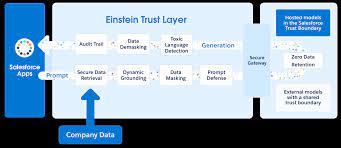
The Einstein Trust Layer is a secure AI architecture. It is natively built into the Salesforce Platform. Designed for enterprise security standards the Einstein Trust Layer continues to allow teams to benefit from generative AI. Without compromising their customer data, while at the same time letting companies use their trusted data to improve generative AI responses: Trusted AI starts with securely grounded prompts. A prompt is a canvas to provide detailed context and instructions to Large Language Models. The Einstein Trust layer allows you to responsibly ground all of your prompts in customer data and mask that data when the prompt is shared with Large Language Models*. With our Zero Retention architecture, none of your data is stored outside of Salesforce. Salesforce gives customers control over the use of their data for AI. Whether using our own Salesforce-hosted models or external models that are part of our Shared Trust Boundary, like OpenAI, no context is stored. The large language model forgets both the prompt and the output as soon as the output is processed. Like1 Related Posts Who is Salesforce? Who is Salesforce? Here is their story in their own words. From our inception, we’ve proudly embraced the identity of Read more Salesforce Marketing Cloud Transactional Emails Salesforce Marketing Cloud Transactional Emails are immediate, automated, non-promotional messages crucial to business operations and customer satisfaction, such as order Read more Salesforce Unites Einstein Analytics with Financial CRM Salesforce has unveiled a comprehensive analytics solution tailored for wealth managers, home office professionals, and retail bankers, merging its Financial Read more AI-Driven Propensity Scores AI plays a crucial role in propensity score estimation as it can discern underlying patterns between treatments and confounding variables Read more

Read More
AI's Impact on the Workforce

AI’s Impact on the Workforce

According to McKinsey, generative AI has the potential to contribute between $2.6 trillion and $4.4 trillion in value to the global economy across various industries, spanning banking, retail, high tech, healthcare, and life sciences. Its impact is expected to reach diverse professions, including customer operations, marketing and sales, software engineering, and research and development. The influence of AI on the workforce is significant. A report by Goldman Sachs suggests that AI could replace the equivalent of 300 million full-time jobs, affecting a quarter of work tasks in the US and Europe. However, it also brings forth new job opportunities and a productivity boom. Despite concerns about job displacement, AI is anticipated to generate numerous new opportunities. Roles like prompt engineer and AI product manager are emerging, with a Salesforce-sponsored IDC white paper predicting a surge in demand for positions such as data architects, AI ethicists, and AI solutions architects over the next 12 months. The report also forecasts the creation of 11.6 million new jobs within the Salesforce ecosystem alone over the next six years. Recent advancements in generative AI, exemplified by products like ChatGPT with 100 million monthly active users in two months, have reignited discussions about automation’s impact on jobs. While the extent of disruption remains unknown, developers, users, and policymakers should consider its effects on workers. To address challenges and opportunities, Majority Leader Chuck Schumer has launched a SAFE Innovation Framework, emphasizing worker security. The Biden administration is developing a National AI Strategy to address economic and job impacts. For individuals in the workforce, there’s an opportunity to cultivate existing skills and acquire new ones through platforms like Salesforce’s Trailhead, Coursera, and LinkedIn. AI’s impact on jobs involves eliminating repetitive tasks, allowing individuals to focus on more strategic and creative aspects of their roles. In fields like sales, customer service, marketing, healthcare, finance, and graphic design, AI will transform roles and create new opportunities. Chris Poole, AI Technical Consulting Lead in Salesforce’s global AI practice, envisions AI becoming ingrained in every aspect of our lives, contributing to fascinating evolution across various fields. The scale of AI adoption’s impact on workers, especially with generative AI tools, remains uncertain. Potential effects include replacing, complementing, or freeing workers for more productive tasks, or creating new jobs. A Goldman Sachs estimate suggests that about two-thirds of current jobs are exposed to some degree of AI automation, with generative AI potentially substituting up to one-fourth of current work. McKinsey Global Institute estimates that 29.5 percent of all hours worked could be automated by 2030. Regarding job impact, professional occupations associated with clerical work in finance, law, and business management are most exposed to AI. However, AI is also concurrently creating many new jobs. Like Related Posts Who is Salesforce? Who is Salesforce? Here is their story in their own words. From our inception, we’ve proudly embraced the identity of Read more Salesforce Marketing Cloud Transactional Emails Salesforce Marketing Cloud Transactional Emails are immediate, automated, non-promotional messages crucial to business operations and customer satisfaction, such as order Read more Salesforce Unites Einstein Analytics with Financial CRM Salesforce has unveiled a comprehensive analytics solution tailored for wealth managers, home office professionals, and retail bankers, merging its Financial Read more AI-Driven Propensity Scores AI plays a crucial role in propensity score estimation as it can discern underlying patterns between treatments and confounding variables Read more

Read More

Measures for Granular Calculated Insights

Add More Measures to Calculated Insights Now you can add more measures to your calculated insights to achieve an improved result. The max number of measures per calculated insight has increased from 5 to 20. View Calculated Insights in Builder Now it’s easier to review the objects, filters, relationships, and logic that you selected for a Calculated Insight. When you use the Insight Builder to create a Calculated Insight, you can view insight logic in the builder and in SQL. Where: This change applies to Lightning Experience in all editions. How: From Customer Data Platform, click Calculated Insights, and then click Show In Builder. Install or Update Data Kits That Power Standard Data Bundles Salesforce CRM data bundles are now powered by data kits to enable more scalable delivery and faster innovation for Salesforce CRM data bundles. As a Customer Data Platform Admin, you can install or update data kits that power Salesforce CRM data bundles. Where: This change applies to Lightning Experience in all editions. Exploring the Power of Calculated Insights (CI) Calculated Insights (CIs) in Salesforce Data Cloud enable you to define and compute complex, multidimensional metrics, offering a deeper understanding of your data. These insights help analyze performance across different dimensions—like channel-level activity or customer engagement metrics—empowering your organization to make data-driven decisions. For example, CIs can rank customers by engagement or spending, evaluate product performance, and uncover trends in purchasing or browsing behavior. Let’s walk through how to use CIs effectively, with examples and reporting guidance. Example 1: Simplifying Metrics with a Single Measure Consider a CI with one aggregatable metric, such as Lifetime Value (LTV). To report on this CI: When the report opens, all CI dimensions appear as groupings, while measures display as columns in a summary format. What Happens with CIs Containing More Than Three Dimensions? Currently, reports support up to three groupings. For CIs with more than three dimensions, the first three are automatically included, though you can replace one dimension with another. Salesforce plans to expand this limit in the future. For example, a CI with the dimensions brand, customer ID, and product category will default to these three groupings in a summary report. Example 2: Handling Complex Metrics Now, imagine a CI that includes: A measure is non-aggregatable when summing it wouldn’t provide meaningful results. For instance, summing rank values for 10 customers doesn’t make sense; instead, metrics like min or max can be applied. Reporting for Complex CIs: By default, reports group CI dimensions and display measures as columns in summary format. However, non-aggregatable measures depend on all dimensions being present. For example, Rank values rely on dimensions like Lead Source and Stage—if one dimension is removed, the related non-aggregatable measures will also be excluded to maintain data integrity. Using Calculated Insights in Real-World Scenarios Use Case 1: Optimizing Marketing Efforts Create a report on a CI that ranks web traffic sources and breaks them down by product category. Use Case 2: Enhancing Patient Engagement Develop a report on a unified patient profile CI, grouping patients by age group and health score. Use Case 3: Identifying High-Performing Channels Generate a CI report grouped by marketing channels and regions in your Customer Lifetime Value metric. Visualizing CIs in Reports You can add charts to your CI reports, adhering to the same restrictions as in Lightning Reports. This visualization capability enables you to uncover trends and share insights effectively. Calculated Insights unlock a powerful layer of reporting in Salesforce, offering flexibility, precision, and actionable intelligence. Whether optimizing marketing efforts, improving patient engagement, or refining customer segmentation, CIs empower teams to make data-driven decisions that drive success. Like Related Posts Who is Salesforce? Who is Salesforce? Here is their story in their own words. From our inception, we’ve proudly embraced the identity of Read more Salesforce Marketing Cloud Transactional Emails Salesforce Marketing Cloud Transactional Emails are immediate, automated, non-promotional messages crucial to business operations and customer satisfaction, such as order Read more Salesforce Unites Einstein Analytics with Financial CRM Salesforce has unveiled a comprehensive analytics solution tailored for wealth managers, home office professionals, and retail bankers, merging its Financial Read more AI-Driven Propensity Scores AI plays a crucial role in propensity score estimation as it can discern underlying patterns between treatments and confounding variables Read more

Read More
gettectonic.com