Artificial Intelligence Archives - gettectonic.com - Page 8
salesforce ai pitchfield

Salesforce AI Pitchfield

AI Pitchfield is more than a showcase of entrepreneurial talent—it’s a launchpad for the next generation of AI pioneers. By fostering connections and providing critical investment opportunities, Salesforce and its partners are driving the evolution of AI across India and Southeast Asia. This initiative reflects Salesforce’s commitment to advancing technology, empowering startups, and shaping a future where AI continues to transform industries and unlock untapped potential.

Read More
LLMs and AI

LLMs and AI

Large Language Models (LLMs): Revolutionizing AI and Custom Solutions Large Language Models (LLMs) are transforming artificial intelligence by enabling machines to generate and comprehend human-like text, making them indispensable across numerous industries. The global LLM market is experiencing explosive growth, projected to rise from $1.59 billion in 2023 to $259.8 billion by 2030. This surge is driven by the increasing demand for automated content creation, advances in AI technology, and the need for improved human-machine communication. Several factors are propelling this growth, including advancements in AI and Natural Language Processing (NLP), large datasets, and the rising importance of seamless human-machine interaction. Additionally, private LLMs are gaining traction as businesses seek more control over their data and customization. These private models provide tailored solutions, reduce dependency on third-party providers, and enhance data privacy. This guide will walk you through building your own private LLM, offering valuable insights for both newcomers and seasoned professionals. What are Large Language Models? Large Language Models (LLMs) are advanced AI systems that generate human-like text by processing vast amounts of data using sophisticated neural networks, such as transformers. These models excel in tasks such as content creation, language translation, question answering, and conversation, making them valuable across industries, from customer service to data analysis. LLMs are generally classified into three types: LLMs learn language rules by analyzing vast text datasets, similar to how reading numerous books helps someone understand a language. Once trained, these models can generate content, answer questions, and engage in meaningful conversations. For example, an LLM can write a story about a space mission based on knowledge gained from reading space adventure stories, or it can explain photosynthesis using information drawn from biology texts. Building a Private LLM Data Curation for LLMs Recent LLMs, such as Llama 3 and GPT-4, are trained on massive datasets—Llama 3 on 15 trillion tokens and GPT-4 on 6.5 trillion tokens. These datasets are drawn from diverse sources, including social media (140 trillion tokens), academic texts, and private data, with sizes ranging from hundreds of terabytes to multiple petabytes. This breadth of training enables LLMs to develop a deep understanding of language, covering diverse patterns, vocabularies, and contexts. Common data sources for LLMs include: Data Preprocessing After data collection, the data must be cleaned and structured. Key steps include: LLM Training Loop Key training stages include: Evaluating Your LLM After training, it is crucial to assess the LLM’s performance using industry-standard benchmarks: When fine-tuning LLMs for specific applications, tailor your evaluation metrics to the task. For instance, in healthcare, matching disease descriptions with appropriate codes may be a top priority. Conclusion Building a private LLM provides unmatched customization, enhanced data privacy, and optimized performance. From data curation to model evaluation, this guide has outlined the essential steps to create an LLM tailored to your specific needs. Whether you’re just starting or seeking to refine your skills, building a private LLM can empower your organization with state-of-the-art AI capabilities. For expert guidance or to kickstart your LLM journey, feel free to contact us for a free consultation. Like Related Posts Who is Salesforce? Who is Salesforce? Here is their story in their own words. From our inception, we’ve proudly embraced the identity of Read more Salesforce Marketing Cloud Transactional Emails Salesforce Marketing Cloud Transactional Emails are immediate, automated, non-promotional messages crucial to business operations and customer satisfaction, such as order Read more Salesforce Unites Einstein Analytics with Financial CRM Salesforce has unveiled a comprehensive analytics solution tailored for wealth managers, home office professionals, and retail bankers, merging its Financial Read more AI-Driven Propensity Scores AI plays a crucial role in propensity score estimation as it can discern underlying patterns between treatments and confounding variables Read more


Read More
Customer Engagement with AI

Customer Engagement with AI

Funlab Explores AI to Boost Customer Engagement in Leisure Venues In a push to enhance customer experiences across its “leisure-tainment” venues, Funlab has begun experimenting with artificial intelligence. Speaking at a Salesforce Agentforce event in Sydney, Funlab’s Head of Customer Relationships and Retention, Tracy Tanti, shared that the company is “excited to be able to start experimenting” with AI. Agentforce, a Salesforce platform designed to create autonomous agents for supporting employees and customers, serves as a key part of Funlab’s AI exploration efforts. According to Tanti, Funlab has a range of AI-focused projects on its roadmap, with the goal of blending digital experiences into real-life interactions and supporting both venue and corporate teams with AI-driven tools. Reflecting the company’s dedication to careful planning, Tanti described how Salesforce connected Funlab with another customer, Norths Collective, to discuss its own AI implementation journey. Robert Lopez, Chief Marketing and Innovation Officer at Norths Collective, has seen success with enhanced personalization and analytics, which have contributed to increased membership and engagement. Tanti noted that Norths Collective’s transformation work would provide valuable insights for Funlab as it optimizes its data in preparation for AI adoption. Currently, Funlab is in a post-digital transformation phase, refining its processes to deliver more connected and personalized guest experiences throughout the customer lifecycle. With ongoing expansion into the U.S. market—including recent openings of Holey Moley venues—Funlab is also focusing on building robust support infrastructure and engaging local audiences through Salesforce. Tanti highlighted the company’s vision for the U.S. to become a significant portion of total revenues and emphasized how Salesforce will help Funlab nurture a strong customer database in this new market. Additionally, Funlab is leveraging Salesforce to grow its event and function sales, which are projected to reach 39% of total online revenue by year’s end, up from 23% earlier this year. This expansion underscores Funlab’s commitment to using AI and data-driven insights to fuel growth and deepen customer engagement across all its markets and venues. Like Related Posts Who is Salesforce? Who is Salesforce? Here is their story in their own words. From our inception, we’ve proudly embraced the identity of Read more Salesforce Marketing Cloud Transactional Emails Salesforce Marketing Cloud Transactional Emails are immediate, automated, non-promotional messages crucial to business operations and customer satisfaction, such as order Read more Salesforce Unites Einstein Analytics with Financial CRM Salesforce has unveiled a comprehensive analytics solution tailored for wealth managers, home office professionals, and retail bankers, merging its Financial Read more AI-Driven Propensity Scores AI plays a crucial role in propensity score estimation as it can discern underlying patterns between treatments and confounding variables Read more
Read More
AI Agents and Digital Transformation

AI Agents and Digital Transformation

In the rapidly developingng world of technology, Artificial Intelligence (AI) is revolutionizing industries and reshaping how we interact with digital systems. One of the most promising advancements within AI is the development of AI agents. These intelligent entities, often powered by Large Language Models (LLMs), are driving the next wave of digital transformation by enabling automation, personalization, and enhanced decision-making across various sectors. AI Agents and digital transformation are here to stay. What is an AI Agent? An AI agent, or intelligent agent, is a software entity capable of perceiving its environment, reasoning about its actions, and autonomously working toward specific goals. These agents mimic human-like behavior using advanced algorithms, data processing, and machine-learning models to interact with users and complete tasks. LLMs to AI Agents — An Evolution The evolution of AI agents is closely tied to the rise of Large Language Models (LLMs). Models like GPT (Generative Pre-trained Transformer) have showcased remarkable abilities to understand and generate human-like text. This development has enabled AI agents to interpret complex language inputs, facilitating advanced interactions with users. Key Capabilities of LLM-Based Agents LLM-powered agents possess several key advantages: Two Major Types of LLM Agents LLM agents are classified into two main categories: Multi-Agent Systems (MAS) A Multi-Agent System (MAS) is a group of autonomous agents working together to achieve shared goals or solve complex problems. MAS applications span robotics, economics, and distributed computing, where agents interact to optimize processes. AI Agent Architecture and Key Elements AI agents generally follow a modular architecture comprising: Learning Strategies for LLM-Based Agents AI agents utilize various learning techniques, including supervised, reinforcement, and self-supervised learning, to adapt and improve their performance in dynamic environments. How Autonomous AI Agents Operate Autonomous AI agents act independently of human intervention by perceiving their surroundings, reasoning through possible actions, and making decisions autonomously to achieve set goals. AI Agents’ Transformative Power Across Industries AI agents are transforming numerous industries by automating tasks, enhancing efficiency, and providing data-driven insights. Here’s a look at some key use cases: Platforms Powering AI Agents The Benefits of AI Agents and Digital Transformation AI agents offer several advantages, including: The Future of AI Agents The potential of AI agents is immense, and as AI technology advances, we can expect more sophisticated agents capable of complex reasoning, adaptive learning, and deeper integration into everyday tasks. The future promises a world where AI agents collaborate with humans to drive innovation, enhance efficiency, and unlock new opportunities for growth in the digital age. AI Agents and Digital Transformation By partnering with AI development specialists at Tectonic, organizations can access cutting-edge solutions tailored to their needs, positioning themselves to stay ahead in the rapidly evolving AI-driven market. Agentforce Like Related Posts Who is Salesforce? Who is Salesforce? Here is their story in their own words. From our inception, we’ve proudly embraced the identity of Read more Salesforce Marketing Cloud Transactional Emails Salesforce Marketing Cloud Transactional Emails are immediate, automated, non-promotional messages crucial to business operations and customer satisfaction, such as order Read more Salesforce Unites Einstein Analytics with Financial CRM Salesforce has unveiled a comprehensive analytics solution tailored for wealth managers, home office professionals, and retail bankers, merging its Financial Read more AI-Driven Propensity Scores AI plays a crucial role in propensity score estimation as it can discern underlying patterns between treatments and confounding variables Read more

Read More
Life of a Salesforce Admin in the AI Era

Life of a Salesforce Admin in the AI Era

The life of Salesforce admins is rapidly evolving as artificial intelligence (AI) becomes integral to business operations. Let’s examine the Life of a Salesforce Admin in the AI Era. By 2025, the Salesforce admin’s role will expand beyond managing CRM systems to include leveraging AI tools to enhance efficiency, boost productivity, and maintain security. While this future offers exciting opportunities, it also comes with new responsibilities that require admins to adapt and learn. So, what will Salesforce admins need to succeed in this AI-driven landscape? The Salesforce Admin’s Role in 2025 In 2025, Salesforce admins will be at the forefront of digital transformation, helping organizations harness the full potential of the Salesforce ecosystem and AI-powered tools. These AI tools will automate processes, predict trends, and improve overall efficiency. Many professionals are already enrolling in Salesforce Administrator courses focused on AI and automation, equipping them with the essential skills to thrive in this new era. Key Responsibilities in Life of a Salesforce Admin in the AI Era 1. AI Integration and Optimization Admins will be responsible for integrating AI tools like Salesforce Einstein AI into workflows, ensuring they’re properly configured and tailored to the organization’s needs. Core tasks include: 2. Automating Processes with AI AI will revolutionize automation, making complex workflows more efficient. Admins will need to: 3. Data Management and Predictive Analytics Admins will leverage AI to manage data and generate predictive insights. Key responsibilities include: 4. Enhancing Security and Compliance AI-powered security tools will help admins proactively protect systems. Responsibilities include: 5. Supporting AI-Driven Customer Experiences Admins will deploy AI tools that enhance customer interactions. Their responsibilities include: 6. Continuous Learning and Upskilling As AI evolves, so too must Salesforce admins. Key learning areas include: 7. Collaboration with Cross-Functional Teams Admins will work closely with IT, marketing, and sales teams to deploy AI solutions organization-wide. Their collaborative efforts will include: Skills Required for Future Salesforce Admins 1. AI and Machine Learning Proficiency Admins will need to understand how AI models like Einstein AI function and how to deploy them. While not requiring full data science expertise, a solid grasp of AI concepts—such as predictive analytics and machine learning—will be essential. 2. Advanced Data Management and Analysis Managing large datasets and ensuring data accuracy will be critical as admins work with AI tools. Proficiency in data modeling, SQL, SOQL, and ETL processes will be vital for handling AI-powered data management. 3. Automation and Process Optimization AI-enhanced automation will become a key responsibility. Admins must master tools like Salesforce Flow and Einstein Automate to build intelligent workflows and ensure smooth process automation. 4. Security and Compliance Expertise With AI-driven security protocols, admins will need to stay updated on data privacy regulations and deploy tools that ensure compliance and prevent data breaches. 5. Collaboration and Leadership Admins will lead the implementation of AI tools across departments, requiring strong collaboration and leadership skills to align AI-driven solutions with business objectives. Advanced Certifications for AI-Era Admins To stay competitive, Salesforce admins will need to pursue advanced certifications. Key certifications include: Tectonic’s Thoughts The Salesforce admin role is transforming as AI becomes an essential part of the platform. By mastering AI tools, optimizing processes, ensuring security, and continuously upskilling, Salesforce admins can become pivotal players in driving digital transformation. The future is bright for those who embrace the AI-powered Salesforce landscape and position themselves at the forefront of innovation. Like Related Posts Who is Salesforce? Who is Salesforce? Here is their story in their own words. From our inception, we’ve proudly embraced the identity of Read more Salesforce Marketing Cloud Transactional Emails Salesforce Marketing Cloud Transactional Emails are immediate, automated, non-promotional messages crucial to business operations and customer satisfaction, such as order Read more Salesforce Unites Einstein Analytics with Financial CRM Salesforce has unveiled a comprehensive analytics solution tailored for wealth managers, home office professionals, and retail bankers, merging its Financial Read more AI-Driven Propensity Scores AI plays a crucial role in propensity score estimation as it can discern underlying patterns between treatments and confounding variables Read more

Read More
Zendesk Launches AI Agent Builder

The State of AI

The State of AI: How We Got Here (and What’s Next) Artificial intelligence (AI) has evolved from the realm of science fiction into a transformative force reshaping industries and lives around the world. But how did AI develop into the technology we know today, and where is it headed next? At Dreamforce, two of Salesforce’s leading minds in AI—Chief Scientist Silvio Savarese and Chief Futurist Peter Schwartz—offered insights into AI’s past, present, and future. How We Got Here: The Evolution of AI AI’s roots trace back decades, and its journey has been defined by cycles of innovation and setbacks. Peter Schwartz, Salesforce’s Chief Futurist, shared a firsthand perspective on these developments. Having been involved in AI since the 1970s, Schwartz witnessed the first “AI winter,” a period of reduced funding and interest due to the immense challenges of understanding and replicating the human brain. In the 1990s and early 2000s, AI shifted from attempting to mimic human cognition to adopting data-driven models. This new direction opened up possibilities beyond the constraints of brain-inspired approaches. By the 2010s, neural networks re-emerged, revolutionizing AI by enabling systems to process raw data without extensive pre-processing. Savarese, who began his AI research during one of these challenging periods, emphasized the breakthroughs in neural networks and their successor, transformers. These advancements culminated in large language models (LLMs), which can now process massive datasets, generate natural language, and perform tasks ranging from creating content to developing action plans. Today, AI has progressed to a new frontier: large action models. These systems go beyond generating text, enabling AI to take actions, adapt through feedback, and refine performance autonomously. Where We Are Now: The Present State of AI The pace of AI innovation is staggering. Just a year ago, discussions centered on copilots—AI systems designed to assist humans. Now, the conversation has shifted to autonomous AI agents capable of performing complex tasks with minimal human oversight. Peter Schwartz highlighted the current uncertainties surrounding AI, particularly in regulated industries like banking and healthcare. Leaders are grappling with questions about deployment speed, regulatory hurdles, and the broader societal implications of AI. While many startups in the AI space will fail, some will emerge as the giants of the next generation. Salesforce’s own advancements, such as the Atlas Reasoning Engine, underscore the rapid progress. These technologies are shaping products like Agentforce, an AI-powered suite designed to revolutionize customer interactions and operational efficiency. What’s Next: The Future of AI According to Savarese, the future lies in autonomous AI systems, which include two categories: The Road Ahead As AI continues to evolve, it’s clear that its potential is boundless. However, the path forward will require careful navigation of ethical, regulatory, and practical challenges. The key to success lies in innovation, collaboration, and a commitment to creating systems that enhance human capabilities. For Salesforce, the journey has only just begun. With groundbreaking technologies and visionary leadership, the company is not just predicting the future of AI—it’s creating it. The State of AI. Like Related Posts Who is Salesforce? Who is Salesforce? Here is their story in their own words. From our inception, we’ve proudly embraced the identity of Read more Salesforce Marketing Cloud Transactional Emails Salesforce Marketing Cloud Transactional Emails are immediate, automated, non-promotional messages crucial to business operations and customer satisfaction, such as order Read more Salesforce Unites Einstein Analytics with Financial CRM Salesforce has unveiled a comprehensive analytics solution tailored for wealth managers, home office professionals, and retail bankers, merging its Financial Read more AI-Driven Propensity Scores AI plays a crucial role in propensity score estimation as it can discern underlying patterns between treatments and confounding variables Read more
Read More
Multi AI Agent Systems

Multi AI Agent Systems

Building Multi-AI Agent Systems: A Comprehensive Guide As technology advances at an unprecedented pace, Multi-AI Agent systems are emerging as a transformative approach to creating more intelligent and efficient applications. This guide delves into the significance of Multi-AI Agent systems and provides a step-by-step tutorial on building them using advanced frameworks like LlamaIndex and CrewAI. What Are Multi-AI Agent Systems? Multi-AI Agent systems are a groundbreaking development in artificial intelligence. Unlike single AI agents that operate independently, these systems consist of multiple autonomous agents that collaborate to tackle complex tasks or solve intricate problems. Key Features of Multi-AI Agent Systems: Applications of Multi-AI Agent Systems: Multi-agent systems are versatile and impactful across industries, including: The Workflow of a Multi-AI Agent System Building an effective Multi-AI Agent system requires a structured approach. Here’s how it works: Building Multi-AI Agent Systems with LlamaIndex and CrewAI Step 1: Define Agent Roles Clearly define the roles, goals, and specializations of each agent. For example: Step 2: Initiate the Workflow Establish a seamless workflow for agents to perform their tasks: Step 3: Leverage CrewAI for Collaboration CrewAI enhances collaboration by enabling autonomous agents to work together effectively: Step 4: Integrate LlamaIndex for Data Handling Efficient data management is crucial for agent performance: Understanding AI Inference and Training Multi-AI Agent systems rely on both AI inference and training: Key Differences: Aspect AI Training AI Inference Purpose Builds the model. Uses the model for tasks. Process Data-driven learning. Real-time decision-making. Compute Needs Resource-intensive. Optimized for efficiency. Both processes are essential: training builds the agents’ capabilities, while inference ensures swift, actionable results. Tools for Multi-AI Agent Systems LlamaIndex An advanced framework for efficient data handling: CrewAI A collaborative platform for building autonomous agents: Practical Example: Multi-AI Agent Workflow Conclusion Building Multi-AI Agent systems offers unparalleled opportunities to create intelligent, responsive, and efficient applications. By defining clear agent roles, leveraging tools like CrewAI and LlamaIndex, and integrating robust workflows, developers can unlock the full potential of these systems. As industries continue to embrace this technology, Multi-AI Agent systems are set to revolutionize how we approach problem-solving and task execution. Like Related Posts Who is Salesforce? Who is Salesforce? Here is their story in their own words. From our inception, we’ve proudly embraced the identity of Read more Salesforce Unites Einstein Analytics with Financial CRM Salesforce has unveiled a comprehensive analytics solution tailored for wealth managers, home office professionals, and retail bankers, merging its Financial Read more AI-Driven Propensity Scores AI plays a crucial role in propensity score estimation as it can discern underlying patterns between treatments and confounding variables Read more Tectonic’s Successful Salesforce Track Record Salesforce Technology Services Integrator – Tectonic has successfully delivered Salesforce in a variety of industries including Public Sector, Hospitality, Manufacturing, Read more

Read More
Generative AI Replaces Legacy Systems

Generative AI Replaces Legacy Systems

Generative AI Will Overtake Legacy Stack Vendors With the rise of generative AI, legacy software vendors like Appian, IBM, Salesforce, SAP, Pegasystems, IFS, Oracle, Software AG, TIBCO, and UIPath are becoming increasingly obsolete. These vendors represent the old guard, clinging to outdated business process automation systems, while the future clearly belongs to AI-driven innovation. Back in the early 2010s, discussions around dynamic processes—self-assembling workflows created by artificial intelligence—were already gaining traction. The vision was to bypass the need for traditional process mapping or manually designing new interfaces. Instead, AI would dynamically generate processes in response to specific tasks, allowing for far greater flexibility and adaptability. However, business rules within BPMS (Business Process Management Systems) often imposed constraints that limited decision-making flexibility. Today, this vision is finally within reach. Many traditional stack vendors are scrambling to integrate generative AI into their offerings in a desperate bid to remain relevant. But the truth is, generative AI renders these vendors largely unnecessary. For instance, Pegasystems, like many others, now incorporates generative AI into its software, but users are still bound to old workflows and low-code development systems. The reliance on building processes, regardless of AI assistance, keeps them stuck in the past. Across the board—whether it’s ERP, CRM, or RPA—vendors such as Salesforce, SAP, and IFS remain tethered to their outdated systems, even though they possess all the necessary data, both structured and unstructured, to benefit from a simpler, AI-powered approach. All that’s needed is a generative AI layer on top to handle tasks like customer complaints. Consider a customer complaint scenario: traditionally, a complaint is processed through a defined workflow, often requiring the creation of expensive, custom SaaS solutions. But what if an LLM (Large Language Model) could handle this instead? The LLM could analyze the complaint, extract key information, assess urgency through sentiment analysis, and generate a custom workflow on the fly. It could even generate backend code in real-time to process refunds or update databases, all without relying on legacy front-end systems. The LLM’s ability to create and execute dynamic workflows eliminates the need for static business processes. The AI generates temporary code and UI elements to handle a specific interaction, then discards them once the task is complete. This shifts the focus away from traditional, bloated enterprise systems and towards dynamic, JIT (Just-In-Time) interactions that are tailored to each individual customer. The efficiency gains are not in cutting jobs but in eliminating the need for costly, antiquated software and lengthy digital transformation programs. Generative AI doesn’t require massive ERP or CRM implementations, and businesses can converse directly with customer data through AI, bypassing the need for complex system integrations. Master Data Management, which once consumed millions of dollars and years of effort, is now positioned to become a simple, AI-powered solution. Enterprises already have well-structured and clean data, and adding a generative AI layer could remove the need for integrating or syncing legacy systems. The era of major vendors selling AI-enhanced solutions built on top of decaying software stacks is coming to an end. The idea of using generative AI as the foundation for a new business operating system, without the need for bloated, legacy software, is increasingly appealing. With the global workflow automation market projected to grow to .4 billion by 2030, the future clearly belongs to AI-driven solutions. Like Related Posts Who is Salesforce? Who is Salesforce? Here is their story in their own words. From our inception, we’ve proudly embraced the identity of Read more Salesforce Marketing Cloud Transactional Emails Salesforce Marketing Cloud Transactional Emails are immediate, automated, non-promotional messages crucial to business operations and customer satisfaction, such as order Read more Salesforce Unites Einstein Analytics with Financial CRM Salesforce has unveiled a comprehensive analytics solution tailored for wealth managers, home office professionals, and retail bankers, merging its Financial Read more AI-Driven Propensity Scores AI plays a crucial role in propensity score estimation as it can discern underlying patterns between treatments and confounding variables Read more

Read More
New Salesforce Maps Experience Auto-Enabled in Winter ‘25 (October) Release

Christmas 2024

With artificial Christmas trees and holiday inflatables already appearing alongside Halloween decorations at big-box retailers, (and in neighbors’ yards before the first drop of pumpkin spice has been sipped) it’s clear that the holiday season is beginning earlier than ever this year. However, according to a new forecast from Salesforce, the expected holiday sales boost may be somewhat modest. Salesforce projects a 2 percent increase in overall sales for November and December, a slight drop from the 3 percent increase seen in 2023. The forecast highlights that consumers are facing higher debt due to elevated interest rates and inflation, which is likely to diminish their purchasing power compared to recent years. About 40 percent of shoppers plan to cut back on spending this year, while just under half intend to maintain their current spending levels. Adding to the challenge is the brief holiday shopping window between Thanksgiving and Christmas this year—only 27 days, the shortest since 2019. This data comes from Salesforce’s analysis of over 1.5 billion global shoppers across 64 countries, with a focus on 12 key markets including the U.S., Canada, U.K., Germany, and France. Shopping Trends and Strategies In terms of shopping habits, bargain hunters are expected to turn to platforms like Temu, Shein, and other Chinese-owned apps, with nearly one in five holiday purchases anticipated from these sources. TikTok is seeing rapid growth as a sales platform, with a 24 percent increase in shoppers making purchases through the app since April. For businesses, the focus on price is likely to intensify. Two-thirds of global shoppers will let cost dictate their shopping decisions this year, compared to 46 percent in 2020. Less than a third will prioritize product quality over price when selecting gifts. This trend suggests a busy Black Friday and Cyber Monday, with two-thirds of shoppers planning to delay major purchases until Cyber Week to seek out bargains. Salesforce forecasts an average discount of 30 percent in the U.S. during this period. Caila Schwartz, director of strategy and consumer insights at Salesforce, notes, “This season will be competitive, intense, and focused heavily on pricing and discounting strategies.” Shipping and Technology Challenges The shipping industry also poses a potential challenge, with container shipping costs becoming increasingly unstable. Brands and retailers are expected to incur an additional $197 billion in middle-mile expenses—a 97 percent increase from last year. To counter the threat from discount online retailers, stores with online capabilities should enhance their in-store pickup options. Salesforce predicts that buy online, pick up in store (BOPIS) will account for up to one-third of online orders globally in the week leading up to Christmas. Additionally, while still emerging, artificial intelligence (AI) is expected to play a role in holiday sales, with 18 percent of global orders influenced by predictive and generative AI, according to Salesforce. As retailers navigate these complexities, strategic pricing and efficient logistics will be key to capturing consumer attention and driving holiday sales. Like Related Posts Who is Salesforce? Who is Salesforce? Here is their story in their own words. From our inception, we’ve proudly embraced the identity of Read more Salesforce Marketing Cloud Transactional Emails Salesforce Marketing Cloud Transactional Emails are immediate, automated, non-promotional messages crucial to business operations and customer satisfaction, such as order Read more Salesforce Unites Einstein Analytics with Financial CRM Salesforce has unveiled a comprehensive analytics solution tailored for wealth managers, home office professionals, and retail bankers, merging its Financial Read more AI-Driven Propensity Scores AI plays a crucial role in propensity score estimation as it can discern underlying patterns between treatments and confounding variables Read more

Read More
AI Agents, Tech's Next Big Bet

AI Agents, Tech’s Next Big Bet

What Marketers Need to Know About AI Agents, Tech’s Next Big Bet Companies like Salesforce and OpenAI are making significant investments in AI agents, which are digital assistants poised to represent the next evolution of artificial intelligence. These agents promise to autonomously handle a variety of tasks, from making reservations to negotiating business deals. During OpenAI’s DevDay event in San Francisco last week, the company showcased a voice bot that successfully ordered 400 chocolate-covered strawberries from a local delivery service, specifying delivery and payment terms with minimal issues. OpenAI CEO Sam Altman stated, “2025 is when agents will work,” highlighting the potential for these technologies to revolutionize workflows. While this may seem futuristic, companies like Salesforce, HubSpot, and Pactum AI are already implementing their own AI agents, though examples from brands like Qantas Airways remain relatively scarce—a point of discussion at Advertising Week New York. What Are AI Agents? AI agents extend beyond mere chatbots. According to Parasvil Patel, a partner at Radical Ventures, they lack a single unifying definition and encompass a wide range of functionalities, from automating workflows to scheduling meetings. The overarching goal, however, is clear: “The ultimate aim is to execute work autonomously,” Patel explained. Currently, AI agents are in the “co-pilot” phase, handling specific tasks such as summarizing meetings. The true breakthrough will occur when they transition to “autopilot,” managing more complex tasks without human intervention. According to Patel, this shift could take up to 24 months. When Did They Emerge? AI agents first gained attention on social media in early 2023, with various startups, including AutoGPT—an open-source application built on OpenAI’s models—promising autonomous capabilities. However, Patel notes that many of these early experiments were not robust enough to be deployed effectively in production environments. How Are Companies Using AI Agents? The appeal of AI agents lies in their ability to save time, enhance efficiency, and free employees from repetitive tasks. For instance, a large distribution company struggling to manage 100,000 suppliers utilized Pactum’s AI, which deploys autonomous agents for negotiations. Instead of seeing negotiations as a dead end, these AI agents continuously customized payment deals based on the speed of suppliers’ goods. This approach led to price discounts, rebates, and allowances. Salesforce has also seen positive results with its AI agents. Its pilot program, AgentForce, launched with five clients—including OpenTable and global publisher Wiley—and achieved a 40% increase in case resolution compared to its previous chatbot for Wiley. At the firm’s Dreamforce event, Salesforce demonstrated AgentForce with Ask Astro, assisting attendees in planning their schedules by suggesting sessions and making reservations. Salesforce’s chief marketing officer, Ariel Kelman, stated that the company has heavily invested in developing its AI agent platform in response to client demand. “What companies are figuring out with generative AI is how to deliver productivity improvements for employees and provide meaningful interactions with customers,” he noted. What About Roadblocks? The journey to fully functional AI agents is not without challenges. Managing different data formats—text, images, and videos—can be complex, as highlighted by William Chen, director of product management for AI & emerging tech at Agora. “Your system is only as good as your data source,” he said. For Salesforce, the challenge lies in the nascent customer adoption of AI agents, with companies just beginning to explore how to leverage them for productivity, according to Kelman. The key challenge is determining what solutions work best for employees and customers across various use cases. Are Jobs at Risk? Not necessarily. AI agents are unlikely to replace jobs in the immediate future. Instead, they allow employees to focus on more strategic and meaningful tasks. Rand explained, “The role of people will shift to configuring the autopilot, rather than flying the plane, which is a positive change.” For example, a major logistics client of Pactum, which previously relied on human negotiators for managing deals with freight providers, can now use AI agents to negotiate more efficiently. This adaptability allows companies to dynamically shift their business strategies based on market conditions. What’s Next? While early adopters of AI agents are seeing initial successes, there’s much more to discover. Salesforce plans to launch its next AI agent later this month: a Sales Development Representative (SDR) designed to manage early-stage sales interactions. Typically, human SDRs follow up on marketing leads through emails and calls, but this AI agent will qualify leads, providing human salespeople with a targeted list of 50 to 100 prospects eager to engage. “Instead of receiving a list of 500 leads, they’ll get a refined list of those who actually want to talk,” Kelman concluded. Like Related Posts Who is Salesforce? Who is Salesforce? Here is their story in their own words. From our inception, we’ve proudly embraced the identity of Read more Salesforce Marketing Cloud Transactional Emails Salesforce Marketing Cloud Transactional Emails are immediate, automated, non-promotional messages crucial to business operations and customer satisfaction, such as order Read more Salesforce Unites Einstein Analytics with Financial CRM Salesforce has unveiled a comprehensive analytics solution tailored for wealth managers, home office professionals, and retail bankers, merging its Financial Read more AI-Driven Propensity Scores AI plays a crucial role in propensity score estimation as it can discern underlying patterns between treatments and confounding variables Read more

Read More
Einstein Copilot for Healthcare

Einstein Copilot for Healthcare

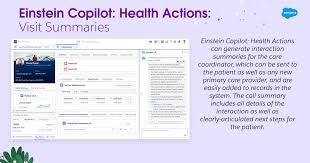
Einstein Copilot for Healthcare – Salesforce has introduced a new AI-powered healthcare assistant within its CRM system, marking its latest move to expand into the healthcare industry. As AI development accelerates, tech giants like Microsoft, Google, Amazon Web Services, and Salesforce are capitalizing on the opportunity to integrate AI and cloud technologies into healthcare to streamline administrative and operational tasks. Salesforce’s healthcare-specific AI tool, Einstein Copilot, is a conversational assistant that leverages an organization’s private data to provide relevant responses. Einstein Copilot enables healthcare providers and care teams to digitally capture and summarize information from both clinical and nonclinical sources, update patient records, and automate manual workflows. Key Features of Einstein Copilot Providers can use Einstein Copilot to generate patient summaries that include medications, diagnoses, social determinants, assessments, clinical service requests, and care gaps. A care manager can also ask the assistant to find an in-network provider based on location, specialty, and insurance coverage, and auto-fill referral forms using natural language prompts. The AI assistant can also trigger workflows for tasks such as sending referrals, scheduling appointments, and updating care plans. Salesforce expects Einstein Copilot to be HIPAA-compliant by summer 2024, with Copilot: Health Actions slated for general availability in winter 2024. Digitizing Health Assessments Salesforce is adding a feature called Assessment Generation that allows healthcare organizations to digitize standardized health assessments. These can be automatically populated into Salesforce Health Cloud, filled out electronically, and tracked for progress over time. Reducing Administrative Waste Salesforce cites research from McKinsey & Co. showing that administrative costs account for nearly a quarter of U.S. healthcare spending, with a potential savings of up to $320 billion. By integrating AI and CRM tools, Salesforce aims to reduce the operational burden on healthcare providers and improve patient outcomes. Amit Khanna, Senior Vice President and General Manager for Health at Salesforce, highlighted the value of these innovations: “These new data, AI, and CRM features reduce the administrative and operational burden for healthcare providers, leading to better outcomes for patients. With Salesforce’s trusted AI, healthcare organizations excited about generative AI—but wary of clinical and security concerns—can confidently integrate these innovations into their workflows.” Early Adopters and Impact Healthcare providers including Baptist Health South Florida and HarmonyCares are already leveraging Salesforce to personalize patient interactions and create unified patient views. HarmonyCares, which operates across 14 states with over 150 primary care providers, has used Salesforce’s AI-driven field service platform to streamline patient scheduling. The company reported a 50% increase in self-scheduling efficiency since adopting the platform and plans to expand its use of Salesforce Health Cloud for care management and engagement. Kristin Darby, Chief Information Officer at HarmonyCares, emphasized the benefits of AI in healthcare: “AI will dramatically improve our ability to quickly synthesize patient needs and preferences, enabling us to offer a more personalized experience with greater accuracy.” However, the integration of AI in healthcare is not without skepticism. A recent survey revealed that 69% of individuals are uncomfortable with AI being used to diagnose them, though more than half are open to its use in nonclinical tasks like scheduling and billing. Salesforce’s Healthcare Journey Salesforce first launched Health Cloud in 2015 to help providers manage patients by aggregating data from electronic medical records, devices, and wearables. In 2022, the company expanded this offering with Customer 360 for Health, a unified platform that combines real-time data from Data Cloud, Einstein AI, and automation tools like Flow to streamline processes such as prior authorizations, intake, and patient scheduling. Like Related Posts Who is Salesforce? Who is Salesforce? Here is their story in their own words. From our inception, we’ve proudly embraced the identity of Read more Salesforce Marketing Cloud Transactional Emails Salesforce Marketing Cloud Transactional Emails are immediate, automated, non-promotional messages crucial to business operations and customer satisfaction, such as order Read more Salesforce Unites Einstein Analytics with Financial CRM Salesforce has unveiled a comprehensive analytics solution tailored for wealth managers, home office professionals, and retail bankers, merging its Financial Read more AI-Driven Propensity Scores AI plays a crucial role in propensity score estimation as it can discern underlying patterns between treatments and confounding variables Read more

Read More
Empowering Patient Self-Service with Salesforce

Empowering Patient Self-Service with Salesforce

Artificial intelligence is transforming healthcare, particularly in self-service solutions. However, innovation alone isn’t enough—hospitals must navigate compliance, integration, and security challenges to implement practical solutions. Let’s explore how Salesforce streamlines patient self-service while addressing these complexities. The Evolution of Self-Service in Healthcare Think about the last time you used self-checkout at a grocery store or booked a flight without speaking to an agent. Self-service isn’t just an option anymore; it’s an expectation—especially through chatbots and AI-powered agents. Healthcare is no different. Patients want to schedule appointments, check lab results, and pay bills without making a phone call. Self-service is faster, more convenient, and gives patients control over their healthcare experience. The Challenge: Overcoming Barriers to Patient Self-Service Despite its advantages, many hospitals hesitate to implement self-service tools. The reason? Healthcare presents unique challenges that standard self-service platforms aren’t equipped to handle. Integration Roadblocks Patients seek answers to various questions: Why was I charged for this? What does my lab result mean? When is my next appointment? The information needed to answer these questions is scattered across electronic health records (EHRs), billing systems, and scheduling tools. Without seamless integration, self-service solutions either provide limited responses or inaccurate information—leading to frustration and potential health risks. Compliance Challenges Healthcare is one of the most tightly regulated industries, and self-service platforms handle sensitive data such as medical records and payment details. To be viable, they must meet stringent standards, including HIPAA compliance, data encryption, authentication protocols, and audit requirements. Many general self-service solutions fail to meet these regulatory requirements, making legal teams hesitant to adopt them. Safety Concerns AI-generated errors, or hallucinations, pose significant risks in healthcare. Unlike retail—where a mistake may result in an incorrect product recommendation—errors in healthcare can lead to misdiagnoses, incorrect medications, or improper treatments. Patients trust hospital-affiliated chatbots, and any misinformation can have serious consequences. Without proper safeguards, self-service tools in healthcare present a risk hospitals cannot afford to take. The Solution: Salesforce for Patient Self-Service Salesforce offers a connected suite of solutions that address integration, compliance, and safety concerns, making patient self-service a reality. The key components include Health Cloud, Experience Cloud, and Agentforce, which work together to create a seamless and secure patient experience. Health Cloud: The Integration Engine Health Cloud unifies data from EHRs, billing systems, and scheduling tools to create a single patient profile. This enables patients to access their medical history, prescriptions, lab results, and appointments through a single interface—eliminating data silos and improving accessibility. Experience Cloud: The Patient Portal Experience Cloud provides an authenticated hub where patients can schedule appointments, access records, and make payments. It integrates with Health Cloud to deliver a personalized experience based on a patient’s medical history and preferences. This enables proactive healthcare management, including appointment reminders and tailored educational content. Agentforce: AI-Powered Assistance with Human Oversight Agentforce enhances patient interactions by handling complex inquiries without requiring cumbersome menu navigation. Unlike traditional chatbots, Agentforce offers human oversight—support agents can step in during a conversation or escalate interactions via phone or email. With access to unified patient profiles, agents can provide personalized support based on a patient’s health history. The Results: A Better Patient Experience By leveraging Salesforce, hospitals can overcome self-service challenges while enhancing patient engagement. The benefits include: Patient self-service is no longer a futuristic vision—it’s a necessity. With Salesforce, hospitals can implement solutions that are not only possible but practical, ensuring compliance, security, and a superior patient experience. Content updated March 2025. Like Related Posts Who is Salesforce? Who is Salesforce? Here is their story in their own words. From our inception, we’ve proudly embraced the identity of Read more Salesforce Marketing Cloud Transactional Emails Salesforce Marketing Cloud Transactional Emails are immediate, automated, non-promotional messages crucial to business operations and customer satisfaction, such as order Read more Salesforce Unites Einstein Analytics with Financial CRM Salesforce has unveiled a comprehensive analytics solution tailored for wealth managers, home office professionals, and retail bankers, merging its Financial Read more AI-Driven Propensity Scores AI plays a crucial role in propensity score estimation as it can discern underlying patterns between treatments and confounding variables Read more
Read More
collaboration between humans and AI

Collaboration Between Humans and AI

The Future of AI: What to Expect in the Next 5 Years In the next five years, AI will accelerate human life, reshape behaviors, and transform industries—these changes are inevitable. Collaboration Between Humans and AI. For much of the early 20th century, AI existed mainly in science fiction, where androids, sentient machines, and futuristic societies intrigued fans of the genre. From films like Metropolis to books like I, Robot, AI was the subject of speculative imagination. AI in fiction often over-dramatized reality and caused us to suspend belief in what was and was not possible. But by the mid-20th century, scientists began working to bring AI into reality. A Brief History of AI’s Impact on Society The 1956 Dartmouth Summer Research Project on Artificial Intelligence marked a key turning point, where John McCarthy coined the term “artificial intelligence” and helped establish a community of AI researchers. Although the initial excitement about AI often outpaced its actual capabilities, significant breakthroughs began emerging by the late 20th century. One such moment was IBM’s Deep Blue defeating chess champion Garry Kasparov in 1997, signaling that machines could perform complex cognitive tasks. The rise of big data and Moore’s Law, which fueled the exponential growth of computational power, enabled AI to process vast amounts of information and tackle tasks previously handled only by humans. By 2022, generative AI models like ChatGPT proved that machine learning could yield highly sophisticated and captivating technologies. AI’s influence is now everywhere. No longer is it only discussed in IT circles. AI is being featured in nearly all new products hitting the market. It is part of if not the creation tool of most commercials. Voice assistants like Alexa, recommendation systems used by Netflix, and autonomous vehicles represent just a glimpse of AI’s current role in society. Yet, over the next five years, AI’s development is poised to introduce far more profound societal changes. How AI Will Shape the Future Industries Most Affected by AI Long-term Risks of Collaboration Between Humans and AI AI’s potential to pose existential risks has long been a topic of concern. However, the more realistic danger lies in human societies voluntarily ceding control to AI systems. Algorithmic trading in finance, for example, demonstrates how human decisions are already being replaced by AI’s ability to operate at unimaginable speeds. Still, fear of AI should not overshadow the opportunities it presents. If organizations shy away from AI out of anxiety, they risk missing out on innovations and efficiency gains. The future of AI depends on a balanced approach that embraces its potential while mitigating its risks. In the coming years, the collaboration between humans and AI will drive profound changes across industries, legal frameworks, and societal norms, creating both challenges and opportunities for the future. Tectonic can help you map your AI journey for the best Collaboration Between Humans and AI. Like Related Posts Who is Salesforce? Who is Salesforce? Here is their story in their own words. From our inception, we’ve proudly embraced the identity of Read more Salesforce Marketing Cloud Transactional Emails Salesforce Marketing Cloud Transactional Emails are immediate, automated, non-promotional messages crucial to business operations and customer satisfaction, such as order Read more Salesforce Unites Einstein Analytics with Financial CRM Salesforce has unveiled a comprehensive analytics solution tailored for wealth managers, home office professionals, and retail bankers, merging its Financial Read more AI-Driven Propensity Scores AI plays a crucial role in propensity score estimation as it can discern underlying patterns between treatments and confounding variables Read more

Read More
ai driven crm explained

AI Driven CRM Explained

AI-driven CRM, also known as AI CRM, is a Customer Relationship Management system that integrates Artificial Intelligence and Machine Learning to enhance customer interactions and improve business operations. It analyzes customer data, identifies patterns, and makes predictions to personalize customer experiences, automate tasks, and provide actionable insights.  Here’s a deeper look: Key Features and Benefits: How AI Enhances CRM: Examples of AI in CRM: Like Related Posts Who is Salesforce? Who is Salesforce? Here is their story in their own words. From our inception, we’ve proudly embraced the identity of Read more Salesforce Marketing Cloud Transactional Emails Salesforce Marketing Cloud Transactional Emails are immediate, automated, non-promotional messages crucial to business operations and customer satisfaction, such as order Read more Salesforce Unites Einstein Analytics with Financial CRM Salesforce has unveiled a comprehensive analytics solution tailored for wealth managers, home office professionals, and retail bankers, merging its Financial Read more AI-Driven Propensity Scores AI plays a crucial role in propensity score estimation as it can discern underlying patterns between treatments and confounding variables Read more

Read More
AI Causes Job Flux

AI Causes Job Flux

AI Barometer Signals Job Disruption Amid Global Productivity Gains A recent PwC report highlights significant productivity improvements worldwide, but also points to potential job disruption due to artificial intelligence (AI). Described as the “Industrial Revolution of knowledge work,” AI is transforming how workers utilize information, generate content, and deliver results at unprecedented speed and scale. The 2024 AI Jobs Barometer, released by PwC, aims to provide empirical data on the impact of AI on global employment. AI Causes Job Flux but not necessarly job loss. AI Causes Job Flux The analysis involved examining over half a billion job ads across 15 advanced economies, including the U.S., Canada, Singapore, Australia, New Zealand, and several European nations. PwC sought to uncover the effects of AI on jobs, skills, wages, and productivity by monitoring the rise of positions requiring specialist AI skills across various industries and regions. The findings show that AI adoption is accelerating, with workers proficient in AI commanding substantial wage premiums. Broader Workforce Impact Interestingly, the impact of AI extends beyond workers with specialized AI skills. According to PwC, the majority of workers leveraging AI tools do not require such expertise. In many cases, a small number of AI specialists design tools that are then used by thousands of customer service agents, analysts, or legal professionals—none of whom possess advanced AI knowledge. This trend is driven largely by generative AI applications, which can typically be operated using simple, everyday language without technical skills. AI’s Economic Promise AI is leading a productivity revolution. Labor productivity growth has stagnated in many OECD countries over the past two decades, but AI may offer a solution. To better understand its effect on productivity, PwC analyzed jobs based on their “AI exposure,” indicating the extent to which AI can assist with tasks within specific roles. The report found that industries with higher AI exposure are experiencing much greater labor productivity growth. Knowledge-based jobs, in particular, show the highest AI exposure and the greatest demand for workers with advanced AI skills. Sectors such as financial services, professional services, and information and communications are leading the way, with AI-related job shares 2.8x, 3x, and 5x higher, respectively, than other industries. Overall, these sectors are witnessing nearly fivefold productivity growth due to AI integration. AI is also playing a role in alleviating labor shortages. Jobs in customer service, administration, and IT, among others, are still growing but at a slower rate. AI-driven productivity may help fill gaps caused by shrinking working-age populations in advanced economies. Wage Premiums for AI Skills Workers in AI-specialist roles are seeing significant wage premiums—up to 25% on average. Since 2016, demand for these roles has outpaced the growth of the overall job market. The highest wage premiums are found in the U.S. (25%) and the U.K. (14%), with data specialists commanding premiums of over 50% in both countries. Financial analysts, lawyers, and marketing managers also enjoy substantial wage boosts. The Disruption of Job Markets The skills required for AI-exposed jobs are evolving rapidly. PwC’s report reveals that new skills are emerging 25% faster in AI-exposed occupations compared to those less affected by AI. Jobs requiring AI proficiency have grown 3.5 times faster than other roles since 2016, and this trend predates the rise of popular tools like ChatGPT. However, while AI is driving demand for new skills, it is also reducing the need for certain old ones. Jobs in fields like IT, design, sales, and data analysis are seeing slower growth, as tasks in these areas are increasingly automated by AI technologies. The Future of Work The PwC report stresses that AI will not necessarily result in fewer jobs overall, but will change the nature of work. Instead of asking whether AI can replicate existing tasks, the focus should be on how AI enables new opportunities and industries. Tectonic recommends you work on this trail of thought by implementing AI Acceptable Use Policies in your company. Encourage your teams to explore AI tools that increase productivity but clearly outline what is and is not acceptable AI usage. PwC outlines several steps for policymakers, business leaders, and workers to take to ensure a positive transition into the AI era. Policymakers are encouraged to promote AI adoption through supportive policies, digital infrastructure, and workforce development. Business leaders should embrace AI as a complement to human workers, focusing on generating new ways to create value. Meanwhile, workers must build AI-complementary skills and experiment with AI tools to remain competitive in the evolving job market. Ultimately, while AI is disrupting the job landscape, it also presents vast opportunities for those who are willing to adapt. Like past technological revolutions, those who embrace change stand to benefit the most from AI’s transformative power. Like Related Posts Who is Salesforce? Who is Salesforce? Here is their story in their own words. From our inception, we’ve proudly embraced the identity of Read more Salesforce Marketing Cloud Transactional Emails Salesforce Marketing Cloud Transactional Emails are immediate, automated, non-promotional messages crucial to business operations and customer satisfaction, such as order Read more Salesforce Unites Einstein Analytics with Financial CRM Salesforce has unveiled a comprehensive analytics solution tailored for wealth managers, home office professionals, and retail bankers, merging its Financial Read more AI-Driven Propensity Scores AI plays a crucial role in propensity score estimation as it can discern underlying patterns between treatments and confounding variables Read more

Read More
gettectonic.com