Privacy Archives - gettectonic.com - Page 11
AI Agents in Line at HR

AI Agents in Line at HR

AI Agents in Line at HR may only be a satirical cartoon for a very short time. Sorry, Farside, but your AI bits may not be able to keep up with AI. July, 2034 — A new software unicorn has just emerged inbehind a bar in a pub in East London. Unicorn, by the way, descibes a startup company valued at over $1 billion, not necessarily with a billion dollar concept. Back to East London behind the soggy bar. Hey, its our fantasy. Besides if Amazon can start in a garage, isn’t anything possible? The CEO logs in as usual and gathers daily updates from the team. The Chief Technology Officer is suggesting a new feature to deploy. The Chief Product Officer wants to redesign the CRM (or whatever CRM has evolved to) integration. The Chief Revenue Officer is showing off the new pipeline, forecast by Accountant in a Box. The Chief Customer Officer is discussing the latest customer levitation tools and product feedback. The Chief Information Security Officer has found a new privacy conflict, which they are addressing with a newly-revised infrastructure set-up. And the Head of HR is fretting about the latest round of IT candidates. This sounds like every software business you’ve ever heard of. But the difference is that the CEO’s teammates are entirely AI, not human: The CTO is Lovable. The CPO is Cogna. The CCO is Gradient Labs. The CRO is 11x. The CISO is Zylon. Back to 2024: The Rise of AI Agents In 2024, the hottest topic in software is AI agents, or Agentic AI. Founders are rapidly standing up agentic applications that can solve specific needs in functions like sales and customer services — without a human required. Software buyers, seeing real opportunities to quickly improve their P&L, are swiftly building or purchasing these agentic products. Investors have poured hundreds of millions of dollars into startups in this space in recent months. Even Salesforce wasn’t launched with a silver AI spoon in its mouth. Salesforce began investing in artificial intelligence (AI) in 2014, when the company started acquiring machine learning startups and announced its Customer Success Platform. In 2016, Salesforce launched Einstein, its AI platform that supports several of its cloud services. Einstein is built into Salesforce products and includes features like natural language processing, machine learning, and predictive analytics. It helps organizations automate processes, make decisions based on insights, and improve the customer experience. YouTube How To Increase Revenue Using AI for CRM: Salesforce … Feb 12, 2024 — What is Salesforce Einstein? Salesforce Einstein is the first trusted artifici… TechForce Services How does Salesforce Use AI for Business Growth? Jan 31, 2024 — Powered by technologies like Machine Learning, Natural Language Processing, im… saasguru · LinkedIn · 7mo History of Salesforce AI From Predictive to Generative – LinkedIn Published Nov 27, 2023. In 2014, Salesforce, under the visionary leadership of… Twistellar AI in Salesforce: History, Present State and Prospects Organizations generate tons of data on marketing and sales, and surely your sales managers… Wikipedia Salesforce – Wikipedia In October 2014, Salesforce announced the development of its Customer Success Platform. Less than ten years ago, folks. Salesforce’s large database of data has helped the company address AI challenges quickly and with quality. The company’s data cloud offering provides AI with the right information at the right time, which can reduce friction and improve the customer experience.  Salesforce’s AI-powered solutions include: To catalyze this evolution, Salesforce strategically acquired RelateIQ in 2014. This move injected machine learning into the Salesforce ecosystem, capturing workplace communications data and providing valuable insights. Europe is home to many of these exciting companies. For example, H, a French AI agent startup, raised a $220 million seed round in May. Beyond RPA: The New Wave of AI Agents AI agents represent a significant step-change from Robotic Process Automation (RPA) bots, which, as explored last year, have several limitations due to their deterministic nature. Next-generation AI agents are non-deterministic, meaning that instead of stopping at a “dead end,” they can learn from mistakes and adjust their series of tasks. Not entirely unlock the mouse running the same maze over and over for the cheese. Eventually Mr. Squeakers learns which paths are dead ends and avoids them by making better choices at intersections. In AI Agents this makes them suited to complex and unstructured tasks and means they can transform the journey from intent to implementation in software development. They can deliver “pure work,” rather than acting only as a helpful co-pilot. The rise of AI agents is not only an opportunity to expand automation beyond what is possible with RPA but also to broadly redefine how knowledge work is performed. And by who. And even how is it defined. Given the right guardrails, next-generation AI agents have the potential to effectively and safely replace knowledge workers in many business scenarios. AI Agents in Action These agents are about to revolutionize the world of work as we know it and are already getting started. For example, Klarna recently revealed that its AI agent system handled two-thirds of customer chats in its first month in operation. While HR may not be swamped with AI CVs yet, it is certainly fathomable. One would suppose those candidates would have to be reviewed and interviewed by IT, not just HR. Here’s another deep thought. The internet of things (IoT) first appeared in a speech by Peter T. Lewis in September 1985. The Internet of Things (IoT) is a network of physical devices that can collect and transmit data over the internet using sensors, software, and other technologies. IoT devices can communicate with each other and with the cloud, and can even perform data analysis and be controlled remotely. The IoT concept was smart homes, health care environments, office spaces, and transportation. Only recently have we begun to think of the IoT as including the actual computers, or AI, in addition to sensored devices. It isn’t exactly a chicken and the egg question, but more of a

Read More
Changes in Advertising Changing CRMs

Changes in Advertising Changing CRMs

Oracle announced last week that it is exiting the advertising business and will sunset its adtech by September 30. While the announcement is not surprising given the massive layoffs in 2022 affecting Oracle Advertising teams, the rapidity of Oracle Advertising’s decline is a clear indicator of how swiftly the digital advertising landscape can evolve. This move is likely just the first of many significant Changes in Advertising Changing CRMs. What happened? Oracle Advertising faced challenges beginning in 2018 and never managed to recover. Several forces related to data deprecation adversely impacted the business: Changes in Advertising Changing CRMs Retooling its acquisitions to function in a consent-driven and regulated environment would have required significant investment from Oracle. Given its track record with privacy law compliance, this would have been a daunting task, necessitating both rapid innovation and market trust in its solutions. What does this mean for the advertising ecosystem? Oracle’s exit from adtech marks a significant shift in the advertising ecosystem. The sharp decline in advertising revenue from $2 billion in 2022 to $300 million in 2024 suggests a major miscalculation by Oracle. Without demand- or supply-side platforms (unlike Google, Microsoft, and Amazon) and lacking a large audience base (unlike Meta, Disney, and Netflix), Oracle’s benefits as an adtech partner or acquirer were unclear. The key question now is whether Oracle’s intellectual property will find new ownership and continue in some form. What does this mean for the marketing ecosystem? The broader marketing ecosystem is likely to see more shifts as major players adapt to the new landscape. Leading martech vendors like Adobe and Salesforce have already transitioned from DMPs to CDPs. Adobe Real-Time CDP and Salesforce Data Cloud for Marketing are gaining market share, while Oracle has struggled in the B2C martech space. Oracle’s decision to cut investments in martech and adtech has significantly impaired its B2C market efforts, with products like Responsys failing to gain the traction that Eloqua has in the B2B space. Oracle also announced it will sunset related B2C marketing products like Oracle Maxymiser in the coming months. These changes are just the beginning of a broader transformation in digital advertising, driven by evolving privacy standards, consumer expectations, and technological advancements. This marks the dawn of a new era in which agility and compliance will be key to success in the digital advertising and marketing landscapes. Like Related Posts Who is Salesforce? Who is Salesforce? Here is their story in their own words. From our inception, we’ve proudly embraced the identity of Read more Salesforce Marketing Cloud Transactional Emails Salesforce Marketing Cloud Transactional Emails are immediate, automated, non-promotional messages crucial to business operations and customer satisfaction, such as order Read more Salesforce Unites Einstein Analytics with Financial CRM Salesforce has unveiled a comprehensive analytics solution tailored for wealth managers, home office professionals, and retail bankers, merging its Financial Read more AI-Driven Propensity Scores AI plays a crucial role in propensity score estimation as it can discern underlying patterns between treatments and confounding variables Read more
Read More
Agentic AI is Here

Agentic AI is Here

Embracing the Era of Agentic AI: Redefining Autonomous Systems A new paradigm in artificial intelligence, known as “Agentic Artificial Intelligence,” is poised to revolutionize the capabilities of the known autonomous universe. This cutting-edge technology represents a significant leap forward in AI-driven decision-making and action, promising transformative impacts across various industries including healthcare, manufacturing, IT, finance, marketing, and HR. Agents are the way to go! There is no two ways about this. Looking into the progression of the Large Language Model based applications since last year, its not hard to see that the Agentic Process (agents as reusable, specific and dedicated single unit of work) — would be the way to build Gen AI applications. What is Agentic AI? Agentic Artificial Intelligence marks a departure from traditional AI models that primarily focus on passive observation and analysis. Unlike its predecessors, which often require human intervention to execute tasks, Agentic AI systems possess the autonomy to initiate actions independently based on their assessments. This allows them to navigate much more complex environments and undertake tasks with a level of initiative and adaptability previously unseen. At least outside of sci-fy movies. Real-World Applications of Agentic Artificial Intelligence Healthcare In healthcare, Agentic AI systems are transforming patient care. These systems autonomously monitor vital signs, administer medication, and assist in surgical procedures with unparalleled precision. By augmenting healthcare professionals’ capabilities, these AI-driven agents enhance patient outcomes and streamline care processes. Augmenting is the key word, here. Manufacturing and Logistics In manufacturing and logistics, Agentic AI optimizes operations and boosts efficiency. Intelligent agents handle predictive maintenance of machinery, autonomous inventory management, and robotic assembly. Leveraging advanced algorithms and sensor technologies, these systems anticipate issues, coordinate complex workflows, and adapt to real-time production demands, driving a shift towards fully autonomous production environments. Customer Service Within enterprises, AI agents are revolutionizing business operations across various departments. In customer service, AI-powered chatbots with Agentic Artificial Intelligence capabilities engage with customers in natural language, providing personalized assistance and resolving queries efficiently. This enhances customer satisfaction and allows human agents to focus on more complex tasks. Marketing and Sales Agentic Artificial Intelligence empowers marketing and sales teams to analyze vast datasets, identify trends, and personalize campaigns with unprecedented precision. By understanding customer behavior and preferences at a granular level, AI agents optimize advertising strategies, maximize conversion rates, and drive revenue growth. Finance and Accounting In finance and accounting, Agentic AI streamlines processes like invoice processing, fraud detection, and risk management. These AI-driven agents analyze financial data in real time, flag anomalies, and provide insights that enable faster, more informed decision-making, thereby improving operational efficiency. Ethical Considerations of Agentic Artificial Intelligence The rise of Agentic AI also brings significant ethical and societal challenges. Concerns about data privacy, algorithmic bias, and job displacement necessitate robust regulation and ethical frameworks to ensure responsible and equitable deployment of AI technologies. Navigating the Future with Agentic AI The advent of Agentic AI ushers in a new era of autonomy and innovation in artificial intelligence. As these intelligent agents permeate various facets of our lives and enterprises, they present both challenges and opportunities. To navigate this new world, we must approach it with foresight, responsibility, and a commitment to harnessing technology for the betterment of humanity. Like1 Related Posts Who is Salesforce? Who is Salesforce? Here is their story in their own words. From our inception, we’ve proudly embraced the identity of Read more Salesforce Marketing Cloud Transactional Emails Salesforce Marketing Cloud Transactional Emails are immediate, automated, non-promotional messages crucial to business operations and customer satisfaction, such as order Read more Salesforce Unites Einstein Analytics with Financial CRM Salesforce has unveiled a comprehensive analytics solution tailored for wealth managers, home office professionals, and retail bankers, merging its Financial Read more AI-Driven Propensity Scores AI plays a crucial role in propensity score estimation as it can discern underlying patterns between treatments and confounding variables Read more

Read More
Dynamic Content Powered Email

Dynamic Content Powered Email

Elevating Email Marketing with Dynamic Content Customers don’t want to feel like just another number to your brand. Relying on a generic “batch and blast” email marketing strategy is likely to land you in the customer’s spam filters—or worse, prompt them to unsubscribe. However, with Dynamic Content Powered Email, you can create a relevant and timely experience they’ll remember for all the right reasons. The Power of Personalization In an era where privacy and security dominate the headlines, it’s surprising that 83% of consumers are willing to share personal data for more personalized experiences. This isn’t just an interesting tidbit—it’s proof that people expect and value personalized experiences from brands. This tradeoff—data for personalization—presents a significant opportunity for marketers who can uphold their end of the bargain. Nowhere is this more evident than in the inbox. Dynamic email content allows for the creation of personalized messages that update when the email is opened, meeting readers’ expectations for tailored communication. The Importance of Dynamic Email Content Modern email marketing must prioritize engaging and relevant content to avoid poor performance and potential relegation to spam folders. Recent developments, such as the loss of third-party cookies, make it increasingly challenging to acquire the right data for personalization. Let’s explore some tactics and resources to achieve quick email marketing wins without the heavy lifting, by automating impactful experiences in the inbox. Understanding Dynamic Email Content Dynamic email content, often called live email content, refers to messages that change based on the subscriber’s personal preferences or history with your website. Unlike static ads, dynamic content offers a tailored shopping experience, increasing engagement and fostering brand loyalty. For example, using dynamic elements such as live polls or customized product recommendations can make subscribers feel valued and understood. Interactive emails enhance the overall experience and encourage deeper engagement. Case Studies in Dynamic Email Success Dynamic content engages audiences and prompts action, crucial for both business success and email program health. Email engagement metrics influence whether your emails are delivered to the inbox or spam folder, making engaging content essential for ISP trust. Not just customer trust. Leveraging First- and Zero-Party Data First-party data is now more important than ever. Email provides a direct line to subscribers, enabling the collection of valuable insights into their preferences and behaviors. This data can fuel further personalization efforts. For example, UK hospitality brand icelolly.com used dynamic email content to display searched and abandoned deals, resulting in a 35% higher open rate, a 201% increase in click-through rate, and a 45% increase in conversion rate. Popular Types of Dynamic Email Content Implementing Dynamic Email Content Simply Personalization with dynamic email content doesn’t have to be resource-intensive. No-code solutions or templates can streamline the process, allowing ongoing implementation with minimal effort. For instance, PrettyLittleThing used automation in birthday emails to show the correct star sign content based on the opening date, driving a 38% increase in click-through rates. Dynamic Content Powered Email has emerged as a powerful tool for marketers aiming to meet and exceed consumer expectations. By incorporating dynamic elements—such as live polls, countdown timers, and personalized images—marketers can create engaging, memorable experiences that build stronger customer relationships and drive brand loyalty. Like Related Posts Who is Salesforce? Who is Salesforce? Here is their story in their own words. From our inception, we’ve proudly embraced the identity of Read more Salesforce Marketing Cloud Transactional Emails Salesforce Marketing Cloud Transactional Emails are immediate, automated, non-promotional messages crucial to business operations and customer satisfaction, such as order Read more Salesforce Unites Einstein Analytics with Financial CRM Salesforce has unveiled a comprehensive analytics solution tailored for wealth managers, home office professionals, and retail bankers, merging its Financial Read more AI-Driven Propensity Scores AI plays a crucial role in propensity score estimation as it can discern underlying patterns between treatments and confounding variables Read more

Read More
Salesforce Data Cloud Hits $900M in Revenue

Salesforce Data Cloud CDP

Salesforce Data Cloud: The Ultimate Customer Data Platform (CDP) Guide Transform Customer Data into Actionable Insights Salesforce Data Cloud (formerly Salesforce CDP) revolutionizes how businesses unify and activate customer data across every touchpoint. By consolidating information from websites, mobile apps, CRM systems, and more, it creates 360° customer profiles that power personalized marketing, sales, and service experiences. What is Salesforce Data Cloud? Salesforce Data Cloud is an AI-powered Customer Data Platform (CDP) that: 💡 Key Benefit: Break down data silos to deliver hyper-personalized customer journeys. Data Cloud vs. Traditional CRM: Key Differences Feature Salesforce CRM Salesforce Data Cloud Data Scope Sales/Service records only All customer interactions (web, email, ads, IoT) Real-Time Updates Manual/periodic syncs Instant profile enrichment AI Capabilities Basic analytics Predictive insights + GenAI recommendations Use Cases Pipeline management Omnichannel personalization Core Capabilities 1. Unified Customer Profiles 2. AI-Powered Segmentation 3. Activation Across Channels 4. Privacy & Compliance How Businesses Use Data Cloud 🚀 Boost E-Commerce Sales 📈 Optimize Ad Spend 🤖 Enhance Customer Service Technical Deep Dive Data Integration Options Key Concepts Getting Started 1. Choose Your Edition 2. Implement in 4 Steps 3. Train Your Team The Future of Data Cloud Final Verdict Salesforce Data Cloud is not just a CDP—it’s the central nervous system for customer-centric businesses. By unifying data + AI, it turns insights into personalized experiences at scale. Ready to explore? Contact Tectonic today. 🔥 Pro Tip: Pair with Einstein AI for predictive analytics and Genie for real-time streaming data. Content updated July 2025. Like Related Posts Who is Salesforce? Who is Salesforce? Here is their story in their own words. From our inception, we’ve proudly embraced the identity of Read more Salesforce Marketing Cloud Transactional Emails Salesforce Marketing Cloud Transactional Emails are immediate, automated, non-promotional messages crucial to business operations and customer satisfaction, such as order Read more Salesforce Unites Einstein Analytics with Financial CRM Salesforce has unveiled a comprehensive analytics solution tailored for wealth managers, home office professionals, and retail bankers, merging its Financial Read more AI-Driven Propensity Scores AI plays a crucial role in propensity score estimation as it can discern underlying patterns between treatments and confounding variables Read more

Read More
Patterns for AI Security

Patterns for AI Security

Supporting the development of AI design patterns that demonstrate trustworthiness not only enhances user experiences but also serves as an enabling tool for informing more effective policy and compliance measures. Patterns for AI Security. By prototyping patterns, teams can effectively communicate complex policies, illustrating how they could function within industries and for users. This approach also facilitates the testing of patterns, enabling teams to swiftly identify trade-offs and challenge assumptions, thereby accelerating the establishment of industry standards for best practices. Ultimately, this iterative process leads to the creation of better policies and services that yield superior outcomes for both individuals and organizations. Patterns for AI Security For instance, consider the pattern of “watermarking,” mandated by China’s Cyberspace Administration and poised to be adopted by the USA and EU. Through exploration of this pattern, the team at IF highlighted the inherent challenges associated with implementing watermarking for users and businesses. Another design pattern is the AI query router. A user inputs a query, that query is sent to a router, which is a classifier that categorizes the input. A recognized query routes to small language model, which tends to be more accurate, more responsive, & less expensive to operate. If the query is not recognized, a large language model handles it. LLMs much more expensive to operate, but successfully returns answers to a larger variety of queries. In this way, an AI product can balance cost, performance, & user experience. Moreover, investing in trustworthy solutions not only addresses immediate challenges but also positions businesses for long-term success. As reliance on AI systems becomes ubiquitous, the complexities of trust, collaboration, and robustness will only intensify. Stakeholders, both in the private and public sectors, increasingly expect organizations to deliver responsible solutions that prioritize user value without compromising on privacy. This is particularly evident among Gen Z individuals, who demand technology that understands and anticipates their needs while upholding privacy standards. Gen Alpha will be even moreso inclined. Organizations that recognize the significance of trustworthiness and proactively invest in differentiating their products and services accordingly stand to gain a competitive advantage in the evolving landscape. By prioritizing trustworthiness, businesses can not only meet the expectations of their stakeholders but also foster lasting relationships built on transparency, reliability, and integrity. We all anchor to some tried and tested methods, approaches and patterns when building something new. This statement is very true for those in software engineering, however for generative AI and artificial intelligence itself this may not be the case. With emerging technologies such as generative AI we lack well documented patterns to ground our solution’s. Here are a handful of approaches and patterns for generative AI, based on evaluation of countless production implementations of LLM’s in production. The goal of these patterns is to help mitigate and overcome some of the challenges with generative AI implementations such as cost, latency and hallucinations. List of Patterns Like Related Posts Who is Salesforce? Who is Salesforce? Here is their story in their own words. From our inception, we’ve proudly embraced the identity of Read more AI-Driven Propensity Scores AI plays a crucial role in propensity score estimation as it can discern underlying patterns between treatments and confounding variables Read more What is Salesforce? Salesforce is cloud-based CRM software. It makes it easier for companies to find more prospects, close more deals, and connect Read more Causes of Data Loss Amidst the unprecedented challenges faced by organizations worldwide, many are swiftly enacting their business continuity plans to mitigate operational disruptions. Read more

Read More
Generative AI and Service Cloud

Generative AI and Service Cloud

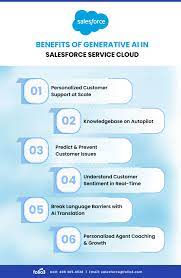
Salesforce Service Cloud users are set to receive more Einstein 1 generative AI tools in June and October. A key development is the expansion of automated customer conversations across more sales and marketing platforms. Generative AI and Service Cloud family of tools is growing. This insight aims to uncover the numerous use cases of generative AI in the modern contact center. We’ll help you understand how generative AI can fast track your contact center’s efficiency, improve data analysis capabilities, streamline QA and coaching processes, and make customers’ experiences better. Today, Salesforce launched Unified Conversations for WhatsApp, which automates bot responses to customer inquiries related to targeted marketing messages on the popular messaging app. Additionally, Salesforce plans to extend support to Line, a messaging app popular in Japan, later this year. These services are built on Salesforce’s Einstein 1 generative AI platform. The platform’s bots aggregate structured and unstructured CRM, product, service, and other data through Salesforce Data Cloud to generate personalized responses. These new features enable conversations to be routed to the digital channels where a Salesforce user’s customers are the most active. And to move omnichannel as customers needs change. Salesforce is also introducing a “bring your own channel” connector to support digital channels not natively covered by the platform. Current examples might include TikTok, Discord, and South Korea’s KakaoTalk, according to Ryan Nichols, Chief Product Officer for Salesforce Service Cloud. Generative AI and Service Cloud “It’s about getting data from all your conversations with customers from Service Cloud into Data Cloud and using that to not just deliver excellent customer service, but also grow your business,” Nichols said. Salesforce Einstein Conversation Mining, a Service Cloud feature currently in beta, aggregates conversations across customer channels to surface insights on the topics customers need help with. This aims to turn inbound customer service from a cost center into a revenue center, a goal long pursued at conferences like Dreamforce and ICMI. This massive change drives more than revenue, it drives ROI. Performance metrics such as time-to-answer and hold-time reduction have traditionally pressured agents to minimize call duration to retain their jobs. Now Salesforce is going to help them. While some skeptics question if generative AI can achieve this ambitious goal, Constellation Research analyst Liz Miller suggests it might be possible. Having previously managed a contact center herself, Miller recognizes the transformative potential of generative AI. With the aid of data, bots, and copilot counterparts assisting humans, agents could save time and access the right information to upsell customers during service engagements. Here are some of the ways Generative AI will change customer service forever. 1. Monitor and Ensure Compliance Maintaining compliance is crucial for fostering customer trust, preserving a positive brand image, and avoiding hefty privacy and compliance fines. In a contact center, compliance mistakes can quickly escalate into costly lawsuits and revenue losses. Generative AI allows your compliance team to proactively manage compliance by quickly identifying trends and addressing issues in real time. Instead of waiting for a compliance issue to escalate, you can fine-tune your AI model to provide compliance insights whenever necessary. For instance, you can ask: This approach offers more comprehensive insights than scorecards, which often lack context and accuracy. Generative AI’s analytical capabilities provide actionable insights to improve compliance across your contact center. 2. Get Insights About Your Call Center Performance at a Glance Generative AI language models make it easier than ever to gain insights into your contact center’s performance. Simply ask the model for the information you need. For example, you can inquire about the real-time average handling time (AHT) by asking, “What is the average handling time today?” But that’s just the beginning. With an advanced language model, you can compare metrics across different quarters or generate ideas for coaching plans by asking for each agent‘s strengths and weaknesses and suggestions for improvement. 3. Automate Post-Call Work Generative AI assistants can act as real-time notetakers, summarizing 100% of calls and freeing agents from manual note-taking. This automation makes after-call work effortless, generating comprehensive and compliant notes with a single click. 4. Capture Coachable Moments Easily Incorporating real-world coachable moments into your sessions is essential for tangible performance improvements. Generative AI can identify areas where agents typically struggle without requiring hours of call listening and note-checking. Traditional methods mean compromising on the specificity of coaching due to time constraints, especially when managing large teams. Generative AI solutions, however, enable call center managers to obtain detailed insights about each agent’s performance quickly. This allows for personalized coaching plans that address individual shortcomings efficiently. You can ask: 5. Improve Decision Making With Efficient Root-Cause Analysis Effective decision-making can transform your contact center. However, many managers struggle to identify the root causes of performance issues. Generative AI algorithms can analyze vast amounts of data and customer interactions, uncovering patterns and trends in customer and agent behavior. These insights help pinpoint the issues most impacting performance and customer satisfaction, allowing you to make informed decisions. The process is nearly fully automated, freeing your team from time-consuming data collection tasks. 6. Reduce Manual Work and Focus on Improvement Improving contact center performance requires extensive data, which is resource-intensive to collect manually. Generative AI simplifies this by analyzing customer interactions and providing actionable insights on demand. This saves time and money, allowing you to focus on improvements that deliver a higher ROI. 7. Scale What Works Discovering and scaling best practices is essential for team-wide success. Generative AI and Natural Language Processing (NLP) models can analyze customer interactions to identify effective strategies and coaching opportunities. For example, if a representative handles challenging situations well, AI can generate tips for other team members based on these successful interactions. Generative AI can identify top-performing agents and analyze their calls to extract best practices, providing a more comprehensive approach than focusing on a single agent. Queries you might use include: 8. Generate Agent Scripts Generative AI enables you to draft and fine-tune agent scripts for various customer interactions. Instead of relying

Read More
Cost of Free Analytics

Cost of Free Analytics

Is It Time to Upgrade Your Web Analytics? For years, you might have relied on free web analytics tools, thinking they do the job or resigning yourself to an “it is what it is” mindset. But what if there’s a better way to truly understand your customers and supercharge your marketing efforts? Upgrading to a premium analytics solution could be a game changer for your brand and your peace of mind. What is the Cost of Free Analytics? It’s time to move beyond those so-called free tools (which aren’t really free when you factor in hidden costs) and invest in a robust analytics solution. The right tool can transform your approach—imagine saying goodbye to the hassle of patching together data or juggling disparate reports. With clear, comprehensive insights into customer interactions, you’ll make smarter, data-driven decisions across your business. The Pitfalls of Free Analytics Tools While free analytics tools might seem like a cost-effective choice, they come with significant drawbacks. They often offer limited functionality, delayed or incomplete data, siloed reporting, and compliance risks. Relying on these tools can lead to guesswork and errors, resulting in costly mistakes. Limited Functionality Free analytics tools barely skim the surface of what’s possible with data collection and reporting. They depend on third-party cookies and route your data through their servers, providing you with only partial insights. Essential features like persistent digital identity tracking, profile building, journey mapping, predictive analytics, and machine learning capabilities are typically missing. In contrast, premium tools leverage advanced algorithms and machine learning to unearth valuable data patterns and insights. For instance, a premium tool might reveal that users who view a product page after watching a related video are significantly more likely to make a purchase—information that could greatly influence your marketing strategy. Subpar Data Quality Free tools often lag in delivering real-time data, giving you an outdated snapshot of customer interactions. Timely data is crucial for agile marketing—without it, you risk missing out on opportunities and wasting ad spend. Stale data leads to missed chances and inefficiencies. Reporting Silos and Inaccuracies Free analytics solutions typically don’t integrate data across your organization, resulting in fragmented and siloed information. Different teams may have access to unaligned reports, often requiring multiple tools to piece together insights. This lack of a unified source of truth makes it impossible to get a comprehensive view of customer interactions across various touchpoints. Organizational Inefficiencies Managing free tools can be resource-intensive. They often require extensive tagging and manual upkeep, leading to increased costs and the risk of inaccurate data due to broken or altered tags. This inefficiency can impact long-term business decisions and strategic planning. Compliance Risks Free tools often involve sending your data to external servers, raising concerns about data loss, latency, and compliance with privacy regulations. These tools process your digital engagement and Personally Identifiable Information (PII) on their servers, complicating the task of maintaining regulatory standards and ensuring data security. The True Cost of Free Tools The reality is, “free” isn’t really free. The hidden costs and risks associated with free analytics tools can outweigh their benefits. While premium analytics solutions may seem expensive at first glance, they offer superior insights and performance improvements that provide a competitive edge. With accurate, real-time data and advanced features, investing in a premium tool is a decision that pays off. Remember, the old adage “nothing’s free” rings true—don’t jeopardize your brand’s success with subpar tools that end up costing more in the long run! Like Related Posts Who is Salesforce? Who is Salesforce? Here is their story in their own words. From our inception, we’ve proudly embraced the identity of Read more Salesforce Marketing Cloud Transactional Emails Salesforce Marketing Cloud Transactional Emails are immediate, automated, non-promotional messages crucial to business operations and customer satisfaction, such as order Read more Salesforce Unites Einstein Analytics with Financial CRM Salesforce has unveiled a comprehensive analytics solution tailored for wealth managers, home office professionals, and retail bankers, merging its Financial Read more AI-Driven Propensity Scores AI plays a crucial role in propensity score estimation as it can discern underlying patterns between treatments and confounding variables Read more
Read More
TEFCA could drive payer-provider interoperability

TEFCA could drive payer-provider interoperability

Bridging the Interoperability Gap: TEFCA’s Role in Payer-Provider Data Exchange The electronic health information exchange (HIE) between healthcare providers has seen significant growth in recent years. However, interoperability between healthcare providers and payers has lagged behind. The Trusted Exchange Framework and Common Agreement (TEFCA) aims to address this gap and enhance data interoperability across the healthcare ecosystem. TEFCA could drive payer-provider interoperability with a little help from the world of technology. TEFCA’s Foundation and Evolution TEFCA was established under the 21st Century Cures Act to improve health data interoperability through a “network of networks” approach. The Office of the National Coordinator for Health Information Technology (ONC) officially launched TEFCA in December 2023, designating five initial Qualified Health Information Networks (QHINs). By February 2024, two additional QHINs had been designated. The Sequoia Project, TEFCA’s recognized coordinating entity, recently released several key documents for stakeholder feedback, including draft standard operating procedures (SOPs) for healthcare operations and payment under TEFCA. During the 2024 WEDI Spring Conference, leaders from three QHINs—eHealth Exchange, Epic Nexus, and Kno2—discussed the future of TEFCA in enhancing provider and payer interoperability. ONC released Version 2.0 of the Common Agreement on April 22, 2024. Common Agreement Version 2.0 updates Common Agreement Version 1.1, published in November 2023, and includes enhancements and updates to require support for Health Level Seven (HL7®) Fast Healthcare Interoperability Resources (FHIR®) based transactions. The Common Agreement includes an exhibit, the Participant and Subparticipant Terms of Participation (ToP), that sets forth the requirements each Participant and Subparticipant must agree to and comply with to participate in TEFCA. The Common Agreement and ToPs incorporate all applicable standard operating procedures (SOPs) and the Qualified Health Information Network Technical Framework (QTF). View the release notes for Common Agreement Version 2.0 The Trusted Exchange Framework and Common AgreementTM (TEFCATM) has 3 goals: (1) to establish a universal governance, policy, and technical floor for nationwide interoperability; (2) to simplify connectivity for organizations to securely exchange information to improve patient care, enhance the welfare of populations, and generate health care value; and (3) to enable individuals to gather their health care information. Challenges in Payer Data Exchange Although the QHINs on the panel have made progress in facilitating payer HIE, they emphasized that TEFCA is not yet fully operational for large-scale payer data exchange. Ryan Bohochik, Vice President of Value-Based Care at Epic, highlighted the complexities of payer-provider data exchange. “We’ve focused on use cases that allow for real-time information sharing between care providers and insurance carriers,” Bohochik said. “However, TEFCA isn’t yet capable of supporting this at the scale required.” Bohochik also pointed out that payer data exchange is complicated by the involvement of third-party contractors. For example, health plans often partner with vendors for tasks like care management or quality measure calculation. This adds layers of complexity to the data exchange process. Catherine Bingman, Vice President of Interoperability Adoption for eHealth Exchange, echoed these concerns, noting that member attribution and patient privacy are critical issues in payer data exchange. “Payers don’t have the right to access everything a patient has paid for themselves,” Bingman said. “This makes providers cautious about sharing data, impacting patient care.” For instance, manual prior authorization processes frequently delay patient access to care. A 2023 AMA survey found that 42% of doctors reported care delays due to prior authorization, with 37% stating that these delays were common. Building Trust Through Use Cases Matt Becker, Vice President of Interoperability at Kno2, stressed the importance of developing specific use cases to establish trust in payer data exchange via TEFCA. “Payment and operations is a broad category that includes HEDIS measures, quality assurance, and provider monitoring,” Becker said. “Each of these requires a high level of trust.” Bohochik agreed, emphasizing that narrowing the scope and focusing on specific, high-value use cases will be essential for TEFCA’s adoption. “We can’t solve everything at once,” Bohochik said. “We need to focus on achieving successful outcomes in targeted areas, which will build momentum and community support.” He also noted that while technical data standards are crucial, building trust in the data exchange process is equally important. “A network is only as good as the trust it inspires,” Bohochik said. “If healthcare systems know that data requests for payment and operations are legitimate and secure, it will drive the scalability of TEFCA.” By focusing on targeted use cases, ensuring rigorous data standards, and building trust, TEFCA has the potential to significantly enhance interoperability between healthcare providers and payers, ultimately improving patient care and operational efficiency. Like Related Posts Who is Salesforce? Who is Salesforce? Here is their story in their own words. From our inception, we’ve proudly embraced the identity of Read more Salesforce Marketing Cloud Transactional Emails Salesforce Marketing Cloud Transactional Emails are immediate, automated, non-promotional messages crucial to business operations and customer satisfaction, such as order Read more Salesforce Unites Einstein Analytics with Financial CRM Salesforce has unveiled a comprehensive analytics solution tailored for wealth managers, home office professionals, and retail bankers, merging its Financial Read more AI-Driven Propensity Scores AI plays a crucial role in propensity score estimation as it can discern underlying patterns between treatments and confounding variables Read more
Read More
mulesoft and healthcare

MuleSoft and Healthcare

Driving Innovation in Healthcare Through Data Interoperability Healthcare organizations are navigating an unprecedented surge in patient data, which is critical for communication, research, and management. This data plays a pivotal role in modernizing healthcare and improving outcomes, particularly with the shift toward a Value-Based Care Model. However, 81% of IT leaders report that much of this data remains trapped in silos, hindering innovation and negatively impacting patient satisfaction. The Importance of Interoperability in Healthcare Improving Patient Outcomes and Managing RiskLeading healthcare organizations understand that achieving interoperability—seamless data exchange across clinical and non-clinical systems—is vital. Beyond supporting Value-Based Care, interoperability drives patient satisfaction, loyalty, and cost-efficiency. By enabling accurate data sharing, healthcare providers can: Interoperability also supports proactive preventative care, reducing long-term healthcare costs and boosting life expectancy. Regulatory Mandates: The Interoperability and Patient Access Final RuleSince May 1, 2020, the Centers for Medicare & Medicaid Services (CMS) have mandated interoperability through the Interoperability and Patient Access Final Rule. This legislation holds U.S. healthcare providers accountable for: Non-compliance can result in significant fines and public reporting of violations, further emphasizing the criticality of achieving interoperability. The Challenge of ImplementationDespite its clear benefits—improved patient outcomes, compliance, and cost savings—achieving interoperability poses challenges. Technological complexities and siloed data structures hinder seamless integration. This is where MuleSoft, a Salesforce company, provides a powerful solution. How MuleSoft Enables Interoperability in Healthcare Breaking Down Silos with API-Led IntegrationMuleSoft is a trusted partner for leading healthcare organizations, offering secure, scalable solutions to eliminate data silos. Recognized as a Leader in Gartner’s Magic Quadrant for iPaaS, MuleSoft empowers providers with its HIPAA-compliant Anypoint Platform, facilitating interoperability through API-led integration. Key Features and Benefits Transforming Healthcare with MuleSoft The digital transformation of healthcare is accelerating, driven by evolving regulations, patient expectations, and a dynamic global environment. MuleSoft stands at the forefront of this shift, empowering healthcare organizations to: By partnering with MuleSoft, healthcare organizations can embrace innovation and build healthier connections—one integration at a time. Contact Tectonic today to get started. Like Related Posts Who is Salesforce? Who is Salesforce? Here is their story in their own words. From our inception, we’ve proudly embraced the identity of Read more Salesforce Marketing Cloud Transactional Emails Salesforce Marketing Cloud Transactional Emails are immediate, automated, non-promotional messages crucial to business operations and customer satisfaction, such as order Read more Salesforce Unites Einstein Analytics with Financial CRM Salesforce has unveiled a comprehensive analytics solution tailored for wealth managers, home office professionals, and retail bankers, merging its Financial Read more AI-Driven Propensity Scores AI plays a crucial role in propensity score estimation as it can discern underlying patterns between treatments and confounding variables Read more

Read More
Public Sector Approval Process Queue

Public Sector Approval Process Queue

Share the workload effectively by establishing queues in Public Sector Solutions to enable reviewers to access ready-to-process applications. This involves creating queues with assigned members based on user roles, such as a queue for application reviewers managing initial approval steps. Multiple queues, like those for compliance officers handling onsite inspections, can be created. During the approval process, the queue takes ownership of the application record, allowing any member to advance the approval steps. In Salesforce, a public sector approval process queue allows multiple approvers to manage a backlog of applications. The queue owns the application record during the approval process, and any member of the queue can take action to complete a step. Here’s a step-by-step guide to creating a queue: To enhance communication, create an email template and enable email approval responses in Setup’s Process Automation Settings. Now, your reps can efficiently manage activities through the Cadences tab, where details and targets for each cadence are visible. Cadences in Salesforce guide reps through prospecting steps, streamlining outreach and ensuring timely logging of activities. To create a branched cadence for varied outreach based on call or email outcomes, utilize the Cadence Builder. This tool enables the addition of email, call, wait periods, or custom steps. Branching is achieved through call or listener branch steps, ensuring tailored outreach steps based on outcomes. Finally, Salesforce users can activate cadences after creation, and both reps and managers can add prospects directly from lead, contact, or person account detail pages. The Sales Engagements component on these pages enhances visibility, allowing reps to act on the next sales step conveniently. In summary, Salesforce’s Cadence Builder Classic streamlines prospecting and opportunity nurturing, while queues optimize workload distribution in Public Sector Solutions. Effective use of cadences and queues contributes to a well-organized and responsive sales process. Like Related Posts Who is Salesforce? Who is Salesforce? Here is their story in their own words. From our inception, we’ve proudly embraced the identity of Read more Salesforce Marketing Cloud Transactional Emails Salesforce Marketing Cloud Transactional Emails are immediate, automated, non-promotional messages crucial to business operations and customer satisfaction, such as order Read more Salesforce Unites Einstein Analytics with Financial CRM Salesforce has unveiled a comprehensive analytics solution tailored for wealth managers, home office professionals, and retail bankers, merging its Financial Read more AI-Driven Propensity Scores AI plays a crucial role in propensity score estimation as it can discern underlying patterns between treatments and confounding variables Read more

Read More
Apple's Privacy Changes: A Call for Email Marketing Innovation

Apple’s MM1

Apple’s MM1: The Next Frontier in Multimodal AI A New Challenger Emerges On March 14, 2024, Apple quietly revolutionized the AI landscape with MM1—a multimodal large language model that redefines what’s possible at the intersection of language and visual understanding. While not yet publicly available, MM1’s technical disclosures reveal an architecture poised to challenge OpenAI’s GPT-4 and Google’s Gemini. Architectural Breakthroughs Vision-Language Fusion Engine Training Data Alchemy MM1’s secret sauce lies in its curated multimodal diet: Benchmark Dominance Early evaluations show MM1 outperforming competitors in key areas: Task MM1-30B GPT-4V Gemini 1.5 Visual QA Accuracy 82.3% 78.1% 80.6% Image Captioning 91.2% 89.4% 90.1% Multimodal Reasoning 76.8% 72.3% 74.5% Scores represent relative performance on MMMU benchmark suite The Apple Advantage Three key differentiators set MM1 apart: Industry Transformations Ahead MM1’s capabilities suggest disruptive potential across sectors: Healthcare Education Retail The Road to Availability While Apple remains characteristically secretive about release plans, industry analysts predict: Why This Matters MM1 represents more than another LLM—it’s Apple’s first shot across the bow in the AI arms race. By combining:✔ Unmatched multimodal understanding✔ Apple’s hardware/software synergy✔ Industry-leading privacy standards This model could redefine how consumers and businesses interact with AI. As the tech world awaits access, one thing is clear: the multimodal AI landscape just got far more interesting. Like Related Posts Who is Salesforce? Who is Salesforce? Here is their story in their own words. From our inception, we’ve proudly embraced the identity of Read more Salesforce Unites Einstein Analytics with Financial CRM Salesforce has unveiled a comprehensive analytics solution tailored for wealth managers, home office professionals, and retail bankers, merging its Financial Read more AI-Driven Propensity Scores AI plays a crucial role in propensity score estimation as it can discern underlying patterns between treatments and confounding variables Read more Tectonic’s Successful Salesforce Track Record Salesforce Technology Services Integrator – Tectonic has successfully delivered Salesforce in a variety of industries including Public Sector, Hospitality, Manufacturing, Read more
Read More
gettectonic.com