
Salesforce AI Archives - gettectonic.com - Page 6
Salesforce AI Agents Explained

Salesforce AI Agents Explained

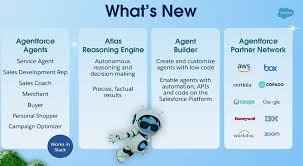
Salesforce’s AI Agents: Revolutionizing Enterprise Sales and Service for the Future In the rapidly evolving landscape of artificial intelligence (AI), Salesforce continues to lead the charge, transforming enterprise operations with cutting-edge AI agents. With the introduction of Agentforce, Salesforce is not just enhancing sales and service departments but reshaping business processes across sectors. This comprehensive exploration highlights how Salesforce’s AI agents are changing the game, offering enterprise-level executives insights into their revolutionary potential. Salesforce AI Agents Explained. AI Agents: Beyond Autonomous Vehicles A fitting analogy to grasp the progression of AI agents is the evolution of autonomous vehicles. Just as self-driving cars advance from basic driver assistance to full autonomy, AI agents evolve from simple automation to more complex decision-making. Salesforce’s Chief Product Officer, David Schmaier, draws this comparison: “In the autonomous driving world, we have levels of autonomy, from level zero to level five. AI agents for enterprises follow a similar path.” At the core of this evolution is what Salesforce defines as the “agentic” phase of AI. Unlike generative AI that follows instructions to create content, agentic AI autonomously determines and takes actions based on broader goals. Schmaier notes, “We’re at the point where AI not only creates content but takes strategic actions. It’s like having an infinite pool of interns handling mundane tasks so human employees can focus on higher-value activities.” Agentforce: Salesforce’s Next-Generation AI Platform Agentforce is the latest addition to Salesforce’s AI arsenal, unveiled during their Q2 ’25 earnings call and now positioned as a significant milestone in AI development. With Agentforce, organizations can build and manage autonomous agents for tasks across various business functions—not just customer service. This versatility is highlighted by Marc Benioff, Salesforce’s CEO, who described the energy around Agentforce during a recent briefing as “palpable.” Agentforce builds on Salesforce’s data management, security, and customization expertise, uniting these capabilities into an AI framework. Schmaier explains, “It’s about creating trusted, enterprise-ready agents, not just deploying a large language model. We’ve developed over 100 out-of-the-box use cases, from sales account summaries to service reply recommendations, all customizable and easy to deploy.” Agentforce “In Every App” A key announcement is the integration of Agentforce in every app across Salesforce’s product suite, including Sales, Service, Marketing, and Commerce Agents. The Atlas reasoning engine, Agent Builder, and a partner network were also introduced to further enhance its capabilities. The Atlas Reasoning Engine acts as the “brain” behind Agentforce, autonomously generating plans and refining them based on actions it needs to perform, such as running business processes or engaging customers through preferred channels. What Makes an AI Agent? Salesforce AI Agents Explained Building an AI agent with Agentforce requires five key elements: These components leverage existing Salesforce infrastructure, making it easier for businesses to deploy agents through Agent Builder, which is part of the new Agentforce Studio. Agents vs. Chatbots Unlike traditional chatbots, which provide pre-programmed responses, Salesforce’s AI agents use large language models (LLMs) and generative AI to interpret and autonomously execute customer requests based on CRM data. This distinction allows AI agents to perform tasks that go beyond simple queries, driving efficiency in customer service, sales, and other business areas. Practical Applications: Sales, Service, and Marketing Salesforce’s AI agents offer tangible business benefits. For instance, Sales Agent, available as both a Sales Development Representative (SDR) and Sales Coach, automates lead nurturing and inquiry management. It utilizes CRM data to deliver personalized pitches, handle objections, and even suggest meeting times—freeing sales teams to focus on more strategic tasks. In customer service, AI agents manage routine inquiries, allowing human representatives to address more complex customer needs. In marketing, AI agents generate data-driven insights to personalize campaigns, improving customer engagement and conversion rates. The Security and Trust Foundation Security and trust remain core to Salesforce’s approach to AI. The Einstein Trust Layer ensures that data protection, privacy, and ethical guidelines are maintained throughout AI interactions. Schmaier emphasizes, “Our platform defines what data agents can access and how they use it, adhering to strict data integrity standards.” The Trust Layer also prevents AI from training on customer data without consent, ensuring transparency and security. A Partnership Between Humans and AI-Salesforce AI Agents Explained Salesforce’s vision emphasizes the synergy between human employees and AI agents. As Schmaier points out, “AI agents handle routine tasks and deliver insights, allowing employees to focus on more creative and strategic work.” This human-AI partnership boosts productivity and innovation, ultimately improving business outcomes. The Future of AI in Business As AI technology advances, Salesforce is already working on next-generation capabilities for Agentforce, including predictive analytics and more sophisticated autonomous agents. Schmaier forecasts, “These agents will handle a wider range of tasks and provide deeper insights and recommendations.” With Agentforce launching in October 2024, businesses can expect significant returns on investment, thanks to its cost-efficient model starting at $2 per conversation. In summary, Salesforce’s Agentforce is a game-changing innovation, blending AI and human intelligence to transform sales, service, and marketing. As more details unfold, it’s clear that Agentforce will redefine the future of business operations—driving efficiency, personalization, and strategic success. Like1 Related Posts Who is Salesforce? Who is Salesforce? Here is their story in their own words. From our inception, we’ve proudly embraced the identity of Read more Salesforce Marketing Cloud Transactional Emails Salesforce Marketing Cloud Transactional Emails are immediate, automated, non-promotional messages crucial to business operations and customer satisfaction, such as order Read more Salesforce Unites Einstein Analytics with Financial CRM Salesforce has unveiled a comprehensive analytics solution tailored for wealth managers, home office professionals, and retail bankers, merging its Financial Read more AI-Driven Propensity Scores AI plays a crucial role in propensity score estimation as it can discern underlying patterns between treatments and confounding variables Read more

Read More
Salesforce to Acquire PredictSpring

Salesforce to Acquire PredictSpring

Salesforce to Acquire PredictSpring, Enhancing Omnichannel Capabilities Last month, Salesforce finalized an agreement to acquire PredictSpring, a leading provider of point-of-sale (POS) software. PredictSpring, known for its omnichannel commerce solutions, offers a suite of mobile POS systems along with clienteling, inventory management, and order management tools tailored for the retail sector. Insights from Industry Analysts In a recent episode of CX Today’s BIG News Update, key analysts shared their perspectives on the acquisition, highlighting three major points. Filling a Critical Gap Rebecca Wetteman, CEO & Principal Analyst at Valoir, noted that while Salesforce has effectively assisted many B2B clients, such as Fiserv and Peloton, in transitioning to B2C strategies, one crucial component was missing: order management. PredictSpring’s solutions address this gap, enhancing Salesforce’s data strategy and providing a more comprehensive customer view. Wetteman stated, “This addition is a significant move for Salesforce, strengthening their position beyond B2B and bridging the B2B to B2C divide.” Advancing Omnichannel Retail Simon Harrison, Founder & CEO at Actionary, emphasized that the acquisition represents a major step forward in delivering effective omnichannel solutions. PredictSpring’s technology promises to solve challenges associated with integrating in-store and digital experiences, enhancing overall customer interactions. Harrison praised the investment, stating, “This is a smart move, addressing real-world issues and increasing value for both staff and customers in today’s dynamic retail environment.” Expanding Market Reach Martin Schnieder, VP and Principal Analyst at Constellation Research, pointed out that acquiring PredictSpring aligns with Salesforce’s strategy to expand its total addressable market (TAM). He highlighted retail as a sector with unique challenges and opportunities, where Salesforce’s Data Cloud and platform can create impactful vertical-specific solutions. Schnieder noted, “Retail offers a different model with constrained margins, and Salesforce can leverage its platform to provide substantial value.” Michael Fauscette, Founder, CEO, and Chief Analyst at Arion Research, observed that Salesforce is strategically acquiring startups to fill gaps in its vertical offerings. He remarked, “Salesforce’s approach involves identifying startups that address specific needs and integrating them into their ecosystem. This strategy has proven effective and allows Salesforce to go to market directly with these partners, a practice not always seen among enterprise vendors.” Conclusion Salesforce’s acquisition of PredictSpring is a strategic move to enhance its omnichannel capabilities and address key gaps in its offerings. By integrating PredictSpring’s advanced POS solutions, Salesforce aims to strengthen its position in the retail sector and continue its growth trajectory in both B2B and B2C markets. Like Related Posts Who is Salesforce? Who is Salesforce? Here is their story in their own words. From our inception, we’ve proudly embraced the identity of Read more Salesforce Marketing Cloud Transactional Emails Salesforce Marketing Cloud Transactional Emails are immediate, automated, non-promotional messages crucial to business operations and customer satisfaction, such as order Read more Salesforce Unites Einstein Analytics with Financial CRM Salesforce has unveiled a comprehensive analytics solution tailored for wealth managers, home office professionals, and retail bankers, merging its Financial Read more AI-Driven Propensity Scores AI plays a crucial role in propensity score estimation as it can discern underlying patterns between treatments and confounding variables Read more

Read More
Salesforce on AI

Salesforce on AI

Marketing success hinges on delivering consistent, timely, and engaging content. According to the Salesforce State of Marketing report, 78% of high-performing marketers identify data as their most critical asset for creating cohesive customer journeys. Yet, only 49% report having a unified view of customer data sources. This disconnect highlights a significant challenge many marketing teams face in effectively leveraging their data. For organizations already invested in Salesforce, incorporating AI-driven business intelligence (BI) tools offers numerous benefits. These include reduced time to deliver insights, enhanced automation, increased innovation, improved agility, and cost savings. However, realizing these benefits depends on having high-quality data and robust data strategies. This insight explores AI-driven BI from a Salesforce perspective, highlighting its benefits, applications, and future trends. By understanding the potential of AI in BI, organizations can better harness their data to drive success and innovation. The Role of AI in Business Intelligence Integrating AI into BI systems elevates data analysis by offering deeper insights and predictive capabilities. Here’s how AI enhances BI: These examples demonstrate AI’s ability to improve BI systems by enhancing data accuracy, providing real-time insights, and improving forecasting. Salesforce’s AI Capabilities in BI Salesforce’s AI capabilities in BI are embodied in the versatile tool, Salesforce Einstein. Easily integrated with BI, Einstein automates tasks and delivers personalized insights. Companies using Einstein have reported a 20% increase in sales productivity. Here’s how Einstein can be utilized in various scenarios: These examples illustrate how Salesforce’s AI tools, particularly Einstein, can transform BI by automating routine tasks and delivering personalized insights, ultimately driving customer satisfaction and business growth. Future Trends in AI and BI The future of AI and BI promises even more advanced capabilities and innovations. As AI evolves, so too will the tools for BI. Here are some trends expected to emerge in the near future: These trends show that AI and BI are evolving rapidly. Companies that stay ahead of these developments will be well-positioned to leverage AI for greater innovation and efficiency. Next Steps AI-powered BI, especially with Salesforce, is transforming how businesses operate by providing deeper insights and better decision-making capabilities. To stay competitive and foster innovation, organizations must embrace AI. The quest is no longer just to be data-driven. It is to be data-decisioned. Here are some actionable steps: By taking these steps, businesses can fully leverage AI-driven BI and maintain a competitive edge in the fast-evolving digital playinf field of AI. Like Related Posts Who is Salesforce? Who is Salesforce? Here is their story in their own words. From our inception, we’ve proudly embraced the identity of Read more Salesforce Marketing Cloud Transactional Emails Salesforce Marketing Cloud Transactional Emails are immediate, automated, non-promotional messages crucial to business operations and customer satisfaction, such as order Read more Salesforce Unites Einstein Analytics with Financial CRM Salesforce has unveiled a comprehensive analytics solution tailored for wealth managers, home office professionals, and retail bankers, merging its Financial Read more AI-Driven Propensity Scores AI plays a crucial role in propensity score estimation as it can discern underlying patterns between treatments and confounding variables Read more
Read More
Qwary Salesforce Integration

Qwary Salesforce Integration

Qwary Enhances Customer Insights with New Salesforce Integration HERNDON, Va., Aug. 13, 2024 /PRNewswire/ — While surveys have long been a staple for gathering customer feedback, data entry often poses a challenge in obtaining comprehensive insights. Qwary’s new Salesforce integration aims to resolve this issue by enabling seamless data transfer and synchronization between the two platforms. This integration allows teams to consolidate customer information into a single hub, providing real-time visibility and enhancing strategic planning and collaboration. Key features include creating email campaigns, importing contacts, mapping survey results, and automating event-based workflows. What Is Qwary’s Salesforce Integration? Qwary’s Salesforce integration is designed to streamline the analysis of Salesforce survey data, offering a more efficient way to understand customer interactions with your brand. By integrating survey feedback with CRM data, this tool helps you quickly adapt your products and services to meet evolving customer needs. It tracks customer journeys, collects feedback, and reveals pain points, enabling you to deliver tailored solutions. Benefits of Using Qwary’s Salesforce Integration Qwary’s integration offers several notable benefits: Automate Feedback Collection The integration automates the feedback collection process by triggering surveys at strategic points in the customer lifecycle. This allows your team to act swiftly to foster engagement and generate leads. Gain Actionable Insights Seamlessly integrating with Salesforce CRM, Qwary scores, analyzes, and enriches customer data, helping your team identify emerging trends and seize opportunities for personalization and customer development. Synchronize Data Automatically With Qwary’s integration, your contact data is consolidated into a single, reliable source of truth. Whether you’re using Salesforce or Qwary, automated data synchronization ensures consistency and provides real-time updates. Collaborate Effectively The integration promotes effective teamwork by sharing data between Salesforce and Qwary, enabling your team to solve problems collaboratively and refine strategies to boost customer retention. Key Capabilities Qwary’s Salesforce integration excels in managing customer feedback, automating workflows, and consolidating contact data: Salesforce Workflow Automation The integration simplifies scheduling and automating survey triggers, eliminating manual processes. Surveys can be initiated via email or following significant events, with responses seamlessly mapped into Salesforce. This creates a comprehensive view of customer behavior, helping your team act on insights, strengthen connections, and enhance satisfaction. Contact Data Importation Qwary facilitates quick access to Salesforce contacts, providing a holistic view of your customer base. The integration streamlines contact data importation and updates, eliminating manual data entry and speeding up data management. Potential Business Impacts By combining automation, synchronization, and data consolidation with a user-friendly interface, Qwary’s Salesforce integration enhances your sales team’s ability to collect and leverage customer feedback. Immediate access to comprehensive consumer insights allows your business to respond promptly to customer needs, improving satisfaction and loyalty. Real-time data aggregation helps your company adapt quickly and refine offerings to exceed customer expectations. Stay Ahead with Qwary’s Salesforce Integration Qwary continuously updates its solutions to meet the evolving needs of businesses focused on customer engagement. Leveraging automation, synchronization, and advanced analytics through an accessible platform, Qwary’s Salesforce integration empowers your team to enhance offerings and connect with customers efficiently. By optimizing the use of survey data and Salesforce feedback, Qwary keeps your business at the forefront of market trends, enabling you to consistently delight your customers. Like Related Posts Who is Salesforce? Who is Salesforce? Here is their story in their own words. From our inception, we’ve proudly embraced the identity of Read more Salesforce Marketing Cloud Transactional Emails Salesforce Marketing Cloud Transactional Emails are immediate, automated, non-promotional messages crucial to business operations and customer satisfaction, such as order Read more Salesforce Unites Einstein Analytics with Financial CRM Salesforce has unveiled a comprehensive analytics solution tailored for wealth managers, home office professionals, and retail bankers, merging its Financial Read more AI-Driven Propensity Scores AI plays a crucial role in propensity score estimation as it can discern underlying patterns between treatments and confounding variables Read more
Read More
AI Adoption Rates

AI Adoption Rates

Businesses Eager to Embrace AI, Yet Concerned About Trust, Data, and Ethics in AI Adoption Rates As AI adoption rates are projected to surge, only 10% of people currently have full trust in AI for making informed decisions. According to Salesforce’s latest research, nearly half of customer service teams, over 40% of salespeople, and a third of marketers have fully integrated AI to enhance their work. However, 77% of business leaders express concerns about trusted data and ethics that could potentially stall their AI initiatives. The “Trends in AI for CRM” report highlights that companies fear missing out on the benefits of generative AI if the data supporting large language models (LLMs) is not based on their own reliable customer records. Additionally, respondents are worried about the lack of clear company policies governing the ethical use of AI and the complex landscape of LLM vendors, with 80% of companies currently using multiple models. Data Trust Issues Stymie AI Progress Despite expectations for a dramatic increase in AI adoption, only 10% of individuals fully trust AI to make informed decisions. The report reveals that 59% of organizations lack unified data strategies essential for ensuring AI reliability and accuracy. While 80% of employees using AI at work report increased productivity—a key driver for rapid AI adoption—only 21% of surveyed workers said their company has established clear policies on approved AI tools and use cases. Many employees, undeterred by the absence of formal policies, continue to use unapproved (55%) or explicitly banned (40%) tools. Furthermore, 69% of respondents noted that their employers have not provided training on AI usage. Critical Focus Areas: Trust, Data Security, and Transparency The report also underscores that 74% of the general public is concerned about the unethical use of AI. Companies that emphasize end-user control are better positioned to build customer trust in their AI strategies, with 56% of survey respondents expressing openness to AI under these conditions. Key factors for deepening trust in AI include increased visibility into AI use, human validation of outputs, and enhanced user control. “This is a pivotal moment as business leaders across various industries look to AI to drive growth, efficiency, and customer loyalty,” said Clara Shih, CEO of Salesforce AI. “Success with AI requires more than just deploying LLMs. It demands trusted data, user access control, vector search capabilities, audit trails, citations, data masking, low-code builders, and seamless UI integration to truly succeed,” Shih added. Like Related Posts Who is Salesforce? Who is Salesforce? Here is their story in their own words. From our inception, we’ve proudly embraced the identity of Read more Salesforce Marketing Cloud Transactional Emails Salesforce Marketing Cloud Transactional Emails are immediate, automated, non-promotional messages crucial to business operations and customer satisfaction, such as order Read more Salesforce Unites Einstein Analytics with Financial CRM Salesforce has unveiled a comprehensive analytics solution tailored for wealth managers, home office professionals, and retail bankers, merging its Financial Read more AI-Driven Propensity Scores AI plays a crucial role in propensity score estimation as it can discern underlying patterns between treatments and confounding variables Read more
Read More
Einstein Chatbot

Einstein Chatbot

Businesses have increasingly adopted “chatbots” to provide quick answers to customer queries outside regular business hours or to route customers to the appropriate department after answering preliminary questions. While these chatbots can be useful, they often fall short in delivering the same level of value as human interaction, sometimes leading to frustration. Today, chatbots are advancing significantly, with Salesforce’s Einstein Service Agent leading this evolution. This technology offers notable benefits but also presents challenges that businesses must address for effective implementation. Advantages of Einstein Service Agent Seamless Integration with Salesforce: Unlike standalone AI tools, Einstein Service Agent leverages comprehensive customer profiles, purchase histories, and previous interactions to offer personalized responses. Its integration within established Salesforce workflows allows for rapid deployment, reducing both time and cost associated with implementation. Experience has shown that selecting technologies with built-in CRM or ERP integration is a significant advantage over those requiring separate integration efforts. Built on Salesforce’s Trust Layer: Einstein Service Agent ensures secure handling of customer data, adhering to relevant regulations. This enhances trust among businesses and their customers, facilitating smoother adoption. GenAI Capabilities: The AI can manage complex, multi-step tasks like processing returns or refunds, and deliver tailored responses based on specific customer needs, enhancing the overall customer experience. Scalability Across Salesforce Clouds: Einstein Service Agent is adaptable to various business needs and can evolve as those needs change. Whether a company expands, introduces new services, or shifts its customer service strategy, the agent can be scaled and customized to maintain long-term value and utility. Challenges in Implementing AI Agents Data Quality and Integration: The effectiveness of AI tools relies heavily on the quality of the data they access. Incomplete, outdated, or poorly maintained data can lead to inaccurate or ineffective responses. To address this, businesses should prioritize data quality through regular audits and ensure comprehensive and up-to-date customer information. Change Management and Employee Training: The introduction of AI can lead to resistance from employees concerned about job displacement or unfamiliarity with new technology. Businesses should invest in change management strategies, including clear communication about AI as a complement to, not a replacement for, human agents. Training programs should focus on helping employees work alongside AI tools, enhancing skills where human judgment and empathy are crucial. Balancing Customer Service: Over-reliance on AI may diminish the personal touch essential in customer service. AI should handle straightforward and repetitive inquiries, while more complex or sensitive issues should be escalated to human agents who can provide personalized responses. Considerations for a Successful Deployment Customization and Flexibility: Tailoring the AI to fit unique processes and customer service requirements may require additional configuration or custom development to align with the company’s goals and service expectations. Ethical and Bias Concerns: AI systems can unintentionally perpetuate biases present in their training data, leading to unfair interactions. Businesses must actively identify and mitigate biases, ensuring that their AI operates fairly and equitably. This includes regularly reviewing training data for biases, implementing safeguards, and maintaining a commitment to ethical AI practices. Customer Acceptance and User Experience: Some customers may be hesitant to interact with AI or have negative perceptions of automated service. To improve acceptance, businesses should design user-friendly AI interactions, ensure transparency, and provide clear options for escalating issues to human agents. Einstein Chatbot Implementing AI agents like Salesforce’s Einstein Service Agent can significantly enhance customer service efficiency, personalization, and scalability. However, businesses must carefully navigate challenges related to data quality, change management, and maintaining trust. A thoughtful approach to AI deployment can transform customer service operations and drive business growth. Like Related Posts Who is Salesforce? Who is Salesforce? Here is their story in their own words. From our inception, we’ve proudly embraced the identity of Read more Salesforce Marketing Cloud Transactional Emails Salesforce Marketing Cloud Transactional Emails are immediate, automated, non-promotional messages crucial to business operations and customer satisfaction, such as order Read more Salesforce Unites Einstein Analytics with Financial CRM Salesforce has unveiled a comprehensive analytics solution tailored for wealth managers, home office professionals, and retail bankers, merging its Financial Read more AI-Driven Propensity Scores AI plays a crucial role in propensity score estimation as it can discern underlying patterns between treatments and confounding variables Read more

Read More
State of AI

State of AI

With the Dreamforce conference just a few weeks away, AI is set to be a central theme once again. This week, Salesforce offered a preview of what to expect in September with the release of its “Trends in AI for CRM” report. This report consolidates findings from several Salesforce research studies conducted from February last year to April this year. The report’s executive summary highlights four key insights: The Fear of Missing Out (FOMO) An intriguing statistic from Salesforce’s “State of Data and Analytics” report reveals that 77% of business leaders feel a fear of missing out on generative AI. This concern is particularly pronounced among marketers (88%), followed by sales executives (78%) and customer service professionals (73%). Given the continued hype around generative AI, these numbers are likely still relevant or even higher as of July 2024. As Salesforce AI CEO Clara Shih puts it: “The majority of business executives fear they’re missing out on AI’s benefits, and it’s a well-founded concern. Today’s technology world is reminiscent of 1998 for the Internet—full of opportunities but also hype.” Shih adds: “How do we separate the signal from the noise and identify high-impact enterprise use cases?” The Quest for ROI and Value The surge of hype around generative AI over the past 18 months has led to high expectations. While Salesforce has been more responsible in managing user expectations, many executives view generative AI as a cure-all. However, this perspective can be problematic, as “silver bullets” often miss their mark. Recent tech sector developments reflect a shift toward a longer-term view of AI’s impact. Meta’s share price fell when Mark Zuckerberg emphasized AI as a multi-year project, and Alphabet’s Sundar Pichai faced tough questions from Wall Street about the need for continued investment. State of AI Shih notes a growing impatience with the time required to realize AI’s value: “It’s been over 18 months since ChatGPT sparked excitement about AI in business. Many companies are still grappling with building or buying solutions that are not overly siloed and can be customized. The challenge is finding a balance between quick implementation and configurability.” She adds: “The initial belief was that companies could just integrate ChatGPT and see instant transformation. However, there are security risks and practical challenges. For LLMs to be effective, they need contextual data about users and customers.” Conclusion: A Return to the Future Shih likens the current AI landscape to the late 90s Internet boom, noting: “It’s similar to the late 90s when people questioned if the Internet was overhyped. While some investments will not pan out, the transformative potential of successful use cases is enormous. Just as with the Internet, discovering the truly valuable applications of AI may require experimentation and time. We are very much in the 1998 moment for AI now.” Like Related Posts Who is Salesforce? Who is Salesforce? Here is their story in their own words. From our inception, we’ve proudly embraced the identity of Read more Salesforce Marketing Cloud Transactional Emails Salesforce Marketing Cloud Transactional Emails are immediate, automated, non-promotional messages crucial to business operations and customer satisfaction, such as order Read more Salesforce Unites Einstein Analytics with Financial CRM Salesforce has unveiled a comprehensive analytics solution tailored for wealth managers, home office professionals, and retail bankers, merging its Financial Read more AI-Driven Propensity Scores AI plays a crucial role in propensity score estimation as it can discern underlying patterns between treatments and confounding variables Read more
Read More
Need AI Training

Need AI Training

Workers in office jobs are missing out on essential AI training, crucial for adapting to the evolving labor market, according to a report from software giant Salesforce. Released Tuesday, the report is based on a series of anonymous surveys and reveals that approximately 70% of desk workers have not received training in generative AI. Furthermore, only 21% of respondents said their companies have clearly defined policies regarding approved AI tools and their usage. Additionally, 62% believe they lack the necessary skills to use the technology effectively. Despite this lack of formal training and clear policies, many workers are taking the initiative to use AI tools independently. The report highlights that “workers aren’t waiting for permission to use AI,” with 55% of survey respondents using unapproved tools and 40% using AI tools explicitly banned by their employers. The report emphasizes the need for clear protocols and approved tools to address data security and ethical concerns. Clara Shih, CEO of Salesforce AI, stresses the importance of continuous learning in response to the rapid changes in AI technology, stating, “The unprecedented pace of change in AI requires companies to upskill their entire workforce. This is not a ‘one-and-done’ exercise, but rather a continuous cycle of learning as AI evolves.” However, some companies are stepping up to meet this challenge. While less than half of U.S. companies had initiated AI training for their workers by April, according to a LinkedIn study, businesses like JPMorgan Chase, Amazon, PricewaterhouseCoopers, AT&T, Verizon, Moderna, and General Motors are launching AI literacy initiatives for their employees and the broader workforce. For instance, Amazon aims to train 2 million people globally in generative artificial intelligence by 2025. Like Related Posts Who is Salesforce? Who is Salesforce? Here is their story in their own words. From our inception, we’ve proudly embraced the identity of Read more Salesforce Marketing Cloud Transactional Emails Salesforce Marketing Cloud Transactional Emails are immediate, automated, non-promotional messages crucial to business operations and customer satisfaction, such as order Read more Salesforce Unites Einstein Analytics with Financial CRM Salesforce has unveiled a comprehensive analytics solution tailored for wealth managers, home office professionals, and retail bankers, merging its Financial Read more AI-Driven Propensity Scores AI plays a crucial role in propensity score estimation as it can discern underlying patterns between treatments and confounding variables Read more
Read More
Salesforce Model Tester

Salesforce Model Tester

Salesforce is taking steps to ensure its AI models perform accurately, even with unexpected data. The company recently filed a patent for an “automated testing pipeline for neural network models.” This technology helps developers predict whether their AI models will maintain accuracy when dealing with “unseen queries,” using customer service bots as a primary example. Salesforce Model Tester Typically, developers test their AI models using a subset of the original training data. However, Salesforce notes that this approach may not be ideal for smaller datasets or when real-time data differs significantly from the training set. To address this, Salesforce’s system creates both easy and hard evaluation datasets from real-time customer data. The “hard” datasets contain queries significantly different from the training data, while the “easy” datasets are more similar. The system begins by passing customer data through a “dependency parser,” which filters out specific actions or verbs representing meaningful commands. Then, a pre-trained language model ranks the queries based on their similarity to the training data. A “bag of words” classifier removes queries that are too similar, ensuring the testing data is diverse. These curated datasets are used to evaluate the model’s performance. The pipeline also includes a “human-in-the-loop” feedback mechanism to notify developers when a model isn’t performing well, allowing for adjustments. Salesforce’s primary AI product, Einstein, enables customers to create generative AI experiences using their data. Unlike some companies that focus on building massive AI models, Salesforce aims to empower enterprise clients to develop their own models, according to Bob Rogers, Ph.D., co-founder of BeeKeeperAI and CEO of Oii.ai. This patent could enhance Salesforce’s offerings by ensuring the AI models built under its platform function as intended. “I think Salesforce wants Einstein to generate more leads and faster. And if that’s not happening, it could be a miss for Salesforce,” Rogers said. The patent’s emphasis on improving customer service chatbots suggests Salesforce is focusing on AI-driven customer interactions. This is in line with the company’s recent unveiling of its fully-autonomous Einstein Service Agent, highlighting where Salesforce believes the most traction for Einstein might be. Rogers noted that while creating tools for customers to build their own AI models is challenging, Salesforce’s approach stands out in a market dominated by companies like Google, Microsoft, and OpenAI, which offer ready-to-use AI services. “At the end of the day, most AI utilization is still people saying, ‘solve my problem for me,’” Rogers said. Like Related Posts Who is Salesforce? Who is Salesforce? Here is their story in their own words. From our inception, we’ve proudly embraced the identity of Read more Salesforce Marketing Cloud Transactional Emails Salesforce Marketing Cloud Transactional Emails are immediate, automated, non-promotional messages crucial to business operations and customer satisfaction, such as order Read more Salesforce Unites Einstein Analytics with Financial CRM Salesforce has unveiled a comprehensive analytics solution tailored for wealth managers, home office professionals, and retail bankers, merging its Financial Read more AI-Driven Propensity Scores AI plays a crucial role in propensity score estimation as it can discern underlying patterns between treatments and confounding variables Read more

Read More
Salesforce API Gen

Salesforce API Gen

Function-calling agent models, a significant advancement within large language models (LLMs), encounter challenges in requiring high-quality, diverse, and verifiable datasets. These models interpret natural language instructions to execute API calls crucial for real-time interactions with various digital services. However, existing datasets often lack comprehensive verification and diversity, resulting in inaccuracies and inefficiencies. Overcoming these challenges is critical for deploying function-calling agents reliably in real-world applications, such as retrieving stock market data or managing social media interactions. Salesforce API Gen. Current approaches to training these agents rely on static datasets that lack thorough verification, hampering adaptability and performance when encountering new or unseen APIs. For example, models trained on restaurant booking APIs may struggle with tasks like stock market data retrieval due to insufficient relevant training data. Addressing these limitations, researchers from Salesforce AI Research propose APIGen, an automated pipeline designed to generate diverse and verifiable function-calling datasets. APIGen integrates a multi-stage verification process to ensure data reliability and correctness. This innovative approach includes format checking, actual function executions, and semantic verification, rigorously verifying each data point to produce high-quality datasets. Salesforce API Gen APIGen initiates its data generation process by sampling APIs and query-answer pairs from a library, formatting them into standardized JSON format. The pipeline then progresses through a series of verification stages: format checking to validate JSON structure, function call execution to verify operational correctness, and semantic checking to align function calls, execution results, and query objectives. This meticulous process results in a comprehensive dataset comprising 60,000 entries, covering 3,673 APIs across 21 categories, accessible via Huggingface. The datasets generated by APIGen significantly enhance model performance, achieving state-of-the-art results on the Berkeley Function-Calling Benchmark. Models trained on these datasets outperform multiple GPT-4 models, demonstrating substantial improvements in accuracy and efficiency. For instance, a model with 7 billion parameters achieves an accuracy of 87.5%, surpassing previous benchmarks by a notable margin. These outcomes underscore the robustness and reliability of APIGen-generated datasets in advancing the capabilities of function-calling agents. In conclusion, APIGen presents a novel framework for generating high-quality, diverse datasets for function-calling agents, addressing critical challenges in AI research. Its multi-stage verification process ensures data reliability, empowering even smaller models to achieve competitive results. APIGen opens avenues for developing efficient and powerful language models, emphasizing the pivotal role of high-quality data in AI advancements. Like Related Posts Who is Salesforce? Who is Salesforce? Here is their story in their own words. From our inception, we’ve proudly embraced the identity of Read more Salesforce Marketing Cloud Transactional Emails Salesforce Marketing Cloud Transactional Emails are immediate, automated, non-promotional messages crucial to business operations and customer satisfaction, such as order Read more Salesforce Unites Einstein Analytics with Financial CRM Salesforce has unveiled a comprehensive analytics solution tailored for wealth managers, home office professionals, and retail bankers, merging its Financial Read more AI-Driven Propensity Scores AI plays a crucial role in propensity score estimation as it can discern underlying patterns between treatments and confounding variables Read more

Read More
Einstein Service Agent is Coming

Einstein Service Agent is Coming

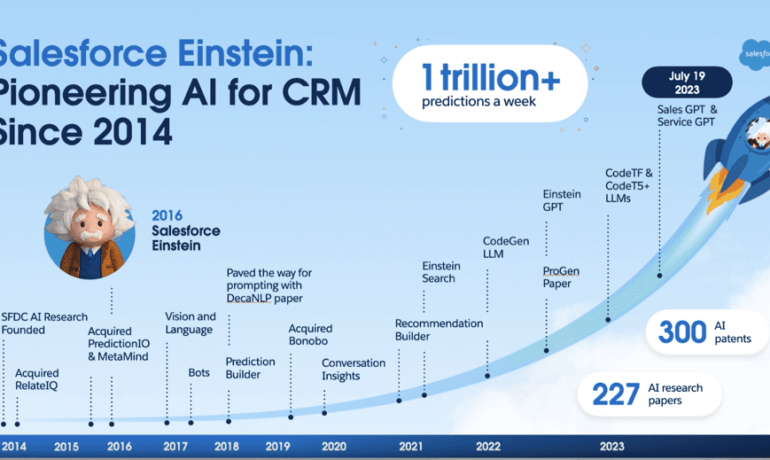
Salesforce is entering the AI agent arena with a new service built on its Einstein AI platform. Introducing the Einstein Service Agent, a generative AI-powered self-service tool designed for end customers. This agent provides a conversational AI interface to answer questions and resolve various issues. Similar to the employee-facing Einstein Copilot used internally within organizations, the Einstein Service Agent can take action on behalf of users, such as processing product returns or issuing refunds. It can handle both simple and complex multi-step interactions, leveraging approved company workflows already established in Salesforce. Initially, Einstein Service Agent will be deployed for customer service scenarios, with plans to expand to other Salesforce clouds in the future. What sets Einstein Service Agents apart from other AI-driven workflows is their seamless integration with Salesforce’s existing customer data and workflows. “Einstein Service Agent is a generative AI-powered, self-service conversational experience built on our Einstein trust layer and platform,” Clara Shih, CEO of Salesforce AI, told VentureBeat. “Everything is grounded in our trust layer, as well as all the customer data and official business workflows that companies have been adding into Salesforce for the last 25 years.” Distinguishing AI Agent from AI Copilot Over the past year, Salesforce has detailed various aspects of its generative AI efforts, including the development of the Einstein Copilot, which became generally available at the end of April. The Einstein Copilot enables a wide range of conversational AI experiences for Salesforce users, focusing on direct users of the Salesforce platform. “Einstein Copilot is employee-facing, for salespeople, customer service reps, marketers, and knowledge workers,” Shih explained. “Einstein Service Agent is for our customers’ customers, for their self-service.” The concept of a conversational AI bot answering basic customer questions isn’t new, but Shih emphasized that Einstein Service Agent is different. It benefits from all the data and generative AI work Salesforce has done in recent years. This agent approach is not just about answering simple questions but also about delivering knowledge-based responses and taking action. With a copilot, multiple AI engines and responses can be chained together. The AI agent approach also chains AI models together. For Shih, the difference is a matter of semantics. “It’s a spectrum toward more and more autonomy,” Shih said. Driving AI Agent Approach with Customer Workflows As an example, Shih mentioned that Salesforce is working with a major apparel company as a pilot customer for Einstein Service Agent. If a customer places an online order and receives the wrong item, they could call the retailer during business hours for assistance from a human agent, who might be using the Einstein Copilot. If the customer reaches out when human agents aren’t available or chooses a self-service route, Einstein Service Agent can step in. The customer will be able to ask about the issue and, if enabled in the workflow, get a resolution. The workflow that understands who the customer is and how to handle the issue is already part of the Salesforce Service Cloud. Shih explained that Einstein Studio is where all administrative and configuration work for Einstein AI, including Service Agents, takes place, utilizing existing Salesforce data. The Einstein Service Agent provides a new layer for customers to interact with existing logic to solve issues. “Everything seemingly that the company has invested in over the last 25 years has come to light in the last 18 months, allowing customers to securely take advantage of generative AI in a trusted way,” Shih said. Like Related Posts Who is Salesforce? Who is Salesforce? Here is their story in their own words. From our inception, we’ve proudly embraced the identity of Read more Salesforce Marketing Cloud Transactional Emails Salesforce Marketing Cloud Transactional Emails are immediate, automated, non-promotional messages crucial to business operations and customer satisfaction, such as order Read more Salesforce Unites Einstein Analytics with Financial CRM Salesforce has unveiled a comprehensive analytics solution tailored for wealth managers, home office professionals, and retail bankers, merging its Financial Read more AI-Driven Propensity Scores AI plays a crucial role in propensity score estimation as it can discern underlying patterns between treatments and confounding variables Read more
Read More
Autodesk Enhancements with Einstein 1

Autodesk Enhancements with Einstein 1

Autodesk Enhances Customer Service and Agent Productivity with Salesforce AI Integration Autodesk, a leader in 3D design, engineering, and entertainment software, has strengthened its partnership with Salesforce by incorporating Salesforce AI technology into its service agent workflow. This integration aims to boost agent productivity and enhance customer satisfaction. Autodesk Enhancements with Einstein 1. Impact of Salesforce Integration By leveraging Salesforce’s CRM, trusted AI, and data solutions, Autodesk has unified data access and developed an AI-powered self-service application. This initiative aims to foster deeper customer relationships and enhance employee productivity. The integration with Salesforce is transforming Autodesk’s customer engagement and agent workflow efficiency. Key Benefits for Autodesk Accelerating Self-Service: Autodesk uses the Einstein 1 Platform, which employs AI to create actionable data and streamline processes. This has enabled the development of a comprehensive, intuitive service cloud application for Autodesk’s team. At the conclusion of customer-agent interactions, Einstein for Service generates AI-powered case summaries, reducing the time agents spend summarizing chats by 63%. Creating Frictionless Experiences: MuleSoft has been pivotal in advancing Autodesk’s automation strategy by providing integrated and unified data access across cloud solutions. This has allowed Autodesk to modernize, simplify, and connect existing SaaS applications, resulting in smoother operations. Minimizing Disruption: Salesforce Professional Services provides real-time, 24/7 monitoring, equipping Autodesk with tools to identify and resolve potential performance issues before they affect customers. Salesforce also enhances data access monitoring, leading to a 30% reduction in ongoing maintenance. Customer Perspective Prakash Kota, SVP and CIO of Autodesk, expressed enthusiasm for the partnership: “We are thrilled to partner with Salesforce as Autodesk continues to innovate, grow, and scale with the customer at the center of our business. Our teams are excited to put generative AI to work across the enterprise, enhancing the productivity of our service agents. Saving time on tasks enables our employees to focus on higher-value work.” This partnership underscores Autodesk’s commitment to customer-centric innovation and operational efficiency, leveraging Salesforce’s advanced technologies to drive continued growth and customer satisfaction. Like Related Posts Who is Salesforce? Who is Salesforce? Here is their story in their own words. From our inception, we’ve proudly embraced the identity of Read more Salesforce Marketing Cloud Transactional Emails Salesforce Marketing Cloud Transactional Emails are immediate, automated, non-promotional messages crucial to business operations and customer satisfaction, such as order Read more Salesforce Unites Einstein Analytics with Financial CRM Salesforce has unveiled a comprehensive analytics solution tailored for wealth managers, home office professionals, and retail bankers, merging its Financial Read more AI-Driven Propensity Scores AI plays a crucial role in propensity score estimation as it can discern underlying patterns between treatments and confounding variables Read more
Read More
Salesforce AI Journey

Salesforce AI Journey

“We’re on an Incredible Journey”: Why Salesforce’s AI Push is Just Beginning This article originally appeared in TechRadar by Mike Moore. Salesforce AI Journey. When it comes to leveraging AI to enhance global workforces, some companies are leading the charge, particularly when their technology is at the forefront. Salesforce, known for its robust AI tools, is one such company pushing the boundaries. At its recent World Tour London event, Salesforce emphasized its commitment to AI, showcasing how its Einstein tools are already benefiting customers worldwide. TechRadar Pro spoke with Paul O’Sullivan, SVP, Solution Engineering & UKI, CTO, Salesforce, about the company’s vision for enhancing efficiency and productivity across all markets, particularly in the UK. A Wave of Innovation “We’re on an incredible journey,” O’Sullivan stated, referencing Salesforce’s $4 billion investment in the UK and Ireland in 2023. “We’re well-positioned in the UK to maximize AI’s potential and help our customers achieve true value.” This ambition is epitomized by Salesforce’s new AI center in London. The 40,000 square foot facility is set to be a hub for AI collaboration and development, addressing the growing demand for AI technology. O’Sullivan hinted that this is just the beginning. “We’re an innovation-led company—always looking ahead,” he said, highlighting the UK’s history of driving innovation as a positive indicator for AI’s future in the capital. Growing Demand and Education As demand for AI tools and services increases among businesses of all sizes, O’Sullivan acknowledged the rapid pace of change in the AI landscape. “It starts with education—at all levels,” he noted, recognizing the varying degrees of AI knowledge among business leaders. O’Sullivan compared the current AI momentum to past technological revolutions like cloud computing, websites, and ecommerce. Companies had to adapt quickly to avoid falling behind, and he noted that the window for catching up with AI might be even smaller. He predicted a “steady wave of innovation” in AI before it becomes ubiquitous in the business world, with various models and platforms vying for dominance. “It feels like everyone is in a race for AI,” he added, “and there’s a collective agreement that AI will enhance productivity and efficiency, benefiting both the bottom and top lines of big enterprises.” Human Jobs and AI Looking forward, O’Sullivan dismissed concerns that AI would replace human jobs. He suggested that AI would instead create new opportunities for human workers. “I think human nature is inherently curious,” he said. “We will continue to explore new ways of doing things and offer different levels of connection and service.” Drawing parallels to the industrial revolution, O’Sullivan pointed out that machines didn’t eliminate jobs; they increased productivity and efficiency. He believes AI will have a similar impact. “We’re going to see a new level of productivity and efficiency with AI, just as we did with the industrial revolution,” he concluded. Salesforce’s AI journey is only just beginning, promising exciting advancements and opportunities for businesses and workers alike. Like Related Posts Who is Salesforce? Who is Salesforce? Here is their story in their own words. From our inception, we’ve proudly embraced the identity of Read more Salesforce Marketing Cloud Transactional Emails Salesforce Marketing Cloud Transactional Emails are immediate, automated, non-promotional messages crucial to business operations and customer satisfaction, such as order Read more Salesforce Unites Einstein Analytics with Financial CRM Salesforce has unveiled a comprehensive analytics solution tailored for wealth managers, home office professionals, and retail bankers, merging its Financial Read more AI-Driven Propensity Scores AI plays a crucial role in propensity score estimation as it can discern underlying patterns between treatments and confounding variables Read more

Read More
AI Safety and Responsibility

AI Safety and Responsibility

The Future of AI: Balancing Innovation and Trust Authored by Justin Tauber, General Manager, Innovation and AI Culture at Salesforce, ANZ. AI Safety and Responsibility AI holds the promise of transforming business operations and freeing up our most precious resource: time. This is particularly beneficial for small businesses, where customer-facing staff must navigate a complex set of products, policies, and data with limited time and support. AI-assisted customer engagement can lead to more timely, personalized, and intelligent interactions. However, trust is paramount, and businesses must use AI power safely and ethically. The Trust Challenge According to the AI Trust Quotient, 89% of Australian office workers don’t trust AI to operate without human oversight, and 62% fear that humans will lose control of AI. Small businesses must build competence and confidence in using AI responsibly. Companies that successfully combine human and machine intelligence will lead in AI transformation. Building trust and confidence in AI requires focusing on the employee experience of AI. Employees should be integrated early into decision-making, output refinement, and feedback processes. Generative AI outcomes improve when humans are actively involved. Humans need to lead their partnership with AI, ensuring AI works effectively with humans at the helm. Strategies for Building Trust One strategy is to remind employees of AI’s strengths and weaknesses within their workflow. Showing confidence values — how much the model believes its output is correct — helps employees handle AI responses with the appropriate level of care. Lower-scored content can still be valuable, but human reviews provide deeper scrutiny. Prompt templates for staff ensure consistent inputs and predictable outputs. Explainability or citing sources for AI-generated content also addresses trust and accuracy issues. Another strategy focuses on use cases that enhance customer trust. The sweet spot is where productivity and trust-building benefits align. For example, generative AI can reassure customers that a product will arrive on time. AI in fraud detection and prevention is another area where AI can flag suspicious transactions for human review, improving the accuracy and effectiveness of fraud detection systems. Salesforce’s Commitment to Ethical AI Salesforce ensures that its AI solutions keep humans at the helm by respecting ethical guardrails in AI product development. Salesforce goes further by creating capabilities and solutions that lower the cost of responsible AI deployment and use. AI safety products help businesses use AI power without significant risks. Salesforce AI products are built with trust and reliability in mind, embodying Trustworthy AI principles to help customers deploy these products ethically. It’s unrealistic and unfair to expect employees, especially in SMBs, to refine every AI-generated output. Therefore, Salesforce provides businesses with powerful, system-wide controls and intuitive interfaces to make timely and responsible judgments about testing, refining responses, or escalating problems. Salesforce has invested in ethical AI for nearly a decade, focusing on principles, policies, and protections for itself and its customers. New guidelines for responsible generative AI development expand on core Trusted AI principles. Updated Acceptable Use Policy safeguards and the Einstein Trust layer protect customer data from external LLMs. Commitment to a Trusted AI Future While we’re still in the early days of AI, Salesforce is committed to learning and iterating in close collaboration with customers and regulators to make trusted AI a reality for all. Originally published in Smart Company. Like Related Posts Who is Salesforce? Who is Salesforce? Here is their story in their own words. From our inception, we’ve proudly embraced the identity of Read more Salesforce Marketing Cloud Transactional Emails Salesforce Marketing Cloud Transactional Emails are immediate, automated, non-promotional messages crucial to business operations and customer satisfaction, such as order Read more Salesforce Unites Einstein Analytics with Financial CRM Salesforce has unveiled a comprehensive analytics solution tailored for wealth managers, home office professionals, and retail bankers, merging its Financial Read more AI-Driven Propensity Scores AI plays a crucial role in propensity score estimation as it can discern underlying patterns between treatments and confounding variables Read more

Read More
DPD Salesforce AI Enhancements

DPD Salesforce AI Enhancements

DPD’s AI Integration: Enhancing Customer and Employee Experience DPD has ambitious plans to integrate AI throughout its Salesforce platform, aiming to automate tasks and significantly enhance the experiences of both customers and employees. DPD Salesforce AI Enhancements. Adam Hooper, Head of Central Platforms at DPD, explains that with over 400 million parcels delivered annually, maintaining robust customer relationships is crucial. To this end, DPD leverages a range of Salesforce technologies, including Service Cloud, Sales Cloud, Marketing Cloud, and Mulesoft. AI-Powered Customer Service In Salesforce’s latest update on DPD: Financial and Operational Efficiency Targeted Marketing Spreadsheets to Salesforce At the Salesforce World Tour event in London, Ben Pyne, Salesforce Platform Manager at DPD, elaborated on their current usage and future AI plans. Pyne’s team acts as internal consultants to optimize organizational workflows. As he explains: “My role is essentially to get people off spreadsheets and onto Salesforce!” He noted that about 40 departments and teams within DPD use Salesforce, far beyond the typical Sales and CRM applications. Custom applications within Salesforce personalize and enhance user experiences by focusing on relevant information. Using tools like Prompt Builder, Pyne’s team recently developed a project management app within Salesforce, streamlining tasks like writing acceptance criteria and user stories. Pyne emphasized: “I want our guys to focus on designing and building, less on the admin.” AI Use Cases When considering AI and generative AI, DPD sees significant potential to reduce operational tasks. Pyne highlighted case summarization as an obvious application, given the millions of customer service cases created each year. Rolling Out Generative AI DPD adopts a cautious approach to rolling out new technologies like generative AI. Pyne explained: “It’s starting small, finding the right teams to be able to do it. But fundamentally, starting somewhere and making slow progressions into it to ensure we don’t scare everybody away.” Ensuring Security and Trust Security and trust are paramount for DPD. Pyne noted their robust IT security team scrutinizes every implementation. Fortunately, Salesforce’s security measures, such as data anonymization and preventing LLMs (Large Language Models) from learning from their data, provide peace of mind. Pyne concluded: “We can focus on what we’re good at and not worry about the rest because Salesforce has thought of everything for us.” Like Related Posts Who is Salesforce? Who is Salesforce? Here is their story in their own words. From our inception, we’ve proudly embraced the identity of Read more Salesforce Marketing Cloud Transactional Emails Salesforce Marketing Cloud Transactional Emails are immediate, automated, non-promotional messages crucial to business operations and customer satisfaction, such as order Read more Salesforce Unites Einstein Analytics with Financial CRM Salesforce has unveiled a comprehensive analytics solution tailored for wealth managers, home office professionals, and retail bankers, merging its Financial Read more AI-Driven Propensity Scores AI plays a crucial role in propensity score estimation as it can discern underlying patterns between treatments and confounding variables Read more

Read More
gettectonic.com