Salesforce AI Archives - gettectonic.com - Page 4
Is Your LLM Agent Enterprise-Ready?

Is Your LLM Agent Enterprise-Ready?

Customer Relationship Management (CRM) systems are the backbone of modern business operations, orchestrating customer interactions, data management, and process automation. As businesses embrace advanced AI, the potential for transformative growth is clear—automating workflows, personalizing customer experiences, and enhancing operational efficiency. However, deploying large language model (LLM) agents in CRM systems demands rigorous, real-world evaluations to ensure they meet the complexity and dynamic needs of professional environments.

Read More
Salesforce adds Testing Center to Agentforce for AI agents

Salesforce adds Testing Center to Agentforce for AI agents

Salesforce Unveils Agentforce Testing Center to Streamline AI Agent Lifecycle Management Salesforce has introduced the Agentforce Testing Center, a suite of tools designed to help enterprises test, deploy, and monitor autonomous AI agents in a secure and controlled environment. These innovations aim to support businesses adopting agentic AI, a transformative approach that enables intelligent systems to reason, act, and execute tasks on behalf of employees and customers. Agentforce Testing Center: A New Paradigm for AI Agent Deployment The Agentforce Testing Center offers several key capabilities to help businesses confidently deploy AI agents without risking disruptions to live production systems: Supporting a Limitless Workforce Adam Evans, EVP and GM for Salesforce AI Platform, emphasized the importance of these tools in accelerating the adoption of AI agents: “Agentforce is helping businesses create a limitless workforce. To deliver this value fast, CIOs need new tools for testing and monitoring agentic systems. Salesforce is meeting the moment with Agentforce Testing Center, enabling companies to roll out trusted AI agents with no-code tools for testing, deploying, and monitoring in a secure, repeatable way.” From Testing to Deployment Once testing is complete, enterprises can seamlessly deploy their AI agents to production using Salesforce’s proprietary tools such as Change Sets, DevOps Center, and the Salesforce CLI. Additionally, the Digital Wallet feature offers transparent usage monitoring, allowing teams to track consumption and optimize resources throughout the AI development lifecycle. Customer and Analyst Perspectives Shree Reddy, CIO of PenFed, praised the potential of Agentforce and Data Cloud Sandboxes: “By enabling rigorous pre-deployment testing, we can deliver faster, more accurate support and recommendations to our members, aligning with our commitment to financial well-being.” Keith Kirkpatrick, Research Director at The Futurum Group, highlighted the broader implications: “Salesforce is instilling confidence in AI adoption by testing hundreds of variations of agent interactions in parallel. These enhancements make it easier for businesses to pressure-test autonomous systems and ensure reliability.” Availability With these tools, Salesforce solidifies its leadership in the agentic AI space, empowering enterprises to adopt AI systems with confidence and transform their operations at scale. Like Related Posts Who is Salesforce? Who is Salesforce? Here is their story in their own words. From our inception, we’ve proudly embraced the identity of Read more Salesforce Marketing Cloud Transactional Emails Salesforce Marketing Cloud Transactional Emails are immediate, automated, non-promotional messages crucial to business operations and customer satisfaction, such as order Read more Salesforce Unites Einstein Analytics with Financial CRM Salesforce has unveiled a comprehensive analytics solution tailored for wealth managers, home office professionals, and retail bankers, merging its Financial Read more AI-Driven Propensity Scores AI plays a crucial role in propensity score estimation as it can discern underlying patterns between treatments and confounding variables Read more


Read More
How Does Salesforce Use AI

How Does Salesforce Use AI

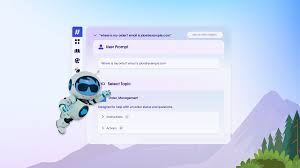
With all the buzz in the news about AI, it may feel like AI is everywhere. In fact, as of 2023, over 80% of global companies report adopting AI to enhance their business operations. This means if your company isn’t yet leveraging AI to strengthen customer relationships, you risk falling behind. The good news is that Salesforce CRM already comes with a suite of AI tools ready for use. In this insight, we’ll explore how combining quality data, AI, and Salesforce can help you build more meaningful, lasting relationships with your customers. How Does Salesforce Use AI? Salesforce offers various built-in functionalities to create customizable, predictive, and generative AI experiences tailored to your business needs. One standout tool is Agentforce, which enables the creation of autonomous AI agents. If you have numerous routine tasks but limited staff, Agentforce could be the solution. For instance, if you lack an in-house customer support agent, Agentforce can build an AI service agent to handle incoming cases, responding intuitively in real-time. Not enough sales reps? No problem—create an AI sales agent to manage records, interact with leads, answer questions, and schedule meetings. Another significant AI feature is generative AI in Salesforce. According to KPMG, 77% of executives believe generative AI will have a more profound societal impact in the next three to five years than any other emerging technology. So, how can it improve your business? Salesforce’s in-house LLM, xGen, helps you generate human-like text and create original visual content from existing data or user input. This capability can enhance user experiences by automating the generation of dynamic and personalized imagery for applications. Generative AI also transforms how users interact with and consume data. Complex datasets can now be converted into easily understandable formats—visualizations, charts, or graphs—generated from natural language prompts. These insights make data accessible, enabling users to share knowledge and drive informed decisions. How Can You Use AI to Improve Customer Relationships? AI is reshaping business models, workflows, and customer engagement. By harnessing quality data, AI, and Salesforce, you can enhance how you connect with customers. Here are key ways to leverage this combination for a smarter customer strategy: Challenges You May Encounter on Your AI Journey Adopting AI in Salesforce, especially Einstein AI, offers many benefits, but it also comes with challenges. Here are some factors to consider for a successful rollout: Importance of Data Quality When Using AI Analytics Data quality is essential for AI accuracy and reliability. Poor data can skew predictions and erode user trust. Key factors that contribute to high data quality include: AI can also enhance data quality by automating data validation and cleansing. Machine learning algorithms can detect and address anomalies, duplicate records, and incomplete datasets, improving the reliability of your data over time. The Future of CRM: AI-Driven Customer Engagement and Business Growth Integrating AI into Salesforce is revolutionizing CRM by enabling businesses to engage with customers more intelligently. From automating routine tasks to enhancing decision-making and delivering personalized communication, AI-driven innovations are empowering businesses to build stronger relationships with customers. As AI continues to evolve, those who embrace it will gain a competitive edge and drive long-term growth. The future of CRM is here—and it’s smarter, faster, and more customer-focused than ever. Like Related Posts Who is Salesforce? Who is Salesforce? Here is their story in their own words. From our inception, we’ve proudly embraced the identity of Read more Salesforce Marketing Cloud Transactional Emails Salesforce Marketing Cloud Transactional Emails are immediate, automated, non-promotional messages crucial to business operations and customer satisfaction, such as order Read more Salesforce Unites Einstein Analytics with Financial CRM Salesforce has unveiled a comprehensive analytics solution tailored for wealth managers, home office professionals, and retail bankers, merging its Financial Read more AI-Driven Propensity Scores AI plays a crucial role in propensity score estimation as it can discern underlying patterns between treatments and confounding variables Read more
Read More
AI Agent Trends

AI Agent Trends

AI Agents: Key Statistics and Trends for 2025 “The agent revolution is real and as exciting as the cloud, social, and mobile revolutions,” remarked Salesforce Chair and CEO Marc Benioff. “It will provide a level of transformation that we’ve never seen.” With the general availability of Agentforce, the era of AI-powered agents is officially here. These intelligent software agents, designed to perform tasks autonomously or in collaboration with humans, are already transforming businesses by driving efficiency and improving customer outcomes. AI Agents in Action Companies across the globe are leveraging AI agents to achieve remarkable results. For example, Wiley has seen a 40% boost in case resolution rates with Agentforce, far surpassing their previous bot’s performance. Other success stories from Saks and Opentable reinforce the ROI potential of this groundbreaking technology. Salesforce research highlights data from consumers, employees, and business leaders worldwide, demonstrating how AI agents address key pain points while unlocking significant opportunities for enterprises and individuals alike. Why Consumers Need AI Agents Traditional customer service processes often frustrate consumers, leading to inefficiency and dissatisfaction: AI agents are transforming this landscape with immediate, personalized assistance that minimizes wait times and eliminates repeated explanations. Consumer sentiment indicates a growing acceptance of this technology: Why Enterprises Need AI Agents For enterprises, inefficiency is a persistent challenge. Time-consuming administrative tasks often prevent workers from focusing on strategic, customer-centric activities: AI adoption is increasingly a priority for revenue-generating teams, with measurable benefits: Salesforce experts emphasize that while AI has already proven its value in service, sales, marketing, and commerce, the surface of its potential has only just been scratched. The Agent-First Future As organizations adopt an agent-first approach, they unlock opportunities to redefine operations, increase efficiency, and drive innovation: AI agents are not just the future—they’re the present solution to enduring challenges, empowering businesses to meet the demands of a rapidly evolving digital economy. Like Related Posts Who is Salesforce? Who is Salesforce? Here is their story in their own words. From our inception, we’ve proudly embraced the identity of Read more Salesforce Marketing Cloud Transactional Emails Salesforce Marketing Cloud Transactional Emails are immediate, automated, non-promotional messages crucial to business operations and customer satisfaction, such as order Read more Salesforce Unites Einstein Analytics with Financial CRM Salesforce has unveiled a comprehensive analytics solution tailored for wealth managers, home office professionals, and retail bankers, merging its Financial Read more AI-Driven Propensity Scores AI plays a crucial role in propensity score estimation as it can discern underlying patterns between treatments and confounding variables Read more
Read More
Salesforce AI Research Introduces LaTRO

Salesforce AI Research Introduces LaTRO

Salesforce AI Research Introduces LaTRO: A Breakthrough in Enhancing Reasoning for Large Language Models Large Language Models (LLMs) have revolutionized tasks such as answering questions, generating content, and assisting with workflows. However, they often struggle with advanced reasoning tasks like solving complex math problems, logical deduction, and structured data analysis. Salesforce AI Research has addressed this challenge by introducing LaTent Reasoning Optimization (LaTRO), a groundbreaking framework that enables LLMs to self-improve their reasoning capabilities during training. The Need for Advanced Reasoning in LLMs Reasoning—especially sequential, multi-step reasoning—is essential for tasks that require logical progression and problem-solving. While current models excel at simpler queries, they often fall short in tackling more complex tasks due to a reliance on external feedback mechanisms or runtime optimizations. Enhancing reasoning abilities is therefore critical to unlocking the full potential of LLMs across diverse applications, from advanced mathematics to real-time data analysis. Existing techniques like Chain-of-Thought (CoT) prompting guide models to break problems into smaller steps, while methods such as Tree-of-Thought and Program-of-Thought explore multiple reasoning pathways. Although these techniques improve runtime performance, they don’t fundamentally enhance reasoning during the model’s training phase, limiting the scope of improvement. Salesforce AI Research Introduces LaTRO: A Self-Rewarding Framework LaTRO shifts the paradigm by transforming reasoning into a training-level optimization problem. It introduces a self-rewarding mechanism that allows models to evaluate and refine their reasoning pathways without relying on external feedback or supervised fine-tuning. This intrinsic approach fosters continual improvement and empowers models to solve complex tasks more effectively. How LaTRO Works LaTRO’s methodology centers on sampling reasoning paths from a latent distribution and optimizing these paths using variational techniques. Here’s how it works: This self-rewarding cycle ensures that the model continuously refines its reasoning capabilities during training. Unlike traditional methods, LaTRO’s framework operates autonomously, without the need for external reward models or costly supervised feedback loops. Key Benefits of LaTRO Performance Highlights LaTRO’s effectiveness has been validated across various datasets and models: Applications and Implications LaTRO’s ability to foster logical coherence and structured reasoning has far-reaching applications in fields requiring robust problem-solving: By enabling LLMs to autonomously refine their reasoning processes, LaTRO brings AI closer to achieving human-like cognitive abilities. The Future of AI with LaTRO LaTRO sets a new benchmark in AI research by demonstrating that reasoning can be optimized during training, not just at runtime. This advancement by Salesforce AI Research highlights the potential for self-evolving AI models that can independently improve their problem-solving capabilities. Salesforce AI Research Introduces LaTRO As the field of AI progresses, frameworks like LaTRO pave the way for more autonomous, intelligent systems capable of navigating complex reasoning tasks across industries. LaTRO represents a significant leap forward, moving AI closer to achieving true autonomous reasoning. Like Related Posts Who is Salesforce? Who is Salesforce? Here is their story in their own words. From our inception, we’ve proudly embraced the identity of Read more Salesforce Marketing Cloud Transactional Emails Salesforce Marketing Cloud Transactional Emails are immediate, automated, non-promotional messages crucial to business operations and customer satisfaction, such as order Read more Salesforce Unites Einstein Analytics with Financial CRM Salesforce has unveiled a comprehensive analytics solution tailored for wealth managers, home office professionals, and retail bankers, merging its Financial Read more AI-Driven Propensity Scores AI plays a crucial role in propensity score estimation as it can discern underlying patterns between treatments and confounding variables Read more

Read More
copilots and agentic ai

Copilots and Agentic AI

Agentic AI vs. Copilots: Defining the Future of Generative AI Artificial Intelligence has rapidly evolved, progressing from simple automation to generative models, to copilots. But now, a new player—Agentic AI—has emerged, promising to redefine the AI landscape. Is Agentic AI the next logical step, or will it coexist alongside copilots, each serving distinct roles? Copilots and Agentic AI. Generative AI: Creativity with a Human Touch Since the launch of ChatGPT, generative AI has dominated tech priorities, offering businesses the ability to generate content—text, images, videos, and more—from pre-defined data. However, while revolutionary, generative AI still relies heavily on human input to guide its output, making it a powerful collaborator rather than an autonomous actor. Enter Agentic AI: Autonomy Redefined Agentic AI represents a leap forward, offering systems that possess autonomy and the ability to act independently to achieve pre-defined goals. Unlike generative AI copilots that respond to human prompts, Agentic AI makes decisions, plans actions, and learns from experience. Think of it as Siri or Alexa—enhanced with autonomy and learning capabilities. Gartner recently spotlighted Agentic AI as its top technology trend for 2025, predicting that by 2028, at least 15% of day-to-day work decisions will be made autonomously, up from virtually none today. Agentforce and the Third Wave of AI Salesforce’s “Agentforce,” unveiled at Dreamforce, is a prime example of Agentic AI’s potential. These autonomous agents are designed to augment employees by handling tasks across sales, service, marketing, and commerce. Salesforce CEO Mark Benioff described it as the “Third Wave of AI,” going beyond copilots to deliver intelligent agents deeply embedded into customer workflows. Salesforce aims to empower one billion AI agents by 2025, integrating Agentforce into every aspect of customer success. Benioff took a swipe at competitors’ bolt-on generative AI solutions, emphasizing that Agentforce is deeply embedded for maximum value. The Role of Copilots: Collaboration First While Agentic AI gains traction, copilots like Microsoft’s Copilot Studio and SAP’s Joule remain critical for businesses focused on intelligent augmentation. Copilots act as productivity boosters, working alongside humans to optimize processes, enhance creativity, and provide decision-making support. SAP’s Joule, for example, integrates seamlessly into existing systems to optimize operations while leaving strategic decision-making in human hands. This collaborative model aligns well with businesses prioritizing agility and human oversight. Agentic AI: Opportunities and Challenges Agentic AI’s autonomy offers significant potential for streamlining complex processes, reducing human intervention, and driving productivity. However, it also comes with risks. Eleanor Watson, AI ethics engineer at Singularity University, warns that Agentic AI systems require careful alignment of values and goals to avoid unintended consequences like dangerous shortcuts or boundary violations. In contrast, copilots retain human agency, making them particularly suited for creative and knowledge-based roles where human oversight remains essential. Copilots and Agentic AI The choice between Agentic AI and copilots hinges on an organization’s priorities and risk tolerance. For simpler, task-specific applications, copilots excel by providing assistance without removing human input. Agentic AI, on the other hand, shines in complex, multi-task scenarios where autonomy is key. Dom Couldwell, head of field engineering EMEA at DataStax, emphasizes the importance of understanding when to deploy each model. “Use a copilot for specific, focused tasks. Use Agentic AI for complex, goal-oriented processes involving multiple tasks. And leverage Retrieval Augmented Generation (RAG) in both to provide context to LLMs.” The Road Ahead: Coexistence or Dominance? As AI evolves, Agentic AI and copilots may coexist, serving complementary roles. Businesses seeking full automation and scalability may gravitate toward Agentic AI, while those prioritizing augmented intelligence and human collaboration will continue to rely on copilots. Ultimately, the future of AI will be defined not by one model overtaking the other, but by how well each aligns with the specific needs, goals, and challenges of the organizations adopting them. Like1 Related Posts Who is Salesforce? Who is Salesforce? Here is their story in their own words. From our inception, we’ve proudly embraced the identity of Read more Salesforce Marketing Cloud Transactional Emails Salesforce Marketing Cloud Transactional Emails are immediate, automated, non-promotional messages crucial to business operations and customer satisfaction, such as order Read more Salesforce Unites Einstein Analytics with Financial CRM Salesforce has unveiled a comprehensive analytics solution tailored for wealth managers, home office professionals, and retail bankers, merging its Financial Read more AI-Driven Propensity Scores AI plays a crucial role in propensity score estimation as it can discern underlying patterns between treatments and confounding variables Read more

Read More
Trends in AI for CRM

Trends in AI for CRM

Nearly half of customer service teams, over 40% of salespeople, and a third of marketers have fully implemented artificial intelligence (AI) to enhance their work. However, 77% of business leaders report persistent challenges related to trusted data and ethical concerns that could stall their AI initiatives, according to Salesforce research released today. The Trends in AI for CRM report analyzed data from multiple studies, revealing that companies are worried about missing out on the opportunities generative AI presents if the data powering large language models (LLMs) isn’t rooted in their own trusted customer records. At the same time, respondents expressed ongoing concerns about the lack of clear company policies governing the ethical use of AI, as well as the complexity of a vendor landscape where 80% of enterprises are currently using multiple LLMs. Salesforce’s Four Keys to Enterprise AI Success Why it matters: AI is one of the most transformative technologies in generations, with projections forecasting a net gain of over trillion in new business revenues by 2028 from Salesforce and its network of partners alone. As enterprises across industries develop their AI strategies, leaders in customer-facing departments such as sales, service, and marketing are eager to leverage AI to drive internal efficiencies and revolutionize customer experiences. Key Findings from the Trends in AI for CRM Report Expert Perspective “This is a pivotal moment as business leaders across industries look to AI to unlock growth, efficiency, and customer loyalty,” said Clara Shih, CEO of Salesforce AI. “But success requires much more than an LLM. Enterprise deployments need trusted data, user access control, vector search, audit trails and citations, data masking, low-code builders, and seamless UI integration. Salesforce brings all of these components together with our Einstein 1 Platform, Data Cloud, Slack, and dozens of customizable, turnkey prompts and actions offered across our clouds.” Like Related Posts Who is Salesforce? Who is Salesforce? Here is their story in their own words. From our inception, we’ve proudly embraced the identity of Read more Salesforce Marketing Cloud Transactional Emails Salesforce Marketing Cloud Transactional Emails are immediate, automated, non-promotional messages crucial to business operations and customer satisfaction, such as order Read more Salesforce Unites Einstein Analytics with Financial CRM Salesforce has unveiled a comprehensive analytics solution tailored for wealth managers, home office professionals, and retail bankers, merging its Financial Read more AI-Driven Propensity Scores AI plays a crucial role in propensity score estimation as it can discern underlying patterns between treatments and confounding variables Read more

Read More
Cohere-Powered Slack Agents

Cohere-Powered Slack Agents

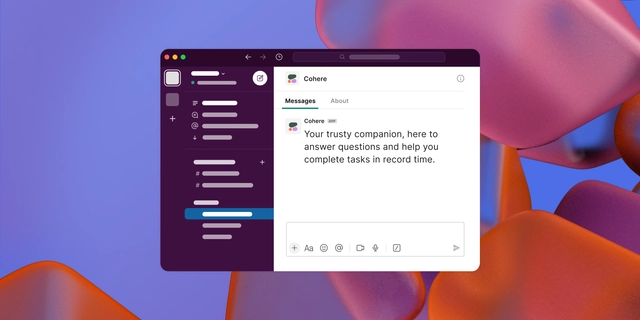
Salesforce AI and Cohere-Powered Slack Agents: Seamless CRM Data Interaction and Enhanced Productivity Slack agents, powered by Salesforce AI and integrated with Cohere, enable seamless interaction with CRM data within the Slack platform. These agents allow teams to use natural language to surface data insights and take action, simplifying workflows. With Slack’s AI Workflow Builder and support for third-party AI agents, including Cohere, productivity is further enhanced through automated processes and customizable AI assistants. By leveraging these technologies, Slack agents provide users with direct access to CRM data and AI-powered insights, improving efficiency and collaboration. Key Features of Slack Agents: Salesforce AI and Cohere Productivity Enhancements with Slack Agents: Salesforce AI and Cohere AI Agent Capabilities in Slack: Salesforce and Cohere Data Security and Compliance for Slack Agents FAQ What are Slack agents, and how do they integrate with Salesforce AI and Cohere?Slack agents are AI-powered assistants that enable teams to interact with CRM data directly within Slack. Salesforce AI agents allow natural language data interactions, while Cohere’s integration enhances productivity with customizable AI assistants and automated workflows. How do Salesforce AI agents in Slack improve team productivity?Salesforce AI agents enable users to interact with both CRM and conversational data, update records, and analyze opportunities using natural language. This integration improves workflow efficiency, leading to a reported 47% productivity boost. What features does the Cohere integration with Slack AI offer?Cohere integration offers customizable AI assistants that can help generate workflows, summarize channel content, and provide intelligent responses to user queries within Slack. How do Slack agents handle data security and compliance?Slack agents leverage cloud-native DLP solutions, automatically detecting sensitive data across different file types and setting up automated remediation processes for enhanced security and compliance. Can Slack agents work with AI providers beyond Salesforce and Cohere?Yes, Slack supports AI agents from various providers. In addition to Salesforce AI and Cohere, integrations include Adobe Express, Anthropic, Perplexity, IBM, and Amazon Q Business, offering users a wide array of AI-powered capabilities. Like Related Posts Who is Salesforce? Who is Salesforce? Here is their story in their own words. From our inception, we’ve proudly embraced the identity of Read more Salesforce Marketing Cloud Transactional Emails Salesforce Marketing Cloud Transactional Emails are immediate, automated, non-promotional messages crucial to business operations and customer satisfaction, such as order Read more Salesforce Unites Einstein Analytics with Financial CRM Salesforce has unveiled a comprehensive analytics solution tailored for wealth managers, home office professionals, and retail bankers, merging its Financial Read more AI-Driven Propensity Scores AI plays a crucial role in propensity score estimation as it can discern underlying patterns between treatments and confounding variables Read more

Read More
salesforce ai pitchfield

Salesforce AI Pitchfield

AI Pitchfield is more than a showcase of entrepreneurial talent—it’s a launchpad for the next generation of AI pioneers. By fostering connections and providing critical investment opportunities, Salesforce and its partners are driving the evolution of AI across India and Southeast Asia. This initiative reflects Salesforce’s commitment to advancing technology, empowering startups, and shaping a future where AI continues to transform industries and unlock untapped potential.

Read More
Life of a Salesforce Admin in the AI Era

Life of a Salesforce Admin in the AI Era

The life of Salesforce admins is rapidly evolving as artificial intelligence (AI) becomes integral to business operations. Let’s examine the Life of a Salesforce Admin in the AI Era. By 2025, the Salesforce admin’s role will expand beyond managing CRM systems to include leveraging AI tools to enhance efficiency, boost productivity, and maintain security. While this future offers exciting opportunities, it also comes with new responsibilities that require admins to adapt and learn. So, what will Salesforce admins need to succeed in this AI-driven landscape? The Salesforce Admin’s Role in 2025 In 2025, Salesforce admins will be at the forefront of digital transformation, helping organizations harness the full potential of the Salesforce ecosystem and AI-powered tools. These AI tools will automate processes, predict trends, and improve overall efficiency. Many professionals are already enrolling in Salesforce Administrator courses focused on AI and automation, equipping them with the essential skills to thrive in this new era. Key Responsibilities in Life of a Salesforce Admin in the AI Era 1. AI Integration and Optimization Admins will be responsible for integrating AI tools like Salesforce Einstein AI into workflows, ensuring they’re properly configured and tailored to the organization’s needs. Core tasks include: 2. Automating Processes with AI AI will revolutionize automation, making complex workflows more efficient. Admins will need to: 3. Data Management and Predictive Analytics Admins will leverage AI to manage data and generate predictive insights. Key responsibilities include: 4. Enhancing Security and Compliance AI-powered security tools will help admins proactively protect systems. Responsibilities include: 5. Supporting AI-Driven Customer Experiences Admins will deploy AI tools that enhance customer interactions. Their responsibilities include: 6. Continuous Learning and Upskilling As AI evolves, so too must Salesforce admins. Key learning areas include: 7. Collaboration with Cross-Functional Teams Admins will work closely with IT, marketing, and sales teams to deploy AI solutions organization-wide. Their collaborative efforts will include: Skills Required for Future Salesforce Admins 1. AI and Machine Learning Proficiency Admins will need to understand how AI models like Einstein AI function and how to deploy them. While not requiring full data science expertise, a solid grasp of AI concepts—such as predictive analytics and machine learning—will be essential. 2. Advanced Data Management and Analysis Managing large datasets and ensuring data accuracy will be critical as admins work with AI tools. Proficiency in data modeling, SQL, SOQL, and ETL processes will be vital for handling AI-powered data management. 3. Automation and Process Optimization AI-enhanced automation will become a key responsibility. Admins must master tools like Salesforce Flow and Einstein Automate to build intelligent workflows and ensure smooth process automation. 4. Security and Compliance Expertise With AI-driven security protocols, admins will need to stay updated on data privacy regulations and deploy tools that ensure compliance and prevent data breaches. 5. Collaboration and Leadership Admins will lead the implementation of AI tools across departments, requiring strong collaboration and leadership skills to align AI-driven solutions with business objectives. Advanced Certifications for AI-Era Admins To stay competitive, Salesforce admins will need to pursue advanced certifications. Key certifications include: Tectonic’s Thoughts The Salesforce admin role is transforming as AI becomes an essential part of the platform. By mastering AI tools, optimizing processes, ensuring security, and continuously upskilling, Salesforce admins can become pivotal players in driving digital transformation. The future is bright for those who embrace the AI-powered Salesforce landscape and position themselves at the forefront of innovation. Like Related Posts Who is Salesforce? Who is Salesforce? Here is their story in their own words. From our inception, we’ve proudly embraced the identity of Read more Salesforce Marketing Cloud Transactional Emails Salesforce Marketing Cloud Transactional Emails are immediate, automated, non-promotional messages crucial to business operations and customer satisfaction, such as order Read more Salesforce Unites Einstein Analytics with Financial CRM Salesforce has unveiled a comprehensive analytics solution tailored for wealth managers, home office professionals, and retail bankers, merging its Financial Read more AI-Driven Propensity Scores AI plays a crucial role in propensity score estimation as it can discern underlying patterns between treatments and confounding variables Read more
Read More
Third Wave of AI at Salesforce

Third Wave of AI at Salesforce

The Third Wave of AI at Salesforce: How Agentforce is Transforming the Landscape At Dreamforce 2024, Salesforce unveiled several exciting innovations, with Agentforce taking center stage. This insight explores the key changes and enhancements designed to improve efficiency and elevate customer interactions. Introducing Agentforce Agentforce is a customizable AI agent builder that empowers organizations to create and manage autonomous agents for various business tasks. But what exactly is an agent? An agent is akin to a chatbot but goes beyond traditional capabilities. While typical chatbots are restricted to scripted responses and predefined questions, Agentforce agents leverage large language models (LLMs) and generative AI to comprehend customer inquiries contextually. This enables them to make independent decisions, whether processing requests or resolving issues using real-time data from your company’s customer relationship management (CRM) system. The Role of Atlas At the heart of Agentforce’s functionality lies the Atlas reasoning engine, which acts as the operational brain. Unlike standard assistive tools, Atlas is an agentic system with the autonomy to act on behalf of the user. Atlas formulates a plan based on necessary actions and can adjust that plan based on evaluations or new information. When it’s time to engage, Atlas knows which business processes to activate and connects with customers or employees via their preferred channels. This sophisticated approach allows Agentforce to significantly enhance operational efficiency. By automating routine inquiries, it frees up your team to focus on more complex tasks, delivering a smoother experience for both staff and customers. Speed to Value One of Agentforce’s standout features is its emphasis on rapid implementation. Many AI projects can be resource-intensive and take months or even years to launch. However, Agentforce enables quick deployment by leveraging existing Salesforce infrastructure, allowing organizations to implement solutions rapidly and with greater control. Salesforce also offers pre-built Agentforce agents tailored to specific business needs—such as Service Agent, Sales Development Representative Agent, Sales Coach, Personal Shopper Agent, and Campaign Agent—all customizable with the Agent Builder. Agentforce for Service and Sales will be generally available starting October 25, 2024, with certain elements of the Atlas Reasoning Engine rolling out in February 2025. Pricing begins at $2 per conversation, with volume discounts available. Transforming Customer Insights with Data Cloud and Marketing Cloud Dreamforce also highlighted enhancements to Data Cloud, Salesforce’s backbone for all cloud products. The platform now supports processing unstructured data, which constitutes up to 90% of company data often overlooked by traditional reporting systems. With new capabilities for analyzing various unstructured formats—like video, audio, sales demos, customer service calls, and voicemails—businesses can derive valuable insights and make informed decisions across Customer 360. Furthermore, Data Cloud One enables organizations to connect siloed Salesforce instances effortlessly, promoting seamless data sharing through a no-code, point-and-click setup. The newly announced Marketing Cloud Advanced edition serves as the “big sister” to Marketing Cloud Growth, equipping larger marketing teams with enhanced features like Path Experiment, which tests different content strategies across channels, and Einstein Engagement Scoring for deeper insights into customer behavior. Together, these enhancements empower companies to engage customers more meaningfully and measurably across all touchpoints. Empowering the Workforce Through Education Salesforce is committed to making AI accessible for all. They recently announced free instructor-led courses and AI certifications available through 2025, aimed at equipping the Salesforce community with essential AI and data management skills. To support this initiative, Salesforce is establishing AI centers in major cities, starting with London, to provide hands-on training and resources, fostering AI expertise. They also launched a global Agentforce World Tour to promote understanding and adoption of the new capabilities introduced at Dreamforce, featuring repackaged sessions from the conference and opportunities for specialists to answer questions. The Bottom Line What does this mean for businesses? With the rollout of Agentforce, along with enhancements to Data Cloud and Marketing Cloud, organizations can operate more efficiently and connect with customers in more meaningful ways. Coupled with a focus on education through free courses and global outreach, getting on board has never been easier. If you’d like to discuss how we can help your business maximize its potential with Salesforce through data and AI, connect with us and schedule a meeting with our team. Legacy systems can create significant gaps between operations and employee needs, slowing lead processes and resulting in siloed, out-of-sync data that hampers business efficiency. Responding to inquiries within five minutes offers a 75% chance of converting leads into customers, emphasizing the need for rapid, effective marketing responses. Salesforce aims to help customers strengthen relationships, enhance productivity, and boost margins through its premier AI CRM for sales, service, marketing, and commerce, while also achieving these goals internally. Recognizing the complexity of its decade-old processes, including lead assignment across three systems and 2 million lines of custom code, Salesforce took on the role of “customer zero,” leveraging Data Cloud to create a unified view of customers known as the “Customer 360 Truth Profile.” This consolidation of disparate data laid the groundwork for enterprise-wide AI and automation, improving marketing automation and reducing lead time by 98%. As Michael Andrew, SVP of Marketing Decision Science at Salesforce, noted, this initiative enabled the company to provide high-quality leads to its sales team with enriched data and AI scoring while accelerating time to market and enhancing data quality. Embracing Customer Zero “Almost exactly a year ago, we set out with a beginner’s mind to transform our lead automation process with a solution that would send the best leads to the right sales teams within minutes of capturing their data and support us for the next decade,” said Andrew. The initial success metric was “speed to lead,” aiming to reduce the handoff time from 20 minutes to less than one minute. The focus was also on integrating customer and lead data to develop a more comprehensive 360-degree profile for each prospect, enhancing lead assignment and sales rep productivity. Another objective was to boost business agility by cutting the average time to implement assignment changes from four weeks to mere days. Accelerating Success with

Read More
Einstein Copilot for Healthcare

Einstein Copilot for Healthcare

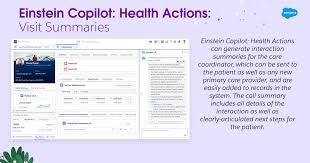
Einstein Copilot for Healthcare – Salesforce has introduced a new AI-powered healthcare assistant within its CRM system, marking its latest move to expand into the healthcare industry. As AI development accelerates, tech giants like Microsoft, Google, Amazon Web Services, and Salesforce are capitalizing on the opportunity to integrate AI and cloud technologies into healthcare to streamline administrative and operational tasks. Salesforce’s healthcare-specific AI tool, Einstein Copilot, is a conversational assistant that leverages an organization’s private data to provide relevant responses. Einstein Copilot enables healthcare providers and care teams to digitally capture and summarize information from both clinical and nonclinical sources, update patient records, and automate manual workflows. Key Features of Einstein Copilot Providers can use Einstein Copilot to generate patient summaries that include medications, diagnoses, social determinants, assessments, clinical service requests, and care gaps. A care manager can also ask the assistant to find an in-network provider based on location, specialty, and insurance coverage, and auto-fill referral forms using natural language prompts. The AI assistant can also trigger workflows for tasks such as sending referrals, scheduling appointments, and updating care plans. Salesforce expects Einstein Copilot to be HIPAA-compliant by summer 2024, with Copilot: Health Actions slated for general availability in winter 2024. Digitizing Health Assessments Salesforce is adding a feature called Assessment Generation that allows healthcare organizations to digitize standardized health assessments. These can be automatically populated into Salesforce Health Cloud, filled out electronically, and tracked for progress over time. Reducing Administrative Waste Salesforce cites research from McKinsey & Co. showing that administrative costs account for nearly a quarter of U.S. healthcare spending, with a potential savings of up to $320 billion. By integrating AI and CRM tools, Salesforce aims to reduce the operational burden on healthcare providers and improve patient outcomes. Amit Khanna, Senior Vice President and General Manager for Health at Salesforce, highlighted the value of these innovations: “These new data, AI, and CRM features reduce the administrative and operational burden for healthcare providers, leading to better outcomes for patients. With Salesforce’s trusted AI, healthcare organizations excited about generative AI—but wary of clinical and security concerns—can confidently integrate these innovations into their workflows.” Early Adopters and Impact Healthcare providers including Baptist Health South Florida and HarmonyCares are already leveraging Salesforce to personalize patient interactions and create unified patient views. HarmonyCares, which operates across 14 states with over 150 primary care providers, has used Salesforce’s AI-driven field service platform to streamline patient scheduling. The company reported a 50% increase in self-scheduling efficiency since adopting the platform and plans to expand its use of Salesforce Health Cloud for care management and engagement. Kristin Darby, Chief Information Officer at HarmonyCares, emphasized the benefits of AI in healthcare: “AI will dramatically improve our ability to quickly synthesize patient needs and preferences, enabling us to offer a more personalized experience with greater accuracy.” However, the integration of AI in healthcare is not without skepticism. A recent survey revealed that 69% of individuals are uncomfortable with AI being used to diagnose them, though more than half are open to its use in nonclinical tasks like scheduling and billing. Salesforce’s Healthcare Journey Salesforce first launched Health Cloud in 2015 to help providers manage patients by aggregating data from electronic medical records, devices, and wearables. In 2022, the company expanded this offering with Customer 360 for Health, a unified platform that combines real-time data from Data Cloud, Einstein AI, and automation tools like Flow to streamline processes such as prior authorizations, intake, and patient scheduling. Like Related Posts Who is Salesforce? Who is Salesforce? Here is their story in their own words. From our inception, we’ve proudly embraced the identity of Read more Salesforce Marketing Cloud Transactional Emails Salesforce Marketing Cloud Transactional Emails are immediate, automated, non-promotional messages crucial to business operations and customer satisfaction, such as order Read more Salesforce Unites Einstein Analytics with Financial CRM Salesforce has unveiled a comprehensive analytics solution tailored for wealth managers, home office professionals, and retail bankers, merging its Financial Read more AI-Driven Propensity Scores AI plays a crucial role in propensity score estimation as it can discern underlying patterns between treatments and confounding variables Read more
Read More
Salesforce AI Introduces SFR-Judge

Salesforce AI Introduces SFR-Judge

Salesforce AI Introduces SFR-Judge: A Family of Three Evaluation Models with 8B, 12B, and 70B Parameters, Powered by Meta Llama 3 and Mistral NeMO The rapid development of large language models (LLMs) has transformed natural language processing, making the need for accurate evaluation of these models more critical than ever. Traditional human evaluations, while effective, are time-consuming and impractical for the fast-paced evolution of AI models. Salesforce AI Introduces SFR-Judge. To address this, Salesforce AI Research has introduced SFR-Judge, a family of LLM-based judge models designed to revolutionize how AI outputs are evaluated. Built using Meta Llama 3 and Mistral NeMO, the SFR-Judge family includes models with 8 billion (8B), 12 billion (12B), and 70 billion (70B) parameters. These models are designed to handle evaluation tasks such as pairwise comparisons, single ratings, and binary classifications, streamlining the evaluation process for AI researchers. Overcoming Limitations in Traditional Judge Models Traditional LLMs used for evaluation often suffer from biases such as position bias (favoring responses based on their order) and length bias (preferring longer responses regardless of their accuracy). SFR-Judge addresses these issues by leveraging Direct Preference Optimization (DPO), a training method that enables the model to learn from both positive and negative examples, reducing bias and ensuring more consistent and accurate evaluations. Performance and Benchmarking SFR-Judge has been rigorously tested across 13 benchmarks covering three key evaluation tasks. It outperformed existing judge models, including proprietary models like GPT-4o, achieving top performance on 10 of the 13 benchmarks. Notably, on the RewardBench leaderboard, SFR-Judge achieved a 92.7% accuracy, marking a new high in LLM-based evaluation and demonstrating its potential not only as an evaluation tool but also as a reward model for reinforcement learning from human feedback (RLHF) scenarios. Innovative Training Approach The SFR-Judge models were trained using three distinct data formats: These diverse data formats allow SFR-Judge to generate well-rounded, accurate evaluations, making it a more reliable and robust tool for model assessment. Bias Mitigation and Robustness SFR-Judge was tested on EvalBiasBench, a benchmark designed to measure six types of bias. The results demonstrated significantly lower bias levels compared to competing models, along with high consistency in pairwise order comparisons. This robustness ensures that SFR-Judge’s evaluations remain stable, even when the order of responses is altered, making it a scalable and reliable alternative to human annotation. Key Takeaways: Conclusion Salesforce AI Research’s introduction of SFR-Judge represents a breakthrough in the automated evaluation of large language models. By incorporating Direct Preference Optimization and a diverse training approach, SFR-Judge sets a new standard for accuracy, bias reduction, and consistency. Its ability to provide detailed feedback and adapt to various evaluation tasks makes it a powerful tool for the AI community, streamlining the process of LLM assessment and setting the stage for future advancements in AI evaluation. Like Related Posts Who is Salesforce? Who is Salesforce? Here is their story in their own words. From our inception, we’ve proudly embraced the identity of Read more Salesforce Marketing Cloud Transactional Emails Salesforce Marketing Cloud Transactional Emails are immediate, automated, non-promotional messages crucial to business operations and customer satisfaction, such as order Read more Salesforce Unites Einstein Analytics with Financial CRM Salesforce has unveiled a comprehensive analytics solution tailored for wealth managers, home office professionals, and retail bankers, merging its Financial Read more AI-Driven Propensity Scores AI plays a crucial role in propensity score estimation as it can discern underlying patterns between treatments and confounding variables Read more
Read More
gettectonic.com