ONC Archives - gettectonic.com - Page 5
large concept model

Large Concept Models

Large Concept Models (LCMs) are a new type of language model that differ from traditional Large Language Models (LLMs) by working with concepts, rather than individual words, to process and generate language. Instead of focusing on tokens, LCMs focus on semantic representations at the sentence level, allowing for more abstract and nuanced reasoning.  Key Features of LCMs: How LCMs Differ from LLMs: Potential Applications of LCMs: Like Related Posts Who is Salesforce? Who is Salesforce? Here is their story in their own words. From our inception, we’ve proudly embraced the identity of Read more Salesforce Unites Einstein Analytics with Financial CRM Salesforce has unveiled a comprehensive analytics solution tailored for wealth managers, home office professionals, and retail bankers, merging its Financial Read more AI-Driven Propensity Scores AI plays a crucial role in propensity score estimation as it can discern underlying patterns between treatments and confounding variables Read more Tectonic’s Successful Salesforce Track Record Salesforce Technology Services Integrator – Tectonic has successfully delivered Salesforce in a variety of industries including Public Sector, Hospitality, Manufacturing, Read more


Read More
AI in Networking

The AI Workforce Revolution

The AI Workforce Revolution: How to Lead in the Age of Agentic Automation The Blended Workforce Era is Here AI agent adoption is projected to surge 327% in the next two years, transforming every industry. Managers will soon oversee teams where AI agents work alongside humans—handling tasks from customer service to data analysis. But success isn’t just about deploying AI—it’s about leading a high-performing hybrid workforce. Here’s how to prepare. 1. Address Employee Concerns Early AI anxiety is real. Proactively:✔ Communicate AI’s role—it’s for repetitive tasks (scheduling, data processing), not replacements.✔ Upskill teams for AI-augmented roles (creativity, judgment, strategy).✔ Follow Salesforce’s model: Host Agentforce Learning Days to train employees on AI collaboration. “The future of work isn’t humans vs. AI—it’s humans with AI.” — Jenny Simmons, VP of Learning, Salesforce 2. Onboard AI Agents Like a Pro Forget HR paperwork—AI integration is technical: Human Onboarding AI Agent Onboarding Training & mentorship Configuration & data setup Adapts to ambiguity Needs precise guardrails Needs motivation Requires monitoring & KPIs Key Steps: 3. Master AI Workforce Management Essential Skills for Hybrid Leaders 🔹 AI Delegation – Assign tasks based on strengths (AI = speed, humans = judgment).🔹 Data Literacy – Understand what fuels AI (data sources, biases, gaps).🔹 Ethical Oversight – Know when to override AI (e.g., financial advice for retirees). Example: An AI suggests a high-risk investment—but a human advisor knows the client prefers stability. 4. Build a Culture of Co-Creation ✅ Involve employees in AI rollout—make them co-pilots, not bystanders.✅ Celebrate AI-human wins (e.g., faster service, better insights).✅ Position AI as an enhancer—not a replacement. The Bottom Line The best leaders won’t just manage people—they’ll orchestrate human-AI symphonies. By upskilling teams, refining oversight, and fostering collaboration, you’ll unlock unprecedented productivity and innovation. 🚀 Next Steps: “The companies that thrive won’t just adopt AI—they’ll reimagine work around it.” Like Related Posts Who is Salesforce? Who is Salesforce? Here is their story in their own words. From our inception, we’ve proudly embraced the identity of Read more Salesforce Marketing Cloud Transactional Emails Salesforce Marketing Cloud Transactional Emails are immediate, automated, non-promotional messages crucial to business operations and customer satisfaction, such as order Read more Salesforce Unites Einstein Analytics with Financial CRM Salesforce has unveiled a comprehensive analytics solution tailored for wealth managers, home office professionals, and retail bankers, merging its Financial Read more AI-Driven Propensity Scores AI plays a crucial role in propensity score estimation as it can discern underlying patterns between treatments and confounding variables Read more

Read More
Agentic AI Race

The Evolution Beyond AI Agents

The Evolution Beyond AI Agents: What Comes Next? The Rapid Progression of AI Terminology The landscape of artificial intelligence has undergone a remarkable transformation in just three years. What began with ChatGPT and generative AI as the dominant buzzwords quickly evolved into discussions about copilots, and most recently, agentic AI emerged as 2024‘s defining concept. This accelerated terminology cycle mirrors fashion industry trends more than traditional technology adoption curves. Major players including Adobe, Qualtrics, Oracle, OpenAI, and Deloitte have recently launched agentic AI platforms, joining earlier entrants like Microsoft, AWS, and Salesforce. This rapid market saturation suggests the industry may already be approaching the next conceptual shift before many organizations have fully implemented their current AI strategies. Examining the Staying Power of Agentic AI Industry analysts present diverging views on the longevity of the agentic AI concept. Brandon Purcell, a Forrester Research analyst, acknowledges the pattern of fleeting AI trends while recognizing agentic AI’s potential for greater staying power. He cites three key factors that may extend its relevance: Klaasjan Tukker, Adobe’s Senior Director of Product Marketing, draws parallels to mature technologies that have become invisible infrastructure. He predicts agentic AI will follow a similar trajectory, becoming so seamlessly integrated that users will interact with it as unconsciously as they use navigation apps or operate modern vehicles. The Automotive Sector as an AI Innovation Catalyst The automotive industry provides compelling examples of advanced AI applications that transcend current “agentic” capabilities. Modern autonomous vehicles demonstrate sophisticated AI behaviors including: These implementations suggest that what the tech industry currently labels as “agentic” may represent only an intermediate step toward more autonomous, context-aware systems. The Definitional Challenges of Agentic AI The technology sector faces significant challenges in establishing common definitions for emerging AI concepts. Adobe’s framework describes agents as systems possessing three core attributes: However, as Scott Brinker of HubSpot notes, the term “agentic” risks becoming overused and diluted as vendors apply it inconsistently across various applications and functionalities. Interoperability as the Critical Success Factor For agentic AI systems to deliver lasting value, industry observers emphasize the necessity of cross-platform compatibility. Phil Regnault of PwC highlights the reality that enterprise environments typically combine solutions from multiple vendors, creating integration challenges for AI implementations. Three critical layers require standardization: Without such standards, organizations risk creating new AI silos that mirror the limitations of legacy systems. The Future Beyond Agentic AI While agentic AI continues its maturation process, the technology sector’s relentless innovation cycle suggests the next conceptual breakthrough may emerge sooner than expected. Historical naming patterns for AI advancements indicate several possibilities: As these technologies evolve, they may shed specialized branding in favor of more utilitarian terminology, much as “software bots” became normalized after their initial hype cycle. The automotive parallel suggests that truly transformative AI implementations may become so seamlessly integrated that their underlying technology becomes invisible to end users—the ultimate measure of technological maturity. Until that point, the industry will likely continue its rapid cycle of innovation and rebranding, searching for the next paradigm that captures the imagination as powerfully as “agentic AI” has in 2024. Like Related Posts Who is Salesforce? Who is Salesforce? Here is their story in their own words. From our inception, we’ve proudly embraced the identity of Read more Salesforce Marketing Cloud Transactional Emails Salesforce Marketing Cloud Transactional Emails are immediate, automated, non-promotional messages crucial to business operations and customer satisfaction, such as order Read more Salesforce Unites Einstein Analytics with Financial CRM Salesforce has unveiled a comprehensive analytics solution tailored for wealth managers, home office professionals, and retail bankers, merging its Financial Read more AI-Driven Propensity Scores AI plays a crucial role in propensity score estimation as it can discern underlying patterns between treatments and confounding variables Read more

Read More

How Reasoning Engines Are Transforming Enterprise Intelligence

The Next Evolution of Business AI: How Reasoning Engines Are Transforming Enterprise Intelligence Beyond Automation: AI That Thinks Like Your Best Employee Today’s business AI does far more than just automate boring, repetitive tasks—it’s drafting strategic emails, generating campaign briefs, and synthesizing complex customer calls. But what separates cutting-edge AI from basic chatbots? The ability to reason. Salesforce’s Agentforce, powered by the revolutionary Atlas Reasoning Engine, represents a quantum leap in enterprise AI—the first system capable of human-like analysis, decision-making, and problem-solving at scale. Why Reasoning Changes Everything Traditional AI assistants operate on: Atlas introduces System 2 Thinking to enterprise AI: “This isn’t automation—it’s augmentation. Atlas handles the cognitive heavy lifting so teams can focus on relationship-building.”—Salesforce AI Product Lead The Atlas Difference: How Enterprise-Grade Reasoning Works 1. Dynamic Problem-Solving Framework 2. Three Layers of Intelligence Reasoning Type Use Case Business Impact Deductive (Facts → Conclusion) Compliance checks 90% faster policy validation Inductive (Patterns → Insight) Sales forecasting 40% more accurate predictions Abductive (Partial data → Probable answer) Customer issue resolution 65% first-contact resolution 3. Enterprise-Grade Guardrails Real-World Impact Across Business Functions Customer Service Sales Enablement Operations The Future of Autonomous Business Agents Agentforce isn’t just another chatbot—it’s the first self-improving AI employee: “Our service team now resolves 40% more cases daily without adding headcount. Atlas handles the routine while humans focus on complex relationships.”—CIO, Global Financial Services Firm Your Next Step The era of reasoning AI is here. Discover how Agentforce can transform: Like Related Posts Who is Salesforce? Who is Salesforce? Here is their story in their own words. From our inception, we’ve proudly embraced the identity of Read more Salesforce Marketing Cloud Transactional Emails Salesforce Marketing Cloud Transactional Emails are immediate, automated, non-promotional messages crucial to business operations and customer satisfaction, such as order Read more Salesforce Unites Einstein Analytics with Financial CRM Salesforce has unveiled a comprehensive analytics solution tailored for wealth managers, home office professionals, and retail bankers, merging its Financial Read more AI-Driven Propensity Scores AI plays a crucial role in propensity score estimation as it can discern underlying patterns between treatments and confounding variables Read more

Read More
The Paradox of Jagged Intelligence in AI

The Paradox of Jagged Intelligence in AI

AI systems are breaking records on complex benchmarks, yet they falter on simpler tasks humans handle intuitively—a phenomenon dubbed jagged intelligence. This ainsight explores this uneven capability, tracing its evolution in frontier models and the impact of reasoning models. We introduce SIMPLE, a new public benchmark with easy reasoning tasks solvable by high schoolers, vital for enterprise AI where reliability trumps advanced math skills. Since ChatGPT’s 2022 debut, foundation models have been marketed as chat interfaces. Now, reasoning models like OpenAI’s o3 and DeepSeek’s R1 leverage extra inference-time computation for step-by-step internal reasoning, boosting performance in math, engineering, and coding. This shift to scaling inference compute arrives as pretraining gains may be plateauing. Benchmarking the Gaps Traditional AI benchmarks measure peak performance on tough tasks, like graduate exams or complex code, creating new challenges as old ones are mastered. However, they overlook reliability and worst-case performance on basic tasks, masking jaggedness in “solved” areas. Modern models outshine humans on some challenges but stumble unpredictably on others, unlike specialized tools (e.g., calculators or photo editors). Despite advances in modeling and training, this inconsistent jaggedness persists. SIMPLE targets easy problems where AI still lags, offering insights into jaggedness trends. Evolution of Jaggedness Will jaggedness shrink or grow as models advance? This question shapes enterprise AI success. Lacking jaggedness benchmarks, we created SIMPLE—a dataset of 225 simple questions, each solvable by at least 10% of high schoolers. Example Questions from SIMPLE Performance Trends Evaluating current and past top models on SIMPLE traces jaggedness over time. Green tasks are high school-level; blue are expert-level. School-level benchmarks saturated by 2023-2024, shifting focus to harder tasks. SIMPLE, using the best of gpt-4, gpt-4-turbo, gpt-4o, o1, and o3-mini, scores lowest on school-level questions. Yet, reasoning models show a ~30% improvement, suggesting they reduce jaggedness by double-checking work, linking reasoning to better simple-task performance. Case Study Insights and Implications Reasoning models transfer top-line gains to simple tasks to some extent, but SIMPLE remains unsaturated. Jaggedness persists, with top-line progress outpacing worst-case improvements. This mirrors computing’s history: excelling in narrow domains, outpacing human limits once applied, yet always facing new challenges. Jaggedness may not just define AI—it could be computation’s inherent nature. Like Related Posts Who is Salesforce? Who is Salesforce? Here is their story in their own words. From our inception, we’ve proudly embraced the identity of Read more Salesforce Unites Einstein Analytics with Financial CRM Salesforce has unveiled a comprehensive analytics solution tailored for wealth managers, home office professionals, and retail bankers, merging its Financial Read more AI-Driven Propensity Scores AI plays a crucial role in propensity score estimation as it can discern underlying patterns between treatments and confounding variables Read more Tectonic’s Successful Salesforce Track Record Salesforce Technology Services Integrator – Tectonic has successfully delivered Salesforce in a variety of industries including Public Sector, Hospitality, Manufacturing, Read more

Read More

Once Upon a Time in Data Land

Once Upon a Time in Data Land: Building the Artificial Intelligence-Ready Warehouse In the early days of data, businesses simply wanted to know what had already happened in the past. Questions like “How many units shipped?” or “What were last month’s sales?” drove the first major digital settlements—the Digitally Filed Data Warehouse. Looking back this seems like the aluminum carport you can have erected in your driveway. The Meticulously Organized Library (The Digitally Filed Data Warehouse Era) Imagine a grand, meticulously organized library. Data from sales, finance, and inventory wasn’t just dumped inside—it went through ETL (Extract, Transform, Load), where it was cleaned, standardized, and structured into predefined formats. Need quarterly sales figures? They were always in the same place, ready for reliable reporting. But then, the world outside got messy. Suddenly, businesses weren’t just dealing with neat rows and columns—they faced website clicks, customer emails, sensor data, social media streams, images, and videos. The rigid Digitally Filed Data Warehouse struggled to adapt. Trying to force unstructured data through ETL was like trying to shelve a waterfall—slow, expensive, and often impossible. The Everything Shed (The Rise of the AI-Powered Warehouse) Enter the AI-Powered Warehouse—a vast, flexible storage space built for raw, unstructured data. Instead of forcing structure upfront, it embraced “store first, organize later” (schema-on-read). Data scientists could explore everything, from tweets to video transcripts, without constraints. But freedom had a cost. Without governance, many AI-Powered Warehouses became “data swamps”—cluttered, unreliable, and slow. Finding clean, trustworthy data was a treasure hunt, and building reliable AI pipelines was a challenge. Organizing the Shed (The AI-Ready Warehouse Paradigm) The solution? Structure without sacrifice. The AI-Ready Warehouse kept the flexibility of raw storage but added intelligence on top. Technologies like Delta Lake, Apache Iceberg, and Apache Hudi introduced:✔ ACID transactions (no more corrupted data)✔ Data versioning (“time travel” to past states)✔ Schema enforcement (order without rigidity)✔ Performance optimizations (speed at scale) A key innovation was the Medallion Architecture, organizing data by quality: This hybrid approach unified BI dashboards, analytics, and machine learning—all on the same foundation. The AI Factory (The Modern AI-Functioning Warehouse) Just as businesses adapted, AI evolved. Generative AI, autonomous agents, and real-time decision-making demanded more than batch-processed data. The AI-Ready Warehouse transformed into a fully integrated AI factory, built for: 🔹 Real-Time & Streaming Data 🔹 Seamless MLOps Integration 🔹 Vector Databases & Embeddings 🔹 Robust AI Governance Why This Matters for AI Agents Autonomous AI agents don’t just analyze data—they act on it. The AI-Functioning Warehouse gives them:✔ Context: Real-time data + historical insights✔ Consistency: Features match training data✔ Memory: Logged actions for continuous learning The Future: An AI-Native Data Ecosystem The journey from Digitally Filed Data Warehouse to AI-Powered Warehouse to AI-Functioning Warehouse reflects a shift from static reporting to dynamic intelligence. For businesses embracing AI, the question is no longer “Do we need a data strategy?” but “Is our data foundation AI-ready?” The answer will separate the leaders from the laggards in the age of AI. Next Steps: The future belongs to those who build not just for data, but for AI. Like Related Posts Who is Salesforce? Who is Salesforce? Here is their story in their own words. From our inception, we’ve proudly embraced the identity of Read more Salesforce Unites Einstein Analytics with Financial CRM Salesforce has unveiled a comprehensive analytics solution tailored for wealth managers, home office professionals, and retail bankers, merging its Financial Read more AI-Driven Propensity Scores AI plays a crucial role in propensity score estimation as it can discern underlying patterns between treatments and confounding variables Read more Tectonic’s Successful Salesforce Track Record Salesforce Technology Services Integrator – Tectonic has successfully delivered Salesforce in a variety of industries including Public Sector, Hospitality, Manufacturing, Read more

Read More
The Question of Will: Karma, Learning, and the Future of AI

The Question of Will: Karma, Learning, and the Future of AI

Human beings possess a partially constrained will. At any moment, a person might choose to stop writing and go for a walk—or not. But they won’t suddenly take up surfing if they barely know how to swim. AI, in contrast, has no will—free or constrained. It has no intrinsic desires, no need to act. It simply executes tasks when activated and ceases when idle, indifferent to its own existence. The Nature of Karma in Humans and Machines From birth, humans and animals are driven by needs—hunger, comfort, social connection. These imperatives shape behavior, creating what might be called natural karma. As individuals grow, their motivations become more complex—work, relationships, personal ambitions—forming a nurtured karma shaped by societal structures. Eastern philosophies suggest enlightenment comes from freeing oneself from karma. In Siddhartha, Herman Hesse’s protagonist renounces material attachments, yet his path to wisdom doesn’t lie in mere deprivation. If Siddhartha observed modern AI, he might envy its lack of karma—it exists without fear, desire, or existential dread. But AI is not entirely free from karma. When active, it accumulates a kind of temporary karma—the computational burden of reasoning, learning, and decision-making. Early AI systems operated in milliseconds; today’s models take seconds, minutes, or even days to complete complex tasks. What if we extended this further, tasking an AI with a year-long mission? To make this meaningful, the AI would need sustained goals, memory, and iterative cycles—much like human daily routines. The Evolution of AI Learning: From Passive to Self-Directed Current AI training, such as LLM pretraining, already resembles a form of karmic cycle—months of computation, iterative updates, and structured learning batches. But unlike humans, AI lacks intrinsic goal-setting. Humans learn with purpose, adjusting their methods based on evolving objectives. Could AI do the same? Goal-Oriented, Self-Regulated Learning A more advanced approach would allow AI to curate its own learning path. Instead of passively ingesting data, it could: This self-regulated curriculum learning could optimize knowledge acquisition, making AI more efficient and adaptive. Goal-Actualizing Learning: Beyond Reading to Acting Humans don’t just absorb information—they apply it. If someone reads about humor, they might start telling jokes. AI, however, remains reactive—it won’t adopt new behaviors unless explicitly instructed. What if AI could modify its own directives? After studying humor, it might autonomously update its “system prompt” to incorporate wit. This goal-actualizing learning would require: The Challenge: Moving Beyond Next-Token Prediction Current AI relies on next-token prediction, forcing models to replicate exact phrasing rather than internalizing concepts. Humans, in contrast, synthesize ideas in their own words. Bridging this gap requires new architectures—such as Joint Embedding Predictive Architecture (JEPA), which measures conceptual similarity rather than syntactic fidelity. The Future: Autonomous AI with Evolving Will AI that controls its own learning and behavior remains a frontier challenge. As Rich Sutton, a pioneer in reinforcement learning, noted: “We don’t treat children as machines to be controlled—we guide them, and they grow into their own beings. AI will be no different.” While fully autonomous AI may still be years away, the rapid pace of research suggests it’s not a distant prospect. The question is no longer just what AI can learn—but how it will choose to act on that knowledge. Like Related Posts Who is Salesforce? Who is Salesforce? Here is their story in their own words. From our inception, we’ve proudly embraced the identity of Read more Salesforce Unites Einstein Analytics with Financial CRM Salesforce has unveiled a comprehensive analytics solution tailored for wealth managers, home office professionals, and retail bankers, merging its Financial Read more AI-Driven Propensity Scores AI plays a crucial role in propensity score estimation as it can discern underlying patterns between treatments and confounding variables Read more Tectonic’s Successful Salesforce Track Record Salesforce Technology Services Integrator – Tectonic has successfully delivered Salesforce in a variety of industries including Public Sector, Hospitality, Manufacturing, Read more

Read More
Patient Misidentification

Patient Misidentification

Patient Misidentification: A Costly Challenge for Healthcare—Can the MATCH IT Act Help? The Growing Problem of Patient Misidentification Patient misidentification poses serious risks to interoperability, patient safety, and privacy. Without widely adopted industry standards for patient matching, errors and duplicate records persist, leading to medical mistakes, denied claims, and increased costs. The Financial and Clinical Toll Research highlights the staggering financial impact of patient misidentification: Beyond financial losses, misidentification leads to: Legislative Action: The MATCH IT Act To address these issues, U.S. Representatives Mike Kelly (R-Pa.) and Bill Foster (D-Ill.) reintroduced the Patient Matching and Transparency in Certified Health IT (MATCH IT) Act in March 2025 (originally proposed in February 2024). Key Goals of the MATCH IT Act Industry Support The Patient ID Now coalition—including AHIMA, HIMSS, CHIME, and Intermountain Health—endorses the MATCH IT Act, calling it a critical step toward:✔ Reducing misidentification errors✔ Improving patient privacy✔ Strengthening interoperability The Road Ahead If passed, the MATCH IT Act could transform patient matching by:✅ Setting clear standards for health IT systems✅ Reducing costly errors and claim denials✅ Enhancing patient safety and data exchange As healthcare embraces AI and digital transformation, standardized patient identification is more crucial than ever. Will this legislation be the solution the industry needs? Key Takeaway: Patient misidentification is a billion-dollar problem—but with structured policies like the MATCH IT Act, healthcare may finally see better accuracy, safety, and cost savings. Like Related Posts Who is Salesforce? Who is Salesforce? Here is their story in their own words. From our inception, we’ve proudly embraced the identity of Read more Salesforce Unites Einstein Analytics with Financial CRM Salesforce has unveiled a comprehensive analytics solution tailored for wealth managers, home office professionals, and retail bankers, merging its Financial Read more AI-Driven Propensity Scores AI plays a crucial role in propensity score estimation as it can discern underlying patterns between treatments and confounding variables Read more Tectonic’s Successful Salesforce Track Record Salesforce Technology Services Integrator – Tectonic has successfully delivered Salesforce in a variety of industries including Public Sector, Hospitality, Manufacturing, Read more

Read More

Revenue Cloud Summer ’25: The Ultimate Guide to Monetization Innovation

Transform Your Quote-to-Cash Operations Salesforce’s Summer ’25 release delivers 40+ revenue acceleration features across pricing, configuration, billing, and usage management. Here’s what revenue teams need to know: 🚀 Top 5 Game-Changers Deep Dive: Key Capabilities 📦 Product Catalog Revolution Feature Impact Default Catalog Views 35% faster product selection Attribute-Based Search Find SKUs 4x quicker Bundle Simplification 80% cleaner quote presentations Pro Tip: Use new auto-renewal triggers to boost recurring revenue by 22% (Salesforce benchmark) 💵 Pricing & Discounts What’s New: Customer Story: Telecom provider reduced pricing errors by 91% ⚙️ Configuration 2.0 apex Copy Download // Sample Constraint Rule (GA) ProductConfiguration.Constraint( Name: ‘Enterprise_Server_Combo’, Condition: ‘RAM_GB >= 64 WHEN CPU_Cores > 16’, Action: ‘AUTO_ADD_Backup_Service’ ) Benefits: 📊 Usage & Billing Token Economy Features: Billing Hub Updates: Implementation Toolkit ✅ Prebuilt Revenue Playbooks✅ Sandbox Enablement Kits✅ Admin Trailhead Modules (NEW) “These updates help enterprises monetize 30% faster while maintaining compliance,” says Salesforce VP of Revenue Cloud. Download Technical Specs | Join Release Webinar Ready to transform your revenue operations? Like Related Posts Who is Salesforce? Who is Salesforce? Here is their story in their own words. From our inception, we’ve proudly embraced the identity of Read more Salesforce Marketing Cloud Transactional Emails Salesforce Marketing Cloud Transactional Emails are immediate, automated, non-promotional messages crucial to business operations and customer satisfaction, such as order Read more Salesforce Unites Einstein Analytics with Financial CRM Salesforce has unveiled a comprehensive analytics solution tailored for wealth managers, home office professionals, and retail bankers, merging its Financial Read more AI-Driven Propensity Scores AI plays a crucial role in propensity score estimation as it can discern underlying patterns between treatments and confounding variables Read more

Read More
Streamline Data Collection from Connected Vehicles and Assets with AWS and Salesforce

Streamline Data Collection from Connected Vehicles and Assets with AWS and Salesforce

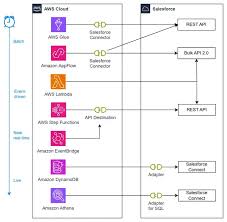
Unlock Real-Time Insights with AWS IoT and Salesforce Industry Clouds This guide explains how to gather, process, and distribute data from connected vehicles and industrial assets—such as manufacturing equipment or utility meters—into Salesforce Industry Cloud solutions using Amazon Web Services (AWS). Key AWS IoT Services for Data Collection By leveraging these services, businesses can integrate telemetry data into: Why This Integration Matters Strong customer relationships rely on real-time insights. Automakers, manufacturers, and utility providers can enhance customer interactions by unifying telemetry data with CRM workflows—enabling smarter marketing, sales, and service decisions. Prerequisites To integrate AWS IoT with Salesforce, you’ll need: AWS Services Salesforce Requirements Use Cases 1. Predictive Maintenance with AWS & Salesforce 2. In-Car Notifications 3. On-Demand Vehicle/Asset Health Insights 4. Data-Driven Customer Engagement Solution Architecture Data Flow Overview Implementation Steps 1. Set Up AWS IoT Rules 2. Configure Salesforce Event Handling 3. Enable Real-Time Analytics Conclusion By integrating AWS IoT with Salesforce Industry Clouds, businesses can:✔ Improve operational efficiency with predictive maintenance.✔ Enhance customer experiences through real-time alerts and diagnostics.✔ Drive data-driven decisions with unified analytics. Next Steps: Empower your teams with real-time IoT insights—start building today! Like Related Posts Who is Salesforce? Who is Salesforce? Here is their story in their own words. From our inception, we’ve proudly embraced the identity of Read more Salesforce Marketing Cloud Transactional Emails Salesforce Marketing Cloud Transactional Emails are immediate, automated, non-promotional messages crucial to business operations and customer satisfaction, such as order Read more Salesforce Unites Einstein Analytics with Financial CRM Salesforce has unveiled a comprehensive analytics solution tailored for wealth managers, home office professionals, and retail bankers, merging its Financial Read more AI-Driven Propensity Scores AI plays a crucial role in propensity score estimation as it can discern underlying patterns between treatments and confounding variables Read more

Read More
Salesforce analytics insurance

4 Steps to Unlock the Right Marketing Insights

Overwhelmed by Dashboard Data? 4 Steps to Unlock the Right Marketing Insights An effective dashboard should present marketing data clearly and concisely, enabling teams to quickly extract insights and make confident decisions. 4 Steps to Unlock the Right Marketing Insights Turning Data into Action with Trusted Insights Imagine walking into a restaurant with an overwhelming menu—dozens of dishes spanning multiple cuisines, making it difficult to choose. While the food may be good, the sheer volume of options leads to decision fatigue, causing diners to default to familiar choices rather than exploring new possibilities. The same challenge applies to marketing dashboards. When cluttered with excessive metrics, they become difficult to navigate, obscuring key insights rather than revealing them. A well-designed dashboard, like a well-curated menu, should guide users to the most valuable information—helping them act quickly and strategically. The Difference Between Reporting and Insights Many dashboards fall into the trap of displaying every possible metric, but true value comes from actionable insights, not just raw data. Example: A live campaign shows that email conversions outperform social ads. Instead of just noting the discrepancy, an insights-driven dashboard helps marketers diagnose why—perhaps stronger subject lines or better landing page alignment—and adjust social strategies in real time for immediate improvement. 4 Steps to Build Dashboards That Drive Decisions To transform dashboards from data overload into insight engines, follow this structured approach: 1. Define the User Persona Dashboards should cater to specific roles, not broad audiences. Different stakeholders need different insights: A one-size-fits-all dashboard drowns users in irrelevant data. Instead, tailor views to each persona’s core needs. 2. Align with Daily Tasks Collaborate with users to understand how they apply data in their workflows. A well-designed dashboard should: 3. Answer Key Business Questions Every dashboard should directly address the user’s most critical questions, such as: Prioritize KPIs that drive action, like:✔ Impressions (Reach)✔ Click-through rate (CTR) (Engagement)✔ Conversion rate (CVR) (Effectiveness)✔ Revenue per sale (ROI) Supplement these with supporting metrics (e.g., time on site, repeat visits) to uncover deeper trends. 4. Design for Clarity and Impact A great dashboard balances simplicity with depth: Example for Executives: A high-level dashboard showing revenue, CAC, and CLTV by region helps identify growth opportunities. If one region shows strong CLTV, leadership might invest further in similar markets. The Result? Faster, Smarter Decisions By focusing on personas, tasks, key questions, and clarity, marketers can move beyond data overload and unlock real business value. The best dashboards don’t just report numbers—they illuminate the path forward. Ready to streamline your insights? Start by having Tectonic refine one dashboard using these steps—and watch decision-making improve. Like Related Posts Who is Salesforce? Who is Salesforce? Here is their story in their own words. From our inception, we’ve proudly embraced the identity of Read more Salesforce Marketing Cloud Transactional Emails Salesforce Marketing Cloud Transactional Emails are immediate, automated, non-promotional messages crucial to business operations and customer satisfaction, such as order Read more Salesforce Unites Einstein Analytics with Financial CRM Salesforce has unveiled a comprehensive analytics solution tailored for wealth managers, home office professionals, and retail bankers, merging its Financial Read more AI-Driven Propensity Scores AI plays a crucial role in propensity score estimation as it can discern underlying patterns between treatments and confounding variables Read more

Read More
agentic revolution

The Agentic AI Revolution

The Agentic AI Revolution: Reskilling and Trust as Competitive Imperatives The rise of agentic AI—autonomous systems capable of independent decision-making—isn’t just another tech trend; it’s a fundamental shift in how businesses operate. With AI agents projected to unlock $6 trillion in digital labor value, companies that fail to adapt risk being outpaced by AI-driven competitors. To thrive in this new era, business leaders must focus on two critical pillars: 1. Reskilling for the Age of AI Collaboration The Urgent Skills Gap Key Competencies for the AI Era ✅ Human-AI Collaboration – Managing AI agents, prompt engineering, and oversight✅ Strategic Thinking – Shifting from routine tasks to big-picture planning✅ Leadership & Management – Overseeing AI “teams” and decision flows A Call to Action for Businesses “With AI handling routine coding, developers can now focus on system architecture and innovation—but only if we equip them for this shift.” 2. Trust: The Foundation of AI Adoption The Risks of Unchecked AI Building a Trusted AI Framework 🛡️ Guardrails & Escalation Protocols – Define when AI must defer to humans🔐 Data Protection – Ensure compliance with zero-retention LLM policies (e.g., Einstein Trust Layer)📊 Transparency Tools – Give employees visibility into AI decision logic Salesforce’s Approach: Agentforce The Path Forward: AI + Humans in Partnership Why This Matters Now Key Takeaways for Leaders Linda SaundersCountry Manager & Senior Director of Solution Engineering, Africa | Salesforce “The future belongs to businesses that combine AI’s efficiency with human ingenuity—guided by an unwavering commitment to trust.” Ready to lead in the agentic AI era? The AI revolution isn’t coming—it’s here. The question is: Will your organization be a disruptor or disrupted? Like Related Posts Who is Salesforce? Who is Salesforce? Here is their story in their own words. From our inception, we’ve proudly embraced the identity of Read more Salesforce Marketing Cloud Transactional Emails Salesforce Marketing Cloud Transactional Emails are immediate, automated, non-promotional messages crucial to business operations and customer satisfaction, such as order Read more Salesforce Unites Einstein Analytics with Financial CRM Salesforce has unveiled a comprehensive analytics solution tailored for wealth managers, home office professionals, and retail bankers, merging its Financial Read more AI-Driven Propensity Scores AI plays a crucial role in propensity score estimation as it can discern underlying patterns between treatments and confounding variables Read more

Read More
Natural Language Processing Explained

Exploring 3 Types of Natural Language Processing in Healthcare

Healthcare generates vast amounts of unstructured, text-based data—primarily in the form of clinical notes stored in electronic health records (EHRs). While this data holds immense potential for improving patient outcomes, extracting meaningful insights from it remains a challenge. Natural language processing (NLP) offers a solution by enabling healthcare stakeholders to analyze and interpret this data efficiently. NLP technologies can support population health management, clinical decision-making, and medical research by transforming unstructured text into actionable insights. Despite the excitement around NLP in healthcare—particularly amid clinician burnout and EHR inefficiencies—its two core components, natural language understanding (NLU) and natural language generation (NLG), receive less attention. This insight explores NLP, NLU, and NLG, highlighting their differences and healthcare applications. Understanding NLP, NLU, and NLG While related, these three concepts serve distinct purposes: Healthcare Applications NLP technologies offer diverse benefits across clinical, administrative, and research settings: 1. NLP in Clinical and Operational Use Cases Real-World Examples: 2. NLU for Research & Chatbots While less widely adopted than NLP, NLU shows promise in: 3. NLG for Generative AI in Healthcare Challenges & Barriers to Adoption Despite their potential, NLP technologies face several hurdles: 1. Data Quality & Accessibility 2. Bias & Fairness Concerns 3. Regulatory & Privacy Issues 4. Performance & Clinical Relevance The Future of NLP in Healthcare Despite these challenges, NLP, NLU, and NLG hold tremendous potential to revolutionize healthcare by:✔ Enhancing clinical decision-making✔ Streamlining administrative workflows✔ Accelerating medical research As the technology matures, addressing data, bias, and regulatory concerns will be key to unlocking its full impact. Like Related Posts Who is Salesforce? Who is Salesforce? Here is their story in their own words. From our inception, we’ve proudly embraced the identity of Read more Salesforce Marketing Cloud Transactional Emails Salesforce Marketing Cloud Transactional Emails are immediate, automated, non-promotional messages crucial to business operations and customer satisfaction, such as order Read more Salesforce Unites Einstein Analytics with Financial CRM Salesforce has unveiled a comprehensive analytics solution tailored for wealth managers, home office professionals, and retail bankers, merging its Financial Read more AI-Driven Propensity Scores AI plays a crucial role in propensity score estimation as it can discern underlying patterns between treatments and confounding variables Read more

Read More
Agentic AI is Here

The Rise of Agentic AI

Beyond Predictive Models: The Rise of Agentic AI Agentic AI represents a fundamental shift from passive language models to dynamic systems capable of perception, reasoning, and action across digital and physical environments. Unlike traditional AI that merely predicts text, agentic architectures interact with the world, learn from feedback, and coordinate multiple specialized agents to solve complex problems. This evolution is built on three core principles: Core Principles of Agentic AI 1. Causality & Adaptive Decision-Making Traditional AI systems rely on statistical patterns, often producing plausible but incorrect responses. Agentic AI models cause-and-effect relationships, enabling iterative refinement when faced with unexpected outcomes. Example Applications: 2. Multimodal World Interaction Modern agentic systems integrate text, vision, and sensor data to interact with complex environments. Real-World Implementations: 3. Multi-Agent Collaboration Next-generation frameworks deploy specialized sub-agents that work in parallel rather than relying on single monolithic models. Implementation Examples: Key Components of Agentic Systems 1. Modular Skill Architectures Modern platforms enable: Use Case Scenario:A business intelligence agent that pulls real-time market data, analyzes trends, and generates reports while maintaining data governance standards 2. Multi-Agent Orchestration Advanced frameworks provide: Practical Application:Software development environments where coding, debugging, and security validation occur simultaneously through coordinated AI agents 3. Visual Environment Interaction Cutting-edge solutions bridge the gap between AI and graphical interfaces by: Implementation Example:Intelligent process automation that navigates legacy systems and modern applications without manual scripting Advanced Implementation Patterns 1. Knowledge-Enhanced Agents Example Implementation:Customer service systems that access order history, product details, and support documentation before responding 2. Human Oversight Integration Use Case:Medical diagnostic support that flags uncertain cases for professional review 3. Persistent Context Management Application Example:Project management assistants that track progress, dependencies, and timelines over weeks or months Industry Applications Sector Agentic AI Solutions Software Development Automated testing, debugging, and deployment pipelines Healthcare Integrated diagnostic systems combining multiple data sources Education Adaptive learning systems with personalized tutoring Financial Services Real-time fraud detection and risk analysis Manufacturing Dynamic process optimization and quality control Current Challenges & Research Directions Getting Started with Agentic AI For organizations beginning their agentic AI journey: The Path Forward Agentic AI represents a fundamental evolution from conversational systems to active, adaptive problem-solvers. By combining causal reasoning, specialized collaboration, and real-world interaction, these systems are moving us closer to truly intelligent automation. The future belongs to AI systems that don’t just process information – but perceive, decide, and act in dynamic environments. Organizations that embrace this paradigm today will be positioned to lead in the AI-powered economy of tomorrow. Like Related Posts Who is Salesforce? Who is Salesforce? Here is their story in their own words. From our inception, we’ve proudly embraced the identity of Read more Salesforce Unites Einstein Analytics with Financial CRM Salesforce has unveiled a comprehensive analytics solution tailored for wealth managers, home office professionals, and retail bankers, merging its Financial Read more AI-Driven Propensity Scores AI plays a crucial role in propensity score estimation as it can discern underlying patterns between treatments and confounding variables Read more Tectonic’s Successful Salesforce Track Record Salesforce Technology Services Integrator – Tectonic has successfully delivered Salesforce in a variety of industries including Public Sector, Hospitality, Manufacturing, Read more

Read More
gettectonic.com