Salesforce Financial Services Solutions Archives - gettectonic.com - Page 3
MC Personalization Tips and Tricks

MC Personalization Tips and Tricks

Salesforce Marketing Cloud Personalization, formerly Interaction Studio, offers incredible power for personalization. MC Personalization Tips and Tricks below will help you level up your game. Einstein Recipes: Enhancements and Challenges Multiple Dimensional Variations for Products in Einstein Recipes Einstein Recipes offer powerful and flexible tools for creating recommendations. However, the fourth step, Variations, falls short compared to other options. Currently, you can configure only a single Dimensional Variation. While multiple Item Types are available, once you select one, you cannot limit recommended products to specific numbers per category or brand. This limitation hinders control over product recommendations, especially for e-commerce sites with diverse catalogs. Unlike Dimensional Variations, multiple Boosters or Exclusions of the same type can be configured differently, which would be a valuable feature to add for Variations. Department Variation for Products in Einstein Recipes Einstein Recipes allow Dimensional Variations at the Category level, but only for primary categories. There is no option for Department (master category) level, which is limiting for e-commerce sites with broad category trees, such as: Recommendations with Category Variation set can still be dominated by similar products due to similar primary categories. Two solutions could address this: Price Reduction Ingredient in Einstein Recipes Triggered Campaigns in Journey Builder can target various events, including Catalog Triggers. Some triggers, like Product Expiring Soon, are available for Web with Einstein Recipes Ingredients. However, there is no Ingredient for the common e-commerce use case of Price Reduction. Marketing Cloud Personalization (Interaction Studio) has the required price and listPrice attributes for Triggered Campaigns. A workaround involves calculating price reductions externally and passing this information to a Related Catalog Object. More efficient solutions would be: Rating Count in Recipe’s Rating Exclusion Marketing Cloud Personalization offers Exclusions/Inclusions on Recipes to fine-tune recommendations. One option is to exclude/include items based on their rating, with an optional zero rating capture. It would be beneficial to include an option to filter based on rating count, allowing for: Currently, such filters can only be applied on the server side in the Template, which can limit recommendations. Having this feature at the recipe level would be more powerful. Abandoned Cart Retention Setting Marketing Cloud Personalization captures cart information for Einstein Recipes recommendations. However, cart content remains indefinitely unless managed proactively. A workaround involves a Web Campaign that checks cart age and pushes a clear cart action if necessary. A better solution would be a configurable option in MCP settings to automatically remove old cart data. Catalog Enhancements Full MCP Category Hierarchy Support for ETL Marketing Cloud Personalization can create a hierarchical tree of categories with automatic summing of views and revenue. However, this is currently possible only under specific conditions, such as having one Category per product and using a Sitemap format. This limitation is problematic, as ETL is often a better way to manage it. The Category ETL already provides detailed information using department and parentCategoryId attributes, but this data does not replicate the drill-down hierarchy in the Catalog UI or pass data from the bottom Category up. Ensuring feature parity between Sitemap and ETL would be beneficial. Segmentation Enhancements MCP Action Name Management Marketing Cloud Personalization captures actions from multiple sources but does not allow managing created actions. An option to view and remove unnecessary actions would improve user experience by reducing the number of options in the segmentation/targeting picklists. An even better solution would be to merge existing actions, preserving behavioral data after refactoring action names. MCP Hourly-Based Segmentation Rules Currently, segmentation rules in Marketing Cloud Personalization are based on days, limiting on-site campaign targeting. For example, to display an infobar for abandoned cart users, the current segmentation can only show users who have not performed a Cart Action today. Hourly-based segmentation rules would allow more precise targeting, showing users who have not performed a Cart Action in the last hour. Adding a picklist to choose between day or hour-based rules would enhance segmentation capabilities. Full MCP Catalog Export Marketing Cloud Personalization supports manual catalog export but only with limited data. The current export file lacks complete catalog data (e.g., promotable and archived attributes), making it unsuitable for ETL sources. An option to export the full catalog data, matching the ETL schema and including hidden items, would greatly benefit debugging and batch-modifying items for subsequent ETL import. Full MCP Catalog Metadata Visibility Marketing Cloud Personalization supports viewing custom attribute metadata in the Catalog but is limited to ETL updates. Extending this to built-in attributes and including origin and lastUpdated values for all sources (Sitemap, Mobile App, Manual update, API) would simplify debugging Catalog metadata issues, reducing admin/developer work and support tickets. ETL Enhancements External Email Campaign ETL Experience Name & ID External Email Campaign ETL allows passing behavioral data but is limited to Campaign ID and Campaign Name. To fully leverage this data in segmentation, it should also support Email ID and Email Name. Adding Experience ID and Experience Name fields to the ETL would enable targeted personalization, allowing segmentation on entire campaigns or specific emails within campaigns. External Email Campaign ETL Send Segmentation External Email Campaign ETL passes Send, Click, and Open data but does not support segmentation based on Send events. Enabling segmentation rules for Send events would unlock use cases like targeting Web or Push campaigns to users who received an email campaign but did not open it, fully leveraging cross-channel and real-time personalization. External Email Campaign ETL Unsubscription Event Type External Email Campaign ETL passes Send, Click, and Open data but cannot pass unsubscriptions. Including the Unsubscribe event would enable targeted campaigns like surveys about unsubscription reasons, win-back campaigns, or replacing email subscription prompts with other channel recommendations. By addressing these enhancements and challenges, Salesforce Marketing Cloud Personalization (Interaction Studio) can further improve its capabilities and provide more precise, effective, and user-friendly tools for personalized marketing. Reporting Enhancements: Direct Attribution at the MCP Campaign Level Current Reporting in Marketing Cloud Personalization (MCP) Marketing Cloud Personalization (Interaction Studio) offers various reports based on Activity, Results, and Visits. However, it

Read More
How Good is Our Data

How Data Cloud and Salesforce Success Depend on Data Quality

Optimizing AI’s Impact on Your Business: The Crucial Role of Data Quality in Salesforce In the ever-evolving digital landscape, the convergence of data quality and artificial intelligence (AI) is a linchpin for organizational success. Success depends on data quality within the Salesforce ecosystem. The synergy between Einstein, an advanced AI system, and Data Cloud underscores the pivotal role of high-quality, comprehensive, and real-time data. Thereby unleashing the full potential of AI-driven insights and interactions with customers and prospects. Let’s explore how data quality profoundly influences these two emerging features. This insight will be shedding light on the repercussions of poor data quality and how Einstein and Data Cloud can elevate your organization to greater levels of sales success. Understanding Data Value Depends on Data Quality: Quality data extends beyond merely addressing duplicate records or inaccurate phone numbers It isn’t just about ensuring the area code field doesn’t contain zip codes. It is more than aligning contacts to accounts. It encompasses factors such as completeness, accuracy, and timeliness in your CRM: Consequences of Bad Data: Poor-quality data leads to inefficiencies and wasted time. Oftentimes causing flawed decision-making and strains on organizational resources. More critically, these poor business decisions often lead to tangible financial losses. Transforming bad data into quality data is imperative. Quality is key for relying on it to enhance company performance, requiring ongoing strategies rather than a one-stop solution. The Financial Impact of Accurate Data: Accurate data holds immense value. With data volumes projected to exceed 180 zettabytes by 2025, organizations must harness the power of their data. Proactive handling of data quality not only ensures higher data quality but also mitigates the financial impact of poor data quality. The sooner a plan is implemented to enhance and sustain data quality, the fewer negative repercussions organizations face in leveraging their data for growth. Your next decision is based on your last data. Is it going to help you or hurt you? Salesforce Einstein and the GIGO Principle: Salesforce Einstein, positioned as Artificial Intelligence for everyone, underscores trust as a core value. The system’s ability to create relevant and timely content and interactions is contingent on the quality of the data it operates on. Similar to the historical concept of “Garbage In, Garbage Out” (GIGO), AI results are only as reliable and valuable as the completeness and accuracy of the input data. No surprise, right? Introduction to Salesforce Data Cloud: Enter Salesforce Data Cloud, a platform allowing the organization and segmentation of customer data from any source. This open, extensible platform enables data enrichment from various sources, creating an optimal customer record. This enriched record empowers Sales, Service, and Marketing teams to perform intelligently and swiftly, ultimately driving enhanced results for the company. The WIIFM Factor: Amidst discussions about AI and Data Cloud, addressing the “What’s in it for me?” (WIIFM) question is crucial for organization adoption. Individual organizations must evaluate the reliability and accuracy of their data and determine forward-looking strategies for maintaining quality data, regardless of the source. The common theme remains: for data to yield valuable insights, it must be complete, timely, relevant, and accurate. Ultimately, success depends on data quality. Like3 Related Posts Who is Salesforce? Who is Salesforce? Here is their story in their own words. From our inception, we’ve proudly embraced the identity of Read more Salesforce Marketing Cloud Transactional Emails Salesforce Marketing Cloud Transactional Emails are immediate, automated, non-promotional messages crucial to business operations and customer satisfaction, such as order Read more Salesforce Unites Einstein Analytics with Financial CRM Salesforce has unveiled a comprehensive analytics solution tailored for wealth managers, home office professionals, and retail bankers, merging its Financial Read more AI-Driven Propensity Scores AI plays a crucial role in propensity score estimation as it can discern underlying patterns between treatments and confounding variables Read more

Read More
Industry Cloud

Salesforce Industry Cloud Explained

What are Salesforce industry clouds? Salesforce Industry Cloud aims to fast-track the digital transformation within different industries by providing tailored solutions that can enhance customer experiences, streamline operations, and improve overall business efficiency. Industry cloud platforms use innovative technologies and approaches, such as packaged business capabilities, industry-aware data fabrics and composable tooling to go beyond traditional cloud and create added value. Over the past few years, Salesforce has dedicated efforts to develop industry-specific solutions, exemplified by offerings such as Financial Services Cloud, Health Cloud, and the Public Sector Cloud.  These customized Salesforce solutions are created with industry experts to assist modernizing your business, saving you time, lowering costs, and focusing on your customers. Salesforce Industry Cloud Explained These specialized solutions take the foundational elements of Salesforce’s core CRM and tailor them to the unique needs of specific industries. In Health Cloud, the emphasis shifts from traditional Accounts and Contacts to focus on Families and Patients. Similarly, Financial Services Cloud redirects attention from standard Opportunities and Products to concentrate on Financial Holdings and Assets. To further enhance its Industries portfolio, Salesforce expanded with the acquisition of Vlocity in 2020. This acquisition broadened the spectrum of industry-specific clouds, extending into areas such as communications, media, and insurance. Whatever size your business, Salesforce has specialized solutions to support the capabilities your business needs to thrive and grow. Current Salesforce Industry Cloud solutions exist for: Automotive Communications Consumer Goods Higher Education Energy and Utilities Financial Services Government and Public Sector Healthcare and Life Sciences Manufacturing Media Nonprofit Professional Services Retail Technology Travel, Transportation, and Hospitality What are the benefits of industry clouds? Industry Clouds are specific offerings that are pre-built and packaged up for organizations to adopt. By implementing these solutions, you could reap a whole host of benefits, including a higher ROI, increased job demand, and better customer experience – all of which are essential in the current climate. Like2 Related Posts Who is Salesforce? Who is Salesforce? Here is their story in their own words. From our inception, we’ve proudly embraced the identity of Read more Salesforce Marketing Cloud Transactional Emails Salesforce Marketing Cloud Transactional Emails are immediate, automated, non-promotional messages crucial to business operations and customer satisfaction, such as order Read more Salesforce Unites Einstein Analytics with Financial CRM Salesforce has unveiled a comprehensive analytics solution tailored for wealth managers, home office professionals, and retail bankers, merging its Financial Read more AI-Driven Propensity Scores AI plays a crucial role in propensity score estimation as it can discern underlying patterns between treatments and confounding variables Read more

Read More
Slack for Financial Services

How Slack Works with Financial Services Cloud

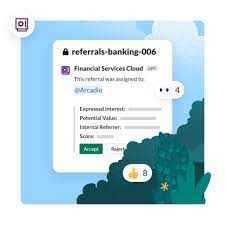
The financial services industry is fiercely competitive, demanding quick access to customer data, seamless collaboration, and well-informed decision-making for growth and staying ahead. Slack and Salesforce Financial Services Cloud (FSC) serve as instrumental tools in achieving these objectives. By synergizing these two robust platforms, organizations in the financial sector can enhance efficiency and organizational structure. How Slack Works with Financial Services Cloud. Salesforce FSC, a cloud-based platform, offers an encompassing suite of applications tailored for financial services. It streamlines processes like sales, marketing, compliance, and customer service. Real-time access to customer data empowers finance professionals, enabling them to make informed decisions efficiently. Slack, an instant messaging platform, facilitates faster and secure communication, fostering collaboration among team members. It simplifies file-sharing across devices, ensuring universal access to essential information. Slack’s user-friendly interface organizes conversations, mitigating the challenge of managing communication across various platforms. The integration of Slack and FSC revolutionizes finance teams’ operations, providing unprecedented speed, efficiency, and collaboration capabilities. Real-time notifications from FSC within Slack enable swift responses to changes in customer databases or workflow processes. Collaborative efforts are further streamlined, as documents from both platforms can be seamlessly shared in Slack conversations, eliminating the need to toggle between platforms or search for files in different locations. In summary, the synergy between Salesforce Financial Services Cloud and Slack empowers finance teams to work smarter, faster, and more effectively, maintaining a competitive edge. Leveraging FSC’s robust features alongside Slack’s user-friendly interface equips financial services organizations with the essential tools needed for success in today’s highly competitive marketplace. Implementing both systems promises a significant boost for your business – are you ready to enhance your operations? Start integrating these systems today! Like Related Posts Who is Salesforce? Who is Salesforce? Here is their story in their own words. From our inception, we’ve proudly embraced the identity of Read more Salesforce Marketing Cloud Transactional Emails Salesforce Marketing Cloud Transactional Emails are immediate, automated, non-promotional messages crucial to business operations and customer satisfaction, such as order Read more Salesforce Unites Einstein Analytics with Financial CRM Salesforce has unveiled a comprehensive analytics solution tailored for wealth managers, home office professionals, and retail bankers, merging its Financial Read more AI-Driven Propensity Scores AI plays a crucial role in propensity score estimation as it can discern underlying patterns between treatments and confounding variables Read more

Read More
Salesforce Einstein Copilot

Salesforce Einstein Copilot – Spring ’24

Salesforce introduces the latest iteration of Einstein, introducing a Conversational AI Assistant to integrate seamlessly into every CRM application and enhance the overall customer experience. The new Einstein Copilot, powered by generative AI, is designed to boost productivity by seamlessly integrating into the workflow. Additionally, organizations can tailor Einstein Copilot to meet their specific business requirements using Einstein Copilot Studio. The inclusion of the Einstein Trust Layer ensures the protection of sensitive data while allowing companies to leverage their trusted data to enhance generative AI responses within the platform. The reality is every company will undergo an AI transformation to increase productivity, drive efficiency, and deliver incredible customer and employee experiences. With Einstein Copilot and Data Cloud we’re making it easy to create powerful AI assistants and infuse trusted AI into the flow of work across every job, business, and industry. In this new world, everyone can now be an Einstein. Marc Benioff, Chair and CEO, Salesforce Einstein Copilot is designed to generate reliable and precise recommendations and content for specific tasks such as constructing digital storefronts, crafting custom code, creating data visualizations, and guiding sales associates in closing deals efficiently. Grounded securely with customer data from Salesforce Data Cloud, encompassing customer data, enterprise content, telemetry data, Slack conversations, and other structured and unstructured data, Einstein Copilot ensures informed and accurate decision-making. In contrast to previous generative AI copilot solutions that operated as separate applications, Einstein Copilot is natively integrated within the world’s leading AI CRM. It taps into data from any Salesforce application, enhancing the generation of more accurate AI-powered recommendations and content. Employing natural language prompts, Einstein Copilot can perform various tasks in sales, service, marketing, commerce, development, Tableau, and industry-specific scenarios: Sales: Service: Marketing: Commerce: Developers: Tableau: Industry-specific: Like1 Related Posts Who is Salesforce? Who is Salesforce? Here is their story in their own words. From our inception, we’ve proudly embraced the identity of Read more Salesforce Unites Einstein Analytics with Financial CRM Salesforce has unveiled a comprehensive analytics solution tailored for wealth managers, home office professionals, and retail bankers, merging its Financial Read more AI-Driven Propensity Scores AI plays a crucial role in propensity score estimation as it can discern underlying patterns between treatments and confounding variables Read more Tectonic’s Successful Salesforce Track Record Salesforce Technology Services Integrator – Tectonic has successfully delivered Salesforce in a variety of industries including Public Sector, Hospitality, Manufacturing, Read more

Read More
Salesforce Einstein and Einstein Automate

AI Fundamentals

The concept of Artificial Intelligence (AI) has long been a fascination for storytellers and sci-fi enthusiasts. However, for a considerable period, most individuals didn’t give AI much serious consideration, perceiving it as a distant futuristic sci-fi possibility. Nevertheless, researchers and computer scientists have been actively working to transform the dream of AI into a tangible reality, leading some to insist that we have already entered the Age of AI. The AI Fundamentals explained. While the extent of AI’s integration into our daily lives remains uncertain, it is evident that meaningful conversations about AI require a shared vocabulary and a solid foundation of core concepts. Presently, asking ten people to define artificial intelligence is likely to yield ten different answers. This insight attempts to establish a common understanding by exploring AI’s current capabilities and digging into the methodologies employed by computer scientists in creating remarkable AI systems. AI Fundamentals Defining AI proves challenging due to distorted perceptions influenced by science fiction narratives portraying AI as a potentially malevolent force. Additionally, our tendency to benchmark AI against human intelligence contributes to this challenge. And I don’t want AI to be able to write a blog post as well as me! Acknowledging the vast spectrum of intelligence in the animal kingdom, as well as the diversity in human intelligence, prompts a need to view artificial intelligence through a similar lens. As humans we may think we are a lot smarter than a bird. But I don’t know how to fly, do you? AI Capabilities Recognizing specific AI capabilities tailored to distinct tasks is crucial, dispelling the notion of a universally proficient AI, known as general AI, which remains a distant goal. AI currently exists in specialized forms, each excelling at particular jobs. Key AI capabilities fall into several categories: It’s safe to say, artificial intelligence encompasses computer abilities associated with human intuition, inference, and reasoning. Presently, AI skills are highly specialized, covering categories like numeric predictions and language processing. The evolving landscape of AI offers a glimpse into the transformative potential of this technology, emphasizing its current application in specific domains. Like1 Related Posts Who is Salesforce? Who is Salesforce? Here is their story in their own words. From our inception, we’ve proudly embraced the identity of Read more Salesforce Marketing Cloud Transactional Emails Salesforce Marketing Cloud Transactional Emails are immediate, automated, non-promotional messages crucial to business operations and customer satisfaction, such as order Read more Salesforce Unites Einstein Analytics with Financial CRM Salesforce has unveiled a comprehensive analytics solution tailored for wealth managers, home office professionals, and retail bankers, merging its Financial Read more AI-Driven Propensity Scores AI plays a crucial role in propensity score estimation as it can discern underlying patterns between treatments and confounding variables Read more
Read More
Salesforce Sales Cloud

Salesforce Sales Cloud GPT

What is Salesforce Sales Cloud GPT? Salesforce’s Einstein GPT is a robust AI tool that seamlessly integrates both public and private AI models with CRM data. This unique synergy allows users to articulate natural-language queries directly within the Salesforce CRM environment, resulting in continuously adapted AI-generated content tailored to evolving customer information and requirements. Salesforce Sales Cloud GPT The suite encompasses a suite of powerful Artificial Intelligence (AI) products, including the Einstein service, the workplace-messaging app Slack, and the data analysis software Tableau. Notably, it unveils a compelling array of natural language tools slated for release in 2023, such as Sales GPT for personalized emails, Service GPT for service messages and chatbots, and Marketing GPT for refined audience targeting. Furthermore, the AI Cloud is meticulously crafted to host extensive language models from various providers such as AWS, Anthropic, and Cohere. Salesforce’s commitment to AI startups is further underscored by a substantial $500 million injection into its venture capital fund. Impact on Sales Cloud with AI and EinsteinGPT: Sales Cloud undergoes a transformative impact through AI, notably EinsteinGPT. Anchored in principles of Trust, Security, and Privacy, Salesforce introduces the Einstein Trust Layer within its AI Cloud offering to assuage privacy concerns. This layer ensures adaptability and transparency while upholding stringent standards for data privacy, security, and compliance. EinsteinGPT for Sales Cloud emerges as a game-changing innovation, serving as a personalized assistant within Salesforce CRM to streamline sales processes. Leveraging Generative AI, it transcends mere data analysis by generating novel content, ideas, and approaches. Key features encompass Einstein GPT, Einstein Conversation Insights, and Einstein Relationship Insights. Industries Experience Tangible Impact: Salesforce’s substantial investments in AI are reshaping the landscape of sales and customer engagement. As EinsteinGPT becomes an integral part of the platform, the anticipation of new and innovative use cases signals a significant leap forward in AI accessibility. Tectonic is please to announce our Sales Cloud Implementation Solutions. Like1 Related Posts Who is Salesforce? Who is Salesforce? Here is their story in their own words. From our inception, we’ve proudly embraced the identity of Read more Salesforce Marketing Cloud Transactional Emails Salesforce Marketing Cloud Transactional Emails are immediate, automated, non-promotional messages crucial to business operations and customer satisfaction, such as order Read more Salesforce Unites Einstein Analytics with Financial CRM Salesforce has unveiled a comprehensive analytics solution tailored for wealth managers, home office professionals, and retail bankers, merging its Financial Read more AI-Driven Propensity Scores AI plays a crucial role in propensity score estimation as it can discern underlying patterns between treatments and confounding variables Read more

Read More
Slack for Financial Services

Salesforce Slack for Financial Services

Enhance collaboration and streamline workflows in the financial services sector with Slack integration. “We believe that to become the number one bank, we need to be the number one tech team. To deliver on the expectations of our clients, we need to give our employees access to the best tools, and Slack is one of them.” Martin Wildberger, Executive Vice President of Innovation and Technology, RBC Access Records with Ease: Efficient Shortcuts and Slash Commands: Financial Services Cloud for Slack: Salesforce Financial Services Cloud: Modernize Operations: Accelerate Decision-Making: Deliver Exceptional Customer Experiences: Unite Teams: Slack connects with all your favorite tools, such as Salesforce, Smarsh, Global Relay and more. Like1 Related Posts Salesforce Unites Einstein Analytics with Financial CRM Salesforce has unveiled a comprehensive analytics solution tailored for wealth managers, home office professionals, and retail bankers, merging its Financial Read more Tectonic’s Successful Salesforce Track Record Salesforce Technology Services Integrator – Tectonic has successfully delivered Salesforce in a variety of industries including Public Sector, Hospitality, Manufacturing, Read more Asset Management Salesforce Can Salesforce do asset management? You can manage assets in Consumer Goods (desktop) and in the Consumer Goods offline mobile Read more Lookup Relationship in Salesforce What is Lookup relationship in Salesforce? Salesforce’s lookup relationships is a significant capability that allows users to connect two objects Read more

Read More
Salesforce data success

Blend Salesforce Integration

Blend Salesforce Integration for the Mortgage Industry While there are many benefits to this Blend Salesforce integration, one of the most important is that it can help to streamline and optimize business processes. By connecting different aspects of your operations and data sources, you can ensure that all critical information is accessible and integrated with your other systems. Furthermore, this streamlined workflow can reduce errors, increase accountability, and improve overall efficiency and performance. Additionally, Salesforce integration can allow you to make better decisions based on real-time data analytics, which can translate into greater profitability for your company. Blend’s integration with SFDC provides a seamless way for loan teams to leverage the intuitive, mobile-first Blend origination experience without disrupting their lead management process in Salesforce. Rapid, out of the box (OOTB) integration, with minimal effort by your team to add it to your Salesforce experience. Supports lead ingestion from Salesforce to Blend and visa-versa with Loan Officer assignment syncing. Simple workflow for loan teams working in Salesforce to easily send and manage full mortgage and/or home equity loan applications through Blend. Ultimately, by blending Salesforce integration with other business processes, you can unlock an entirely new level of success for your organization. Like Related Posts Who is Salesforce? Who is Salesforce? Here is their story in their own words. From our inception, we’ve proudly embraced the identity of Read more Salesforce Marketing Cloud Transactional Emails Salesforce Marketing Cloud Transactional Emails are immediate, automated, non-promotional messages crucial to business operations and customer satisfaction, such as order Read more Salesforce Unites Einstein Analytics with Financial CRM Salesforce has unveiled a comprehensive analytics solution tailored for wealth managers, home office professionals, and retail bankers, merging its Financial Read more AI-Driven Propensity Scores AI plays a crucial role in propensity score estimation as it can discern underlying patterns between treatments and confounding variables Read more

Read More
Salesforce Success Story

Case Study: Financial Services-Insurance Healthcare-Salesforce Service/Marketing Clouds

Salesforce provides comprehensive solutions tailored for the healthcare industry, addressing the specific needs of both payers (insurance providers) and providers (healthcare organizations). These solutions are designed to enhance patient engagement, improve operational efficiency, and drive better health outcomes. Salesforce Financial Services and Healthcare solutions.

Read More
gettectonic.com