Salesforce Financial Services Solutions Archives - gettectonic.com - Page 4
Data Collection

Marketing Cloud Personalization Explained

Marketing Cloud Personalization introduces an advanced level of customization for both you and your clients. By tracking customer interactions on your website, the system can adjust messaging on web pages and customize experiences based on the products and services that interest your customer. With Marketing Cloud Personalization (formerly Interaction Studio), visualize, track, and manage customer experiences with real-time interaction management. SMCP gives you the power to utilize the 4 P’s of marketing personalization. What are the 4 Ps of marketing personalization? The timeless 4 Ps of marketing—Product, Place, Price, and Promotion—remain relevant. To capitalize on contemporary capabilities, it’s essential to update strategies. A recent Infosys survey found that: While monitoring customer behavior for personalized experiences is not new, the ability to do it in real-time is. To bring this vision to life, rely on Marketing Cloud Personalization (formerly Salesforce Interaction Studio). Salesforce Marketing Cloud Personalization is a real-time personalization and interaction management solution, creating personalized experiences at crucial touch points throughout the customer journey. Marketing Cloud Personalization enables you to: Other beneficial reasons to implement Marketing Cloud Personalization include: Impact & Benefits Across Industries: Marketing Cloud Personalization captures data from every interaction, building unique customer profiles for known and unknown visitors. It supports web, mobile, and email campaigns, offering real-time personalization experiences and advanced features like triggered and server-side campaigns. Gears, Feeds, and Catalogs: Like1 Related Posts Who is Salesforce? Who is Salesforce? Here is their story in their own words. From our inception, we’ve proudly embraced the identity of Read more Salesforce Marketing Cloud Transactional Emails Salesforce Marketing Cloud Transactional Emails are immediate, automated, non-promotional messages crucial to business operations and customer satisfaction, such as order Read more Salesforce Unites Einstein Analytics with Financial CRM Salesforce has unveiled a comprehensive analytics solution tailored for wealth managers, home office professionals, and retail bankers, merging its Financial Read more AI-Driven Propensity Scores AI plays a crucial role in propensity score estimation as it can discern underlying patterns between treatments and confounding variables Read more


Read More
MuleSoft Direct for Industry Cloud

Announcing MuleSoft Direct for Salesforce Industry Clouds

MuleSoft provides the easy-to-use tools you need to automate your way to higher productivity and lower costs.  Announcing MuleSoft Direct for Salesforce Industry Clouds! Salesforce and MuleSoft have introduced a groundbreaking connectivity solution, MuleSoft Direct for Industry Clouds, designed to expedite project delivery and foster innovation within specific industries. This solution empowers both business and IT professionals to swiftly implement industry-standard integration use cases, enhancing critical business operations. The initial rollout of MuleSoft is now accessible for Salesforce Communications Cloud and Energy & Utilities Cloud. Key Significance: In the post-pandemic landscape, the demand for quicker and more efficient project delivery is paramount. Industries face increased pressure to adopt interoperability standards such as Fast Healthcare Interoperability Resources (FHIR), Banking Industry Architecture Network (BIAN), and TeleManagement Forum (TM Forum). MuleSoft Direct for Industry Clouds addresses these demands by delivering turnkey connectivity solutions tailored for specific industries, streamlining the integration of systems and data. Leverage pre-built solutions in industry standard for business critical operations to accelerate time to value. Innovation Highlights: With MuleSoft Direct, industry-leading connectivity is accelerated in the following ways: MuleSoft Direct for Salesforce Industry Clouds MuleSoft Direct simplifies connectivity by offering pre-built industry-specific use cases that cater to unique and complex business requirements. Use cases for Communications and Energy & Utilities include validating addresses and services during quoting and ordering, submitting new orders to order management systems, and streamlining billing processes. Future Steps: MuleSoft Direct solutions are set to expand to Health Cloud and Financial Services Cloud in the coming year, addressing integration needs related to Prior Authorization and fee reversals. There are plans to onboard additional industries in the future. Perspective from Salesforce and MuleSoft: “MuleSoft helps you automate any system and connect to any data, anywhere,” emphasizing the embedding of modern, industry-compliant connectivity and automation into industry clouds. Liam Doyle, SVP, Product Management, Mulesoft Jujhar Singh, EVP & GTM, Salesforce Industries, emphasized the significance of MuleSoft Direct in accelerating the implementation of industry cloud solutions, pre-building and packaging critical connectivity use cases to hasten customers’ time to value. Connectivity made easy for… Health Cloud Speed up Prior Authorization and power patient 360 initiatives with FHIR integrations directly in Health Cloud. Financial Services Cloud Modernize legacy systems to deliver digital-first experiences with BIAN integrations directly in Financial Services Cloud. Communications Cloud Streamline service and order operations with TM Forum integrations directly in Communications Cloud. Energy & Utilities Cloud Expedite key service processes with packaged billing and pricing integrations directly in Energy & Utilities Cloud. Consumer Goods Cloud Implement key initiatives like trade promotion management faster with pre-built integrations directly in Consumer Goods Cloud. Media Cloud Enhance key media & entertainment operations with pre-built integrations directly in Media Cloud. If you’re a beginner in data integration tools, this could be a reason why Mulesoft may not be right for you. It has a vast number of integrations and capabilities that can make it difficult for beginners to use. Contact Tectonic today for assistance. Content updated January 2024. Like1 Related Posts Who is Salesforce? Who is Salesforce? Here is their story in their own words. From our inception, we’ve proudly embraced the identity of Read more Salesforce Unites Einstein Analytics with Financial CRM Salesforce has unveiled a comprehensive analytics solution tailored for wealth managers, home office professionals, and retail bankers, merging its Financial Read more Tectonic’s Successful Salesforce Track Record Salesforce Technology Services Integrator – Tectonic has successfully delivered Salesforce in a variety of industries including Public Sector, Hospitality, Manufacturing, Read more Asset Management Salesforce Can Salesforce do asset management? You can manage assets in Consumer Goods (desktop) and in the Consumer Goods offline mobile Read more

Read More
salesforce private lending

Private Lending Simplified

Private Lending Simplified: Unlocking Success with Salesforce In the dynamic world of private lending, technology is transforming the way lenders operate. Salesforce stands out as a powerful platform, enabling private lenders to optimize processes, enhance borrower relationships, and drive sustainable growth. Let’s explore how Salesforce can simplify private lending and boost efficiency. The Landscape of Private Lending and Its Challenges Private lending refers to providing loans to individuals or businesses outside of traditional banks. While this approach offers flexibility and faster approvals, it also comes with challenges such as: Given these complexities, lenders need robust tools to manage the entire loan lifecycle effectively. The Role of Loan Management Software in Private Lending Loan management software is indispensable for automating and streamlining lending operations. Salesforce, with its flexible loan management capabilities, is particularly well-suited for private lenders. Key functionalities include: 1. Automated Underwriting Salesforce enables automated underwriting by using predefined rules and algorithms to evaluate borrower eligibility. This speeds up decision-making, reduces manual errors, and ensures consistency. 2. Loan Processing A centralized system in Salesforce allows lenders to track applications, manage documentation, and communicate with borrowers, ensuring no step in the process is overlooked. 3. Loan Servicing Post-loan disbursement, Salesforce’s integration capabilities support repayment tracking, automated reminders, and delinquency management, ensuring seamless loan servicing. Why Private Lenders Turn to Salesforce Salesforce empowers private lenders with tools designed to optimize every stage of the lending process. 1. Customizable Solutions Salesforce’s flexibility allows lenders to create workflows tailored to different loan types, whether it’s mortgage servicing or merchant cash advance (MCA) underwriting. 2. Advanced Data Management With secure, cloud-based infrastructure, Salesforce ensures easy access to data anytime, anywhere. This not only enhances decision-making through analytics but also supports regulatory compliance. 3. Enhanced Customer Relationship Management (CRM) Strong borrower relationships are key to private lending success. Salesforce’s CRM tools help lenders manage interactions from initial inquiries to post-loan follow-ups, ensuring clients feel supported throughout their journey. 4. Seamless Integration Salesforce integrates effortlessly with other financial tools, such as microfinance platforms and construction loan management software, creating a unified ecosystem for managing diverse loan portfolios. Choosing the Right Loan Management Solution When adopting Salesforce or similar platforms for private lending, consider the following: For private lenders, specialized solutions like Fundingo, built on Salesforce, can take operational efficiency to the next level. Conclusion Salesforce is transforming private lending by simplifying operations and strengthening lender-borrower relationships. With tools to manage the entire loan lifecycle—from underwriting to servicing—private lenders can increase efficiency, maintain compliance, and enhance customer satisfaction. Adopting advanced technologies like Salesforce positions private lenders for long-term success in an increasingly competitive market. Are you ready to harness the power of Salesforce for your private lending business? Let’s connect and explore how Tectonic can streamline your processes. Like Related Posts Who is Salesforce? Who is Salesforce? Here is their story in their own words. From our inception, we’ve proudly embraced the identity of Read more Salesforce Marketing Cloud Transactional Emails Salesforce Marketing Cloud Transactional Emails are immediate, automated, non-promotional messages crucial to business operations and customer satisfaction, such as order Read more Salesforce Unites Einstein Analytics with Financial CRM Salesforce has unveiled a comprehensive analytics solution tailored for wealth managers, home office professionals, and retail bankers, merging its Financial Read more AI-Driven Propensity Scores AI plays a crucial role in propensity score estimation as it can discern underlying patterns between treatments and confounding variables Read more

Read More
Salesforce Slack Integration

Slack and Salesforce Announce Industry Specific Solutions

As the pace of digital transformation accelerates, businesses seek solutions to enhance productivity, foster connection and collaboration, and automate workflows in an increasingly digital-centric environment. Slack and Salesforce Industry Specific Solutions are leading the charge. Every company, regardless of size, can benefit from a digital platform that dismantles silos, fostering connectivity among people, tools, and customers—an approach we refer to as a digital HQ. However, embarking on digital transformation is a complex undertaking, demanding expertise and a profound understanding of trends shaping the business landscape and workforce. To address these challenges, we have collaborated with Slack and Salesforce consulting partners to introduce the initial phase of Slack Partner Industry Solutions. Slack and Salesforce Industry Solutions is the result! Earlier this year, we expanded Slack’s global consulting partner ecosystem. As the adoption of Slack continues to grow, our partners have invested in crafting solutions tailored to meet specific industry requirements, seamlessly integrating Slack into diverse work methodologies. Today, a broader array of solutions and services is available, empowering Slack and Salesforce customers to optimize their digital tools further. For those seeking a personalized solution aligned with their industry’s unique characteristics, Slack-certified consulting partners have developed tailored solutions for industries such as financial services, manufacturing, communications, retail, media, technology, and more. This development is particularly advantageous for Slack customers aiming to establish a digital HQ that aligns with the specific needs of their businesses. Customers will benefit from cutting-edge technologies offered by Slack and Salesforce’s Customer 360, complemented by invaluable services from our partners, encompassing advisory, strategy, organizational transformation, and change management. This collaborative effort aims to dismantle data silos, enabling organizations to collaborate productively in a work-from-anywhere paradigm. Our partners also provide strategic guidance, helping create digital HQs that address industry-specific challenges, such as intelligent case swarming for lapsing insurance policies, predicting customer churn in wealth management, streamlining manufacturing supplier onboarding and management, transforming contact centers for retail and consumer goods companies, or enhancing advertisement sales for communications and media businesses. “The world’s largest and most influential consultancies have recognized that every customer needs a digital HQ. Slack and Salesforce are a key enabler to make that happen. Having these partners engaged and primed to deliver these industry solutions is a big step in our ability to bring the digital HQ to market.” Richard Hasslacher, VP of Slack Alliances & Channels Like2 Related Posts Salesforce Unites Einstein Analytics with Financial CRM Salesforce has unveiled a comprehensive analytics solution tailored for wealth managers, home office professionals, and retail bankers, merging its Financial Read more Tectonic’s Successful Salesforce Track Record Salesforce Technology Services Integrator – Tectonic has successfully delivered Salesforce in a variety of industries including Public Sector, Hospitality, Manufacturing, Read more Asset Management Salesforce Can Salesforce do asset management? You can manage assets in Consumer Goods (desktop) and in the Consumer Goods offline mobile Read more Step By Step Guide to a Salesforce Quickstart Salesforce Implementation with a Tectonic Quickstart: Step-by-Step Salesforce Quickstart Guide. Step 1: Define Your Business Requirements Identify specific business processes Read more

Read More
ABM

Scaling Account-Based Marketing in Financial Services

Scaling Account-Based Marketing in Financial Services Account-Based Marketing (ABM) is a powerful strategy for financial services firms looking to deepen client relationships and drive growth in a competitive, trust-driven industry. However, achieving long-term success requires scaling ABM effectively. The Impact of ABM on Client Growth ABM delivers tangible results where it matters most—expanding existing client relationships. According to our research, 34% of financial services (FS) marketers report growth in existing accounts due to ABM. In an industry where relationships develop over decades, this advantage is significant. At a recent Momentum ITSMA roundtable in London, senior FS marketers discussed the challenges of embedding ABM as a strategic growth driver. They identified several key roadblocks: Our Global Account-Based Marketing Benchmark reveals that while 93% of FS marketers use ABM, many remain in the early stages, struggling to scale effectively. Pitfalls in Scaling ABM Despite initial pilot successes, expanding ABM presents challenges. Many firms rush to scale without addressing foundational issues, which can undermine long-term results. Common pitfalls include: The Path to Best-in-Class ABM Despite these challenges, FS firms are making significant strides in performance optimization and personalization. Our research shows: To scale effectively, firms need a structured approach. The Momentum ITSMA ABM Adoption Framework provides a roadmap with four stages, seven foundational pillars, and 21 success factors. By following this framework, organizations can move from experimentation to best-in-class execution—turning ABM into a sustainable growth driver. Content updated January 2025. Like1 Related Posts Who is Salesforce? Who is Salesforce? Here is their story in their own words. From our inception, we’ve proudly embraced the identity of Read more Salesforce Marketing Cloud Transactional Emails Salesforce Marketing Cloud Transactional Emails are immediate, automated, non-promotional messages crucial to business operations and customer satisfaction, such as order Read more Salesforce Unites Einstein Analytics with Financial CRM Salesforce has unveiled a comprehensive analytics solution tailored for wealth managers, home office professionals, and retail bankers, merging its Financial Read more AI-Driven Propensity Scores AI plays a crucial role in propensity score estimation as it can discern underlying patterns between treatments and confounding variables Read more

Read More
Salesforce Slack Integration

Workflows for Salesforce Slack

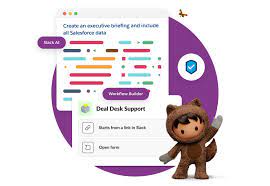
We all rely on processes to keep our teams organized and propel work forward. However, manual processes can be cumbersome, with work often getting lost in the chaos of Slack DMs or crowded team channels. Imagine if there were a way to structure processes into forms within Slack, allowing people to fill them out and automatically route requests to the appropriate individuals for follow-up. This is where Slack workflows come into play. What are Workflows for Salesforce Slack? A workflow is a multi-step process within your company, representing the sequence of tasks undertaken to achieve a business objective. Examples of Workflows for Salesforce Slack include: Workflows have a sequence of steps: Each workflow consists of multiple stages that typically occur in a specific order. Workflow Automation: Workflow automation is the use of software to streamline multi-step, multi-team workflows, ensuring the correct steps are followed, and tasks are completed efficiently. Types of Workflow Automation: Benefits of Workflow Automation in Slack: By incorporating workflow automation into Slack, teams can enhance efficiency, maintain structure, and reduce the risk of tasks getting lost or delayed. Contact Tectonic to learn more about Slack integration. Like1 Related Posts Who is Salesforce? Who is Salesforce? Here is their story in their own words. From our inception, we’ve proudly embraced the identity of Read more Salesforce Marketing Cloud Transactional Emails Salesforce Marketing Cloud Transactional Emails are immediate, automated, non-promotional messages crucial to business operations and customer satisfaction, such as order Read more Salesforce Unites Einstein Analytics with Financial CRM Salesforce has unveiled a comprehensive analytics solution tailored for wealth managers, home office professionals, and retail bankers, merging its Financial Read more AI-Driven Propensity Scores AI plays a crucial role in propensity score estimation as it can discern underlying patterns between treatments and confounding variables Read more
Read More
Salesforce Success Story

Case Study: Automated CRM for Fundraising Development and Grants

The largest integrated, not-for-profit group practice in the world. Physicians and scientists from every medical specialty work in collaborative teams to advance discovery and translational research on behalf of patients. Client is a single institution located at three main campuses and over 70 smaller hospitals, laboratories and other facilities. Client’s unique, team-based approach to science is supported by world class resources, core facilities, and computing and other infrastructure. Automated CRM for Fundraising Development and Grants.

Read More
Ncino Salesforce

Ncino Salesforce

nCino for Salesforce Overview: Ncino Salesforce nCino is a cloud-based banking operating system, offering a suite of solutions designed to automate the operations of financial institutions (FIs) and revolutionize client interactions in small businesses, commercial, and retail banking. The nCino platform digitalizes documents and processes, enhancing transparency in data and establishing an open ecosystem by operating as a data hub. It seamlessly connects and interacts with the FI’s core banking data, CRM data, data lakes, customer financial data, third-party industry data, and APIs. Is nCino the Same as Salesforce? While nCino is a bank operating system built on the Salesforce platform, it operates as a distinct entity. The nCino architecture is cloud-based and inherently versatile, utilizing Salesforce technology as its foundation. Relationship Between nCino and Salesforce nCino and Salesforce have a strategic partnership established in 2011 to empower financial institutions with digital innovations. This collaboration aims to drive efficiencies, deliver intelligence, reduce risks, and promote customer growth and loyalty in the financial services industry. The partnership involves deepening connectivity to Salesforce platform tools, including CRM, powered by AI and automation, and Financial Services Cloud. Expanding on this collaboration, nCino will enhance its integration with Salesforce to empower financial institutions further. The partnership extension includes updated commercial terms, improving nCino’s subscription gross margins and extending the term of the agreement to 2031. About nCino nCino is a global leader in cloud banking, providing a single Software-as-a-Service (SaaS) platform. It assists financial institutions in modernizing operations related to corporate and commercial, small business, consumer, and mortgage customers. nCino partners with over 1,850 financial service providers globally. For more information, visit www.ncino.com. Salesforce, Financial Services Cloud, and others are trademarks of Salesforce, Inc. For Media Inquiries: Natalia Moose Email: press@ncino.com Safe Harbor Statement This press release contains forward-looking statements within the safe harbor provisions of the Private Securities Litigation Reform Act of 1995. These statements are based on nCino’s historical performance, current plans, estimates, and expectations. Forward-looking statements involve risks and uncertainties that may cause actual results to differ materially. nCino does not undertake any obligation to update or revise forward-looking statements. These statements are subject to risks and uncertainties, including market adoption of the solution and privacy and data security matters. Further information on potential risks is available in reports filed by nCino with the U.S. Securities and Exchange Commission. For additional information, please refer to nCino’s filings with the SEC, available at www.ncino.com or www.sec.gov. Content updated January 2024. Like1 Related Posts Salesforce Unites Einstein Analytics with Financial CRM Salesforce has unveiled a comprehensive analytics solution tailored for wealth managers, home office professionals, and retail bankers, merging its Financial Read more Tectonic’s Successful Salesforce Track Record Salesforce Technology Services Integrator – Tectonic has successfully delivered Salesforce in a variety of industries including Public Sector, Hospitality, Manufacturing, Read more Asset Management Salesforce Can Salesforce do asset management? You can manage assets in Consumer Goods (desktop) and in the Consumer Goods offline mobile Read more Salesforce Vlocity Acquisition Salesforce’s Acquisition of Vlocity: A Game-Changer for the CRM Ecosystem The news of Salesforce acquiring Vlocity, though somewhat overshadowed by Read more

Read More
Salesforce Partner Platform Experience Cloud

Manage Customer Relationships with Experience Cloud

Offer your customers a secure and exclusive platform for managing their account details through the Experience Cloud’s Customer Account Portal solution. Enhance customer relationships with Experience Cloud. Better interactions and reduced service-related expenses by implementing Salesforce Experience Cloud granting customers the ability to view and settle invoices. They canupdate account information and access your knowledge base for answers to common queries. Tailored for effective account management, the Customer Account Portal empowers you to: The Customer Account Portal maintains the flexibility and extensibility you’ve come to expect with other Lightning sites, enabling you to: Salesforce Experience Cloud’s Customer Portal is a perfect solution for the public sector, government, manufacturing industry, and financial services sector. The primary distinction between customer experience and customer relationships lies in their scope. Improved customer relationships with Experience Cloud grow over time. Customer experience encompasses a broader, more comprehensive perspective on individuals’ emotions during interactions with your business. In contrast, customer relationships specifically pertain to your company’s enduring connections with customers. Like1 Related Posts Who is Salesforce? Who is Salesforce? Here is their story in their own words. From our inception, we’ve proudly embraced the identity of Read more Salesforce Marketing Cloud Transactional Emails Salesforce Marketing Cloud Transactional Emails are immediate, automated, non-promotional messages crucial to business operations and customer satisfaction, such as order Read more Salesforce Unites Einstein Analytics with Financial CRM Salesforce has unveiled a comprehensive analytics solution tailored for wealth managers, home office professionals, and retail bankers, merging its Financial Read more AI-Driven Propensity Scores AI plays a crucial role in propensity score estimation as it can discern underlying patterns between treatments and confounding variables Read more

Read More
Salesforce Action Plans

Salesforce Action Plans Explained

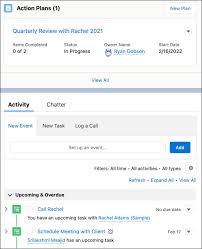
An action plan defines the tasks and other items needed to complete a business process. Each task has a priority, a number of days in which it must be completed, and a person who is responsible for its completion. Action plans are created from action plan templates, which allow you to capture repeatable tasks. Users see the tasks assigned to them through task lists and views in Salesforce. Users record task status information using the standard interfaces for tasks or the Action Plan details view. Target records, such as accounts or contacts, also show lists of related action plans. For example, in Financial Services Cloud, you can create an action plan template for financial plan review meetings with clients. For such engagements, wealth managers need to set up a meeting in advance, collect financial documentation, and review the documentation. You set up this Salesforce action plan template once, and update it as your understanding of the repeatable tasks improves over time. Then as wealth managers need review meetings with clients, you can create an action plan based on the template. You don’t have to worry about all the appropriate tasks getting created because those tasks are defined in the template. Salesforce action plans defines the tasks and other items needed to complete a business process. Each task has a priority, a number of days in which it must be completed. What is included in a Salesforce Action Plan? Salesforce action plans generally include “what,” “who,” and “when.” They outline the action steps (the “what”) your program will take to achieve your goals and objectives, the person(s) responsible (the “who”), and the projected completion dates (the “when”). You can create an action plan template and its generated action plans for various objects, depending on the products and licenses available in your org. You can also create them for custom objects that have Activities enabled. Here are some examples of use cases for action plans: Action Plan Data Model The types of items that can be included in an action plan template and its generated action plans include: Target objects are: In an action plan template, assign each task or other item to a person, a role, a queue, or the action plan creator. When creating templates with the UI, the plan creator becomes the plan owner. When creating templates using the API, you can designate a plan owner different from the plan creator. Action plan template is a reusable framework that you can use to schedule visits where the set of activities to be performed in each visit remains constant. How do you create an action plan in Salesforce? Create Action Plans Buttons Navigate to Setup > Object Manager > Account > Search Layouts for Salesforce Classic. Click on “Edit” from the menu near “List View.” Move the “Create Account Action Plans” button from “Available Buttons” to “Selected Buttons.” Click “Save.” Salesforce admins enable users to edit and delete action plan details by giving them permissions for the Action Plans, Action Plan Templates, and Recurrence Schedule objects. Your users interact with action plans using standard features. The following standard Salesforce features are supported. Like1 Related Posts Who is Salesforce? Who is Salesforce? Here is their story in their own words. From our inception, we’ve proudly embraced the identity of Read more Salesforce Marketing Cloud Transactional Emails Salesforce Marketing Cloud Transactional Emails are immediate, automated, non-promotional messages crucial to business operations and customer satisfaction, such as order Read more Salesforce Unites Einstein Analytics with Financial CRM Salesforce has unveiled a comprehensive analytics solution tailored for wealth managers, home office professionals, and retail bankers, merging its Financial Read more AI-Driven Propensity Scores AI plays a crucial role in propensity score estimation as it can discern underlying patterns between treatments and confounding variables Read more

Read More
Business Card Scanner App for Salesforce

Business Card Scanner App for Salesforce

Can I Scan a Business Card into Salesforce? Yes, you can scan a business card into Salesforce if your scanning system can create a CSV file or import data into Excel, which can then be saved as a .csv file. This resulting file can be uploaded to Salesforce. And there are several Business Card Scanner App for Salesforce solutions. Business Card Scanner App for Salesforce Does Salesforce Have a Business Card Scanner? Yes, Salesforce can utilize CamCard for Salesforce, a top OCR software that allows you to batch scan and digitize multiple business cards with unrivaled accuracy. Does CamCard Sync with Salesforce? Yes, CamCard perfectly integrates with customized Salesforce fields, making lead and contact management easier and more efficient on mobile. With a standard subscription, you can save unlimited cards to your Salesforce account. Is the CamCard App Free? CamCard offers many features, such as dating when you received a card, grouping cards received at one location, writing notes on each card, and searching by keywords, locations, or dates. The app is free, which is an added benefit. Is Scan to Salesforce Free? Yes, Scan to Salesforce allows you to instantly and accurately scan business cards and upload data to Salesforce for free. You can keep contacts in the iOS/Android app or sync them to your phone. How Do I Install Scan to Salesforce? Other Business Card Scanning Solutions: Using Outlook for Business Card Scanning: If you prefer more tools, consider those that import to Outlook and then use Salesforce’s Outlook integration tool to sync with Salesforce. This adds an extra step but offers more flexibility in choosing business card scanning software. Direct Integration with Salesforce: These options provide a variety of ways to seamlessly integrate business card data into Salesforce, ensuring efficient and accurate data management. Content updated March 2025. Like1 Related Posts Who is Salesforce? Who is Salesforce? Here is their story in their own words. From our inception, we’ve proudly embraced the identity of Read more Salesforce Marketing Cloud Transactional Emails Salesforce Marketing Cloud Transactional Emails are immediate, automated, non-promotional messages crucial to business operations and customer satisfaction, such as order Read more Salesforce Unites Einstein Analytics with Financial CRM Salesforce has unveiled a comprehensive analytics solution tailored for wealth managers, home office professionals, and retail bankers, merging its Financial Read more AI-Driven Propensity Scores AI plays a crucial role in propensity score estimation as it can discern underlying patterns between treatments and confounding variables Read more

Read More
Salesforce Einstein and Einstein Automate

Salesforce Analytics in the Insurance Industry

In the insurance sector, data analytics are an indispensable tool for making informed decisions and achieving measurable, positive business outcomes. Salesforce analytics in insurance, and data can make all the difference. The current landscape poses heightened and more frequent risks, presenting substantial threats to carriers, reinsurers, and brokers across various business lines. Salesforce Analytics in Insurance Key benefits of data analytics for Property and Casualty (P&C) companies include: Life and annuity companies leverage these capabilities to connect with customers seamlessly, while group benefits providers streamline operations and enhance scalability throughout the benefits lifecycle. The digital, data, and cloud technology innovations offer robust solutions to support and elevate portfolios, streamline operations, and deliver superior customer experiences. The transformative force of data and analytics in the insurance industry has been further accelerated by the challenges posed by the COVID-19 pandemic and the changes in the way companies do business in a far more digital landscape. The property and casualty insurance sector, in particular, grapples with fundamental challenges, such as increased price competition and the need to demonstrate value comprehensively. The market’s competitiveness and fast-paced nature underscore the urgency for insurers to operate at the speed of light and sound. The future of underwriting hinges on artificial intelligence, automated workflows, machine learning, and an agile development approach. Salesforce’s cloud-based solutions not only reduce operational costs but also facilitate faster innovation through purpose-built insurance solutions. Tectonic specializes in implementing these solutions without the need for additional IT staff or extended operational downtime. Salesforce Analytics in Insurance Capabilities: In Europe and North America, data and analytics capabilities are becoming standard in the P&C sector. Leading performers distinguish themselves by building advanced data and analytics underwriting capabilities that deliver substantial value. These capabilities result in improvements such as decreased loss ratios, increased new business premiums, and enhanced retention in profitable segments. Salesforce analytics in insurance play a crucial role in fraud detection, expediting the process and improving accuracy. Insurers need to stay ahead by utilizing preventive, data-driven parametric models. Data in the insurance industry empowers carriers to collect, process, and utilize information across various stages of the insurance product lifecycle. Leading insurance carriers leverage data and advanced analytics to reimagine risk evaluation, enhance customer experience, and improve efficiency throughout the underwriting process. These insights also contribute to loss prevention. Insurers utilizing big data technology can efficiently work on a customer’s profile, from checking history to automating claims processing. The development of sophisticated tech stacks by insurance carriers has proven essential for efficient model development and continual revisions, resulting in rapid and profitable growth. Risk Segmentation Risk segmentation models, powered by machine learning, consider regulatory landscapes and identify risk characteristics to enhance pricing and reduce losses. Actuaries benefit from risk analysis software. By applying statistical and mathematical models to demographic data, and combining with external sources, to calculate the likelihood of various events. Salesforce Analytics in Insurance Best-in-class performers invest in cross-functional agile teams, emphasize adoption and scale, build skills and capabilities, practice continuous improvement, and partner with technology consulting firms. Tectonic supports P&C insurance carriers in harnessing the power of data and analytics to transform their underwriting and pricing efforts, providing substantial benefits and a competitive edge. Salesforce’s suite of tools, including a 360-degree customer data view, enables reps, agents, agencies, and companies to deliver outstanding customer service. The cloud infrastructure seamlessly integrates with various insurance solutions, enhancing data accessibility and overall business performance. For a demonstration of these capabilities, reach out to Tectonic for a free demo today. Like Related Posts Who is Salesforce? Who is Salesforce? Here is their story in their own words. From our inception, we’ve proudly embraced the identity of Read more Salesforce Marketing Cloud Transactional Emails Salesforce Marketing Cloud Transactional Emails are immediate, automated, non-promotional messages crucial to business operations and customer satisfaction, such as order Read more Salesforce Unites Einstein Analytics with Financial CRM Salesforce has unveiled a comprehensive analytics solution tailored for wealth managers, home office professionals, and retail bankers, merging its Financial Read more AI-Driven Propensity Scores AI plays a crucial role in propensity score estimation as it can discern underlying patterns between treatments and confounding variables Read more

Read More
salesforce asset management

Asset Management Salesforce

Can Salesforce do asset management? You can manage assets in Consumer Goods (desktop) and in the Consumer Goods offline mobile app in Salesforce. Let’s understand the process in detail. Create Asset Templates and Asset Types: Before you create assets, ensure that admins have created asset templates and asset types. Assets are items, such as refrigerators or freezers, that you place at a customer location (retail store) to increase your sales. Assets are also items you use in your business such as vehicles or computers. As an asset’s owner, you’re responsible for the maintenance, repair, or any other services required for the asset. Managing assets efficiently can help reduce customer complaints and, in turn, increase your brand value. By actively tracking your assets’ conditions, you can budget better, reduce losses, and ensure employee safety. What is the use of asset object in Salesforce? So, Assets are used quite frequently by sales, customer service in your back office. Assets are a standard object. It comes out-of-the-box with Salesforce. And being a standard object we can add custom fields, validation rules, record types, multiple page layouts. How do I create an asset for a product in Salesforce? Create an Asset What is the asset state period in Salesforce? An asset state period represents a time span when an asset has the same quantity, amount, and monthly recurring revenue (MRR). An asset has as many asset state periods as there are changes to it (asset actions) during its lifecycle. The dashboard and related pages show the current asset state period. What is the difference between subscription and asset in Salesforce? Use subscriptions to keep records of subscription products you’ve quoted or sold. Use assets to keep records of stand-alone products you’ve quoted or sold. You can use these records later to manage amendments and renewals to your opportunities and orders. How do I enable assets in Salesforce? Enable Asset Scheduling in Salesforce Scheduler How do I create an asset in Salesforce CPQ? Salesforce CPQ creates assets when you click Contracted on an opportunity or order. The asset creation process varies based on your account’s renewal model and the value of the asset conversion field on the product you’re contracting. How do you renew assets in Salesforce CPQ? Select the assets you want to renew, and then click Renew. Salesforce CPQ creates a renewal quote, associates it with a renewal opportunity, and opens the quote line editor. Edit the quantities of the assets from your original quote as needed. You can also add new products. What is an asset state? Asset State denotes the different states of assets in the organization such as assets in Use, In Store, Expired and so on. Apart from the default asset states, you can create custom ones. You can also enable or disable ownership and scan for custom asset states you create. Note that Salesforce also has a Digital Asset Management (DAM) capability. Where is asset library in Salesforce? To view asset files in Files home, select Libraries and then select Asset Library . To view and edit asset files in Setup, enter Asset Files in the Quick Find box, then select Asset Files. For more information on Salesforce Asset Management, contact Tectonic today. Like1 Related Posts Who is Salesforce? Who is Salesforce? Here is their story in their own words. From our inception, we’ve proudly embraced the identity of Read more Salesforce Marketing Cloud Transactional Emails Salesforce Marketing Cloud Transactional Emails are immediate, automated, non-promotional messages crucial to business operations and customer satisfaction, such as order Read more Salesforce Unites Einstein Analytics with Financial CRM Salesforce has unveiled a comprehensive analytics solution tailored for wealth managers, home office professionals, and retail bankers, merging its Financial Read more AI-Driven Propensity Scores AI plays a crucial role in propensity score estimation as it can discern underlying patterns between treatments and confounding variables Read more

Read More
gettectonic.com