
Technology Archives - gettectonic.com - Page 42

Digital Marketing Roadmap

Digital transformation is becoming a mantra in business, but how do you embark on this journey? What is the goal? What does it look like? Begin with a digital marketing roadmap. What is the roadmap for digital marketing? A digital marketing roadmap lays out your major areas of focus and ensures iterations stay grounded in that strategy. As you build your digital marketing roadmap, remember the goal is to facilitate: Alignment: A strategy-driven roadmap rallies the team around the work that needs to be done. What are the four phases of digital marketing? Awareness – Content focused on educating your audience. Evaluation – Customers determine whether they need your product. Conversion – Reasons to buy your product. Delight – Keeping your audience engaged. The initial draft is likely straightforward, conceived by visionaries in your organization, outlining the roadmap’s initial steps: This initial draft is a good start but needs refinement before presentation to management for buy-in. The key is to make metrics SMART, following the framework proposed by management theorist Peter F. Drucker: Now, let’s transform the draft into a presentation-worthy strategic roadmap: Strategic Plan Vision Statement: Provide a seamless omnichannel customer experience to become the number 1 seller of our industry. This refined roadmap is more achievable, being both measurable and time-bound. For added effectiveness, consider SMARTER goals, where “E” stands for engagement evaluator and “R” stands for reward. Have an evaluator determine goal achievement and showcase how it impacts the organization in the long run. What are the 5 key elements of digital marketing? The five most important elements of a digital campaign consist of mobile considerations, organic search, social media marketing, content marketing and lead nurturing. All of these elements combined make up a cohesive digital marketing strategy. What is 4Ps vs the 4Cs of digital marketing? 4Ps is Product, Price, Place, and Promotion. On other hand 4Cs is Customer Value, Cost, Conveniece, and Communication. 4Ps is more company centered in other hand 4Cs is more customer focused. Note: For expert assistance with your assessment and strategic roadmap, contact your account executive at Tectonic to explore how our Salesforce team can assist with your planning. Once completed, revisit and tweak your roadmap to ensure customer experience is at its core and goals are SMARTER. Like Related Posts Who is Salesforce? Who is Salesforce? Here is their story in their own words. From our inception, we’ve proudly embraced the identity of Read more Salesforce Marketing Cloud Transactional Emails Salesforce Marketing Cloud Transactional Emails are immediate, automated, non-promotional messages crucial to business operations and customer satisfaction, such as order Read more Salesforce Unites Einstein Analytics with Financial CRM Salesforce has unveiled a comprehensive analytics solution tailored for wealth managers, home office professionals, and retail bankers, merging its Financial Read more AI-Driven Propensity Scores AI plays a crucial role in propensity score estimation as it can discern underlying patterns between treatments and confounding variables Read more

Read More
Salesforce and Healthcare

Healthcare Technology Solutions

Healthcare institutions have the golden opportunity to enhance the technology systems implemented over the past few pandemic years, particularly in the realm of virtual rounding—where clinicians utilize collaboration technologies to interact with patients remotely. This approach gained significant traction during the pandemic and is now poised for further growth and refinement. Healthcare Technology Solutions. Healthcare technology solutions refer to the use of technology to improve both healthcare delivery and outcomes.  These solutions encompass a wide range of technologies from electronic health records to wearable devices to mobile applications.  Many believe the solution to better healthcare is data and collaboration.  The right software can help. Healthcare Technology Solutions Here are ways to maximize the impact of virtual rounding specifically in your healthcare organization: Devices: Collaboration Software: Telehealth Peripherals: Electronic Medical Records: Patient Experience APIs: Asset Tracking: Business Intelligence: Mobility Management: Whether your organization requires healthcare technology hardware, software, or cloud-based solutions, Tectonic is well-equipped to expedite the implementation process with numerous healthcare implementations under our belt. Five Exciting and emerging healthcare technology solutions coming in 2023 and beyond: Like Related Posts Who is Salesforce? Who is Salesforce? Here is their story in their own words. From our inception, we’ve proudly embraced the identity of Read more Salesforce Marketing Cloud Transactional Emails Salesforce Marketing Cloud Transactional Emails are immediate, automated, non-promotional messages crucial to business operations and customer satisfaction, such as order Read more Salesforce Unites Einstein Analytics with Financial CRM Salesforce has unveiled a comprehensive analytics solution tailored for wealth managers, home office professionals, and retail bankers, merging its Financial Read more AI-Driven Propensity Scores AI plays a crucial role in propensity score estimation as it can discern underlying patterns between treatments and confounding variables Read more

Read More
Salesforce Logo

What is Salesforce and Why is it so Popular?

What is Salesforce and Why is it so Popular? Salesforce, a software company specializing in Customer Relationship Management (CRM), has emerged as a dominant force in business technology since its establishment in 1999. It encompasses both a software package and a complete ecosystem designed to enhance and modernize various business processes. The widespread popularity of Salesforce can be attributed to its all-encompassing CRM solutions, user-friendly interface, cloud-based platform, scalability, and the robust ecosystem it has fostered. Offering comprehensive tools for managing customer data, automating processes, analyzing data and insights, and creating personalized customer experiences, Salesforce extends its reach to various solutions such as customer service, marketing automation, commerce, app development, and more. What sets Salesforce apart is its highly customizable platform, allowing users to tailor CRM according to specific requirements. Renowned for its flexibility, Salesforce offers a plethora of customizable features and functionalities, making it stand out in the business technology landscape. Many companies opt for Salesforce due to its role as a customer relationship management solution, effectively bringing together companies and customers. Positioned as an integrated CRM platform, Salesforce provides all departments, including marketing, sales, commerce, and services, with a unified view of each customer. This capability to foster collaboration and coherence across diverse business functions contributes to the widespread adoption of Salesforce by numerous companies. Like Related Posts Who is Salesforce? Who is Salesforce? Here is their story in their own words. From our inception, we’ve proudly embraced the identity of Read more Salesforce Marketing Cloud Transactional Emails Salesforce Marketing Cloud Transactional Emails are immediate, automated, non-promotional messages crucial to business operations and customer satisfaction, such as order Read more Salesforce Unites Einstein Analytics with Financial CRM Salesforce has unveiled a comprehensive analytics solution tailored for wealth managers, home office professionals, and retail bankers, merging its Financial Read more AI-Driven Propensity Scores AI plays a crucial role in propensity score estimation as it can discern underlying patterns between treatments and confounding variables Read more

Read More
Forecasting With Foundation Models

Forecasting Tools

Leveraging Technology and AI for Accurate Sales Forecasting Sales forecasting is essential for business success, helping organizations allocate resources, set goals, and anticipate challenges. However, forecasting is inherently complex, involving uncertainty, variability, and vast datasets. By leveraging modern tools and AI-powered technologies, businesses can streamline this process, improve forecast accuracy, and drive better decision-making. This section explores the benefits of using technology for sales forecasting, highlights key tools available in the market, and discusses how AI enhances forecasting and analytics for B2B sales. Benefits of Technology in Sales Forecasting Tools for Enhanced Sales Forecasting AI’s Role in Revolutionizing Sales Forecasting AI-driven tools enable businesses to overcome traditional forecasting limitations, offering several advantages: AI Tools for Sales Forecasting Conclusion Harnessing technology and AI for sales forecasting transforms the process from a time-consuming challenge to a strategic advantage. By adopting visualization tools, automation, and AI-powered insights, businesses can generate reliable projections, optimize decision-making, and position themselves for success in dynamic markets. Content updated November 2024. Like Related Posts Who is Salesforce? Who is Salesforce? Here is their story in their own words. From our inception, we’ve proudly embraced the identity of Read more Salesforce Marketing Cloud Transactional Emails Salesforce Marketing Cloud Transactional Emails are immediate, automated, non-promotional messages crucial to business operations and customer satisfaction, such as order Read more Salesforce Unites Einstein Analytics with Financial CRM Salesforce has unveiled a comprehensive analytics solution tailored for wealth managers, home office professionals, and retail bankers, merging its Financial Read more AI-Driven Propensity Scores AI plays a crucial role in propensity score estimation as it can discern underlying patterns between treatments and confounding variables Read more

Read More
Salesforce Success Story

Case Study: Service Cloud Marketing Cloud Hospitality

Resort company builds loyalty and drives sales increase across all sites using data and segmentation. hospitality salesforce service marketing case study. Industry: Hospitality Located at the epicenter of Honolulu’s most exciting neighborhoods, resort offers guaranteed oceanfront panoramic views in guestrooms and luxury suites. The hotel also has its own golf course. Problem: Implemented : Technologies integrated : Our solution? Results: Tectonic has assisted customers in generating a live view of their visitors so they can pleasantly surprise and amuse them with customized service during every engagement. Salesforce offers customized solutions for the travel and hospitality industries, assisting companies in this field to provide outstanding client experiences, optimize workflows, and spur expansion. These solutions make use of the Salesforce Customer 360 platform to improve communication, organize data, and give visitors a customized experience. Salesforce offers digital transformation technology for travel, tourist, and hospitality industries. If you are considering a Salesforce hospitality implementation, contact Tectonic today. Like2 Related Posts Who is Salesforce? Who is Salesforce? Here is their story in their own words. From our inception, we’ve proudly embraced the identity of Read more Salesforce Marketing Cloud Transactional Emails Salesforce Marketing Cloud Transactional Emails are immediate, automated, non-promotional messages crucial to business operations and customer satisfaction, such as order Read more Salesforce Unites Einstein Analytics with Financial CRM Salesforce has unveiled a comprehensive analytics solution tailored for wealth managers, home office professionals, and retail bankers, merging its Financial Read more AI-Driven Propensity Scores AI plays a crucial role in propensity score estimation as it can discern underlying patterns between treatments and confounding variables Read more
Read More
industry

Digital BSS

Digital BSS, which stands for Digital Business Support System, refers to a set of software solutions and platforms designed to enable and enhance the operational and business support capabilities of a telecommunications service provider. These systems play a crucial role in managing and monetizing telecommunications services in the digital era. Digital BSS solutions are part of the broader digital transformation initiatives undertaken by telecom companies to adapt to changing market dynamics and customer expectations. Key components and functionalities of Digital BSS include: Digital BSS Adoption The adoption of Digital BSS is driven by the need for telecom operators to stay competitive in a rapidly evolving digital landscape. It allows them to launch new services quickly, improve customer experience, and streamline their internal processes. The shift towards 5G, IoT, and other emerging technologies further emphasizes the importance of advanced BSS systems in the telecommunications industry. Like Related Posts Who is Salesforce? Who is Salesforce? Here is their story in their own words. From our inception, we’ve proudly embraced the identity of Read more Salesforce Unites Einstein Analytics with Financial CRM Salesforce has unveiled a comprehensive analytics solution tailored for wealth managers, home office professionals, and retail bankers, merging its Financial Read more AI-Driven Propensity Scores AI plays a crucial role in propensity score estimation as it can discern underlying patterns between treatments and confounding variables Read more Tectonic’s Successful Salesforce Track Record Salesforce Technology Services Integrator – Tectonic has successfully delivered Salesforce in a variety of industries including Public Sector, Hospitality, Manufacturing, Read more
Read More
Marketing Cloud Intelligence

Salesforce Marketing Cloud Intelligence Explained

What is Marketing Cloud Intelligence? Salesforce’s Marketing Cloud Intelligence, formerly known as Datorama, is an analytics tool designed to integrate and visualize marketing performance data across various platforms. It caters to analytically driven marketers and seasoned analysts, providing an easy-to-use interface while offering connections to traditional BI tools like Tableau. Marketing efforts generate extensive data across multiple platforms, and Marketing Cloud Intelligence consolidates all these marketing tools into a centralized source. It serves as a comprehensive solution for reporting, measurement, and optimization. Market intelligence involves gathering real-time data from the market to understand customers, trends, behaviors, and more, enabling a company to stay competitive and meet market demands. By leveraging out-of-the-box connections, Marketing Cloud Intelligence seamlessly links platforms like Google, YouTube, Instagram, and others without the need for complex coding. The tool, now known as Marketing Cloud Intelligence, reveals trends, tracks progress against goals, and quantifies the ROI of marketing initiatives once connected. The system features a connected library of over 170 connectors for acquiring data from major advertising, commerce, CRM, and database vendors. The unique universal connector, powered by AI, allows effortless connection of any data stream within minutes, even from sources lacking an API connection. Marketing Cloud Intelligence addresses the challenge of data consistency by providing an out-of-the-box marketing data model. It helps organize data into a clear and consistent taxonomy, enriching it with naming conventions, data classification, and automated maintenance alerts for trustworthy decision-making. Beyond reporting and dashboards, Marketing Cloud Intelligence, with the assistance of Einstein, provides actionable insights. Marketers can select a KPI to improve and create a perpetual pipeline of AI insights, addressing overarching questions or specific areas like reducing spend or analyzing creative impacts. What can marketers do with Marketing Cloud Intelligence? Marketers can efficiently compile multiple sources of data in Marketing Cloud using various KPIs, creating at-a-glance and visually appealing dashboards and reports. Marketing Cloud Intelligence, powered by Datorama, facilitates the organization and analysis of diverse data within Marketing Cloud. What does Marketing Cloud Intelligence do? Marketing Cloud Intelligence integrates data from marketing and advertising platforms, web analytics, CRM, e-commerce, and more. It offers a unified view for optimizing campaign performance and real-time insights. The tool optimizes marketing spend and customer engagement with unified performance data, automated reporting, and AI-driven insights. Why is marketing intelligence important in Salesforce? Marketing intelligence tools help businesses gather and analyze market data. CRM and CDP tools, such as Salesforce Marketing Cloud Intelligence, unite data from disparate sources to provide a fuller picture of their customers and the marketplace. Like Related Posts Who is Salesforce? Who is Salesforce? Here is their story in their own words. From our inception, we’ve proudly embraced the identity of Read more Salesforce Marketing Cloud Transactional Emails Salesforce Marketing Cloud Transactional Emails are immediate, automated, non-promotional messages crucial to business operations and customer satisfaction, such as order Read more Salesforce Unites Einstein Analytics with Financial CRM Salesforce has unveiled a comprehensive analytics solution tailored for wealth managers, home office professionals, and retail bankers, merging its Financial Read more AI-Driven Propensity Scores AI plays a crucial role in propensity score estimation as it can discern underlying patterns between treatments and confounding variables Read more

Read More
Why BANT Isn’t Always Enough

BANT

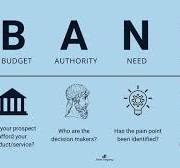
Why BANT Isn’t Always Enough: Rethinking Lead Qualification for Modern Sales In the world of sales, the BANT framework (Budget, Authority, Need, Timing) has long been a go-to method for qualifying leads. For companies selling familiar or low-complexity products where price is the primary differentiator, BANT can be an effective tool for identifying prospects ready for aggressive sales pursuit. However, in today’s rapidly evolving business landscape—particularly for B2B tech companies offering innovative or paradigm-shifting solutions—relying solely on BANT can actually do more harm than good. In this article, we’ll explore the limitations of the BANT framework, why it falls short in certain scenarios, and how you can adapt your lead qualification process to better align with modern sales challenges. What is BANT, and Why is it Popular? BANT, a framework popularized by companies like IBM, is designed to help sales teams quickly assess whether a prospect is worth pursuing. The acronym stands for: For straightforward sales scenarios, BANT works well. It helps sales teams prioritize leads that are most likely to convert, saving time and resources. However, as sales environments become more complex—especially in B2B tech—the limitations of BANT become increasingly apparent. The Limitations of BANT in Modern Sales While BANT is a useful starting point, it has several inherent limitations that can hinder your sales efforts, particularly when selling innovative or high-complexity solutions. Here’s why: When BANT Falls Short: Real-World Scenarios Let’s look at a few scenarios where BANT might not be the best fit: How to Overcome BANT’s Limitations The good news is that you don’t have to abandon BANT entirely. Instead, you can augment it with additional strategies to create a more holistic lead qualification process. Here’s how: Conclusion: Evolving Beyond BANT While BANT remains a useful tool for certain sales scenarios, it’s not a one-size-fits-all solution. For B2B tech companies selling innovative or high-complexity offerings, a more nuanced approach to lead qualification is essential. By addressing the limitations of BANT and incorporating strategies like value-based selling, stakeholder mapping, and relationship building, you can better align your sales process with the realities of modern B2B buying. In a world where customer needs and decision-making processes are constantly evolving, the ability to adapt and think beyond traditional frameworks like BANT will set you apart from the competition. So, the next time you’re qualifying leads, ask yourself: Is BANT enough, or is it time to rethink your approach? Like Related Posts Who is Salesforce? Who is Salesforce? Here is their story in their own words. From our inception, we’ve proudly embraced the identity of Read more Salesforce Unites Einstein Analytics with Financial CRM Salesforce has unveiled a comprehensive analytics solution tailored for wealth managers, home office professionals, and retail bankers, merging its Financial Read more AI-Driven Propensity Scores AI plays a crucial role in propensity score estimation as it can discern underlying patterns between treatments and confounding variables Read more Tectonic’s Successful Salesforce Track Record Salesforce Technology Services Integrator – Tectonic has successfully delivered Salesforce in a variety of industries including Public Sector, Hospitality, Manufacturing, Read more

Read More
Salesforce Sales Enablement

Modern Sales Enablemen

The Ultimate Guide to Modern Sales Enablement: Driving Revenue Through Strategic Enablement Why Sales Enablement Matters More Than Ever In today’s competitive landscape, sales teams face unprecedented challenges: Sales enablement has evolved from basic training to a strategic revenue driver that:✔ Accelerates ramp time for new reps✔ Increases win rates by 20-30%✔ Boosts deal sizes through value-selling✔ Shortens sales cycles with battle-tested playbooks The 4 Pillars of High-Impact Enablement 1. Goal-Driven Enablement Stop generic training. Start with one revenue-critical KPI: Example: A SaaS company increased deal size 22% by training reps to lead with ROI calculators instead of discounts. 2. Behavior-Based Coaching Leverage AI and data to target specific skill gaps: 3. Technology Stack Integration Essential tools for measurable impact: Tool Key Benefit CRM Tracks enablement progress to revenue outcomes Conversation AI Surfaces coaching moments from calls/emails Enablement Platform Delivers contextual training in workflow Learning LMS Gamifies certifications & skill development Pro Tip: Integrate tools so reps learn while selling (e.g., Salesforce Sales Enablement auto-suggests battle cards during opp stages). 4. Continuous Optimization Quarterly enablement health checks: Best Practices for 2024 For Enablement Leaders For Sales Reps The Future: AI-Powered Enablement Leading organizations now deploy:🤖 Autonomous Coaching Agents – Real-time deal guidance📊 Predictive Content Recommendations – AI suggests optimal assets per stage🎯 Skill Gap Analytics – Prescriptive training based on deal outcomes “Enablement isn’t about training—it’s about engineering revenue behaviors.”– Sales Enablement Leader, Fortune 500 Tech Company Get Started Template Quarter 1 Enablement Plan markdown 1. **Goal**: Increase win rate by 15% 2. **Behavior Focus**: Executive stakeholder alignment 3. **Actions**: – Build “C-Suite Messaging” playbook – Train on discovery questioning frameworks – Implement call tracking for “business outcome” language 4. **Tools**: Salesforce Enablement + Gong 5. **Success Metrics**: – 25% more exec-level meetings booked – 10% higher win rate on deals with CFO engagement Content updated February 2025. Like Related Posts Who is Salesforce? Who is Salesforce? Here is their story in their own words. From our inception, we’ve proudly embraced the identity of Read more Salesforce Marketing Cloud Transactional Emails Salesforce Marketing Cloud Transactional Emails are immediate, automated, non-promotional messages crucial to business operations and customer satisfaction, such as order Read more Salesforce Unites Einstein Analytics with Financial CRM Salesforce has unveiled a comprehensive analytics solution tailored for wealth managers, home office professionals, and retail bankers, merging its Financial Read more AI-Driven Propensity Scores AI plays a crucial role in propensity score estimation as it can discern underlying patterns between treatments and confounding variables Read more

Read More
CRM analytics

Advertising Cloud

Advertising Cloud is an Adobe product. Often times confused with Salesforce Advertising Studio. What is Adobe advertising Cloud do? Adobe Advertising Cloud is a cross-channel platform which offers customers the ability to plan, buy, manage, and optimize: DSP, Search and TV advertising campaigns, and to leverage dynamic ad templates to deliver relevant ad content to end users. Is Adobe ad cloud a DSP? The Adobe Advertising Cloud Demand-Side Platform (DSP) destination allows you to share authenticated first-party audiences with approved advertisers and users for campaign activation with DSP. Definitions (A) The (1) creation of one new Template, and (2) performance of all services required to create one new Campaign that utilizes such new Template; (B) The (1) creation of one new Template for use with an existing Campaign, and (2) performance of all services required to insert such new Template into the existing Campaign; (C) The performance of all services required to create one new Campaign that uses (1) one existing Template, and (2) a new collection(s) of Advertising Materials; or (D) The performance of all services required to bring a new collection(s) of Advertising Materials into an existing Campaign that utilizes an existing Template(s). (A) the actual amount of media spend in Accounts owned by Customer where Customer is responsible for contracting with and paying a Media Partner(s), including allocations for billing discrepancies; or (B) the costs associated with media buys purchased for Customer via Accounts owned by Adobe where Adobe is responsible for contracting with and paying a Media Partner(s), including allocations for billing discrepancies. Like Related Posts Salesforce Marketing Cloud Transactional Emails Salesforce Marketing Cloud Transactional Emails are immediate, automated, non-promotional messages crucial to business operations and customer satisfaction, such as order Read more Tectonic’s Successful Salesforce Track Record Salesforce Technology Services Integrator – Tectonic has successfully delivered Salesforce in a variety of industries including Public Sector, Hospitality, Manufacturing, Read more Perfect Drip Campaign In an ideal world, you effortlessly conquer the lead generation challenges with one creative arm tied behind your back, craft Read more Salesforce Content Builder Salesforce Content Builder empowers you to craft compelling emails and landing page templates, complete with reusable and interactive content blocks. Read more

Read More
ABM

Scaling Account-Based Marketing in Financial Services

Scaling Account-Based Marketing in Financial Services Account-Based Marketing (ABM) is a powerful strategy for financial services firms looking to deepen client relationships and drive growth in a competitive, trust-driven industry. However, achieving long-term success requires scaling ABM effectively. The Impact of ABM on Client Growth ABM delivers tangible results where it matters most—expanding existing client relationships. According to our research, 34% of financial services (FS) marketers report growth in existing accounts due to ABM. In an industry where relationships develop over decades, this advantage is significant. At a recent Momentum ITSMA roundtable in London, senior FS marketers discussed the challenges of embedding ABM as a strategic growth driver. They identified several key roadblocks: Our Global Account-Based Marketing Benchmark reveals that while 93% of FS marketers use ABM, many remain in the early stages, struggling to scale effectively. Pitfalls in Scaling ABM Despite initial pilot successes, expanding ABM presents challenges. Many firms rush to scale without addressing foundational issues, which can undermine long-term results. Common pitfalls include: The Path to Best-in-Class ABM Despite these challenges, FS firms are making significant strides in performance optimization and personalization. Our research shows: To scale effectively, firms need a structured approach. The Momentum ITSMA ABM Adoption Framework provides a roadmap with four stages, seven foundational pillars, and 21 success factors. By following this framework, organizations can move from experimentation to best-in-class execution—turning ABM into a sustainable growth driver. Content updated January 2025. Like1 Related Posts Who is Salesforce? Who is Salesforce? Here is their story in their own words. From our inception, we’ve proudly embraced the identity of Read more Salesforce Marketing Cloud Transactional Emails Salesforce Marketing Cloud Transactional Emails are immediate, automated, non-promotional messages crucial to business operations and customer satisfaction, such as order Read more Salesforce Unites Einstein Analytics with Financial CRM Salesforce has unveiled a comprehensive analytics solution tailored for wealth managers, home office professionals, and retail bankers, merging its Financial Read more AI-Driven Propensity Scores AI plays a crucial role in propensity score estimation as it can discern underlying patterns between treatments and confounding variables Read more

Read More
Employ Marketing Cloud Data with Datorama

Employ Marketing Cloud Data with Datorama

Unlocking the Power of Salesforce Marketing Cloud with Dataorama-Employ Marketing Cloud Data with Datorama (now Salesforce Marketing Cloud Intelligence) In the realm of modern marketing, success hinges on data-driven insights rather than creative chaos. Salesforce Marketing Cloud’s Dataorama tackles the challenges associated with marketing data, offering a robust platform to store, visualize, and leverage data from diverse sources. What is Datorama? Originally developed to streamline reporting for advertising technology companies, Datorama is now a pivotal feature within Salesforce Marketing Cloud. It caters not only to advertising but also to industries spanning automotive to publishing. Datorama empowers marketers to consolidate marketing spend, campaign results, and trends into a unified and accessible platform. Key Features and Use Cases of Dataorama (now Salesforce Marketing Cloud Intelligence): Advantages and Limitations of Datorama-Marketing Cloud Intelligence: Implementation and Adoption: To implement Datorama-Marketing Cloud Intelligence within your organization: Salesforce Marketing Cloud’s Intelligence empowers marketers to shift focus from mundane reporting tasks to creative and strategic endeavors. By harnessing the power of data integration, visualization, and AI-driven insights, organizations can elevate their marketing performance and drive business growth effectively. Employ Marketing Cloud Data with Datorama Content updated September 2023. Like1 Related Posts Who is Salesforce? Who is Salesforce? Here is their story in their own words. From our inception, we’ve proudly embraced the identity of Read more Salesforce Marketing Cloud Transactional Emails Salesforce Marketing Cloud Transactional Emails are immediate, automated, non-promotional messages crucial to business operations and customer satisfaction, such as order Read more Salesforce Unites Einstein Analytics with Financial CRM Salesforce has unveiled a comprehensive analytics solution tailored for wealth managers, home office professionals, and retail bankers, merging its Financial Read more AI-Driven Propensity Scores AI plays a crucial role in propensity score estimation as it can discern underlying patterns between treatments and confounding variables Read more
Read More
Salesforce Einstein Next Best Action

What is Salesforce Next Best Action?

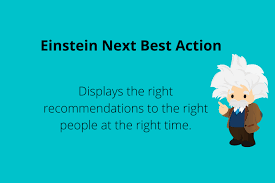
Einstein Next Best Action Efficiently present tailored recommendations to the right individuals at the right moment with Einstein Next Best Action. Correspondingly craft and showcase offers and actions personalized to your specific criteria. Formulate a strategy applying your business logic to refine these recommendations. Then distilling them into key suggestions like repairs, discounts, or add-on services. Display the final recommendations seamlessly within your Lightning app or Experience Builder site. Einstein Next Best Action (ENBA) is an innate Salesforce Platform feature empowering users to configure business rules and filters, especially surfacing the optimal course of action for any user. This tool seamlessly offers a range of recommended actions accessible directly within Salesforce. Next Best Action (NBA) is a strategic approach aiding businesses in identifying the most effective marketing actions to guide customers towards desired conversion events lest they veer off the desired path. It optimizes marketing efforts by enhancing the return on investment (ROI) of marketing campaigns. Key Features: FAQs: Like2 Related Posts Who is Salesforce? Who is Salesforce? Here is their story in their own words. From our inception, we’ve proudly embraced the identity of Read more Salesforce Marketing Cloud Transactional Emails Salesforce Marketing Cloud Transactional Emails are immediate, automated, non-promotional messages crucial to business operations and customer satisfaction, such as order Read more Salesforce Unites Einstein Analytics with Financial CRM Salesforce has unveiled a comprehensive analytics solution tailored for wealth managers, home office professionals, and retail bankers, merging its Financial Read more AI-Driven Propensity Scores AI plays a crucial role in propensity score estimation as it can discern underlying patterns between treatments and confounding variables Read more

Read More
Cloud Based Managed Services

Cloud Based Managed Services

At Tectonic, our aim is to enable you to concentrate on your business operations while we handle the intricacies of technology. Our team oversees all technology assets and evaluates your IT systems to ensure your employees have the necessary equipment to support their work. We work diligently in the background to maintain the seamless functioning of your business, encompassing tasks such as consistent backups, 24/7 server monitoring, event logging, and more. Cloud Based Managed Services. Managed Cloud Cloud managed services, or managed cloud, refer to applications, services, or ecosystems in the cloud managed by a third-party organization. These services include IT tasks like engineering on demand, operations management, 24/7 help desk support, hosting, and implementation. Cloud-based service involves the organized administration of cloud computing products and services. It encompasses processes, strategies, policies, and technology used to control and maintain public and private clouds, hybrid clouds, or multicloud environments. Cloud infrastructure managed services involve companies like Microsoft, AWS, HubSpot, IBM, and Google Cloud. This allows businesses to receive personalized tech support from specialists in specific software providers. Examples of cloud-based services include file storage and backup, web-based email, and project management tools. SaaS cloud service providers include Dropbox, G Suite, Microsoft Office 365, and Slack. While cloud service providers are cost-effective, they lack the robustness of fully managed IT services. With Tectonic, managed cloud services provide scalable solutions, offering benefits like consistent backups, disaster recovery, and flexibility to adapt to changing business requirements without downtime. Managed services differ from SaaS as they go beyond software provision, often handling networking and hardware requirements. Managed cloud services offer hybrid IT and cloud administration, with providers offering unique values in areas like migration, optimization, security, and configuration. Advantages of Managed Cloud Service Providers (MCSPs) include resource optimization, cloud service integration, and predictable spending. However, potential drawbacks include high costs, optimization impacting performance, and security risks due to multi-tenancy. Amid the global COVID-19 pandemic, cloud adoption has surged, with companies embracing remote work models. Businesses increasingly partner with cloud managed service providers to optimize IT infrastructure, address regulatory compliance, and ensure security in the cloud environment. Local servers, physically located on-premises or in private data centers, are not considered cloud services. They host applications, websites, or services within a specific organization’s infrastructure. Like Related Posts Who is Salesforce? Who is Salesforce? Here is their story in their own words. From our inception, we’ve proudly embraced the identity of Read more Salesforce Marketing Cloud Transactional Emails Salesforce Marketing Cloud Transactional Emails are immediate, automated, non-promotional messages crucial to business operations and customer satisfaction, such as order Read more Salesforce Unites Einstein Analytics with Financial CRM Salesforce has unveiled a comprehensive analytics solution tailored for wealth managers, home office professionals, and retail bankers, merging its Financial Read more AI-Driven Propensity Scores AI plays a crucial role in propensity score estimation as it can discern underlying patterns between treatments and confounding variables Read more

Read More
gettectonic.com